

Disclosure: This post may contain affiliate links. We earn a small commission at no extra cost to you when you buy through our links.
- Treat every gun as loaded
- Point the muzzle in a safe direction
- Keep your finger off the trigger until you’re ready to shoot
- Know your target and what’s beyond
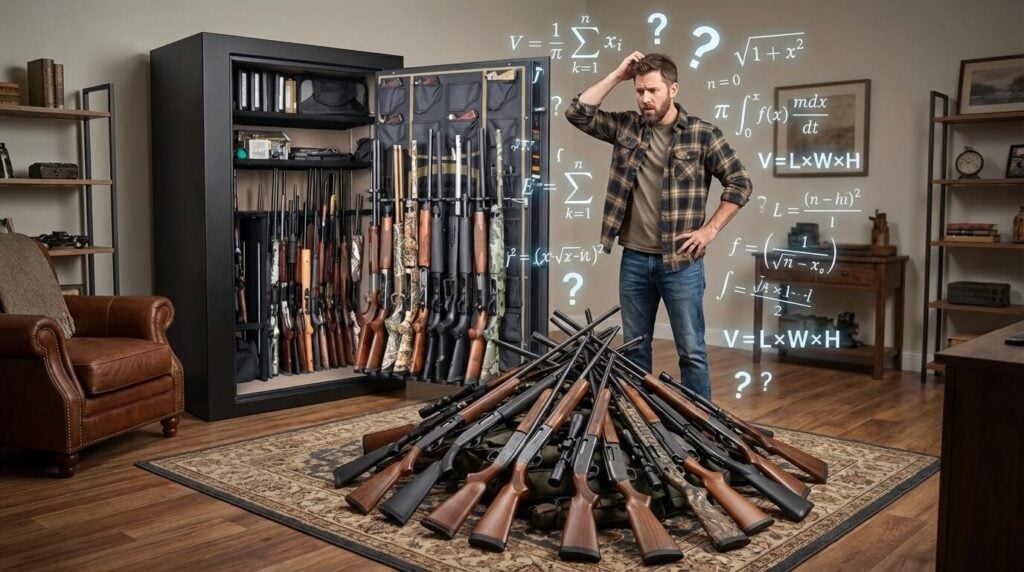
Every gun safe manufacturer lies about capacity. Not a little. A lot. That “24-gun safe” you’re eyeing? It holds about 14 actual rifles with scopes. That “48-gun” model? Maybe 28 in real life. The industry counts capacity by cramming bare, scopeless rifles shoulder-to-shoulder with zero room for accessories. Nobody stores guns like that.
I’ve helped dozens of people pick the right size safe, and the number one regret I hear is “I should have gone bigger.” This guide gives you honest, real-world capacity numbers by safe size, explains why manufacturers inflate their claims, and helps you figure out exactly what size you actually need.
Why Manufacturers Inflate Capacity Numbers
The short answer: bigger numbers sell more safes. When a customer sees “48-gun capacity” on a $1,200 safe, that sounds like incredible value. The problem is how they count.
Manufacturers test capacity using bare long guns with no scopes, no optics, no slings, no accessories. They position them perfectly alternating barrel-up and barrel-down like sardines in a can. No one stores firearms this way unless they enjoy scratching every stock and bending every scope.
They also count the interior shelving area as additional “gun” capacity. A shelf that could hold two handguns gets counted as “4 gun capacity.” Some brands are more honest than others. Check our best gun safe brands guide to see which manufacturers provide realistic capacity claims.
The Real Capacity: Marketed vs Actual
Here’s what you’ll actually fit in each common safe size based on real-world loading with scoped rifles, handguns on shelves, and room for accessories.
| Marketed Size | Exterior Dimensions (typical) | Marketed Capacity | Realistic Long Gun Capacity | With Handguns + Accessories | Weight (empty) |
|---|---|---|---|---|---|
| Compact / 10-Gun | 55″H x 20″W x 17″D | 10 long guns | 5 to 7 rifles | 4 rifles + 2 handguns | 150 to 250 lbs |
| Small / 14-Gun | 55″H x 23″W x 18″D | 14 long guns | 8 to 10 rifles | 6 rifles + 3 handguns | 200 to 350 lbs |
| Mid-Size / 24-Gun | 59″H x 28″W x 20″D | 24 long guns | 12 to 16 rifles | 10 rifles + 4 handguns | 350 to 550 lbs |
| Large / 36-Gun | 60″H x 36″W x 24″D | 36 long guns | 20 to 24 rifles | 16 rifles + 6 handguns | 500 to 750 lbs |
| XL / 48-Gun | 60″H x 40″W x 25″D | 48 long guns | 26 to 32 rifles | 22 rifles + 8 handguns | 650 to 900 lbs |
| XXL / 64-Gun | 72″H x 42″W x 28″D | 64 long guns | 34 to 42 rifles | 30 rifles + 10 handguns | 800 to 1,200 lbs |
The rule of thumb: take the marketed capacity and multiply by 0.55 to 0.65. That’s your realistic long gun count with scopes and normal spacing. If you add handguns, documents, ammo, and accessories, reduce it even further.
How Scopes and Accessories Reduce Capacity
Scoped rifles are capacity killers. A bare rifle is about 2 inches wide at the stock. Add a scope and you’re at 4 to 5 inches. That means a scoped rifle takes up roughly the same space as two bare rifles. If your collection is mostly scoped hunting rifles or AR-15s with optics, cut the marketed capacity in half.
Pistol grips on AR-style rifles also eat space. The grip sticks out and prevents neighboring rifles from sliding in close. Shotguns with extended magazine tubes, rifles with bipods, and anything with a suppressor attached will reduce your usable capacity further.
Then there’s all the other stuff you’ll inevitably store in there. Handguns on the shelf. A stack of important documents. A few boxes of ammo. Spare magazines. Cleaning kits. All of that eats into the gun slots and shelf space. In my experience, about 25% to 30% of most people’s safe space ends up holding non-firearm items.
The “Buy One Size Up” Rule
Ask anyone who’s owned a gun safe for more than two years and they’ll tell you the same thing: buy one size bigger than you think you need. Collections grow. You’ll pick up a new hunting rifle, inherit grandpa’s shotgun, or impulse-buy a pistol at a gun show. It happens to all of us.
If you currently own 8 guns and you’re shopping for a safe, don’t buy a “10-gun” safe. Buy a 24-gun safe. You’ll have room to grow, room for accessories, and room to organize your firearms properly without cramming them in like a game of Tetris.
The price difference between one size up is usually $100 to $300. The cost of buying a second safe when you outgrow the first is $500 or more, plus you’re stuck with the old one taking up space. Get the bigger safe from the start. I promise you won’t regret having extra room.
Interior Dimensions: What Actually Matters
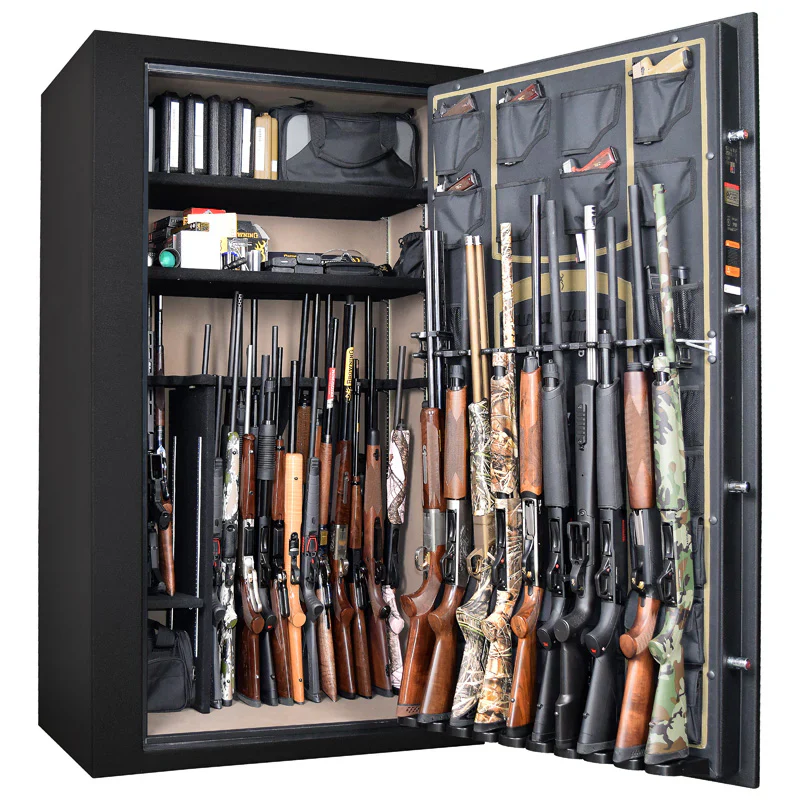
Manufacturers list exterior dimensions prominently. Interior dimensions are harder to find but far more important. The difference between exterior and interior can be significant because fire-rated safes have 1 to 3 inches of fireboard lining on every wall.
A safe that’s 28 inches wide on the outside might be only 24 inches wide on the inside. That 4-inch difference costs you 2 to 3 rifle slots. Always check interior dimensions before buying, and understand that better fire-rated safes have thicker walls, which means less interior space for the same exterior footprint.
Interior Width
Width determines how many long guns fit side by side. Each rifle with a scope needs about 4 inches of width. Bare rifles need about 2.5 inches. So a safe with 24 inches of interior width holds about 6 scoped rifles in a single row, or 9 to 10 bare rifles.
Interior Depth
Depth matters for two things: fitting long guns without angling them, and accommodating shelving. Most long guns need 12 to 14 inches of front-to-back depth to stand upright. If the safe has adjustable shelving on one side (common in mid-size and larger safes), the shelf section reduces the depth available for long guns on that side.
Interior Height
Height needs to accommodate your longest firearm. A standard hunting rifle is 42 to 46 inches long. An AR-15 with a collapsible stock is about 32 inches. Shotguns with extended barrels can reach 50 inches. Measure your longest gun and add 2 inches for clearance. If the safe interior isn’t tall enough, you’ll have to angle your rifles, which wastes lateral space.
Measuring Your Space
Before you buy, measure where the safe will live. Check three things: the final resting spot dimensions, the path to get there, and the floor’s weight capacity.
Final location: Measure the width, depth, and height of the space. Leave at least 1 inch on each side for air circulation and 2 inches behind for dehumidifier cords or power cables. Make sure the safe door can swing fully open in the available space. A safe wedged into a tight closet with a door that only opens 60 degrees is a daily frustration.
The path: Measure every doorway, hallway, and turn between the delivery point and the final location. You need the safe’s width plus 2 inches of clearance minimum. Don’t forget about ceiling height on stairs and any tight corners. A 600-pound safe stuck in a hallway corner is a very expensive problem.
Floor capacity: Concrete floors handle any safe. Wood floors need verification for safes over 500 pounds. Position heavy safes over load-bearing walls or joists. Read our guide on where to put a gun safe for detailed floor load information.
Weight Considerations by Location
The safe’s weight affects where you can put it and how you’ll get it there. Here’s a practical breakdown.
Ground floor, concrete slab: No weight limit concerns. Put whatever you want here. This is the easiest scenario for large safes.
Ground floor, wood framing: Most wood-framed floors handle up to 600 to 800 pounds if the safe is positioned over or near a load-bearing wall. Safes over 800 pounds loaded weight should be verified by checking joist size and spacing.
Second floor: Limit to compact and small safes (under 400 to 500 pounds loaded) unless you’ve verified the floor structure. Position over load-bearing walls. A structural engineer consultation costs $200 to $300 and gives you a definitive answer.
Basement: Concrete floor, no weight issues. The challenge is getting the safe down the stairs. Many delivery services charge extra for basement delivery, and some refuse safes over certain weights for stairway delivery. Budget $100 to $300 for professional safe movers if stairs are involved.
Choosing the Right Size: A Decision Framework
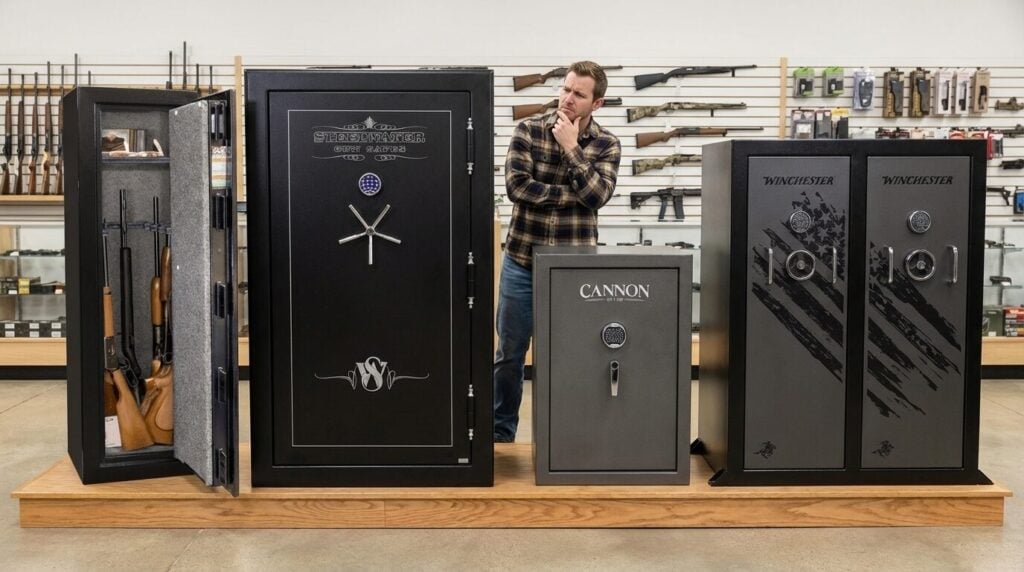
Count your current firearms. Add the number you realistically expect to acquire in the next 5 years. Multiply by 1.5 to account for scopes, accessories, and non-firearm storage. That’s your target capacity number.
For example: you own 6 guns now and might buy 4 more in the next few years. That’s 10 guns times 1.5 equals 15 gun capacity needed. A marketed “24-gun” safe (realistic capacity 12 to 16) is your sweet spot.
Here’s a quick recommendation by collection size:
1 to 5 guns: A 14 to 18 gun safe gives you room to grow. Affordable options exist in the under $500 range.
6 to 12 guns: A 24 to 30 gun safe is the sweet spot. Plenty of room for scoped rifles and accessories. Great options available under $1,000.
13 to 25 guns: A 36 to 48 gun safe. You’re a serious collector now. Look at our best gun safes list for top recommendations in this range.
25+ guns: A 48 to 72 gun safe or multiple safes. At this level, invest in a quality brand. Our best gun safe brands guide covers manufacturers who deliver at this tier.
Common Size Mistakes to Avoid
Buying based on current collection only. Your collection will grow. It always does. Buy for where you’ll be in 5 years, not where you are today.
Trusting marketed capacity numbers. They’re inflated by 40% to 50%. Always calculate based on realistic numbers using the table above.
Forgetting about non-gun storage. Documents, ammo, optics, cleaning supplies, and valuables all compete for space inside your safe. Budget at least 25% of the safe’s interior for non-firearm items.
Ignoring the delivery path. That beautiful 72-inch tall, 42-inch wide safe won’t fit through a 30-inch doorway. Measure everything between the truck and the final location before you order.
Choosing exterior size without checking interior dimensions. Fire-rated safes lose 2 to 6 inches of interior space per dimension compared to exterior measurements. A safe that looks huge on the outside can be surprisingly tight inside. Check the fire ratings guide to understand the trade-off between fire protection and interior space.
The Bottom Line on Gun Safe Sizes
Buy bigger than you think you need. Use realistic capacity numbers, not marketing claims. Measure your space, your guns, and every doorway in between. And don’t forget to bolt it down once it’s in position.
The difference between an RSC and a true safe matters at every size. A huge cabinet is still just a cabinet. Make sure you’re getting real protection, not just a big box. Start with our best gun safes guide to find the right safe at the right size for your collection.
Related Guides
🔹 Gun Safe Fire Ratings Explained
Shop Gun Safes
Best-scored accessories across 80+ retailers · Updated every 4 hours
Frequently Asked Questions
How many guns does a 24-gun safe actually hold?
Realistically 12 to 16 long guns with scopes, or about 10 rifles plus 3-4 handguns with room for accessories. Marketed capacity assumes bare rifles packed tightly.
What size gun safe do I need for 10 rifles?
Buy a safe marketed as a 24-gun model. That gives you 12-16 realistic slots plus room for growth. A marketed 10-gun safe only fits 5-7 scoped rifles.
Do AR-15s take up more space than bolt-action rifles?
Yes. AR-15s with pistol grips and optics are wider. The pistol grip alone adds 1-2 inches of width. Some safes sell AR-specific racks to optimize the layout.
Can I store ammo inside my gun safe?
Yes, many people do. Ammo takes shelf space though, so factor it into capacity planning. Some owners use a separate ammo can for bulk storage.
What is the most popular gun safe size?
The 24-gun size is the best seller. It fits in a standard closet, weighs 350-550 pounds, and holds a realistic 10-16 firearms. Best balance of capacity, size, and price.
How tall should a gun safe be for hunting rifles?
Most hunting rifles are 42-46 inches long. Your safe interior height should be at least 48-50 inches for clearance. Full-size safes typically provide 48-55 inches interior height.
Is it worth getting a 72-inch tall safe?
Yes if you have the space and floor support. The extra height accommodates long-barreled shotguns without angling and provides more shelf space for handguns and valuables.
How do I organize the inside of my gun safe?
Use door organizers for handguns, barrel socks on long guns, adjustable shelves for accessories, and a dehumidifier rod in the bottom. Leave breathing room between firearms.
Author

14,528+ Gun & Ammo Deals
Updated daily from 10+ top retailers. Filter by category, caliber, action type, and price.
Related Guides