
Last updated March 10th 2026
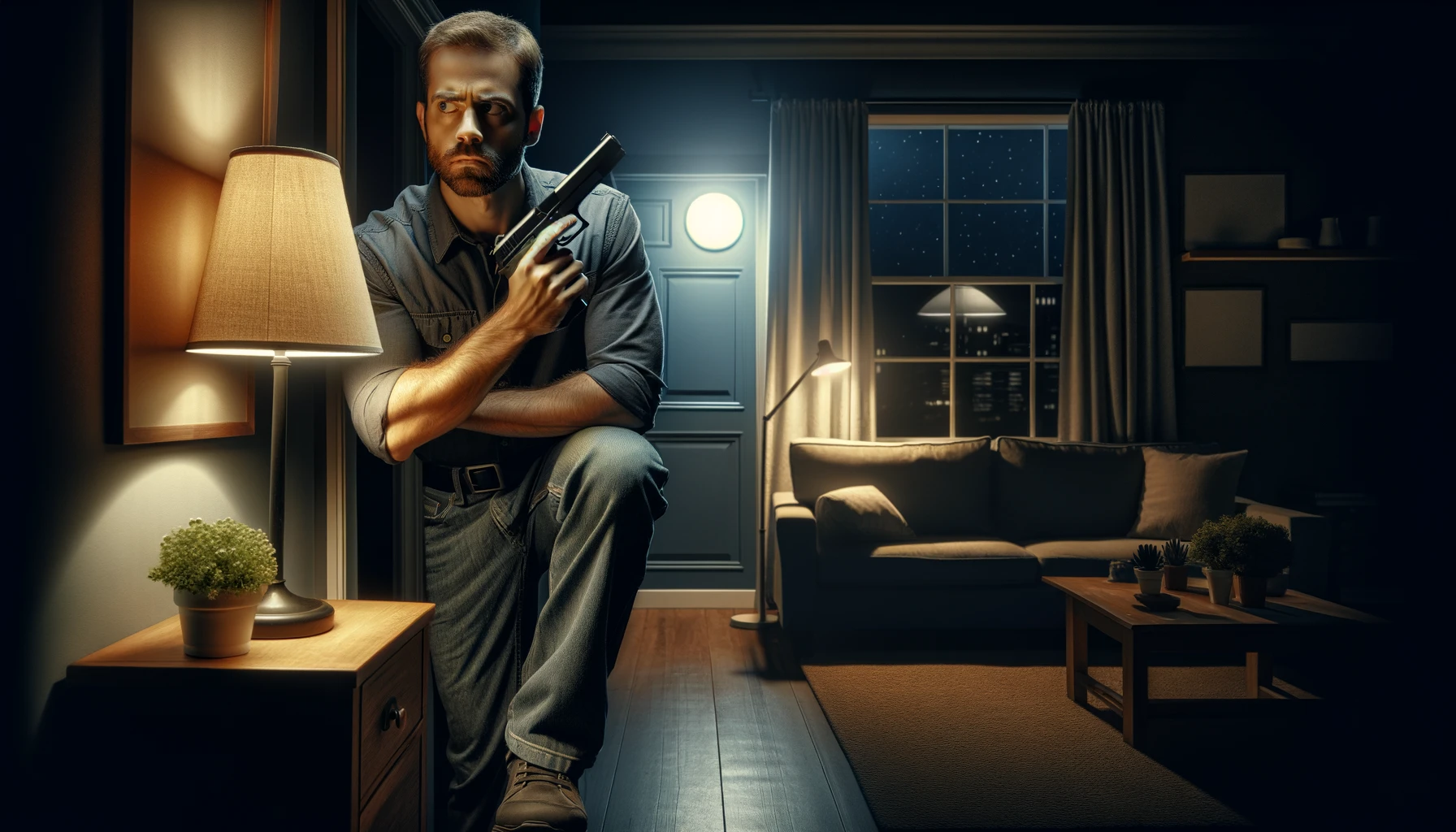
I have set up home defense configurations with shotguns, handguns, and AR-15s — testing each in low-light drills, from barricade positions, and in force-on-force training scenarios. This guide is based on years of real-world preparation and professional instruction, not YouTube speculation. Some links are affiliate links that support our independent testing. Read our editorial policy.

Quick Answer: Best Home Defense Firearms
- Best Overall: AR-15 (BCM RECCE-16 or Daniel Defense DDM4 V7) — Low recoil, 30-round capacity, accurate, proven
- Best Shotgun: Mossberg 590A1 — Pump-action reliability, devastating terminal performance, $500-$600
- Best Handgun: Glock 19 Gen 5 with weapon light — 15+1, concealable, one-handed operation
- Best Budget Option: Mossberg Maverick 88 — Pump shotgun, proven reliability, under $250
- Best for Apartments: 9mm handgun with quality hollow-points — reduced overpenetration risk
- Best Non-Lethal: POM OC Spray + Streamlight flashlight — essential tools even if you own firearms
The Big Three: Shotguns vs. Handguns vs. AR-15s
The home defense debate usually comes down to three platforms: shotguns, handguns, and AR-15 rifles. Each has genuine advantages and real limitations. The right answer depends on your living situation, training level, physical ability, and the specific threats you are preparing for. Let me break down each platform honestly — including the downsides nobody on forums wants to admit.
For a direct side-by-side comparison, see our detailed shotgun vs. AR-15 for home defense article.
Shotguns for Home Defense
Why Choose a Shotgun
The shotgun has been the go-to home defense weapon for over a century, and for good reason. A 12-gauge shotgun loaded with 00 buckshot delivers 8-9 .33-caliber pellets with every trigger pull — the equivalent of being hit by a burst from a submachine gun. The terminal performance of a close-range shotgun blast is unmatched by any other platform available to civilians.
Advantages:
- Devastating stopping power. No other civilian firearm delivers as much energy per trigger pull. A center-mass hit with 00 buckshot at 10 yards is catastrophically effective.
- Ammunition versatility. You can load buckshot, slugs, birdshot, or less-lethal rounds depending on the situation. No other platform offers this flexibility.
- Psychological deterrent. The sound of a pump-action shotgun racking is universally recognized. I do not recommend relying on this — but it is a real factor.
- Budget-friendly. A reliable home defense shotgun starts under $250 (Maverick 88). No other firearm platform offers proven defensive capability at this price.
- Legal everywhere. Shotguns face fewer restrictions than AR-15s or handguns in every state.
Disadvantages:
- Heavy recoil. 12-gauge buckshot produces significant recoil — 2-3x more than a 5.56 AR-15. For smaller-framed shooters, elderly individuals, or anyone with shoulder issues, this is a real limitation. Follow-up shots are slower.
- Limited capacity. Most defensive shotguns hold 5-8 rounds. An AR-15 holds 30. In a worst-case scenario involving multiple intruders, capacity matters.
- Slow reloads. Reloading a shotgun is painfully slow compared to swapping a magazine. Under stress, loading individual shells into a tube magazine is a fine motor skill that degrades rapidly.
- Length. An 18.5-inch barrel shotgun is awkward in tight hallways and doorways. You must practice maneuvering with it in your home.
- Overpenetration. 00 buckshot and slugs penetrate multiple walls easily. This is a serious concern in apartments, townhomes, and homes with family members in other rooms.
Best Home Defense Shotguns
1. Mossberg 590A1 ($500-$600) — The gold standard military-grade pump shotgun. Heavy-walled barrel, metal trigger guard, metal safety, and 8+1 capacity with the extended tube. The 590A1 is what the US military uses. It is overbuilt, runs every ammunition type, and will outlast you. This is my top shotgun recommendation.
Mossberg 590A1
2. Mossberg Maverick 88 ($199-$249) — The budget king. Made by Mossberg with slightly downgraded components (crossbolt safety instead of tang, different trigger group), it shares the same receiver, barrel, and reliability. Under $250, it is the most affordable proven home defense firearm on the market. If budget is your primary constraint, buy this and spend the savings on ammunition and training.
Mossberg Maverick 88
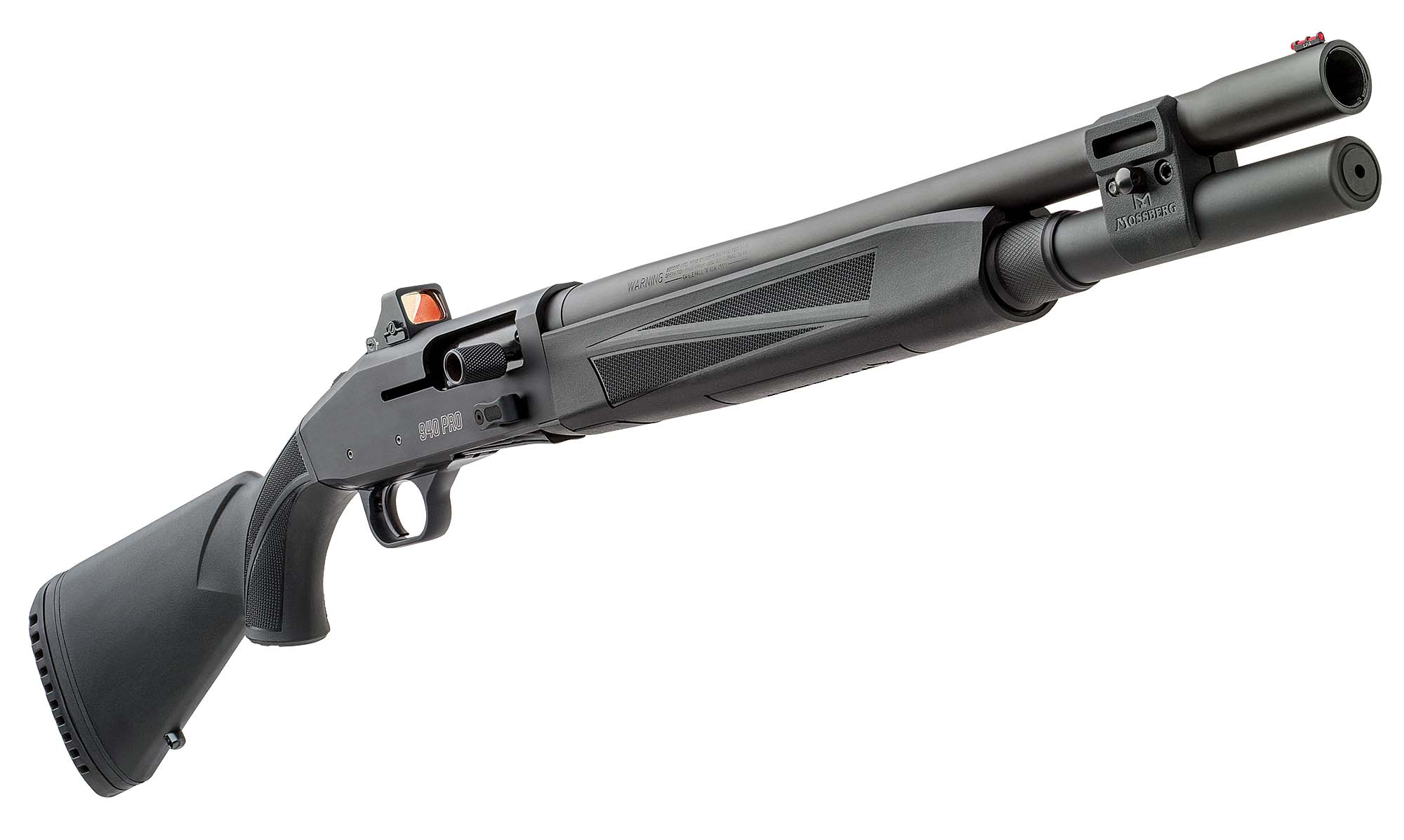
3. Mossberg 940 Pro Tactical ($900-$1,000) — The best semi-auto defensive shotgun. Gas-operated, low recoil, 7+1 capacity, and it runs reliably out of the box with both target and defensive loads. Semi-auto shotguns reduce felt recoil by 30-40% compared to pump-actions, making follow-up shots significantly faster. The trade-off is price and the possibility of short-stroking under stress (which does not exist with a semi-auto).
Mossberg 940 Pro Tactical
4. Remington 870 ($350-$500) — The classic. Over 11 million sold, with the largest aftermarket of any shotgun ever made. Our Remington 870 review covers the current production quality in detail. The 870 remains a solid choice, though I give the edge to Mossberg for the ambidextrous tang safety and dual extractors.
Remington 870
For the complete comparison of defensive shotguns including semi-autos, pumps, and short-barrel options, see our 10 best shotguns for home defense and best short-barrel shotguns guides.
Handguns for Home Defense
Why Choose a Handgun
A handgun is the most practical home defense firearm for many people — not because it is the most effective at stopping threats, but because it is the most usable under real-world conditions.
Advantages:
- One-handed operation. You can hold a flashlight, open doors, carry a child, call 911, or push a family member behind you — all while keeping the gun ready. A long gun requires both hands.
- Maneuverability. A handgun is dramatically easier to use in tight spaces — hallways, doorways, staircases, closets. No barrel extending past corners to give away your position.
- Quick access. A handgun in a bedside biometric safe is accessible in 2 seconds. A long gun in a full-size safe takes longer.
- Concealment and storage. Handguns fit in bedside safes, quick-access vaults, and concealment furniture. This makes staged defense positions practical throughout your home.
- Dual-purpose. Your home defense handgun can also serve as your concealed carry gun. One gun, two roles, more practice time per platform.
Disadvantages:
- Lower terminal performance. A 9mm hollow-point is significantly less effective per round than 5.56 or 12-gauge buckshot. Shot placement matters more with a handgun.
- Harder to shoot accurately under stress. Handguns are inherently harder to aim than long guns — shorter sight radius, no stock for stabilization, and grip-dependent accuracy. Defensive handgun accuracy degrades dramatically under adrenaline.
- More training required. Proficiency with a handgun requires significantly more practice than a rifle or shotgun. The fundamentals are less forgiving.
Best Home Defense Handguns
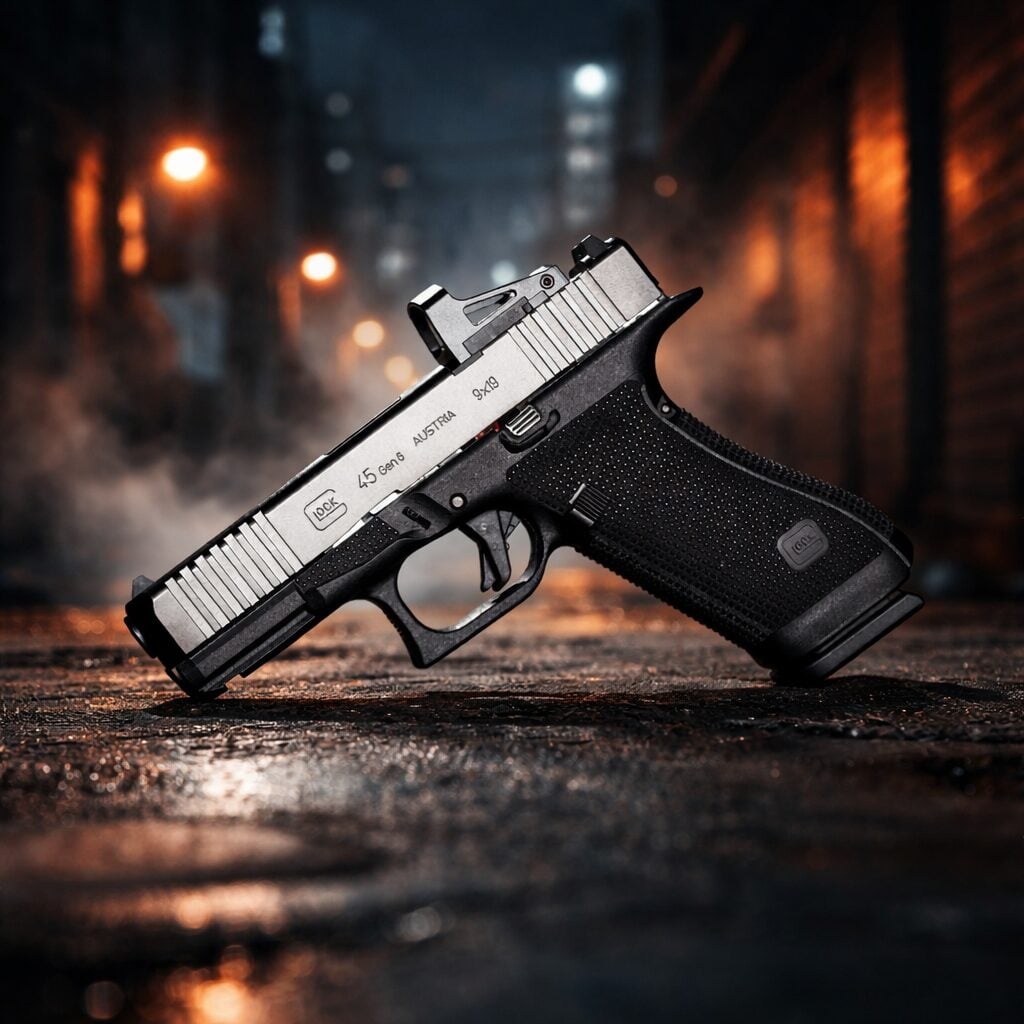
1. Glock 19 Gen 5 / Gen 6 ($549-$599) — The most popular defensive handgun in America. 15+1 capacity, utterly reliable, optics-ready (MOS versions), and massive aftermarket support for lights, sights, and holsters. This is the pistol I recommend to more people than any other for home defense. See our Glock 19 review.
Glock 19 Gen 5
2. Sig Sauer P320 Full Size ($549-$649) — Modular (swap grip sizes without tools), striker-fired, 17+1 capacity, excellent trigger. The US Army’s M17 service pistol. Optics-ready. The full-size frame is easier to shoot accurately than compact models — in a home defense gun, there is no reason to compromise on size. See our P320 review.
Sig Sauer P320 Full Size
3. Smith & Wesson M&P 2.0 Full Size ($449-$549) — Excellent ergonomics, aggressive texturing, 17+1, and optics-ready. The 2.0 trigger is a significant improvement over the original M&P. At $50-$100 less than a Glock or Sig, it is a strong value play. See the best full-size 9mm handguns for more options.
S&W M&P 2.0 Full Size
4. Glock 17 ($549-$599) — The full-size Glock with 17+1 capacity. Slightly larger than the Glock 19, with a longer barrel and sight radius. If the gun stays at home and is not being carried concealed, the G17 is arguably the better choice — more rounds, better accuracy, softer recoil. Same legendary reliability.
Glock 17 Gen 5
For the complete handgun selection process, read our handgun buyer’s guide. If you also plan to carry your home defense handgun, see our concealed carry guide.
AR-15 Rifles for Home Defense
Why Choose an AR-15
The AR-15 has become the preferred home defense rifle for a growing number of gun owners — and for very good reasons that may surprise you.
Advantages:
- Low recoil. 5.56 NATO produces less felt recoil than a 12-gauge shotgun, a .308 rifle, or even some magnum handgun calibers. This means faster follow-up shots and less flinching.
- High capacity. A standard 30-round magazine gives you significantly more ammunition than a shotgun (5-8 rounds) or handgun (15-17 rounds). In a worst-case multiple-intruder scenario, capacity saves lives.
- Easier to shoot accurately. A rifle with a stock, foregrip, and red dot sight is dramatically easier to shoot accurately under stress than a handgun. The fundamentals are more forgiving.
- Less overpenetration than you think. This is the counterintuitive truth: 5.56 NATO with proper defensive ammunition (Hornady 75-grain TAP, Speer Gold Dot 62-grain) fragments and tumbles through drywall more than pistol rounds or buckshot. Multiple independent tests have shown 5.56 penetrates fewer walls than 9mm, .45 ACP, or 00 buckshot.
- Accessory ecosystem. Weapon lights, red dots, slings, and suppressors (where legal) make the AR-15 the most configurable defensive platform available.
Disadvantages:
- Size. Even a 16-inch AR-15 is long. Maneuvering through doorways and hallways requires practice and specific techniques. A pistol is significantly more maneuverable.
- Two-handed operation. You cannot effectively operate an AR-15 with one hand. If you need to open doors, hold a phone, or carry a child, you have to put the rifle down or sling it.
- Noise. An unsuppressed AR-15 indoors is dangerously loud — 165+ dB. Without hearing protection, you risk permanent hearing damage from a single shot. Suppressors (where legal) bring the report down to 130-140 dB — still loud but less damaging.
- Legal restrictions. Some states ban or restrict AR-15s or specific features (pistol grips, adjustable stocks, magazine capacity). Check your state’s gun laws.
Best Home Defense AR-15s
1. BCM RECCE-16 ($1,300-$1,450) — My personal home defense rifle. Bravo Company Manufacturing builds rifles to a duty-grade standard with excellent quality control. The 16-inch mid-length gas system runs smooth, the BCM furniture is top-tier, and the reliability is Daniel Defense-level at a lower price. BCM spends money on quality, not marketing.
BCM RECCE-16
2. Daniel Defense DDM4 V7 ($1,749-$1,849) — The gold standard premium AR-15. Cold hammer forged, chrome-lined barrel, impeccable machining, and a track record of military and law enforcement use. Our 2,000-round test confirmed zero malfunctions. For the complete DDM4 V7 breakdown, see our AR-15 buyer’s guide.
Daniel Defense DDM4 V7
3. S&W M&P15 Sport III ($629-$679) — The best value home defense AR-15. Mid-length gas, reliable, backed by Smith & Wesson’s customer service. If you want a proven AR-15 for defense without spending $1,500+, this is the answer. Read our 1,500-round review.
S&W M&P15 Sport III
For a deep dive into AR-15 selection, specifications, and budget tiers, see our complete AR-15 buyer’s guide.
Essential Home Defense Accessories
The firearm is only part of the equation. These accessories are critical for effective home defense:
Weapon-Mounted Light (Mandatory)
You must identify your target before you shoot. Most home invasions happen at night. A weapon-mounted light (WML) lets you see what you are aiming at, temporarily blind an intruder, and navigate your home without a separate handheld light. This is not optional — it is the single most important accessory on any home defense firearm.
- For handguns: Streamlight TLR-1 HL ($130) or Surefire X300U ($270). Both produce 1,000+ lumens and mount to any standard Picatinny rail.
- For AR-15s: Streamlight ProTac HLX ($100-$120) with a pressure pad switch, or Surefire M600DF ($270) for duty-grade reliability.
- For shotguns: Streamlight TL-Racker ($125) replaces the forend on a Mossberg 500/590 and integrates a 1,000-lumen light directly into the pump.
Optics (For Rifles and Handguns)
A red dot sight dramatically improves target acquisition speed in low light. For home defense, speed matters more than magnification. The Holosun 510C ($250) or Sig Romeo5 ($120) for rifles, and the Holosun 507C ($250) for handguns, are all excellent choices. See our AR-15 optics guide for the complete breakdown.
Ammunition Selection
Your defensive ammunition must balance stopping power with reduced overpenetration. Here are my recommendations:
- 9mm handgun: Federal HST 124-grain or Speer Gold Dot 124-grain — both are FBI-protocol tested and expand reliably
- 5.56 AR-15: Hornady 75-grain TAP or Speer Gold Dot 62-grain — both fragment through barriers, reducing overpenetration risk
- 12-gauge shotgun: Federal FliteControl 00 buckshot — the FliteControl wad keeps pellets in a tight pattern out to 25 yards, dramatically reducing the spread that makes buckshot dangerous in close quarters
- Reduced-recoil option: Federal Tactical 8-pellet 00 buckshot — less recoil, tighter patterns, 8 pellets instead of 9
For complete ammunition selection, see our ammo buying guide, best 9mm ammo guide, and best AR-15 ammo guide.
Gun Safe and Storage
Your home defense firearm must be both secure and accessible. A bedside biometric safe like the Vaultek DS2i or GunVault SV500 keeps your handgun secured from children and unauthorized access while allowing 1-2 second retrieval in an emergency. For long guns, an under-bed vault (Stealth Defense Vault DV652) provides quick access to a shotgun or AR-15.
Home Defense Strategy: It Is Not Just About the Gun
The firearm is the last resort in a layered home defense strategy. Before you ever pick up a gun in the middle of the night, these layers should already be working for you:
Layer 1: Deterrence
Most burglars are opportunists. Motion-activated exterior lights, visible security cameras, alarm system signs (even if you do not have a system), a dog (real or simulated — a “Beware of Dog” sign is free), reinforced door frames, and deadbolts all make your home a harder target. Burglars move on to easier homes.
Layer 2: Detection
A monitored alarm system or smart home sensors (door/window sensors, motion detectors) alert you before an intruder reaches your bedroom. Ring, SimpliSafe, or ADT all offer affordable monitoring. The earlier you detect an intrusion, the more time you have to prepare.
Layer 3: Delay
Reinforced door frames (Door Armor, $80) and 3-inch screws in strike plates turn a door that can be kicked in with one hit into one that takes 5-10 kicks. Window security film prevents easy glass entry. Every second of delay is a second you are preparing — waking up, accessing your firearm, calling 911, and moving family members to a safe position.
Layer 4: Safe Room
Ideally, your plan is to gather your family in a single reinforced room (your bedroom is fine), call 911, arm yourself, and wait for police. Clearing your home room by room is extremely dangerous — even for trained professionals with teammates. Police officers do it in pairs or teams for a reason. If you are alone, barricading in place is almost always safer than hunting an intruder.
For a comprehensive home defense strategy beyond just firearms, read our home defense strategies guide.
Overpenetration: Understanding the Real Risk
Overpenetration — a bullet or pellet passing through the target and walls to hit an unintended person — is the most serious safety concern in home defense. Here is what the data actually shows:
- 5.56 NATO (55-grain FMJ): Fragments rapidly in drywall. Penetrates 2-3 sheets of drywall before fragmenting into non-lethal pieces. Counterintuitively, the LEAST likely of the major calibers to overpenetrate.
- 5.56 NATO (75-grain TAP / 62-grain Gold Dot): Designed for barrier performance. Penetrates 3-4 sheets of drywall while fragmenting. Excellent balance of terminal performance and reduced overpenetration.
- 9mm JHP (Federal HST): Penetrates 4-6 sheets of drywall. Expands and slows significantly but retains more mass through barriers than 5.56.
- 12-gauge 00 buckshot: Penetrates 4-8+ sheets of drywall depending on the load. Each pellet retains lethal energy through multiple walls. This is the MOST likely to overpenetrate of common defensive loads.
- 12-gauge #4 buckshot: A compromise — smaller pellets (21 pellets per shell) that penetrate less than 00 buck while still delivering devastating close-range performance. Worth considering if you live in an apartment or have family members in adjacent rooms.
Bottom line: If overpenetration is your primary concern, 5.56 with fragmenting ammunition is the best choice — not the worst. If you must use a shotgun, consider #4 buckshot or Federal FliteControl loads for tighter patterns.
Which Platform Should You Choose?
Here is my recommendation based on your situation:
- House with family, dedicated home defense gun: AR-15 with a red dot, weapon light, and sling. The combination of low recoil, high capacity, accuracy under stress, and reduced overpenetration (with proper ammo) makes it the best overall home defense platform.
- Apartment or shared-wall dwelling: 9mm handgun with quality hollow-points. Reduced overpenetration risk, maneuverability in tight spaces, and the ability to use one hand while calling 911.
- Tight budget (under $300): Mossberg Maverick 88. Proven reliability, devastating stopping power, and the lowest cost of any effective defensive firearm.
- Physical limitations (recoil-sensitive, smaller frame): 9mm handgun or AR-15 (both have low recoil). Avoid 12-gauge shotguns unless you have trained extensively with them.
- Already carry concealed: Use your carry gun for home defense too. You already train with it. Add a weapon light and a bedside safe. See our concealed carry guide.
- Want maximum stopping power, cost is no concern: Shotgun (Mossberg 590A1) loaded with Federal FliteControl 00 buckshot. Nothing available to civilians delivers more energy per trigger pull.
Frequently Asked Questions
Is an AR-15 too powerful for home defense?
No. This is one of the most persistent myths in firearms. 5.56 NATO with proper defensive ammunition actually overpenetrates less than pistol rounds or buckshot through interior walls. The low recoil, high capacity, and ease of accuracy make the AR-15 one of the best home defense platforms available. The US military and law enforcement switched to 5.56 for close-quarters battle for exactly these reasons.
Should I use birdshot for home defense?
No. Birdshot (#6, #7.5, #8) does not reliably penetrate deep enough to reach vital organs. The FBI standard for defensive ammunition is 12-18 inches of penetration in calibrated ballistic gel. Birdshot barely reaches 6 inches. At across-the-room distances, it will cause superficial wounds — painful and bloody, but rarely incapacitating. Use 00 buckshot or #4 buckshot for home defense.
Do I need a suppressor for home defense?
You do not need one, but if suppressors are legal in your state and you are willing to invest the money ($700-$1,200 + $200 tax stamp + 6-12 month wait), a suppressed AR-15 or 9mm handgun is significantly better for home defense. Firing an unsuppressed gun indoors without hearing protection causes immediate and permanent hearing damage. A suppressor reduces the report to a level that is still loud but far less damaging. It also reduces muzzle flash, which helps maintain night vision.
What is the best caliber for home defense?
9mm for handguns (best balance of capacity, recoil, and terminal performance with modern hollow-points). 5.56 NATO for rifles (low recoil, reduced overpenetration with proper ammo, excellent terminal performance). 12-gauge for shotguns (maximum stopping power per trigger pull). All three calibers are effective with quality defensive ammunition and proper shot placement.
Should I clear my house or stay in place?
Stay in place. Unless you need to reach a family member (especially a child), barricading in your bedroom with your firearm pointed at the door is the safest strategy. Call 911, announce that you are armed and have called police, and let them clear the house. Clearing a house solo is one of the most dangerous things you can do — professional teams do it with multiple people, body armor, and extensive training. You have none of those advantages at 3 AM in your underwear.
How should I store my home defense gun?
In a quick-access safe next to your bed. For handguns, a biometric safe like the Vaultek DS2i opens in under 2 seconds with a fingerprint. For long guns, an under-bed vault (Stealth Defense Vault) keeps a shotgun or AR-15 accessible but secured. Never leave a loaded firearm unsecured — especially if children ever visit your home. See our gun safe buyer’s guide for the best options.
Final Thoughts
There is no single “best” home defense firearm — only the best one for your specific situation, skill level, and living environment. An AR-15 is objectively the most capable platform for most homeowners, but a handgun or shotgun may be the better choice depending on your circumstances.
Whatever you choose, invest in training, a weapon-mounted light, quality defensive ammunition, and a secure storage solution. The firearm is just a tool — your preparation, your plan, and your mindset are what actually protect your family.
Use our price comparison tool to find the best deal on your next home defense firearm, and browse the daily gun deals for current discounts. For detailed buying guidance, see our AR-15 buyer’s guide, handgun buyer’s guide, and best home defense shotguns.
Already have your gun? Make sure you also have non-lethal tools for situations that do not warrant deadly force, and self-defense insurance to protect you legally if you ever need to use it.
Keep your firearms running reliably. Our complete gun cleaning and maintenance guide covers step-by-step cleaning for handguns, rifles, and shotguns — plus storage, rust prevention, and recommended supplies.