
Last updated March 28th, 2026. This post contains affiliate links. If you click and buy, I may earn a small commission at no extra cost to you. Full disclosure here.
- Treat every gun as loaded
- Point the muzzle in a safe direction
- Keep your finger off the trigger until you’re ready to shoot
- Know your target and what’s beyond
Zeroing your AR-15 seems simple until you realize there are about six “correct” zero distances and everyone on the internet insists their choice is the only right one. The truth is that different zeros serve different purposes, and the best one depends on how you use your rifle.
I’ve zeroed more AR-15s than I can count using every method from 25-yard bench zeros to 300-yard confirmed zeros at precision matches. Here’s the complete guide, including the zero I recommend for most shooters and the step-by-step process to get it done.
Understanding AR-15 Zeroing
When you zero a rifle, you’re adjusting the sights so the bullet impacts where you aim at a specific distance. The bullet doesn’t travel in a straight line. It arcs upward after leaving the barrel (because the barrel is angled slightly upward relative to the sight line) and then gravity pulls it back down.
The bullet’s trajectory crosses the sight line twice: once on the way up and once on the way down. These two crossing points are your zero distances. For example, with a 50/200 yard zero, the bullet crosses the sight line going up at roughly 50 yards and again coming down at about 200 yards.
Your sight height above the bore matters too. On a standard AR-15 with a flat-top receiver and red dot, the sight is about 2.6 inches above the bore. At very close range (inside 10 yards), your bullet will impact about 2.5 inches below where your dot is. This is critical for close-range precision shots.
Common Zero Distances Compared
| Zero Distance | Trajectory at 100 yds | Trajectory at 200 yds | Trajectory at 300 yds | Best For |
|---|---|---|---|---|
| 25-yard | +2.5″ | +1.5″ | -5.5″ | Quick initial zero |
| 36-yard | +1.5″ | 0″ | -7.5″ | General purpose (recommended) |
| 50-yard | +1.0″ | 0″ | -8.0″ | 50/200 yard zero |
| 100-yard | 0″ | -3.5″ | -13.0″ | Known-distance target shooting |
| 200-yard | +2.0″ | 0″ | -8.5″ | Extended range work |
Trajectory values are approximate for M193 55gr from a 16″ barrel. Heavier bullets and different velocities will shift these numbers. Always confirm at distance with your specific ammo.
The 36-Yard Zero: My Recommendation
The 36-yard zero (sometimes called the “improved battlesight zero”) is what I run on most of my AR-15s. It gives you point-of-aim/point-of-impact hits from about 30 yards to 200 yards with only about 1.5 inches of deviation at any point in that range. For a general-purpose rifle, that’s hard to beat.
Here’s why I prefer it over the traditional 25-yard or 50-yard zero. At 50 yards, you’re only 0.5″ high. At 100 yards, you’re about 1.5″ high. At 200 yards, you’re right on. At 300 yards, you’re about 7.5″ low, which is still a center-mass hold on a torso target. That flat trajectory window from 0 to 250 yards covers the vast majority of practical AR-15 shooting.
The 36-yard zero was popularized by the military’s Improved Battlesight Zero (IBZ) concept. It’s been validated extensively by both military and civilian precision shooters. For a home defense or general-purpose rifle, it’s the most practical zero available.
The 50/200 Yard Zero
The 50/200 yard zero is the traditional military battlesight zero. You zero at 50 yards, and the trajectory arc brings the bullet back to the sight line at approximately 200 yards. It’s been the standard for decades and works well.
The main advantage of the 50/200 zero is simplicity and the fact that most ranges can accommodate 50-yard shooting. You zero at 50, confirm at 200 if possible, and you’re done. The trajectory stays within about 2 inches of the sight line from 25 to 225 yards.
The slight disadvantage compared to the 36-yard zero is that you’re a bit higher at 100 yards (about 2″ vs 1.5″). It’s a minor difference that doesn’t matter much in practice. If you’re already running a 50/200 zero, there’s no compelling reason to switch.
The 25-Yard Zero
The 25-yard zero is popular because nearly every indoor range is 25 yards. It approximates a 300-yard zero (the bullet crosses the sight line at 25 yards going up and approximately 300 yards coming down). This was the standard M16A2 battlesight zero.
The problem with the 25-yard zero is that you’re 2-3 inches high at 100-150 yards. For precision work, that matters. For combat accuracy on human-sized targets, it doesn’t. I don’t recommend it as a primary zero because the 36-yard zero gives a flatter trajectory through the most common engagement distances.
However, the 25-yard zero is excellent as a starting point. Zero at 25, then fine-tune at your preferred distance. It gets you on paper quickly and saves ammo compared to starting from scratch at 100 yards.
The 100-Yard Zero
A 100-yard zero means point of aim equals point of impact at exactly 100 yards. Simple, clean, and easy to remember. It’s popular with precision shooters and hunters because 100 yards is a common reference distance and makes calculating holdovers straightforward.
The downside is that at 200 yards you’re 3-4 inches low, and at 300 yards you’re 12-14 inches low. You need to hold over at every distance beyond 100 yards. For a general-purpose rifle, I find the 36-yard or 50/200 zero more practical because they give you a larger “point and shoot” window.
If you’re shooting a magnified optic with a reticle that has holdover marks (BDC or mil/MOA hash marks), a 100-yard zero makes reticle-based holdovers very intuitive. It’s the right choice for an 18″ or 20″ precision build with a quality LPVO or scope.
MOA vs MIL Adjustments
Your optic’s turrets adjust in either MOA (Minute of Angle) or MIL (Milliradians). Understanding which system your optic uses is essential for making accurate zero adjustments.
MOA: 1 MOA equals approximately 1.047 inches at 100 yards (most shooters round to 1 inch). Most American-market optics adjust in 1/4 MOA clicks. So 4 clicks equals 1 MOA, which moves your point of impact 1 inch at 100 yards, 2 inches at 200 yards, and so on.
MIL: 1 MIL equals approximately 3.6 inches at 100 yards (or 10 cm at 100 meters). Most MIL optics adjust in 0.1 MIL clicks. So 10 clicks equals 1 MIL, which moves your point of impact 3.6 inches at 100 yards.
Neither system is inherently better. MOA is more intuitive for shooters who think in inches and yards. MIL is preferred by military and precision shooters who work in the metric system. Use whatever your optic has and learn the math. Our red dot sights guide covers specific adjustment specs for top optics.
Step-by-Step Zeroing Process
Step 1: Bore Sight First
Before you waste ammo, bore sight your rifle. Remove the bolt carrier group, look through the bore from the rear, and center a target at 25-50 yards in the bore. Without moving the rifle, adjust your optic until the reticle or dot is on the same point. A laser bore sighter ($15-30) makes this even easier.
Bore sighting won’t give you a perfect zero, but it’ll get you on paper. This saves the frustration (and ammo) of shooting at 100 yards with no idea where the bullets are going. I bore sight every new optic mount. It takes two minutes and saves ten rounds.
Step 2: Set Up Properly
Use a stable shooting position. A bench with sandbags or a rifle rest is ideal. You want to eliminate as much human error as possible. The goal is to find out where the rifle shoots, not where you flinch.
Use quality targets with clearly defined aiming points and measurement grids. The NSSF zeroing targets are free to download and print. They have grid lines that make measuring adjustments easy.
Step 3: Fire a 3-Round Group
Fire three carefully aimed rounds at your target. Take your time. Breathe. Squeeze the trigger. Don’t rush. The goal is three rounds in a tight group that shows where the rifle is actually shooting. If one shot is clearly a flier (you pulled it), ignore it and shoot another.
Step 4: Measure and Adjust
Measure the distance from the center of your group to the center of your target. Calculate how many clicks you need to move. Remember: adjust in the direction you want the impact to move. If you’re hitting low and right, adjust up and left.
At 36 yards with a 1/4 MOA optic: 1 click moves impact about 0.09 inches. You’ll need about 11 clicks per inch of adjustment. At 100 yards: 1 click moves impact about 0.25 inches. 4 clicks per inch.
Step 5: Confirm
Fire another 3-round group to confirm your adjustment. If you’re centered, great. If not, make small corrections. Usually takes 2-3 groups (9-12 rounds total) to nail it down. Once you’re zeroed at your initial distance, confirm at longer range if your range allows it.
How Many Rounds to Zero?
With a bore sight, most zeroing jobs take 12-20 rounds. Without a bore sight, budget 20-30 rounds. If you’re on a brand-new build with a new optic and no bore sighting, you might need 30-40 rounds if your first shots are way off paper and you need to walk them in.
Buy a laser bore sighter. They cost $15-30 and will save you their cost in ammo on your very first zeroing session. I keep one in my range bag permanently.
Zeroing Red Dots vs Magnified Optics
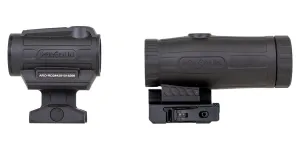
Red dot sights (Aimpoint, Holosun, SIG Romeo) are parallax-free at the distance they’re designed for (usually 50 yards or infinity). This means the dot can be anywhere in the window and as long as it’s on target, the bullet goes there. This makes red dots very forgiving for zeroing and practical shooting.
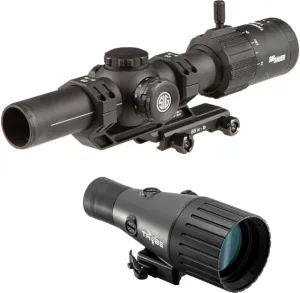
Magnified optics (scopes, LPVOs) have eye relief and parallax considerations. Make sure your eye is properly positioned behind the scope (consistent cheek weld) and that the parallax adjustment (if equipped) is set for your zero distance. Inconsistent eye position behind a magnified optic will shift your zero.
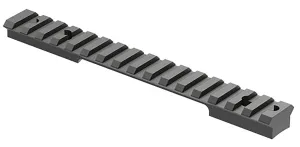
For either optic type, make sure your mount is properly torqued and won’t shift. A scope that moves on the rail will lose its zero immediately. Use quality mounts, proper torque specs, and blue Loctite on mounting screws. Our red dot guide covers mounting best practices.
Common Zeroing Mistakes
- Shooting off an unstable rest: Use sandbags, not your hand. Consistency matters.
- Adjusting after one shot: Always shoot groups of 3. One shot tells you nothing about the rifle’s actual zero.
- Ignoring wind: Even mild crosswind shifts impact at 100 yards. Zero on a calm day or account for wind.
- Poor trigger control: If your groups are 4+ inches at 100 yards, the problem is you, not the zero. Slow down.
- Adjusting the wrong direction: Remember the rule: move the impact toward the reticle. If hitting low-left, adjust up and right.
- Not confirming at distance: A 36-yard zero is theoretical until confirmed at 100-200 yards with your actual ammo.
- Using different ammo later: Different loads shoot to different points of impact. Zero with your primary ammo.
- Loose optic mount: If your zero shifts after transport, check mount screws first.
Confirming Your Zero Over Time
Zero is not a set-it-and-forget-it thing. Reconfirm your zero periodically, especially after transporting your rifle, dropping it, or changing any hardware (optic, mount, barrel, handguard). I confirm zero at the start of every range session with a 3-round group. It takes 30 seconds and three rounds.
Temperature can also shift zero slightly. A rifle zeroed in July at 95 degrees may shoot differently in January at 20 degrees because temperature affects powder burn rate and velocity. For a general-purpose rifle, the shift is typically less than 1 MOA. For precision work, it’s worth re-confirming seasonally.
If your zero shifts consistently, investigate the cause. Loose scope mount, loose barrel nut, worn gas rings, or a shifting stock can all cause zero drift. A quality rifle with quality components and proper assembly should hold zero for thousands of rounds. See our parts guide for components that maintain zero reliability.
Shop AR-15 Optics
Best-scored accessories across 80+ retailers · Updated every 4 hours


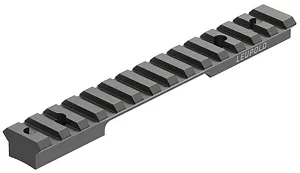
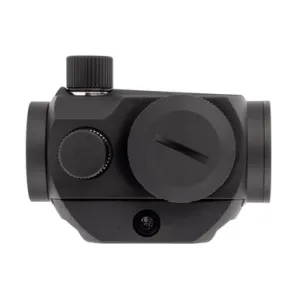

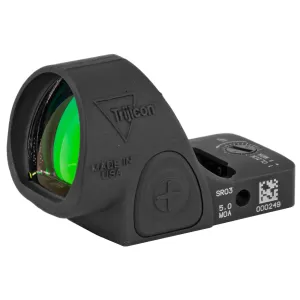


Compare Optics from 80+ Retailers →
Frequently Asked Questions
Related Guides
What is the best zero distance for an AR-15?
36 yards for a general-purpose rifle. It gives the flattest trajectory from 0 to 250 yards with minimal deviation, keeping the bullet within about 2 inches of the sight line.
How many rounds does it take to zero an AR-15?
With a bore sight, 12 to 20 rounds. Without one, 20 to 30 rounds. Start with bore sighting to get on paper, then fire 3-round groups and make adjustments.
Should I zero at 25 yards or 36 yards?
36 yards if your range accommodates it. The 36-yard zero gives a flatter trajectory at common distances. A 25-yard zero approximates a 300-yard zero and rides higher at mid-range.
Does ammo type affect zero?
Yes. Different bullet weights, velocities, and manufacturers produce different points of impact. Always zero with your primary ammo. Switching loads can shift impact several inches at 100 yards.
How often should I re-zero my AR-15?
Confirm zero at the start of every range session with 3 rounds. A full re-zero is needed after changing optics, mounts, or barrel components.
What does minute of angle MOA mean?
1 MOA is approximately 1.047 inches at 100 yards, commonly rounded to 1 inch. It scales linearly: 2 inches at 200 yards, 3 inches at 300 yards.
Can I zero my AR-15 at an indoor range?
Yes, at whatever distance the range offers, usually 25 yards. Zero at 25 and confirm at your preferred distance outdoors later.
Do I need to zero iron sights and a red dot separately?
Yes. Iron sights and optics have different sight heights and will zero independently. Zero your primary sighting system first, then zero your backup irons.
14,528+ Gun & Ammo Deals
Updated daily from 10+ top retailers. Filter by category, caliber, action type, and price.
Related Guides