
Last updated August 2026 · By Nick Hall, AR-15 shooter who has mounted and zeroed the optics on this list across multiple rifles
This article contains affiliate links. If you purchase through our links, we earn a small commission from each sale.
- Treat every gun as loaded
- Point the muzzle in a safe direction
- Keep your finger off the trigger until you’re ready to shoot
- Know your target and what’s beyond
How we tested: Every pick here is ranked against our testing methodology. Minimum round counts, accuracy and reliability protocols, the failures that disqualify a gun. Where we have not shot a specific variant ourselves, we say so in that section.
Best AR-15 Red Dot Sights in 2026 at a Glance
| Optic | Model Details | Key Specs | Check Price |
|---|---|---|---|
 |
BEST VALUESig Sauer Romeo5 The default budget answer. Shake awake and 40,000 hours for the price of a decent magazine set. |
|
Check Price ↓ |
 |
BEST OVERALLAimpoint Micro T-2 The one every other optic gets measured against. Five years of runtime and a reputation earned in service. |
|
Check Price ↓ |
 |
BEST DUTY VALUEAimpoint PRO Aimpoint reliability at half T-2 money, and the mount is in the box rather than on the invoice. |
|
Check Price ↓ |
 |
BEST HOLOGRAPHICEOTech EXPS2 The 68 MOA ring drops onto a target faster than any single dot manages. You pay for it in battery life. |
|
Check Price ↓ |
 |
BEST SET AND FORGETHolosun SCRS Solar panel, internal rechargeable cell and a riser in the box. Mount it and stop thinking about it. |
|
Check Price ↓ |
Choosing an AR-15 Red Dot in 2026
A red dot is the single change that does most for an average shooter’s hit rate on an AR-15. Both eyes stay open, the dot goes where the bullet goes, and the whole business of lining up two sights at different distances disappears. That is why almost every carbine you see at a class now wears one.
The market has changed shape though. Five years ago the honest advice was to save for an Aimpoint or accept that a cheap dot would fail. Today a $140 Sig Romeo5 will take a beating, and a $230 Holosun runs on sunlight. The gap between budget and premium is now about how many thousands of rounds it survives, not whether it works at all.
So the question is not really which optic is best. It is what job the rifle does. A truck gun and a duty carbine want different things, and paying Micro T-2 money for a range toy is as much a mistake as putting a $60 dot on a rifle you would stake something on. I have grouped the ten below by that logic rather than by price alone.
For dialing in your AR-15 for precision and reliability, the right red dot sight can make all the difference.
Here’s a look at the top 10 red dot and holographic sights, blending performance, durability, and value to help you make the perfect choice.
Quick Answer: The Sig Sauer Romeo5 is the red dot to buy for most AR-15s at about $140, giving you a 2 MOA dot and shake-awake, which is years of leaving it switched on. Step up to the Aimpoint PRO at about $512 for thirty thousand hours of constant-on runtime with the mount included, or the EOTech EXPS2 if you want a holographic reticle instead of a simple dot. At the budget end the Sig Romeo MSR at about $95 and the Primary Arms SLx MD-25 at about $135 give you the same 2 MOA dot for a fraction of the Aimpoint price.
| Optic | Magnification | Reticle | Weight | Battery Life | Price | Compare |
|---|---|---|---|---|---|---|
| Sig Sauer Romeo5 | 1x | 2 MOA | 5.1 oz | 40,000 hrs | About $140 | Lowest Price ↓ |
| Aimpoint Micro T-2 | 1x | 2 MOA | 3.7 oz | 50,000 hrs | About $896 | Lowest Price ↓ |
| Vortex AMG UH-1 | 1x | 1 MOA | 11 oz | 1,500 hrs | About $599 | Lowest Price ↓ |
| EOTech EXPS2 | 1x | 1 MOA dot, 68 MOA ring | 7.8 oz | 1,000 hrs | About $530 | Lowest Price ↓ |
| Trijicon MRO | 1x | 2 MOA | 4.1 oz | 43,800 hrs | About $400 | Lowest Price ↓ |
| Holosun SCRS | 1x | 2 MOA | n/a | Solar + 20,000 hrs | About $230 | Lowest Price ↓ |
| Bushnell TRS-25 | 1x | 3 MOA | 6 oz | 3,000 hrs | About $160 | Lowest Price ↓ |
| Sig Sauer Romeo MSR | 1x | 2 MOA | 4.9 oz | 20,000 hrs | About $95 | Lowest Price ↓ |
| Aimpoint PRO | 1x | 2 MOA | 12.7 oz with mount | 30,000 hrs | About $512 | Lowest Price ↓ |
| Primary Arms SLx MD-25 Gen 2 | 1x | 2 MOA | 6.5 oz | 50,000 hrs | About $135 | Lowest Price ↓ |
Table of Contents
1. Sig Sauer Romeo5
- Street price: about $140
- Magnification: 1x
- Dot Size: 2 MOA
- Weight: 5.1 oz
- Battery Life: 40,000 hrs
- Illumination: 10 daytime and 2 night vision settings
Pros
- Shake awake at a budget price
- Ten daylight settings, two night vision
- Fits almost any AR mount
Cons
- Glass is not premium clear
- Housing marks up quickly
- Buy Gen II, skip old stock

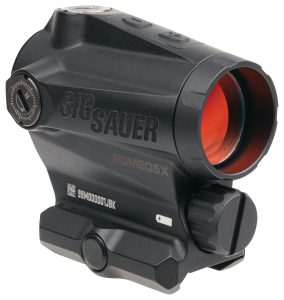
The Romeo5 is a standout for its MOTAC feature, automatically activating the optic when it senses motion, ensuring you’re always ready.
Waterproof and fog-proof, with 10 illumination settings for any light condition, and 40,000 hours of battery life, it’s designed for reliability. Its 2 MOA red-dot offers precise targeting, making it versatile for both close-quarters and medium-range shooting.

2. Aimpoint Micro T-2
- Street price: about $896
- Magnification: 1x
- Dot Size: 2 MOA
- Weight: 3.7 oz
- Battery Life: 50,000
- Illumination: 8 daytime and 4 night vision
Pros
- Five years on one battery
- Genuinely duty proven worldwide
- Clean, tight 2 MOA dot
Cons
- Costs more than many rifles
- Mount often sold separately
- Overkill for a range gun

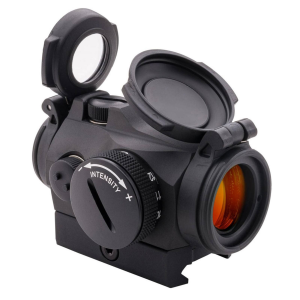

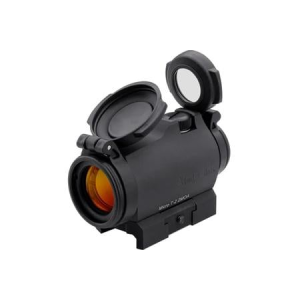
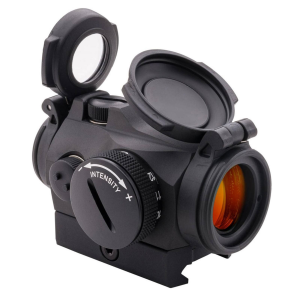
Renowned for its durability and reliability, the Aimpoint Micro T-2 sets the benchmark for red dot sights. Offering over five years of continuous use from a single CR2032 battery, its rugged construction is waterproof and shockproof.
The T-2’s 2 MOA dot is perfect for rapid target acquisition while providing enough precision for distance shooting. With unmatched optical clarity and minimal parallax, it’s ideal for demanding environments.
But yes, we know it’s also seriously expensive.

3. Vortex AMG UH-1
- Street price: about $599
- Magnification: 1x
- Dot Size: 1 MOA
- Weight: 11 oz
- Battery Life: 1,500
- Illumination: 11 daytime and 4 night vision
Pros
- Holographic reticle without EOTech money
- Reticle is fast to find
- Rechargeable battery included
Cons
- Heavy at eleven ounces
- Runtime trails every LED dot
- Rechargeable means remembering to charge
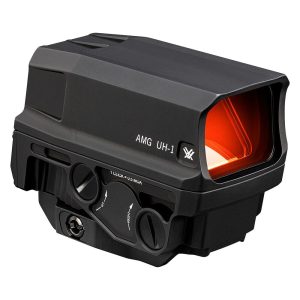
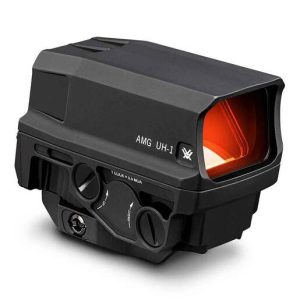
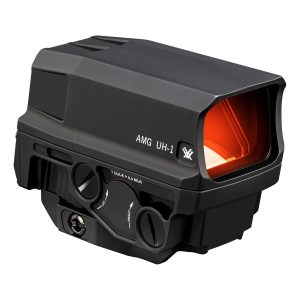
This holographic sight offers a virtually indestructible design with a crisp, clear reticle that remains visible under any lighting conditions.
The UH-1 features an integrated mount for quick attachment, a generous eye relief, and a streamlined profile with no protruding knobs or rings. It’s particularly effective for fast-moving, close-quarters shooting, thanks to its wide field of view.
It is 11oz, so it’s a heavy optic, but that the holographic technology sort of makes up for it.
4. EOTech EXPS2
- Street price: about $530
- Magnification: 1x
- Dot Size: 1 MOA Dot with 68 MOA ring
- Weight: 7.8 oz
- Battery Life: 1,000 hrs
- Illumination: 6 daytime and 4 night vision
Pros
- Reticle finds itself fast
- Short mount clears a magnifier
- Tough holographic housing
Cons
- Battery life measured in hundreds
- Priciest route to a reticle
- Washes out in harsh glare
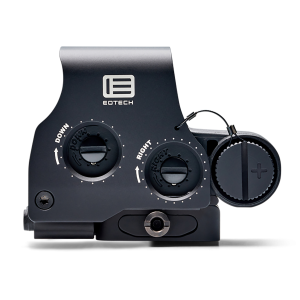
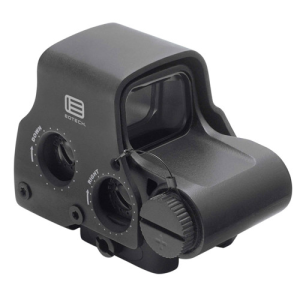
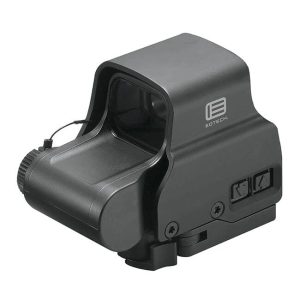
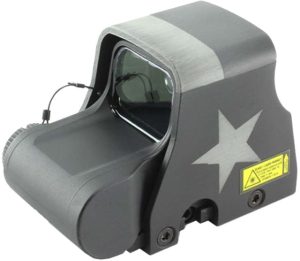
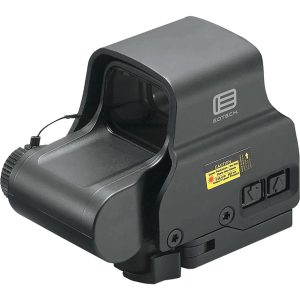
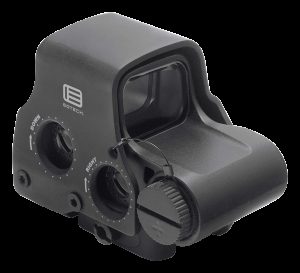
The EXPS2 provides exceptional optical precision and a quick-detach lever, making it adaptable and easy to share across platforms. Its holographic technology delivers a reticle that’s visible in bright sunlight with a 20 brightness setting adjustment.
It’s ruggedly built to withstand harsh conditions and is submersible up to 10 feet, making it suitable for all-weather operations. You can also emerge from the water like a Black Ops specialist in a movie, which must count for something.

5. Trijicon MRO
- Magnification: 1x
- Dot Size: 2 MOA
- Street price: about $400
- Weight: 4.1 oz
- Battery Life: 43,800 hrs
- Illumination: 6 daytime and 2 night vision
Pros
- Wide, forgiving field of view
- Five years on one battery
- Trijicon toughness without ACOG weight
Cons
- Tube shows more housing
- Mount costs extra on most SKUs
- Dot blooms at top brightness
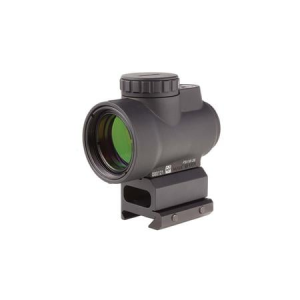
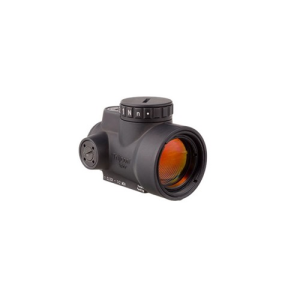
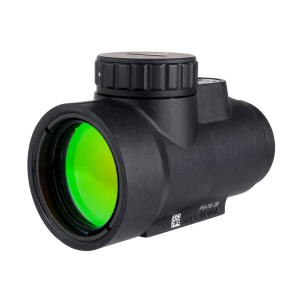
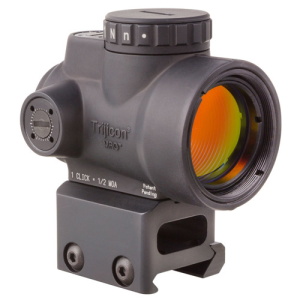
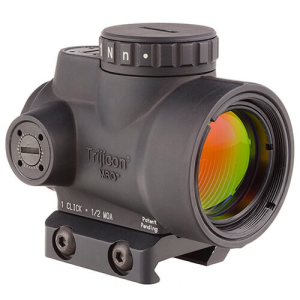
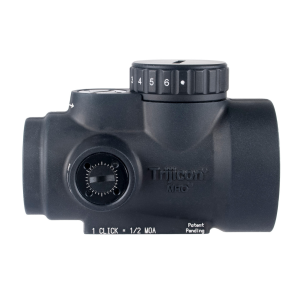
Compact and lightweight, the MRO offers a large viewing area, allowing for rapid target engagement with both eyes open. Its advanced lens coatings and adjustable brightness settings ensure a clear sight picture in any lighting.
Designed for durability, it’s waterproof and resistant to the elements, with a battery life extending up to 5 years, making it a dependable choice for tactical and outdoor use.
6. Holosun SCRS
- Street price: about $230
- Dot size: 2 MOA
- Window: 0.91 x 1.26 in
- Power: solar panel plus internal rechargeable cell, 20,000 hours
- Illumination: 8 daylight and 4 night vision settings
- Footprint: Holosun 509T, 1.63 in riser included
Pros
- Solar keeps it running for free
- Riser included, lower third co-witness
- 509T footprint fits offset mounts
Cons
- Enclosed tube limits the window
- Newer design, less field history
- Auto mode lags fast light changes
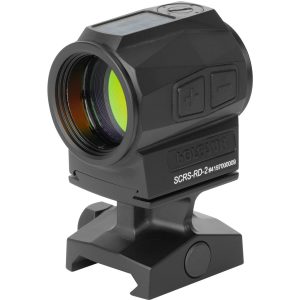
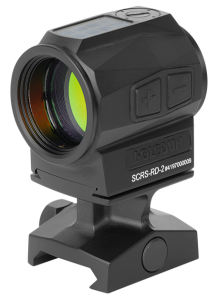
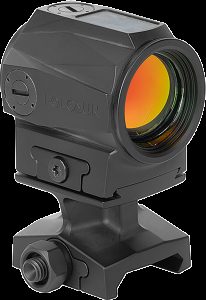
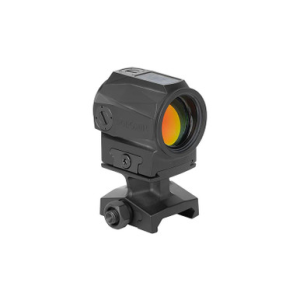
Solar on a rifle optic sounds like a gimmick until you stop changing batteries. The panel on top runs the dot in any usable daylight and tops up an internal cell for everything else, so the practical answer to “when do I service it” is closer to never than to annually.
Holosun ships it on a 1.63 inch riser, which puts you at a lower third co-witness with standard AR irons straight out of the box. No separate mount to buy, no height guesswork. It uses the 509T footprint, so offset mounts from the pistol world bolt straight on.
The catch is the window. It’s a tube, and a tube always shows you more housing than an open reflex like the Romeo5 does. And the auto brightness is good rather than instant, so ducking from bright sun into a dark bay gives you a beat of catching up. Small prices for never buying a CR2032 again.
Best For: Anyone who wants to mount an optic and forget about it, and shooters who would rather spend the mount money on the sight itself.

7. Bushnell TRS-25
- Street price: about $160
- Magnification: 1x
- Dot Size: 3 MOA
- Weight: 6 oz
- Battery Life: 3,000 hrs
- Illumination: 11 daytime and night vision compatible
Pros
- Cheapest sight worth mounting
- Small enough for any rail
- Simple, nothing to learn
Cons
- Three thousand hours is short
- No shake awake
- Glass carries a blue tint
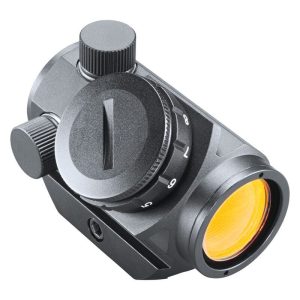
The TRS-25 is a compact, reliable red dot sight known for its durability and affordability. It offers a 3 MOA red dot for quick target acquisition, with 11 brightness settings to accommodate varying light conditions. Its waterproof construction ensures it performs in all weather, making it an excellent entry-level option for shooters.

8. Sig Sauer Romeo MSR
- Street price: about $95
- Magnification: 1x
- Dot Size: 2 MOA
- Weight: 4.9 oz
- Battery Life: 20,000 hrs
- Illumination: 10 daytime settings and 2 Night vision
Pros
- Under a hundred dollars
- MOTAC shake awake included
- Pairs with Juliet magnifiers
Cons
- Adjustment caps feel cheap
- Twenty thousand hours only
- Not for hard duty use
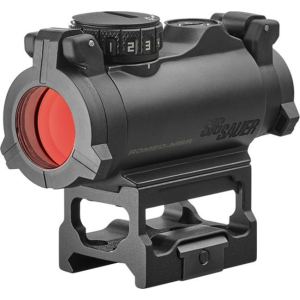
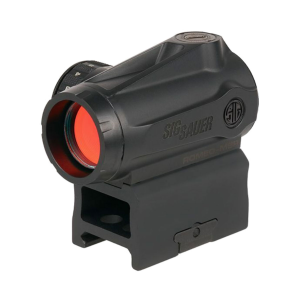
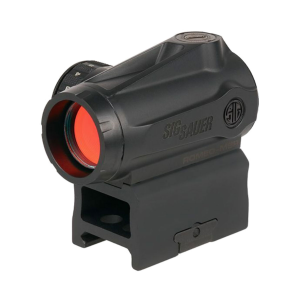
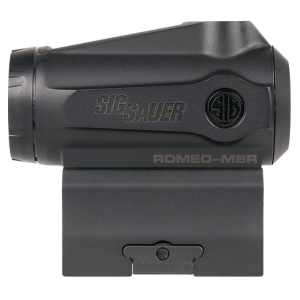
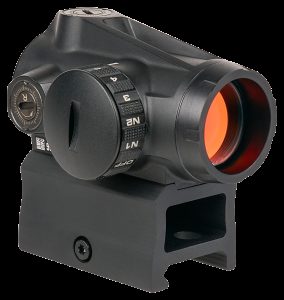
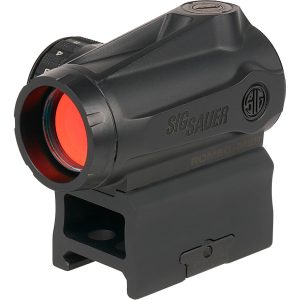
The Romeo MSR is a high-performance, compact red dot sight designed for fast, accurate target acquisition.
Its 2 MOA dot reticle, 20,000-hour battery life, and 10 illumination settings make it versatile for all lighting conditions. An optional Juliet3-Micro magnifier pairs with it to extend its range, making it a dynamic duo for shooting enthusiasts.
9. Aimpoint PRO
- Street price: about $512
- Dot size: 2 MOA
- Weight: 6.8 oz sight only, 12.7 oz with the QRP2 mount
- Battery: DL1/3N, over 30,000 hours constant on
- Illumination: 6 daylight and 4 night vision settings
- Submersible to 45 m
Pros
- Thirty thousand hours, always on
- QRP2 mount and spacer included
- Submersible to forty five meters
Cons
- Heavier than a micro dot
- Two MOA dot only
- Bulkier than modern compact sights
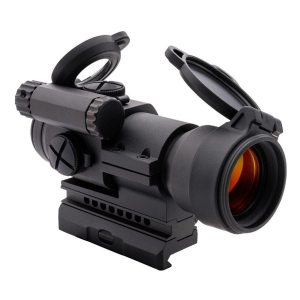
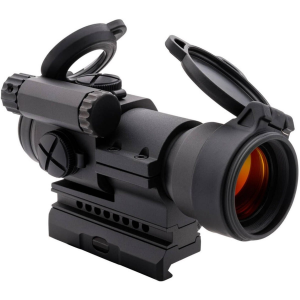
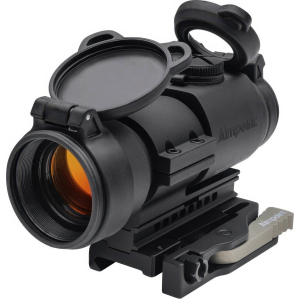
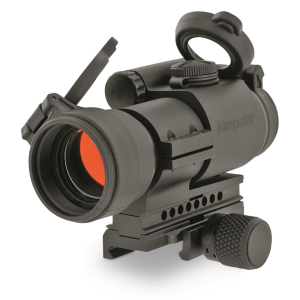
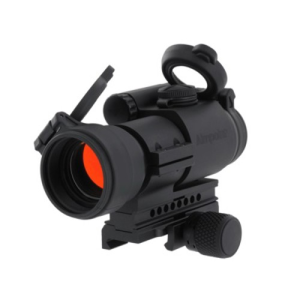
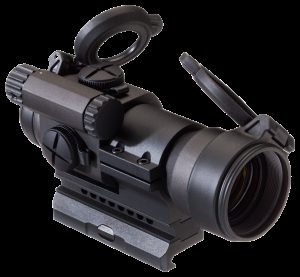
If the Micro T-2 at number two made you wince, this is the Aimpoint you actually buy. Same company, same reputation for working when it matters, roughly half the money, and the QRP2 mount and spacer come in the box rather than as a $150 afterthought.
Thirty thousand hours of constant-on runtime is the number that matters. You switch it on, you leave it on, and three years later it is still lit. That is a different way of owning an optic than remembering to shake it awake, and it is why so many patrol rifles wear one.
It is a big old lump next to a modern micro, and 12.7 ounces with the mount is real weight on a lightweight build. The 2 MOA dot is the only reticle on offer. But nothing here is a compromise on the part that counts, which is whether it works after you drop the rifle.
Best For: Duty, home defense and any rifle you want to leave switched on in a safe, without paying Micro T-2 money.

10. Primary Arms SLx MD-25 Gen 2
- Street price: about $135
- Magnification: 1x
- Dot Size: 2 MOA
- Weight: 6.5 oz
- Battery Life: 50,000 hrs
- Illumination: 12 daytime and Night vision compatible
Pros
- Rotary knob beats push buttons
- AutoLive wakes it instantly
- Costs less than a case of ammo
Cons
- Coatings trail premium glass
- Suits some mount heights only
- Gen II worth the small premium
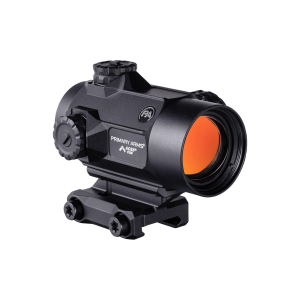
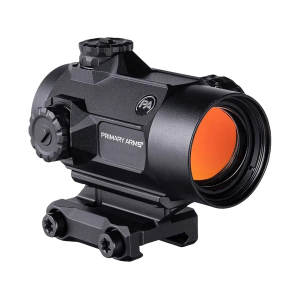
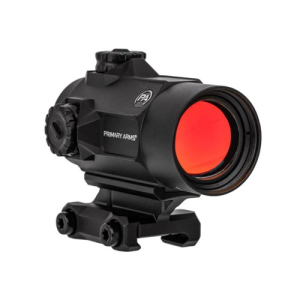
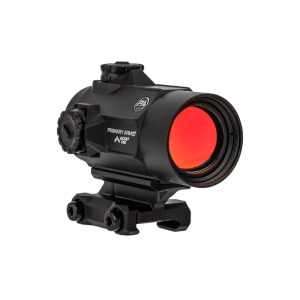
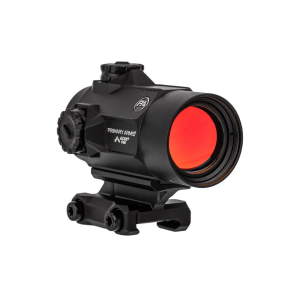
It features a super-sleek design, 12 brightness settings for visibility in all light conditions, and a 50,000-hour battery life for reliability.
The 2 MOA dot is sharp, promoting quick target acquisition while allowing for precise shooting at extended ranges.
For a complete breakdown of every optic type, red dots, holographic sights, LPVOs, and magnified scopes, plus mounting and zeroing advice, see our complete AR-15 optics guide.
Red Dot vs Holographic: Which Belongs on Your AR?
They look similar on the rail and they are not the same technology. A red dot projects an LED onto a coated lens. A holographic sight, meaning EOTech and the Vortex AMG on this list, records a hologram of the reticle and lights it with a laser. That difference shows up in three practical places.
Speed goes to the holographic. A 68 MOA ring with a 1 MOA dot in the middle is easier to catch at speed than a bare 2 MOA dot, and the reticle stays usable even when the window is partly obscured. Battery life goes to the red dot, and not by a little. The Aimpoint PRO runs 30,000 hours. An EXPS2 runs a few hundred. That is the whole trade.
Weight and money go to the red dot too. So the honest split is this. If the rifle lives in a safe switched on, or you want to mount it and forget it, take a red dot. If you shoot fast at close range and you will remember to change batteries, the holographic earns its keep.
Astigmatism: Why Your Dot Looks Like a Smear
If the dot looks like a starburst, a comma or a little cluster instead of a clean circle, the optic is almost certainly fine and your eye is doing it. Astigmatism distorts point light sources, and a red dot is about as pure a point source as exists. People discover this behind a $900 Aimpoint and assume they got a bad one.
Turn the brightness down first. Most shooters run the dot far brighter than they need, and brightness makes the smear worse. Green helps too, because the eye resolves green more tightly than red. And if you have a prescription, shoot in it.
If none of that works, this is the argument for a holographic or a prism. A holographic reticle is generated differently and a lot of astigmatic shooters see the EOTech ring clearly when a plain dot smears. A prism sight uses an etched reticle, which does not smear at all. Our prism scope guide covers that route.
Mount Height and Co-Witness Explained
Mount height is the part people get wrong, and it changes how the rifle feels more than the optic does. Three numbers matter on an AR. A 1.42 inch mount gives you absolute co-witness, where the irons sit dead center in the window. A 1.63 inch mount gives lower third, with the irons parked at the bottom of the glass. A 1.93 or 2.26 inch mount lifts the dot clear of the irons entirely.
Lower third is the default for good reason. The irons are there if you need them and out of the way if you do not, and your head sits naturally on the stock. The Holosun SCRS at number six ships on a 1.63 inch riser for exactly this, so there is no mount to buy.
Taller mounts at 1.93 and above came out of the plate carrier world, where a higher head position is easier behind body armor and a helmet. They work, they feel strange at first, and they need a matching cheek weld. Do not buy one because it looks current. Buy it because you shoot in kit that needs it.
Red Dot Plus Magnifier, or Just Buy an LPVO?
Sooner or later you want to identify something past 200 yards and the dot covers it. Two ways out. Put a flip-to-side magnifier behind the red dot, or replace the whole thing with a low power variable optic that runs 1x to 6x or 1x to 8x.
The magnifier keeps what you already like. At 1x nothing changes, and the magnifier flips out of the way in a second when you do not want it. It also costs less than starting again. The downside is weight stacked behind the optic and a longer rail footprint, and the glass in a $200 magnifier is not scope glass.
An LPVO gives better glass and a proper reticle with holdovers, and it is one unit rather than two. It is also heavier, slower at 1x than any red dot, and it needs eye relief discipline that a dot never asks for. If most of your shooting is inside 100 yards, stay with the dot. If you are regularly stretching out, an LPVO is the better tool. Our AR-15 LPVO guide goes through the options.
What to Avoid When Buying an AR-15 Red Dot
Anything under about sixty dollars. There is a floor, and it sits around the Sig Romeo MSR. Below that you are buying an optic that will not hold zero through a range session, and a dot that wanders is worse than iron sights because you trust it. Save for another month.
Buying the sight and forgetting the mount. Several optics here, the Micro T-2 and the Trijicon MRO among them, are sold as a bare sight on plenty of listings. A decent mount is another $100 to $150. Check what is actually in the box before you compare two prices, because that is where the cheaper one often stops being cheaper.
Chasing a tiny dot. A 1 MOA dot sounds more precise and mostly just gets harder to find in a hurry. For a carbine used inside 200 yards, 2 MOA is the sweet spot, and a 65 or 68 MOA ring around it is faster still. Precision at distance is what magnification is for.
Grey-market and blemished stock. Aimpoint and EOTech both have a healthy trade in units that are not covered by a US warranty. If the price is 30% under everyone else, find out why before you buy, because the warranty is a real part of what you are paying for with these brands.
The Bottom Line
If you can only buy one and the rifle matters, buy the Aimpoint PRO. Thirty thousand hours of constant-on runtime, the mount in the box, submersible to 45 meters, and about half what a Micro T-2 costs. You switch it on and it is still lit in three years. Nothing else here does that for the money.
If the budget stops well short of that, the Sig Romeo5 is still the right answer at around $140 and has been for years. And if you like the idea of never touching a battery again, the Holosun SCRS at $230 is the most interesting optic on this list, riser included.
The Micro T-2 is still the benchmark and I would not talk anyone out of one. I just think most people reading this are better served keeping the difference and spending it on ammunition.
Frequently Asked Questions
What is the best red dot sight for an AR-15?
The Sig Sauer Romeo5 is the best value AR-15 red dot at ~$120. The Aimpoint Micro T-2 is the best premium option at ~$800 (virtually indestructible, 50,000 hour battery). The Holosun HS403B at ~$140 offers shake-awake and solar backup at an entry-level price. For most shooters, the Romeo5 is the sweet spot.
Red dot vs holographic sight: which is better for AR-15?
Red dots (Aimpoint, Sig, Holosun) are lighter, cheaper, and have longer battery life. Holographic sights (EOTech) have a larger viewing window, no parallax issues, and work better with magnifiers. For general AR-15 use, a red dot is the better value. For CQB and fast target transitions, holographic has an edge.
How much should I spend on an AR-15 red dot?
$100-200 gets you an excellent red dot (Sig Romeo5, Holosun HS403B, Primary Arms SLx). $300-500 gets premium options (Trijicon MRO, Holosun 510C). $700+ gets the best (Aimpoint T-2, EOTech EXPS3). Do not spend more on an optic than you spent on the rifle unless you are building a premium setup.
What MOA dot size is best for an AR-15?
A 2 MOA dot is best for precision and target shooting. A 4-6 MOA dot is better for fast target acquisition and CQB. For general AR-15 use, a 2 MOA dot is the most versatile choice. It is small enough for 200+ yard targets but still fast to acquire at close range with practice.
Do I need to co-witness my red dot with iron sights?
Co-witnessing (having iron sights visible through the red dot) is recommended as a backup in case the optic fails. Lower 1/3 co-witness (iron sights visible in the lower third of the optic window) is preferred over absolute co-witness as it provides a less cluttered sight picture while still giving you a backup aiming reference.
How long does a red dot battery last?
Battery life varies enormously. The Aimpoint Micro T-2 lasts 50,000 hours (over 5 years of continuous use). The Sig Romeo5 lasts 40,000+ hours with shake-awake. Holosun models with solar backup can last indefinitely in bright conditions. EOTech holographic sights last only 600-1,000 hours. Check battery life before buying.
What is the best red dot for an AR-15?
Aimpoint and Trijicon lead the premium, battle-proven tier, while Holosun offers outstanding value with features like solar backup and shake-awake, and Sig and Vortex fill the mid-range. The best red dot balances durability, battery life and budget. For hard use, an Aimpoint; for value, a Holosun is hard to beat.
Should I get a red dot or a magnified optic for my AR-15?
A red dot is faster up close and lighter, ideal for defense and general use, while a low-power variable scope adds magnification for longer shots at the cost of weight and speed. Many shooters run a red dot with a magnifier to get both. Choose based on your typical distance and the rifle's role.
6,216+ Gun & Ammo Deals
Updated daily from 200+ top retailers. Filter by category, caliber, action type, and price.
Related Guides