

Affiliate disclosure: This Remington 870 review contains affiliate links. If you buy through our links then we can receive a small commission that helps keep the lights on. You don’t pay anything more.
- Treat every gun as loaded
- Point the muzzle in a safe direction
- Keep your finger off the trigger until you’re ready to shoot
- Know your target and what’s beyond
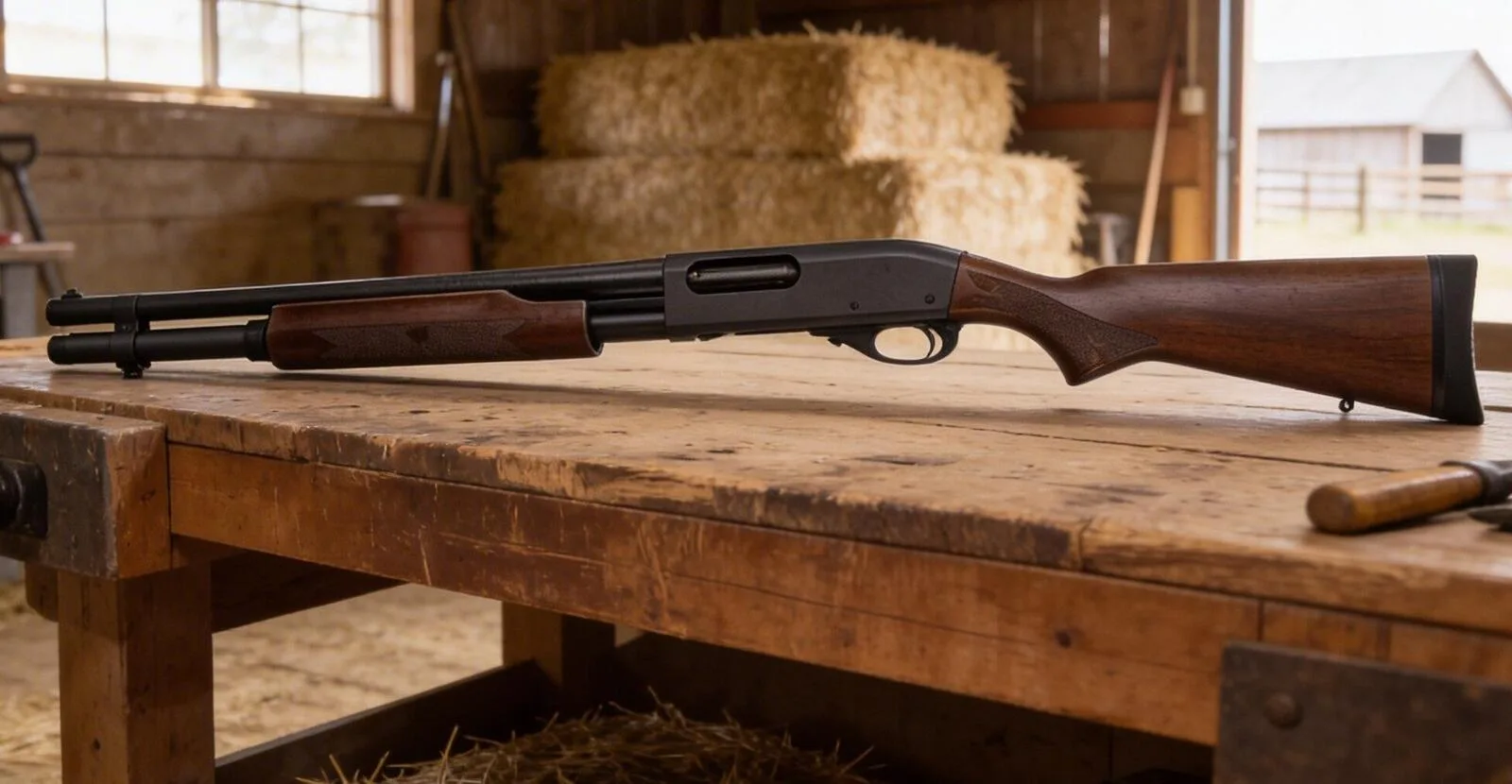
Review: Remington 870 – The Shotgun That Refuses to Die
Our Rating: 8.2/10
- MSRP: $400-$480 (Tactical models); $459 (Fieldmaster); $795+ (Wingmaster)
- Street Price: $350-$450 (Check our live pricing for the best current deal)
- Gauge: 12 Gauge, 3″ chamber
- Action: Pump-action, twin action bars
- Barrel Length: 18.5″ (Tactical) / 26″-28″ (Fieldmaster)
- Overall Length: ~38.5″ (Tactical)
- Weight: ~7-7.5 lbs
- Capacity: 4+1 (standard) or 6+1 (7-round model)
- Receiver: Milled from solid steel billet
- Stock: Black synthetic (Tactical) / Walnut (Fieldmaster) / Various
- Finish: Matte black oxide (improved post-2022)
- Choke: Fixed cylinder bore (Tactical); Rem Choke system (Fieldmaster)
- Sights: Bead front (standard); ghost ring or rifle sights on select models
- Safety: Cross-bolt (trigger guard)
- Manufacturer: RemArms, LLC (Roundhill Group)
- Made in: LaGrange, Georgia, USA
Pros
- Steel receiver milled from solid billet (not aluminum like the Mossbergs)
- Twin action bars make for the smoothest pump action in the business
- 11+ million sold, with a massive aftermarket to match
- Post-bankruptcy quality under RemArms is genuinely improved
- Fieldmaster fixes the notorious Express rust issues
- Versatile platform: tactical, hunting, sport, and everything between
Cons
- The “Rustington” reputation was earned and the brand is still rebuilding trust
- MIM extractor on non-Wingmaster models can chip (swap for Volquartsen immediately)
- Cross-bolt safety is not lefty-friendly (Mossberg’s tang safety is better here)
- Single extractor vs Mossberg’s dual extractors
- 4+1 standard capacity is low (mag extension fixes this)
- $400-480 puts it in Mossberg 590A1 territory, which is mil-spec
Remington 870 Price
Quick Take
Eleven million units. Over 70 years in continuous production. Carried by cops, soldiers, hunters, and competitive shooters on every continent. The Remington 870 is the best-selling shotgun in American history, and it’s not particularly close. That kind of track record doesn’t happen by accident.
Here’s the thing, though. Not all 870s are created equal. The guns Remington cranked out between roughly 2010 and 2020 were, to put it charitably, inconsistent. The Express finish was dogshit for years. Let’s not sugarcoat it. Rusty spots out of the box, MIM parts that chipped, and quality control that would’ve made the old Ilion craftsmen weep. Then Remington went bankrupt in 2020, got chopped up, and everyone assumed the 870 was done.
It wasn’t. RemArms picked up the pieces, moved production to LaGrange, Georgia, and started actually caring about the product again. The new Fieldmaster (which replaces the Express) has a dramatically improved finish. The Wingmaster is back to being a premium gun. And the tactical models are shipping with fit and finish that would’ve been unthinkable five years ago. The 870 is genuinely good again, and that matters.
The steel receiver, twin action bars, and that buttery smooth pump stroke are all still here. So is the biggest aftermarket of any shotgun on the planet. You can turn a bone-stock 870 into literally anything: a home defense cannon, a turkey slayer, a 3-gun competitor, a waterfowl workhorse. If you’re looking at the best pump-action shotguns in 2026, the 870 belongs on your shortlist. Period.
Best For: Home defense, hunting, law enforcement, and anyone who wants a pump-action shotgun backed by 70 years of proven service and the largest aftermarket in the shotgun world.
Why the Remington 870 Survived Everything
The 870 story starts in 1950, when Remington needed a replacement for the aging Model 31. They designed a pump gun with twin action bars (smoother cycling, no binding), a receiver milled from a solid steel billet (not stamped, not cast, not aluminum), and a price point that working folks could actually afford. It was an instant hit. By the 1960s, police departments across America were standardizing on the 870. The military adopted it. Hunters loved it. Competition shooters won with it. The gun just worked.
For decades, the 870 was untouchable. The Wingmaster was the gold standard for fit and finish. The Express, introduced in 1987, brought the platform down to an everyman price. Life was good. Then Cerberus Capital bought Remington in 2007, and things started sliding. Cost-cutting became the priority. The Express finish got thinner and more porous. MIM (metal injection molded) parts replaced machined components. QC dropped. Guns started shipping with rust spots. The internet christened it “Rustington,” and honestly, they weren’t wrong.
The bankruptcy hit in 2020. Remington got chopped up and sold for parts. Marlin went to Ruger. The ammo business went elsewhere. And the firearms division, including the 870, went to Roundhill Group, who formed RemArms. They moved production from the historic Ilion, New York factory (which had been making guns since 1816) to a new facility in LaGrange, Georgia. A lot of people wrote the obituary right there.
But here’s the twist: the new 870s are actually good. RemArms clearly got the message. The Fieldmaster, which replaces the Express, has a noticeably better finish. The Flexi Tab anti-jam system on the Home Defense model actually works. The Wingmaster is back to the standard it should’ve never left. It’s a genuine comeback story, and I don’t say that lightly. Plenty of brands have tried to resurrect themselves post-bankruptcy and failed. RemArms seems to be pulling it off.
Competitor Comparison
Mossberg 500 (~$300-$400)
The eternal rival. The Mossberg 500 and the 870 have been going head-to-head since 1961, and the debate never gets old. The Mossberg wins on two counts: the tang-mounted safety (ambidextrous, better for lefties) and dual extractors (more reliable ejection). The 870 wins on receiver material (steel vs aluminum), action smoothness (twin bars vs single), and aftermarket depth. Both are rock-solid guns. If you’re left-handed or want to save a few bucks, go Mossberg. If you want the smoother action and steel receiver, go 870.
Mossberg 500 Price
Mossberg 590A1 (~$550+)
If you’re buying strictly for tactical or home defense use, the Mossberg 590A1 is the 870’s toughest competitor. It’s mil-spec (it literally passed MIL-S-3443 testing), has a heavy-walled barrel, metal trigger guard and safety, and comes with ghost ring sights. It also costs more. At $550+, you’re paying a premium for the mil-spec designation, but you’re getting a gun that the Marines trust. The 870 Tactical undercuts it on price and matches it on real-world durability for most users. But if “mil-spec” matters to you, the 590A1 is the one.
Mossberg 590A1 Price
Maverick 88 (~$200-$250)
The budget king. The Maverick 88 is made by Mossberg, shares most Mossberg 500 parts, and costs about half what an 870 does. At $200-$250, it’s the best value in pump shotguns. Period. The trade-offs? Cross-bolt safety (like the 870), a single action bar instead of twin, and cheaper fit and finish. But it goes bang every time you pump it, and for a first shotgun or a truck gun, it’s hard to argue against saving $150-$200. If budget is your primary concern, get the Maverick and spend the difference on ammo and training.
Maverick 88 Price
Benelli Nova (~$400-$450)
The Nova is Benelli’s entry into the pump-action game, and it’s a legitimately good gun. The monobody steel receiver (receiver and trigger guard are one piece) is incredibly strong. The rotating bolt is smooth. It eats 3.5″ magnums without complaint. The downside? Almost zero aftermarket compared to the 870. If you want to customize your shotgun over time, the Nova is a dead end. If you want a buy-it-and-forget-it pump gun for Benelli money, it’s worth a look.
Benelli Nova Price
Winchester SXP (~$350-$400)
Winchester’s SXP has one party trick: inertia-assisted action. It’s the fastest cycling pump shotgun you can buy. Seriously, if you short-stroke pump guns (and a lot of people do under stress), the SXP’s inertia system helps prevent that. It’s a solid gun for the money. The problems? Thin aftermarket, and the inertia system means the action can cycle if you bump it hard enough. That’s a feature for some shooters and a bug for others. For pure speed, the SXP wins. For everything else, the 870 is more versatile.
Winchester SXP Price
Features & Technical Deep Dive
The Steel Receiver
This is the 870’s single biggest engineering advantage over the Mossberg 500/590 series. The receiver is milled from a solid block of steel. Not cast. Not stamped. Not aluminum. Milled steel. That means it’s stronger, more rigid, and better able to handle abuse over decades of use. It also means it’s heavier, which some people don’t love, but I’d rather have 7 pounds of steel between my hands and a 3-inch magnum than 6 pounds of aluminum.
The steel receiver also means you can drill and tap it for optics without worrying about stripping threads in soft aluminum. It takes a beating. I’ve seen 870s from the 1960s that have been dropped, dinged, scratched to hell, and they still run like sewing machines. The receiver is the reason the 870 outlasts everything else in the safe.
Twin Action Bars
Most cheap pump shotguns use a single action bar to connect the forend to the bolt. It works, but it can bind if you rack the pump at an angle or under stress. The 870 uses twin action bars, one on each side of the magazine tube. This means the bolt slides straight back every time, regardless of how you grip the forend or how much adrenaline you’ve got pumping through your system. It’s the reason the 870’s pump stroke feels like butter compared to a Maverick 88.
The twin bars also make the gun more durable long-term. Single-bar guns can develop wobble after thousands of cycles. Twin bars distribute the force evenly and keep everything tight. It’s one of those engineering decisions that you don’t notice until you’ve pumped a lesser gun a few thousand times.
The 870 Lineup in 2026
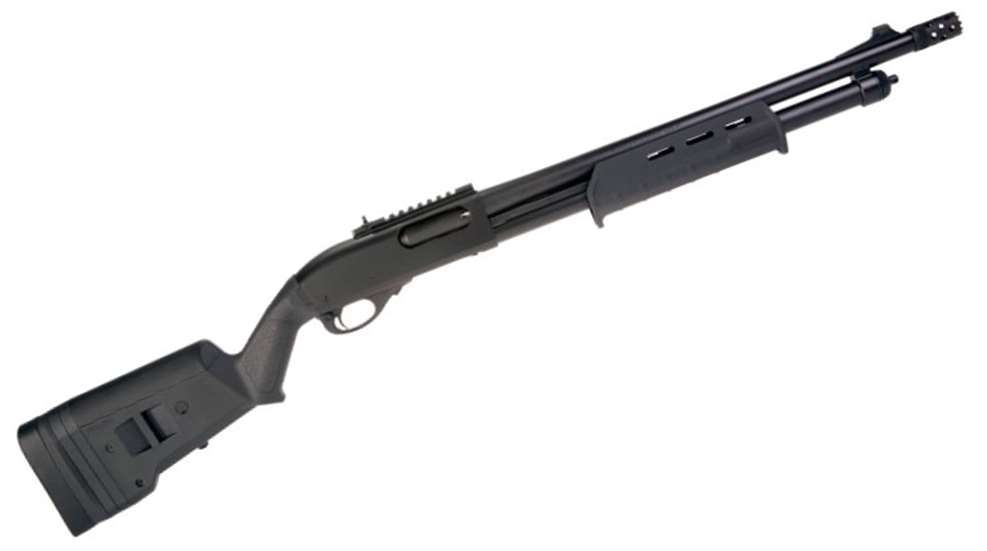
RemArms has rebuilt the 870 lineup from the ground up. The big news is the Fieldmaster, which officially replaces the Express as the entry-level 870. It comes with improved bluing, a walnut stock, and the Rem Choke system. There’s also a Fieldmaster Synthetic for people who don’t care about pretty wood. MSRP is around $459, which slots it right between budget pumps and premium guns.
On the tactical side, you’ve got the 870 Synthetic Tactical (18.5″, 4+1, fixed cylinder bore), the Tactical 7-Round (same but with a factory magazine extension for 6+1), the Tactical Magpul (Magpul furniture from the factory), and the Tactical Side Folder. The Tac-14 is still in the lineup too, with its 14-inch barrel and Raptor grip, for folks who want a non-NFA “firearm” that’s basically a breaching tool with a stock option. And the Wingmaster is back at the top, running around $795-$800, with the fit and finish the name deserves.

The Rustington Problem (And How RemArms Fixed It)
Let’s talk about it. The 870 Express, from roughly 2007 to 2020, had a rust problem. It wasn’t a rumor. It wasn’t internet drama. The matte finish Remington used on the Express was porous and offered almost no corrosion protection. Guns were developing surface rust in the safe. New guns were arriving at dealers with orange spots on the barrel. It was embarrassing for a brand that built its reputation on quality.
The root cause was cost-cutting under Cerberus Capital’s ownership. The Express finish got cheaper and thinner with each production year. The old-school deep blue that made Remington famous was reserved for the Wingmaster, and even that slipped. It was a dark era.
RemArms has addressed this head-on. The Fieldmaster’s finish is noticeably better than the late-era Express. It’s not Wingmaster-grade, but it’s legitimate protection that doesn’t need to be oiled every week. The matte black oxide on the tactical models is also improved. If you’re buying new in 2026, the rust issue is largely behind you. If you’re buying used, stick to pre-2007 or post-2022 production dates. The stuff in between is a gamble.
At the Range: 500 Round Test
I put 500 rounds through an 870 Synthetic Tactical (18.5″ barrel, 4+1 capacity) over three range sessions. Here’s what I fed it:
- Federal FliteControl 00 Buck, 100 rounds
- Winchester Super-X 00 Buck, 100 rounds
- Remington Express #4 Buck, 50 rounds
- Federal Truball Rifled Slugs, 50 rounds
- Assorted cheap birdshot (Rio, Federal, Winchester), 200 rounds
Break-In
Out of the box, the action was stiff. Not unusably stiff, but you could feel the newness. I ran about 100 rounds of cheap birdshot through it on the first session just to get everything wearing in. By round 75 or so, the pump stroke was noticeably smoother. By round 150, it felt like an 870 should feel: slick, positive, and satisfying. If you buy one and it feels tight, don’t panic. Feed it birdshot and it’ll loosen up.
Reliability
Zero malfunctions in 500 rounds. Not one. No failures to feed, no failures to eject, no short-stroke issues. I deliberately tried to short-stroke it a few times (pumping fast and lazy), and the twin action bars kept everything tracking straight. Federal FliteControl, Winchester white box, bottom-shelf birdshot: the 870 ate it all without a hiccup. This is the kind of reliability that made the gun famous in the first place.
Patterning
The Federal FliteControl 00 Buck was the star of the show. At 15 yards (a realistic home defense distance), it was keeping all eight pellets inside a fist-sized group. That’s the FliteControl wad doing its thing, and the 870’s cylinder bore is a perfect match for it. Winchester Super-X opened up more, as expected, about a 10-12 inch spread at the same distance. Still very usable.
Slugs were a pleasant surprise. The Federal Truball Rifled Slugs grouped about 3 inches at 50 yards off a rest, which is solid for a bead-sighted cylinder bore. You’re not going to win any precision rifle matches, but for deer inside 75 yards or any realistic defensive scenario, the 870 puts slugs exactly where you need them.
Known Issues & Common Problems
The Rust Issue
Covered this above, but it bears repeating. If you’re buying a used 870 Express from the 2007-2020 era, inspect it carefully. Surface rust on the barrel, receiver, and magazine tube is common. It’s cosmetic in most cases, but it’s annoying and speaks to the quality decline under Cerberus. New production Fieldmaster and Tactical models have a much better finish. Keep it oiled and you’ll be fine.
MIM Extractor
On non-Wingmaster models, Remington uses a metal injection molded (MIM) extractor. It works fine most of the time, but MIM parts can chip or break under heavy use. The fix is dead simple: buy a Volquartsen Exact Edge extractor for about $25, swap it in (takes 5 minutes), and never think about it again. This should be the first thing you do with any new 870 that isn’t a Wingmaster.
Single Extractor Design
The 870 uses a single extractor. The Mossberg 500/590 series uses dual extractors. In theory, dual extractors provide more reliable ejection because if one fails, the other still grabs the shell. In practice, I’ve never had an extraction failure on an 870 with a good extractor installed. But it’s a valid design criticism, and if you’re choosing between the two platforms purely on mechanical redundancy, Mossberg wins this one.
Cross-Bolt Safety
The 870’s cross-bolt safety sits in the trigger guard. Push right to fire, push left to safe. It’s fine for right-handed shooters. It’s not fine for lefties. Mossberg’s tang-mounted safety, which sits on top of the receiver and is operated by the thumb, is ambidextrous and objectively better in this regard. If you’re left-handed, this is a genuine mark against the 870. You can train around it, but why should you have to?
Quality Control (2010-2020)
If you’re shopping the used market, be very selective about production dates. The 2010-2020 era 870s are the most inconsistent the platform has ever been. Some are fine. Some shipped with rust, rough chambers, sticky extractors, and finish that looked like it was applied by a paint roller. Check the serial number, research the production date, and inspect before you buy. Pre-2007 guns are generally excellent. Post-2022 RemArms guns are looking solid. The middle decade is where you gamble.
Parts, Accessories & Upgrades
The 870’s aftermarket is absolutely massive. You could build ten different guns from one receiver. Here are the upgrades I’d actually recommend, in order of priority:
| Upgrade | Recommended Part | Why It Matters | Cost |
|---|---|---|---|
| Extractor | Volquartsen Exact Edge | Replaces the MIM extractor. Do this first on any non-Wingmaster 870. | ~$25 |
| Stock | Magpul SGA Stock | Adjustable length of pull, better cheek weld, QD sling mounts. | ~$100 |
| Forend | Magpul M-LOK Forend | M-LOK slots for lights, hand stop. Solid grip texture. | ~$30 |
| Light | Streamlight TL-Racker | Replaces the entire forend. Integrated 1,000 lumen light. Brilliant design. | ~$150 |
| Mag Extension | Wilson Combat +2 | Brings capacity from 4+1 to 6+1. Steel construction, clamp included. | ~$40 |
| Sights | XS Ghost Ring (tritium front) | Massive upgrade over the bead sight. Tritium front for low-light use. | ~$100 |
| Full Service | Vang Comp Systems Upgrade | The gold standard. Backbored barrel, porting, big safety, action job. Turns an 870 into a different animal. | ~$400+ |
You can find most of these parts at Brownells or Palmetto State Armory. The Volquartsen extractor should be your very first purchase. Everything else is gravy.
The Verdict
The Remington 870 has earned its place in the American firearms pantheon. Eleven million sold. Seven decades of service. A bankruptcy that should’ve killed it and didn’t. The 870 isn’t perfect. The Express era was a stain on the brand, the MIM extractor is cheap, the safety isn’t lefty-friendly, and the standard capacity is low. But every one of those problems has a solution, and the core platform (that steel receiver, those twin action bars, that aftermarket) is still unmatched in the pump-action world.
If you’re buying new in 2026, get the Fieldmaster for hunting or the Synthetic Tactical for home defense. Swap the extractor for a Volquartsen on day one. Add a mag extension if it’s a defensive gun. And don’t look back. The 870 is back, and it deserves another chance. If you’re shopping used, stick to pre-2007 or post-2022 production. Avoid the dark years.
Final Score: 8.2/10
Best For: Home defense, hunting, law enforcement, and anyone who wants a proven pump-action shotgun with the biggest aftermarket in the business and 70 years of track record behind it. Check our home defense shotgun picks if you’re still deciding.
Remington 870 Price
FAQ: Remington 870
Is the Remington 870 still being made?
Yes. After Remington’s 2020 bankruptcy, RemArms (owned by Roundhill Group) took over the firearms business. They moved production from Ilion, New York to LaGrange, Georgia in 2024 and are currently manufacturing the full 870 lineup, including the Fieldmaster (which replaced the Express), Wingmaster, Tactical, Tac-14, and Home Defense models. Quality has improved significantly under new ownership.
Is the Remington 870 better than the Mossberg 500?
It depends on what you prioritize. The 870 has a steel receiver (vs Mossberg’s aluminum), twin action bars (smoother pump stroke), and a larger aftermarket. The Mossberg 500 has a tang safety (better for lefties), dual extractors (more redundant), and typically costs a bit less. Both are excellent, proven platforms. For most right-handed shooters who want maximum customization options, the 870 has a slight edge.
What’s the difference between the Remington 870 Express and Fieldmaster?
The Fieldmaster officially replaces the Express in RemArms’ lineup. The biggest improvement is the finish. The Express was notorious for poor corrosion resistance (especially 2007-2020 production), while the Fieldmaster has a significantly improved bluing. The Fieldmaster also comes standard with a walnut stock and the Rem Choke system at an MSRP of around $459.
Is the Remington 870 good for home defense?
The 870 is one of the most popular home defense shotguns ever made, and for good reason. The Tactical model with its 18.5-inch barrel, cylinder bore, and 4+1 capacity (6+1 with the 7-round model) is purpose-built for the job. Load it with Federal FliteControl 00 Buck, add a Streamlight TL-Racker forend light, and you’ve got a seriously effective defensive tool. The pump action sound alone has deterrent value, though you should never count on that.
What is the first upgrade I should do on a Remington 870?
Replace the MIM extractor with a Volquartsen Exact Edge extractor (about $25). The factory MIM extractor on non-Wingmaster models can chip or break under heavy use. The Volquartsen is machined steel and will last the life of the gun. It’s a 5-minute swap and the single most important upgrade for any 870.
Which Remington 870 model should I buy?
For home defense: the 870 Synthetic Tactical (18.5″, 4+1) or the Tactical 7-Round (6+1) if you want extra capacity. For hunting: the Fieldmaster with Rem Choke tubes. For a do-everything gun: the Fieldmaster Synthetic. For the best 870 money can buy: the Wingmaster at ~$795. And if you want something compact and unconventional, the Tac-14 with its 14-inch barrel and Raptor grip is a blast (literally).
Is the Remington 870 still being made?
Yes. RemArms (owned by Roundhill Group) produces the 870 at a new factory in LaGrange, Georgia. The original Ilion, New York factory closed in March 2024 after nearly 200 years. The current lineup includes the Fieldmaster, Wingmaster, Tactical, Tac-14, and several other variants.
Is the Remington 870 better than the Mossberg 500?
They are very close. The 870 has a steel receiver (vs aluminum on the Mossberg), tighter action feel, and a massive aftermarket. The Mossberg 500 has an ambidextrous tang safety, dual extractors, and costs less. For home defense, either is excellent. Personal preference usually decides it.
Did Remington fix the rust problem on the 870?
The post-bankruptcy 870 Fieldmaster has an improved surface preparation and finish that addresses the notorious rust-prone Express finish. Early reviews are positive, but long-term data is still limited. If you buy a used 870 Express, Cerakote refinishing is recommended.
What is the best Remington 870 model for home defense?
The 870 Synthetic Tactical 7-Round is the best home defense model. It has an 18.5 inch barrel, 6+1 capacity with the factory magazine extension, and fixed cylinder bore. The standard Synthetic Tactical (4+1) is also solid if you plan to add your own mag extension.
What is the first upgrade to make on a Remington 870?
Replace the MIM extractor with a Volquartsen Exact Edge extractor. It costs about 25 dollars and takes 10 minutes. The factory MIM extractor on non-Wingmaster models can chip, causing extraction failures. This single upgrade dramatically improves reliability.
Is the Remington 870 California legal?
Yes. The Remington 870 is legal in California in standard configurations. Be aware that magazine capacity restrictions apply (10-round limit in California), so the standard 4+1 or 6+1 configurations are compliant. The Tac-14 may have additional restrictions depending on your state.
Author

14,752+ Gun & Ammo Deals
Updated daily from 10+ top retailers. Filter by category, caliber, action type, and price.