
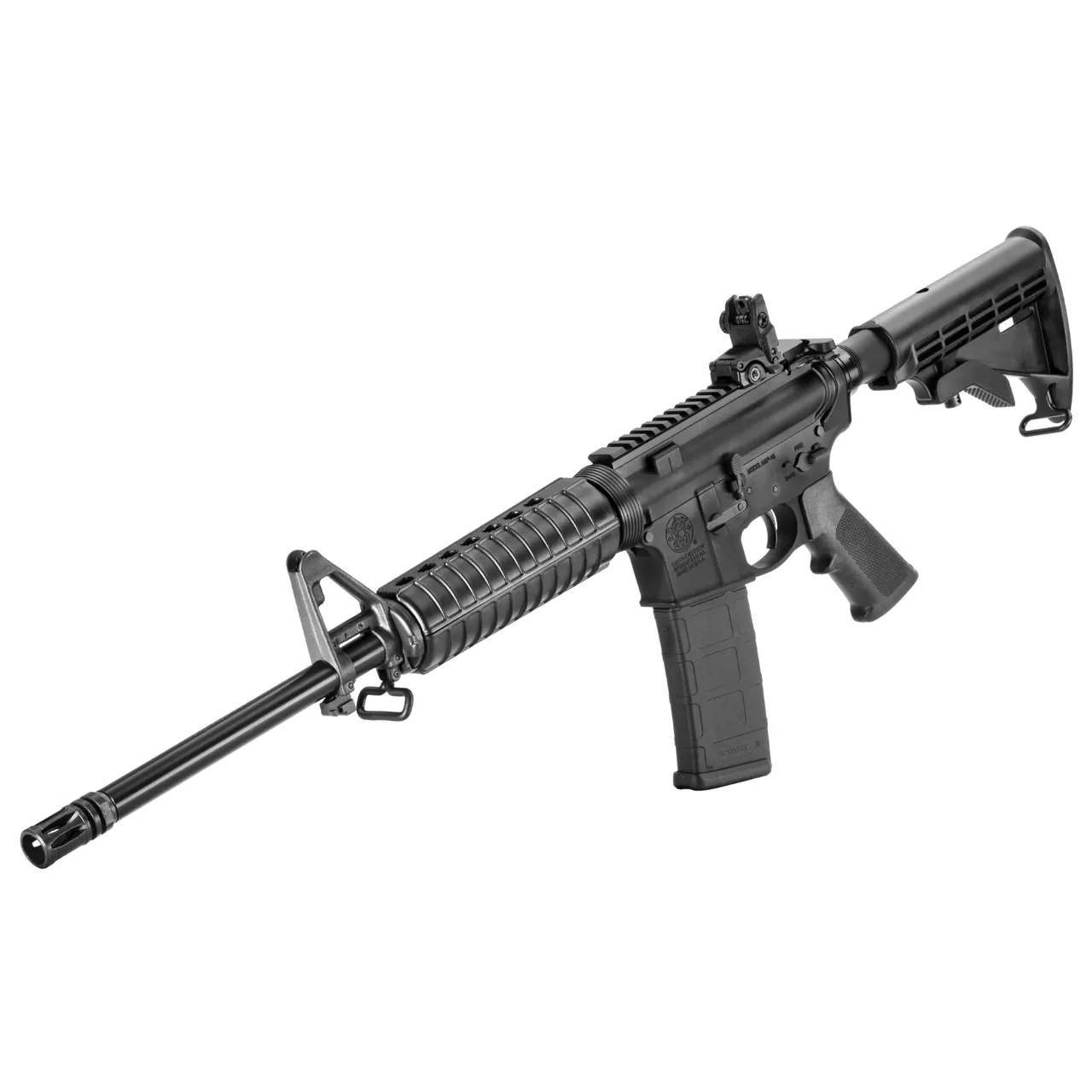
Smith & Wesson M&P15 Sport II Review (2026)
Last updated: March 10th, 2026
- Treat every gun as loaded
- Point the muzzle in a safe direction
- Keep your finger off the trigger until you’re ready to shoot
- Know your target and what’s beyond
This post contains affiliate links. If you click and purchase, we may earn a small commission at no extra cost to you. We only recommend products we trust.
Specifications
- Caliber: 5.56 NATO / .223 Remington
- Barrel Length: 16 inches
- Barrel Material: 4140 steel, chrome-lined bore and chamber
- Twist Rate: 1:9
- Gas System: Carbine-length, direct impingement
- Upper/Lower Receivers: 7075-T6 aluminum, Type III hard coat anodized
- Handguard: Polymer drop-in, round, carbine-length
- Stock: 6-position collapsible M4-style
- Pistol Grip: Polymer A2-style
- Front Sight: A2 post (adjustable for elevation)
- Rear Sight: Magpul MBUS folding
- Muzzle Device: A2 birdcage flash hider
- BCG: Carpenter 158 bolt, chrome-lined carrier
- Trigger: Mil-spec single-stage
- Magazine: One 30-round Magpul PMAG
- Overall Length: 32.25″ collapsed / 35.25″ extended
- Weight: 6.45 lbs (unloaded)
- MSRP: $739 (street price: $450-550)
Scorecard
| Price | Performance | Reliability | Ergonomics | Value |
|---|---|---|---|---|
| 5/5 | 3.5/5 | 4.5/5 | 3/5 | 4.5/5 |
Pros
- Exceptional reliability out of the box
- Chrome-lined barrel and carrier — built to last
- Street price regularly under $500
- Includes Magpul MBUS rear sight and PMAG
- Forward assist and dust cover included
- 1,000+ rounds with zero malfunctions in our testing
Cons
- Carbine-length gas system is snappier than mid-length
- Plastic drop-in handguard feels dated
- Mil-spec trigger is gritty with a heavy pull
- A2 pistol grip is uncomfortable for long sessions
- 1:9 twist limits heavy bullet performance
- No free-float accuracy potential without handguard swap
S&W M&P15 Sport II
Overview
The Smith & Wesson M&P15 Sport II is arguably the most recommended first AR-15 in existence. Walk into any gun shop in America, ask for a reliable AR under $500, and there’s a very good chance someone points you toward this rifle. It’s been a best-seller since its release, and for good reason — it does the fundamentals right at a price point that’s hard to beat.
The Sport II isn’t trying to compete with $1,500 rifles from Daniel Defense or BCM. It’s positioned squarely as an entry-level, workhorse AR-15 for people who want a reliable, no-frills rifle that they can upgrade over time as their needs and budget evolve. Think of it as a solid foundation rather than a finished product.
Smith & Wesson — one of the oldest and most established firearms manufacturers in America, founded in 1852 — backs it with their lifetime service policy. That’s not a throwaway promise from a no-name brand; it’s a company that’s been standing behind their products for over 170 years.
The Sport II improves on the original M&P15 Sport by adding a dust cover and forward assist — two features the original Sport controversially omitted. It also upgraded to a Magpul MBUS folding rear sight (replacing the fixed A2 carry handle rear sight) and ships with a Magpul PMAG instead of an aluminum USGI magazine. These are all meaningful quality-of-life improvements.
Range Report: 1,000+ Rounds
We put 1,047 rounds through our Sport II over several range sessions, testing reliability and accuracy with a variety of ammunition. Here’s what we found.
Ammunition tested:
- Federal American Eagle 55gr FMJ (XM193) — 400 rounds
- PMC Bronze 55gr FMJ — 200 rounds
- Wolf Gold 55gr FMJ (brass-cased) — 150 rounds
- Tula 55gr FMJ (steel-cased) — 200 rounds
- Hornady Frontier 55gr FMJ — 50 rounds
- Federal Fusion MSR 62gr SP — 27 rounds
- Hornady TAP 55gr — 20 rounds
Reliability: Zero malfunctions. Not a single failure to feed, failure to fire, failure to extract, or failure to eject across all 1,047 rounds. That includes the 200 rounds of cheap Tula steel-cased ammunition, which many budget ARs struggle with. The chrome-lined chamber on the Sport II handles steel cases without complaint. This is exactly the reliability performance you want from a home defense or range rifle.
Accuracy at 25 yards (bench rest, iron sights): Groups averaged 1.0-1.5 inches with Federal XM193 and PMC Bronze. At this distance, the rifle shoots better than most shooters can hold. Iron sight accuracy was excellent — the A2 front post and MBUS rear provide a clean, precise sight picture.
Accuracy at 50 yards (bench rest, Sig Romeo 5 red dot): We mounted a Sig Sauer Romeo 5 on the flat-top upper for 50 and 100-yard testing. At 50 yards, best five-shot groups measured 1.8 inches with Federal XM193 and 2.0 inches with PMC Bronze. Wolf Gold was slightly less precise at 2.3 inches. These are respectable numbers for a carbine-gassed 16″ barrel with a 1:9 twist.
Accuracy at 100 yards (bench rest, Sig Romeo 5): This is where you see the Sport II’s limitations. Best five-shot groups with Federal XM193 measured 3.2 inches (roughly 3 MOA). PMC Bronze was similar at 3.5 inches. This is acceptable for a defensive rifle and plenty accurate for steel targets, practical shooting, and training. It is not precision rifle accuracy — but nobody is buying a $500 AR for precision work.
Steel-cased performance: The Tula 55gr FMJ averaged 3.8-inch groups at 100 yards. Noticeably less accurate than brass-cased ammo, but 100% reliable. The extractor had no trouble with the steel cases, and we observed no unusual wear after cleaning. If you want to shoot cheap for training, steel case works in the Sport II.
Heat management: During rapid fire drills (magazine dump of 30 rounds in roughly 15 seconds), the polymer handguard got uncomfortably warm but not scorching. By the third consecutive magazine, it was hot enough that you’d want gloves. This is the biggest practical limitation of the plastic handguard — a free-float M-LOK rail wouldn’t have this issue to the same degree.
Build Quality & Fit
For a sub-$500 rifle, the Sport II’s build quality is genuinely impressive in some areas and predictably budget in others.
Receivers: The 7075-T6 aluminum upper and lower are forged (not billet) and finished with Type III hard coat anodizing. Fit between the upper and lower was tight on our sample — minimal wobble, no play at the pins. The anodizing was even and consistent with no visible machining marks. Honestly, the receiver quality punches above its price point.
Barrel: 16-inch, 4140 chrome-moly vanadium steel with a chrome-lined bore and chamber. The chrome lining is a significant feature at this price — many competing rifles in this range use nitride-treated bores instead. Chrome lining excels at corrosion resistance and longevity, though it can slightly reduce accuracy compared to an unlined match barrel. The barrel profile is a government/M4 contour — thin under the handguard, stepping up at the gas block and forward to the muzzle. The 1:9 twist rate stabilizes 55-grain ammunition extremely well but won’t stabilize heavier projectiles (75-77 grain) as effectively as a 1:7 or 1:8 twist. For the most common and affordable 55-62 grain ammunition, 1:9 is perfectly adequate.
Front sight: The A2 front sight base is pinned to the barrel and serves double duty as the front sight post and the gas block. It’s robust, virtually indestructible, and adjustable for elevation with the included sight tool. The downside: it’s a fixed, non-removable sight tower that creates a silhouette in your optic window if you mount a red dot. Many Sport II owners eventually switch to a low-profile gas block and free-float handguard to eliminate it.
Handguard: The round, polymer, drop-in handguard is the most obviously “budget” component on the rifle. It’s functional — it keeps your hand off the barrel and provides a solid grip surface. But it’s light on features: no accessory mounting (no M-LOK, no Picatinny), it traps heat, and it rattles slightly. This is the first thing most Sport II owners upgrade.
BCG: Carpenter 158 steel bolt (MPI tested) with a chrome-lined bolt carrier. This is full mil-spec and a legitimate feature highlight. Some competing rifles at this price cut corners on the BCG — the Sport II doesn’t. The gas key was properly staked on our sample.
Trigger
The Sport II ships with a standard mil-spec single-stage trigger, and it’s… fine. It’s not good. It’s not terrible. It’s mil-spec.
Pull weight measured 6.8 lbs on our Lyman trigger pull gauge, which is within the typical mil-spec range of 6-8 lbs. Takeup is about 1/8 inch with noticeable grit throughout the pull. The break is mushy — you won’t feel a distinct “wall” before the trigger releases. Reset is long (roughly 3/8 inch of forward travel) but tactile — you can feel and hear the click.
For a defensive rifle, this trigger is completely adequate. You’re not going to be shooting precision groups under stress — you need a trigger that goes bang when you pull it, and this one does. For range shooting and trying to maximize accuracy, the trigger is the limiting factor long before the barrel is.
The good news: a trigger upgrade is one of the simplest and most transformative modifications you can make. The Larue MBT-2S ($90-100) drops in with two pins and turns the Sport II into a dramatically better shooting rifle. It’s arguably the single best $100 you can spend on any AR-15 upgrade.
Ergonomics
At 6.45 pounds unloaded, the Sport II is light enough for extended range sessions and easy handling around the house. Add a loaded 30-round PMAG (roughly 1 lb), a red dot, and a weapon light, and you’re looking at 8-8.5 lbs total — still very manageable.
Stock: The 6-position collapsible M4-style stock is standard mil-spec. It locks solidly at each position with no wobble or play. Adjustment range accommodates everything from a small-framed shooter in a t-shirt to a large person in winter clothing. The stock is polymer without any rubber buttpad — it works, but it’s not particularly comfortable for extended shooting. Upgrading to a B5 SOPMOD or Magpul CTR adds better cheek weld and a rubber buttpad for minimal cost.
Pistol grip: The included A2-style grip is the most universally disliked component on mil-spec AR-15s, and the Sport II’s grip is no exception. It’s too thin, the angle is aggressive, and the finger groove doesn’t suit many hand sizes. A Magpul MOE+ or BCM Mod 3 grip ($20-25) is a night-and-day improvement. This is a $20 upgrade that should be mandatory.
Controls: The safety selector, magazine release, and bolt catch are all standard mil-spec and positioned in their traditional locations. They work as expected. Ambidextrous controls are not included — right-handed shooters will be fine; left-handed shooters will want to add an ambi safety and an extended bolt catch.
Charging handle: Standard mil-spec — small and requires a firm grip to manipulate. An ambidextrous charging handle (Radian Raptor or BCM Gunfighter) is a worthwhile upgrade, especially if you shoot with optics that make reaching the standard handle awkward.
Balance: The M4 barrel profile and lightweight handguard keep the weight centered. The rifle doesn’t feel front-heavy, which is a common complaint with heavy-barreled or free-float railed ARs. It points naturally and handles well during transitions.
Upgrades Worth Making
The Sport II is a great platform for incremental upgrades. Here’s the order we’d prioritize, based on what gives you the most performance improvement per dollar:
1. Optic (first priority). The Sport II’s flat-top Picatinny rail is begging for a red dot. A Holosun 403B ($120-140) or Sig Sauer Romeo 5 ($100-120) co-witnesses perfectly with the included iron sights and transforms target acquisition speed. If you want magnification for longer range work, an LPVO like the Vortex Strike Eagle 1-6x ($250-300) is an excellent mid-range choice. For more options, see our AR-15 optics guide.
2. Weapon light (essential for home defense). If this rifle serves a defensive role, a weapon light is non-negotiable. The Streamlight ProTac HL-X ($100-120 with mount) or Cloud Defensive REIN 2.0 ($250-280) are the standards. You need to identify your target before you engage it — no exceptions.
3. Trigger. The Larue MBT-2S ($90-100) is the best value trigger upgrade in the AR world. It’s a two-stage design with a clean, crisp break at approximately 4.5 lbs. The improvement over the mushy mil-spec trigger is dramatic. Installation takes 10 minutes with two pins. If you want a single-stage trigger, the CMC 3.5lb flat ($130-150) is excellent.
4. Free-float handguard. Replacing the polymer drop-in with a free-float M-LOK rail does three things: improves accuracy (by eliminating contact between the handguard and barrel), adds accessory mounting for lights and grips, and looks better. The Aero ATLAS S-ONE ($120-140) and Midwest Industries Combat Rail ($130-160) are excellent choices. Note: swapping to a free-float rail requires removing the A2 front sight base and installing a low-profile gas block — this is a moderate project that requires some specific tools.
5. Sling. A two-point sling (Blue Force Gear Vickers or Magpul MS4, $40-65) lets you carry the rifle hands-free and provides a shooting support point. For a home defense rifle, it also prevents the gun from being taken from you.
6. Pistol grip. Swap the A2 grip for a Magpul MOE+ ($20) and never look back. Five-minute install, massive comfort improvement.
Sport II vs Sport III
Smith & Wesson released the M&P15 Sport III as the successor to the Sport II, and it addresses several of the Sport II’s weaknesses. The key differences:
- Handguard: The Sport III ships with an M-LOK free-float handguard, eliminating the Sport II’s plastic drop-in. This is the single biggest upgrade.
- Gas system: Mid-length on the Sport III vs. carbine-length on the Sport II. The mid-length system runs softer, produces less felt recoil, and puts less stress on internal components.
- Twist rate: 1:8 on the Sport III vs. 1:9 on the Sport II. The faster twist stabilizes a wider range of bullet weights, including heavier 69-77 grain match ammunition.
- Low-profile gas block: The Sport III uses a low-profile gas block under the handguard instead of the A2 front sight tower. This gives a cleaner sight picture through optics.
- Upgraded furniture: The Sport III includes a better grip and stock out of the box.
- Price: The Sport III typically runs $550-650 — roughly $100-150 more than the Sport II.
Our take: If you’re buying new and can afford the premium, the Sport III is the better rifle. It comes with the upgrades most Sport II owners end up making anyway. However, the Sport II at $450-500 remains the better pure value — especially if you plan to customize it your way regardless. Read our full Sport III review (1,500-round test) for the complete comparison.
Sport II vs Ruger AR-556
The Ruger AR-556 is the Sport II’s most direct competitor. They occupy the same price bracket and target the same buyer. Here’s how they compare:
- Barrel: Both are 16″ chrome-moly, but the Ruger uses a 1:8 twist (vs. 1:9 on the Sport II). Edge: Ruger — the faster twist is more versatile for different bullet weights.
- Handguard: Both ship with plastic drop-in handguards. The Ruger’s is slightly more ergonomic with flattened sides. Neither is great. Tie.
- Trigger: Both are mil-spec. Both are mediocre. Tie.
- Front sight: Both use an A2 front sight base/gas block. Tie.
- BCG: Both are mil-spec with Carpenter 158 bolts. The Sport II’s carrier is chrome-lined; the Ruger’s is not always chrome-lined (it varies). Slight edge: Sport II.
- Rear sight: The Sport II includes a Magpul MBUS. The Ruger AR-556 includes a Ruger Rapid Deploy folding rear sight. Both work; the MBUS is slightly more popular. Tie.
- Delta ring: The Ruger AR-556 MPR variant (different model) comes with a free-float handguard. The base AR-556 does not. Tie at the base level.
- Price: Nearly identical — both run $450-550 street price. Tie.
Our take: These are so close that it genuinely comes down to which one you find a better deal on and which one fits your hand better. If pressed, the Ruger’s 1:8 twist gives it a slight edge for versatility, while the Sport II’s chrome-lined BCG gives it a slight edge for longevity. You can’t go wrong with either. Read our full Ruger AR-556 review (1,200-round test).
Sport II vs PSA PA-15
Palmetto State Armory’s PA-15 undercuts the Sport II on price and gives it a real fight on features. Here’s the comparison:
- Price: The PA-15 regularly goes on sale for $350-400, about $100 less than the Sport II. Edge: PSA, significantly.
- Barrel: PSA uses a 4150 CMV barrel (slightly harder steel than the Sport II’s 4140) with nitride treatment. The Sport II’s chrome lining is arguably better for longevity and corrosion resistance, but nitride is no slouch. Slight edge: Sport II for chrome lining, PSA for barrel steel.
- BCG: PSA includes a full-auto-profile bolt carrier (which is the mil-spec standard). Comparable to the Sport II’s. Tie.
- Gas system: PSA offers mid-length options at this price point. The Sport II is carbine-length only. Edge: PSA if you choose mid-length.
- Handguard: Standard PA-15 models have similar polymer drop-in handguards. PSA also offers M-LOK free-float configurations for $50-100 more. Edge: PSA for options.
- Quality control: This is where the Sport II separates itself. Smith & Wesson’s QC is consistently excellent. PSA has improved dramatically over the years, but their QC history includes more reported issues (canted front sights, rough finishes, occasional tolerance issues). Most PA-15s ship perfect, but the odds of receiving one that needs attention are slightly higher. Edge: Sport II.
- Brand reputation and resale: Smith & Wesson carries stronger brand recognition and better resale value. Edge: Sport II.
Our take: If you’re on a tight budget and can tolerate a small chance of needing to deal with PSA’s customer service, the PA-15 is an incredible value. If you want peace of mind, better QC, and the S&W name, the Sport II is worth the premium. For budget-conscious buyers, the PSA is genuinely hard to beat on pure dollars-to-performance. Read our full PSA AR-15 review.
Final Verdict
The Smith & Wesson M&P15 Sport II has earned its reputation as the go-to recommendation for a first AR-15, and after putting 1,000+ rounds through one, we understand why. It’s not the most exciting rifle on the market — it doesn’t have a fancy handguard, a match trigger, or a precision barrel. What it has is ironclad reliability, solid build quality where it counts (BCG, barrel, receivers), and a price that makes it accessible to nearly every budget.
Buy the Sport II if:
- It’s your first AR-15 and you want a proven, reliable platform
- You want a home defense rifle that works out of the box
- You plan to upgrade components over time and want a solid foundation
- You value the Smith & Wesson name and lifetime service policy
- Your budget is $450-550 for the rifle itself
Spend more if:
- You want a free-float handguard and mid-length gas system out of the box — look at the Sport III ($550-650) or Ruger AR-556 MPR ($600-700)
- You want a premium rifle that needs no upgrades — look at BCM RECCE-16 ($1,200-1,400) or Daniel Defense DDM4V7 ($1,600-1,800)
- You want maximum accuracy — a purpose-built rifle from LaRue, SOLGW, or ADM will outshoot the Sport II significantly
The Sport II isn’t perfect. The trigger is mediocre, the handguard is dated, and the carbine gas system runs harder than necessary. But at under $500 street price with a chrome-lined barrel, mil-spec BCG, Magpul sights, and bulletproof reliability, it remains one of the best values in the AR-15 market in 2026. It’s the rifle we hand to people when they ask “what should I buy first?” — and not one of them has come back disappointed.
Full Specifications
- Model: Smith & Wesson M&P15 Sport II (SKU 10202)
- Action: Semi-automatic, direct impingement
- Caliber: 5.56 NATO / .223 Remington
- Barrel Length: 16 inches
- Barrel Material: 4140 chrome-moly vanadium, chrome-lined
- Barrel Twist: 1:9 RH
- Barrel Profile: M4 (government contour)
- Gas System: Carbine-length
- Muzzle Thread: 1/2×28
- Muzzle Device: A2 flash hider
- Upper Receiver: 7075-T6 aluminum, Type III hard coat anodized, M4 flat top with Picatinny rail
- Lower Receiver: 7075-T6 aluminum, Type III hard coat anodized
- BCG: Carpenter 158, MPI tested, chrome-lined carrier
- Trigger: Single-stage mil-spec, ~6.5-7 lb pull
- Handguard: Carbine-length polymer, round, drop-in
- Stock: 6-position collapsible M4
- Pistol Grip: A2-style polymer
- Front Sight: A2 post, adjustable for elevation
- Rear Sight: Magpul MBUS folding
- Overall Length: 32.25″ (collapsed) to 35.25″ (extended)
- Weight: 6.45 lbs (empty)
- Magazine: 1x 30-round Magpul PMAG
- Country of Origin: USA
- MSRP: $739
Related AR-15 Guides
- AR-15 Buyer’s Guide
- S&W M&P Sport III Review
- PSA AR-15 Review
- Ruger AR-556 Review
- Cheapest AR-15s Under $500
- Best AR-15s Under $1000
Author

14,752+ Gun & Ammo Deals
Updated daily from 10+ top retailers. Filter by category, caliber, action type, and price.
Related Guides