

Last updated May 21, 2026 · By Nick Hall, who has bought, sold, and shot more than a dozen used Glock 19s across all four current generations
Affiliate disclosure: USA Gun Shop is reader-supported. When you buy through links on our site, we may earn a small commission at no extra cost to you. Full disclaimer.
- Treat every gun as loaded
- Point the muzzle in a safe direction
- Keep your finger off the trigger until you’re ready to shoot
- Know your target and what’s beyond
Table of Contents
What a Used Glock 19 Actually Costs in 2026
The used Glock 19 price picture in 2026 splits by generation. A used Glock 19 Gen 3 in honest holster-wear condition trades between $200 and $350. Gen 5 examples clear $280 to $500, and Gen 5 MOS premiums push $600. The pricing has held steady through 2025-2026 even as new-pistol MSRP climbed because the used market is genuinely deep. Police agencies cycle through Glock 19s constantly, civilian owners trade in for the newer Gen 6, and the consignment market never runs dry.
The pricing spread within a single generation comes down to three factors. Round count (or lack thereof) is the biggest swing variable, accessories matter (Trijicon HD night sights add $80-$120 to a listing, original Tupperware case and three factory magazines add $40-$60), and the source channel sets a price floor. A police trade-in Gen 4 with documented armorer inspection logs runs $280; the same gun on GunBroker from an unknown seller asks $400 with no provenance.
| Generation | Used Price Range (2026) | New Equivalent | Sweet-Spot Listing | What You’re Getting |
|---|---|---|---|---|
| Glock 19 Gen 3 (1998-present) | $200-$350 | $499 (still in production) | $280, police trade-in | Finger grooves, single recoil spring, basket-weave grip, no backstraps. The budget pick. |
| Glock 19 Gen 4 (2010-2025) | $250-$400 | $549 (discontinued new) | $320, dealer consignment | RTF grip, interchangeable backstraps, dual recoil spring, reversible mag release. The sweet spot. |
| Glock 19 Gen 5 (2017-2025) | $280-$500 | $549 (discontinued new) | $385, civilian consignment | No finger grooves, flared magwell, Marksman barrel, ambi slide stop, nDLC finish. |
| Glock 19 Gen 5 MOS (2017-2025) | $300-$600 | $649 (discontinued new) | $465, dealer consignment | All Gen 5 features plus the MOS optic plate system. Adds $50-$100 over standard Gen 5. |
| Glock 19 Gen 6 (2025-present) | $450-$580 (lightly used) | $599-$649 new | Buy new at this price differential | RTF-6 hex grip, integrated beavertail, flat trigger, ORS direct-mill optic cut. Used market still thin. |
Note on Gen 6 specifically: used examples are scarce in 2026 because the generation only launched in 2025 and the typical 18-24 month civilian-trade cycle hasn’t completed. Used Gen 6 pricing runs only 15-25% under new, and at that small a delta the warranty + Glock-perfection-guarantee of buying new is worth the price differential. See our Glock 19 Gen 6 review for the current-production reference point, or the official Glock 19 Gen 6 spec sheet on Glock’s US site.
Which Generation Should You Buy?
The Gen 4 is the sweet spot of the used market. Modern dual recoil spring, interchangeable backstraps, abundant supply, and the lowest dollar-per-feature on the curve. But the right answer depends on what you actually want from the gun. Here’s the per-generation breakdown.
Gen 3 Glock 19 (1998-present): The Budget Pick
The Gen 3 is the longest-running Glock 19 production variant. Glock Inc. (the US-market arm of Austrian company Glock Ges.m.b.H., founded by Gaston Glock in 1963) introduced the Gen 3 in 1998, and the Glock Sport Shooting Foundation (GSSF) competition circuit has held it as the bedrock platform for over two decades. Introduced in 1998 with the addition of the accessory rail under the dust cover, finger grooves on the front strap, and thumb rests on the grip frame. The Gen 3 is still in current production alongside Gen 6, primarily for law enforcement agencies who standardized on it and don’t want to retrain their armorers.
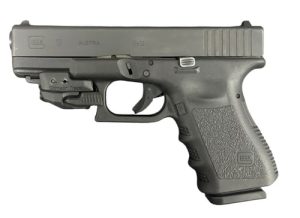
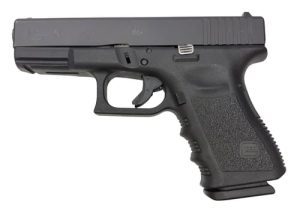
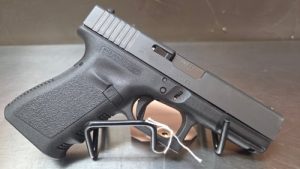
Visual tells: front strap finger grooves (the iconic Gen 3 feature, polarizing for shooters with larger hands), single captured recoil spring assembly visible at the muzzle, smaller non-reversible magazine release button, and the older-style basket-weave grip texture. The trigger is the standard Glock factory trigger with the curved face and the integrated trigger safety blade.
Used Gen 3 G19s run $200-$350 depending on condition and source. Police trade-ins (which are heavily Gen 3 in the late 1990s to early 2010s service period) cluster $250-$300 and are the absolute floor of the market for a functional 9mm defensive pistol. Civilian consignment Gen 3s run $300-$400 with the original case and accessories.
Gen 4 Glock 19 (2010-2025): The Sweet Spot
The used Glock 19 Gen 4 is the workhorse of the 2010s. Three significant upgrades over Gen 3: the dual nested recoil spring assembly (longer service life and reduced recoil impulse), the RTF-2 / RTF-4 enhanced grip texture (more aggressive than basket-weave but not as sharp as Gen 6 RTF-6), and the reversible enlarged magazine release. Interchangeable backstraps came standard, allowing shooters to fit the grip to hand size.
Gen 4 production ran 2010-2025 alongside Gen 3 and Gen 5. Glock officially discontinued new Gen 4 production in late 2025 in favor of Gen 6, which means used Gen 4s now represent a defined-supply market. Police agencies that adopted Gen 4 are starting to cycle them out, which is where the trade-in volume comes from.
Used Gen 4 pricing runs $250-$400 with $320 being the sweet-spot listing for a clean dealer consignment with the original box and three magazines. Police trade-ins cluster $280-$320. Federal trade-ins (Air Marshals, DEA, parts of DHS) occasionally hit the market with Trijicon HD night sights pre-installed and command a $50-$80 premium.
Gen 5 Glock 19 (2017-2025): The Modern Standard
Gen 5 dropped the polarizing finger grooves, added the Glock Marksman Barrel (recut rifling for improved accuracy), introduced the ambidextrous slide stop, and flared the magwell for faster reloads. The nDLC slide finish replaced the older Tenifer treatment. For shooters who never warmed to the Gen 3 / Gen 4 finger grooves, the Gen 5 was the long-awaited fix.
Used Gen 5 G19s run $280-$500 in 2026. The supply is still building because Gen 5 didn’t enter civilian trade-in volume until around 2023, and police agencies are still actively using Gen 5 platforms. Pricing reflects that: clean Gen 5s with three magazines and the original case go for $385 typical, with night-sight equipped examples (Glock factory steel sights are awful, so most owners upgrade to Ameriglo Tropper or Trijicon HD) running $440-$500.
Gen 5 MOS (2017-2025): The Optic-Ready Premium
The Modular Optic System (MOS) variant adds an interchangeable adapter plate system to the rear of the Gen 5 slide, allowing direct mounting of red dot sights from Trijicon, Holosun, Aimpoint, Leupold, and other major optics brands. The MOS plates ship with the pistol from the factory, and the same plate set fits Gen 5 MOS and Gen 6 MOS slides interchangeably.
Used MOS Gen 5 pricing runs $300-$600 with the sweet spot around $465 for a clean dealer consignment example with the original plate set complete. The supply is thinner than standard Gen 5 because optic-ready buyers tend to hold their pistols longer, but consignment examples appear regularly as buyers upgrade to Gen 6 ORS (which has the optic cut machined directly into the slide rather than the plate-adapter system).
Gen 6 Glock 19 (2025-present): Skip the Used Market
The Gen 6 launched in late 2025 with the ORS direct-mill optic cut on the slide (no plates required), the flat-faced trigger replacing the curved Gen 3-5 trigger, the RTF-6 hex/pyramid grip texture, the integrated beavertail, and front + rear slide serrations standard. It is the most refined Glock 19 in the 27-year production history.
Used Gen 6 pricing in 2026 runs $450-$580, which is only 15-25% under new. At that price differential, the warranty + Glock’s full-coverage repair policy on new pistols makes buying new the smarter play. The used Gen 6 market will mature around 2027-2028 as the first civilian-trade cycle completes. For now, buy new.
It is worth knowing what else lives in the Glock family before settling on the 19. The Glock 17 is the full-size 9mm parent of the platform with a 17-round magazine and a longer 4.49-inch barrel; used Gen 3 and Gen 4 G17 police trade-ins run $20-$40 cheaper than equivalent G19s because the larger profile is less popular for concealed carry. The Glock 22 in .40 S&W is the dominant US police trade-in by volume from the 1990s through about 2015 when most agencies transitioned back to 9mm; used Gen 3 G22s clear $250-$320, and the slide-and-frame is mechanically convertible to 9mm with a $250 conversion barrel + magazine swap. The compact Glock 23 in .40 S&W is the direct .40 sibling to the 9mm Glock 19 and runs similar pricing. The Glock 19X (the crossover model with the full-size Glock 17 frame and the Glock 19 slide) runs $400-$500 used. The Glock 45 (G19 slide on G17 frame, marketed as the “thinking man’s Glock 19X”) runs $450-$520 used. For Glock 19 buyers, the cross-shopping question is usually 19 vs 17 (size preference) or 19 vs 23 (caliber preference).
Police & Federal Trade-In Glock 19s
A used Glock 19 police trade-in has spent more time in a holster than on a range. The slide wears, the internals don’t. State and municipal agencies typically run a duty firearm for 7-12 years before contracting a wholesale platform upgrade, at which point the retiring fleet (often a few hundred to a few thousand identical pistols) goes to a single firearms broker, gets inspected and graded, then enters the civilian used channel.
The math is brutal: a typical state police officer fires roughly 100 rounds per year in qualification (twice-yearly, 50 rounds per session). Over a 10-year service life, that is 1,000 rounds.
The Glock 19 is rated for 50,000+ rounds of service life. A police trade-in is mechanically 2% used.
Federal Agency Trade-Ins (the gold standard)
Federal Air Marshals, US Marshals, DEA, ICE, and the DHS contract programs all trade their G19s back to the manufacturer or to single-source brokers (typically Glock USA or Aldila / RSR Group).
Federal trade-ins tend to ship with factory night sights still installed (Glock factory steel notch-and-post are usually replaced with Trijicon HD or Ameriglo at agency level), often the original three magazines, and arrive with arsenal-grade armorer inspection paperwork.
DHS specifically transitioned to the Glock 19 series for several component agencies between 2020-2024. Those trade-in waves are still in the pipeline. Look for federal-marked frames (subtle agency stamps inside the magazine well or on the dust cover), original Trijicon HD night sights, and the arsenal-paint touch-up on internal pins as visual markers of federal provenance.
State and Municipal Police Trade-Ins
State patrols and large municipal departments (NYPD’s specialized units, LAPD detective bureaus, FBI special teams, several state highway patrols) have moved between Gen 3, Gen 4, Gen 5, and the M-series (the federal contract variant of the Glock 19). Trade-in waves typically hit the civilian market 6-12 months after the contract changeover.
Palmetto State Armory and Aim Surplus are the two highest-volume distributors of police trade-in Glocks in 2026. PSA’s pricing is typically the cheapest at $250-$320 for Gen 3 and $300-$380 for Gen 4 trade-ins. Aim Surplus runs $20-$50 higher but consistently delivers better-graded condition examples.
Both retailers publish trade-in batch information on their websites when lots arrive, so check back weekly during early Q1 when most agency contracts renew.
The 7-Point Used Glock 19 Inspection
Before money changes hands, work through seven inspection points. The Glock 19 is mechanically simple, which makes thorough inspection achievable at the dealer counter in five minutes. Each of these checks reveals a specific failure mode.
1. Slide Rails
Strip the slide off the frame and look at the contact surfaces on both halves. Even wear is normal; peening (mushroomed metal at the rail contact points) indicates very high round counts (typically 20,000+). Reassemble and rack the slide briskly. It should feel smooth, not gritty. Gritty cycling usually means dry rails, not damaged rails, but it can also indicate a bent recoil spring guide or worn slide stop.
2. Breech Face
The breech face is the flat surface on the slide that contacts the cartridge case head during firing. Look for excessive carbon buildup (cleanable but indicates infrequent cleaning), pitting from primer cratering (suggests heavy +P load use), and any visible damage to the firing pin hole. A worn breech face causes inconsistent primer strikes and is a major mechanical issue.
3. Extractor
The extractor is the small claw on the breech face that pulls the spent case out of the chamber. Look for chipping on the leading edge, proper tension when you press a dummy round into the breech face (the extractor should snap firmly onto the case rim), and a clean return to position. Glock recommends extractor inspection every 10,000 rounds. A weak or chipped extractor is the single most common failure point on a high-mileage Glock, and replacement is a $30 part that takes 60 seconds.
4. Barrel Bore
Drop the barrel out of the slide and look down the bore from the chamber end with a bore light or flashlight. The rifling should be sharp and well-defined with clean lands and grooves. Pre-Gen 5 barrels have the polygonal rifling profile (broader lands, less aggressive grooves); Gen 5 and Gen 6 use the Marksman barrel with conventional cut rifling. Both wear slowly. Visible pitting in the first 6 inches from the chamber suggests heavy +P or steel-case ammo use and reduces accuracy. Check the crown at the muzzle for any nicks or asymmetry that would affect accuracy.
5. Frame Rails
The Glock frame rails are short metal inserts pinned into the polymer frame, not machined into the polymer itself. If those inserts are loose, peened, or have any visible play in the polymer, the gun will not return to battery reliably. Press down on each rail insert with a thumb to verify it sits flush and tight. Loose rails are a frame-replacement issue, not a field repair.
6. Trigger Safety Function
Dry-fire the action multiple times with the dealer’s permission and an empty chamber verified. The trigger should feel consistent across pulls (no creep, no grit, no shifting wall position). The trigger safety blade (the small lever on the face of the trigger) should engage and disengage cleanly. A trigger that drops the striker without the safety being depressed, or a trigger that does not reset reliably after a shot, is a safety issue and walk-away signal.
7. Magazine Condition
The most overlooked failure point on any used pistol. Pop the included magazines out and check spring tension when pressing the follower down, feed lip geometry (lips should be parallel and undented), and follower travel (no binding). A worn magazine spring causes failures to feed that get blamed on the gun. New Glock factory magazines run $25-$30 each; ask if you can substitute new mags for the used ones in the deal. Two or three factory magazines should ship with any reasonable used Glock 19 listing.
How Many Rounds Are Already on It
Glock recommends recoil-spring replacement every 3,000 to 5,000 rounds and extractor inspection at 10,000; assume any used trade-in is due for both. The platform is rated for 50,000 rounds minimum, and documented torture tests on Glock 19 Gen 4s have crossed 80,000 rounds on a single frame with only scheduled spring + extractor replacement.
The challenge with used pistols is that most sellers genuinely do not know the round count, and some lie. Three signals reveal the truth more reliably than the seller’s statement.
First, holster wear pattern: deep slide-edge wear from many years of carry but minimal muzzle-end finish wear typically indicates a duty/carry gun with low range volume. Second, magazine condition: heavily worn factory mags suggest many reload cycles, which correlates with range time. Third, recoil spring condition: a spring that has lost its captured compression (visible when stripped) has 4,000+ rounds on it.
For peace of mind on any used Glock you plan to carry or rely on for defense, replace the recoil spring assembly ($15-$20 from Glock, OEM part) and the extractor ($30, also OEM) before relying on the gun. That is $50 in parts that resets the wear clock on the two highest-frequency failure points. Skip this on a range plinker; do it religiously on a carry gun.
Used vs New: The $300 Question
Buy used and you save roughly $300 versus a new Gen 5, money better spent on quality ammo, a holster, and a real training class.
The math: a new Glock 19 Gen 5 retails $549; a clean used Gen 4 dealer consignment runs $320. That $229 differential funds 600 rounds of Federal HST 124gr ($240 at current prices) plus a quality Tier 1 holster ($90), with $50 left for a half-day defensive pistol class registration.
The case for buying new on a Glock 19 specifically is narrow. You get a full factory warranty (Glock’s lifetime guarantee transfers to subsequent owners on most models, though), the assurance of a confirmed round count of zero, and access to the latest generation features (RTF-6 grip on Gen 6, ORS optic cut on Gen 6, flat trigger). The savings on a used Gen 4 are real money; the savings on a used Gen 6 (only 15-25% under new) are not worth the trade-offs.
The decision tree: if you want a Gen 3, Gen 4, or Gen 5, buy used. The savings are substantial and the platform is mechanically simple. If you want a Gen 6, buy new , the used premium hasn’t compressed yet. If you’re cross-shopping platforms entirely, our used Sig P226 buyer guide · used 1911 buyer guide · used M1 Garand buyer guide · used AR-15 buyer guide · used Remington 870 buyer guide · used vs new guide covers the broader market dynamics.
Where to Buy a Used Glock 19 in 2026
When you decide to buy used Glock 19 online, the right retailer depends on whether you prioritize price, risk control, or hands-on inspection. For inspected used Glocks with return windows, Guns.com leads; for raw value on police trade-ins, Palmetto State Armory and Aim Surplus consistently undercut auction prices. The right retailer depends on whether you prioritize price (Tier 1), risk control (Tier 2), or hands-on inspection (Tier 3).
Tier 1: Trade-In Specialists (lowest price)
- Palmetto State Armory: Highest volume of US police trade-in Glock 19s. Gen 3 pricing typically $250-$320, Gen 4 $300-$380. Inventory listed by batch with arsenal grade indication. Returns within 30 days of FFL transfer.
- Aim Surplus: Second-highest trade-in volume. Pricing $20-$50 higher than PSA but consistently better-graded condition examples. Frequent Trijicon HD night-sight pre-installed inventory.
- Classic Firearms: Surplus specialist with occasional foreign-police Glock trade-ins (German, Austrian, occasional Italian Carabinieri). Pricing reflects rarity premium.
Tier 2: Inspected Used Retailers (lowest risk)
- Guns.com: The largest curated used inventory in the country. Each pistol is hand-inspected by an in-house gunsmith and graded honestly. Pricing typically $30-$60 above the trade-in specialists, but the return policy + condition guarantee is worth it for first-time used buyers.
- Buds Gun Shop: Mid-volume curated used inventory with the Lifetime Replacement Plan (paid add-on, $30) that gives you a free replacement if the gun ever fails. Pricing similar to Guns.com.
Tier 3: Peer-to-Peer + Local (hands-on)
- GunBroker.com: The eBay of firearms. Massive Glock 19 listing depth across all generations. Vet sellers carefully (500+ transactions, 99%+ positive feedback), require photos of the bore + serial number + matching mag floor plates. Auction-fever risk: prices regularly exceed retail comparison.
- Cabela’s Gun Library / Bass Pro Shops: Hand-curated used inventory at brick-and-mortar locations. You can actually rack the slide, check the bore, and dry-fire before buying. Pricing runs 10-15% above online but the inspection quality is real.
- Local independent gun shops (“used Glock 19 for sale near me”): Variable pricing and condition. Use the ATF FFL eZ Check to find your nearest licensed FFL dealer and call to ask about current used Glock 19 inventory. Best for building a relationship with a single dealer over time. Always negotiate; nothing on a used pistol case is firm.
Live Used Glock 19 Inventory
Live inventory from our partner dealer network. Filter by generation, price, and condition in the carousel below. New listings post every few hours.
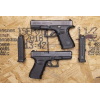
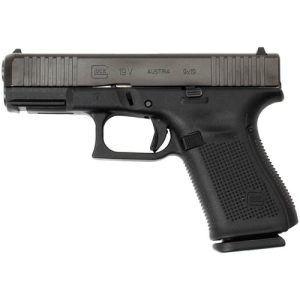
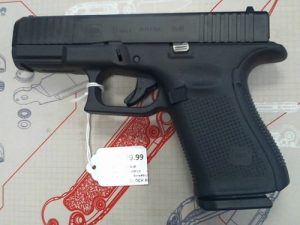
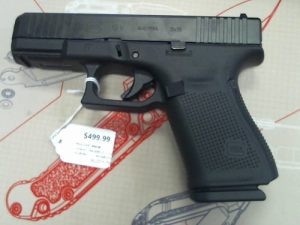
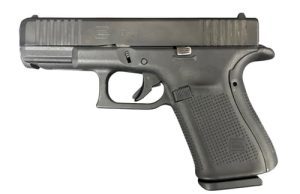
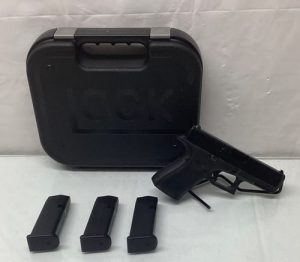
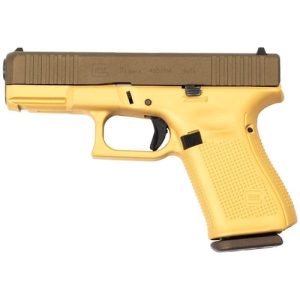
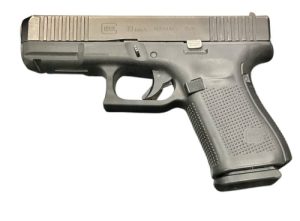
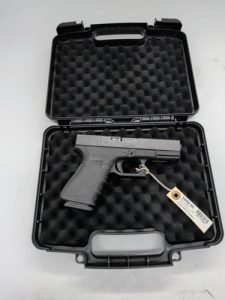
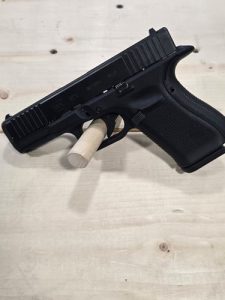
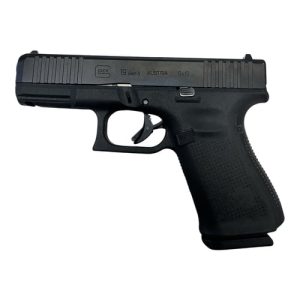
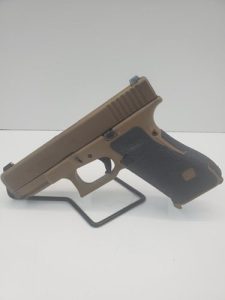
Glock 19 Gen4 9mm Police Trade-In Pistols with Night Sights (Fair Condition)
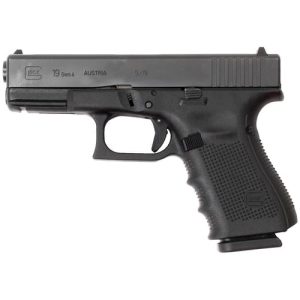
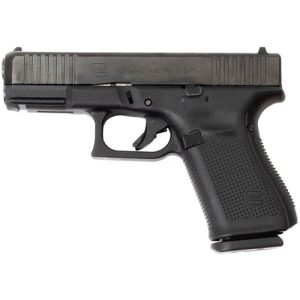
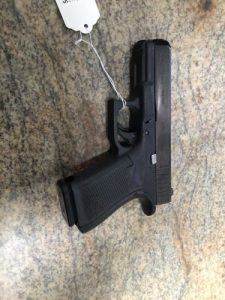
 -20%
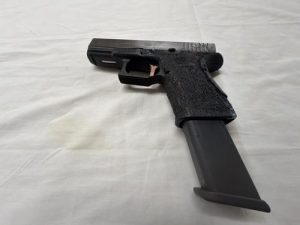
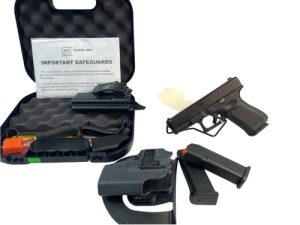
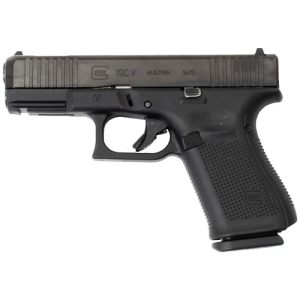
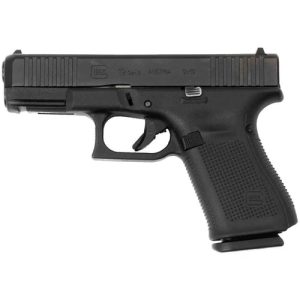
-20%USED Glock 19 Gen 5 9mm 15d Pistol w/ NS - USD-GLK-19-5-N

What Accessories Often Come Included
A fair used Glock 19 listing should ship with at least two factory 15-round magazines and the original Tupperware case; night sights are a bonus, not a baseline. Here is what’s standard versus what’s a value-add when shopping the used market.
- Factory magazines (standard expectation, 2-3 included): A Glock 19 ships from the factory with two 15-round magazines as standard, or three if it’s a Gen 4 / Gen 5 with the bonus mag bundle. Police trade-ins typically come with two; civilian trades typically have all three originals plus aftermarket purchases.
- Original Tupperware case (standard, often missing): The standard hard plastic Glock case with the Allen wrench and the documentation pouch. Many police trade-ins have lost the original case; civilian trades usually retain it. Adds $20-$30 to the value of a listing when present.
- Night sights (premium, value-add): Glock factory steel notch-and-post sights are widely considered the platform’s weakest stock feature. Most owners upgrade to Trijicon HD ($120 new), Ameriglo Tropper ($75 new), or Big Dot XS ($150 new). Pre-installed Trijicon HD on a used listing should add $80-$120 to the asking price.
- Holster (occasional): Carrier-owner Glock 19s often include the holster they were carried in (typically a Safariland 7TS or a leather IWB). Add $30-$50 to listing value if it matches your carry preference; subtract that amount if it doesn’t.
- Light or laser (rare): A pre-installed Streamlight TLR-1 or Surefire X300 adds $80-$150 to the listing value. Most owners pull lights before trading because they’re often the most valuable accessory.
- Spare extractor / recoil spring (occasional): Some federal trade-ins ship with spare wear parts in the case. Bonus value but not common.
The FFL Transfer, NICS, and Form 4473
Every used Glock 19 bought online ships to your local FFL, where you fill out ATF Form 4473 and the dealer runs a NICS background check before the gun is yours. The process is identical for new and used purchases. The “used” designation on the receiver has zero impact on the transfer paperwork.
The transfer timeline: the selling dealer ships the pistol to your FFL within 1-3 business days of purchase. Your local FFL notifies you when it arrives (typically 3-7 business days).
You go to the FFL with photo ID, complete Form 4473 (about 10 minutes), the dealer queries NICS (typically 1-5 minute response), and you walk out with the pistol. Total wall-clock time from online purchase to taking possession: 7-14 business days typically.
FFL transfer fees vary by dealer: $25-$50 is typical, $20 at the cheapest, $75+ at premium gun shops. Many trade-in retailers (PSA, Aim Surplus, Guns.com) maintain a network of preferred local FFLs that have negotiated discounted transfer rates. Always shop transfer fees before settling on which local FFL to use. The pistol price + transfer fee + any state-specific fees (CA roster compliance, NJ permit add-ons) is the all-in cost.
Who Should NOT Buy a Used Glock 19
If you want a flat-faced trigger, integrated optic cut, and aggressive RTF-6 stippling out of the box, skip the used market and buy a new Gen 6 , the used pool is dominated by Gen 3 and Gen 4. Three other buyer profiles should also walk away from the used Glock 19 market.
- First-time gun buyers without a knowledgeable friend. The inspection checklist is achievable but requires baseline familiarity with how a striker-fired pistol works. A new gun from a local dealer with a 30-day return policy is a lower-risk first purchase. Once you own one Glock and understand the platform, used buying becomes far less risky.
- California, New York City, or other roster-restricted buyers. California’s handgun roster has specific generation eligibility (some Gen 5 and Gen 6 variants are still off-roster). Verify California roster eligibility before buying any used Glock from out-of-state. NYC similarly has specific permit complications.
- Competition shooters wanting a Gen 6 trigger. The Gen 6 flat trigger is significantly better for fast and precise shooting than the curved Gen 3-5 trigger. If you compete or take training where trigger feel matters, the new Gen 6 is worth the price differential. Used Gen 5 + aftermarket flat trigger conversion approaches the Gen 6 feel but voids the warranty.
- Anyone wanting a brand-new optic-ready configuration. The Gen 6 ORS direct-mill optic cut is a meaningful upgrade over the Gen 5 MOS plate system. If you’re building an optic-equipped pistol from scratch, buy new Gen 6.
Used Glock 19 Buyer Glossary
- RTF-2 / RTF-4 Grip Texture: The aggressive cube-pattern grip stippling Glock used on Gen 4 production. More aggressive than Gen 3 basket-weave, less sharp than Gen 6 RTF-6 hex.
- RTF-6 Hex Grip Texture: The pyramid/hex stippling Glock introduced on Gen 6. The most aggressive factory Glock grip texture. Provides positive retention but can be uncomfortable for extended dry-fire practice.
- MOS (Modular Optic System): Glock’s plate-based optic mounting system. Plates ship with the pistol and adapt to red dot sights from major manufacturers. Available on Gen 4, Gen 5, and Gen 6 production.
- ORS (Optic Ready System): Glock’s direct-mill optic cut introduced on Gen 6. The optic mounts directly to the slide without an adapter plate, eliminating the small zero-shift risk of the plate system.
- Holster Wear: Cosmetic finish wear on the slide and frame edges of a defensive pistol caused by repeated holster draws. The most visible indicator of carry use. Cosmetic only , does not indicate mechanical condition issues.
- Frame Rail Peening: Mushrooming or deformation of the metal contact surfaces where the slide rides on the frame rails. Indicates very high round counts (typically 20,000+). Mechanical wear indicator that warrants deeper inspection.
- Police Trade-In: A duty firearm retired from US law enforcement service as part of an agency-wide platform replacement. Holster wear external; internals typically near-new because qualification courses fire less ammunition annually than a serious enthusiast shoots on a Saturday.
- Glock Marksman Barrel: The recut rifling profile Glock introduced on Gen 5 production. Improves accuracy over the older polygonal rifling. Standard on Gen 5 and Gen 6.
- nDLC Finish: The diamond-like carbon coating Glock uses on Gen 5 and Gen 6 slides. Replaces the older Tenifer treatment. More corrosion-resistant and harder.
- Finger Grooves: The molded indentations on the front strap of Gen 3 and Gen 4 frames designed to align finger placement. Polarizing for shooters with larger hands. Dropped on Gen 5 and Gen 6.
- NICS (National Instant Criminal Background Check System): The FBI-operated database that licensed dealers query at point of sale to determine if a buyer is prohibited from purchasing a firearm. Applies identically to new and used purchases.
- ATF Form 4473: The Firearms Transaction Record completed by every firearm purchaser at a licensed dealer. Question 11.h asks about prohibited-person status; false statements are a federal felony.
Related Reading
- Used Handguns Sub-Hub: Police Trade-Ins, Pre-Owned & Surplus Pistols
- Used Guns Pillar: Surplus, Police Trade-Ins, and the Full Used Market
- used Sig P226 buyer guide · used 1911 buyer guide · used M1 Garand buyer guide · used AR-15 buyer guide · used Remington 870 buyer guide · Used vs New Guns: When to Buy Each
- Glock 19 Gen 6 Review: 1,200-Round Hands-On Test
- Glock 19 Gen 5 Review: 2,000-Round Hands-On Test
- Best Weapon Lights: Pistol & Rifle Picks Tested
- Best Home Defense Ammo by Caliber
- Best Online Gun Stores: Where to Buy
Frequently Asked Questions
How much is a used Glock 19 worth?
In 2026, Gen 3 trades $200-$350, Gen 4 $250-$400, Gen 5 $280-$500, and Gen 5 MOS $300-$600. Police trade-ins skew to the low end with cosmetic holster wear and barely-used internals; private-sale low-round-count examples with night sights and the original case skew to the high end. Federal trade-ins (DHS, Air Marshals, DEA) with pre-installed Trijicon HD or Ameriglo night sights add $50-$80 to the asking price.
Are police trade-in Glock 19s reliable?
Yes. The slide wears from holster carry, the internals do not. A typical state police officer fires roughly 100 rounds per year in qualification courses (twice yearly, 50 rounds each session). Over a 10-year service life, that is 1,000 rounds against a 50,000+ round Glock service-life rating. Inspect the rails, swap the recoil spring ($15-$20 OEM part), and run 200 rounds before relying on the gun for carry.
What should I look for when buying a used Glock 19?
Seven inspection points in order of importance: slide rails (even wear, no peening), breech face (no pitting, clean firing pin hole), extractor (proper claw tension, no chipping), barrel bore (sharp rifling, no pitting in the first 6 inches), frame rails (insert tightness in the polymer), trigger safety function (consistent reset, safety blade engages), and magazine springs (tension under pressure, intact feed lips). The full inspection takes about 5 minutes at the dealer counter.
How many rounds will a used Glock 19 last?
50,000 to 100,000 rounds with scheduled recoil spring and extractor replacement. Documented torture tests on Gen 4 G19s have crossed 80,000 rounds on a single frame. Glock recommends recoil-spring replacement every 3,000 to 5,000 rounds and extractor inspection every 10,000 rounds. Both are OEM parts under $50 combined and take 5 minutes to install.
Is it safe to buy a used Glock 19?
Safer than most used pistols. Glock's parts catalog is universal across generations and almost every wear part is owner-replaceable in minutes. The platform is mechanically simple, the inspection checklist is straightforward, and the police trade-in supply chain provides documented-history pistols at exceptional pricing. The risk factors are common to any used firearm purchase: verify the seller, inspect before purchase, and replace wear parts on any gun you plan to carry.
What is the difference between Glock 19 Gen 3, Gen 4, and Gen 5?
Gen 3 (1998-present): finger grooves on front strap, single recoil spring, smaller non-reversible mag release, basket-weave grip texture. Gen 4 (2010-2025): RTF-2 / RTF-4 enhanced grip texture, interchangeable backstraps, dual nested recoil spring, reversible enlarged mag release. Gen 5 (2017-2025): no finger grooves, flared magwell, Glock Marksman Barrel (recut rifling), ambidextrous slide stop, nDLC slide finish. Gen 6 (2025-present): RTF-6 hex grip texture, integrated beavertail, flat-faced trigger, ORS direct-mill optic cut on the slide.
Where is the best place to buy a used Glock 19?
Tier 1 (lowest price): Palmetto State Armory and Aim Surplus for police trade-ins ($250-$380 typical). Tier 2 (lowest risk): Guns.com for inspected used inventory with return windows. Tier 3 (hands-on): GunBroker for the widest selection (verify seller carefully) and Cabela's Gun Library / Bass Pro Shops for hand-curated brick-and-mortar inventory you can dry-fire before buying.
How can I tell what generation my Glock 19 is?
Quick visual check: front strap finger grooves = Gen 3 or Gen 4. No finger grooves + flared magwell = Gen 5 or Gen 6. Ambidextrous slide stops = Gen 5 or Gen 6. ORS optic cut directly on the slide = Gen 6 only. RTF-6 hex/pyramid grip texture = Gen 6 only. Flat-faced trigger = Gen 6 only. For positive confirmation, look up the serial number prefix on the Glock production date chart, or check the magazine well where Glock often stamps generation indicators.
4,659+ Gun & Ammo Deals
Updated daily from 200+ top retailers. Filter by category, caliber, action type, and price.