

Last updated May 21, 2026 · By Nick Hall, who has owned five used AR-15s across a Colt 6920 police trade-in, a BCM Recce-16, an Aero Precision M4E1 build, a Smith & Wesson M&P15 Sport II, and a budget PSA PA-15 he eventually sold to fund a duty-tier upgrade
Affiliate disclosure: USA Gun Shop is reader-supported. When you buy through links on our site, we may earn a small commission at no extra cost to you. Full disclaimer.
- Treat every gun as loaded
- Point the muzzle in a safe direction
- Keep your finger off the trigger until you’re ready to shoot
- Know your target and what’s beyond
Table of Contents
Is a Used AR-15 Worth Buying in 2026?
The used-AR-15 discount is unusually thin. The used market averages $649.62 against $667.08 new in 2026, a $17.46 spread that has actually narrowed over the past 12 months as used values rose $19.62 while new values fell. The “used = significant discount” assumption most buyers carry in from USA Gun Shop’s used guns hub simply does not apply to this platform.
What still makes a used AR-15 worth buying is the chance to skip a tier. A $750 used Colt 6920 buys you a TDP-compliant mil-spec rifle that new costs $900-$1,100. A $650 used BCM Recce-16 buys a duty-tier rifle that new costs $1,500-$1,700. The savings only matter when the previous owner already paid for a quality bolt carrier group, a chrome-lined or nitride-finished barrel, and a free-float handguard worth $200+ on its own.
The case against buying used is also narrow. A police trade-in patrol rifle that sat in a vehicle lock for ten years has fewer rounds through it than a brand-new range rifle a civilian shot through one busy weekend. Direct-impingement rifles have a 60-plus-year service record and tolerate neglect better than most modern firearms. The platform is also the easiest in shooting sports to repair, with parts interchangeability across nearly all mil-spec lowers and uppers.
Used AR-15 Prices in 2026: The Four-Band Ladder
Used AR-15 prices in 2026 break into four bands: budget private market ($300-$750), police trade-in patrol rifles ($499-$899), federal-agency M4 trade-ins ($899-$1,499), and pre-ban Colt collector grade ($800-$8,000+). The 12-month trailing average across all configurations sits at $649.62, only about $17 below the new-market average of $667.08, a far narrower used-vs-new gap than most rifle platforms.
| Tier | Used Price (2026) | What It Is | Typical Examples | Best For |
|---|---|---|---|---|
| Budget Private Market | $300-$750 | Civilian-built rifles, brand-name budget tier, or worn private-market trade-ups | PSA PA-15, Anderson, Bear Creek Arsenal BC-15, Ruger AR-556, S&W M&P15 Sport II | First AR, range plinker, parts donor |
| Police Patrol Trade-In | $499-$899 | Patrol rifle cycled out of an agency, low round count, cosmetic wear | Colt 6920, RRA LAR-15, DPMS A-15, Bushmaster XM15-E2S, S&W M&P15 | Strongest value play, defense rifle |
| Federal Agency M4 Trade-In | $899-$1,499 | Federal-agency M4-pattern rifle (DEA, ICE, Border Patrol), often select-fire neutralized | Colt M4 LE6920, FN15 SBR conversions, Knight’s Armament SR-15 | Mil-spec build pedigree, premium duty |
| Mid-Tier Used (Civilian) | $700-$1,300 | Quality civilian rifles, properly built, light use, upgraded furniture | Aero Precision M4E1, Sig M400, Springfield Saint Victor, IWI Zion-15, Ruger SFAR | Daily driver, two-gun matches |
| Duty Tier Used | $900-$1,600 | Duty-grade rifles built to mil-spec or beyond, hand-fit tolerances | BCM Recce-16, Daniel Defense DDM4 V7, LWRC IC DI-E, FN15 Patrol | Hard-use rifle, defensive carbine |
| Pre-Ban / Collector | $800-$8,000+ | Pre-1994 AWB Colt rifles, Model 601 lineage, transferable selective-fire | Colt SP-1, Colt AR-15 A1, Colt R6000, R6450 transferable | Investment, collector, NY-grandfathered |
| Caliber-Converted | $650-$1,200 | Used AR-15 lowers paired with .300 Blackout, 6.5 Grendel, or 6.8 SPC upper | Aero M4E1 .300 BLK, Faxon 6.5 Grendel uppers, Wilson Combat .300 HAM’R | Hunter, suppressor host, Texas hog rifle |
| Premium Piston | $1,400-$2,200 | Short-stroke piston operating system, higher used premium | LWRC IC-DI / IC-A5, POF-USA Renegade, Sig M400 Tread | Cleaner cycling, suppressor-friendly |
The used AR-15 prices spread within a single tier comes down to BCG quality, barrel material and finish, accessories included, and source channel. A Colt 6920 police trade-in from Classic Firearms runs $695 with the original factory three-prong flash hider and a single 30-round magazine. The same rifle from a private GunBroker seller with no documentation might list at $850 with optic and red-dot already mounted.
If you want a budget benchmark, our best AR-15 rifles under $1,000 covers the new-market ladder that sets used pricing expectations.
Used vs New AR-15: The $17 Question
The used-AR-15 discount is unusually thin. A AR-15 averages $649.62 against $667.08 new, a $17.46 spread that has actually narrowed over the past 12 months as used values rose $19.62 while new values fell. Buying used pays off only when the rifle includes a quality BCG, a chrome-lined or nitride barrel, and an upgraded handguard worth $200 or more on its own.
The math sharpens at the tier transitions. A new Colt 6920 LE retails $1,099; a clean used 6920 police trade-in runs $750. That $349 delta is real. A new PSA PA-15 retails $499; a used PSA PA-15 with the same configuration runs $425. That $74 delta is barely worth the FFL transfer fee. The further up the brand tier, the more the used-versus-new math works in your favor.
For context across other platforms, our used vs new guns deep-dive covers the broader framework. AR-15 used pricing behaves more like Toyota Tacoma resale than like a typical depreciating consumer good, condition-elastic rather than depreciation-elastic.
Police Trade-In AR-15 Patrol Rifles
My Colt 6920 LE trade-in came in at $695 with predictable dust-cover wear, scuffed magazine catch, and a bore that mic’d cleaner than the new-production rifle a friend bought the same week. A police trade-in AR-15 is a patrol rifle that an agency cycled out, typically a Colt 6920, Rock River Arms LAR-15, DPMS A-15, Bushmaster XM15-E2S, or S&W M&P15. Most show cosmetic holster and rack wear but low round counts because patrol rifles spend their service lives in vehicle locks, not on the range, making them one of the strongest used-market value plays.
The economics work in the buyer’s favor. A typical patrol officer touches the carbine for annual qualification (roughly 100-300 rounds per year), plus rare deployment activations. Over an eight-year service life, that adds up to maybe 1,500-2,500 rounds on a rifle mechanically rated for 10,000-15,000 rounds before barrel replacement. Externally the rifle looks beat up; mechanically it is barely broken in.
The trade-in trail follows the same path as handgun trade-ins. Agencies cycle rifles through 8-12 year contracts, then sell the entire fleet to a wholesale broker (often the original manufacturer, RSR Group, or Sportsman’s Warehouse acquisition partners). The broker grades the inventory, ships to civilian-market retailers (Classic Firearms, Aim Surplus, Recoil Gun Works, Blue Mountain Supply), and the rifles hit consumer inventory at 30-50% off comparable new-rifle retail.
What to Expect Cosmetically
Police trade-in patrol rifles arrive with predictable wear: holster and lock-mount scuff marks on the magazine well, finish wear on the magazine catch and bolt release, slight blue-edge wear at the safety-selector detent, and dust-cover spring fatigue. None of this is mechanically significant. What does matter and what should walk you away from a listing: cracked or bulged barrel, peened bolt lugs, an unstaked or fatigued gas key, a worn extractor, or a sloppy lower-receiver pin fit. The cosmetic wear is the price you pay for the low round count.
The Four Brand Tiers of Used AR-15s
The used AR-15 market sorts cleanly into four brand tiers: duty (Colt 6920, BCM, Daniel Defense, LWRC, FN15, Knight’s Armament), mid (Aero Precision, Sig M400, Ruger AR-556, Springfield Saint, IWI Zion-15), budget (PSA, S&W M&P15 Sport II, Anderson, Bear Creek), and avoid (Hesse, Olympic Arms, Vulcan, Model1Sales, mystery-stamp no-name lowers).
Duty Tier: $900-$1,600 Used
The duty tier is built to and often beyond mil-spec: properly staked BCG, MP-tested barrel, chrome-lined chamber and bore, mid-length gas, free-float handguard, hand-fit upper-lower mating. Bravo Company Manufacturing (BCM) Recce-16 MCMR runs $1,100-$1,400 used. The BCM I owned was the closest a civilian-priced rifle has come to feeling like a Knight’s SR-15 in my hand: tight upper-lower fit, sharp dust-cover spring, and the trigger broke cleaner after 500 rounds than my Colt 6920 ever did. Daniel Defense DDM4 V7 runs $1,300-$1,600 used. LWRC IC DI-E runs $1,400-$1,800 used. FN America FN15 Patrol runs $1,100-$1,400 used. Knight’s Armament SR-15 holds its value the strongest at $1,800-$2,400 used. Colt 6920 LE runs $825-$1,200 used with $913 as the 12-month-trailing average.
Mid Tier: $700-$1,300 Used
The mid tier is well-built civilian rifles with quality BCGs, nitride or chrome-lined barrels, and upgraded furniture, but without the duty-tier hand-fit tolerances or full TDP compliance. Aero Precision M4E1 builds run $750-$1,000 used. The Aero I built on a used M4E1 stripped lower at $135 plus a $385 Aero upper turned into the daily-driver I shoot more than any other rifle, and the fit-and-finish punches well above the price tier. Sig Sauer M400 Tread runs $800-$1,100 used. Ruger AR-556 MPR runs $700-$950 used. Springfield Armory Saint Victor runs $850-$1,150 used. IWI Zion-15 holds the “$1,000 sweet spot” at $850-$1,050 used. This tier is where most cross-shoppers should be looking, balancing quality against not over-paying for duty tolerances that you, the civilian shooter, will never operationally need.
Budget Tier: $300-$750 Used
The budget tier is functional, often mil-spec-equivalent on paper, but built with cost-engineered components. My first AR was a Palmetto State Armory (see our PSA AR-15 review) PA-15 I bought used at $425 a decade ago, and it ran reliably for 3,000 rounds before I sold it to fund a duty-tier upgrade. PSA PA-15 and Sabre run $375-$525 used in 2026. Smith & Wesson M&P15 Sport II runs $475-$650 used. Ruger AR-556 standard runs $500-$700 used. Anderson AM-15 runs $325-$475 used. Bear Creek Arsenal BC-15 runs $350-$525 used. This tier is appropriate for a first AR, a range plinker, or a parts donor. For dedicated budget builds we cover the new-market floor in cheap AR-15 rifles.
For a full ranked brand list including newer entrants, see our complete AR-15 brand tier ranking.
Used AR-15 Brands to Avoid
Three names recur in every “brands to avoid” thread on AR15.com, Glock Talk, and ar15forums: Hesse Arms (defunct, documented receiver quality failures), Olympic Arms (universal condemnation for finish quality and ammo sensitivity), and Vulcan / Hi-Point AR (lowest-tier no-name). Any unbranded lower under $400 used or any rifle without a readable manufacturer mark should be walked past.
Hesse Arms went out of business in the 2000s with documented complaints about lower-receiver pin holes drilled out of spec and upper-receiver index marks misaligned. Model 1 Sales kit rifles from the same era share the same QC problems. Olympic Arms’ OA-93 pistols and full rifles have decades of documented light-primer-strike, ejector-failure, and bolt-binding reports.
Vulcan rebadged various low-tier components under generic markings and is essentially unsupported. The pattern across all four brands: cheap pricing on the secondary market, no parts support, no warranty, and resale value below the cost of replacing the lower receiver.
The harder call is a no-name lower without a readable manufacturer’s mark. Some are perfectly serviceable kit-build lowers from a forge that contracted to BCM or Aero; some are import-grade castings. Without a brand stamp you have no warranty, no parts traceability, and no resale market. Pay $400 for an Anderson, PSA, or S&W M&P15 Sport II lower before paying $300 for an unmarked one.
The 15-Point Used AR-15 Inspection
The bolt carrier group is the first thing to inspect on any used AR-15. The used AR-15 inspection starts with the gas key, specifically whether it is properly staked. Unstaked gas key screws back out under recoil and cause cycling failures, and the lack of staking signals an inexperienced builder. The full 15-point inspection takes 8-12 minutes at the dealer counter.
- 1. Bolt carrier group condition. Pull the charging handle, drop the BCG out of the upper. Look for visible burrs, peening at the bolt-lug contact surfaces, and scorching on the bolt face. A properly maintained BCG looks heat-discolored at the gas rings but otherwise smooth. Replacement BCGs run $90-$220.
- 2. Gas key staking. With the BCG out, look at the two Allen-head screws securing the gas key to the carrier. The metal around each screw should be visibly punched or staked, creating a dimpled deformation around the screw head. Unstaked screws are a major red flag and the single most common builder shortcut.
- 3. Extractor tension and spring. Push the extractor down toward the bolt face with a fingertip. It should have firm spring resistance and snap back smartly. A mushy or dead-feeling extractor signals a worn spring or buffer (the small o-ring or spring buffer under the extractor body). Replacement extractor kits run $25-$45.
- 4. Ejector spring tension. Press the ejector plunger on the bolt face. Same test: firm resistance, snap-back. A weak ejector throws brass straight down at your feet instead of cleanly to the right.
- 5. Bolt lug condition. Rotate the bolt and inspect the locking lugs. Look for cracks, peening, or unusual wear patterns. The lugs should be sharp-edged and uniform; mushroomed lugs indicate very high round counts or improper headspace.
- 6. Barrel throat erosion. Drop the barrel out and look down the chamber end with a bore light. The first inch ahead of the chamber is the throat, where erosion shows first. A used AR-15 with mirror-smooth lands and a clean throat has fewer than 2,000 rounds through it. Pitting or visible fire-cracking signals 5,000+ rounds.
- 7. Barrel bore condition. With the bore light, look the full length of the rifling. Hammer-forged or button-rifled barrels should show sharp lands and clean grooves the entire length. Chrome-lined or nitride-finished barrels last 2-3 times longer than plain steel barrels and are the spec to look for.
- 8. Feed ramp alignment. Look at the M4-style feed ramps cut into the barrel extension. Verify they align cleanly with the matching ramps on the upper receiver. Misaligned ramps cause chronic feed failures and are a builder error that requires receiver replacement to fully fix.
- 9. Takedown and pivot pin tension. Try to wiggle the upper and lower receivers when the rifle is assembled. Slop indicates worn pin holes or fatigued detent springs. A tiny amount of play is normal; significant rattle is a structural issue.
- 10. Buffer tube specification. Pull the buffer and spring. Mil-spec buffer tubes measure 1.148 inches in diameter (the threaded portion); commercial tubes measure 1.172 inches. Mil-spec is the universal spec and parts-compatible with everything; commercial is a cost-engineering shortcut that limits future stock upgrades. See our mil-spec vs commercial AR-15 explainer for the full breakdown.
- 11. Lower receiver pin hole condition. Look at the takedown pin holes from inside the lower receiver. They should be clean cylinders. Oval or worn-out holes are a quality control failure on the lower; the receiver needs replacement.
- 12. Magazine catch and release. Cycle a magazine in and out 5-6 times. It should drop free when the release is pressed. Sticky catches indicate worn or out-of-spec parts; replacement runs about $15.
- 13. Safety selector detent. Rotate the safety selector through both positions. It should click distinctly with clean detents at SAFE and FIRE. Mushy detents indicate worn springs or a sloppy detent installation.
- 14. Charging handle wear. Pull the charging handle to the rear and inspect the latch and the rail wear. The latch should engage cleanly; worn rails on the handle itself are a wear part replaceable for $25-$50.
- 15. Muzzle device squareness and crown. Look at the muzzle device crush washer. A properly indexed flash hider should clock straight; a tilted device indicates a bad install. Inspect the crown of the barrel under the device for nicks, dings, or imperfections that would impact accuracy.
- Used 1911 buyer guide: the brand-tier ladder from $400 Tisas to $8,000+ Wilson Combat custom.
- Used M1 Garand buyer guide: the WWII service rifle, with the CMP pipeline closure decoded.
The full 15-point inspection takes 8-12 minutes at the dealer counter. Bring a bore light and a small Allen wrench set if you want to verify gas key staking and inspect under the muzzle device. Most reputable dealers will let you inspect to this depth.
Gas Systems and Barrel Length
An AR-15 with a 16-inch barrel and a mid-length gas system (9-inch gas port) is the configuration sweet spot for civilian use. Mid-length systems cycle more reliably and recoil softer than carbine-length systems (7-inch port) on the same 16-inch barrel. Rifle-length systems require a 20-inch barrel; pistol-length appears only on SBRs and AR pistols.
The gas port distance from the chamber determines how much dwell time the bullet has to seal the bore before gas is bled off to cycle the action.
Carbine-length gas (7 inches from the chamber) is what the original M4 used because it needed a 14.5-inch barrel; on a civilian 16-inch barrel it produces sharp impulse and accelerated bolt velocity. Mid-length gas (9 inches) on the same 16-inch barrel adds two inches of dwell, softening the impulse and extending parts life. Rifle-length gas (12 inches) on a 20-inch barrel is what the original M16A2 used and remains the gentlest configuration.
The corollary for twist rate: a used AR-15 with a 1:7 twist stabilizes heavier 62-77 grain bullets common in modern 5.56 NATO. 1:8 twist is the modern compromise, stabilizing 55-77 grain across the board. 1:9 twist is the legacy spec from the 1990s, optimized for lighter 55-grain bullets and a poor fit for heavier loads. For depth, see our twist rate guide.
Calibers and Caliber Conversions
The standard chambering for an AR-15 is 5.56x45mm NATO, which safely fires .223 Remington as well. A .223 Wylde chamber, increasingly common on mid-tier rifles since 2018, optimizes both rounds. Upper-receiver swaps to .300 AAC Blackout (uses standard 5.56 magazines and BCG, barrel change only) cost about $250-$400 used; 6.5 Grendel and 6.8 SPC require a new bolt and dedicated magazines.
The conversion economics matter. A AR-15 lower is essentially the SBR/AR pistol/caliber-conversion chassis for an entire ecosystem of upper receivers. A clean used PSA PA-15 lower at $300 plus a .300 Blackout upper at $350 produces a suppressor-friendly hunting rifle for $650 all-in. Same math for 6.5 Grendel (~$400-$500 upper) for medium-game hunting, 6.8 SPC ($350-$450 upper) for thicker brush, or .350 Legend ($400 upper) for straight-walled-cartridge deer states.
Our AR-15 caliber comparison covers each chambering’s ballistic profile in depth. For ammo selection on the standard 5.56 / .223 chambering, see our best 5.56 NATO and .223 Rem ammo guide.
Compliance and Ban States
Ten states restrict AR-15 ownership in 2026: California, Connecticut, Delaware, Illinois, Maryland, Massachusetts, New Jersey, New York, Rhode Island (effective July 1, 2026), and Washington, plus the District of Columbia. New York’s 2013 SAFE Act registered pre-2013 rifles; California requires featureless configuration per the California DOJ Roster compliance regime (no pistol grip, no flash hider, no collapsible stock); Massachusetts enforces a 2016 AG notice covering “copies and duplicates.”
| State | Status | Used AR-15 Path |
|---|---|---|
| California | Banned (featureless config legal) | Featureless build: no pistol grip, no flash hider, no collapsible stock. Fin-grip and bullet-button options. |
| Connecticut | Banned (2013) | Pre-1994 registered rifles only. Featureless not recognized. |
| Delaware | Banned (2022) | Pre-ban grandfathered only. |
| Illinois | Banned (2023) | Pre-ban grandfathered. Registration required by January 1, 2024. |
| Maryland | Banned (Heller-Class enforcement) | Heritage and Heller-class exemptions, narrow legal path. |
| Massachusetts | Banned (2016 AG notice) | “Copies and duplicates” coverage is enforcement-dependent. |
| New Jersey | Banned | Pre-ban registered only. |
| New York | Banned (SAFE Act 2013) | Registered pre-2013 rifles grandfathered. |
| Rhode Island | Banned effective July 1, 2026 | Pre-ban grandfathered. New possession after July 1 prohibited. |
| Washington | Restricted (2023) | No new sales; existing ownership grandfathered. |
| District of Columbia | Banned | Effectively no civilian AR-15 ownership path. |
For state-by-state legal references and the full grandfathering map, see our AR-15 legal states map. The federal layer is straightforward: any AR-15 purchase through a licensed dealer requires Form 4473 and a NICS background check. Private sales between two unlicensed individuals are federally exempt from Form 4473. Six states require all transfers go through a licensed FFL regardless of party status: California, Colorado, Nevada, New Jersey, Virginia, and Washington. In every other state, private-party sales between residents of the same state remain legal without a 4473 (with caveats around the buyer’s prohibited-person status, which the seller must verify in good faith).
Mil-Spec vs Commercial: What It Actually Means
The mil-spec versus commercial distinction matters most at the buffer tube and the trigger pocket. Mil-spec buffer tubes measure 1.148 inches in diameter at the threaded portion; commercial tubes measure 1.172 inches. A 24-thousandths-of-an-inch difference sounds trivial, but it means stocks designed for one will not properly fit the other. Mil-spec is the universal parts-compatible standard.
Upper-receiver configuration also signals provenance on a used rifle. The A2 upper has a fixed carry handle (the original M16A2 / Colt SP-1 configuration); the A3 upper has a removable carry handle on a flat-top Picatinny rail; the A4 upper is the modern flat-top with no carry handle. Most used AR-15s built after 2000 are A3 or A4 flat-tops. The trigger pocket dimensions, lower-receiver pin hole specs, and gas tube outer diameter are all governed by the AR-15 TDP (Technical Data Package) originally issued by the US Army. Colt, BCM, Daniel Defense, FN, LWRC, and Knight’s Armament build to full TDP compliance. Aero Precision, Sig M400, Springfield Saint, and IWI Zion-15 build to mil-spec equivalent without the full TDP audit. PSA, Anderson, S&W M&P15 Sport II, and most budget rifles are mil-spec-equivalent in critical dimensions but skip the QC controls that the TDP requires.
For the used buyer, this matters in two specific ways: a TDP-compliant rifle will accept any mil-spec aftermarket part without fitting work, and the documentation pedigree adds resale value when you sell. A non-TDP rifle is functionally identical for civilian use but may require minor fitting on aftermarket buttstocks, free-float handguards, or trigger groups.
The Eugene Stoner / ArmaLite / Colt Lineage
Knowing the lineage helps when reading a used listing. The AR-15 began as Eugene Stoner‘s ArmaLite AR-10 (1956), a battle rifle in 7.62x51mm NATO. Robert Fremont and Jim Sullivan, working under Stoner at ArmaLite, scaled the AR-10 down to the 5.56x45mm AR-15 in 1959. ArmaLite sold the AR-15 design to Colt’s Manufacturing Company the same year, and Colt began civilian production as the SP-1 in 1964 alongside the M16 military contract.
The civilian platform genealogy: Colt SP-1 (1964-1980s) was the first civilian AR-15. Colt Model 601 (early 1960s) was the rare pre-A1 military variant. The M16A1 entered US Army service in 1967, followed by the M16A2 (1983), M4 carbine (1994), M16A4 (1998), and M4A1 (2006). A used Colt SP-1 from the 1970s is a $1,500-$2,500 collector piece; a used Colt 6920 LE carbine is a $800-$1,200 patrol-rifle buyer. Different markets, same platform DNA.
Knowing where in this 60-year timeline a used rifle was built tells you what you are buying. Pre-1994 Colt SP-1 and AR-15 A1 production carries collector value because the 1994 Federal Assault Weapons Ban froze new civilian “assault weapon” production for 10 years. The post-2004 expiration unleashed the modern AR-15 boom, and platform-wide refinement (M-LOK handguards, mid-length gas as default, free-float standard on mid-tier, 1:7 and 1:8 twist rates) all date from the 2004-2018 window. A “used AR-15” built in 2020 is mechanically a more refined rifle than one built in 1995, even at the same brand tier.
Where to Buy a Used AR-15 in 2026
The strongest used AR-15 for sale inventories in 2026 are at Classic Firearms and Aim Surplus for police trade-ins, Guns.com for general used catalog, GunBroker for auction-format private-party transactions, and Sportsman’s Outdoor Superstore for cataloged used 5.56 rifles. Local FFLs and gun shows fill the private-party tier; “used AR-15 near me” search results almost always surface a local independent dealer with one or two trade-ins in stock. When you buy used AR-15 inventory out of state, the purchases ship to your FFL of record; Form 4473 and a NICS check apply at pickup. Our best websites to buy an AR-15 online guide breaks down each retailer in depth.
Tier 1: Police Trade-In Specialists (lowest price)
- Classic Firearms: Highest volume of police trade-in AR-15s in 2026. Their inventory rotates by batch with photographed condition; Colt 6920 trade-ins typically land at $695-$795.
- Aim Surplus: LE trade-in specialty; cleaner-graded Colt 6920 LE patrol rifles run $750-$895 with original magazines.
- Recoil Gun Works, Blue Mountain Supply: Smaller-batch trade-in rotation, occasional clean Bushmaster XM15-E2S and DPMS A-15 listings at $499-$650.
Tier 2: Graded Used Catalogs (lowest risk)
- Guns.com: Curated used inventory hand-inspected by in-house gunsmith and condition-graded. Best path for mid-tier and duty-tier rifles. Pricing $30-$80 above raw trade-in but worth the inspection assurance.
- Sportsman’s Outdoor Superstore: Mid-volume used 5.56 catalog, brick-and-mortar inspection at physical locations.
- Bud’s Gun Shop: Lower-volume rotation but reliable condition descriptions and free 3-day inspection-and-return policy.
Tier 3: Auction + Local (highest variability)
- GunBroker: The deepest listing pool, all variants from PSA budget builds to Knight’s Armament SR-15 premium. Verify seller feedback (500+ transactions, 99%+ positive), require photographs of the bore, BCG, gas key staking, and lower receiver markings.
- Armslist: Private-party-heavy. Check your state’s transfer requirements before pursuing; CA, CO, NV, NJ, VA, and WA require FFL transfers on private sales.
- AR15.com Equipment Exchange: Forum-marketplace with vetted-seller emphasis. Best for specific brand-model hunts and builder-grade components.
- Local gun shops and gun shows: Variable pricing and condition; best for hands-on inspection and building a relationship with one dealer over time.
Live Used AR-15 Inventory
Live inventory from our partner dealer network, filterable by brand tier, price, and condition grade. Police trade-in batches at Classic Firearms and Aim Surplus typically refresh Monday mornings; GunBroker-syndicated listings rotate hourly. Sportsman’s Outdoor and Bud’s Gun Shop catalog inventory updates daily. Use the filter to isolate the brand tier you care about: budget for first-AR or parts donor, mid-tier for daily driver, duty for hard-use defensive carbine, pre-ban for collector or NY/CT compliance. Read the listing condition grades carefully, demand bore photos before paying, and verify the seller’s feedback score on GunBroker listings (target 500+ transactions, 99%+ positive).
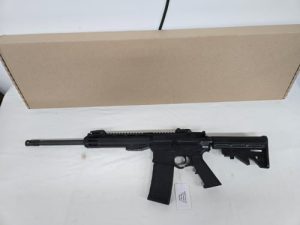
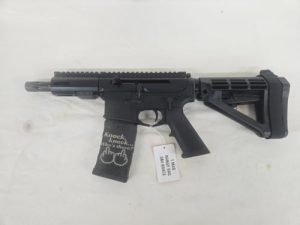
FIREARMS INTERNATIONAL CORP. Alpha Maxx AR-15
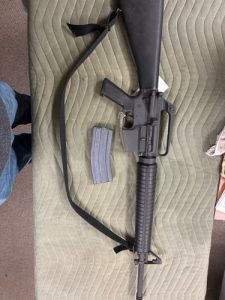
Used Bushmaster XM15 Patrolman, Semi-Auto AR-15 Rifle, 16" Barrel w/ A2 Front Sight, Flat Top Upper, (1) 30rd Magazine - Surplus Good Condition
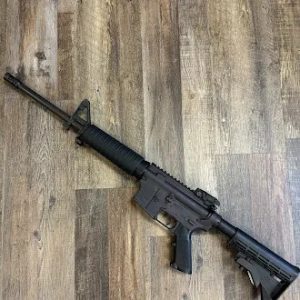
Used Rock River Arms LAR15, Semi-Automatic AR-15 Rifle, 5.56 NATO, 16" Barrel, (1) 30rd Magul Magazine, LEO ONLY MARKING - Surplus Good Condition
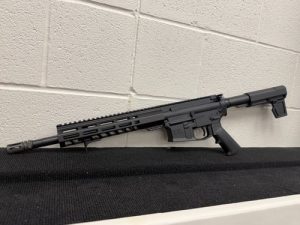
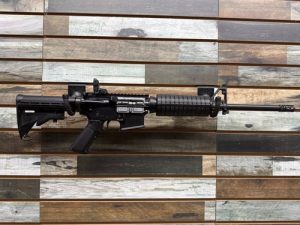
Windham Weaponry WW-15, Semi-Auto AR-15 Rifle, .223/5.56 NATO, 16" Barrel, 30rd Mag, 6-Position, Black, Law Enforcement Trade In, Used, Good Condition
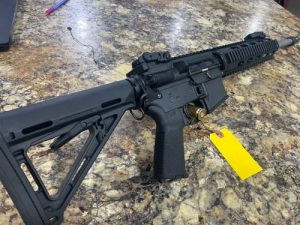
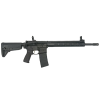
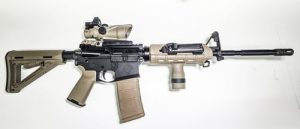
Springfield Saint, Semi Automatic AR-15 Rifle, .223 Rem/5.56, 30rd Magazine, BCM Grip/Stock, MLok Handguard, LE Trade In, Used, Good Condition
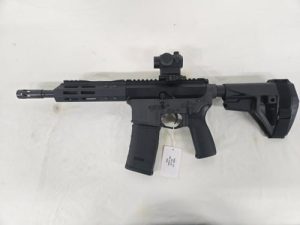
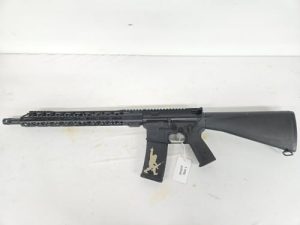
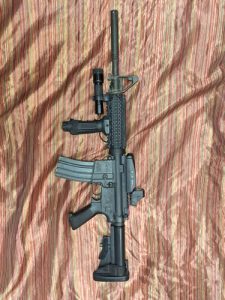
ANDERSON MANUFACTURING Unfired Anderson/BCA AR-15 w/Fixed A2 Stock, Magazine
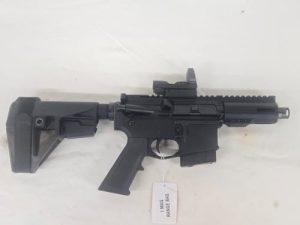
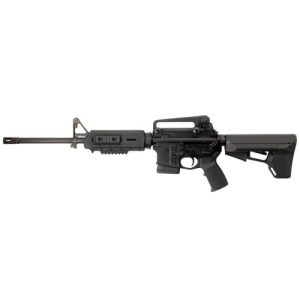
Colt Defense Law Enforcement Used Turn-In, M4-AR-15 Carbine Rifle 5.56 Nato, 16" Barrel, 1:7 Twist, Monolithic Quad Rail Upper Receiver, Flip Up Sights
Should You Buy a Used AR-10 Instead?
The AR-10 is the larger 7.62x51mm NATO / .308 Winchester sibling to the AR-15. Same Stoner lineage, same direct-impingement operating system, same manual of arms, packed into a slightly larger upper and lower receiver. The AR-10 platform is the right call if you need ballistics that the 5.56 cannot deliver: 800+ yard precision, hog and elk-class hunting energy, or designated marksman roles.
For most buyers, the used AR-15 wins on cost, ammunition availability, recoil, and parts ecosystem. A 30-round 5.56 mag retails for $12; a 20-round .308 mag retails for $35. Bulk 5.56 runs $0.40-$0.65 per round; bulk .308 runs $1.00-$1.50 per round. Used AR-10 pricing runs roughly $200-$400 above equivalent AR-15 tiers across all four bands. Buy the AR-10 only if your shooting use case actually needs .308 ballistics; otherwise the AR-15 is the smarter buy used.
If you’re cross-shopping handguns instead, our used Glock 19 buyer guide and used Remington 870 · used Sig P226 guide cover the equivalent four-tier ladder in their respective markets.
Who Should NOT Buy a Used AR-15
The AR-15 is the most adaptable platform in shooting sports, but four buyer profiles should walk away from the used market and either buy new or buy a different gun entirely.
- First-time shooters with no inspection skills. A used rifle demands a 15-point inspection that requires a bore light, an Allen wrench set, and enough knowledge to evaluate gas key staking and bolt-lug peening. Without those skills, pay $499 for a new PSA PA-15 or S&W M&P15 Sport II with a factory warranty before paying $425 for a used one with no provenance.
- Buyers in CA, CT, IL, MD, MA, NJ, NY, RI, WA, or DC. Compliance complexity makes used purchases harder than new. Featureless builds, registration deadlines, and “copies and duplicates” enforcement create traps that licensed dealers handle better with new inventory. Buy in-state, buy at a dealer who knows the state’s enforcement profile, and document everything.
- Optic-ready out-of-box buyers. A used build may or may not have a flat-top upper, may or may not have an upgraded handguard with M-LOK or Picatinny accessory mounting, and rarely ships with current-spec backup iron sights or red dots. A new S&W M&P15 Optic Ready or PSA Sabre comes with everything pre-mounted for less than the inspection-plus-upgrade cost on a used rifle.
- Shooters wanting a Toyota Tacoma resale curve. Used rifles lose value on cosmetic damage, optic-mount holes drilled out of spec, and aftermarket trigger swaps that void OEM warranty. A used PSA at $425 might resell at $375. A used Daniel Defense DDM4 V7 at $1,500 might resell at $1,400. The duty tier holds value; the budget tier does not. Buy what you intend to keep.
Used AR-15 Buyer Glossary
- BCG (Bolt Carrier Group): The reciprocating assembly inside the upper receiver containing the bolt, carrier, gas key, firing pin, and cam pin. The single most important wear part on a used AR-15.
- Gas Key Staking: The peened or punched metal around the two Allen-head screws securing the gas key to the carrier. Properly staked gas keys do not loosen under recoil. The most common quality marker for builder-grade work.
- Direct Impingement: Eugene Stoner’s gas-operated cycling system where high-pressure gas from the fired cartridge is bled directly back through the gas tube into the bolt carrier group. The mechanically simplest AR-15 operating system; the alternative is short-stroke piston.
- Mil-Spec Buffer Tube: 1.148-inch threaded diameter, the universal AR-15 spec. Commercial tubes measure 1.172 inches and are not parts-compatible with mil-spec stocks. The first thing to verify on any used rifle.
- TDP (Technical Data Package): The full set of dimensional and material specifications originally issued by the US Army for M16/M4 production. Colt, BCM, Daniel Defense, and FN15 build to full TDP compliance.
- M-LOK: Magpul-developed modular handguard mounting standard, replaced KeyMod as the industry default around 2017. Most used AR-15s built after 2018 have M-LOK; pre-2018 rifles often have Picatinny rail or KeyMod.
- Free-Float Handguard: A handguard that contacts only the barrel nut, not the gas block or barrel itself, improving accuracy by removing pressure points from the barrel. Standard on duty-tier and mid-tier rifles, optional on budget-tier.
- Forward Assist: The button on the right side of the upper receiver above the magazine release that lets a shooter manually push the BCG into battery. Required on TDP-compliant rifles, omitted on minimalist civilian builds.
- Dust Cover: The hinged plate over the ejection port that closes when the rifle is at rest, preventing dust ingress. Standard on virtually all AR-15 patterns; some boutique upper receivers omit it.
- Patrol Rifle: An AR-15 issued to a law enforcement officer as standard-duty equipment, typically Colt 6920, RRA LAR-15, DPMS A-15, or S&W M&P15. Cycled out of agency inventory every 8-12 years, the largest source of clean low-round-count used rifles.
- Pre-Ban (Pre-1994): An AR-15 manufactured before the 1994 Federal Assault Weapons Ban (10-year ban that lapsed in 2004). Pre-ban Colts (SP-1, AR-15 A1, R6000) command collector premiums and remain legal in some otherwise-restricted states.
- Featureless Configuration: A California-compliant AR-15 configured without “evil features” (no pistol grip, no flash hider, no collapsible stock) to meet California Penal Code 30515. The legal path for new used AR-15 ownership in California.
Related Reading
- Used rifles buyer guide: the full used-rifles sub-hub covering AR-15s, AR-10s, bolt-actions, lever-actions, and military surplus.
- USA Gun Shop’s used guns hub: the pillar guide covering handguns, rifles, and shotguns across the used market.
- Used Glock 19 buyer guide: the sibling spoke covering used 9mm carry pistols with the same buyer-tier framework.
- Used Sig P226 guide: the sibling spoke covering federal trade-in handguns, variant pricing, and pre-purchase inspection.
- Complete AR-15 brand tier ranking: the full ranked brand list across duty, mid, budget, and avoid tiers.
- Best AR-15 rifles under $1,000: the new-market budget tier that sets used pricing expectations.
- AR-15 caliber comparison: 5.56 NATO, .223 Rem, .300 Blackout, 6.5 Grendel, 6.8 SPC ballistic profiles.
Frequently Asked Questions
How much is a used AR-15 worth?
A used AR-15 averages $649.62 across all configurations in 2026, against a new-market average of $667.08, only a $17.46 spread. Prices break into four tiers: budget private market $300-$750, police trade-in patrol rifles $499-$899, federal-agency M4 trade-ins $899-$1,499, and pre-ban Colt collector grade $800-$8,000+. Used values rose $19.62 over the past 12 months while new values fell.
Is it safe to buy a used AR-15?
Yes, with a 15-point inspection. The critical checks are gas key staking (the punched metal around the gas key screws on the bolt carrier group), extractor and ejector tension, barrel throat erosion, feed ramp alignment, bolt lug condition, and takedown pin tension. Walk away from any rifle with an unstaked gas key, visible bolt-lug peening, or sloppy upper-lower receiver fit. Reference Shooting Illustrated and AR Build Junkie 15-point checklists.
What brands of AR-15 should I avoid?
Three names recur in every "brands to avoid" thread: Hesse Arms (out of business with documented receiver quality failures), Olympic Arms (universal condemnation for finish quality and ammo sensitivity), and Vulcan or Hi-Point AR (lowest-tier no-name). Avoid any unbranded lower under $400 used or any rifle without a readable manufacturer mark. Model1Sales legacy kit rifles share the same QC issues as Hesse.
What is a police trade-in AR-15?
A patrol rifle that an agency cycled out, typically a Colt 6920, Rock River Arms LAR-15, DPMS A-15, Bushmaster XM15-E2S, or S&W M&P15. They show cosmetic wear from duty carry but low round counts because most patrol rifles spend their service lives in vehicle locks, not on the range. Available at Classic Firearms, Aim Surplus, Recoil Gun Works, and Blue Mountain Supply, typically $499-$899.
Are used AR-15s reliable?
Generally yes. The direct-impingement design has a 60-plus-year service record. Reliability depends more on BCG quality, gas key staking, and barrel condition than on round count. A correctly built mil-spec AR-15 will run 10,000-20,000 rounds before barrel replacement; bolt service life is approximately 8,000-10,000 rounds. A police trade-in with 2,000 documented rounds has roughly 90% of its mechanical service life remaining.
Do I need an FFL to buy a used AR-15?
Required when buying through any licensed dealer, with Form 4473 and a NICS background check. For private party sales between two unlicensed individuals, federal law does NOT require Form 4473, but six states (California, Colorado, Nevada, New Jersey, Virginia, Washington) require all transfers go through an FFL regardless of party status. Out-of-state purchases must ship to a licensed FFL in your state of residence.
What is the difference between a used Colt 6920 and a used DPMS?
The Colt 6920 is TDP-compliant mil-spec with an MP-tested barrel, properly staked BCG, and full M4 feed ramps, running $825-$1,200 used with $913 as the 12-month-trailing average. The DPMS A-15 is budget mil-spec, often with a 1:9 twist, 4150 chrome-moly barrel, running $400-$700 used. The Colt commands a $300-$500 premium for documentation and reputation, not always for measurable mechanical performance.
Where can I buy a used AR-15?
Online: GunBroker for auction-format, Guns.com for graded used catalog, Classic Firearms for police trade-in specialty, Aim Surplus for LE trade-in specialty, Sportsman's Outdoor Superstore for cataloged used 5.56 rifles, Bud's Gun Shop with 3-day inspection return policy. Local: gun shops, gun shows, range bulletin boards. Private: Armslist (state law caveats), AR15.com Equipment Exchange. Always require FFL on out-of-state transfers.
4,659+ Gun & Ammo Deals
Updated daily from 200+ top retailers. Filter by category, caliber, action type, and price.