Last updated August 2026 · By Nick Hall, NFA owner who has been through the Form 4 wait and tracks the suppressor market for USA Gun Shop
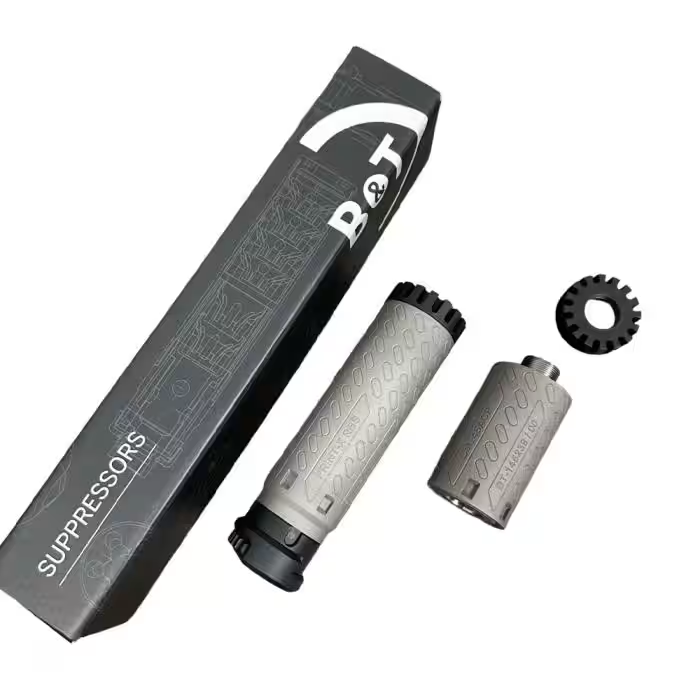
Quick take: B&T USA’s Utah plant can now turn out 7,000 suppressors a month. It got there in under a year, and it did it mostly with 3D printers rather than machine tools.
- What changed: B&T USA expanded its Herriman, Utah facility to 88,000 square feet and raised output to as many as 7,000 suppressors a month.
- Why it matters: The plant runs nine industrial 3D printers against seven CNC machines. That ratio is the story.
- Affects: Anyone waiting on a can. Supply is catching up with the demand the zero tax stamp created.
- What’s next: B&T says it will keep hiring and adding equipment through 2026.
Every outlet that covered this led with the jobs number. Fifty new positions is good news for Herriman and it is not why this matters to anyone buying a suppressor. Look at what they bought instead of who they hired.
Deals of the Day
Today's best discounts · Updated 3x daily
Gun Deals
See All →
Ammo Deals
See All →



Table of Contents
Nine Printers, Seven CNC Machines
In late 2025 the Herriman operation was three people, two industrial 3D printers and a single CNC machine. Today it is more than 55 people, nine industrial 3D printers and seven CNC machines.
Read that ordering again. The printers outnumber the mills. This is not a machine shop that added additive manufacturing as a sideline, it is a plant built around printing that keeps CNC capacity for the parts printing cannot do well, which is close to the inverse of how suppressors were made for most of their history.
The reason is geometry. A traditional baffle stack is a series of individually machined cones that get stacked and welded or threaded into a tube, and every one of those operations is a chance to introduce a tolerance error or a weld that cracks. A printed core comes out of the machine as a single piece, with internal shapes that no cutter could reach, and it comes out the same every time.
And that changes how a company adds capacity. Scaling a machine shop means tooling, fixtures, programming and skilled machinists. Scaling a print farm means buying another printer and pressing go. Which is how a three-person operation becomes a 7,000-unit-a-month operation inside twelve months.
The Zero Stamp Is Behind All of This
Nobody builds an 88,000 square foot suppressor plant on a hunch. The transfer and making tax on suppressors went to zero on 1 January 2026, which took $200 off the price of every can in the country overnight and pulled a large number of fence-sitters into the market.
B&T is reading that as durable demand rather than a spike, and putting real capital behind that read. Worth noting the registry those cans still have to pass through is currently being litigated, so the regulatory picture underneath this investment is less settled than the tax picture.
One thing this will not do is speed up your paperwork. Manufacturing capacity and ATF approval are separate queues, and a plant running flat out has no effect on the second one. What it changes is whether the can you picked is actually in stock when your approval lands, which for the past few years has often been the real delay rather than the approval time itself.
What It Means If You Are Shopping
More domestic supply from a serious manufacturer is straightforwardly good. B&T is Swiss, the Herriman plant is American, and cans built there sidestep the import questions that have complicated European suppressor availability before.
It is also a signal about where the wider market is going. If the fastest-scaling suppressor plant in the country is a print farm, expect the rest of the field to follow, and expect the mid-tier price bracket to get considerably more crowded over the next two years.
Fifty jobs made the headlines. Nine printers is the thing worth watching.
Frequently Asked Questions
How many suppressors can B&T's Utah plant make?
Up to 7,000 a month. The Herriman facility runs to 88,000 square feet and now handles development, machining, additive manufacturing, finishing, assembly, quality control, customer service and shipping in one building.
How fast did the plant scale up?
Late 2025 it had three employees, two industrial 3D printers and one CNC machine. Under a year later it has more than 55 employees, nine industrial 3D printers and seven CNC machines.
Why does 3D printing matter for suppressors?
A printed baffle core comes out as one piece, so geometry that would need multi-axis machining and welding gets produced in a single build. That is what lets a plant add capacity by buying another printer instead of retooling a machine shop.
Will this cut suppressor wait times?
Not directly. Manufacturing capacity and ATF approval are separate queues. More production means the can is on the shelf when your paperwork clears, it does not make the paperwork clear faster.
Is B&T an American company?
B&T is Swiss. B&T USA is its American arm, and the Herriman plant means these suppressors are made in the United States rather than imported.
Does the zero tax stamp affect suppressor demand?
It already has. The transfer and making tax on suppressors went to zero on 1 January 2026, removing $200 from the cost of every can. Manufacturers have been adding capacity on the back of it.
Do I still need to register a suppressor?
Yes. The tax is zero but the registration, background check, approval and serial tracking are all unchanged. You still file and you still wait.
Is B&T hiring more?
The company says it plans to keep adding staff and production equipment through 2026.
Related Reading
- Best Suppressors
- Suppressor Wait Times in 2026
- How Much Does a Suppressor Cost?
- How to Buy a Suppressor
- DOJ Defends the NFA Registry After Winning Wolford
6,216+ Gun & Ammo Deals
Updated daily from 200+ top retailers. Filter by category, caliber, action type, and price.