

Disclosure: Some of the links below are affiliate links, meaning at no additional cost to you, we will earn a commission if you click through and make a purchase. For more information, read our full affiliate disclosure here.
- Treat every gun as loaded
- Point the muzzle in a safe direction
- Keep your finger off the trigger until you’re ready to shoot
- Know your target and what’s beyond

Aero Precision Buyer’s Guide (2026): Everything You Need to Know
If you’re building an AR-15 or AR-10 in 2026, there’s a good chance Aero Precision is on your shortlist. Based out of Washington state, Aero has become the go-to brand for builders who want premium quality without paying custom-shop prices. They sit in that sweet spot between budget AR makers like Palmetto State Armory and Anderson Manufacturing on one end, and premium brands like BCM and Daniel Defense on the other.
I’ve built three rifles on Aero receivers and they’ve all been excellent. The fit and finish is consistently tight, the tolerances are on point, and the M4E1 platform genuinely makes the build process easier with features like threaded pins and integrated trigger guards. Whether you’re assembling your first AR or your tenth, Aero gives you a solid foundation without breaking the bank.
This guide covers every major Aero Precision product line: the M4E1 AR-15 platform, the M5 AR-10 series, the EPC pistol caliber builds, and even their newer SOLUS bolt-action rifles. I’ll walk you through what to buy, what to skip, and how Aero stacks up against the competition.
Who Is Aero Precision?
Aero Precision was founded in 1994 as a small 2,000-square-foot machine shop near Tacoma, Washington. Originally, the company specialized in producing parts for the aerospace industry, which is where the “Aero” in the name comes from. That aerospace background matters because it established a culture of tight tolerances and quality control that carried over when they pivoted into firearms manufacturing.
Over the years, Aero grew rapidly and made some strategic acquisitions. They purchased Ballistic Advantage (a well-regarded barrel maker) in 2014 and VG6 Precision (known for muzzle devices) in 2015. In 2017 they partnered with Grey Ghost Precision for Glock slides and pistol components. These acquisitions let Aero control more of the supply chain and maintain quality across their product line.
Today, Aero Precision operates out of a massive 268,000-square-foot facility in Lakewood, Washington. They manufacture everything in-house in the USA. The company is led by founder and CEO Scott Dover, and they produce components and complete firearms for the commercial, law enforcement, and military markets. Their reputation is built on delivering “billet aesthetics in a forged package,” meaning you get the clean lines and premium look of billet machining at forged receiver prices.
Aero Precision Product Lines Explained
Aero offers a lot of products and it can be overwhelming if you’re new to the brand. Here’s a quick breakdown of their major product lines and what each one is designed for.
| Product Line | Platform | Calibers | Best For |
|---|---|---|---|
| M4E1 | AR-15 | 5.56 NATO, .223 Wylde, .300 BLK | Flagship AR-15 builds (most popular) |
| Gen 2 / X15 | AR-15 | 5.56 NATO, .223 Wylde | Budget-friendly mil-spec builds |
| M5 | AR-10 (DPMS pattern) | .308 Win, 6.5 Creedmoor | Big-bore precision and hunting |
| EPC-9 | Pistol Caliber AR | 9mm, .40 S&W | Competition PCC, home defense |
| SOLUS | Bolt-Action | .308 Win, 6.5 CM, 6mm CM, 6.5 PRC | Precision rifle, hunting, competition |
In addition to receivers, Aero sells complete uppers, complete lowers, builder kits (upper + lower + handguard, minus BCG and charging handle), complete rifles, handguards, barrels (through Ballistic Advantage), muzzle devices (through VG6 Precision), and small parts kits. You can build an entire rifle sourcing only Aero components if you want.
Best Aero Precision AR-15 Builds
The AR-15 platform is where Aero Precision made its name, and the M4E1 is the centerpiece of that lineup. Here are the best ways to get into an Aero AR-15, whether you want to build from parts or buy a complete rifle.
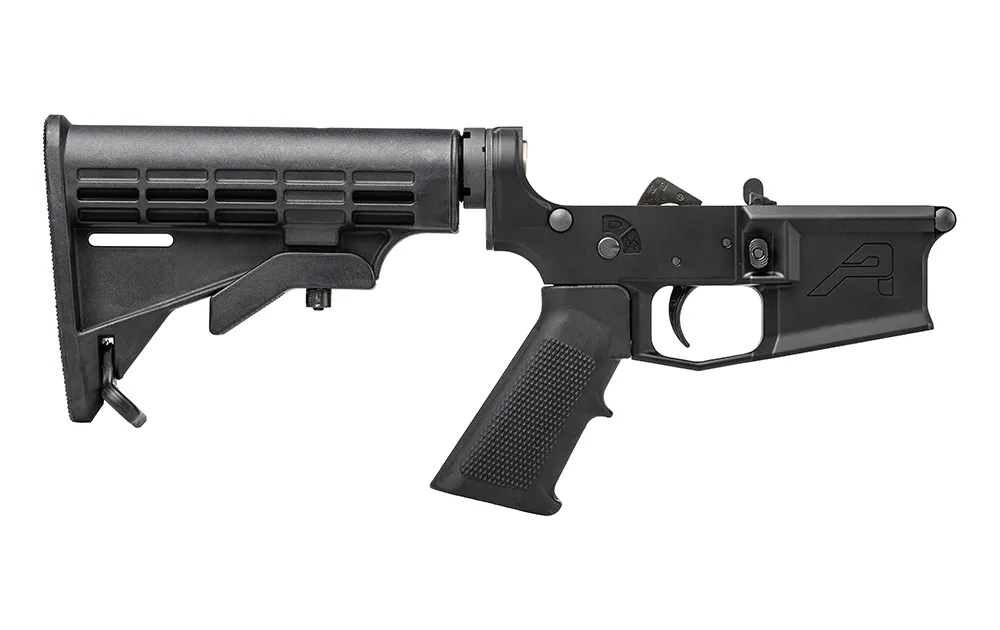
M4E1 Complete Lower Receiver (~$250-300)
Aero Precision M4E1 Complete Lower
The M4E1 Complete Lower is where most Aero builds start, and for good reason. It comes fully assembled with a mil-spec trigger, buffer tube assembly, pistol grip, and stock. All you need is a complete upper receiver and you’ve got a functioning rifle.
What makes the M4E1 lower special is the builder-friendly design. The bolt catch uses a threaded pin instead of a traditional roll pin, so you only need a 1/16″ hex key instead of a roll pin punch. The trigger guard is integrated into the receiver (no separate piece to install and potentially snap). The magwell has an aggressive flare for faster reloads. And the upper tension screw lets you dial out any wobble between the upper and lower receivers.
The receiver itself is machined from 7075-T6 aluminum with a Type III hard coat anodized finish (Mil 8625 Class 2). It’s compatible with all mil-spec AR-15 parts and features selector markings that work with both 90-degree and 45-degree safety selectors.
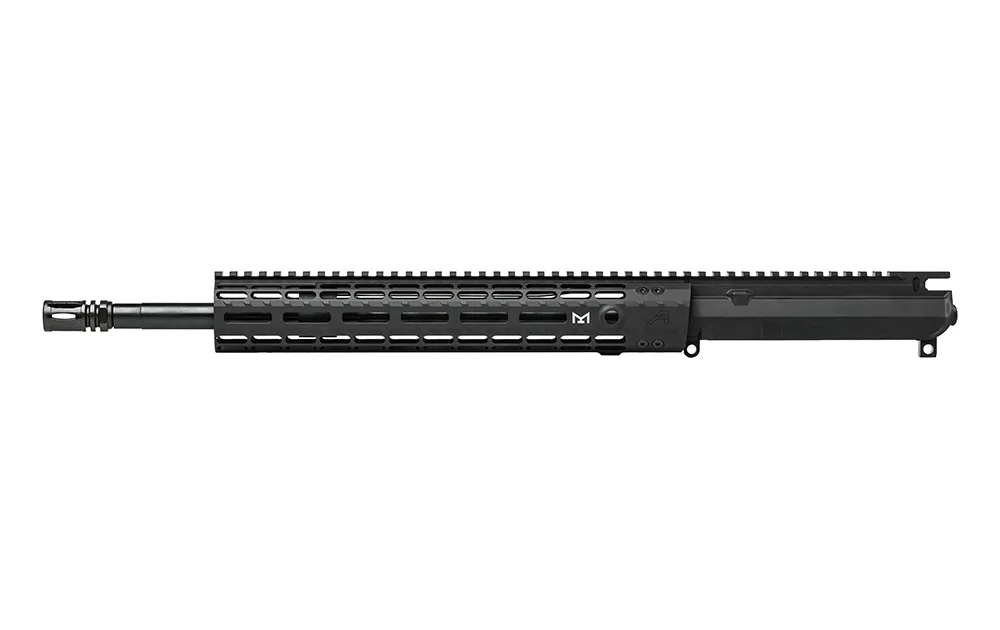
M4E1 Complete Upper (16″ 5.56, ~$400-500)
Aero Precision M4E1 16" 5.56 Complete Upper
Aero’s M4E1 complete uppers come ready to drop onto any mil-spec AR-15 lower receiver. The standard 16″ 5.56 NATO configuration runs a mid-length gas system, which gives you a smoother recoil impulse and longer dwell time compared to carbine-length gas. The barrels are 4150 CMV (Chrome Moly Vanadium) steel with a QPQ nitride finish for excellent corrosion and wear resistance.
You’ll typically get a choice between the ATLAS S-ONE or R-ONE handguard. Both are free-floating M-LOK designs that use Aero’s proprietary ATLAS (Aero Taper Lock Attachment System) barrel nut. The S-ONE is the lighter option at around 7 ounces for a 15″ rail, while the R-ONE has a full Picatinny top rail. The handguards are machined from 6061-T6 aluminum and available in multiple lengths.
The upper receiver features M4 feed ramps and is designed as an integral unit with the handguard mounting system. It’s compatible with standard AR-15 BCGs and charging handles, so you can pair it with whatever you prefer.
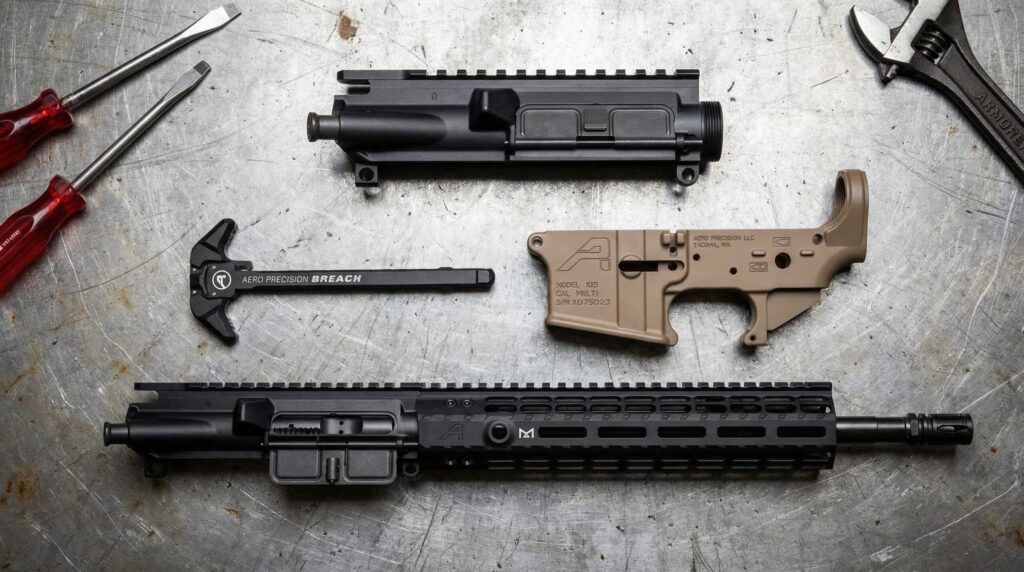
M4E1 Builder Kit (~$650-800)
Aero Precision M4E1 Builder Kit
If you want the best value in the Aero lineup, the M4E1 Builder Kit is hard to beat. These kits include a complete upper receiver, stripped or complete lower receiver, and handguard. You supply the BCG (bolt carrier group), charging handle, and lower parts kit (if stripped lower). That’s it.
The beauty of the builder kit is that Aero has already matched everything for you. The upper, lower, and handguard all come from the same production run, so the finish matches perfectly and all the tolerances line up. No guessing about compatibility. You’re essentially getting a complete rifle minus a few easy-to-source parts, and you’re saving $100-200 compared to buying everything individually.
I’ve used a builder kit for one of my three Aero builds and it was the smoothest experience. Everything dropped right in with zero fitting required. If you already have a preferred BCG and charging handle, this is the way to go.
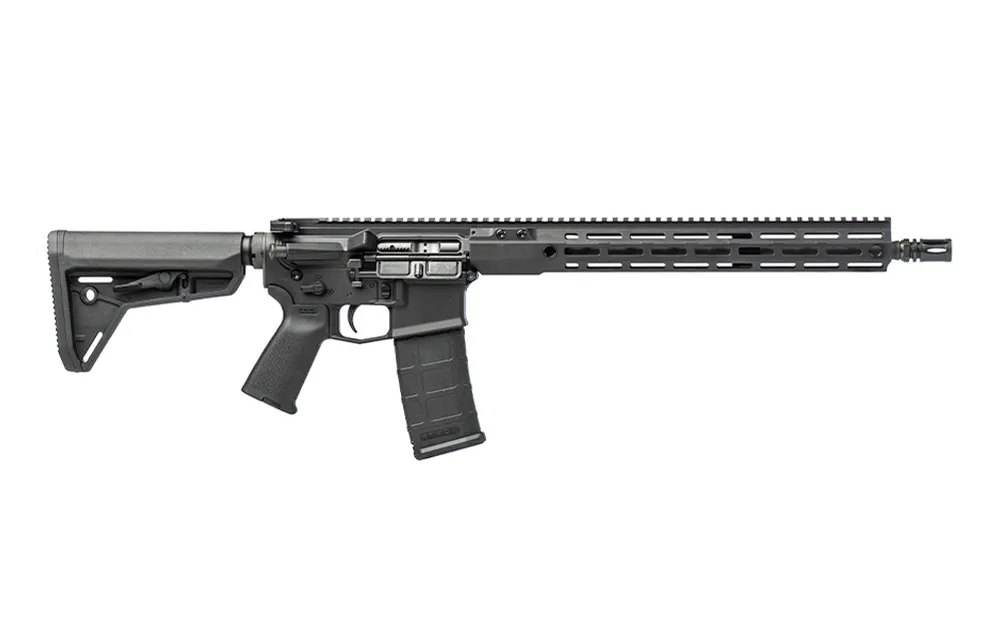
Aero Precision Complete Rifle (~$900-1,200)
Aero Precision Complete AR-15 Rifle
For buyers who don’t want to build, Aero sells complete rifles ready to shoot out of the box. These come in 5.56 NATO and .300 Blackout configurations, with barrel lengths from 10.5″ to 18″ depending on the model. You get the full M4E1 platform with an ATLAS handguard, Ballistic Advantage barrel, VG6 muzzle device, and Magpul furniture.
The complete rifles represent Aero’s vision of what their platform should be when everything works together. They’re factory-assembled and test-fired before shipping. For the price, you’re getting a rifle that punches well above its weight class. Most Aero complete rifles will shoot 1.5 to 2 MOA with quality ammunition, which is more than adequate for defensive use, recreational shooting, and even some competition work.
The only downside is that you’re paying a premium for the convenience of not building. If you’re comfortable with basic tools and watching a YouTube tutorial, you can save $150-250 by going the builder kit route and get the exact same rifle.
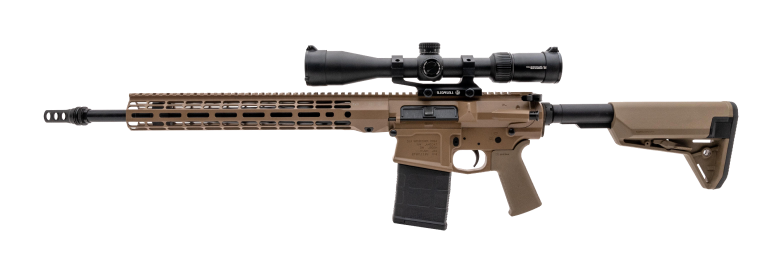
Aero Precision M5E1 – AR-10
Aero Precision M5 .308 / 6.5 Creedmoor
The M5 is Aero Precision’s AR-10 platform, designed for shooters who need more power, more range, or both. It follows the DPMS High pattern and is compatible with standard DPMS .308 components and magazines. Like the M4E1, the M5 receivers are machined from 7075-T6 aluminum with Type III hard coat anodizing.
The M5 is available in .308 Winchester and 6.5 Creedmoor, making it a solid choice for precision shooting, hunting, and long-range work. The receivers share many of the same builder-friendly features as the M4E1: threaded bolt catch pin, integrated trigger guard, upper tension screw, and flared magwell. If you’ve built an M4E1, the M5 will feel familiar.
Complete M5 uppers typically feature 16″ or 20″ barrels in 4150 CMV steel with mid-length or rifle-length gas systems. The M5 platform does add weight compared to the AR-15 (the stripped lower alone weighs 12 ounces), but that’s the trade-off for shooting full-power rifle cartridges out of a semi-automatic platform. For hunters who want a modern sporting rifle in .308 or 6.5 Creedmoor, the M5 is one of the best values on the market.
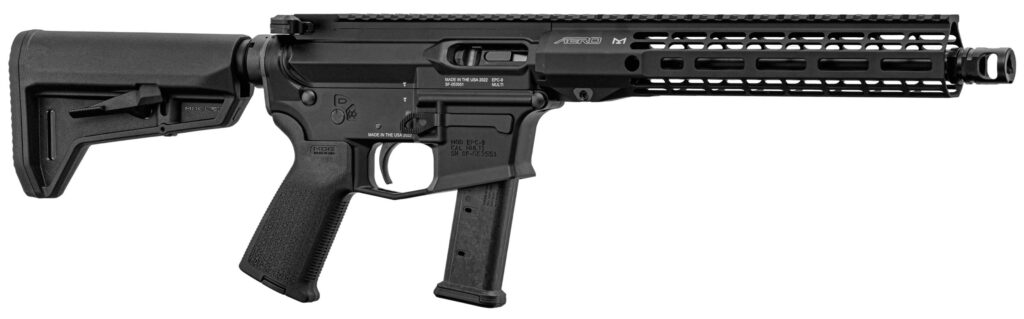
Aero Precision EPC: Pistol Caliber Carbines
Aero Precision EPC-9 Pistol Caliber
The EPC (Enhanced Pistol Caliber) line is Aero’s entry into the pistol caliber carbine world. These AR-pattern receivers are chambered in 9mm and .40 S&W, running a direct blowback operating system. The EPC-9 lower is designed to accept Glock-pattern magazines for both calibers, with a proprietary magazine release built right into the receiver.
One of the standout features is the last round bolt hold open (LRBHO) that’s built into the EPC upper receiver. This locks the bolt back on an empty magazine, which is a feature many competing PCC platforms struggle to implement reliably. The flared magwell is optimized for fast Glock mag changes, and the magazine release is positioned so you can drive your trigger finger into it for quick drops.
Aero offers EPC barrels in 5.5″, 8.3″, 11″, and 16″ lengths, so you can build anything from a compact pistol to a full-size competition carbine. The complete EPC weighs about 6 pounds 10 ounces (without magazine or optic in the 16″ configuration), making it a lightweight and low-recoil option for competition shooting, home defense, and range fun. Compatible magazines include Glock OEM, Magpul, ETS, and KCI.
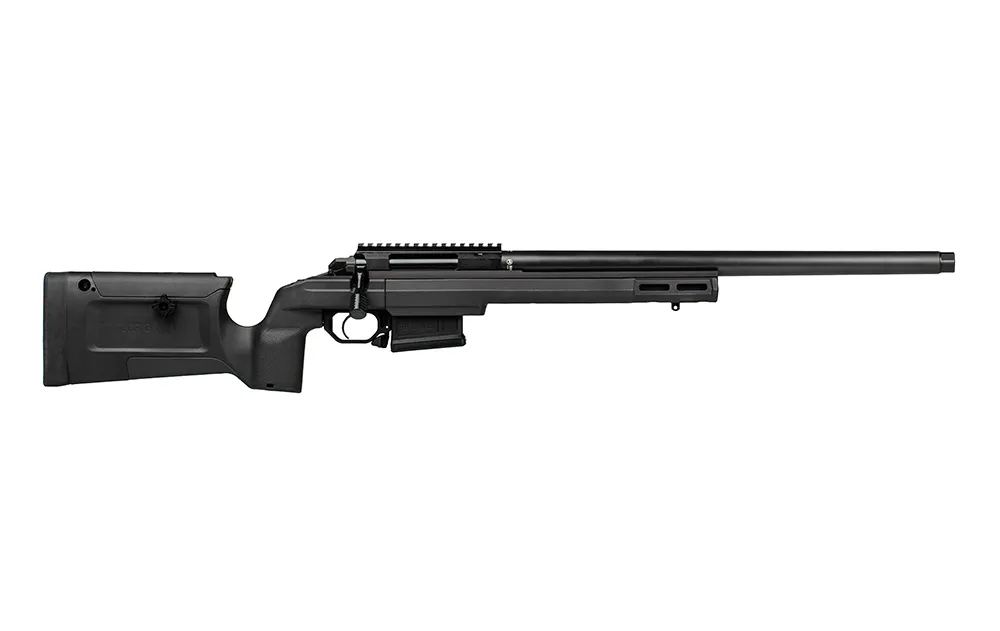
Aero Precision SOLUS Bolt-Action
Aero Precision Solus
The SOLUS is Aero Precision’s newest and most ambitious platform: a bolt-action precision rifle built on a Remington 700 footprint. This means it’s compatible with the massive ecosystem of R700 triggers, stocks, chassis, and accessories. Available in .308 Winchester, 6.5 Creedmoor, 6mm Creedmoor, and 6.5 PRC, the SOLUS is aimed squarely at the precision rifle and hunting markets.
The action features a 3-lug, 60-degree bolt throw with interchangeable bolt heads (.478 and .540 bolt faces). Dual ejectors on the replaceable bolt head provide reliable extraction, and the Picatinny rail is machined directly into the receiver so it can never come loose. The SOLUS Hunter model ships with a 24″ 416R stainless steel barrel, an adjustable single-stage trigger (2 lbs 7 oz to 5 lbs 13 oz pull weight), an AG Composite carbon fiber stock with adjustable cheek riser, and an AICS-pattern detachable 4-round magazine.
All SOLUS rifles come with a sub-MOA accuracy guarantee from the factory. The Hunter model weighs 7.8 pounds and measures 43.75″ overall. At its price point, the SOLUS competes directly with the Bergara B-14 HMR and Tikka T3x, and from my research it holds its own against both. If you’re already invested in the Aero ecosystem and want a bolt gun for hunting or PRS-style competition, the SOLUS is a compelling option.
Aero Precision SOLUS Bolt-Action Rifle
Aero Precision Accessories: BCGs, Charging Handles, and Muzzle Devices
Aero Precision is more than receivers and handguards. They make a full ecosystem of accessories that pair perfectly with their builds. And because they own both Ballistic Advantage (barrels) and VG6 Precision (muzzle devices), you can build a complete rifle using nothing but Aero-family parts.
Bolt Carrier Groups
Aero Precision Bolt Carrier Groups
Aero offers BCGs in phosphate, nitride, and nickel boron finishes. The phosphate is the most affordable and runs reliably. The nickel boron is easier to clean and looks great, but costs more. All use 9310 steel bolts and Carpenter 158 bolt material. I have run the phosphate BCG in two builds with zero issues past 2,000 rounds each.
For most builders, the Aero nitride BCG hits the sweet spot between price and performance. It wipes clean with minimal effort and feeds reliably. If you want to save money, a Toolcraft nitride BCG is an equally reliable alternative at a lower price.
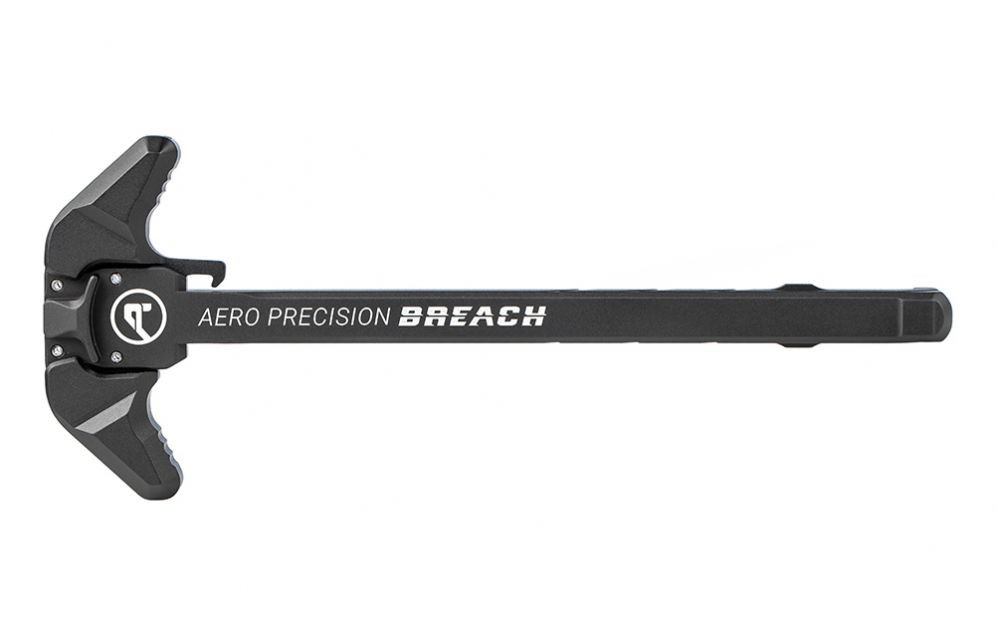
Breach Charging Handles
Aero Precision Breach Charging Handle
The Aero Breach is an ambidextrous charging handle that has become one of the most popular options in its price range. It comes in small, mid, and large lever configurations. The large lever version gives you a solid grip surface for running the charging handle under stress or with gloves.
Build quality is good, and the Breach undercuts the Radian Raptor by $20 to $30 while offering very similar functionality. If you are building on a budget, the Breach is one of the smartest upgrades you can make over a standard mil-spec charging handle.
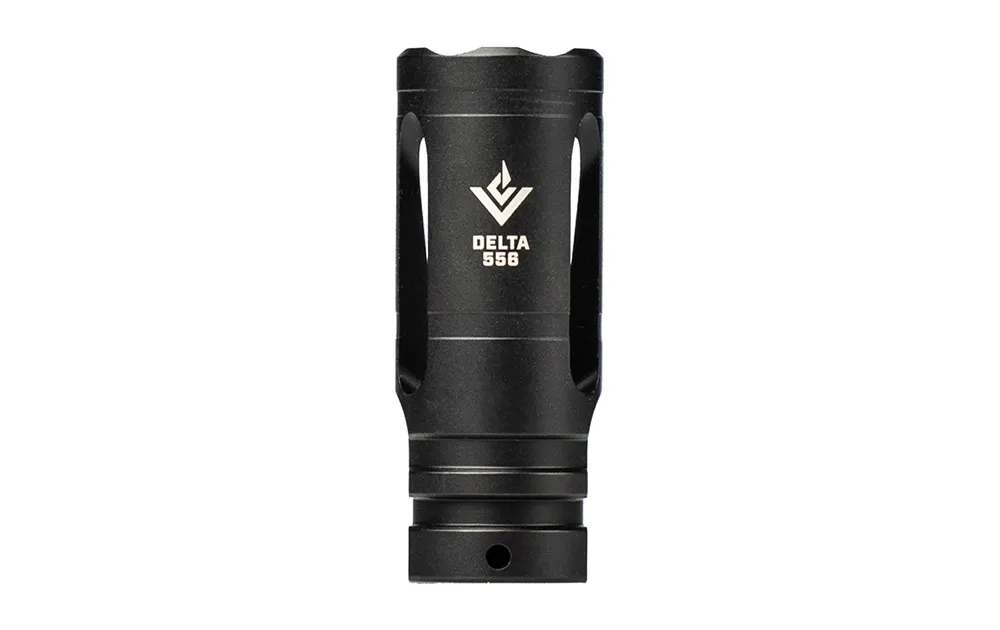
VG6 Precision Muzzle Devices
VG6 Precision Muzzle Devices
Aero acquired VG6 Precision, and their muzzle devices are some of the best performing options under $100. The VG6 Gamma 556 is a muzzle brake that dramatically reduces felt recoil. The Epsilon 556 combines brake and flash hider functions. Both are loud (as all effective brakes are), but the recoil reduction is genuinely impressive.
The VG6 CAGE device is worth mentioning. It is a blast diffuser that slips over the Gamma or Epsilon and redirects concussion forward and away from shooters beside you. If you shoot at public ranges, your neighbors will appreciate it. The CAGE plus Gamma combo gives you excellent recoil control without being antisocial.
Ballistic Advantage Barrels
Ballistic Advantage barrel
Aero owns Ballistic Advantage, and BA barrels come standard in most Aero complete uppers and rifles. These are made from 4150 CMV steel with a QPQ nitride finish (or 416R stainless for precision builds). BA offers multiple profiles: Government (heavy, durable), Hanson (lightweight, optimized gas port placement), and SPR (precision oriented).
The Hanson profile is particularly noteworthy. It features a pinned gas block and an optimized gas port size for each barrel length, which means less tuning required. For a 16-inch 5.56 mid-length build, the BA Hanson barrel is one of the best options under $200. Since Aero owns BA, you often see bundle deals on complete uppers that include these barrels at a discount.
M4E1 Enhanced vs Threaded Upper: Know the Difference
This is the single most common source of confusion for first-time Aero buyers. Aero makes two versions of the M4E1 upper receiver, and they are not interchangeable when it comes to handguard selection.
The M4E1 Enhanced upper has a built-in barrel nut that is proprietary to Aero. It only works with Aero Enhanced handguards (the older BAR system). You cannot use third-party handguards with this upper. The advantage is a very clean, seamless look and easy installation.
The M4E1 Threaded upper uses a standard barrel nut thread pattern. This means you can use any standard AR-15 handguard, including the Aero ATLAS S-ONE, ATLAS R-ONE, and Quantum lines, plus any third-party handguard from Midwest Industries, BCM, Geissele, or others.
My recommendation: go with the Threaded upper unless you specifically want the Enhanced aesthetic. The Threaded version gives you far more flexibility for handguard swaps down the road, and the ATLAS handguards are excellent options that mount to it perfectly.
Aero Precision Blem Deals
If you want to save money on Aero parts, their blemished (blem) section is one of the best deals in the AR world. Aero sells cosmetically imperfect receivers, handguards, and other parts at 20 to 30 percent off regular price. The “blemishes” are typically minor anodizing marks or tiny tool marks that are invisible once the rifle is assembled.
I have bought three blem receivers from Aero. On two of them, I genuinely could not find the cosmetic defect. The third had a small anodizing mark inside the magwell that disappeared behind the magazine. Blems carry the same Limited Lifetime Warranty as standard products. The only catch is they are non-returnable for cosmetic reasons.
Blem drops happen regularly on the Aero Precision website. They sell out fast, especially on popular items like stripped M4E1 lowers and builder sets. Follow Aero on social media or sign up for email alerts to catch them. A blem M4E1 stripped lower for $65 to $75 is one of the best values in the AR market.
Cerakote and Limited Edition Builder Sets
One of Aero Precision’s biggest differentiators is their rotating lineup of Cerakote builder sets. These are matched upper, lower, and handguard combinations in custom color schemes that drop in limited quantities throughout the year. Past finishes have included everything from subtle FDE and tungsten to eye-catching patterns.
Builder sets are only available direct from Aero and they sell out quickly. If you want a rifle that stands out at the range, these sets are an affordable way to get a custom look without paying a custom shop. Prices typically run $50 to $100 more than the standard black version. Check the Aero Precision website regularly for new drops.
Warranty and Customer Service
Aero Precision offers a Limited Lifetime Manufacturer Warranty that covers defects in materials and workmanship for the life of the product. The warranty transfers to second owners, which is a nice touch for the used market. If something breaks due to a manufacturing defect, Aero will repair or replace it.
Customer service has been a mixed bag based on community feedback. When things go right, Aero is responsive and handles warranty claims quickly. During peak demand periods, response times can stretch to a week or more. Direct orders from aeroprecisionusa.com have occasionally had slow shipping times compared to buying through retailers like Palmetto State Armory or Brownells. For fastest delivery, I recommend buying through a retailer rather than direct.
Aero Precision vs The Competition
Aero Precision occupies a unique position in the AR market. They’re not the cheapest, and they’re not the most expensive. Understanding where they fit relative to the competition will help you decide if they’re right for your build.
Aero Precision vs Palmetto State Armory (PSA)
PSA is the king of budget AR builds, and their prices are hard to beat. You can get a complete PSA rifle for $500-700, while a comparable Aero build will run $900-1,200. So what does the extra money buy you?
Better quality control, primarily. Aero’s tolerances are tighter, the fit and finish is noticeably cleaner, and you’re less likely to get a part that needs fitting or has cosmetic blemishes. PSA rifles work fine for most people, but I’ve seen more QC issues with PSA than with Aero. If you’re building your first AR on a tight budget, PSA is a great entry point. If you want something you’ll be proud of and plan to keep for years, spend the extra money on Aero.
Aero Precision vs BCM (Bravo Company Manufacturing)
BCM is the standard for duty-grade AR-15s. Their rifles and components are built to withstand hard professional use, and they command a premium price. A BCM complete upper runs $700-900, while a comparable Aero upper is $400-500.
Is BCM worth the premium? For duty use, law enforcement, or military applications, yes. BCM’s quality control is legendary and their track record in professional environments speaks for itself. For recreational shooting, home defense, and even competition, Aero gets you roughly 80% of the quality at about 60% of the price. That’s a trade-off most civilian shooters are happy to make.
Aero Precision vs Daniel Defense
Daniel Defense is widely considered the gold standard for premium AR-15 rifles. A DD complete rifle runs $1,800-2,200, putting it at nearly double the price of a comparable Aero build. DD uses cold hammer forged barrels, has an impeccable reputation for reliability, and offers arguably the best factory AR trigger on the market.
For most shooters, Daniel Defense is overkill. You’re paying for a name, a track record, and marginal improvements in barrel life and accuracy that 95% of shooters will never notice. Aero Precision is the smart value play: excellent quality at a price that lets you spend the savings on optics, ammo, and training, which will do more for your shooting than a more expensive receiver ever will.
Aero Precision vs Anderson Manufacturing
Anderson is the bare-bones budget option. Their stripped lowers regularly sell for $30-50, compared to $80-100 for an Aero M4E1 stripped lower. Anderson receivers are mil-spec and functional, but that’s about all you can say for them. The finish is rougher, the tolerances are looser, and you don’t get any of the builder-friendly features like threaded pins or integrated trigger guards.
If you’re building a beater rifle that lives in the truck or a dedicated parts-bin build, Anderson is fine. For anything else, the upgrade to Aero is absolutely worth it. The M4E1’s features alone (threaded bolt catch, tension screw, flared magwell) make the build process significantly easier and the end result noticeably better.
How to Build an Aero Precision AR-15
If this is your first build, don’t be intimidated. Building an AR-15 on Aero Precision receivers is one of the most beginner-friendly experiences in the firearms world, especially with the M4E1 platform. The threaded bolt catch pin, integrated trigger guard, and clear machining marks make the process straightforward even if you’ve never assembled a firearm before.
We’ve put together a complete, step-by-step guide that walks you through the entire process from stripped receivers to a functioning rifle. It covers tool requirements, parts lists, and detailed instructions with photos. You can find it here: How to Build an AR-15 Rifle.
The short version: if you buy an Aero M4E1 builder kit, you’ll need a BCG, charging handle, and basic tools (armorer’s wrench, vise block, torque wrench, punch set, and hex keys). The entire build takes about 1-2 hours for a first-timer. The M4E1’s design eliminates the two most frustrating steps in a traditional AR build (the bolt catch roll pin and trigger guard installation), so you can focus on the fun parts.
Where to Buy Aero Precision
Aero Precision products are widely available from major online firearms retailers. Here are the best places to shop for Aero components and complete rifles.
Palmetto State Armory regularly runs deals on Aero receivers, uppers, and builder kits. They’re one of the largest Aero dealers and often have the best prices during sales events. Shop Aero Precision at PSA.
Brownells carries the full Aero lineup including the SOLUS bolt-action platform and hard-to-find configurations. Their customer service is excellent and they have a generous return policy. Shop Aero Precision at Brownells.
Primary Arms is another excellent retailer with a strong Aero selection. They frequently bundle Aero receivers with optics deals, which can save you money if you’re buying both at the same time. Shop Aero Precision at Primary Arms.
Aero Precision Direct (aeroprecisionusa.com) is always worth checking, especially during their seasonal sales when they offer up to 40% off sitewide. Buying direct also gives you access to limited-edition Cerakote finishes and builder sets that aren’t available through third-party retailers.
FAQ: Aero Precision
Is Aero Precision made in the USA?
Yes. Aero Precision manufactures all of their products in Lakewood, Washington (formerly Tacoma). The company was founded in 1994 and all machining, assembly, and finishing is done in their 268,000-square-foot American facility.
Is Aero Precision mil-spec?
Aero Precision meets or exceeds mil-spec standards. Their receivers are machined from 7075-T6 aluminum (the same alloy used in military M4 receivers) with Type III hard coat anodizing. The M4E1 platform adds features beyond mil-spec, like threaded roll pins and an integrated trigger guard, while maintaining full compatibility with mil-spec parts.
What is the difference between M4E1 and Gen 2 Aero lowers?
The M4E1 lower features a billet-style aesthetic, integrated trigger guard, threaded bolt catch pin (uses a hex key instead of a roll pin), and a more aggressively flared magwell. The Gen 2 is a traditional forged mil-spec lower with a removable trigger guard and standard roll pins. Both share the upper tension screw feature. The M4E1 costs more but makes the build process significantly easier.
Can I use a non-Aero upper with an Aero lower?
Yes. Aero Precision receivers are compatible with any mil-spec AR-15 upper or lower receiver. You can mix and match brands freely. The upper tension screw on Aero lowers will help eliminate any wobble between mismatched receivers.
What magazines does the Aero EPC-9 use?
The EPC-9 accepts standard Glock-pattern magazines in both 9mm and .40 S&W. This includes Glock OEM magazines, Magpul GL9, ETS, and KCI aftermarket magazines. The proprietary magazine release is pre-installed in the lower receiver.
Is the Aero SOLUS compatible with Remington 700 accessories?
Yes. The SOLUS action is built on a Remington 700 footprint, meaning it’s compatible with R700 triggers, stocks, chassis systems, and other accessories. It uses AICS-pattern detachable magazines. This gives you access to the largest ecosystem of bolt-action rifle accessories on the market.
What barrel does Aero Precision use?
Most Aero Precision AR barrels are manufactured by Ballistic Advantage (a company Aero acquired in 2014). AR-15 and AR-10 barrels are typically 4150 CMV (Chrome Moly Vanadium) steel with a QPQ nitride finish. The SOLUS bolt-action rifles use 416R stainless steel barrels. Both types are made in the USA.
Is Aero Precision good for a first AR-15 build?
Aero Precision is one of the best brands for first-time builders. The M4E1 platform eliminates the two most frustrating steps in a traditional AR build: the bolt catch roll pin (replaced with a threaded screw) and the trigger guard installation (integrated into the receiver). Combined with excellent documentation and wide parts availability, it’s an ideal platform for beginners.
Is Aero Precision good quality?
Yes. Aero Precision is widely considered the best value in the AR-15 market. Their receivers are machined from 7075-T6 aluminum with Type III hard coat anodizing, meeting or exceeding mil-spec standards. Fit and finish is noticeably better than budget brands like Anderson or PSA, and approaches premium brands like BCM at a lower price point.
Is Aero Precision better than PSA?
Aero Precision offers tighter tolerances, better fit and finish, and more consistent quality control than Palmetto State Armory. PSA is cheaper and offers better deals on complete rifles, but Aero is the better choice for builders who want precise receiver fitment and a more polished product. For a first AR build, Aero is worth the extra $50 to $100.
What is the difference between Aero M4E1 and standard AR-15?
The M4E1 is Aero enhanced AR-15 platform with an integrated trigger guard, threaded bolt catch roll pin (no more hammering), and a flared magwell. These features make assembly easier and the finished product more polished than a standard mil-spec lower. The M4E1 upper has a similar enhanced design. Both are fully compatible with standard AR-15 parts.
Where is Aero Precision made?
Aero Precision manufactures all products in Lakewood, Washington, USA (near Tacoma). They operate a 268,000 square foot facility. The company was founded in 1994 and originally did aerospace machining before pivoting to firearms. They also own Ballistic Advantage (barrels) and VG6 Precision (muzzle devices).
Does Aero Precision make complete rifles?
Yes. Aero Precision offers complete rifles in both their M4E1 (AR-15, 5.56/.300 BLK) and M5 (AR-10, .308/6.5 Creedmoor) platforms. They also sell complete uppers, complete lowers, and builder kits for those who prefer to assemble their own. The SOLUS bolt-action rifle is also available as a complete rifle.
What magazines does the Aero EPC use?
The Aero Precision EPC-9 uses Glock-pattern magazines for both the 9mm and .40 S&W versions. Standard Glock 17 magazines work in the 9mm version. This is a major advantage since Glock mags are affordable, widely available, and proven reliable.
Does Aero Precision have a lifetime warranty?
Yes. Aero Precision offers a Limited Lifetime Manufacturer Warranty covering defects in materials and workmanship. The warranty transfers to second owners. Blemished products carry the same warranty but are non-returnable for cosmetic reasons.
Are Aero Precision blem lowers worth it?
Absolutely. Blem (blemished) parts have minor cosmetic imperfections in the anodizing or machining that are typically invisible once the rifle is assembled. They carry the same warranty and are 20 to 30 percent cheaper. A blem M4E1 stripped lower for $65 to $75 is one of the best values in the AR market.
What is the difference between Aero Precision Enhanced and Threaded uppers?
The Enhanced upper has a proprietary built-in barrel nut that only works with Aero Enhanced handguards. The Threaded upper uses a standard barrel nut thread and accepts any AR-15 handguard including the Aero ATLAS series. The Threaded version is more versatile and is recommended for most builders.
Does Aero Precision make their own barrels?
Aero owns Ballistic Advantage, which manufactures barrels for both BA-branded products and Aero complete uppers and rifles. BA barrels are made from 4150 CMV steel (QPQ nitride) or 416R stainless steel and are highly regarded for their accuracy and quality at the price point.
Author

Related Guides