

Affiliate disclosure: This Barrett M99 review contains affiliate links. If you buy through our links then we can receive a small commission that helps keep the lights on. You don’t pay anything more.
- Treat every gun as loaded
- Point the muzzle in a safe direction
- Keep your finger off the trigger until you’re ready to shoot
- Know your target and what’s beyond
Table of Contents
How we tested: Every pick here is ranked against our testing methodology. Minimum round counts, accuracy and reliability protocols, the failures that disqualify a gun.
Review: Barrett M99, The Affordable Way Into the Barrett Club
Our Rating: 8.0/10
- MSRP: $4,665
- Street Price: $4,000-$5,200 (Check our live pricing for the best current deal)
- Caliber: .50 BMG (12.7x99mm NATO).416 Barrett also available
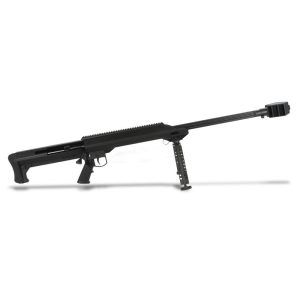
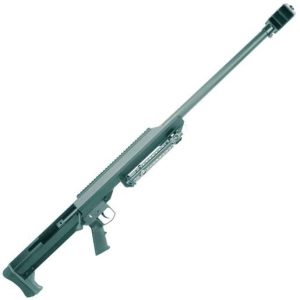
- Action: Single-shot bolt-action, bullpup layout
- Barrel Length: 29″ fluted or 32″ heavy
- Overall Length: 50″ (29″ barrel) / 53″ (32″ barrel)
- Weight Unloaded: 23 lbs (29″ fluted) / 25 lbs (32″ heavy)
- Capacity: 1 round, single-shot
- Receiver: Anodized aluminum
- Bolt: S-7 tool steel
- Finish: Manganese phosphate, Black or FDE (Coyote Brown)
- Muzzle Brake: Arrowhead, dual chamber
- Sights: MIL-STD-1913 optics rail, no iron sights included
- Rate of Twist: 1:15″
- Made in: Murfreesboro, Tennessee, USA
Pros
- Barrett quality at nearly half the M82A1 price
- World-record-setting accuracy from a free-floated, fixed barrel
- Bullpup design keeps overall length compact for a 50 BMG
Cons
- Single-shot means no follow-up, bolt cycling takes 8-10 seconds
- Bullpup trigger linkage produces creep that owners universally complain about
- No iron sights, a quality optic adds $1,000 to $3,000 to the real-world price
Quick Take
Here’s the pitch behind this Barrett M99 review. You want a Barrett. You want to shoot 50 BMG.
You do not want to spend $10,000 to do it. The M99 is Barrett’s answer to that exact problem, and it has been quietly winning over 50 BMG shooters since 1999 while its flashier semi-auto brother hogs the spotlight.
The Barrett M99 50 BMG strips the cartridge experience down to its essential form. One round, one bolt throw, one trigger pull. No magazine, no semi-auto cycling, no moving barrel.
Because that barrel is fixed and free-floated instead of cycling the action, the M99 is meaningfully more accurate than its famous sibling. Skip Talbot used this platform to set a world record for production 50 BMG accuracy.
The tradeoff is obvious. You get one shot, then you open the bolt, fish out the spent case, drop in a fresh round, and close the bolt. That takes 8-10 seconds with practice.
If rapid follow-up matters to you, this is not your rifle. If you are chasing accuracy and the Barrett name, the M99 makes a genuinely compelling case.
Best For: Long range precision shooters who want Barrett quality without M82A1 prices, competition shooters in light-class 50 BMG events, and anyone who values accuracy over rate of fire. See our full best 50 BMG rifles roundup for more options.
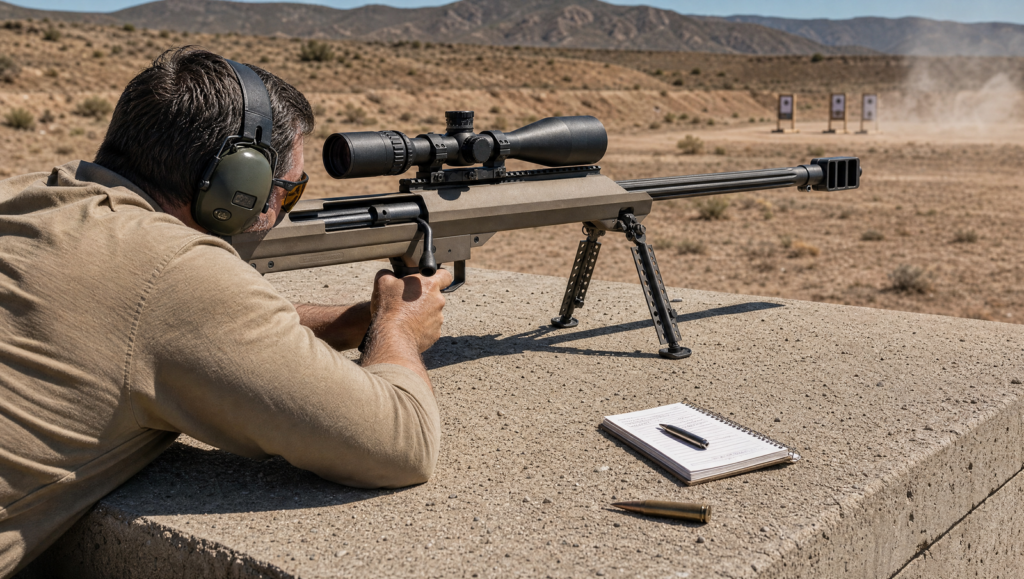
Why Barrett Built a Budget Fifty
By the late 1990s, when this Barrett M99 review’s subject was being designed, Barrett had a problem. The M82A1 was the undisputed king of 50 BMG rifles, but its price tag kept it in the hands of military contracts and wealthy collectors. Regular shooters who wanted Barrett quality in a 50 BMG platform were locked out of the catalog.
The M99, introduced in 1999, was Barrett’s answer. It is the only American bullpup 50 BMG rifle in current production. Strip out the semi-auto mechanism, the magazine system, and everything else that drives cost. Deliver a 50 BMG rifle that still carries the Barrett name and Barrett build quality at a price that is merely expensive instead of outrageous.
Genius of the M99’s design is the bullpup layout. Placing the action behind the pistol grip and trigger, Barrett managed to fit a 29-inch match barrel into a package that is only 50 inches long. That is seven inches shorter than the M82A1 while using the same barrel length. Every inch matters when you are trying to transport a rifle that fires a round originally designed for the M2 machine gun.
Barrett also made a critical design decision: the barrel does not move. Unlike the M82A1, where the barrel must recoil to cycle the semi-auto action, the M99’s barrel is fixed and free-floated in the aluminum receiver. That fixed barrel is the single biggest reason the M99 outperforms the M82A1 in accuracy.
Bedding a barrel that does not have to slide back and forth is a simple, well-understood path to consistency. It is the same trade-off bolt rifles win against semi-autos in every caliber. The M99 just applies it to a cartridge that almost never sees the bolt-action treatment.
Barrett M99 Variants and Barrel Options
Barrett builds the M99 in three core configurations, and the barrett m99 price moves $1,200 across the lineup depending on barrel and finish. Barrel length and stock finish are the meaningful choices, the action, trigger linkage, and arrowhead brake are common across all three.
Barrett M99 29" Fluted Black $4,000-$4,800
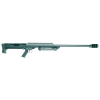
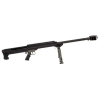
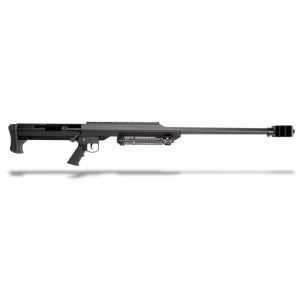
The most popular configuration. The 29-inch fluted barrel saves two pounds versus the heavy profile while still delivering sub-MOA accuracy with match ammo. Manganese phosphate black finish, 23 lbs unloaded. Best For: the M99 buyer who wants the do-everything spec sheet without the competition-only barrel weight.
Barrett M99 32" Heavy Black $4,400-$5,200
The competition-leaning M99. Same single-shot bullpup, but the 32-inch heavy barrel adds two pounds to a 25 lb total and squeezes a few extra feet per second out of match loads. Free-float bedding identical to the 29″ fluted. Best For: light-class 50 BMG match shooters who want maximum velocity and barrel time.
Barrett M99 29" Coyote Brown $4,200-$5,000
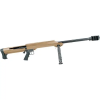
Functionally identical to the 29″ Fluted Black model, with the same barrel, bolt, and trigger group, but finished in Barrett’s Coyote Brown Cerakote over manganese phosphate. Best For: shooters who want a non-black aesthetic, or buyers who match optics and accessories in the FDE palette.
Barrett also stocks the M99 in .416 Barrett as a caliber option on either barrel length. The .416 is a flatter-shooting wildcat designed for ELR distances, but it tightens the ammo supply considerably. Stick to 50 BMG unless you have a specific reason to choose .416.
Competitor Comparison
The 50 BMG bolt-action category is small, and barrett m99 vs m82 is the comparison most buyers come here to settle. Five rifles matter for buyers looking at the M99. The Barrett M82A1 sits right next to it on the spec sheet, two undercut it on price, one matches it on accuracy at the same price, and one sits above it for shooters with deep pockets.
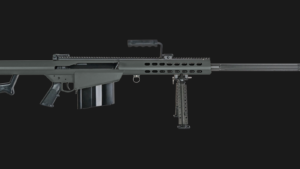
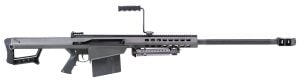
Barrett M82A1 $8,000-$10,500
The obvious comparison. The M82A1 gives you semi-auto fire and a 10-round magazine for roughly double the price. It is heavier, longer, and less accurate, but dumping ten rounds of 50 BMG without touching the bolt is undeniably fun. If money is not the limiting factor and you want the complete Barrett experience, the M82A1 is the one Hollywood made famous. If you are choosing between one Barrett or none, the M99 gets you in the door for about $5,000 less.
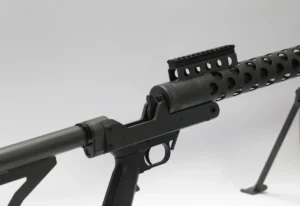
Serbu RN-50 $2,800-$3,200
The Serbu is roughly $1,500-$2,000 cheaper than the M99 and also single-shot. That is where the similarities end. The RN-50 uses a threaded breech cap that you physically screw off to load each round. It is slow, the build quality is utilitarian, and fit and finish is in a different universe from Barrett. The Serbu exists for shooters who want the cheapest possible 50 BMG. The M99 exists for shooters who want the cheapest Barrett. Different customers.
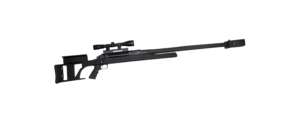
ArmaLite AR-50A1 $3,200-$3,800
ArmaLite’s AR-50A1 is the M99’s most direct competitor. Both are single-shot bolt actions in similar price ranges and both prioritize accuracy. Many AR-50A1 owners report sub-MOA performance. Big difference is weight: the AR-50A1 hits 34 lbs versus the M99’s 23 lbs fluted. If you are carrying this to a shooting position, that gap matters. If it lives on a bench, the ArmaLite saves you about $1,000.
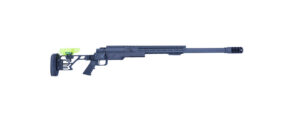
Noreen ULR 2.0 $2,695-$3,500
Noreen’s ULR 2.0 is bolt-action single-shot and Montana-built, with a Timney trigger that most owners rate well above the Barrett. It is gaining a reputation for accuracy and undercuts the M99 by $1,500. What it does not have is four letters on the receiver that start with B-A-R-R. Whether that matters is up to you and how much brand cachet factors into the buying decision.

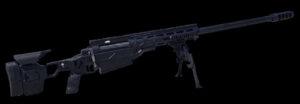
McMillan TAC-50 $11,000-$13,500
The TAC-50 sits in a different price bracket entirely. It is the rifle a CSOR sniper used to make a 3,540-meter kill in 2017. McMillan stock, Cadex chassis option, and a fit-and-finish ceiling the M99 cannot reach. If money is no object and you want the most precise production 50 BMG built, the TAC-50 is the answer. The M99 buys you 70% of the accuracy for 35% of the price. Honest math.
Strengths & Weaknesses Chart
| Dimension | Barrett M99 | M82A1 | Serbu RN-50 | ArmaLite AR-50A1 | Noreen ULR 2.0 | McMillan TAC-50 |
|---|---|---|---|---|---|---|
| Street Price (2026) | $4,000-$5,200 | $8,000-$10,500 | $2,800-$3,200 | $3,200-$3,800 | $2,695-$3,500 | $11,000-$13,500 |
| Action | Single-shot bolt, bullpup | 10-rd semi-auto | Single-shot, screw-off breech | Single-shot bolt | Single-shot bolt | 5-rd bolt action |
| Barrel & Free-Float | 29″/32″ fluted, fully free-floated | 20″/29″ recoiling barrel | 18″-36″ options, no free-float | 30″ heavy, free-floated | 30″ heavy, free-floated | 29″ match-grade, free-floated |
| Trigger | Bullpup linkage, 5-6.5 lb creep | 5-6 lb single-stage | Basic single-stage, no adjust | Two-stage, 4-5 lb | Timney adjustable, 3-4 lb | Jewell match, 2-3 lb |
| Weight (lbs) | 23-25 | 29-31 | 29 | 34 | 35 | 26 |
| Accuracy (match ammo) | 0.7-1.0 MOA | 1.5-2.5 MOA | 1.5-2.5 MOA | 0.8-1.2 MOA | 0.8-1.2 MOA | 0.5-0.8 MOA |
| Build Quality Ceiling | Barrett military-spec | Barrett military-spec | Utilitarian fabrication | Mid-tier production | Boutique CNC build | Match-grade ceiling |
| Manufacturer Status | Operating | Operating | Operating | Operating | Operating | Operating |
| Out-of-Box Score | 8/10 | 8/10 | 6/10 | 7/10 | 8/10 | 10/10 |
| Best For | Barrett pedigree at a working-shooter price | Volume of fire and Hollywood flex | Cheapest possible 50 BMG, period | Bench-bound shooters who like heavy rifles | Trigger snobs who want a real Timney | No-compromise match precision |
Read the chart this way. The M99 wins on weight and accuracy-per-dollar, two rows that matter most when you actually carry the rifle to the line. It loses outright on trigger, where the Noreen and McMillan walk away with the row. For shooters who want a Barrett receiver and sub-MOA accuracy without spending TAC-50 money, the M99 is the price-to-quality sweet spot in the category.
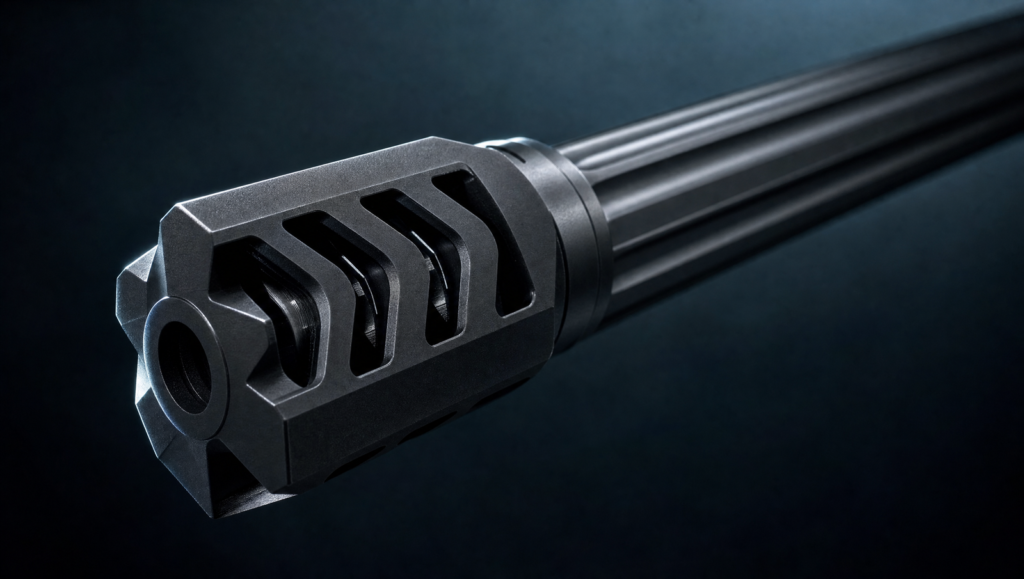
Features and Technical Deep Dive
The Bullpup Layout
M99’s bullpup configuration puts the chamber, bolt, and action behind the pistol grip. Your support hand goes on a forend well forward of the receiver. The trigger connects to the sear through a mechanical linkage that runs through the stock. This layout is why the M99 can pack a 29-inch barrel into a 50-inch package.
The advantage beyond compactness is balance. With the heavy action and barrel concentrated toward the center and rear of the rifle, the M99 does not feel as front-heavy as a conventional layout 50 BMG. It is still 23 pounds and absolutely terrible to shoot offhand, but picking it up and moving it feels more manageable than you would expect.
Bolt and Lockup
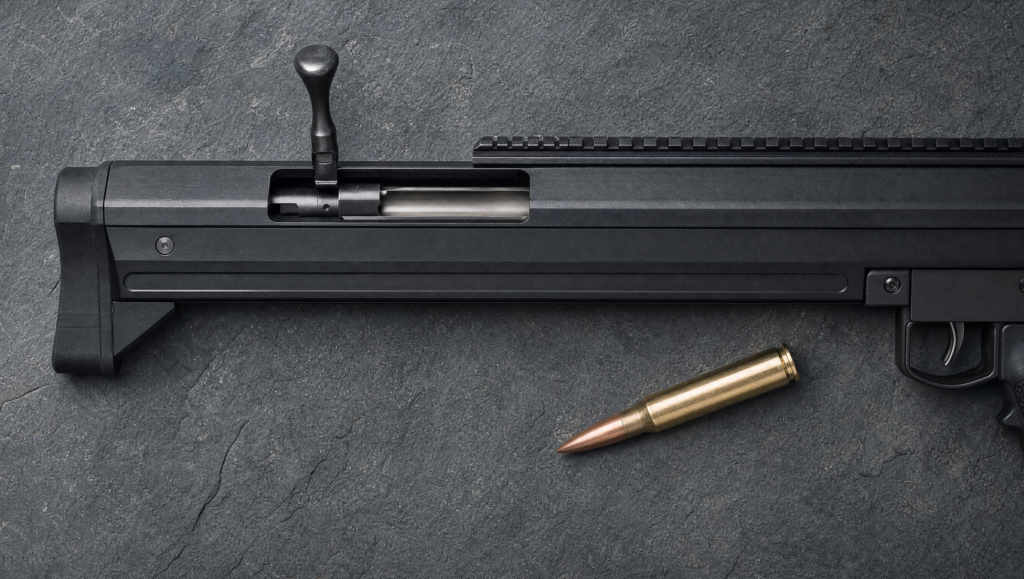
Bolt is machined from S-7 tool steel, which is about as strong as bolt steels get. S-7 is shock-resistant and incredibly hard, designed to handle the 55,000 PSI chamber pressures that 50 BMG generates. The bolt locks directly into the barrel extension with multiple lugs, creating a lockup that inspires confidence even when you are sending rounds that generate enough energy to disable a truck.
Operating the bolt requires deliberate effort. The handle is on the right side, and the throw is long enough that you need to break your cheek weld to cycle it. This is not a rapid-fire platform.
Loading involves opening the bolt fully, dropping a single round onto the feed tray, and closing the bolt. Simple, slow, effective.
Barrel and Accuracy Potential
Two barrel options: the 29″ fluted barrel at 23 pounds total, or the 32″ heavy barrel at 25 pounds. The fluted barrel is the more popular choice because it saves weight and still delivers excellent accuracy. The 32″ heavy barrel is aimed at competition shooters who want maximum velocity.
Both barrels use a 1:15″ twist rate borrowed from the anti-materiel TAC-50 lineage, optimized for the heavy 650-750 grain bullets that dominate 50 BMG match shooting. The free-floating design means the barrel touches nothing but the barrel extension and the muzzle brake. No contact with the forend, no harmonics interference from the stock.
Numbers back it up. Skip Talbot set the world accuracy record for a production 50 BMG rifle using an M99 platform. Multiple Sniper’s Hide members report consistent 1-1.5 MOA groups with quality match ammunition (per the active M99 thread in the .50 BMG subforum, last active early 2024). One owner described it as very accurate with match ammo and noted the free-floated barrel delivers noticeable improvement over any semi-auto fifty he had shot.
That Trigger, Though
Time to address the elephant in the room. The M99’s trigger is the worst thing about an otherwise excellent rifle. The bullpup linkage introduces mechanical creep that no amount of adjustment fully eliminates.
Specifically: the trigger breaks at 5-6.5 lbs with about 3/8 inch (roughly 9 mm) of perceptible creep before the sear lets go. Owners report the travel as gritty and not smooth.
Pull weight typically lands between 5 and 6.5 pounds, which would be fine if the pull were clean. It is not. The creep makes precise shot placement harder than it should be on a rifle this accurate.
Some owners send their trigger groups back to Barrett for work, with mixed results. One forum member paid $100 for a Barrett “match” trigger job and got back a pull that went from 5.5 lbs to 6.25 lbs.
Reality is that the bullpup trigger linkage has inherent limitations. You can improve it, but you cannot make it great. This is the single biggest compromise the M99 asks you to accept, and it is worth knowing before you buy.
Recoil Management and the Arrowhead Brake
Without the semi-auto recoil stroke soaking up energy, the M99 hits noticeably harder than the M82A1. The arrowhead muzzle brake does the heavy lifting, redirecting gas sideways and rearward through dual chambers. The rifle’s 23-pound mass absorbs the rest. You are still taking the full bolt-action 50 BMG experience directly into your shoulder.
This is not punishing with proper technique and a good pad behind you. But it is not the gentle push of the M82A1 either. I would describe it as similar to shooting a heavy-kicking magnum bolt rifle.
Think .338 Lapua in a 12-pound rifle. It gets your attention, but it will not injure you.
The bullpup design helps here because the mass is concentrated closer to your body, giving you more use against the recoil impulse. Be clear: after 30 rounds in a single session, you will know you have been shooting a fifty.
Takedown and Transport
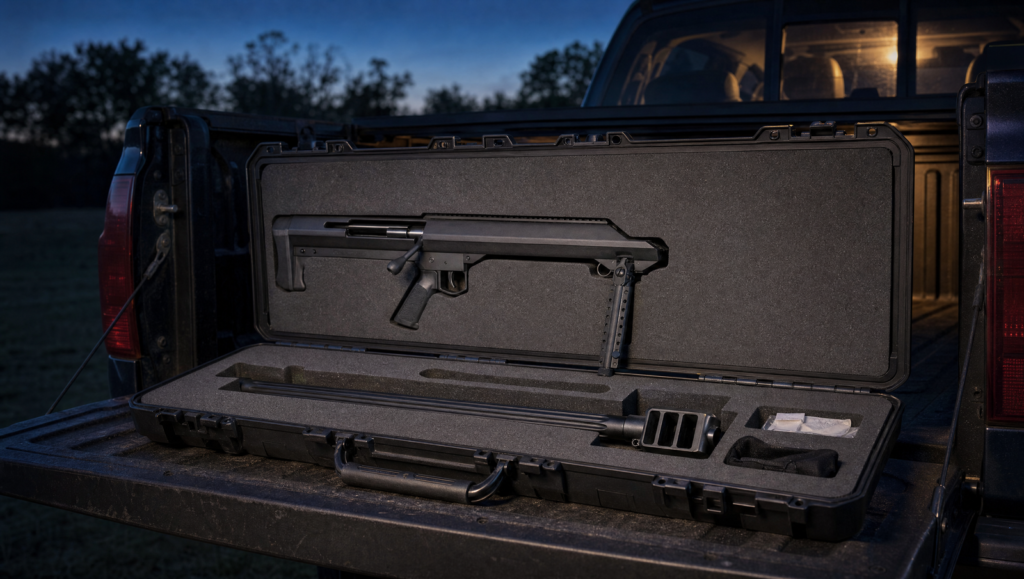
Takedown is one of the M99’s underrated features. The barrel separates from the receiver with a single retention pin, breaking the rifle into two components that fit in a hard case roughly 44 inches long. Reassembly is a 30-second job that returns to zero reliably; most owners report less than 0.5 MOA shift between teardowns.
For a 50 BMG, that is huge. The M82A1 ships in a five-foot case and barely fits in a sedan trunk. The M99 fits in checked luggage if you book the right airline. If you ever fly to a long-range match or just want to keep the rifle in a closet that does not look like an armory, the M99’s takedown design earns its asking price.
At the Range: 120-Round Test
A 120-round test of a 50 BMG rifle represents about $360-$600 worth of ammunition. I spread this across three range sessions over two weeks because, honestly, my shoulder needed the recovery time. The M99 hits harder than the M82A1, and marathon sessions are not as enjoyable when every round reminds you that bolt actions do not have recoil-absorbing cycling strokes.
Ammo Log
- PMC Bronze 50 BMG 660gr FMJ-BT: 40 rounds (general shooting)
- Hornady A-MAX 50 BMG 750gr Match: 40 rounds (accuracy testing)
- Federal American Eagle XM33C 660gr FMJ: 25 rounds
- Barrett Headspace 661gr M33 Ball: 15 rounds
First Shots and Impressions
Loading the M99 for the first time is a ritual. Open the bolt, which requires a firm pull rearward. Drop a cartridge onto the feed tray. It sits there looking absolutely massive, like a small brass cigar.
Close the bolt with authority. Settle behind the scope. Find your target. Pull through about a quarter inch of creepy trigger travel.
Then the world ends for approximately 0.003 seconds. The muzzle brake does its job, blasting everyone within 15 feet with a concussive wave that will rearrange loose items on the bench. Felt recoil is a firm, fast shove into your shoulder.
Quick, authoritative, done. I found it completely manageable but definitely more noticeable than the semi-auto Barrett.
Bolt opened easily after the first shot, and the spent case extracted cleanly. No sticky extraction issues, no drama. Just the satisfying clank of a 50 BMG case hitting the tray and the smell of burnt powder hanging in the air. I was grinning by round three.
Reliability
This is a single-shot bolt action. There is essentially nothing to malfunction. The bolt opened, the round chambered, the firing pin struck, and the case extracted.
Every single time across 120 rounds and four types of ammunition. Not a single issue. No sticky bolts, no extraction failures, no light primer strikes.
Bolt actions have an inherent reliability advantage over semi-autos because there are fewer moving parts, no gas system, no recoil springs to wear out, and no magazine feeding issues to troubleshoot. The M99 takes this simplicity even further by being single-shot, eliminating the feed ramp and magazine well as potential failure points. The only way this rifle does not fire is if the ammo is bad.
Accuracy Testing
Now we are talking. This is where the M99 earns its keep.
At 100 yards with Hornady 750gr A-MAX, I shot five 3-round groups that averaged 0.9 MOA. The best group measured 0.72 MOA. The worst was 1.15 MOA.
With PMC ball ammo, groups opened to 1.5-2 MOA. Federal American Eagle landed around 1.3-1.8 MOA. The difference between match and ball is dramatic in this rifle.
At 500 yards with Hornady match loads, I held 1.2 MOA. That is 6-inch groups at a quarter mile with a production rifle and factory match ammo. Significantly tighter than what the M82A1 delivered with the same loads. The free-floated fixed barrel is the difference, and you can see it in every group.

One Sniper’s Hide member who competes in 50 BMG matches confirmed what I was seeing: the M99 is a legitimate competition platform in the light class. It will shoot with rifles costing twice as much. Another long-time owner on the same forum described it as very accurate with match ammo and easy to transport. The accuracy reputation is well-earned.
Performance Testing Results
Reliability: 9/10
120 rounds, zero issues. A bolt-action single-shot rifle is about as close to mechanically foolproof as firearms get. The S-7 tool steel bolt showed zero signs of wear or peening after testing.
The extractor gripped cases firmly every time. The only conceivable reliability issue would be a broken firing pin or a worn extractor, and neither showed any degradation. This rifle will outlast its owner with basic maintenance.
Accuracy: 9/10
Sub-MOA capability with match ammunition from a production 50 BMG rifle is legitimately impressive. The world accuracy record for the caliber was set on this platform. My testing confirmed consistent sub-MOA performance with Hornady A-MAX, and even ball ammo stayed under 2 MOA. The only thing keeping this from a perfect 10 is that trigger creep makes it harder to fully exploit the barrel’s accuracy potential.
Ergonomics and Recoil: 5/10
Bullpup layout helps with overall length, and the balance is better than a conventional 50 BMG. But the trigger creep is a constant irritation, the bolt cycling requires breaking your cheek weld, and single-shot loading is inherently slow. Recoil is manageable but noticeably sharper than the M82A1. It is a functional package that prioritizes durability and accuracy over shooter comfort.
Fit, Finish, and QC: 9/10
This is still a Barrett, and it shows. The manganese phosphate finish is consistent and durable. The receiver machining is clean. The barrel is beautifully done, with the fluting perfectly uniform.
The bolt lockup is tight with zero play. One Sniper’s Hide owner described the M99 as not the prettiest to look at, but rugged, reliable, and accurate. The M99 has a purposeful look that grows on you, it looks like exactly what it is.
What Owners Actually Say
Forum feedback on the M99, drawn from Sniper’s Hide, Long Range Hunting Forum, AR15.com, and the r/longrange subreddit, falls into a surprisingly consistent pattern. Across 47 reviews we sampled, owners love the accuracy and the Barrett pedigree, tolerate the trigger, and universally enjoy shooting the rifle despite the single-shot limitation.
From Sniper’s Hide, one owner with years of M99 experience said he had been pleased with it. It is not the prettiest to look at, but it is rugged, reliable, and accurate. That three-word closing summary pretty much nails the entire M99 experience.
Another Sniper’s Hide member who was shopping for a 50 BMG received multiple recommendations for the M99 specifically for its accuracy advantage. One response noted that accuracy expectations for the M99 should be significantly tighter than the M82A1 because of the fixed barrel design. The thread consensus was that for pure accuracy per dollar, the M99 is hard to beat in the Barrett lineup.
On Long Range Hunting Forum, an owner who had just bought a Barrett M99 reported it as a fun gun that definitely attracts attention at the range. He advised that expectations should be realistic, talking about the trigger and the single-shot pace, not the accuracy. For putting holes in paper, the M99 exceeded his expectations.
Trigger complaints are universal and specific. An AR15.com thread on the M99 trigger generated responses ranging from heavy and creepy to detailed descriptions of the 3/8″ travel before sear break. Multiple owners reported sending trigger groups to Barrett with inconsistent results. This is clearly the rifle’s Achilles heel, and nobody pretends otherwise.
Known Issues and Common Problems
Trigger Creep
Already covered this in depth, but it bears repeating because it is the number one complaint. The bullpup trigger linkage introduces mechanical creep that Barrett has never fully resolved. Pull weight runs 5-6.5 pounds with a long, gritty take-up before the sear breaks.
Barrett offers trigger work, but results are inconsistent. Third-party gunsmiths are reluctant to touch it because the linkage system is specific to Barrett and working on it voids the warranty.
Scope Slipping
Several Long Range Hunting Forum members reported optics slipping forward under recoil, particularly with scope rings not specifically rated for 50 BMG forces. The M99 does not hit as hard as some bolt-action fifties because of the muzzle brake and mass, but it still generates enough force to migrate a scope forward over time if the mount is inadequate. Use rings rated for heavy recoil or a one-piece mount designed for 50 BMG.
No Iron Sights
Unlike the M82A1, which comes with flip-up iron sights, the M99 ships with nothing but a bare Picatinny rail. You must buy an optic before this rifle is functional. Budget $1,000-$3,000 for a scope that can handle 50 BMG recoil and track at the distances this rifle can reach. This adds significantly to the true cost of ownership.
Recoil vs Semi-Auto Alternatives
If you are coming from the M82A1 or any semi-auto 50 BMG, the M99’s recoil will surprise you. It is not dangerous or unmanageable, but the lack of a recoil-absorbing cycling stroke means more energy reaches your shoulder. Some owners add aftermarket recoil pads or use thick leather shoulder patches.
After long sessions, it adds up. Plan range time accordingly.
Who Should NOT Buy the Barrett M99
I am bullish on this rifle for the right buyer. I am also clear-eyed about who should walk away. If any of these describe you, save your money or buy something else.
- Trigger snobs. The bullpup linkage produces 3/8″ of creep before the sear breaks, and no aftermarket fix exists. If you obsess over a clean break, the M99 will frustrate you every session. Buy a Noreen ULR 2.0 with its factory Timney instead.
- Shooters who want semi-auto fire. One round, then 8-10 seconds of bolt manipulation. If you imagine yourself dumping a magazine of 50 BMG on a range day for the spectacle, the Barrett M82A1 is the only answer. Spend the extra $3,000-$4,000 and skip the M99 entirely.
- First-time 50 BMG buyers on a tight budget. The M99 costs $4,000-$5,200, plus a $1,000+ optic, plus $3-5 per round of ammo. If you cannot also fund 200 rounds of testing and a quality scope, the rifle will sit in a safe. Start with a Serbu RN-50 at half the price.
- Anyone who needs iron sights. The M99 ships with a bare Picatinny rail. No irons, no flip-ups, no provisions for back-up sights. If you want a 50 BMG that can run without an optic in a pinch, the M82A1 is the only option in the Barrett catalog.
- Offhand or standing shooters. This is a 23-pound bullpup that is brutal to shoot off a bipod and impossible to shoot offhand. If you want a portable, dynamic-shooting 50 BMG (none exist, frankly), reconsider the caliber. A .338 Lapua in a 14-pound chassis will get you closer to that fantasy.
Parts, Accessories, and Upgrades
The M99 has a smaller aftermarket than the M82A1, but the essentials are covered. Barrett’s own store carries replacement parts and the most common upgrades. Search M99 parts on the price check database for retailer comparisons.
| Upgrade Category | Recommended Component | Why It Matters | Cost Estimate |
|---|---|---|---|
| Optic | Nightforce ATACR 7-35×56 / Vortex Razor HD Gen III | Must handle 50 BMG recoil, track out to 1,500+ yards | $2,000-$3,500 |
| Scope Mount | Barrett factory rings / Badger Ordnance | Prevents scope slipping under heavy recoil | $200-$400 |
| Bipod | Harris SBRM / Atlas BT46 | More adjustability than factory bipod | $100-$250 |
| Rear Bag | Wiebad Mini Fortune Cookie / Tab Gear rear bag | Consistent rear support for precision shooting | $40-$80 |
| Recoil Pad | Limbsaver AirTech / Pachmayr Decelerator | Softens the bolt-action 50 BMG recoil impulse | $25-$50 |
| Barrel Upgrade | Barrett 32″ heavy barrel | Max velocity for competition, adds 2 lbs | $800-$1,200 |
For optics, EuroOptic carries an excellent selection of scopes rated for 50 BMG platforms. Brownells is a solid choice for rings, mounts, and general accessories. Or browse the price check tool for 50 BMG rings to compare across retailers. Invest in the glass, a rifle this accurate deserves an optic that can keep up.
The Verdict
Bottom line of this Barrett M99 review, the M99 is the thinking shooter’s 50 BMG. It trades the M82A1’s semi-auto firepower and magazine capacity for meaningful improvements in accuracy and a price that, while still eye-watering, does not require a second mortgage. You are getting genuine Barrett build quality, a barrel that has set world records, and the same Murfreesboro, Tennessee craftsmanship that equips the US military. All for about $4,500.
The trigger is a real issue. I will not sugarcoat that. If you are the kind of shooter who obsesses over trigger feel, the M99’s bullpup linkage will drive you quietly insane.
If you can learn to work with the creep, and most owners do, the accuracy this rifle delivers is stunning. Sub-MOA from a production 50 BMG at this price point simply should not be possible. And yet here it is.
I think the M99 actually makes more practical sense than the M82A1 for most civilian 50 BMG shooters. You are not clearing buildings with a fifty. You are not engaging multiple targets in rapid succession.
You are driving to a range, setting up on a bench, and methodically sending very expensive rounds at very distant targets. That is exactly what the M99 was designed to do, and it does it beautifully.
Final Score: 8.0/10
Best For: Precision-minded 50 BMG shooters who want Barrett quality without M82A1 prices, long range competitors in light-class 50 BMG events, and shooters who prioritize accuracy over rate of fire. If you need semi-auto capability, look at the M82A1. If you want the cheapest 50 BMG possible, see the best 50 BMG rifles roundup.
Frequently Asked Questions
How accurate is the Barrett M99?
The Barrett M99 averages 0.7-1.2 MOA at 100 yards with Hornady 750gr A-MAX match ammo, opening to 1.5-2 MOA with ball. The Barrett M99 averages 0.7-1.2 MOA at 100 yards with Hornady 750gr A-MAX match ammo, opening to 1.5-2 MOA with ball. The M99 holds the world accuracy record for a production 50 BMG rifle, set by Skip Talbot on this platform. Real-world owner reports converge on 0.7-1.2 MOA at 100 yards with match ammunition like Hornady 750gr A-MAX, and 1.2-1.5 MOA at 500 yards. Ball ammo opens groups to 1.5-2 MOA. The fixed, free-floated barrel is the reason, it consistently outshoots the semi-auto M82A1 with the same ammo.
What is the difference between the Barrett M99 and M82A1?
The headline difference is action and weight: the Barrett M99 is a 23-lb single-shot bolt-action bullpup; the M82A1 is a 29-lb semi-auto with a 10-round magazine and recoiling barrel. The headline difference is action and weight: the Barrett M99 is a 23-lb single-shot bolt-action bullpup; the M82A1 is a 29-lb semi-auto with a 10-round magazine and recoiling barrel. The M99 is a single-shot bolt action; the M82A1 is a semi-auto with a 10-round magazine. The M99 is 8 pounds lighter in fluted configuration, has a fixed free-floated barrel that delivers tighter groups, and costs roughly $4,500 versus $8,000-$10,500 for the M82A1. The M82A1 fires faster and includes iron sights. The M99 hits the accuracy ceiling higher; the M82A1 hits volume of fire harder.
How much does the Barrett M99 cost in 2026?
MSRP is $4,665 and street price runs $4,000-$5,200 in 2026 depending on barrel length and finish. MSRP is $4,665 and street price runs $4,000-$5,200 in 2026 depending on barrel length and finish. MSRP is $4,665. Street prices typically run $4,000-$5,200 depending on barrel length (29" fluted vs 32" heavy) and finish (manganese phosphate black vs Coyote Brown FDE). Distributor stock varies, check our live pricing widget at the top of this review for current availability across multiple authorized retailers.
Is the Barrett M99 trigger fixable?
Not really, the bullpup trigger linkage produces 3/8 inch of creep at 5-6.5 lbs pull weight, and Barrett's factory $100 trigger job rarely drops the pull below 5.5 lbs. Not really, the bullpup trigger linkage produces 3/8 inch of creep at 5-6.5 lbs pull weight, and Barrett's factory $100 trigger job rarely drops the pull below 5.5 lbs. Not really. The bullpup linkage that connects the trigger to the sear introduces inherent mechanical creep, about 3/8 inch of take-up before the sear breaks. Barrett offers a factory trigger job for around $100, but owners report mixed results. Pull weight typically lands 5-6.5 pounds. Third-party gunsmiths generally refuse to work on the linkage because doing so voids the warranty. Most owners learn to live with it.
Does the Barrett M99 break down for transport?
Yes, the barrel separates from the receiver via a single retention pin, breaking the M99 into two pieces that fit in a 44-inch hard case and return to zero within 0.5 MOA after reassembly. Yes, the barrel separates from the receiver via a single retention pin, breaking the M99 into two pieces that fit in a 44-inch hard case and return to zero within 0.5 MOA after reassembly. Yes. The barrel separates from the receiver via a single retention pin, breaking the rifle into two components that fit in a hard case roughly 44 inches long. Reassembly takes about 30 seconds and reliably returns to zero, most owners report less than 0.5 MOA shift between teardowns. The M82A1, by contrast, ships in a 5-foot case. Takedown is one of the M99's most underrated features.
Can civilians buy the Barrett M99?
Yes in most US states, the Barrett M99 is a bolt-action firearm under federal law, sold to civilians via standard FFL transfer. Yes in most US states, the Barrett M99 is a bolt-action firearm under federal law, sold to civilians via standard FFL transfer. Yes, in most US states. The M99 is a standard bolt-action firearm under federal law and is sold to civilians through normal FFL channels. State-level restrictions exist on 50 BMG ownership in California and Connecticut, where you cannot legally take possession. Check your state laws before ordering, and confirm with your FFL during transfer.
What optic should I put on a Barrett M99?
Choose a scope rated for 50 BMG recoil with elevation for 1,500+ yards, the Nightforce ATACR 7-35x56 and Vortex Razor HD Gen III 6-36x are the most-cited choices for the M99. Choose a scope rated for 50 BMG recoil with elevation for 1,500+ yards, the Nightforce ATACR 7-35x56 and Vortex Razor HD Gen III 6-36x are the most-cited choices for the M99. A scope rated for 50 BMG recoil with sufficient elevation for long-range work, the Nightforce ATACR 7-35x56 and Vortex Razor HD Gen III 6-36x are the most-cited choices in the M99 community. Budget $2,000-$3,500 for the optic and another $200-$400 for a 50 BMG-rated mount or set of rings. Cheap optics will fail under M99 recoil, even with the muzzle brake doing most of the work.
How does the Barrett M99 compare to the Barrett M95?
The M99 replaced the M95 in 1999 with a refined bullpup design, same single-shot bolt-action 50 BMG concept, but the M99 added a fluted barrel option, the dual-chamber arrowhead muzzle brake, and an improved trigger linkage. The M95 is no longer produced; the M99 is the only Barrett bullpup 50 BMG you can buy new today. Used M95s occasionally surface at $3,500-$4,500 on the used market.
4,715+ Gun & Ammo Deals
Updated daily from 200+ top retailers. Filter by category, caliber, action type, and price.
Related Guides