

Last updated September 2026 · By Nick Hall, who has been following 8.6 Blackout since Q first showed the cartridge
Some of the links below are affiliate links, meaning at no additional cost to you, we may earn a commission if you click through and make a purchase.
- Treat every gun as loaded
- Point the muzzle in a safe direction
- Keep your finger off the trigger until you’re ready to shoot
- Know your target and what’s beyond
Quick take: 8.6 Blackout is a .338-bore cartridge built to do one thing properly, which is throw a heavy subsonic bullet through a suppressor. There are only a handful of complete rifles chambered for it, and they run from about $1,170 to $4,000. If you want the short version, the Diamondback DB10 is the cheap way in and Q’s own Fix is the reference gun.
Table of Contents
How we tested: Every pick here is ranked against our testing methodology. Minimum round counts, accuracy and reliability protocols, the failures that disqualify a gun.
SAAMI Standardized 8.6 Blackout in January 2026, and Changed the Twist Rate
This is the part most write-ups have not caught up with, and it matters if you are about to buy a barrel.
8.6 Blackout became famous for a 1:3 twist, which is an absurdly fast rate by rifle standards and was the whole party trick. Spinning a heavy .338 bullet that hard is what produced the dramatic terminal effect people posted videos of. When SAAMI formally standardized the cartridge in January 2026, the recommended twist came out at 1:6, not 1:3.
Both work. Plenty of 1:3 barrels are in circulation and they are not suddenly wrong. But a spec being standardized at half the original twist tells you the cartridge has settled into something more conventional than the launch marketing suggested, and new barrels are increasingly cut to the SAAMI number. Check the twist before you order rather than assuming.
What 8.6 Blackout Actually Is
The cartridge was developed by Q LLC and Kevin Brittingham, the same person behind 300 Blackout. The design brief was to fix what 300 Blackout could not: genuinely serious subsonic terminal performance from a bore bigger than .308.
| Also called | 8.6 BLK, 8.6x43mm |
| Bore | .338 |
| Parent case | 6.5 Creedmoor, necked up to .338 |
| Bolt face | Standard .308, so it drops into AR-10 and .308-family actions |
| Bullet weights | 210 to 300+ grains |
| Subsonic velocity | Under roughly 1,050 fps |
| Twist | 1:3 originally, SAAMI standard 1:6 from January 2026 |
| Typical barrel | 12 to 16 inches |
The .308 bolt face is the practical detail. It means a manufacturer can build an 8.6 gun on tooling they already have, and it means a barrel swap is a realistic path for anyone already running an AR-10. That is why the rifles below exist at all.
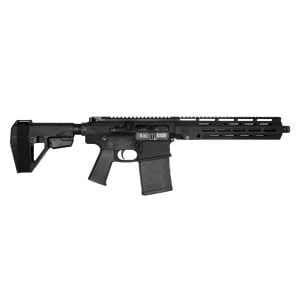
1. Diamondback DB10 8.6 Blackout: The Cheap Way In
At around $1,170 the DB10 is roughly a third the price of Q’s rifle and it is the reason 8.6 stopped being a boutique-only proposition. It is a conventional AR-10 pattern gun, offered as both a 12-inch pistol with a brace and a longer rifle, and Diamondback has been building .308-family ARs for long enough to make that unremarkable in a good way.

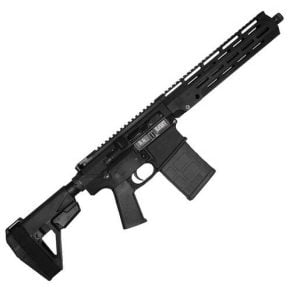
Best For: Anyone who wants to try the cartridge without a four-figure commitment, and who already owns a .338-capable can or is buying one alongside.
2. CMMG Banshee Mk3 8.6 Blackout: The Short One
CMMG put 8.6 into the Banshee Mk3 with a 12.5-inch barrel and a 20-round magazine, which is about as compact as a .338-bore semi-auto gets. Prices sit around $1,700 to $1,725. The Banshee line has a long history of taking odd chamberings and making them work in a short package, and a heavy subsonic bullet out of a short barrel is exactly the use case 8.6 was drawn for, since you are not chasing velocity anyway.
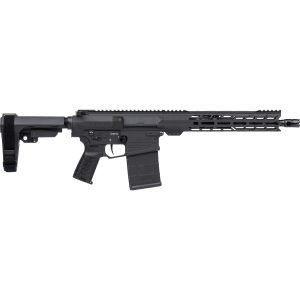
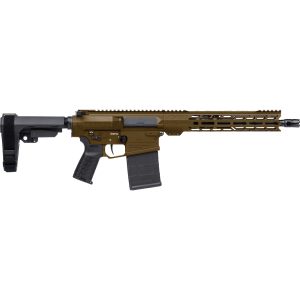
Best For: A suppressed truck gun or a home-defense-adjacent build where overall length matters more than reach.
3. Faxon Sentinel 8.6 Blackout: The One Built Around the Cartridge
Faxon has done more to make 8.6 Blackout a real option than anyone except Q. They build barrels, complete uppers, bolt guns and their own suppressors for it, and the Sentinel is their AR-10 platform gun. Expect roughly $1,978 for the 12-inch and about $2,209 for the 16-inch.
The reason to pay the premium over a DB10 is the ecosystem. If you decide later that you want a different barrel length, a different twist, or a matched can, Faxon is the company most likely to have it on the shelf.
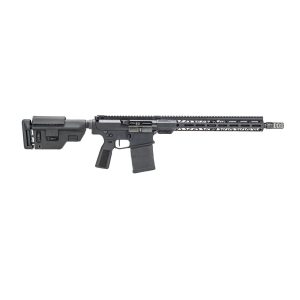
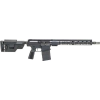
Best For: The buyer who wants a semi-auto 8.6 from a company that treats the cartridge as a product line rather than a novelty chambering.
4. Q The Fix 8.6 Blackout: The Reference Gun
Q invented the cartridge, and The Fix is the rifle it was drawn around. It is a bolt gun with a side-charging handle, a folding skeleton stock and an AICS-pattern magazine, offered in 12-inch and 16-inch, and it costs about $4,000.
That is a lot of money and there is no pretending otherwise. What you are buying is the definitive version, from the people who set the spec, in a package that is genuinely light and genuinely short once the stock is folded. If you care about 8.6 Blackout as a system rather than as a barrel you bolted on, this is the one.
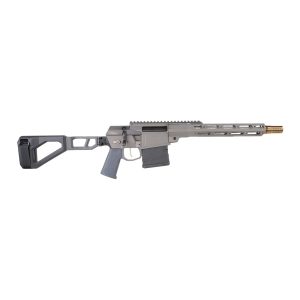
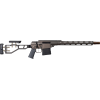
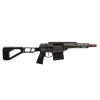
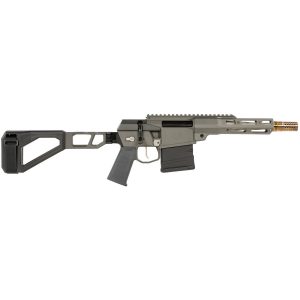
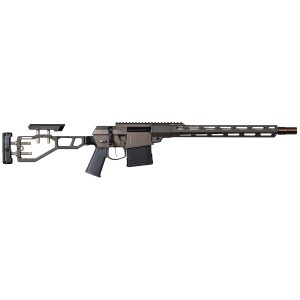
Best For: Buyers who want the originator’s rifle and will actually use the folding-stock, short-barrel, suppressed configuration it was designed for.
You Need a Suppressor for This to Make Sense
Buying an 8.6 Blackout rifle and shooting it unsuppressed is spending a lot of money to own a loud, short-range .338. The entire design argument is subsonic bullets through a can.
Q’s own Short CHOP in 8.6 BLK runs about $800, and Faxon build the Harmonix line for the same cartridge. Budget for the can and the stamp when you price the rifle, not afterwards. Our guide to buying a suppressor covers the process now the transfer tax is $0, and suppressor laws by state covers where you can own one.
Who Should Actually Buy One
8.6 Blackout is a specialist tool and it is worth being blunt about that. It is excellent at close-range suppressed work on game and it is not a long-range cartridge, because a 300-grain bullet at 1,050 fps drops like a thrown brick past a couple of hundred yards.
If you want reach, buy a .308. If you want a general-purpose semi-auto, buy an AR-15. If you specifically want a heavy, quiet, hard-hitting bullet inside 200 yards and you already run a can, 8.6 does something nothing else does as well.
Ammo is the other honest caveat. It is made by a handful of specialists rather than the big factories, so it costs more and you will not find it in every shop. Reloaders have an easier time of it than most.
Related Reading
- Best .308 rifles
- Best AR-15 rifles
- Best suppressors you can buy right now
- How to buy a suppressor in 2026
- Suppressor laws by state
- Today’s gun deals
4,618+ Gun & Ammo Deals
Updated daily from 200+ top retailers. Filter by category, caliber, action type, and price.
Related Guides