
Last updated and checked October 29, 2026 · By Nick Hall
- Treat every gun as loaded
- Point the muzzle in a safe direction
- Keep your finger off the trigger until you’re ready to shoot
- Know your target and what’s beyond
Paper tells you where you hit. Steel tells you that you hit, right now, with a ring you can hear from 300 yards. Most shooters end up wanting both, plus a stand to hang them on and a timer once they get serious. Targets are cheap next to ammo, but the wrong steel at the wrong distance is how people get hurt, so the safety numbers on this page matter more than the prices.
We compare shooting targets from 200+ retailers: paper targets, AR500 and AR550 steel, spinners and dueling trees, self-healing targets, stands, clay throwers and shot timers. Filter by type, brand and price. Below the finder, I’ve laid out what the steel makers say about safe distances, which ammo never touches steel, and the public land rules.
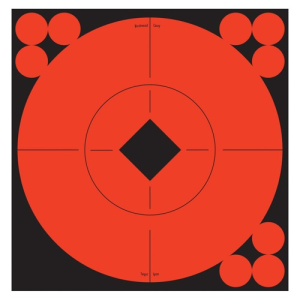
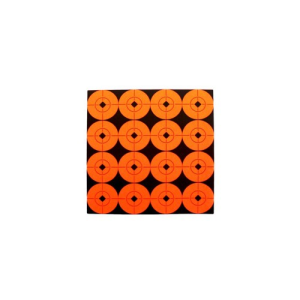
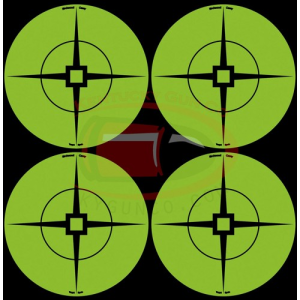
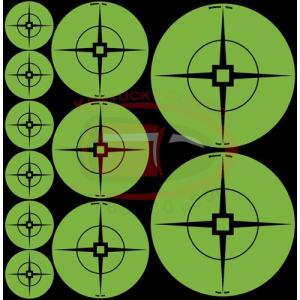
BIRCHWOOD CASEY Target Spots Assort Grn 1" - 60, 2" - 30 & 3" 10pk
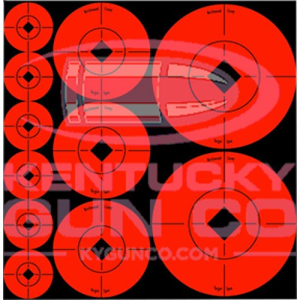
BIRCHWOOD CASEY Target Spots Assort - 1" - 60, 2" - 30 & 3" 10pk
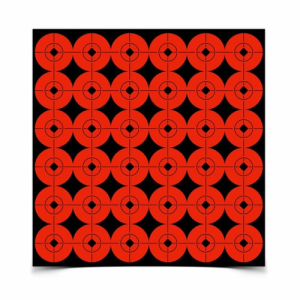
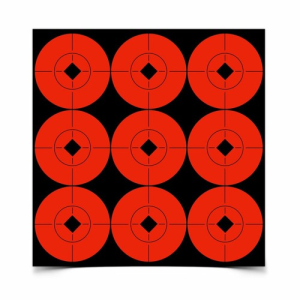
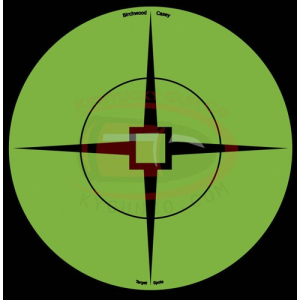
 -50%
Birchwood Casey Handgun Looped Cleaning Brush .40 Caliber 9 Inch 3-Pack
 -59%
Oncore Targets Apple Self-Healing Archery Target Red/Green Small
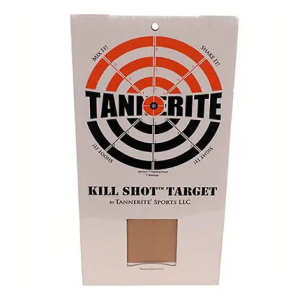
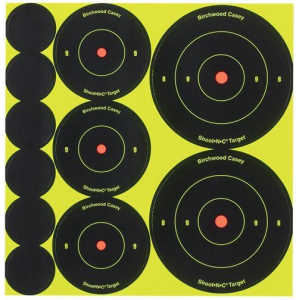
Birchwood Casey Shoot-N-C Targets Assortment 1", 2", & 3" Targets 10/ct
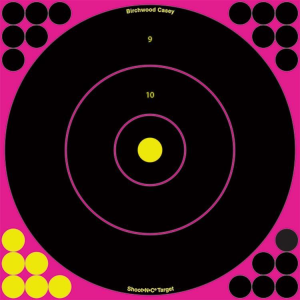
Birchwood Casey Shoot-N-C Pink Reactive Targets 8" 6/ct
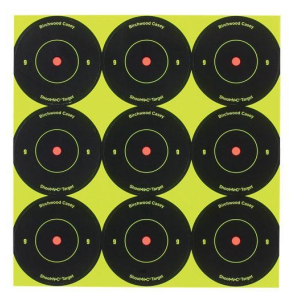
Birchwood Casey Shoot-N-C Targets 2" Targets 10/ct
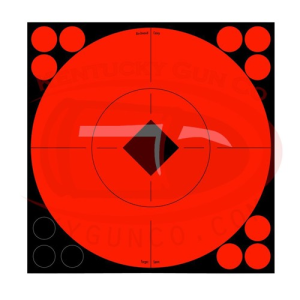
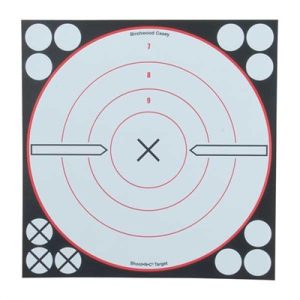
Shoot-N-C White/Black Targets - Shoot-N-C 8'''' Bulls-Eye Target (6 Pack)
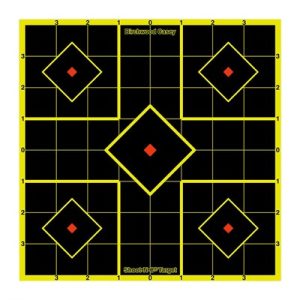
Bc Sight-In Target 8 6 She - Shoot-N-C 8'''' Sight-In Targets 6 Pack With 36 Pasters
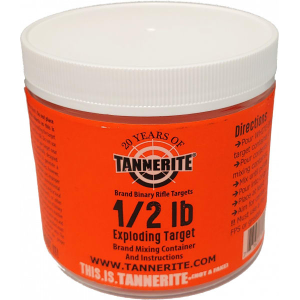
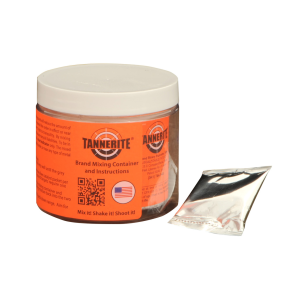
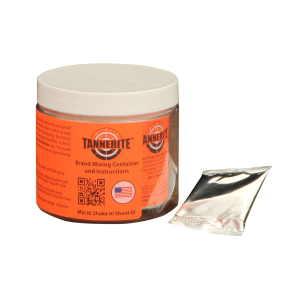
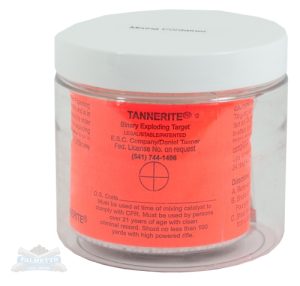
Tannerite 1/2ET Entry Level Impact Enhancement Explosion White Vapor Centerfire Rifle Firearm 0.50 lb Target
Table of Contents
Paper, Steel or Self-Healing?
| Type | Best for | Example and price |
|---|---|---|
| Paper | Zeroing, groups, scoring | Birchwood Casey Shoot-N-C 8 in, $7.99 |
| Steel gong | Instant feedback, long range | ShootingTargets7 3/8 in AR500 8 in, $32.99 |
| Steel spinner or dueling tree | Speed drills, competing with a friend | Do-All Handgun Dueling Tree, $179.99 |
| Self-healing | Plinking without fragments | Do-All Impact Seal 9 in gong, $39.99 |
| Clay thrower | Shotgun practice | Do-All Raven automatic trap, $529.99 |
Paper is the only way to see a group, so you need it to zero any optic. Shoot-N-C targets splatter a bright ring around each hole so you can see hits from the bench. Steel is for practice that feels like the real thing: you call your shot, you hear the hit, and you don’t walk downrange to tape anything. Self-healing polymer targets close up after the bullet passes, so they’re the safe choice for close plinking and rimfire.
For zeroing a rifle, buy a sight-in target with a grid printed in 1-inch squares. Counting squares from your group to the bullseye is faster than measuring, and it makes the clicks easy to work out. Champion’s VisiColor line runs $11.99 for the 8 inch bull and $16.99 for the 100-yard sight-in sheet. For pistol work, a plain silhouette or a USPSA cardboard target teaches you to hit the vital zone fast instead of chasing a tiny dot.
How Far From Steel? The Makers Disagree
| Maker | Handgun minimum | Rifle minimum |
|---|---|---|
| Action Target (safety guide) | 10 yards | 100 yards under 3,000 fps |
| Shoot Steel | 10 yards | 100 yards; 200 above 3,000 fps |
| ShootingTargets7 | 10 yards | 50 yards if impact is under 2,850 fps |
| MGM Targets | 15 yards | 100 yards |
| Infinity Targets | 50 yards | 100 yards |
There’s no single standard, so don’t trust anyone who quotes one. For handguns the makers range from 10 to 50 yards. For centerfire rifles most say 100 yards, and Shoot Steel doubles that to 200 yards for loads above 3,000 fps at the muzzle. My rule is simple: use the number from the maker of the plate you’re shooting, and if you don’t know who made it, use the bigger number. MGM says it “strongly discourages shooting ANY steel at closer than 15 yards with handguns and from less than 100 yards with rifles.”
Velocity matters more than caliber. Infinity notes that “muzzle velocity is different from impact velocity” and caps impact under 2,850 fps, which is why a fast .223 that’s fine at 100 yards can crater a plate at 25.
Ammo That Never Touches Steel
Every steel maker bans armor-piercing and steel-core ammo. Infinity names M855 green tip directly, along with bi-metal and steel-jacketed rounds, and MGM tells you flatly not to shoot its steel with XM193. Action Target adds BBs, steel shot and air gun pellets, and Shoot Steel bans tracers. Those rounds pit or punch through plate, and a pitted plate sends fragments in directions you can’t predict.
Plate thickness has limits too. Action Target says never put centerfire rifle rounds on .22 or handgun-rated plates, meaning 1/4 inch AR500 or 3/8 inch AR500, and says its 3/8 inch AR550 isn’t meant for big magnums like the .300 Win Mag or .338 Lapua.
AR500 vs AR550 Steel
The number is the nominal Brinell hardness, and harder steel resists the cratering that makes splatter unpredictable. Steel maker SSAB rates its Hardox 500 plate at 470 to 530 HBW, Hardox 550 at 525 to 575, and Hardox 600 at 570 to 640. MGM says all its standard targets are AR550 and that it requires a hardness of at least 495. For pistol and rimfire, 3/8 inch AR500 is plenty. For centerfire rifle at distance, buy thicker AR500 or AR550 from a maker that publishes its ratings.
Hang It at an Angle
Never hang steel flat-faced to you. Infinity says to mount a plate with a downward angle of about 10 to 20 degrees so splatter goes into the dirt, and ShootingTargets7 recommends 20 degrees or more. Action Target says never exceed a 20 degree angle of engagement. Chains or rubber straps that let the plate swing help too, because a plate that moves absorbs energy instead of throwing it back. Check every plate for pits and craters before each session and retire any that are damaged.
Spinners and Dueling Trees
Reactive targets turn practice into a game. A spinner flips when you hit it, and a dueling tree swings each paddle to the other side, so two shooters race to clear it. Champion’s Centerfire Double Gong Spinner is $59.99 and Do-All’s Handgun Dueling Tree is $179.99. At the top end, MGM’s Dueling Tree with six targets is $892.56. Make sure any spinner is rated for what you’re shooting: rimfire-rated spinners won’t survive centerfire.
Rimfire and Self-Healing Targets
A .22 is the cheapest way to shoot a lot, and it needs targets built for it. MGM’s 3/16 inch AR400 reactive targets are rated for rimfire at 15 yards or more, and they’re light enough to swing and reset on a .22 hit. Self-healing targets are the other route: Do-All’s Impact Seal line closes up around the hole, so there’s no steel splatter at all. The Bullet Pong target is $24.99, the 9 inch Big Gong Show is $39.99, and the 3D Prairie Dog is $109.99. Champion makes an 8 inch self-healing gong rated for centerfire at $39.99.
Self-healing targets are what I hand new shooters and kids first. They move when you hit them, they’re forgiving of a close distance, and you don’t have to explain fragment risk before the first shot.
Clay Throwers
Shotgun practice needs moving targets, and a hand thrower gets old after the first box of clays. Champion’s Workhorse electronic trap is $350 and its Wheelybird 3.0 auto-feed trap lists at $475. Do-All’s Raven automatic trap is $529.99. An auto-feed machine lets one person shoot alone with a remote, which is the whole point for most buyers.
Target Stands
A stand holds paper or cardboard at chest height, so you’re not stapling targets to a fence. Champion’s Folding Target Holder Stand is $49.95 and packs into its own carry case. If you build your own, use furring strips in a 2×4 base so the uprights are cheap to replace, because you’ll shoot them eventually. For steel, use a stand made for steel, with the plate hung so hits push it backward, never one that holds the plate rigid.
Shot Timers
A shot timer is the cheapest way to get faster. It beeps, records each shot, and tells you exactly how long your draw and splits take, which is the only honest way to measure progress. Competition Electronics’ Pocket Pro is $137.95 and the ProTimer BT with Bluetooth is $167.95. AMG Lab’s Commander is $189, and its Sidekick dry-fire timer is $65. Pair one with our dry-fire training systems guide and the concealed carry dry-fire drills.
USPSA Targets and Scoring
If you want to compete, practice on the target you’ll see at a match. Under USPSA’s Appendix B1, an A-zone hit scores 5 points whether you shoot major or minor power factor, a C-zone hit scores 4 major or 3 minor, and a D-zone hit scores 2 major or 1 minor. B-zone hits on older targets now count as C. Cardboard USPSA targets come in 100-packs. New to the sport? Start with what USPSA is and USPSA vs IDPA.
Exploding Targets and Tannerite
Binary exploding targets are legal to buy under federal law because ATF doesn’t regulate the unmixed components. Once you mix them, ATF treats the result as an explosive. You can mix them for your own personal use without a license, but a mixed target must sit in an explosives magazine until you use it, and moving one needs a federal explosives license or permit. So mix at the range, right before you shoot it. Exploding targets are banned on a lot of public land, and regional Forest Service orders cover much of the West, so check the current order for your area first. More in our Tannerite explainer.
Shooting on Public Land
The BLM allows target shooting on most of its public lands outside developed recreation sites, though it notes that glass and exploding targets are banned in some states. Its rule for everyone: carry in your targets, and carry out all litter, brass and shell casings. In national forests, 36 CFR 261.10(d) bans shooting within 150 yards of a residence, building, campsite, developed recreation site or occupied area, across or on a forest road or a body of water next to it, or into a cave. Use a dirt backstop, never shoot at rocks, and pick up every target you brought.
My Shopping Order
Start with paper and a stand, because you can’t zero without them. Second, buy one 3/8 inch AR500 gong from a maker that publishes its distance and ammo limits, plus the chain or strap to hang it at an angle. Third, a shot timer once you care about speed. Spinners, dueling trees and clay throwers are the fun extras, and they’re worth it once the basics are covered. Wear eyes and ears every time, steel or not; our shooting protection hub has both.
Facts and Figures

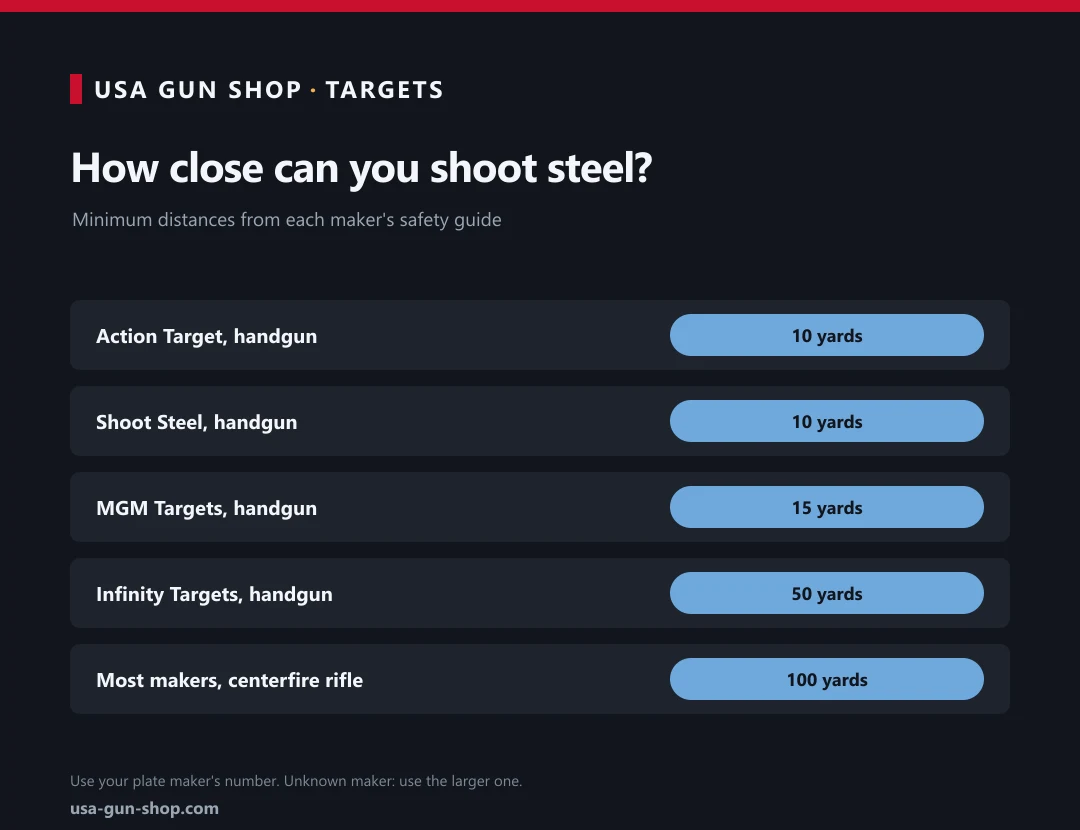
- 10 to 50 yards: the range of handgun minimums the steel makers publish, per Action Target and MGM
- 2,850 fps: Infinity’s impact velocity cap for its steel
- 470 to 530 HBW: SSAB’s Hardox 500 hardness range
- 150 yards: no shooting this close to a residence or campsite in a national forest, per 36 CFR 261.10
- 5 points: a USPSA A-zone hit at either power factor
Related Guides
- What is Tannerite?
- Best dry-fire training systems
- What is USPSA?
- USPSA vs IDPA
- Shooting protection
- Slings and bipods
Frequently Asked Questions
How far away should I stand when shooting steel targets with a pistol?
Action Target's safety guide lists 10 yards and further for handguns on its AR500 and AR550 plates, while MGM Targets sets 15 yards as its minimum. Use the larger figure unless your plate's maker states otherwise, and wear eye protection every time.
What is the minimum distance for shooting steel with a rifle?
Action Target, MGM and Shoot Steel all set 100 yards as the rifle minimum for standard centerfire ammunition under 3,000 fps. Shoot Steel moves that to 200 yards for loads above 3,000 fps at the muzzle.
What ammo should I never shoot at steel targets?
Every major maker bans armor-piercing and steel-core rounds, and Infinity Targets names M855 green tip by name. MGM Targets also bans XM193, and Action Target bans BBs, steel shot and air gun pellets.
What is the difference between AR500 and AR550 steel?
The number is the nominal Brinell hardness. SSAB rates its Hardox 500 plate at 470 to 530 HBW and Hardox 550 at 525 to 575 HBW. MGM Targets says its AR550 plates run 495 to 540 Brinell, and harder steel resists the pitting that makes splatter unpredictable.
Should a steel target hang straight or at an angle?
Hang it tilted downward. Infinity Targets advises a 10 to 20 degree downward angle so splatter goes into the dirt, and Action Target says never to exceed a 20-degree angle of engagement.
Is Tannerite legal?
Under federal law, yes: ATF does not regulate the unmixed binary components, but once mixed the result is an explosive. Moving a mixed target needs a federal explosives license or permit, and a mixed target must sit in an explosives magazine until you use it. Regional Forest Service orders ban exploding targets across much of the West, so check the current order for your area.
What are the rules for target shooting in a national forest?
Federal rule 36 CFR 261.10(d) bars shooting within 150 yards of a residence, building, campsite, developed recreation site or occupied area. It also bans shooting across or on a forest road or an adjacent body of water, or into a cave.
How is a USPSA target scored?
Under USPSA Appendix B1, an A-zone hit scores 5 points at either power factor, a C-zone hit scores 4 major or 3 minor, and a D-zone hit scores 2 major or 1 minor. B-zone hits on older targets now count as C.
4,367+ Gun & Ammo Deals
Updated daily from 200+ top retailers. Filter by category, caliber, action type, and price.