
Last updated November 21st 2026
By Nick Hall, who wrote our National Firearms Act explainer.
Quick Answer: The Gun Control Act of 1968 is the federal law that governs most gun sales in the US today. It ended mail-order gun sales to the public, required anyone in the business of selling guns to hold a federal license, barred dealers from selling handguns to buyers from another state, set the 18 and 21 age limits at dealers, expanded the list of people barred from shipping or receiving guns, and added a “sporting purposes” test for imported guns. President Lyndon B. Johnson signed it on October 22, 1968. Its rules live in 18 U.S.C. chapter 44, including the prohibited-person list at 18 USC 922(g).
This is a plain-English guide to federal law, not legal advice. Your state can add its own rules on top, and some of the federal rules below are being argued in court right now. Checked against 18 U.S.C. chapter 44 as current through Public Law 119-142, Public Law 90-618 and the Supreme Court opinions linked below.
Table of Contents
What the Gun Control Act of 1968 Did
The Gun Control Act of 1968, Public Law 90-618, rewrote the federal gun laws in 18 U.S.C. chapter 44 and rewrote the National Firearms Act. The act as passed describes itself as a law “To amend title 18, United States Code, to provide for better control of the interstate traffic in firearms.” In practice, it did seven big things:
- Ended mail-order sales to the public. Only licensed dealers, makers, importers and collectors could ship guns across state lines to each other.
- Licensed the gun business. Anyone in the business of making, importing or dealing guns needed a federal license, which today is the FFL.
- Kept handgun sales in-state. A dealer can’t sell a handgun to a buyer who lives in another state.
- Set age limits at dealers. 18 for rifles and shotguns, 21 for everything else, including handguns.
- Rewrote the prohibited-person list. The 1938 act already barred fugitives and people indicted for or convicted of a crime of violence. The 1968 act barred four categories from shipping, transporting or receiving guns. Today 922(g) has nine and covers possession too.
- Restricted imports. Imported guns had to pass a “sporting purposes” test.
- Rewrote the NFA. Title II brought destructive devices under federal control and opened a 30-day amnesty to register unregistered NFA guns.
Section 101 of the Gun Control Act also said what it was not meant to do: it was not intended “to discourage or eliminate the private ownership or use of firearms by law-abiding citizens for lawful purposes.”
Why Congress Passed It in 1968
The act followed the assassinations of President John F. Kennedy in 1963, and Dr. Martin Luther King Jr. and Senator Robert F. Kennedy in 1968. The rifle used to kill President Kennedy had been ordered by mail from Klein’s Sporting Goods in Chicago in March 1963, on a magazine coupon signed “A. Hidell.” Johnson’s own summary of the new law began: “It stops murder by mail order.”
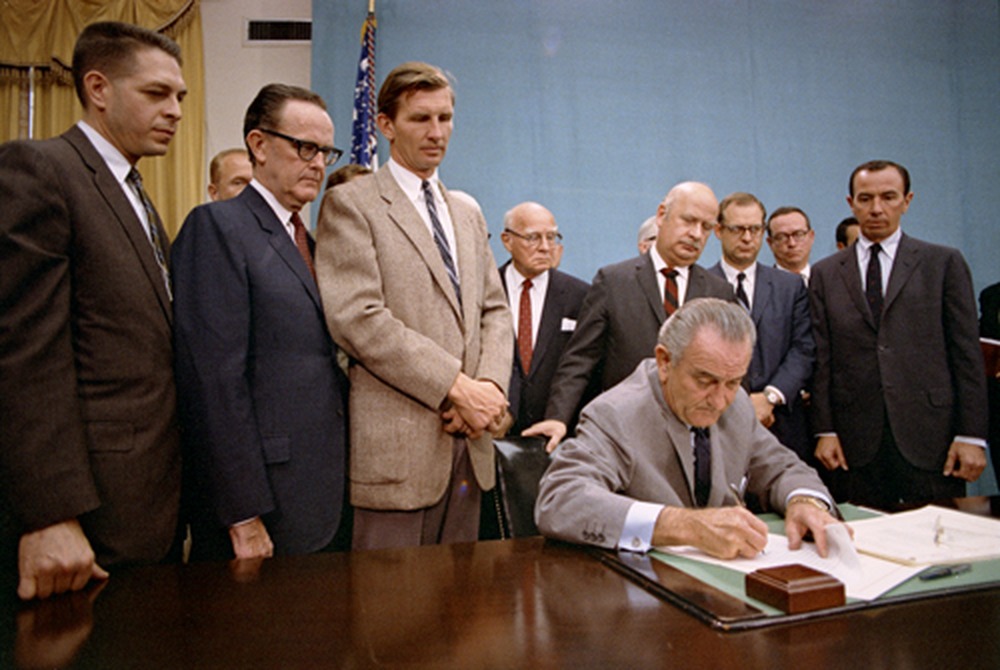
Johnson signed it in the Cabinet Room on October 22, 1968, and didn’t hide that he wanted more. “Today we begin to disarm the criminal and the careless and the insane,” he said, according to the American Presidency Project. He also said: “I asked for the national registration of all guns and the licensing of those who carry those guns.” Congress gave him neither, and the act has never required gun registration or a license to own a gun.
One detail most histories skip: Congress had already created chapter 44 in June 1968, in Title IV of the Omnibus Crime Control and Safe Streets Act. That version focused on handguns. The October act rewrote it before it took effect and extended the controls to rifles, shotguns and ammunition.
Key Dates
- June 30, 1938: The Federal Firearms Act creates the first federal dealer licenses.
- June 19, 1968: The Omnibus Crime Control and Safe Streets Act creates chapter 44 and repeals the 1938 act.
- October 22, 1968: Johnson signs the Gun Control Act. The import ban and the sporting-purposes import test take effect that day.
- December 16, 1968: Most of the rest, including the dealer rules, takes effect.
- May 19, 1986: The Firearm Owners Protection Act rewrites large parts of the GCA and freezes new machine guns.
- November 30, 1993: The Brady Act adds background checks.
- June 25, 2022: The Bipartisan Safer Communities Act adds dating partners and under-21 checks.
Who Can’t Own a Gun: 18 USC 922(g)
Under 18 USC 922(g), nine groups of people can’t ship, transport, possess or receive a gun or ammunition. This is the part of the GCA most people search for. Here is the current list in 18 USC 922, in plain English:
- 922(g)(1): Anyone convicted of a crime punishable by more than one year in prison. That’s the felony ban. Under 921(a)(20), it also reaches a state misdemeanor punishable by more than two years. It doesn’t count business-regulation offenses such as antitrust, or a conviction that has been expunged, set aside or pardoned or for which civil rights were restored, unless that relief expressly bars guns.
- 922(g)(2): Fugitives from justice.
- 922(g)(3): Unlawful users of, or people addicted to, a controlled substance. Since January 22, 2026, ATF’s rule defines an unlawful user as a person who “regularly uses a controlled substance over an extended period of time continuing into the present” without a lawful prescription.
- 922(g)(4): Anyone adjudicated as a mental defective or committed to a mental institution.
- 922(g)(5): People unlawfully in the US, and most people admitted on a nonimmigrant visa.
- 922(g)(6): Anyone dishonorably discharged from the Armed Forces.
- 922(g)(7): Anyone who has renounced US citizenship.
- 922(g)(8): Anyone subject to a qualifying domestic violence restraining order, issued after a hearing, protecting an intimate partner or child.
- 922(g)(9): Anyone convicted of a misdemeanor crime of domestic violence.
A separate rule, 922(n), bars anyone under felony indictment from buying or receiving a gun. It doesn’t ban keeping one they already own. And 922(d) makes it a crime for anyone, dealer or private seller, to sell a gun to someone they know or have reasonable cause to believe is prohibited.
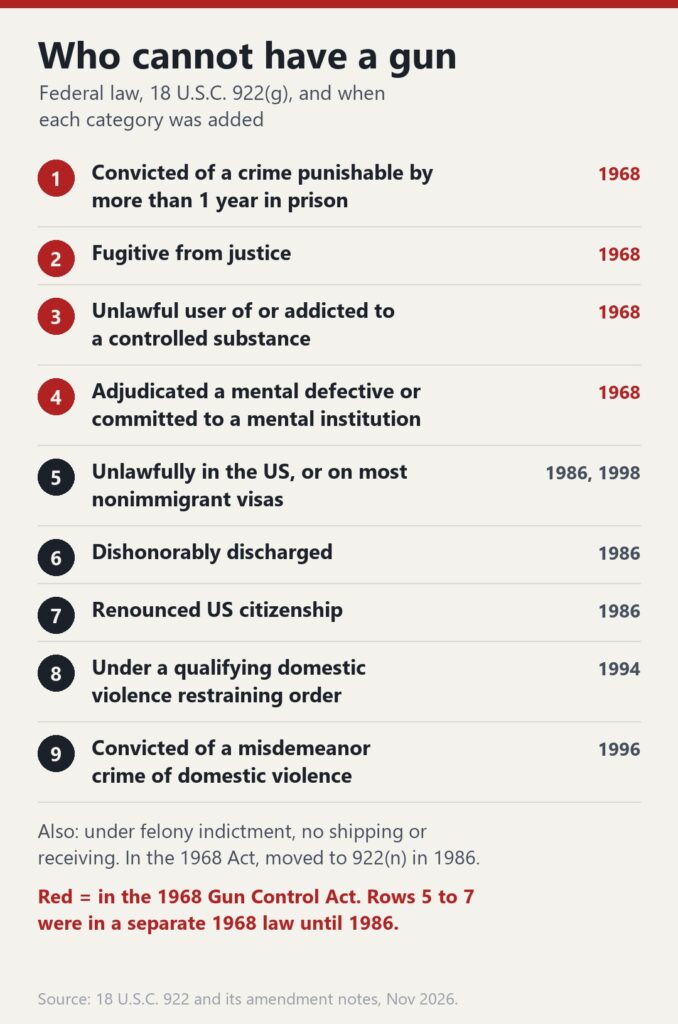
Only four of the nine were in the original 1968 act: felony conviction, fugitive, drug user and mental adjudication. The discharge, citizenship and immigration categories came from a separate 1968 law and moved into 922(g) in 1986. The restraining-order category came in 1994 and the domestic violence misdemeanor in 1996. Many explainers present today’s list as the 1968 list. It isn’t.
The Lautenberg Amendment: 922(g)(9)
The Lautenberg Amendment is the 1996 law that added 922(g)(9), which bans gun possession by anyone convicted of a misdemeanor crime of domestic violence. It was named for Senator Frank Lautenberg and became law inside the Omnibus Consolidated Appropriations Act, 1997, on September 30, 1996.
It matters because it reaches misdemeanors, not just felonies. A single domestic violence misdemeanor conviction can mean a lifetime federal ban, and it applies to police officers and soldiers too, because the government-use exemption in 925(a)(1) expressly excludes 922(g)(9). The conviction has to involve the use or attempted use of physical force, or the threatened use of a deadly weapon, against a covered victim.
In 2022, the Bipartisan Safer Communities Act widened the covered victims to include “a person who has a current or recent former dating relationship with the victim.” That change applies only to convictions entered on or after June 25, 2022. It also added a way back for that group only. A person with no more than one such conviction against a dating partner, and no other prohibition, gets their rights back once 5 years have passed since the later of the conviction or the end of the sentence, as long as they haven’t since been convicted of another such offense, a misdemeanor involving force or a deadly-weapon threat, or anything else that bars them under 922(g). That restoration doesn’t apply to spouses, parents, guardians, people who share a child with the victim, or people who lived with the victim as a spouse.
The restraining-order ban in 922(g)(8) is different. It covers intimate partners, which the statute defines as spouses, former spouses, a child’s other parent and people who have lived together. Dating partners are not in that definition. The Supreme Court upheld 922(g)(8) in United States v. Rahimi, 602 U.S. 680, in 2024.
Age Limits: 18 for Long Guns, 21 for Handguns
Under 922(b)(1), a licensed dealer can’t sell a rifle or shotgun, or its ammunition, to anyone under 18, or any other gun or ammunition to anyone under 21. The rule is the same today as in 1968, and it applies to dealers. Private sales follow a different federal rule. Under 922(x), added in 1994, no one may sell, deliver or transfer a handgun or handgun-only ammunition to anyone under 18, and no one under 18 may possess one. The exceptions are narrow, such as hunting, ranching, target practice or a safety course with a parent’s prior written consent carried at all times. Federal law sets no 21 limit on private sales, but many states do.
Two recent changes matter here. First, the 2022 BSCA added an extra background check step for buyers under 21. NICS checks for disqualifying juvenile records, and the dealer may have to wait up to 10 business days. That step is temporary and is set to expire on September 30, 2032.
Second, on September 18, 2026, the Justice Department’s Office of Legal Counsel concluded that 922(b)(1) and 922(c)(1) “may not be enforced to impose criminal penalties on dealers who sell handguns” to otherwise law-abiding adults ages 18 to 20, according to the Justice Department. That’s an enforcement position, not a court ruling. The statute hasn’t been repealed, and ATF’s regulation at 27 CFR 478.99(b) still sets the 21 limit. An opinion like this binds the current Justice Department, not the courts or a later administration, and the general federal statute of limitations in 18 U.S.C. 3282 is five years. Don’t assume an 18 to 20 year old can now buy a handgun at a dealer. State under-21 laws, dealer policies and the BSCA juvenile-record check above all still apply, so check with your dealer and your state.
Buying a Gun in Another State
You can buy a rifle or shotgun from a dealer in another state, in person, if the sale is legal in both states. A handgun has to be shipped to a dealer in your home state. That’s 922(b)(3), as rewritten in 1986. The 1968 version allowed out-of-state long gun sales only to residents of neighboring states.
Private sales across state lines are a different story. Under 922(a)(5), an unlicensed person can’t sell or give a gun to someone they know lives in another state, except through a will or a short loan for lawful sporting use. Under 922(a)(3), you can’t bring home a gun you bought or were given privately in another state, unless you inherited it and can legally own it at home. Run those sales through a dealer in the buyer’s state. Private sales between two residents of the same state need no federal background check, though many states require one. Our FFL transfer guide walks through it, and how to buy a gun online covers the shipping side.
Active duty service members count as residents of the state where their permanent duty station is, under 921(b).
Shipping a Gun Under the GCA
Federal law lets you ship a gun you legally own to a licensee, such as a gunsmith or dealer, in any state. 922(a)(2) says it “shall not be held to preclude an individual from mailing a firearm owned in compliance with Federal, State, and local law” to a licensee. Handguns are the exception for Postal Service mail, covered below. What you can’t do is ship a gun to an unlicensed person in another state.
If you ship a gun or ammunition by carrier to anyone other than a licensee, 922(e) requires written notice to the carrier. The same rule bars carriers from requiring a label on the outside of the box that says it contains a gun, and 922(f)(2) requires the carrier to get a written receipt from the recipient on delivery.
Handguns are the tricky part. 18 U.S.C. 1715 says handguns are “nonmailable” through the Postal Service. On January 15, 2026, the Justice Department’s Office of Legal Counsel concluded that section 1715 is unconstitutional as applied to handguns and that the Postal Service should change its rules, and the Postal Service proposed new rules in April 2026. Until a final rule is in place, assume the old Postal Service limits still apply, and remember that private carriers set their own policies. Most will only take guns from licensees.
Dealers and the FFL System
The Gun Control Act requires anyone “engaged in the business” of dealing, making or importing guns to hold a federal firearms license. Under 923, a standard dealer license costs $200 for 3 years and $90 for each 3-year renewal. The 1968 fee was $10 a year.
Who counts as “engaged in the business” changed in 2022. The test used to be dealing “with the principal objective of livelihood and profit.” It’s now dealing “to predominantly earn a profit,” which is a lower bar. The statute still excludes “a person who makes occasional sales, exchanges, or purchases of firearms for the enhancement of a personal collection or for a hobby.”
Licensees keep records of every gun they receive and sell, and manufacturers and importers must put a serial number on every frame or receiver, under 923(i). Shipping, receiving or possessing a gun whose serial number has been removed, obliterated or altered is a crime under 922(k). Licensees don’t send their sales records to the government as a matter of course, and routine warrantless compliance inspections are limited to once in any 12-month period. When you buy from a dealer, you fill out ATF Form 4473, the sale record the Gun Control Act’s record-keeping rules require, and the dealer runs a background check. The check came from the Brady Act in 1993, not the Gun Control Act. If NICS doesn’t answer within 3 business days, the dealer may complete the sale under 922(t), unless state law says otherwise.
For what dealers charge to handle a transfer, see our guide to FFL transfer fees.
Imports and the Sporting Purposes Test
Under 925(d)(3), an imported gun has to be of a type “particularly suitable for or readily adaptable to sporting purposes,” and surplus military guns are excluded. This took effect the day Johnson signed the act. A later amendment, 925(e), lets licensed importers bring in rifles and shotguns on ATF’s curio and relic list, which is why surplus military rifles still reach US dealers. Johnson also signed Executive Order 11432, “Control of Arms Imports,” at the same ceremony.
The test is why many military-pattern rifles were imported in sporting configurations over the years. In 1990, Congress added 922(r), which bars assembling a semi-auto rifle or any shotgun from imported parts if it would be identical to one that couldn’t be imported. ATF’s regulation, 27 CFR 478.39, bars using more than 10 of 20 listed imported parts in such a build, and the list includes magazine bodies, followers and floorplates, which is why US-made parts and magazines matter to AK builders. Our best AK magazines guide covers how magazine parts count.
Curios, Relics and the C&R License
The Gun Control Act created the licensed collector, and ATF defines curios and relics as guns made at least 50 years ago, not counting replicas, guns certified by a museum curator, or guns that get much of their value from being novel, rare or historic. A collector license costs $10 a year under 923(b), and it “shall only apply to transactions in curios and relics.”
A C&R license lets a collector receive curio and relic guns across state lines. It doesn’t make C&R guns exempt for everyone. Without the license, buying a 70-year-old military rifle from another state goes through a dealer like any other gun. Antique firearms, which the statute defines as guns made in or before 1898 and certain replicas and muzzleloaders, aren’t “firearms” under the Gun Control Act at all. That excludes any muzzleloader built on a firearm frame or receiver, or one that can be readily converted to fire fixed ammunition.
Title II: Destructive Devices and the NFA Rewrite
Title II of the Gun Control Act rewrote the National Firearms Act and added destructive devices to it. That’s why 26 U.S.C. 5845, the NFA definitions, traces back to the 1968 act. A destructive device includes bombs, grenades and mines, and any weapon with a bore over one-half inch, except shotguns suitable for sporting use.
Title II also opened a 30-day amnesty to register NFA guns, and promised that information used to register couldn’t be used as evidence of a prior crime. The NFA tax has since changed: since January 2026, the federal transfer and making taxes are $0 for suppressors, short-barreled rifles and shotguns and any other weapons, but still $200 for machine guns and destructive devices. Registration still applies. Our National Firearms Act explainer covers the NFA side in full.
What Has Changed Since 1968
| Rule | In the 1968 act | Today | Changed by |
|---|---|---|---|
| License to sell ammunition | Required | Only to make or import ammo | FOPA, 1986 |
| Dealer ammo sales records | Required | Armor-piercing ammo only | 1982 and FOPA, 1986 |
| Out-of-state long gun from a dealer | Neighboring states only | Any state, in person, legal in both | FOPA, 1986 |
| Mailing your gun to a licensee | For repair or customizing only | To any licensee | FOPA, 1986 |
| Private sale to a prohibited person | Not covered | Crime for anyone | FOPA, 1986 |
| Prohibited categories | 4 | 9, plus indictment | 1986, 1994, 1996, 1998 |
| New machine guns for civilians | Allowed with NFA registration | Frozen after May 19, 1986 | FOPA, 1986 |
| Assembly from imported parts | No rule | Restricted by 922(r) | Crime Control Act, 1990 |
| Background check | None, buyer statement only | NICS check at dealers | Brady Act, 1993 |
| Dating-partner domestic violence | Not covered | Covered, with 5-year restoration | BSCA, 2022 |
| Notice to police for a sale not at the dealer’s premises | Registered or certified mail | Mail or verified electronic notice | NDAA, December 2024 |
| Under-21 juvenile record check | None | Up to 10 business days, until 2032 | BSCA, 2022 |
The Firearm Owners Protection Act of 1986 did more to change the GCA than any law since. It loosened the interstate and ammunition rules and added the machine gun freeze in 922(o), which is a FOPA rule, not a GCA rule.
The Supreme Court and the GCA Today
Three recent Supreme Court decisions shape how the GCA works now.
- United States v. Rahimi, 2024: Upheld 922(g)(8). The Court held that “When an individual has been found by a court to pose a credible threat to the physical safety of another, that individual may be temporarily disarmed consistent with the Second Amendment.”
- Bondi v. VanDerStok, 2025: Upheld ATF’s 2022 frame and receiver rule, holding it “is not facially inconsistent with the GCA.” That rule treats some weapon parts kits as firearms.
- United States v. Hemani, June 18, 2026: Held that “The government’s prosecution of Mr. Hemani under §922(g)(3)’s unlawful user provision is inconsistent with the Second Amendment.” The government had relied solely on his admitted marijuana use about every other day. The Court said “In many respects, this case is a narrow one,” and left open addicts, people who are presently intoxicated, the felony ban, and prosecutions backed by individualized proof that a user is dangerous. 922(g)(3) is still law. Marijuana is still a federally controlled substance, and a false answer about drug use on Form 4473 is a separate federal crime under 922(a)(6).
Lower courts are still hearing challenges to other parts of 922(g), especially the felony ban. Treat every category above as binding law unless Congress repeals it or the Supreme Court strikes it down.
Penalties and Getting Your Rights Back
Knowingly violating 922(g) or 922(d) carries up to 15 years in federal prison under 924(a)(8). Lying on Form 4473 under 922(a)(6) carries up to 10 years under 924(a)(2).
Section 925(c) lets a prohibited person apply to the Attorney General for relief from the federal ban, and the Justice Department published final rules for those applications on August 20, 2026, effective September 21, 2026. A pardon, expungement or set-aside can also remove a conviction under 921(a)(20) and 921(a)(33), unless it expressly bars guns. If you think you might be prohibited, talk to a lawyer before you buy or possess a gun.
Common Mistakes About the Gun Control Act
- “The Gun Control Act repealed the Federal Firearms Act of 1938.” It didn’t. Section 906 of the Omnibus Crime Control and Safe Streets Act repealed it in June 1968.
- “The Gun Control Act created background checks.” It didn’t. The Gun Control Act of 1968 relied on the buyer’s own statement. Background checks came with the Brady Act in 1993.
- “It took effect October 22, 1968.” Only the import rules and definitions did. Most of the act took effect December 16, 1968.
- “The 1968 act banned machine guns.” It didn’t. The freeze on new civilian machine guns is 922(o), added in 1986.
- “It created gun registration.” It didn’t. Johnson asked for national registration and licensing of gun owners, and Congress said no.
- “Removing a serial number became a crime in 1968.” The 1938 act already banned shipping or receiving a gun with an altered serial number.
The Bottom Line
The Gun Control Act of 1968 is why you buy guns through licensed dealers, why a handgun bought in another state has to go through a dealer in your home state, why dealers check your age, and why some people can’t legally own a gun at all. It has been amended many times, most heavily in 1986, but its basic structure still governs almost every gun sale in the country. For your state’s rules on top of it, see our gun laws by state guide.
FAQ: Gun Control Act of 1968
What did the Gun Control Act of 1968 do?
It ended mail-order gun sales to the public, required federal licenses for gun dealers, kept dealer handgun sales in the buyer's home state, set the 18 and 21 age limits at dealers, expanded the prohibited-person list and added a sporting-purposes test for imports.
Who signed the Gun Control Act of 1968?
President Lyndon B. Johnson signed it on October 22, 1968, in the Cabinet Room of the White House. It is Public Law 90-618.
What is 18 USC 922(g)?
It's the federal list of people who can't ship, transport, possess or receive a gun or ammunition. There are nine categories, including felony convictions, fugitives, unlawful drug users, people unlawfully in the US and domestic violence misdemeanors.
What is the Lautenberg Amendment?
The 1996 law that added 18 U.S.C. 922(g)(9), which bans gun possession by anyone convicted of a misdemeanor crime of domestic violence. Since 2022 it also covers dating partners, with a 5-year restoration for a single such conviction.
Did the Gun Control Act create background checks?
No. The 1968 act relied on the buyer's own statement. The Brady Act added background checks in 1993, and NICS checks are in 18 U.S.C. 922(t).
How old do you have to be to buy a gun under the Gun Control Act?
At a licensed dealer, 18 for rifles and shotguns and 21 for handguns. In September 2026 the Justice Department said it won't criminally prosecute dealers who sell handguns to law-abiding 18 to 20 year olds, but the statute and ATF's regulation haven't changed. Check your state and dealer.
Can I buy a gun in another state?
A rifle or shotgun from a dealer, in person, if the sale is legal in both states. A handgun has to be transferred through a dealer in your home state.
What is the difference between the Gun Control Act and the NFA?
The NFA, from 1934, registers machine guns, short-barreled rifles and shotguns, suppressors and any other weapons, and Title II of the Gun Control Act added destructive devices in 1968. The tax is $200 for machine guns and destructive devices and $0 for the rest since January 2026. The Gun Control Act governs the gun trade as a whole: licensing, interstate sales, ages and prohibited persons.
What is a curio and relic firearm?
Under ATF's rule, a gun at least 50 years old, a gun certified by a museum, or one valued mainly because it's rare or historic. Collectors with a C&R license can buy them across state lines.
Did the Gun Control Act ban machine guns?
No. The ban on new civilian machine guns is 18 U.S.C. 922(o), added by the Firearm Owners Protection Act in 1986. Machine guns registered before May 19, 1986 can still be transferred.
What is the penalty for violating 18 USC 922(g)?
Up to 15 years in federal prison under 924(a)(8) for knowingly violating 922(g) or 922(d). Lying on Form 4473 carries up to 10 years.
Can a prohibited person get their gun rights back?
Sometimes. A pardon, expungement or set-aside can remove a conviction unless it expressly bars guns, and 925(c) relief applications reopened under Justice Department rules effective September 21, 2026. Talk to a lawyer first.
2,799+ Gun & Ammo Deals
Updated daily from 200+ top retailers. Filter by category, caliber, action type, and price.