
- Treat every gun as loaded
- Point the muzzle in a safe direction
- Keep your finger off the trigger until you’re ready to shoot
- Know your target and what’s beyond
Last updated and checked October 28, 2026 · By Nick Hall
The AR-15 has the deepest aftermarket of any firearm platform in history. That’s great for builders, but it also means sorting through thousands of barrels, BCGs, triggers, and handguards from 200+ retailers to find the right part at the right price. I’ve built more ARs than I’d like to admit, and I still catch myself with 15 tabs open trying to find who has the best deal on a Toolcraft BCG this week.
We pull live pricing from Brownells, Palmetto State Armory, Optics Planet, MidwayUSA, Primary Arms, and 200+ other retailers so you can compare AR-15 parts prices in one place. Filter by part type, brand, and price range. Every link goes straight to the retailer’s product page so you’re always getting the real, current price.
Whether you’re building from a stripped lower, upgrading a factory rifle, or just replacing a worn part, start with the grid below.
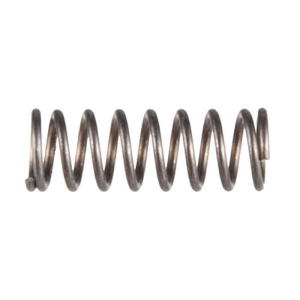
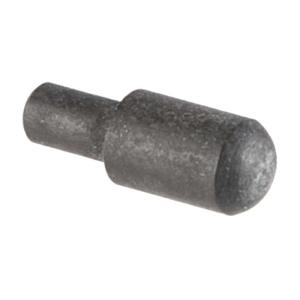
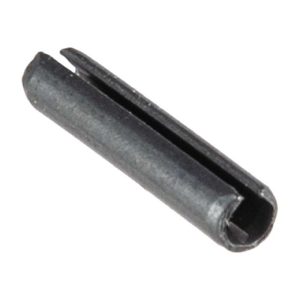
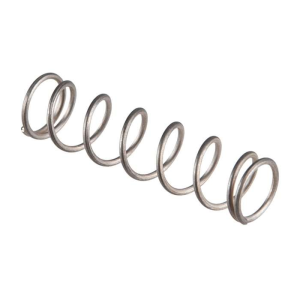
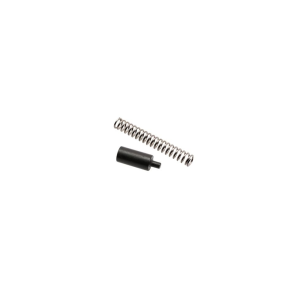
FORWARD CONTROLS DESIGNS AR-15 MAGAZINE RELEASE SPRING
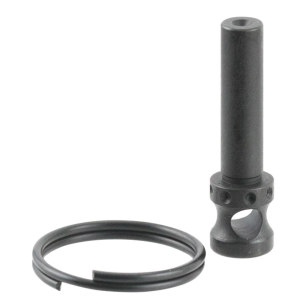
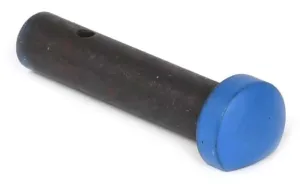
TacFire Rear Extended Take Down Pin for AR-15 Black
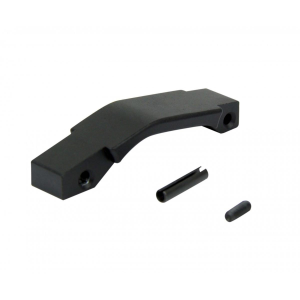
TacFire AR-15 Trigger Guard w/Pin for M4 Style Rifles - MAR019
 -20%
Ar-15 Charging Handle Latch Spring - Brn Ar-15 A2 Charging Handle Latch Spring
 -20%
Ar-15 Ejection Port Cover Springs - Brn Ar-15 Ejection Port Cover Spring, Chrome Silicon
 -20%
Ar-15/M16 Magazine Release Springs - Brn Ar-15 Magazine Catch Spring
 -20%
Ar-15 Trigger Guard Roll Pin - Brn Ar-15 Trigger Guard Roll Pin

Ergo Grips Gapper 4085 Rubber AR Platform Grip for AR-15 M16

 -20%
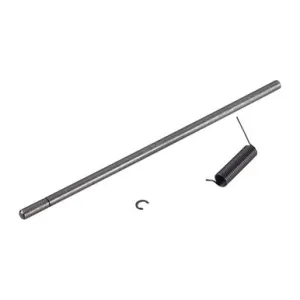
Ar-15 Trigger Guard Assembly Mil-Spec - Brn Ar-15 Mil-Spec Trigger Guard Assembly
 -33%
 -31%
Strike Industries Grip Plug Tool Holder Insert for Strike Industries AR-15 Pistol Grips

 -30%

 -56%
Table of Contents
AR-15 Parts Breakdown: What You Actually Need to Build
If you’ve never built an AR-15 from scratch, the parts list can look overwhelming. It’s really not. The rifle breaks down into two main groups: the lower receiver assembly and the upper receiver assembly. Here’s the complete shopping list.
Lower receiver group: Stripped lower receiver (the serialized part that requires an FFL), lower parts kit (LPK), trigger group (or a drop-in upgrade), buffer tube, buffer spring, buffer weight, castle nut, end plate, and stock or pistol brace. Check which LPK you’re buying. Aero Precision and CMMG both sell a kit with the mil-spec trigger group and one without it: Aero’s Minus FCG kit has no fire control group, and CMMG’s Gunbuilder’s Kit leaves out the trigger guard, fire control group and grip. If you’re putting in an upgraded trigger, buy the kit without one and don’t pay for a part you’ll throw in a drawer.
Upper receiver group: Stripped or assembled upper receiver, barrel, gas block, gas tube, handguard, barrel nut (most free-float handguards ship with their own), bolt carrier group (BCG), charging handle, and muzzle device. You can also buy complete uppers that come fully assembled, which is the fastest path if you don’t want to deal with barrel installation and timing a gas block.
Count the parts named above and a from-scratch build comes to 18, before the pins, springs and detents inside the lower parts kit. Sounds like a lot, but most of it snaps together with basic tools. The barrel install and gas block alignment are the only steps that need real attention to detail.
Mil-Spec vs. Upgraded: When the Price Jump Is Worth It
The AR-15 parts market has three rough tiers, and knowing which tier matters for which parts will save you a ton of money. Not every component needs to be premium. Some mil-spec parts are genuinely fine. Others are worth every penny of the upgrade.
Budget tier (PSA, Anderson, Aero Precision): Perfectly functional for a range gun or home defense rifle. PSA builds thousands of rifles and their parts are reliable. Aero Precision sits slightly above with better fit and finish. Anderson lowers are the cheapest option and they work, but the machining is rougher. For lower parts kits, buffer assemblies, castle nuts, takedown pins, and A2 flash hiders, budget tier is all you need.
Mid-tier (BCM, Ballistic Advantage, LaRue, Toolcraft): This is the sweet spot for most builders. BCM uppers and barrels are genuinely excellent. Ballistic Advantage makes some of the best barrels at any price point, and its Hanson Series comes with a pinned low-profile gas block. LaRue’s MBT-2S trigger was $134.99 at Ammunition Depot on October 28, and it shoots like the $259.99 Geissele SSA-E. Toolcraft BCGs are the industry’s open secret: bolts in 9310 steel or Carpenter 158, gas keys staked to government spec, at prices that make branded BCGs look silly. Check which bolt steel the listing names. I’ve run Toolcraft BCGs for thousands of rounds across multiple builds with zero issues.
Premium tier (Geissele, Radian, Daniel Defense, KAC): This is where you’re paying for the best materials, tightest tolerances, and brand reputation. A Geissele SSA-E is the trigger other two-stage triggers get measured against. Radian’s Raptor charging handle and their complete lower receivers are beautifully machined. Daniel Defense barrels are cold hammer forged and built to take a beating. Are they twice as good as mid-tier? No. But they’re noticeably better for shooters who will appreciate the difference.
The honest take: Put your money into the barrel, trigger, and BCG. Those three parts decide how well your rifle shoots and how reliably it runs. Everything else can be budget or mid-tier without compromise. A LaRue MBT-2S in an Anderson lower ($66.99 stripped at Kentucky Gun Co on October 28) with a Ballistic Advantage barrel and a quality BCG will outshoot plenty of factory rifles that cost twice as much.

Barrels, Gas Lengths, and Twist Rates: Matching Parts to Your Build
Barrel selection is where most new builders get confused, because there are more variables than any other single part. Here’s the cheat sheet.
Barrel length: 16″ is the standard for a do-everything rifle and the minimum legal length without an NFA stamp. Federal law measures from the closed bolt face to the muzzle (27 CFR 479.11), and ATF counts a muzzle device only when it’s permanently attached: welded, high-temperature silver soldered, or blind pinned with the pin head welded over. So a 14.5″ barrel with a long enough pinned and welded device reaches 16″ for a lighter, handier rifle. 18″ is the precision/SPR choice for longer range accuracy. 10.3″ to 11.5″ are SBR/pistol territory for close quarters builds.
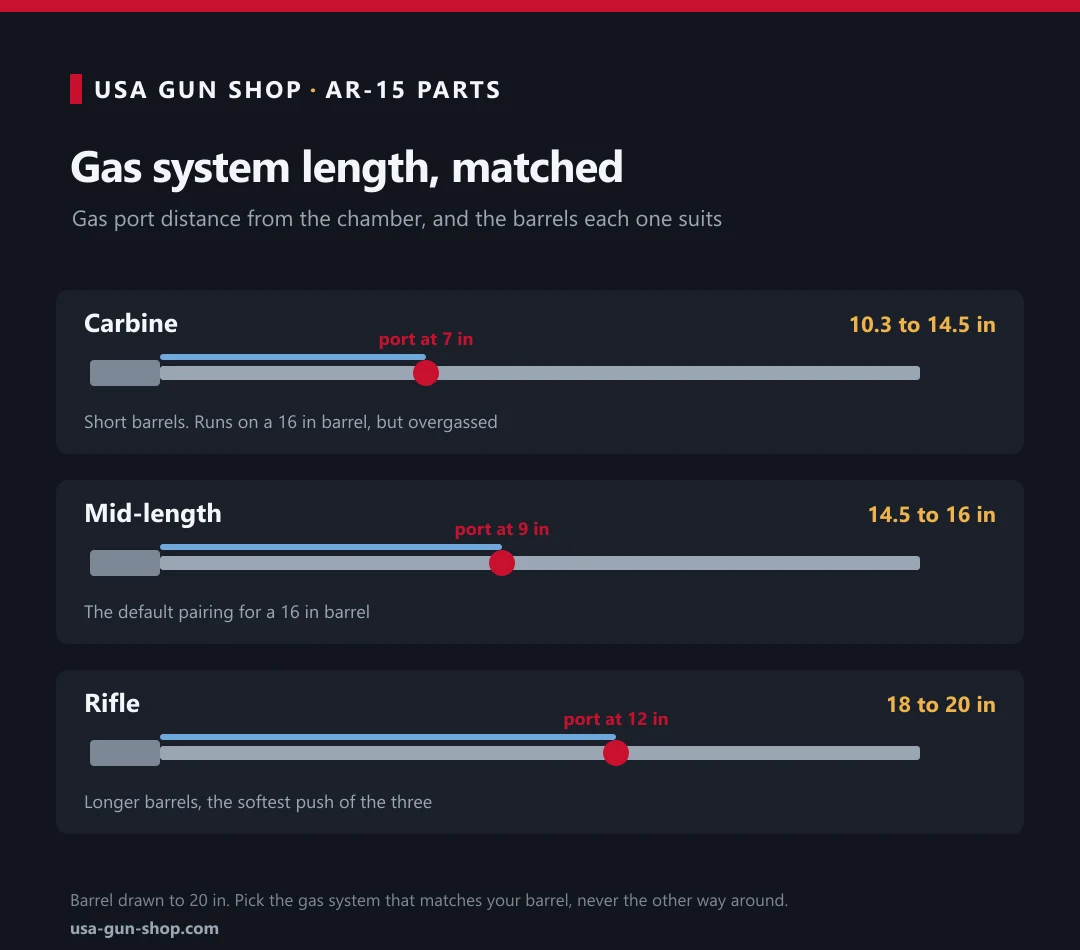
Gas system length: This is critical and people get it wrong constantly. The gas port sits 7 inches from the chamber on a carbine system, 9 on a mid-length and 12 on a rifle-length. Carbine gas goes with barrels up to 14.5″. Mid-length is the default for a 16″ barrel and the most popular pairing for a reason: the longer dwell gives a softer recoil impulse and less wear on the bolt than carbine gas on the same barrel. Rifle-length gas pairs with 18″ and 20″ barrels. A carbine gas system on a 16″ barrel works, but it’s overgassed and beats up the gun harder than it needs to.
Twist rate: 1:7 stabilizes everything from 55gr to 77gr+ heavy bullets, making it the most versatile choice. 1:8 is slightly better with lighter 55gr ammo and still handles 77gr fine. 1:9 is older and struggles with heavier bullets. Unless you have a specific reason, 1:7 or 1:8 and don’t think twice about it.
Barrel treatment: Chrome-lined bores last the longest under sustained fire and are easier to clean but can sacrifice a tiny bit of accuracy. Nitride (melonite/QPQ) is the modern go-to: extremely durable, great accuracy, and doesn’t add cost like chrome lining. Stainless steel is the precision shooter’s barrel, most accurate out of the box but less durable under heat. For a general-purpose rifle, nitride is the right call.
Triggers, BCGs, and Charging Handles: The Upgrades That Actually Matter
If you’re only going to upgrade three parts on a factory AR-15, these are the three. Everything else is nice to have. These three will change how the rifle shoots and feels.
Triggers: A stock mil-spec trigger is heavy, with a gritty, vague break. Swap in a LaRue MBT-2S ($134.99 at Ammunition Depot on October 28, the best value in the AR world) and you get a crisp two-stage pull that transforms your shooting. If you want to spend more, the Geissele SSA-E ($259.99 at Sportsman’s Guide) is the gold standard for a precision two-stage, and the CMC or Timney drop-in cassettes are excellent single-stage options. This is the single biggest accuracy upgrade you can make because it directly affects how consistently you press the trigger.
Bolt carrier groups: The BCG is the engine of the rifle. It strips rounds from the magazine, chambers them, fires them, extracts the case, and does it again. A quality BCG with a properly staked gas key and a Carpenter 158 or 9310 bolt is non-negotiable for reliability. Toolcraft makes the best value BCG on the market, and a BCM BCG was $214 direct from BCM on October 28 if you want the name brand. Nickel boron and DLC (diamond-like carbon) coatings make cleaning easier but aren’t required. Phosphate coating works fine.
Charging handles: The stock mil-spec charging handle is a small, slick nub that’s hard to grip, especially with gloves or when you’re in a hurry. An extended ambidextrous handle like the Radian Raptor or Geissele ACH makes manipulations faster and easier. On October 28 a mil-spec handle was $18.50 at KAK Industry, the Radian Raptor LT $79.95 at MidwayUSA and the full Raptor $104.95 at MidwayUSA. The Raptor LT is the sweet spot if you don’t want to spend full price, and you’ll appreciate it every time you charge the rifle.
Where to Buy AR-15 Parts (and How to Get the Best Price)
Different retailers have different strengths. Knowing who’s best for what saves you time and money.
Palmetto State Armory is the king of budget AR-15 parts. Their daily deals on complete uppers, BCGs, lower build kits, and magazines are regularly the lowest prices in our feed. If you’re building on a budget, check PSA first. They also run near-constant sales on their own branded parts that are solid quality for the money.
Brownells has the widest selection and runs excellent coupon codes. Their edge codes (search “Brownells edge code” before you buy) often stack with sale prices for ridiculous savings.
MidwayUSA is excellent for small parts, tools, and accessories. Their selection of springs, pins, detents, and gunsmithing supplies is massive. They also carry a deep inventory of barrels and triggers from major brands. Shipping is fast and reliable.
Optics Planet has huge inventory and competitive pricing, but be aware of their backorder situation. If it says “in stock,” you’re golden. If it says “ships in 1-3 weeks,” that can mean months. Check stock status carefully. When they have something in stock at a good price, though, they’re hard to beat.
Or just use the price comparison grid above. We pull from all of these retailers and 200+ more, so the best deal is right there in one view. No tab juggling required.
Common AR-15 Build Mistakes (and How to Avoid Them)
I’ve made most of these mistakes myself, so learn from my pain.
Wrong gas system for your barrel length. This is the number one compatibility mistake. A mid-length gas system on a 10.5″ barrel leaves 1.5 inches of barrel past the port and won’t cycle reliably. A carbine gas system on an 18″ barrel will be massively overgassed. Match your gas system length to your barrel length. Always.
Not staking the castle nut. The castle nut holds your buffer tube to the lower receiver. If it loosens, your stock wobbles and eventually your buffer tube can unthread mid-shooting. Stake it with a punch and hammer, or use a staking tool. It takes 30 seconds and prevents a serious problem.
Buying a “complete” upper without a BCG or charging handle. This one gets people constantly. Many retailers sell “complete” uppers that include the barrel, handguard, gas system, and upper receiver, but NOT the bolt carrier group or charging handle. Read the listing carefully. If the price seems low for a complete upper, check whether the BCG and charging handle are in the box.
Overtorquing the barrel nut. A mil-spec barrel nut goes on at 30 ft-lbs to start and never past 80 ft-lbs, turning only as far as you need to line up the gas tube hole. Many free-float handguards use their own nut with a lower limit, so follow that maker’s number. Gorilla-arming it to 100+ ft-lbs risks cracking the upper receiver. Use a torque wrench. They’re cheap and prevent expensive mistakes.
Skipping headspace checks on a new barrel. If you’re installing a new barrel, check headspace with go/no-go gauges. A barrel with incorrect headspace can cause dangerous overpressure events. It takes two minutes and a set of go and no-go gauges. Just do it.
Are Cheap AR-15 Parts Worth It?
Depends on the part. Some cheap AR-15 parts are totally fine. PSA lower receivers, generic mil-spec LPKs, standard A2 flash hiders, and basic buffer assemblies all work perfectly well and don’t need to be expensive. An Anderson stripped lower ($66.99 at Kentucky Gun Co on October 28) does the same job as an Aero Precision M4E1 ($139.99 at Hinterland Outfitters) in terms of function. The Aero is nicer to look at and easier to work with, but both go bang.
Where cheap gets dangerous: no-name BCGs with improperly heat-treated bolts, unbranded barrels with unknown steel composition, Amazon-sourced optic mounts that won’t hold zero, and bargain-bin triggers that feel like dragging a boot across gravel. If a part directly affects reliability or accuracy, buy from a manufacturer you can name and trust. Use our price comparison tool to find the best price on quality parts rather than settling for junk because it’s cheaper.
Facts and Figures
- A from-scratch AR-15 build takes 18 major parts, before the small parts inside the lower parts kit.
- Federal law sets 16 inches as the minimum rifle barrel length without NFA registration, measured from the closed bolt face.
- The gas port sits 7 inches from the chamber on a carbine system, 9 inches on a mid-length and 12 inches on a rifle-length.
- A mil-spec barrel nut is torqued from 30 ft-lbs and never past 80 ft-lbs.
- On October 28, 2026, a LaRue MBT-2S was $134.99 and a Geissele SSA-E $259.99 in our feed.
- The same day, a mil-spec charging handle was $18.50 and a Radian Raptor LT $79.95.
Frequently Asked Questions
What parts do you need to build an AR-15?
A lower receiver group (stripped lower, lower parts kit, trigger group, buffer tube, buffer spring, buffer weight, castle nut, end plate and stock) and an upper receiver group (upper receiver, barrel, gas block, gas tube, handguard, barrel nut, BCG, charging handle and muzzle device). That's 18 major parts before the pins and springs.
Which AR-15 parts are worth upgrading first?
The trigger, the bolt carrier group and the charging handle on a factory rifle, and the barrel on a build. Those parts decide how the rifle shoots and runs. Buffer parts, castle nuts, pins and A2 flash hiders can stay budget.
Does a lower parts kit include the trigger?
It depends on the kit. Aero Precision and CMMG both sell a kit with the mil-spec trigger group and one without it. If you plan to install an upgraded trigger, buy the version without the fire control group.
What gas system length should I use with a 16 inch barrel?
Mid-length. Its port sits 9 inches from the chamber, which gives a softer recoil impulse than carbine gas on a 16 inch barrel. Carbine gas suits barrels up to 14.5 inches and rifle-length gas suits 18 and 20 inch barrels.
How much does an AR-15 trigger upgrade cost?
On October 28, 2026, a LaRue MBT-2S two-stage was $134.99 at Ammunition Depot and a Geissele SSA-E was $259.99 at Sportsman's Guide in our feed.
What torque does an AR-15 barrel nut need?
A mil-spec barrel nut starts at 30 ft-lbs and should never go past 80 ft-lbs, tightened only as far as needed to line up the gas tube hole. Many free-float handguards use their own nut with a lower limit, so follow that maker's spec.
Can I put a 14.5 inch barrel on an AR-15 without an NFA stamp?
Only if a muzzle device is permanently attached and brings the total to 16 inches. ATF counts welding, high-temperature silver soldering or a blind pin with the pin head welded over as permanent. A pin alone doesn't count.
Where is the best place to buy AR-15 parts?
Palmetto State Armory for budget parts and daily deals, Brownells for selection, MidwayUSA for small parts and tools. The price grid on this page compares 200+ retailers at once.
Browse Other Platforms
1911 Parts & Upgrades – Compare Prices • AK-47 Parts & Upgrades – Compare Prices • AR-10 / .308 Parts & Upgrades – Compare Prices • Glock Parts & Upgrades – Compare Prices • Shotgun Parts & Upgrades: Compare Prices • SIG P320 Parts & Upgrades – Compare Prices • SIG P365 Parts & Upgrades – Compare Prices
3,907+ Gun & Ammo Deals
Updated daily from 200+ top retailers. Filter by category, caliber, action type, and price.