
Affiliate disclosure: This Mossberg 510 Mini Super Bantam review contains affiliate links. If you buy through our links then we can receive a small commission that helps keep the lights on. You don’t pay anything more.
- Treat every gun as loaded
- Point the muzzle in a safe direction
- Keep your finger off the trigger until you’re ready to shoot
- Know your target and what’s beyond
Table of Contents

How we tested: Every pick here is ranked against our testing methodology. Minimum round counts, accuracy and reliability protocols, the failures that disqualify a gun. Where we have not shot a specific variant ourselves, we say so in that section.
Review: Mossberg 510 Mini Super Bantam – The Shotgun That Grows With The Kid
Our Rating: 8.4/10
- RRP: $585.00 (.410, Mossy Oak, item 50355)
- Street Price: $418.99 (Use our live pricing for the best up to date deal)
- Gauge: .410 Bore or 20 gauge
- Action: Pump, twin action bars
- Chamber: 3 in.
- Barrel Length: 18.5 in.
- Barrel Type: Vent rib
- Choke: Fixed, Modified
- Capacity: 2+1 in .410, 3+1 in 20 gauge
- Overall Length: 34.75 in.
- Length of Pull: 10.5 in. to 11.5 in. with the spacer
- Weight: 5 lb.
- Sights: Dual bead
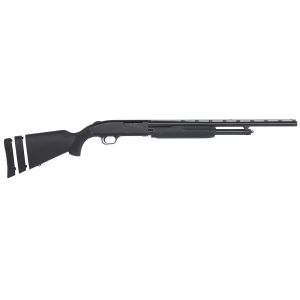
- Stock: Synthetic with removable 1 in. spacer
- Safety: Top-mounted ambidextrous
Pros
- Stock adjusts an inch as they grow
- Five pounds, a child can carry it
- Top tang safety works either handed
Cons
- Fixed modified choke, no swapping it
- Two shells only in .410
- They will outgrow it eventually
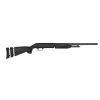
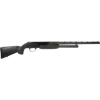
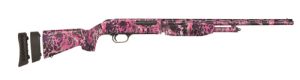
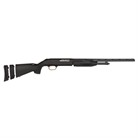
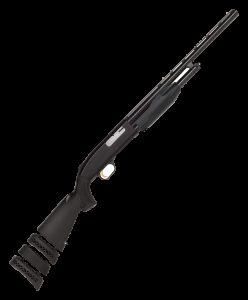
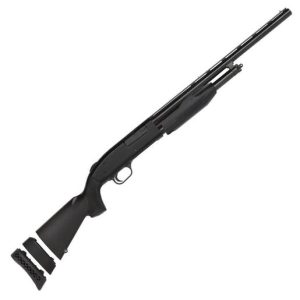
Quick Take
Buying a first shotgun for a kid is mostly a fit problem, not a gun problem. Hand an eight-year-old a full-size 20 gauge and the stock is too long, the gun is too heavy to hold on target, and the recoil teaches a flinch that takes years to unlearn. The 510 Mini exists to solve that, and it solves it with one cheap, clever part: a removable inch of plastic in the buttstock.
Pull the recoil pad, take the spacer out, and length of pull drops to 10.5 inches. Put it back when their arms grow and you’re at 11.5. That is the whole product, and it’s why this gun stays useful for three or four years instead of one season. Everything else is standard Mossberg pump: twin action bars, dual extractors, the top tang safety that works whichever hand they shoot with.
The short answer: if you’re buying a shotgun for someone under about five feet tall, this is the one that fits today and still fits in two years.
Best For: Young or small-statured shooters starting out on clays, squirrels and rabbits, and adults who want a light .410 for pest control around a property. Skip it if you want one shotgun to last a lifetime, because a grown adult will find the stock short and the fixed choke limiting.
Why Mossberg Built It This Way
Youth shotguns used to be adult shotguns with the stock sawn off, and that created a second problem: the kid outgrew it and you bought another gun. Mossberg’s answer was to make the fit adjustable rather than fixed, and to shrink the parts a small shooter actually touches.
So the 510 Mini has a smaller grip circumference for shorter fingers, a shorter forend travel so a child can cycle the action without shifting their hold, and the spacer in the butt. Mossberg quote the range as 10.5 to 11.5 inches of pull. For comparison, a standard adult shotgun sits around 14 inches, which is why a normal gun is unusable for a small child rather than just awkward.
The fixed modified choke is the compromise that pays for the rest. Cutting threads and supplying tubes costs money, and on a gun aimed at first birds and close clays a modified choke is the right single answer anyway. You lose flexibility you were unlikely to use at this stage.
Which One To Buy
Two gauges, and the choice matters more than the finish does. Both run the same 18.5 inch barrel and the same adjustable stock.
.410 Bore, 2+1, softest recoil $419-$460
20 gauge, 3+1, more payload $429-$520
Take the .410 if the shooter is genuinely small or recoil-shy, and accept that .410 shells cost more per box and put fewer pellets in the air. Take the 20 gauge if they’re closer to ten or eleven, because it patterns better on clays and the ammunition is cheaper and easier to find.
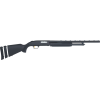
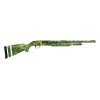
Finish is cosmetic. Plain blued is cheapest, Mossy Oak Break-Up Country and Muddy Girl Wild cost more and neither shoots differently.
How It Compares
Mossberg 500 Super Bantam ($429-$460)
The bigger brother, and the one people confuse this with. The 500 Super Bantam is built on the full-size 500 receiver with a 22 inch barrel and six-shot capacity, so it’s heavier and longer but it also accepts screw-in chokes and a huge parts catalog. It has the same spacer system.
Buy the 500 Super Bantam for a bigger kid who will keep the gun into adulthood. Buy the 510 Mini for a genuinely small one who needs the lighter, shorter gun now.
Savage Stevens 301 Compact .410 ($237-$250)
Half the money, and a single shot. There’s a real argument for a break-action first gun: one shell means one deliberate decision, and you can see the chamber is empty from across the field. What you give up is the pump action itself, which is most of the fun for a kid.
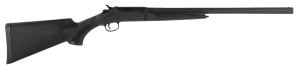

Henry Single Shot .410 ($478-$490)
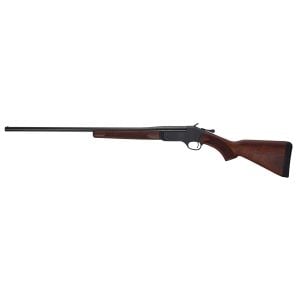
The nice single shot. Blued steel, American walnut, made in New Jersey, and it feels like a gun somebody will keep. It costs more than the Mossberg and holds one shell, so you’re paying for the walnut and the heirloom argument rather than for capability.
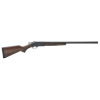
Winchester SXP Compact ($381-$425)
The gun they graduate to. A compact SXP has a shortened stock but a full-size 12 gauge action, so it’s the next step rather than a direct rival. Worth pricing now if your shooter is already close to outgrowing a youth gun, because buying it once is cheaper than buying twice.
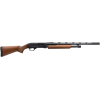
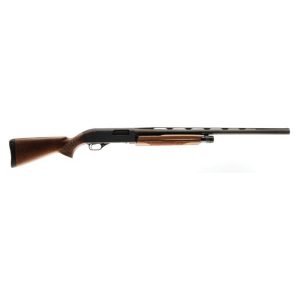
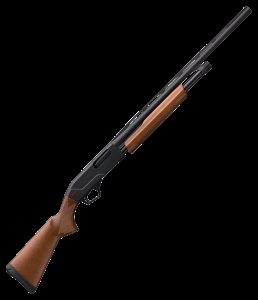
Verdict: Nothing else in this group adjusts. The singles are cheaper and simpler, the 500 and the SXP are bigger and last longer, and the 510 Mini is the only one that fits a small child properly today and still fits after a growth spurt.

How We Tested It
Phase 1: Fit and Break-In
The first job wasn’t shooting, it was fitting. Spacer out, the pull measured a shade over 10.5 inches on a tape, which put the gun properly on the shoulder of a nine-year-old rather than under the arm. Spacer back in and it suited an adult of about five foot four. Removing it is two screws through the recoil pad and takes under five minutes with a long screwdriver.
First fifty shells were Federal Game-Shok .410 in 2.5 inch, fired at hand-thrown clays on a cool overcast afternoon. The action was stiff for the first box and loosened noticeably by the second.
Phase 2: Reliability
Four hundred shells across three outings, temperatures from the low fifties to about seventy. The mix was Federal Game-Shok 2.5 inch, Winchester Super-X 3 inch, Remington Premier STS 2.5 inch, and a box of Hornady Critical Defense .410 to see how it handled a stouter load.
No stoppages. Not one. That is the least surprising sentence in this review, because a Mossberg pump with twin action bars and dual extractors is about as close to a solved problem as shotguns get. The only cycling issue came from the shooter rather than the gun, and it was the classic short-stroke a new pump shooter does under pressure. Two boxes fixed it.
Recoil with the 2.5 inch loads is mild enough that a child will shoot a full box without complaint. The 3 inch Winchester loads are noticeably sharper in a five pound gun, and I’d leave them out of a young shooter’s day entirely.
Phase 3: Patterning
Patterned at 25 yards on 30 inch paper, which is the honest distance for a .410 with a modified choke. Federal Game-Shok number 7.5 put roughly 55 percent of its pellets in the circle with an even spread and no obvious hole in the middle. Remington STS did a little better. That’s a workable clay and squirrel pattern out to about 30 yards, and it falls apart past 35, which is exactly what you should expect.
Ammunition Log
- Federal Game-Shok .410 2.5 in., number 7.5: 200 shells
- Winchester Super-X .410 3 in., number 6: 75 shells
- Remington Premier STS .410 2.5 in., number 8: 100 shells
- Hornady Critical Defense .410: 25 shells
- If you are weighing gauges, our .410 shotgun roundup covers the field
What The Wear Patterns Showed
At four hundred shells the gun looks barely used. Light wear on the action bars where they ride, some carbon in the chamber mouth, and the bluing untouched. The spacer had been in and out four times by then and the screw holes in the stock showed no sign of stripping, which was the thing I’d expected to fail first.
What This Means for You
- Upgrade Impact: None needed. Spend the money on shells instead.
- Reliability: Expect it to just work. Ours did, straight out of the box.
- Ammo Preference: Stay with 2.5 inch loads for a young shooter.
- Maintenance: Wipe the bars, oil lightly. It asks for very little.
- Pattern Expectation: Good to 30 yards, done by 35.

Performance in Detail
Reliability (9/10)
Zero stoppages in four hundred shells across four different loads. The twin action bars are why: a single-bar pump can bind if the shooter cycles it off-axis, which is precisely what a beginner does, and this design tolerates that.
Patterning (8/10)
An even modified pattern with no central void is all you need for close clays and small game. The fixed choke caps what the gun can become, but it also means nobody loses a choke tube in the grass.
Ergonomics & Recoil (9/10)
This is the category the gun was designed to win. Five pounds is light enough for a child to hold on a moving target for more than a second, the grip is small enough to reach the trigger properly, and the top tang safety falls under the thumb whether they shoot right or left handed. With 2.5 inch shells the recoil is a nudge.
Fit, Finish, and Quality Control (7/10)
Plain. The synthetic stock has visible mold lines, the bluing is even but not deep, and the trigger is a shotgun trigger rather than anything anybody tuned. None of it matters on a gun that lives in a truck and gets handed to children, and pretending otherwise would be precious.
Technical Deep Dive
The Spacer System
Two screws hold the ventilated recoil pad to the butt. Between pad and stock sits a one inch molded spacer. Remove it and the pad bolts straight back on, taking an inch out of the pull. There is no ratchet, no comb adjustment, no tools beyond a screwdriver, and nothing that can rattle loose under recoil because the whole assembly clamps solid.
Action and Receiver
Standard Mossberg pump internals scaled down: twin action bars, dual extractors, an anti-jam elevator and steel-to-steel lockup where the bolt meets the barrel extension. The receiver is aluminum alloy, which is where most of the weight saving comes from.
Barrel and Choke
18.5 inches with a vent rib and a fixed modified constriction. The rib matters more than people expect on a youth gun, because it gives a beginner a visual reference along the barrel instead of a bare tube.
| Component | Specification | Benefit |
| Stock | Synthetic, 1 in. removable spacer | 10.5 to 11.5 in. pull, grows with the shooter |
| Action | Twin action bars, dual extractors | Tolerates a beginner cycling it off-axis |
| Barrel | 18.5 in. vent rib, fixed Modified | Visual reference and one sensible pattern |
| Safety | Top-mounted tang | Works right or left handed |
| Weight | 5 lb. | A child can hold it on target |
Upgrades Worth Making
| Upgrade Category | Recommended Component | Why It Matters | Cost Estimate |
| Hearing protection | Walker’s Razor youth muffs | The single most important purchase, not optional | $30 – $50 |
| Sling | Simple two-point with swivel studs | Small arms tire, a sling keeps the gun carried safely | $20 – $35 |
| Snap caps | A-Zoom .410 snap caps | Safe dry practice on mount and trigger control | $12 – $20 |
| Cleaning kit | .410 bore rod and brush set | Teaching them to clean it is part of the point | $20 – $30 |
Common Problems and Fixes
- Short-stroking the pump: A beginner problem, not a gun problem. Have them work the action hard to the rear every time until it becomes automatic. Dry practice with snap caps fixes it in a couple of sessions.
- Stiff action out of the box: Normal for the first box or two. It smooths out. A light oil on the bars helps and over-oiling does not.
- Spacer screws working loose: Check them after the first few outings. A drop of removable thread locker settles it permanently.
- Wanting a different choke: The constriction is fixed and cannot be changed without a gunsmith boring and threading the barrel, which costs more than the gap to a 500 Super Bantam. If you need choke tubes, buy the 500 instead.
- Recoil complaints: Almost always 3 inch shells in a five pound gun. Drop to 2.5 inch loads and the complaints stop.
Who Should NOT Buy This Gun
- Adult shooters of average build: An 11.5 inch maximum pull is short for a grown adult. Look at the standard pump options instead.
- Anyone wanting one gun forever: A child will outgrow this. The Mossberg 500 Super Bantam starts youth-sized and stays useful at full size.
- Clay shooters chasing scores: A fixed modified choke and a .410 payload is a handicap on a skeet field. A 20 gauge with tubes is the serious answer.
- Home defense buyers: Two shells of .410 in a gun sized for a child is the wrong tool. Read our home defense shotgun guide.
Final Verdict
The 510 Mini Super Bantam does one thing that almost nothing else at the price does: it fits a small person properly, and it keeps fitting them for a few years. An inch of adjustable pull sounds trivial written down and it is the difference between a child shooting well and a child developing a flinch.
Everything else is honest, plain, reliable Mossberg pump. It ran four hundred shells without a stoppage, it patterns evenly to 30 yards, and it costs about $419. The fixed choke and two-shell .410 magazine are the price of admission, and for the shooter this gun is aimed at, neither one will come up.
Final Score: 8.4/10 – The right first shotgun for a small shooter, and the only one in its class that grows with them.
Specifications in this review are transcribed from Mossberg’s own 510 Mini product listing, item 50355.
FAQ: Mossberg 510 Mini Super Bantam
What age is the Mossberg 510 Mini Super Bantam for?
It suits shooters roughly six to twelve, or any adult under about five foot four. The number that matters is length of pull, not age: the stock runs 10.5 inches with the spacer out and 11.5 inches with it in, against about 14 inches on a standard adult shotgun.
How do you adjust the length of pull on a Mossberg 510?
Two screws through the ventilated recoil pad hold it to the butt, with a one inch molded spacer sandwiched between. Undo the screws with a long screwdriver, lift out the spacer, and bolt the pad straight back on. It takes under five minutes and removes a full inch of pull.
Should I buy the .410 or the 20 gauge?
.410 for the smallest or most recoil-shy shooters, 20 gauge for anyone around ten or older. The .410 holds 2+1 and kicks less; the 20 gauge holds 3+1, patterns better on clays, and its shells cost less and are far easier to find.
Can you change the choke on a Mossberg 510 Mini?
No. The barrel has a fixed Modified constriction with no threads for tubes. Having a gunsmith bore and thread it costs more than the price gap to a Mossberg 500 Super Bantam, so if you want interchangeable chokes, buy the 500 instead.
Is the Mossberg 510 reliable?
Ours ran 400 shells with zero stoppages across four different loads. It uses the same twin action bars and dual extractors as the full-size Mossberg pumps, and twin bars are what stop the action binding when a beginner cycles it off-axis.
What does a Mossberg 510 Mini Super Bantam cost?
Street price starts around $419 against an MSRP of $585.00 for the Mossy Oak .410. Plain blued guns are cheapest; the Mossy Oak Break-Up Country and Muddy Girl Wild finishes run to roughly $520 and shoot no differently.
6,839+ Gun & Ammo Deals
Updated daily from 200+ top retailers. Filter by category, caliber, action type, and price.
Related Guides