

Last updated October 10, 2026
Some of the links below are affiliate links, meaning at no additional cost to you, we may earn a commission if you click through and make a purchase.
You’ve got a Smith & Wesson in your hand and you want to know what year it was made. We’ll save you an hour of clicking around. No Smith and Wesson serial number lookup can give you that year from a chart, because S&W has never published one.
That isn’t us being lazy. The year-by-year tables you see copied around the web come out of a commercial reference book, and the people who hold the factory records say charts like that don’t match what the records show. So we haven’t printed one.
What we can do is get you to the right number on the gun, tell you which era its format belongs to, show you the serial ranges the ATF prints, and walk you through the factory letter that gives the real date. Every line below names its source.
Quick answer
- Find the real number. On a revolver it’s on the bottom of the grip frame. The number inside the yoke cut is often an assembly number or a model number. On a pistol, look on the side of the frame.
- Read the format. Digits alone means the old overlapping number ranges. One letter and then digits means the 1940s to the 1980s. Three letters and four digits means 1980 or later.
- Want the exact date? Order a Letter of Authenticity from the Smith & Wesson Historical Foundation. It costs $100 and it reports the day the gun shipped.
Smith & Wesson serial number lookup
It reads the same tables printed further down this page. Smith & Wesson publishes no serial number date chart, so this gives you an era and a model family, never an exact year. The exact date comes from a factory letter. Nothing you type leaves your browser.
Table of Contents
Used Smith & Wesson Guns for Sale Right Now
If the gun you’re dating has you thinking about another one, these are the cheapest used Smiths at the dealers we track, with the current polymer pistols filtered out so the older guns show.
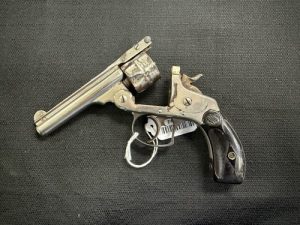
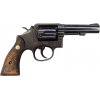
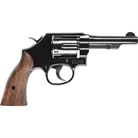
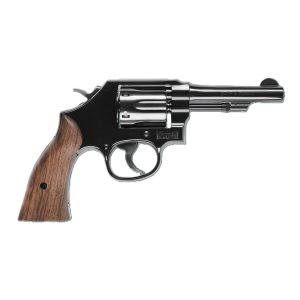
Smith & Wesson Model 10-6 Police Turn-In Revolvers 38 Spl 4" Blued Heavy Barrel - 6 Round. Surplus Fair
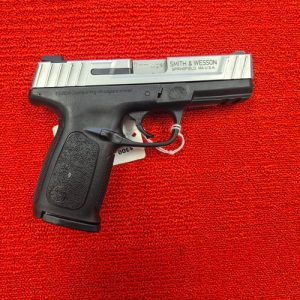
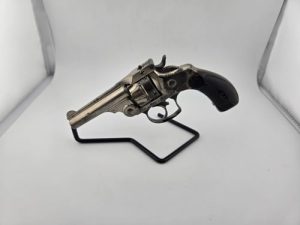
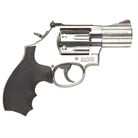
Smith & Wesson 642-2 Airweight 38 SPL Police Trade-In Revolver with Grip Laser
See every used Smith & Wesson in stock.
Where to Find the Serial Number on a Smith & Wesson
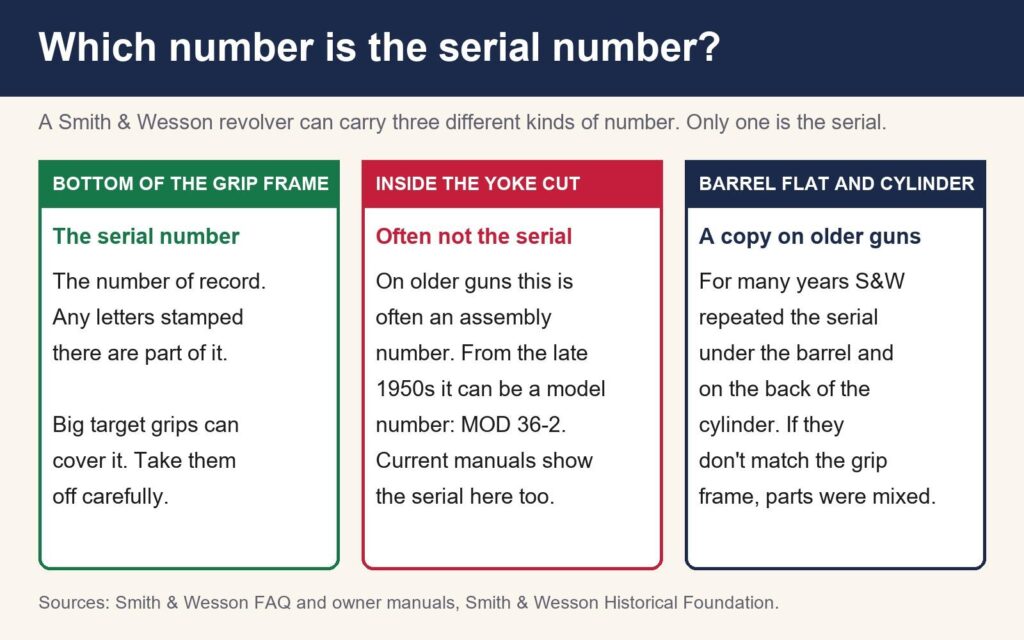
Start here, because this is where most people go wrong. A Smith & Wesson revolver can have numbers in three or four places, and only one of them is the serial number the factory recorded.
| Gun | Where the serial number is | Who says so |
|---|---|---|
| Revolvers | On the bottom of the butt of the frame. Some also have it inside the frame, in the yoke area | Smith & Wesson FAQ |
| Current J, K, L and N-frame revolvers | Inside the yoke with the model number, visible when the cylinder is open | Smith & Wesson owner’s manual |
| A few early .22 and .32 revolvers | On the front strap of the grip frame | Historical Foundation |
| Top-break revolvers | On the grip frame, and again in small digits inside the barrel catch | Historical Foundation |
| Pistols | On the side of the frame | Smith & Wesson FAQ |
| Model 41 | On the sides of the frame above the trigger guard, with the model number | Smith & Wesson owner’s manual |
| Sigma series pistols | On the frame, under the front of the handgun | Smith & Wesson FAQ |
| SW99 | On the frame at the rear of the pistol | Smith & Wesson FAQ |
| Model of 1913 and Model of 1924 pistols | On the front of the grip frame | Historical Foundation |
Sources: Smith & Wesson customer service FAQ and owner’s manuals; Smith & Wesson Historical Foundation, Smith & Wesson Serial Numbers. Accessed October 10, 2026.
The Foundation is blunt about revolvers. It says the serial number of record will always be on the bottom of the grip frame, and that any letters stamped there are part of the number even if they sit a little apart from the digits. Copy the letters too.
Can’t see anything on the butt? The grips are probably in the way. The Foundation points at the large checkered target stocks that came into vogue in the 1950s, which cover the bottom of the frame. Unload the gun, back the grip screw out and lift the panels off gently.
The Number in the Yoke Cut Is Often Not the Serial Number
Swing the cylinder out and you’ll see a number stamped on the frame behind the yoke. On a Colt that spot often holds the serial number, which is how this mix-up got started. On an older Smith & Wesson it’s more often an assembly number.
Assembly numbers kept hand-fitted parts together on their way through the factory. The Foundation says they were assigned at random, were never written into the factory records and are no use for research. Give one to a records clerk and you’ll get nothing back.
That same spot can hold three other things, by the Foundation’s account:
- A model number. From the late 1950s S&W would often stamp it here, as in MOD 36. A dash and a second number, as in MOD 36-2, marks the second engineering variant of that model.
- A registration number. S&W’s earliest .357 Magnums, the guns collectors call Registered Magnums, carry one. REG 3000 is registration number 3000, not a serial.
- The serial number itself. At times S&W stamped it here too. Its FAQ says some revolvers have it inside the frame in the yoke area, and the current revolver manuals show it there beside the model number.
So how do you tell which you’ve got? Check the bottom of the grip frame. If the two numbers match, you’ve found the serial twice. If they don’t, the one on the grip frame wins.
Barrel, Cylinder and Star Marks
For many years S&W also stamped the serial number on the flat under the barrel and on the back of the cylinder. Top-break revolvers carry it inside the barrel catch as well, in digits small enough to need a magnifying glass. The Foundation says mismatched numbers mean the gun was put together from the parts of several.
A missing number on the barrel or cylinder isn’t a warning sign by itself, since the practice changed over the years. And a small star beside the serial number tells a story too. S&W stamped one after major factory service, often a refinish, and put a date code for the work inside the grip frame.
Why There’s No Smith & Wesson Serial Number Chart Here
Every other page in this series has year tables, because Winchester, Ruger, Browning and the rest published them or left records a museum has opened up. Smith & Wesson didn’t. Its own FAQ answers the history question with a link to its Firearm History Request page, and that page hands you to the Historical Foundation.
The Foundation holds the company’s archives, and its factory letter FAQ takes the chart question head on. Asked whether there’s an online tool to date a firearm, it says no comprehensive one exists. The reason is how the factory worked.
- S&W didn’t ship guns in serial number order. The Foundation says they were picked at random from inventory, so serial numbers don’t line up with shipping dates.
- The date that survives is the ship date. The Foundation treats it as the gun’s born-on date because shipping records are the ones that were kept.
- Frames could sit for years. Its example is the .44 Double Action, whose frames were all finished before 1898 while the model stayed in the catalog through the early 1910s.
It also says, in plain words, that collectors who date guns from published serial number charts often find the factory records disagree. That’s the outfit with the ledgers telling you not to trust the charts. We took the hint.
So there are two honest things a page like this can offer. One is the era your number’s format belongs to. The other is a short list of serial ranges the federal government has printed. Both are below, and our lookup at the top of the page reads from the same two tables.
What the Format of a Smith & Wesson Serial Number Tells You
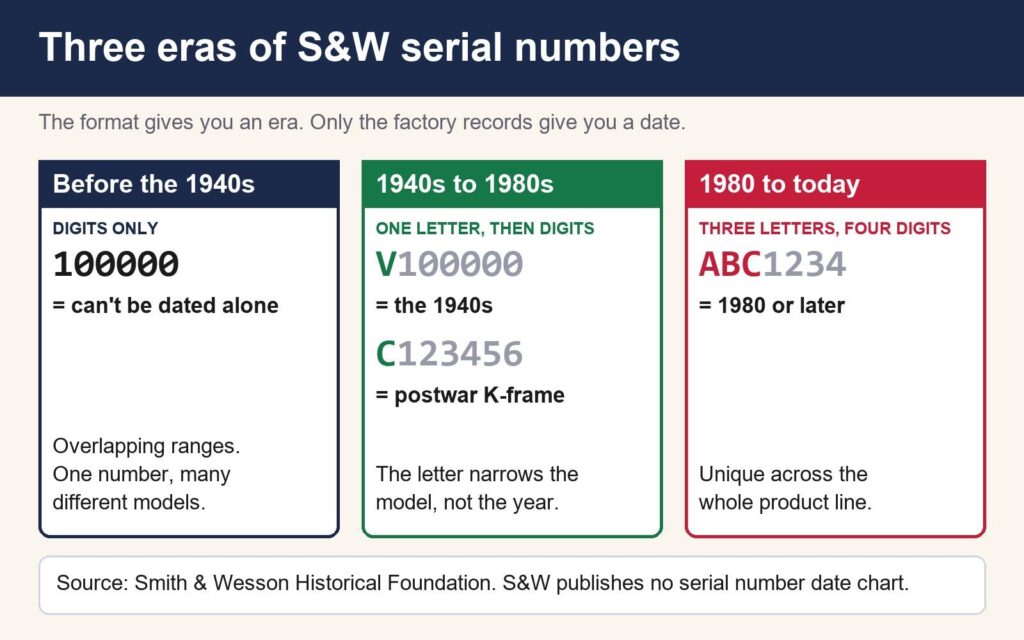
S&W has numbered its guns three different ways, and the Foundation describes all three. The shape of your number tells you which system it came from.
| Era | Serial number looks like | What it tells you |
|---|---|---|
| Before the 1940s, and some later guns | Digits only, no letters | Not enough to identify the gun, let alone date it. Until the 1940s S&W ran overlapping number ranges for its different models |
| The 1940s | V, then digits | A .38 Military & Police Victory or a .38/200 British Service Revolver. S&W dates the Victory to 1942 |
| The 1940s to the 1980s | C, then digits | A postwar K-frame revolver with fixed sights, in the Foundation's words |
| The 1940s to the 1980s | Any other single letter, then digits | One of the revolver models S&W gave a letter prefix. The letter helps identify the model. It does not carry a year |
| 1980 to today | Three letters, then four digits | The current system. S&W began the change in 1980 and had every firearm on it by the mid-1980s. These numbers are unique across the whole line |
| Two different things | REG, then digits | Inside the yoke cut of an early .357 Magnum it is a registration number, not the serial. ATF also lists a Model 27 commemorative with serial numbers REG0001 through REG2500 |
| Late 1950s on | MOD, then a number | A model number stamped in the yoke cut, such as MOD 36 or MOD 36-2. It is not the serial number |
Source: Smith & Wesson Historical Foundation, Smith & Wesson Serial Numbers and its factory letter FAQ; Smith & Wesson’s Our Story timeline for the Victory. This describes the numbering systems. It is not a table of factory dates. Accessed October 10, 2026.
The first system is the one that trips people. Until the 1940s S&W ran overlapping number ranges for its different models. The Foundation’s example is serial number 100,000, which could belong to any one of thirteen models, each with a completely different shipping date. A plain number with no model attached is close to useless.
Letters came next. In the 1940s S&W began putting a single letter in front of the number on some revolver models. The Foundation gives two examples. V100,000 could only be a .38 Military & Police Victory or a .38/200 British Service Revolver, and a C prefix means a postwar K-frame revolver with fixed sights.
Then came the system on every S&W made today. In 1980 the company began shifting to three letters followed by four digits, and by the mid-1980s every firearm it made used that format. These numbers are unique across the whole product line, so one of them identifies exactly one gun.
Notice what none of this gives you: a year. A letter narrows down the model. It doesn’t carry a date, and anyone who tells you a prefix equals one exact year is reading from a chart the factory never issued.
Smith & Wesson Serial Numbers on the ATF Curios or Relics List
There is one government document that prints Smith & Wesson serial ranges, and it’s an odd place to look. The ATF’s Curios or Relics List names the guns the agency has classified as collector’s items, and for some S&W models it spells out which serial numbers qualify.
| Years ATF prints | Serial numbers | Model, as ATF lists it |
|---|---|---|
| None printed | 1 to 241703, no letter | .38 Hand Ejector Military and Police, cal. .38 |
| None printed | 1 to 62488, no letter | .44 Hand Ejector, all calibers |
| None printed | 45768 to 60000, no letter | .357 Magnum Hand Ejector, cal. .357 Magnum |
| None printed | 36500 to 62023, no letter | .38/44 Outdoorsman and Heavy Duty, cal. .38 |
| 1956 to 1958 | S130000 to S160350 | .44 Magnum, old style N-frame with a four-screw side plate and no model number in the yoke cut |
| None printed | S75000 to S263000 | Model 21, cal. .44 Special, the .44 Hand Ejector Fourth Model or 1950 Model Military |
| None printed | S76000 to S263000 | .45 Hand Ejector Model of 1950, Military, fixed sight, in .45 Auto Rim, .45 ACP and .45 Colt |
| None printed | 632132 to 696952, no letter | K-22 Hand Ejector, cal. .22 LR |
| None printed | 653388 to 682207, no letter | K-32 Hand Ejector, the K-32 Masterpiece, cal. .32 S&W Long |
| None printed | 138220 to 534636, no letter | Model .22/32 Hand Ejector, the Bekeart Model, cal. .22LR |
| None printed | 525670 to 534636, no letter | .22/32 Kit Gun, cal. .22LR |
| None printed | 209302 and higher | .32 Double Action Top Break, cal. .32 S&W |
| None printed | 91401 and higher | .32 Safety Hammerless Top Break, the New Departure, cal. .32 S&W |
| None printed | 382023 and higher | .38 Double Action Top Break, cal. .38 S&W |
| None printed | 19901 and higher | .38 Safety Hammerless Top Break, the New Departure, cal. .38 S&W |
| None printed | K500001 through K515205 | Model 56, U.S. Air Force contract, cal. .38 Special |
| None printed | REG0001 through REG2500 | Model 27, Registered, 50 Yr. Commemorative, cal. .357 Magnum |
| None printed | EMK1 to EMK2500 | Model 29 Elmer Keith Commemorative, cal. .44 Magnum |
| None printed | CSP001 to CSP704 | Model 39, Connecticut State Police 75th Anniversary |
| None printed | SWC 0001 through SWC 0184 | Model 29, Smith & Wesson Collectors Association 25th Anniversary Commemorative |
| None printed | TWT prefix | Model 544 Texas Wagon Train Commemorative, cal. .44/40 |
| None printed | BATF prefix | Model 66, Bureau of Alcohol, Tobacco & Firearms 50th Anniversary Commemorative, cal. .357 Magnum |
Source: Bureau of Alcohol, Tobacco, Firearms and Explosives, Firearms Curios or Relics List, January 1972 through April 2025, Section II, linked from the ATF curios and relics page. Accessed October 10, 2026.
Read the table for what it is. A match tells you the ATF lists that model in that range as a curio or relic. Only one line carries years: the first .44 Magnums, numbered S130000 to S160350, which the list says were produced from 1956 to 1958 in a run of 6,500 guns.
Look at the first four lines and you can watch the overlap problem happen. The .38 Military and Police, the .44 Hand Ejector, the .357 Magnum and the .38/44 all have ranges with no letter, and all four include the number 60000. Type that into our lookup and it comes back with every one of them.
A gun doesn’t have to be on this list to count as a curio or relic, and plenty of old Smiths aren’t. Our guide to C&R guns explains the 50-year rule and what the status changes when you buy or sell.
When Smith & Wesson Introduced Each Model
If you know the model, you at least know the earliest year the gun could be. These dates come from the timeline on S&W’s own Our Story page. The years are S&W’s and the names in the second column are our shorthand for its entries.
| Year | What Smith & Wesson says it introduced |
|---|---|
| 1852 | The Smith & Wesson partnership |
| 1854 | The Volcanic |
| 1857 | Model 1 |
| 1870 | Model 3 |
| 1887 | .38 Safety Hammerless |
| 1899 | .38 Military & Police, now the Model 10 |
| 1913 | .35 Automatic |
| 1935 | .357 Magnum |
| 1942 | Victory Model |
| 1950 | Model 36 Chief's Special |
| 1955 | Model 29 |
| 1957 | Model 41 |
| 1961 | Model 52 |
| 1965 | Model 60 |
| 1990 | Model 4006 and the .40 S&W |
| 2003 | Model S&W500 |
| 2005 | M&P pistols |
| 2006 | M&P15 |
| 2012 | M&P Shield |
| 2017 | M&P M2.0 |
| 2018 | M&P380 Shield EZ |
| 2019 | M&P9 Shield EZ |
| 2021 | M&P Shield Plus |
| 2021 | M&P12 shotgun |
| 2021 | M&P 10mm M2.0 |
Source: Smith & Wesson, Our Story timeline. Accessed October 10, 2026.
One of those years needs a footnote. S&W files the Model 29 under 1955, while the ATF list above dates the first block of .44 Magnums to 1956 through 1958. We’ve printed both as they stand.
Model 10, Military & Police and Victory Serial Numbers
This is the family most people are asking about, and it shows every numbering system on one gun. S&W says the .38 Military & Police arrived in 1899 and that more than six million have been made since. It’s now called the Model 10.
The early guns have plain numbers, and the ATF lists the .38 Hand Ejector Military and Police from 1 to 241703 as curios or relics. Wartime guns wear the V. Postwar fixed-sight guns wear a C. Our Model 10 buyer’s guide goes through the variations and what the old ones sell for, and a new Model 10 Classic starts at $965.00 with the sellers we track.
Model 19, Model 27, Model 29 and 686 Serial Numbers
The magnums follow the same pattern. A gun old enough to have a single-letter prefix sits between the 1940s and the 1980s, and one with three letters and four digits is 1980 or later. For the year, it’s the letter from the Foundation. No public table exists for any of them.
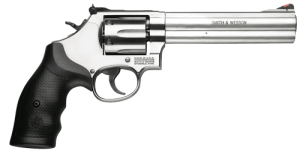
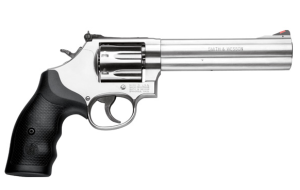
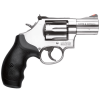
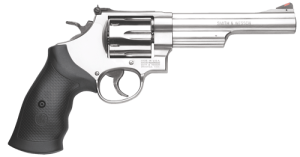
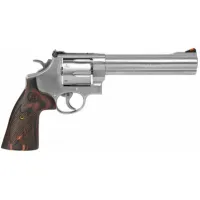
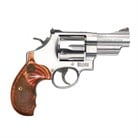
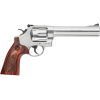
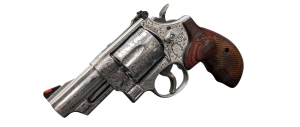
We’ve written up the K-frame in our Model 19 buyer’s guide and the big .44 in our Model 29 review. The stainless guns are still in the catalog. A new Model 686 starts at $869.99 and a Model 629 at $966.99 with the sellers we track, and we put a lot of rounds through one for our 686 Plus review.
Model 36, Model 60, 642 and Other J-Frame Serial Numbers
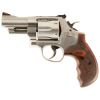
S&W dates the Model 36 Chief’s Special to 1950 and the stainless Model 60 to 1965, so neither can be older than that. On a small frame, check under the grips before you decide there’s no number. And remember the Foundation’s note that a few early .22 and .32 revolvers carry the serial on the front strap.
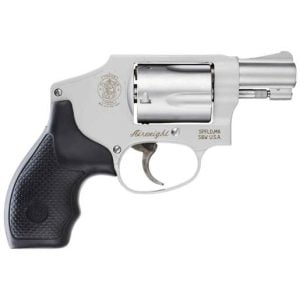
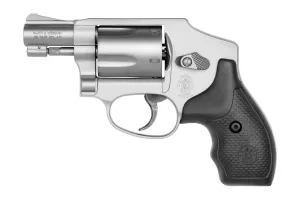
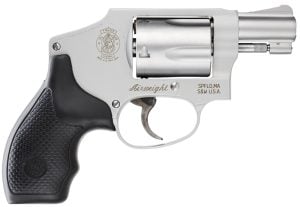
The current Airweights use the three-letter system. We carried one for our 642 Airweight review, and a new 642 starts at $489.99 with the sellers we track.

Model 41, M&P Shield and Other Pistol Serial Numbers
Pistols are simpler to read and no easier to date. S&W puts the serial number on the side of the frame, and the Model 41 manual puts it on the sides of the frame above the trigger guard. The two oldest designs, the Model of 1913 and the Model of 1924, have it on the front of the grip frame.
By S&W’s timeline the Model 41 went on sale in 1957, the M&P pistols arrived in 2005 and the Shield in 2012. Anything from that M&P family will have a number from the current system. We cover the carry guns in our M&P Shield Plus review and rank the whole line in our best Smith & Wesson pistols.
Model Numbers and Dash Numbers as Dating Clues
Here’s a clue that costs nothing. Open the cylinder and look for a model number. Through the late 1950s S&W sold its guns by name, and the names were a mouthful. The Foundation’s favorite example is the .45 Hand Ejector, Model of 1955, Heavy Target Barrel, which became the Model 25.
The numbers came in during the late 1950s, and the Foundation says that by the early 1960s S&W was marking them on most firearms. So a revolver with no model number in the yoke cut is very likely older than that, and one stamped MOD is not.
The ATF list backs this up from the other side. It describes those first .44 Magnums of 1956 to 1958 as having no model designation stamped in the yoke cut.
Dash numbers are the next layer. Each one marks an engineering change, so a 19-3 is later than a 19-2. S&W’s service forms ask for the dash number, which tells you the factory cares about it. What S&W hasn’t published is a list of the year each dash began, so we haven’t printed one.
What the Serial Number Doesn’t Tell You
People ask a serial number for a lot more than it can give.
- What it’s worth. S&W’s FAQ says it can’t predict the value of a handgun after it leaves the factory, and the Foundation says its staff don’t do appraisals.
- Whether it’s original. The Foundation’s letter describes the gun as it shipped. It says it can’t verify that the finish on the gun today is the factory one.
- Who has owned it. The records show where the gun went when it left the factory, which was most often a wholesaler or distributor. Later sales aren’t in them.
- Whether it’s stolen. No public list answers that, and this page doesn’t try. If you have doubts about a gun, call your local police or sheriff’s office and ask them to run the number.
How to Get a Smith & Wesson Factory Letter
This is the real answer to the date question. The Letter of Authenticity used to come from Smith & Wesson itself. The Foundation says it took the job over in 2016, and S&W’s site now sends every history request there.
The Foundation says that for most manufacturing periods the letter documents the original factory specifications, including finish, barrel length and grip style, along with where the gun was first shipped and the date it left. If the archives hold other paperwork on your gun, copies come with it.
- Get the model name or number, the exact caliber, the full serial number from the grip frame, the finish and the barrel length. The Foundation measures a revolver barrel from the front of the cylinder to the muzzle.
- Take a few clear photos. They aren’t required, but the Foundation asks for both sides of the gun and the serial number if you can manage it.
- Order on the Foundation’s Letters page. A letter is $100. Members of the Foundation or of the Smith & Wesson Collectors Association pay $90, and members of both pay $75. Shipping outside the United States adds $8.
- Prefer paper? The same page has a request form you can print and mail with a check.
Two things to know before you pay. The Foundation doesn’t print a turnaround time, so don’t order the week before an auction. And if you aren’t sure what model you have, it asks you to email one clear photo and the serial number first.
For a gun made in the last few years, S&W customer service is the other door to knock on. The number is 1-800-331-0852, and S&W asks you to have the model and serial number ready when you call.
What It’s Worth, and Selling It
Now you’ve got an era, or a letter on the way. The next question is money, and that starts with condition. Our gun values guide walks through the NRA condition grades and how to turn a grade into a price.
If you’re selling, put what you know in the listing and say where it came from. A factory letter is worth mentioning by name. Our guide on how to sell a gun compares what each sales channel leaves in your pocket. For a private sale, print our free firearm bill of sale and copy the serial number from the grip frame, letters and all.
Shopping instead? We rank the current wheel guns in our best revolvers and look back at the collectible ones in classic revolvers.
Smith & Wesson Gun Deals: 30% Off or Better
Serial Number Lookups for Other Makers
Got other makes in the safe? We’ve built a page like this for six more makers. Some of them published real year tables. Colt, like Smith & Wesson, mostly didn’t.
- Colt serial number lookup: how Colt’s own online lookup works, the serial ranges that do come with years, and the archive letter
- Winchester serial number lookup: year of manufacture by model, from the tables Winchester itself published
- Ruger serial number lookup: the first serial number Ruger shipped each year, model by model
- Remington serial number lookup: the two-letter barrel date codes, plus serial tables for the older models
- Browning serial number lookup: Browning’s own dating tables and date codes, one model at a time
- Marlin serial number lookup: the prefix key collectors use, the surviving factory ledger ranges and the barrel date codes
Photo credits: the lead photo of the Smith & Wesson Model 1917 is a U.S. Army Ordnance Department photograph published in 1920, public domain via Wikimedia Commons, resized. The two charts are our own.
Smith & Wesson Serial Number FAQ
How do I find out what year my Smith & Wesson was made?
Smith & Wesson publishes no serial number date chart, so no free lookup can give you the exact year. The format of the number gives you an era: digits alone is the old system, one letter and then digits runs from the 1940s to the 1980s, and three letters and four digits means 1980 or later. For the actual date, order a Letter of Authenticity from the Smith & Wesson Historical Foundation for $100. It reports the day the gun shipped from the factory.
Where is the serial number on a Smith & Wesson revolver?
On the bottom of the grip frame. Smith & Wesson's FAQ calls that the official serial number and adds that some revolvers also have it inside the frame in the yoke area. Large target grips can cover the butt, so you may have to take them off to read it. Include any letters stamped with the number.
Is the number inside the yoke cut the serial number?
Often it isn't. The Smith & Wesson Historical Foundation says the number there is more often an assembly number that was never recorded by the factory. It can also be a model number such as MOD 36-2, or a registration number on an early .357 Magnum. Current S&W manuals do show the serial number inside the yoke, so compare it with the bottom of the grip frame. The grip frame number is the one of record.
What does a letter in front of a Smith & Wesson serial number mean?
It identifies a model family, not a year. The Foundation says S&W began using single-letter prefixes on some revolvers in the 1940s. Its examples are V, which can only be a .38 Military & Police Victory or a .38/200 British Service Revolver, and C, which is a postwar K-frame revolver with fixed sights. From 1980 S&W moved to three letters followed by four digits.
Does Smith & Wesson have a serial number lookup?
No. Smith & Wesson's site has a Firearm History Request page that sends you to the Smith & Wesson Historical Foundation, which holds the factory records and writes the Letter of Authenticity. The Foundation says no comprehensive online dating tool exists, because S&W did not ship guns in serial number order.
How much does a Smith & Wesson factory letter cost?
The Smith & Wesson Historical Foundation charges $100. Members of the Foundation or of the Smith & Wesson Collectors Association pay $90, and members of both pay $75. Shipping outside the United States adds $8. The letter gives the original finish, barrel length and grip style, and where and when the gun was first shipped.
How old is a Smith & Wesson with a V serial number?
It's a 1940s gun. The Foundation says a V number can only be a .38 Military & Police Victory or a .38/200 British Service Revolver, and Smith & Wesson's own timeline dates the Victory to 1942. For the exact ship date you need a factory letter.
Does the serial number tell me what my Smith & Wesson is worth or if it was stolen?
No to both. The number gives you an era and, with a factory letter, a ship date. Condition, model and originality set the value. If you're worried a gun might be stolen, ask your local police or sheriff's office to check the number.
5,473+ Gun & Ammo Deals
Updated daily from 200+ top retailers. Filter by category, caliber, action type, and price.
Related Guides