

Last updated October 4, 2026
Some of the links below are affiliate links, meaning at no additional cost to you, we may earn a commission if you click through and make a purchase.
A firearm bill of sale is a short, signed record of a private gun sale: who sold it, who bought it, which gun, for how much and when. Federal law doesn’t require one between two private parties, and ATF’s guide for private sellers doesn’t mention one. I write one every time anyway, because it’s my only proof of the day a gun stopped being mine.
You can fill in our bill of sale right on this page and print it, or download it as a PDF or a Word file. Below the form, we cover what each line is for, which states have their own paperwork, and what a bill of sale can’t do for you.
Fill In Your Firearm Bill of Sale
Type the details below and the bill underneath fills itself in. Press print, pick Save as PDF if you’d rather keep a digital copy, and print two paper copies to sign.
Prefer a blank form to fill in by hand? You can download the free PDF, or grab the editable Word version if you want to edit the wording.
Firearm Bill of Sale at a Glance
| Question | Answer |
|---|---|
| Required by federal law? | No, not for a sale between two private parties |
| Who signs it? | The seller and the buyer, on two copies |
| Does it replace a background check? | No. In the 22 states with private-sale check laws, the state process still applies |
| Does it need a notary? | Not under any state law we reviewed |
| Who keeps it? | Both of you, one signed copy each |
| How long should you keep it? | No federal rule sets a period for private sellers, so keep it for good |
| Does ATF publish a form? | No. ATF's private seller guide doesn't mention a bill of sale |
Table of Contents
What to Put on a Firearm Bill of Sale
Every line on our form is there for a reason. Here's what goes where, and the mistakes I see most.
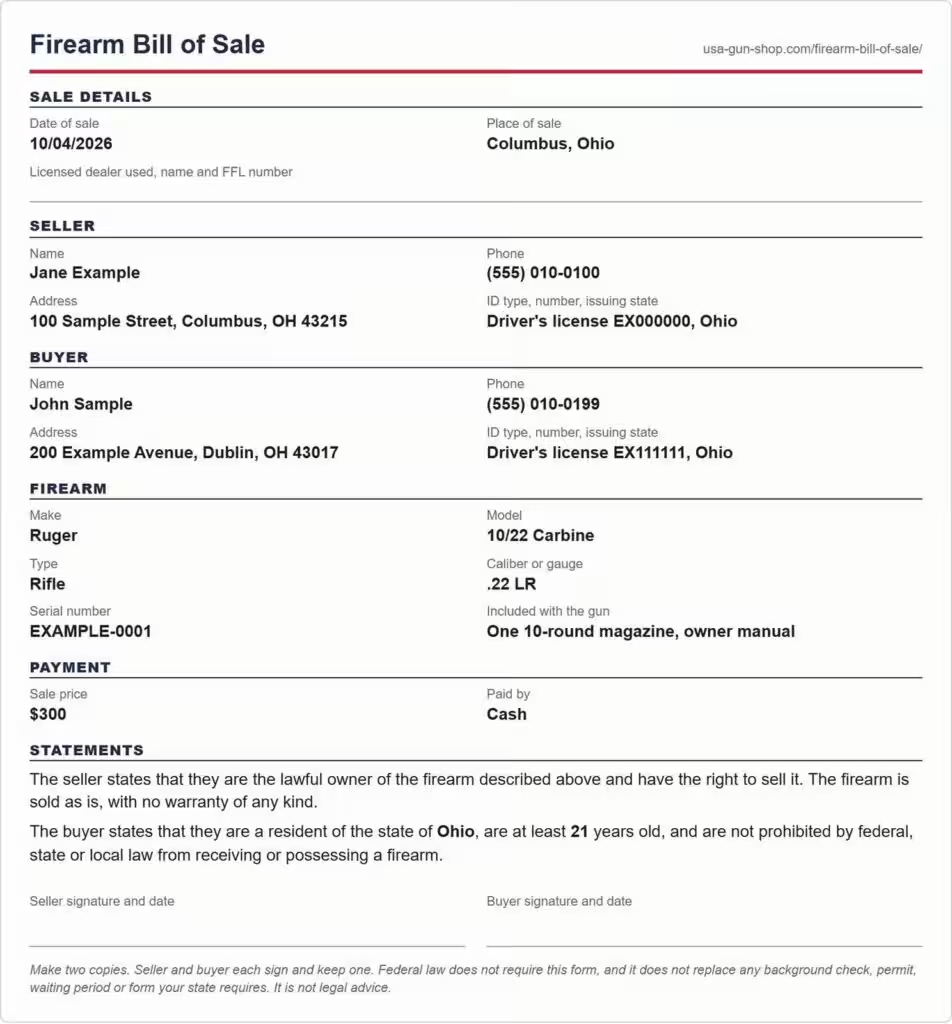
Date and Place of Sale
Write the date and the city and state where the gun changed hands. The place matters because a sale to someone who lives in another state follows different federal rules. If a licensed dealer handled the transfer, add the dealer's name and FFL number, so your record points to the dealer's.
Seller and Buyer
Full names, home addresses and phone numbers for both of you, then the ID: type, number and the state that issued it. ATF suggests that a private seller who doesn't use a dealer check the buyer's ID to confirm they live in the same state. The ID line on your bill is the record that you did.
I copy the buyer's address from their ID, not from what they tell me. If the two don't match, that's worth a question before any money changes hands.
The Firearm
Make, model, type, caliber or gauge, and the serial number. Copy the serial number from the gun itself, not from the box or an old receipt, because boxes get swapped and receipts carry typos. Read it twice, then have the buyer read it back to you.
Add anything that goes with the gun, like magazines, a case or the manual. If the gun has a known problem, write that down too. One line now saves an argument later.
Price and Payment
Write the price in dollars and how it was paid. For a trade, describe what you got in return. The IRS treats a gun you own for personal use as a capital asset, so the buyer's copy is their proof of what they paid if they ever sell it at a profit.
The Two Statements
The seller statement says you own the gun, have the right to sell it, and are selling it as is. For a used gun, the as-is line puts in writing that nobody promised it would shoot like new.
The buyer statement covers residency, age and eligibility. Ask the eligibility question directly, and let the buyer answer it in writing. Federal law makes it a crime for anyone to sell a gun to a person they know or have reasonable cause to believe:
- is under indictment for, or has been convicted of, a crime punishable by more than one year in prison
- is a fugitive from justice
- is an unlawful user of, or addicted to, a controlled substance
- has been adjudicated mentally defective or committed to a mental institution
- is in the country unlawfully or, with some exceptions, on a nonimmigrant visa
- was dishonorably discharged from the armed forces
- has renounced US citizenship
- is subject to a qualifying domestic violence restraining order
- has been convicted of misdemeanor domestic violence
- intends to use the gun in a felony, an act of terrorism or drug trafficking
- intends to pass the gun to someone who is prohibited
On age, federal law bars selling a handgun to anyone you know or have reasonable cause to believe is under 18. Under federal law, an 18 to 20 year old can buy a handgun from a private seller in their own state, but state law can set a higher age. Colorado, for one, bars a private seller from selling any gun to anyone under 21.
Signatures
Print two copies. Both of you sign and date both, and each of you keeps one. Sign in ink, so neither copy can be quietly edited later.
How to Use a Bill of Sale in a Private Sale
Here's the order I follow, from first message to handshake:
- Check your state's rules first. In the 22 states with private-sale check laws, the sale goes through the state's process, and the bill of sale is extra paperwork, not a shortcut.
- Fill in your details and the gun's details at home, before you meet.
- Meet somewhere public, or at a gun shop that handles private-party transfers.
- Check the buyer's ID against what they told you, and ask the eligibility question out loud.
- Fill in the buyer's details, the price and how they paid.
- Both of you sign both copies. Then hand over the gun.
- File your copy with your other records the same day.
Here's what a finished bill looks like, filled in with made-up details:
Is a Bill of Sale Required to Sell a Gun?
Not under federal law. ATF says no federal paperwork is required for a private sale between two residents of the same state. Its own suggestions to private sellers are to use a licensed dealer or check the buyer's ID, and it calls those recommendations, not legal requirements.
State law is a different story. Some states have their own forms, records or registration for private sales, and in those states a bill of sale is extra, not a substitute. Here's what each one requires, taken from the statutes and agency pages themselves.
| State | Paperwork state law requires on a private sale | Who keeps or files it |
|---|---|---|
| Connecticut | State form DPS-3-C and a state authorization number, for every gun | Seller keeps the original for at least 5 years, gives the buyer a copy, and sends copies to the state and the buyer's local police within 48 hours for a handgun or 24 hours for a long gun |
| Rhode Island | Buyer's purchase application in triplicate, a 7-day wait, and a bill of sale packed in the wrapper with the gun | Seller sends copies to the police and, within 7 days, the attorney general, and keeps the receipted original for 6 years |
| Massachusetts | Every sale is entered in the state's online Gun Transaction Portal at or before the sale, which produces the EFA10 form | The state system keeps the record and sends both of you a confirmation; print or save the form before closing the page |
| Illinois | A written transfer record: date, serial number, the buyer's FOID number and the state police approval number | Seller keeps it for 10 years and shows it to police on request; a buyer in a private sale gives a copy to a dealer within 10 days |
| Michigan | Seller fills in the gun and sale date on the buyer's license to purchase and signs it | Seller gives the buyer a copy and may keep one; for a pistol, one copy goes back to the licensing authority within 10 days |
| Minnesota | For pistols and listed semiautomatic rifles sold without a dealer, a state record-of-transfer form with copies of both IDs and the buyer's sworn statement | Both of you keep a copy for 10 years; a digital copy is fine |
| Hawaii | Seller signs the buyer's permit to acquire for a handgun, or sends written transfer details for a long gun; the buyer then registers the gun | Seller sends it to the police within 48 hours; the buyer registers within 5 days and the police inspect the gun |
| Maryland | MSP 77R application, filed online by a dealer or state police barrack, for handguns and listed rifles | Seller sends the state police a notice of the completed sale within 7 days of delivery |
| New Jersey | Handguns: a state web portal entry, with the sale run through a dealer. Long guns: the buyer's certification | Both of you keep a copy of the handgun record permanently |
| District of Columbia | The sale runs through a dealer, and the buyer needs a registration certificate | Seller notifies the police chief in writing within 2 business days |
| Pennsylvania | Handguns and short guns: an Application/Record of Sale, done at a dealer or county sheriff's office | The dealer or sheriff files it, not you |
| California | Dealer's Record of Sale, with both of you at the dealer in person | The dealer; the seller can ask for a copy |
| Delaware, New York, Oregon, Virginia, Washington | The sale goes through a dealer, who runs the check | The dealer keeps the record |
| Texas | None | Nobody; a state agency says a record is optional |
Sources: each state's statute, official forms and agency pages, read October 3 and 4, 2026. Rules change, so confirm with your state before you sell.
Rhode Island is the one state whose law names a bill of sale: it goes in the wrapper with the gun when it's delivered. Everywhere else in this table, the paperwork is the state's own form or the dealer's record. Texas is the clearest example of a state with none. Its State Law Library says neither federal nor Texas law requires a private seller to keep a record.
For any state not in the table, check its rules in our state gun laws guide before you sell.
Bill of Sale vs Background Check
A bill of sale proves who bought the gun. It doesn't prove they were allowed to. In 22 states plus DC, state law requires a background check, permit or state approval on at least some private sales, and in most of them that means meeting at a licensed dealer. Our universal background check states page lists all 22, with the statute for each.
When a dealer handles the transfer, the buyer fills out ATF Form 4473 and the dealer runs the background check before handing over the gun. Write your bill of sale anyway. It's the one record of the sale that you hold yourself.
Our FFL transfer guide walks through the dealer side step by step, and our FFL transfer fees page shows what dealers charge.
Should You Get a Gun Bill of Sale Notarized?
Not under any law we found. We read the private-sale rules for every state in the table above, and none requires a gun bill of sale to be notarized. The only notary requirements we came across are on purchase applications. Rhode Island's application carries a notary block, and Nebraska requires one on a handgun certificate application sent by mail.
A notary's stamp proves who signed the paper. It doesn't make the sale legal or replace anything your state requires. If you and the buyer want that extra proof, there's no harm in it.
Selling to a Buyer in Another State
A bill of sale can't make an interstate sale legal. Federal law bars an unlicensed seller from selling or giving a gun to an unlicensed buyer they know or have reasonable cause to believe lives in another state. The only exceptions are an inheritance and a temporary loan or rental for lawful sporting purposes.
To sell to someone out of state, ship the gun to a licensed dealer in the buyer's state. The buyer picks it up there after filling out a Form 4473 and passing a background check. Write a bill of sale anyway, with that dealer's name and FFL number on it.
How Long to Keep a Firearm Bill of Sale
No federal rule tells a private seller how long to keep one, so I keep mine for good. If a gun you sold ever turns up in a police investigation, your copy shows when it left your hands and who took it.
Buyers should keep theirs too. It's proof of ownership and of what you paid, which is the starting point for tax if you ever sell the gun at a profit. ATF also suggests buyers log each gun they acquire in a personal firearms record.
Keep it somewhere safe, away from the gun, and take a photo of it with your phone. A bill of sale locked in the same safe as the gun is no help if the safe is stolen.
What a Bill of Sale Can't Do
- It can't make an illegal sale legal. Selling to a prohibited buyer, or to a buyer from another state without a dealer, is a federal crime with or without paperwork.
- It doesn't replace your state's process. A bill of sale is no substitute for a background check, permit, waiting period or state form your state requires.
- It won't protect you if you knew. The federal rule covers sales to anyone you know or have reasonable cause to believe is prohibited, so a signed statement from a buyer you had doubts about is no shield.
- It isn't a government record. It stays with you and the buyer, unless your state has its own form.
- It isn't legal advice. Our form is a plain record of a sale, not a contract a lawyer drafted for your state.
Haven't Sold the Gun Yet?
Our how to sell a gun guide covers every way to do it, from a private sale to a pawn shop, with what each one pays. Not sure what to ask for it? Check what yours sells for first:
Find the Best Price in Seconds
Search once, compare 200+ trusted retailers instantly.
Prefer to skip meeting a stranger altogether? WeBuyGuns and Cash for Arms both make mail-in offers, so you ship the gun to them instead. Get a quote from each, because offers vary.
Frequently Asked Questions
Do I need a bill of sale to sell a gun?
Not under federal law, which requires no paperwork for a private sale between two residents of the same state. Some states have their own forms or records for private sales. We recommend a bill of sale every time anyway, signed by both of you, because it's the only proof of when the gun left your hands and who took it.
What should a firearm bill of sale include?
The date and place of sale, the full names, addresses and ID details of the seller and buyer, the gun's make, model, type, caliber and serial number, the price and how it was paid, a seller statement that the gun is theirs to sell and sold as is, a buyer statement on residency, age and eligibility, and both signatures.
Does a gun bill of sale need to be notarized?
Not under any law we found. None of the state rules we reviewed requires a private-sale bill of sale to be notarized. Rhode Island's purchase application and Nebraska's mailed handgun certificate application need a notary, but those are applications, not bills of sale. A notary's stamp only proves who signed.
Can a bill of sale replace a background check?
No. In the 22 states with private-sale check laws, the state's process still applies, and in most of them that means a licensed dealer runs the check. A bill of sale only records the sale. It doesn't show that the buyer was allowed to buy the gun.
Who keeps the firearm bill of sale?
Both of you. Print two copies, both sign both, and each keeps one. The seller's copy shows when the gun left their hands. The buyer's copy is proof of ownership and of what they paid.
How long should I keep a gun bill of sale?
No federal rule sets a period for a private seller, so keep it for good. Store it away from the gun, and keep a photo of it on your phone.
Can I sell a gun to someone in another state with a bill of sale?
Not directly. Federal law bars an unlicensed seller from selling to an unlicensed buyer they know or have reasonable cause to believe lives in another state. Ship the gun to a licensed dealer in the buyer's state, where the buyer fills out a Form 4473 and passes a background check.
Do I need a bill of sale to give a gun as a gift?
No federal law requires one, but a short signed record of the gift is still worth having. Some states cover gifts. Hawaii requires a permit to acquire even for gifts and inheritance, and Washington's dealer requirement covers gifts outside the immediate family.
What if the buyer won't show ID?
Don't sell. ATF suggests a private seller who doesn't use a dealer check the buyer's ID to confirm they live in the same state. A buyer who won't show one is asking you to take a risk for them.
Is there an official ATF bill of sale form?
No. ATF's guide for private sellers doesn't mention a bill of sale. Its suggestion for buyers is a personal firearms record, a log of each gun they acquire. Any bill of sale you find online, ours included, is a private form.