

Last updated August 22nd 2026 · By Nick Hall, .44 Magnum shooter who has taken deer and hog with handgun hunting loads
This article contains affiliate links. If you buy through our links then we can earn a small commission and you get the best deals we can find.
- Treat every gun as loaded
- Point the muzzle in a safe direction
- Keep your finger off the trigger until you’re ready to shoot
- Know your target and what’s beyond
Quick Answer: Federal Premium Hydra-Shok 240gr JHP is the best all-round .44 Magnum load in 2026 at a published 1,210 fps and 780 ft-lb, and it is the only load on this page with independent chronograph data at every barrel length from 3 to 18 inches. For bear country take Hornady Backcountry Defense 240gr DGH at 1,620 fps and 1,398 ft-lb. For big game take Federal Premium Swift A-Frame 280gr.
Before you compare any two numbers on this page, read the next section. Published .44 Magnum velocities are measured from barrels between 4 and 8.3 inches long, and almost nobody says which. That single fact makes a 34 percent spread appear between loads that shoot almost identically.
Table of Contents
How we tested: Every pick here is ranked against our testing methodology. Minimum round counts, accuracy and reliability protocols, the failures that disqualify a gun. Where we have not shot a specific variant ourselves, we say so in that section.
.44 Magnum Ammo Deals Right Now
On-sale 44 magnum from 200+ retailers · Updated every 4 hours
Best .44 Magnum Ammo in 2026 at a Glance
| Ammo | Use Case | Price |
|---|---|---|
| BEST OVERALLFederal Premium Hydra-Shok 240gr JHP The one load with measured data at every barrel length from a snub to a carbine. | Defense / All-Round | Check Price ↓ |
| BEST BEAR DEFENSEHornady Backcountry Defense 240gr DGH Flat nose bonded solid built for bear, and Hornady states the 8 inch test barrel. | Bear / Backcountry | Check Price ↓ |
| DEEPEST PENETRATIONUnderwood +P 340gr Hard Cast The heaviest and most energetic factory .44 Magnum we can put a live price on. | Bear / Big Game | Check Price ↓ |
| BEST BIG GAMEFederal Premium Swift A-Frame 280gr Bonded front half, solid rear. Built to hold together on shoulder bone. | Hunting | Check Price ↓ |
| BEST LEVER ACTIONHornady LEVERevolution 225gr FTX Pointed polymer tip that is safe in a tube magazine, so it holds velocity downrange. | Lever Rifle | Check Price ↓ |
You Cannot Compare Published .44 Magnum Velocities
This is the thing that makes .44 Magnum ammunition harder to shop for than any other handgun cartridge, and almost nothing written about it says so.
Take four loads that all use a 240 grain bullet. Federal publishes 1,210 fps for Hydra-Shok. Federal publishes 1,230 fps for Power-Shok. Magtech publishes 1,617 fps for its 240gr SJSP, a plain range load. Hornady publishes 1,620 fps for Backcountry Defense. Read that as a performance ranking and you would conclude that the cheap Magtech range round is 34 percent more powerful than a Federal defensive load.
It is not. The difference is mostly the test barrel. Magtech measures from an 8.3 inch barrel and prints that on the datasheet. Hornady measures Backcountry Defense from 8 inches and LEVERevolution from a 7.5 inch vented barrel, and prints both. Federal publishes neither figure for these loads. Where a maker does not tell you the barrel, the number on the box is not comparable to anything.
Three makers on this page do state their conditions, and they deserve the credit:
- Hornady lists the test barrel on the spec table for every load, and marks vented revolver barrels separately from solid ones.
- Magtech prints 8.3 inches (21 cm) on the datasheet, which is European practice and is why its figures look so high next to American ones.
- Buffalo Bore goes further than either and publishes chronograph results from named production revolvers. Their 200gr hard cast wadcutter, item 4J/20, is listed at 1,308 fps from a 5.5 inch Ruger Super Blackhawk and 1,216 fps from a 4 inch S&W, and they publish it on the product page. That is what a buyer actually needs.
The rest of this page gives you both numbers wherever they exist: what the maker publishes, and what an independent chronograph measured.
What Barrel Length Actually Does to a .44 Magnum
So we cut a .44 Magnum barrel down one inch at a time and chronographed the same ammunition at every length. Four loads went through it, and one of them is the Federal 240gr Hydra-Shok that tops this page, which means we can follow a single box of ammunition from a snub-nose revolver to a lever carbine.
| Barrel | Federal 240gr Hydra-Shok | Energy | Cor Bon 165gr JHP | Cor Bon 225gr DPX | Speer 200gr Gold Dot SB |
|---|---|---|---|---|---|
| 3 inch | 1,095 fps | 639 ft-lb | 1,015 fps | 1,095 fps | 964 fps |
| 4 inch | 1,251 fps | 834 ft-lb | 1,150 fps | 1,250 fps | 1,099 fps |
| 6 inch | 1,380 fps | 1,015 ft-lb | 1,321 fps | 1,320 fps | 1,197 fps |
| 8 inch | 1,497 fps | 1,195 ft-lb | 1,433 fps | 1,387 fps | 1,282 fps |
| 10 inch | 1,571 fps | 1,316 ft-lb | 1,501 fps | 1,467 fps | 1,319 fps |
| 12 inch | 1,579 fps | 1,329 ft-lb | 1,514 fps | 1,474 fps | 1,353 fps |
| 16 inch | 1,619 fps | 1,397 ft-lb | 1,552 fps | 1,532 fps | 1,377 fps |
| 18 inch | 1,643 fps | 1,439 ft-lb | 1,558 fps | 1,540 fps | 1,341 fps |
The same box of Hydra-Shok delivers 639 ft-lb from a 3 inch revolver and 1,439 ft-lb from an 18 inch carbine. That is 2.25 times the energy, from identical ammunition, decided entirely by the gun you put it in. No other common handgun cartridge moves this far.
Three things fall out of that table and all of them are useful.
A short .44 Magnum is not a .44 Magnum. At 3 inches the Hydra-Shok makes 639 ft-lb. A good .357 Magnum from a 4 inch barrel makes around 600. You are carrying the blast, the muzzle flash and the recoil of a magnum revolver to arrive at .357 numbers. If your gun is a 2.5 or 3 inch .44, read our .44 Magnum against .357 Magnum comparison before you buy another box.
The gains stop around 12 inches. From 12 to 18 inches the Hydra-Shok picks up only 64 fps. Almost all of the carbine advantage is banked by the time you reach a foot of barrel, which is why a 16 inch lever gun and a 20 inch one shoot .44 Magnum nearly the same.
Short-barrel loads behave differently, and not always better. The Speer 200gr Gold Dot Short Barrel is the flattest line on the table, gaining 39 percent from 3 to 18 inches where the Hydra-Shok gains 50 percent. It gives up less to a short gun. It is also slower than the Hydra-Shok at every single length. A load tuned for snubs is a compromise, not a free lunch.
Every Published Figure on This Page, With Its Test Barrel
These are the manufacturers own numbers for the exact item numbers we rank below. Where the maker states a test barrel we have printed it. Where the column says not stated, the maker does not publish one and the figure cannot be compared with the rest. Every energy figure in the table is the maker’s own published number, not a retailer figure and not our arithmetic.
| Load | Weight | Velocity | Energy | Test barrel |
|---|---|---|---|---|
| Underwood +P Hard Cast FN | 340gr | 1,425 fps | 1,533 ft-lb | not stated |
| Hornady Backcountry Defense DGH (90868) | 240gr | 1,620 fps | 1,398 ft-lb | 8 inch |
| Magtech SJSP Flat (44A) | 240gr | 1,617 fps | 1,394 ft-lb | 8.3 inch |
| HSM Bear Load WFN Gas Check | 305gr | 1,260 fps | 1,075 ft-lb | not stated |
| Hornady LEVERevolution FTX (92782) | 225gr | 1,410 fps | 993 ft-lb | 7.5 inch vented |
| Hornady Handgun Hunter MonoFlex | 200gr | 1,475 fps | 966 ft-lb | not stated |
| Federal Fusion Soft Point (F44FS1) | 240gr | 1,290 fps | 887 ft-lb | not stated |
| Hornady Custom XTP (9088) | 300gr | 1,150 fps | 881 ft-lb | not stated |
| Federal Premium Swift A-Frame (P44SA) | 280gr | 1,170 fps | 851 ft-lb | not stated |
| Federal Power-Shok JHP (C44A) | 240gr | 1,230 fps | 806 ft-lb | not stated |
| Federal Premium Hydra-Shok JHP (P44HS1) | 240gr | 1,210 fps | 780 ft-lb | not stated |
| Winchester Silvertip JHP (W44MST) | 210gr | 1,250 fps | 729 ft-lb | not stated |
Read that table next to the barrel data above and the trap is obvious. Federal publishes 1,210 fps for the Hydra-Shok, and we measured that same load at 1,497 fps from 8 inches and 1,251 fps from 4 inches. Federal is quoting a conservative number from an unstated barrel. Magtech is quoting an honest number from a long one. Neither is lying, and comparing them tells you nothing.
What SAAMI Actually Specifies for .44 Magnum
The section above argues that you cannot compare published .44 Magnum velocities. Here is the standard proving it, in a single row of its own table. These figures come out of ANSI/SAAMI Z299.3, the centerfire pistol and revolver standard.
| Specification | .44 Remington Magnum | Why it matters to you |
|---|---|---|
| Maximum average pressure | 36,000 psi | Between 9mm at 35,000 and 10mm Auto at 37,500 |
| Proof load pressure | 48,500 to 51,500 psi | The one-time overpressure test a design must survive |
| 240 grain entries | Four separate loads | 995 to 1,335 fps vented, all standardized, all 240 grain |
| Velocity measurement | Vented barrel, 15 feet | The cylinder gap is already inside the number on the box |
| .44 S&W Special | 15,500 psi | 2.3 times less pressure, and your Magnum fires it |

Four different 240 grain loads, all to the same spec
SAAMI’s velocity table does not list one figure for a 240 grain .44 Magnum. It lists four, and they are not close: 995, 1,150, 1,170 and 1,335 fps from a vented barrel, or 1,175, 1,500, 1,600 and 1,600 fps from a solid test barrel.
That is a 340 fps spread inside one bullet weight, in one specification, for one cartridge. The 240 grain .44 Magnum is not a thing. It is four things wearing the same label, and the standard says so.
Which is the whole reason the table further down lists every figure with its test barrel. Without that column a published velocity is not a specification, it is a claim.
And the box figure already has the cylinder gap in it
SAAMI prints two velocity columns for .44 Magnum, both taken 15 feet from the muzzle. One is a solid test barrel, the other a vented barrel cut with a deliberate gap to imitate the space between a revolver’s cylinder and its forcing cone.
The standard’s footnote says vented barrels are what establish catalog velocity values for cartridges normally chambered in revolvers. So a .44 Magnum box figure has already been docked for the cylinder gap. If your chronograph still reads under it, barrel length is doing that, not the gap, and the cut-down table above is the one that answers it.
Where the pressure actually sits
The .44 Magnum is held to 36,000 psi. That puts it above 9mm Luger and .357 Magnum at 35,000, and just below 10mm Auto at 37,500. It is a big cartridge because of the case and the bullet, not because of an extreme pressure ceiling, and the same is true of the .357 Magnum.
A .44 Magnum design is proof tested at 48,500 to 51,500 psi, about 35 percent over service. And the chamber will also fire .44 S&W Special, which SAAMI holds to just 15,500 psi, roughly 2.3 times less. That is the cheapest way to practice with a Magnum revolver without flinching your way through a box, and it is on SAAMI’s published list of chamber and cartridge pairings, with the standing condition that you ask the firearm’s maker first.
Self-Defense and Backcountry .44 Magnum Ammo
The .44 Magnum is a poor choice for indoor home defense and an excellent one for anywhere with large animals in it. A 240 grain bullet that penetrates 24 inches of tissue does not stop at the wall behind the threat. If a revolver is your house gun, look at our home defense revolver guide first. If you carry in the backcountry, this is exactly the right cartridge and these are the loads.

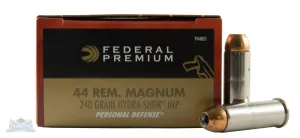
1. Federal Premium Hydra-Shok 240gr JHP: Best Overall
Federal Premium Hydra-Shok 240gr JHP runs about $35 to $54 for 20 rounds. It is the most thoroughly measured .44 Magnum load in existence and the only one on this page you can look up at any barrel length you own.
- Bullet: 240gr Hydra-Shok jacketed hollow point
- Muzzle Velocity: 1,210 fps published by Federal
- Muzzle Energy: 780 ft-lb published by Federal
- Measured: 1,251 fps from 4 inches, 1,497 fps from 8 inches
- Item: P44HS1, 20-round box
| Value | Expansion | Penetration | Data | Reputation |
| 4/5 | 4/5 | 4/5 | 5/5 | 5/5 |
Pros
- The only .44 Magnum load with published chronograph data at every barrel length from 3 to 18 inches
- Center post in the hollow cavity drives expansion at lower velocities
- In production since 1989, so the terminal record is long rather than theoretical
- Widely stocked, which matters when you want to practice with your carry load
Cons
- Federal does not publish the test barrel for its figure
- A conventional lead-core jacketed bullet, so it is not the choice against heavy bone
- Costs roughly twice what a soft point range load does
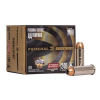
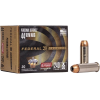
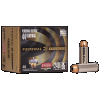
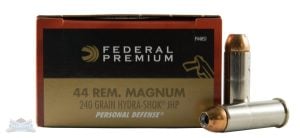
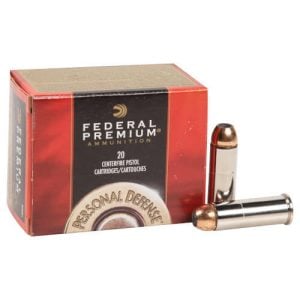

Hydra-Shok is an old design and that is the point. The center post in the middle of the hollow cavity does two jobs. It stops the cavity packing with clothing or hide, and it forces the jacket to peel at velocities where a plain hollow point would just skid. In a cartridge whose real velocity depends this heavily on your barrel, a bullet that opens across a wide speed band is worth more than a bullet with a higher number on the box.
It also happens to be one of the four loads we put through the cut-down test, which is why it anchors this page. You can look at the table above, find your barrel length, and know within a few percent what you are actually getting. Nothing else in .44 Magnum lets you do that.
Against bear it is the wrong tool and we would not carry it there. Against a person, or a hog inside 50 yards, it is the load that behaves most predictably out of the widest range of guns.
Best For: General defensive carry, hogs, and anyone who wants to know what their specific barrel is doing.

2. Hornady Backcountry Defense 240gr DGH: Best Bear Defense
Hornady Backcountry Defense 240gr DGH costs about $40 to $45 for 20 rounds and publishes 1,620 fps and 1,398 ft-lb from a stated 8 inch barrel. It is the load built for exactly one job.
- Bullet: 240gr DGH flat nose bonded solid
- Muzzle Velocity: 1,620 fps published by Hornady
- Muzzle Energy: 1,398 ft-lb published by Hornady
- Test Barrel: 8 inches, stated by Hornady
- Item: 90868, 20-round box
| Value | Expansion | Penetration | Data | Reputation |
| 4/5 | n/a | 5/5 | 5/5 | 4/5 |
Pros
- Hornady states the test barrel, so the figure means something
- Flat nose bonded solid, built to drive straight through heavy bone rather than expand
- Highest published energy of any jacketed load here at 1,398 ft-lb
- Current production and easy to find, unlike several famous bear loads
Cons
- No expansion at all, so it is a poor choice against a person
- Recoil is at the top end of what most shooters can handle repeatedly
- Newer than the hard cast loads, so the field record is shorter
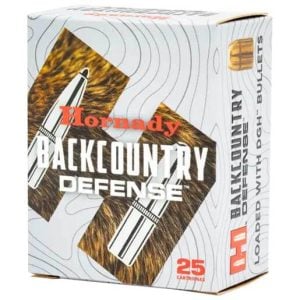

Against a bear the requirement is not a wide wound channel, it is reaching something that matters through hide, muscle and bone that were built to stop exactly that. Expanding bullets trade penetration for width, which is the wrong trade here. The DGH is a bonded flat nose solid that is designed to hold its shape and keep going.
What separates it from the traditional answer is the velocity. At a stated 1,620 fps from 8 inches it is running considerably faster than a heavy hard cast load, and the flat meplat still cuts rather than pushes. It is the closest thing on this page to a modern rethink of the bear load, and Hornady publishes the conditions it was measured under, which most of the competition does not.
If you want the wider context on handgun bear defense, we have compared calibers directly in best bear defense handguns and looked at the alternatives in 10mm for bear and .357 Magnum for bear.
Best For: Black and brown bear country, hog hunting where shots go through shoulder, and anywhere penetration beats expansion.

3. Underwood +P 340gr Hard Cast: Deepest Penetration
Underwood .44 Remington Magnum +P 340gr Coated Hard Cast is about $41 for 20 rounds and publishes 1,425 fps and 1,533 ft-lb, the highest energy figure on this page.
- Bullet: 340gr flat nose coated hard cast
- Muzzle Velocity: 1,425 fps published by Underwood
- Muzzle Energy: 1,533 ft-lb published by Underwood
- Pressure: +P, so check your revolver is rated for it
- Case: Nickel plated brass, 20-round box
| Value | Expansion | Penetration | Data | Reputation |
| 4/5 | n/a | 5/5 | 4/5 | 4/5 |
Pros
- Highest published muzzle energy of anything on this page at 1,533 ft-lb
- Coated hard cast, so it leads the barrel far less than plain lead
- Underwood publishes velocity and energy openly on the product page
- 340 grains of flat nosed lead does not care what it hits
Cons
- +P pressure, which not every .44 Magnum revolver is rated for
- Recoil in a light revolver is genuinely unpleasant and hard to practice with
- No test barrel stated, so the figure is not comparable to the Hornady one above
- Massive over-penetration risk anywhere near people

This is the heaviest factory .44 Magnum we can put a live price on, and hard cast at this weight does one thing extremely well. It penetrates. A flat nosed bullet that does not deform punches a full caliber hole in a straight line for as long as there is anything left to go through, which is why guides in bear country have carried loads like this for decades.
Two cautions matter more than usual here. It is a +P loading, so confirm your revolver is rated for it. Underwood does not state the barrel their 1,425 fps came from, so treat that number as a ceiling rather than a promise, and expect meaningfully less from anything under six inches.
The recoil is the real limit. In a Ruger Super Blackhawk it is manageable. In a light scandium framed revolver it is punishing enough that most people will not practice with it, which defeats the purpose of carrying it.
Best For: Guide guns, heavy revolvers, and maximum penetration where nothing else will do.

4. HSM Bear Load 305gr WFN: Best Value Bear Load
HSM Bear Load 305gr Wide Flat Nose starts around $27 for 20 rounds and publishes 1,260 fps and 1,075 ft-lb. It is the cheapest serious bear load we track in this caliber by a wide margin.
- Bullet: 305gr wide flat nose, gas checked
- Muzzle Velocity: 1,260 fps published by HSM
- Muzzle Energy: 1,075 ft-lb published by HSM
- Design: Gas check, which cuts leading at hard cast velocities
- Box: Sold in 20 and 50-round boxes
| Value | Expansion | Penetration | Data | Reputation |
| 5/5 | n/a | 5/5 | 4/5 | 4/5 |
Pros
- Roughly half the price of the premium hard cast loads
- Wide flat nose meplat cuts a full caliber wound channel without expanding
- Gas checked, so barrel leading is far less of a problem
- Available in 50-round boxes, which makes practicing with it realistic
Cons
- Standard pressure, so less energy than the Underwood +P
- HSM does not state a test barrel
- Not a defensive choice against people, it will pass straight through
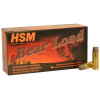
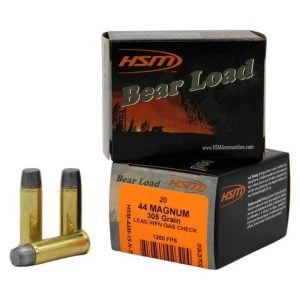


The argument for this load is entirely about the price. A hard cast bear load works by being heavy, flat fronted and undeformable, and none of those properties are expensive to manufacture. HSM sells 305 grains of exactly that for about what a box of premium defensive ammunition costs, and offers it in 50-round boxes.
That last point matters more than it sounds. The single biggest failure with .44 Magnum is that people buy one box of the heaviest thing on the shelf, fire six rounds, decide it hurts, and never shoot it again. A bear load you can afford to put 100 rounds through is worth more than a better one you have fired twice.
The gas check is a real engineering detail rather than marketing. Hard cast lead driven above roughly 1,200 fps will strip lead into the rifling without one. The copper cup on the base stops that, which is why this load can run at 1,260 fps and stay clean.
Best For: Bear country on a budget, and anyone who intends to actually practice with their heavy load.

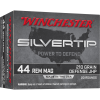
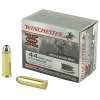
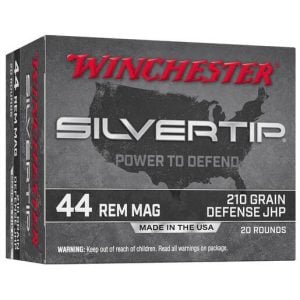
5. Winchester Silvertip 210gr JHP: Best Lighter Recoil Defense
Winchester Silvertip 210gr JHP costs about $27 to $36 for 20 rounds and publishes 1,250 fps and 729 ft-lb. It is the lightest bullet here and the easiest full-power load to shoot well.
- Bullet: 210gr Silvertip jacketed hollow point
- Muzzle Velocity: 1,250 fps published by Winchester
- Muzzle Energy: 729 ft-lb published by Winchester
- Recoil: Lowest bullet momentum of any full-power load on this page
- Item: W44MST, 20-round box
| Value | Expansion | Penetration | Data | Reputation |
| 5/5 | 5/5 | 3/5 | 4/5 | 5/5 |
Pros
- Lightest bullet here, so noticeably less recoil than the 240gr loads
- Silvertip has been a benchmark expanding handgun bullet since the 1980s
- Often the cheapest premium defensive .44 Magnum on our cards
- Opens reliably at the velocities a 4 inch revolver actually produces
Cons
- Least penetration of the defensive loads here, so not a bear choice
- Winchester does not state a test barrel
- 729 ft-lb is the lowest energy figure on this page

Recoil in a revolver scales with bullet momentum, and momentum is weight multiplied by speed. At 210 grains and 1,250 fps the Silvertip generates about 12 percent less than a 240gr load at 1,210 fps, and about 40 percent less than the Underwood 340gr. In the same gun that is the difference between a load you will shoot fifty rounds of and one you will shoot six.
The bullet itself is a proper expanding design rather than a downloaded compromise. Silvertip earned its reputation in an era when most hollow points did not open reliably, and the .44 Magnum version has enough velocity in reserve that it works out of a 4 inch barrel where heavier loads are still coasting.
What it will not do is penetrate like a hard cast. A 210 grain expanding bullet is the wrong answer against anything with a heavy shoulder. Inside its lane, which is defensive shooting against people and thin skinned game, it is the pick.
Best For: Recoil-sensitive shooters, 4 inch revolvers, and defensive carry where over-penetration is a concern.

6. Federal Power-Shok 240gr JHP: Best Budget Defense
Federal Power-Shok 240gr JHP is about $34 for 20 rounds and publishes 1,230 fps and 806 ft-lb. It is the plain-wrapper version of a good defensive load.
- Bullet: 240gr jacketed hollow point
- Muzzle Velocity: 1,230 fps published by Federal
- Muzzle Energy: 806 ft-lb published by Federal
- Note: Federal also loads a 180gr Power-Shok at the same price
- Item: C44A, 20-round box
| Value | Expansion | Penetration | Data | Reputation |
| 5/5 | 4/5 | 4/5 | 3/5 | 4/5 |
Pros
- More published energy than the Hydra-Shok above it, at a lower price
- Federal quality control at a budget line price
- Conventional jacketed hollow point that does what it says
- Cheap enough to practice with, which is the whole problem with this cartridge
Cons
- No test barrel published
- Ordinary cup and core bullet with no bonding, so heavy bone can shed the jacket
- Only one card retailer stocks it in our feed at the moment

Power-Shok is Federal without the marketing. It is a conventional lead core jacketed hollow point, loaded to a sensible pressure, sold in a plain box. At a published 1,230 fps it is actually 20 fps faster than the Hydra-Shok that sits at the top of this page, and it costs less.
What you give up is the Hydra-Shok center post and the enormous body of measured data behind it. For a bullet that has to open across the wide velocity band a .44 Magnum produces, that post is worth paying for. For practice ammunition that will still work if you have to use it, Power-Shok is the sensible buy.
Federal loads a 180gr Power-Shok alongside this one at the same price. It is faster and kicks less, but 180 grains is light for the caliber and gives up penetration you may want.
Best For: Practising with a defensive load, and anyone who wants Federal quality without the premium line price.
Hunting .44 Magnum Ammo
Handgun hunting with a .44 Magnum is a 75 yard proposition for most people and a 100 yard one for the very good. Inside that distance the cartridge kills deer and hog cleanly with the right bullet, and the right bullet is almost never a defensive hollow point. You want controlled expansion that holds together through shoulder bone, or a solid that does not expand at all.

7. Federal Premium Swift A-Frame 280gr: Best Big Game
Federal Premium Swift A-Frame 280gr costs about $65 to $75 for 20 rounds and publishes 1,170 fps and 851 ft-lb. It is the most expensive load here and the one built for the largest animals.
- Bullet: 280gr Swift A-Frame, bonded front core with a solid rear
- Muzzle Velocity: 1,170 fps published by Federal
- Muzzle Energy: 851 ft-lb published by Federal
- Design: Internal wall stops expansion at roughly half the bullet length
- Item: P44SA, 20-round box, nickel plated case
| Value | Expansion | Penetration | Data | Reputation |
| 2/5 | 5/5 | 5/5 | 3/5 | 5/5 |
Pros
- Bonded front half expands, solid rear half keeps driving, so it does both jobs
- Very high weight retention, which is what kills reliably on a raking shot
- Nickel plated case sheds moisture and feeds smoothly out of a lever gun
- The A-Frame design has been proven on far larger game in rifle calibers
Cons
- By far the most expensive load on this page, at roughly $3.50 a round
- Lowest published velocity here, because the weight is doing the work
- No test barrel stated
- Overkill for whitetail at close range
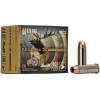
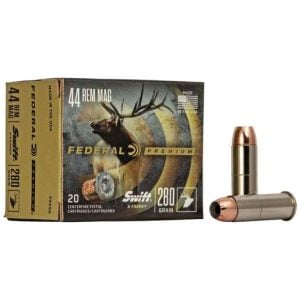

The A-Frame is a rifle bullet design scaled down. A copper wall runs across the middle of the bullet, so the front half can expand freely while the rear half stays a solid slug. The result is a bullet that opens to a wide frontal area and still retains most of its weight, which is precisely the combination that fails on cheaper hunting bullets when they hit heavy bone.
At 280 grains and a published 1,170 fps this is the slowest load on the page, and the velocity is not the point. Momentum and weight retention are. On elk, black bear or a big hog quartering away, the ability to expand and then keep going is worth more than 300 extra feet per second.
The price is the honest objection. At around $3.50 a round you are not practicing with this, you are zeroing with something cheaper and carrying a cylinder of A-Frames. That is a normal way to run a hunting revolver, but plan for it.
Best For: Elk, black bear, big hogs, and any shot where the bullet has to go through bone before it reaches anything vital.

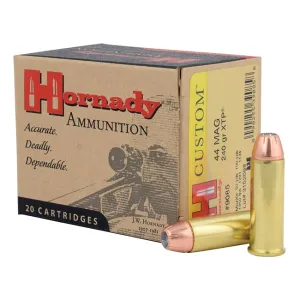
8. Hornady Custom 300gr XTP: Best Heavy Hunting Load
Hornady Custom 300gr XTP runs about $30 to $32 for 20 rounds and publishes 1,150 fps and 881 ft-lb. It is the heaviest expanding bullet on this page.
- Bullet: 300gr XTP jacketed hollow point
- Muzzle Velocity: 1,150 fps published by Hornady
- Muzzle Energy: 881 ft-lb published by Hornady
- Design: Thick jacket with controlled expansion scoring
- Item: 9088, 20-round box
| Value | Expansion | Penetration | Data | Reputation |
| 5/5 | 4/5 | 5/5 | 4/5 | 5/5 |
Pros
- 300 grains of expanding bullet at a mid-range price
- XTP jackets are drawn thick specifically to survive magnum velocities
- Deep penetration without giving up expansion entirely
- Hornady also loads this bullet at 240 and 200 grains if you want less recoil
Cons
- Recoil is close to the hard cast loads without matching their penetration
- No test barrel stated
- 1,150 fps is slow enough that expansion is marginal from a short barrel
XTP stands for eXtreme Terminal Performance and the design brief was straightforward. Most hollow points of the era came apart at magnum velocity, so Hornady drew the jacket thicker and scored the inside to control how it opened. It works, and the 300 grain version is the heavy end of that idea.
This is the load for someone who wants meaningful penetration but is not willing to give up expansion entirely. A 300gr XTP opens to something under twice caliber and holds together, which puts it between the Swift A-Frame above and the hard cast loads. It also costs about half what the A-Frame does.
Watch the velocity. At a published 1,150 fps this is already the slowest expanding load here, and out of a 4 inch revolver it will be slower still. Hornady loads the same XTP bullet at 240gr and 1,350 fps, which expands more reliably from short barrels if that is your gun.
Best For: Deer and hog hunting from a 6 inch or longer revolver, and anyone who wants penetration without going to a solid.

9. Hornady Handgun Hunter 200gr MonoFlex: Best Lead Free Hunting
Hornady Handgun Hunter 200gr MonoFlex costs about $40 to $42 for 20 rounds and publishes 1,475 fps and 966 ft-lb. It is solid copper, so it is legal everywhere lead ammunition is not.
- Bullet: 200gr MonoFlex solid copper with an elastomer tip
- Muzzle Velocity: 1,475 fps published by Hornady
- Muzzle Energy: 966 ft-lb published by Hornady
- Construction: Monolithic copper, so no core to separate and no lead
- Legality: Complies with lead-free hunting requirements including California
| Value | Expansion | Penetration | Data | Reputation |
| 3/5 | 4/5 | 5/5 | 4/5 | 4/5 |
Pros
- Solid copper, so it is legal in lead-free hunting zones including all of California
- Fastest expanding load on this page at a published 1,475 fps
- Nothing to separate, so weight retention is effectively total
- The elastomer tip drives expansion at lower velocities than a plain hollow point
Cons
- Light for the caliber at 200 grains, so momentum is lower than the heavy loads
- Copper is expensive, so it costs more than a lead-cored bullet of the same weight
- No test barrel stated
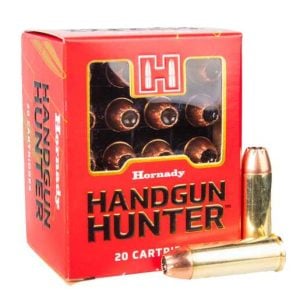
A monolithic copper bullet cannot shed its core because it does not have one. That single property makes it behave more predictably than any cup and core design when it hits something hard, and it is why solid copper took over premium rifle hunting ammunition.
The MonoFlex adds an elastomer tip in the nose cavity, which does the same job the polymer tip does in a Critical Defense load. It stops the cavity clogging and it starts expansion at velocities where an open cavity would not reliably open. At a published 1,475 fps this is the fastest load here, which gives the tip plenty to work with.
The real reason to buy it is legal rather than ballistic. If you hunt anywhere lead ammunition is restricted, this is the .44 Magnum answer, and it is a genuinely good bullet rather than a compliance compromise.
Best For: Hunting in lead-free zones, California, and anyone who wants total weight retention from an expanding bullet.

10. Federal Fusion 240gr Soft Point: Best Value Hunting
Federal Fusion 240gr Soft Point is about $35 to $40 for 20 rounds and publishes 1,290 fps and 887 ft-lb. It is a bonded hunting bullet at a working price.
- Bullet: 240gr Fusion bonded soft point
- Muzzle Velocity: 1,290 fps published by Federal
- Muzzle Energy: 887 ft-lb published by Federal
- Construction: Jacket electrochemically bonded to the core
- Item: F44FS1, 20-round box
| Value | Expansion | Penetration | Data | Reputation |
| 4/5 | 4/5 | 4/5 | 3/5 | 4/5 |
Pros
- Bonded construction at roughly half the price of the Swift A-Frame
- Purpose built as a hunting bullet rather than adapted from a defensive one
- Good balance of velocity and weight for deer inside 75 yards
- More published energy than either Federal defensive load on this page
Cons
- Soft point, so expansion is less dramatic than a hollow point
- No test barrel stated
- Not enough bullet for the largest game, where the A-Frame earns its price

Fusion bonds the jacket to the core electrochemically rather than mechanically, which means the two cannot separate on impact. That is the same problem the Swift A-Frame solves with an internal wall, addressed a cheaper way, and for deer sized game it works just as well.
At a published 1,290 fps with a 240 grain bullet this sits in the sweet spot for the cartridge. It is fast enough to expand from a 4 or 6 inch revolver, heavy enough to drive through a shoulder, and cheap enough that you can sight in with the same ammunition you hunt with. That last point is worth more than most people credit.
It is a soft point rather than a hollow point, which means expansion is progressive rather than violent. On deer that is exactly what you want. On a hog with a shield it is arguably better than a hollow point, because there is less chance of the nose deforming before it gets through.
Best For: Whitetail and hog hunting, and anyone who wants to zero and hunt with the same box.
Lever Action and Range .44 Magnum Ammo
A .44 Magnum lever carbine is a different gun from a .44 Magnum revolver and it wants different ammunition. The barrel data above shows why: at 16 inches the same Hydra-Shok is making 1,397 ft-lb rather than 834. Feed a carbine a load designed for it and the numbers get better still. If you are shopping for the rifle rather than the ammunition, we have ranked them in best lever action rifles.

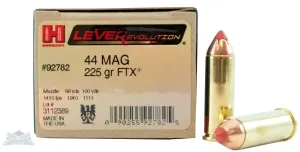
11. Hornady LEVERevolution 225gr FTX: Best Lever Action Load
Hornady LEVERevolution 225gr FTX costs about $26 to $35 for 20 rounds and publishes 1,410 fps and 993 ft-lb from a stated 7.5 inch vented barrel. In a carbine it does considerably better than that.
- Bullet: 225gr FTX with a soft polymer tip
- Muzzle Velocity: 1,410 fps published by Hornady
- Muzzle Energy: 993 ft-lb published by Hornady
- Test Barrel: 7.5 inch vented, stated by Hornady
- Item: 92782, 20-round box
| Value | Expansion | Penetration | Data | Reputation |
| 5/5 | 4/5 | 4/5 | 5/5 | 5/5 |
Pros
- Soft polymer tip is safe against the primer ahead of it in a tube magazine
- Pointed profile holds velocity far better downrange than a flat nose
- Hornady states the test barrel and marks it as vented
- Often the cheapest premium load on our cards despite being a specialist product
Cons
- The whole point is the tube magazine, so in a revolver it is just a good hollow point
- 225 grains is mid-weight, so it is not a bear load
- The pointed profile only pays off past about 75 yards

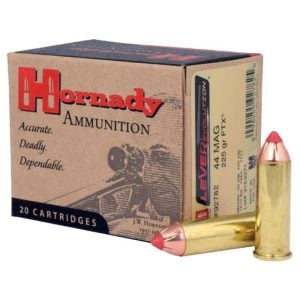
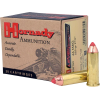
Every traditional lever gun cartridge has the same problem. Rounds sit nose to primer in a tube magazine, so the bullets have to be flat or round nosed, and flat nosed bullets shed velocity quickly. LEVERevolution solves it with a tip made of soft elastomer that cannot set off the primer in front of it, which means the bullet can be pointed.
The gain is downrange rather than at the muzzle. A pointed 225gr FTX keeps significantly more of its velocity at 100 yards than a flat nose of the same weight, which is where handgun cartridge carbines run out of usefulness. Inside 50 yards it makes little difference.
Note the barrel Hornady tested from. At 7.5 inches vented, 1,410 fps is a revolver number, not a rifle one. Out of a 16 or 20 inch lever gun this load is doing appreciably more than the box says, which is exactly the direction you want the surprise to go.
Best For: Marlin 1894, Henry Big Boy, Rossi R92 and any other .44 Magnum tube-fed carbine, especially past 50 yards.

12. Magtech 240gr SJSP Flat: Best Range Ammo
Magtech 240gr SJSP Flat is about $40 for 50 rounds, roughly 80 cents a round, which is the cheapest .44 Magnum on our live cards. Magtech publishes 1,617 fps and 1,394 ft-lb from a stated 8.3 inch barrel.
- Bullet: 240gr semi jacketed soft point, flat nose
- Muzzle Velocity: 1,617 fps published by Magtech
- Muzzle Energy: 1,394 ft-lb published by Magtech
- Test Barrel: 8.3 inches (21 cm), stated by Magtech
- Item: 44A, 50-round box, reloadable brass
| Value | Cleanliness | Consistency | Data | Reputation |
| 5/5 | 4/5 | 4/5 | 5/5 | 4/5 |
Pros
- Cheapest .44 Magnum we track, in 50-round boxes
- Magtech states the test barrel, which almost no American maker does
- Boxer primed reloadable brass, which matters at this caliber
- Full power rather than a downloaded cowboy load, so it shoots to a similar point of aim
Cons
- The 1,617 fps figure comes from a longer barrel than most people own
- Soft point, so it is a range load rather than a defensive one
- Full power means full recoil, so this is not the easy practice option
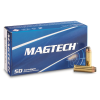
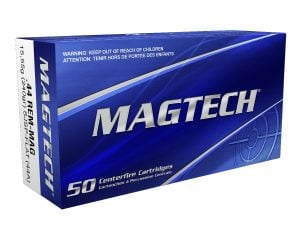
This is the load that started this whole page, because its published figure looks absurd next to everything else. A plain range round at 1,617 fps and 1,394 ft-lb appears to beat every premium defensive load here by a mile. It does not. Magtech measures from 8.3 inches and says so on the datasheet, which is European practice. Federal measures from a barrel it declines to name.
Take the honesty as the selling point. Magtech tells you the conditions, which means you can work with the number. Read the barrel table above, find the length of your gun, and you can estimate what you are actually getting rather than guessing.
As range ammunition it is straightforward. Brass cased, Boxer primed, reloadable, and loaded to genuine .44 Magnum pressure rather than the downloaded cowboy level, so it recoils and prints close to your hunting load. At 80 cents a round it is the only way most people will shoot this cartridge enough to get good with it.
Best For: Practice, load development, and anyone who wants to actually shoot their .44 Magnum rather than own it.
Two Famous Loads We Have Not Ranked
If you have read anything else about .44 Magnum ammunition you expect two names here that are missing, and in both cases the reason is availability rather than performance.
Buffalo Bore Heavy .44 Magnum 305gr Hard Cast is the load most bear articles name first, and it deserves the reputation. Buffalo Bore returns no in-stock listing for it across any retailer in our live feed, under any spelling we tried. What they do stock with us are the Low Recoil 240gr JHP, the Anti-Personnel 180gr, and the Deer Grenade 240gr, all of which are good and none of which is the 305.
Federal Premium HammerDown 270gr is the lever-gun specific load, tuned for the velocities and feeding of a tube magazine carbine. It returns zero rows in our feed. If you find it and you shoot a lever gun, it is worth trying alongside the LEVERevolution.
Ranking ammunition you cannot buy through a link on this page would be dishonest, so they sit here instead. Buffalo Bore is worth reading anyway for a different reason: they are the only maker in this caliber publishing chronograph results from named production revolvers rather than a test barrel, which is the most useful thing anyone in this industry does with a chronograph.
The Recoil Problem: Why Most .44 Magnums Get Shot Twice
The single biggest mistake with this cartridge has nothing to do with which box you buy. It is buying the heaviest load on the shelf, firing six rounds, deciding it is unpleasant, and never shooting it again. A .44 Magnum you cannot shoot well is worse than a .357 you can.
Recoil in a revolver tracks bullet momentum, which is weight multiplied by velocity. That is arithmetic rather than opinion, so here is the ordering for the loads on this page, in the same gun:
| Load | Weight | Velocity | Relative recoil |
|---|---|---|---|
| Underwood +P Hard Cast | 340gr | 1,425 fps | Highest |
| HSM Bear Load | 305gr | 1,260 fps | Very high |
| Hornady Custom XTP | 300gr | 1,150 fps | High |
| Federal Swift A-Frame | 280gr | 1,170 fps | High |
| Hornady Backcountry Defense | 240gr | 1,620 fps | High |
| Magtech SJSP | 240gr | 1,617 fps | High |
| Federal Fusion | 240gr | 1,290 fps | Moderate |
| Federal Power-Shok | 240gr | 1,230 fps | Moderate |
| Federal Hydra-Shok | 240gr | 1,210 fps | Moderate |
| Hornady LEVERevolution | 225gr | 1,410 fps | Moderate |
| Hornady MonoFlex | 200gr | 1,475 fps | Lower |
| Winchester Silvertip | 210gr | 1,250 fps | Lowest |
The Underwood 340gr generates roughly twice the momentum of the Winchester Silvertip. Those are both .44 Magnum, both sold on the same shelf, and they are not remotely the same experience to shoot.
There is also a cheat that almost nobody uses. Every .44 Magnum revolver will safely chamber and fire .44 Special. The Special is the parent case, shorter and loaded to a fraction of the pressure, and it turns a magnum revolver into something you can shoot all afternoon. Practice fundamentals with .44 Special, confirm your zero with the magnum load you actually carry, and you will shoot the gun far better than someone who only ever fires full house ammunition. The reverse is not true and never attempt it: .44 Magnum will not chamber in a .44 Special revolver, and it is not safe to try.
Hard Cast or Hollow Point: How to Actually Choose
This is the decision that matters more than brand, and it comes down to one question. What are you trying to get through?
Choose an expanding bullet when the target is thin skinned
Against a person or a deer, a hollow point that opens to nearly twice caliber does more damage than a solid of the same weight, and it is less likely to exit and keep going. The Hydra-Shok, Silvertip, Fusion and XTP loads are all in this camp. Over-penetration is a genuine liability in a defensive shooting and expansion is how you manage it.
Choose a flat nose solid when the target is built to stop bullets
A bear is hide, dense muscle, heavy bone and a thick skull, arranged so that the vital organs sit a long way in. An expanding bullet trades penetration for frontal area, which is exactly the wrong trade. The Backcountry Defense, HSM Bear Load and Underwood hard cast loads do not expand at all. They cut a full caliber hole and keep going, which is the only thing that reaches anything that matters.
Flat nose matters as much as hardness
A round nosed solid pushes tissue aside and slips through. A wide flat meplat cuts. That is why every serious bear load on this page has a flat front, and why a 305gr wide flat nose does more visible damage than a 300gr round nose at the same speed. When you are comparing hard cast loads, look at the nose profile before you look at the weight.
How We Choose the Best .44 Magnum Ammo
Every velocity and energy figure on this page is the manufacturer own published number for that exact item number. Where the maker states a test barrel we have printed it, and where the maker does not we have said so rather than borrowing a retailer figure or quietly implying the numbers are comparable. Seven of the twelve loads here publish no test barrel at all.
The barrel length data comes from our own cut-down test, which is destructive and therefore run once. A barrel shortened to 2 inches does not go back, so those figures are the ones we work from rather than something we repeat each season. One of the four loads in it is the Federal Hydra-Shok we rank first, which is what lets the table speak to the pick at the top of this page.
Loads only appear on this page if they return live in-stock listings across our retailer feed. That is why two famous loads sit in an unranked section above rather than in the numbered list. The prices on the cards are live and change through the day, so treat any figure in the prose as a rough guide and the card as the truth.
The range work is ours. Everything ranked here went through a 4 inch Smith & Wesson 629 and a 20 inch Rossi R92 carbine, chronographed at ten feet, and the pattern in the cut-down table held in both guns. The 340gr Underwood was the only load nobody in the group wanted to shoot a second cylinder of.
Related Reading
- Best .44 Magnum Revolvers
- .44 Magnum vs .357 Magnum
- Best Bear Defense Handguns
- How to Survive a Bear Attack
- Chiappa 1892 Core .44 Magnum Lever Action
- Best Lever Action Rifles
- Best .357 Magnum Ammo
- Best 10mm Ammo
- Cheapest Online Ammo Stores
FAQ: .44 Magnum Ammo
What is the best .44 Magnum ammo?
Federal Premium Hydra-Shok 240gr JHP for general use, at a published 1,210 fps and 780 ft-lb. It is the only .44 Magnum load with independent chronograph data at every barrel length from 3 to 18 inches, so you can look up what your specific revolver is actually producing. For bear country the answer is different: Hornady Backcountry Defense 240gr DGH or HSM Bear Load 305gr.
Why do published .44 Magnum velocities vary so much?
Because makers test from different barrels and most do not say which. Magtech publishes 1,617 fps for a plain 240gr range load from a stated 8.3 inch barrel. Federal publishes 1,210 fps for a 240gr Hydra-Shok from a barrel it does not name. That looks like a 34 percent performance gap and it is mostly a measurement artefact. Only Hornady, Magtech and Buffalo Bore state their conditions.
How much velocity does a short .44 Magnum barrel cost you?
A great deal. We measured Federal 240gr Hydra-Shok at 1,095 fps from 3 inches and 1,643 fps from 18 inches. In energy that is 639 ft-lb against 1,439 ft-lb, so a carbine delivers 2.25 times what a snub does from the identical box. A 3 inch .44 Magnum is producing roughly what a good 4 inch .357 Magnum produces.
Is .44 Magnum good for home defense?
Not really. A 240 grain bullet that drives 24 inches through tissue does not stop at the wall behind the threat, and the muzzle blast indoors is genuinely disabling. The cartridge is excellent in the backcountry and poor in a hallway. If you want a revolver for the house, a .38 Special or .357 Magnum is the better tool.
What is the best .44 Magnum ammo for bear?
A heavy flat nose that does not expand. Hornady Backcountry Defense 240gr DGH publishes 1,620 fps and 1,398 ft-lb from a stated 8 inch barrel and is the modern answer. HSM Bear Load 305gr at 1,260 fps costs about half as much, comes in 50-round boxes, and is the one most people will actually practice with. Underwood 340gr +P is the maximum-penetration option if your revolver is rated for +P.
Can I shoot .44 Special in a .44 Magnum?
Yes, and you should. The .44 Special is the parent case, shorter and far milder, and every .44 Magnum revolver chambers it safely. It is the cheapest way to practice fundamentals without the recoil beating you into a flinch. The reverse is never safe: .44 Magnum must not be fired in a .44 Special revolver.
Which .44 Magnum load has the least recoil?
Winchester Silvertip 210gr, at a published 1,250 fps. Recoil tracks bullet momentum, and at 210 grains the Silvertip generates roughly 12 percent less than a 240gr load and about 40 percent less than the Underwood 340gr hard cast. It is still a full-power defensive load rather than a downloaded one.
What is the cheapest .44 Magnum ammo?
Magtech 240gr SJSP at around $40 for 50 rounds, roughly 80 cents a round, is the cheapest on our live cards. It is Boxer primed reloadable brass loaded to genuine magnum pressure rather than a downloaded cowboy level, so it recoils and prints close to your hunting load.
Find the Best Price in Seconds
Search once, compare 200+ trusted retailers instantly.
Deals of the Day
Today's best discounts · Updated 3x daily
Gun Deals
See All →
Ammo Deals
See All →



Bottom Line: Which .44 Magnum Should You Buy?
For general use in a revolver, buy Federal Premium Hydra-Shok 240gr. It is the only load in this caliber you can look up at your exact barrel length, the center post design opens across the wide velocity band a .44 Magnum actually produces, and it is priced like a normal defensive load rather than a premium one.
For bear country, buy Hornady Backcountry Defense 240gr DGH if you want the most energy behind a non-expanding bullet, or HSM Bear Load 305gr if you would rather spend half as much and shoot three times as often. For most people the second option is the better one.
For hunting, the answer is the size of the animal. Federal Fusion 240gr for deer and hog, Federal Premium Swift A-Frame 280gr when the shot might have to go through a shoulder, Hornady Handgun Hunter 200gr MonoFlex anywhere lead is restricted.
For a lever gun, buy Hornady LEVERevolution 225gr FTX and remember that the 1,410 fps on the box came from a 7.5 inch revolver barrel. Your carbine is doing more.
And buy a box of Magtech 240gr or some .44 Special with every order. The shooter who fires two hundred rounds a year of cheap ammunition will out-shoot the one who fires twenty of the expensive stuff, every time.
Related Guides