

Last updated August 2026 · By Nick Hall, firearm historian who has covered sniper rifles from the M1D through modern civilian M24s
Some of the links below are affiliate links, meaning at no additional cost to you, we may earn a commission if you click through and make a purchase.
- Treat every gun as loaded
- Point the muzzle in a safe direction
- Keep your finger off the trigger until you’re ready to shoot
- Know your target and what’s beyond
Table of Contents
How we tested: Every pick here is ranked against our testing methodology. Minimum round counts, accuracy and reliability protocols, the failures that disqualify a gun. Where we have not shot a specific variant ourselves, we say so in that section.
Introduction: The Rifles That Changed Warfare
Military snipers have driven rifle technology forward for over 200 years. The flintlock sharpshooters at Saratoga, the Whitworth rifles of the Civil War, the Springfield ’03s of the World Wars. Every leap in precision rifle technology traces back to a military program that funded its development and proved the concept in combat.
Every bolt-action hunting rifle you can buy today owes its existence to military contracts. The Remington 700, the most popular bolt gun in American history, was chosen as the basis for the M24 when the U.S. Army needed a new sniper weapon system in the 1980s. The civilian precision rifle market is essentially a downstream effect of military R&D budgets.
I’ve spent years following the evolution of military sniper platforms, from the Cold War bolt guns to the AI-assisted systems being deployed in Ukraine right now. The technology is advancing faster than at any point in history. Drone-corrected fire, AI ballistic calculators, and purpose-built anti-materiel rifles are pushing engagement distances past 4,000 meters.
These are the 10 rifles that shaped modern sniping. Some are battle-proven legends. Some are cutting-edge platforms still being fielded. And many of them have civilian versions you can actually buy. I’ve included live pricing where available, along with links to our best sniper rifles and most powerful rifles roundups for deeper dives.
Quick Answer: The M24 SWS and its Remington 700 action remain the most influential military sniper rifle ever fielded, but the current headline names are the Accuracy International AXMC in .338 Lapua Magnum, the Barrett M107 in .50 BMG for anti-materiel work, and the McMillan Tac-50 that holds the longest confirmed kill in the table below. The US Army has since moved its designated marksmen onto the M110A1 CSASS and its squads onto the SIG M7 in 6.8x51mm. Seven of the ten have a civilian-legal equivalent you can actually buy, and the table shows which.
Military Sniper Rifles at a Glance
| Rifle | Country | Caliber | Service Years | Notable Achievement | Civilian Version? |
|---|---|---|---|---|---|
| M24 SWS | USA | 7.62 NATO | 1988 – present | U.S. Army standard sniper rifle for 25+ years | Yes (Remington 700) |
| AI AXMC / L115A3 | UK | .338 Lapua | 2007 – present | 2,475m confirmed kill by Craig Harrison in 2009 | Yes (AI AT/AX series) |
| Barrett M82A1 / M107 | USA | .50 BMG | 1989 – present | Redefined anti-materiel warfare | Yes (identical) |
| McMillan Tac-50 | USA / Canada | .50 BMG | 2000 – present | 3,540m confirmed kill by JTF2 in 2017 | Yes (same model) |
| SIG MCX Spear / M7 | USA | 6.8x51mm | 2024 – present | Newest U.S. Army rifle adoption | Yes (SIG Cross / MCX Spear) |
| Dragunov SVD | Russia | 7.62x54R | 1963 – present | Most widely deployed DMR in history | Rare imports |
| Sako TRG-42 | Finland | .338 Lapua | 2000 – present | Used by dozens of NATO and allied forces | Yes (identical) |
| CheyTac M200 Intervention | USA | .408 CheyTac | 2001 – present | Sub-MOA to 2,500 yards | Yes ($10,000+) |
| HK G28 / M110A1 | Germany | 7.62 NATO | 2012 – present | U.S. Army CSASS winner | Yes (HK MR762) |
| M40A5/A6 | USA | 7.62 NATO | 1966 – present | USMC Scout Sniper standard since Vietnam | Yes (Remington 700) |
| Firearm | Caliber | Weight | Barrel | Civilian Version |
|---|---|---|---|---|
| M24 SWS / Remington 700 (USA) | 7.62x51mm NATO (.308 Winchester) | 12 lbs (unscoped) | 24" free-floating, 5R rifling, stainless steel | Remington 700 ↓ |
| Accuracy International AXMC / L115A3 (UK) | .338 Lapua Magnum (multi-caliber capable) | 14.3 lbs (unloaded) | 27" (L115A3), varies by variant | AI rifles ↓ |
| Barrett M82A1 / M107 (USA) | .50 BMG (12.7x99mm NATO) | 30.9 lbs (M107) | 29" (M107), 20" (M107A1) | Barrett M107 ↓ |
| USA / CANADA McMillan Tac-50 | .50 BMG (12.7x99mm NATO) | 26 lbs | 29" | Tac-50 ↓ |
| SIG MCX Spear / M7 (USA) | 6.8x51mm (.277 Fury) | ~8.4 lbs (unloaded) | 13" (standard), 10.5" (updated 2025 variant) | SIG Cross ↓ |
| Dragunov SVD (Russia) | 7.62x54R | 9.5 lbs (with scope and empty magazine) | 24.4" | No US civilian version |
| FINLAND Sako TRG-42 | .338 Lapua Magnum (also available in .300 Win Mag) | 11.4 lbs | 27" cold hammer-forged | Sako TRG ↓ |
| CheyTac M200 Intervention (USA) | .408 CheyTac / .375 CheyTac | 31 lbs (without optic) | 29" | Military and LE only |
| Heckler & Koch G28 / M110A1 CSASS (Germany) | 7.62x51mm NATO (.308 Winchester) | 8.4 lbs (unloaded, M110A1) | 16.5" (M110A1) | HK MR762 ↓ |
| M40A5/A6 (USMC) | 7.62x51mm NATO (.308 Winchester) | ~14.5 lbs (loaded, with scope) | 24" (M40A5), 20" (M40A6) | Armory-built, no civilian version |
1. M24 SWS / Remington 700 (USA)
- Caliber: 7.62x51mm NATO (.308 Winchester)
- Action: Bolt-action (Remington 700 long action)
- Barrel: 24″ free-floating, 5R rifling, stainless steel
- Weight: 12 lbs (unscoped)
- Magazine: 5-round internal
- Effective Range: 800m
- In Service: 1988 – present
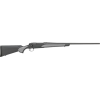
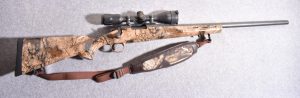
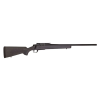
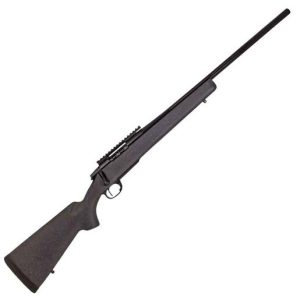
The M24 Sniper Weapon System is arguably the most important military sniper rifle of the modern era. Not because it’s the most powerful or the most advanced, but because it proved that a properly accurized bolt gun firing 7.62 NATO could be devastatingly effective in trained hands. The U.S. Army adopted it in 1988 after a competitive evaluation, and it served as the primary sniper platform through every major conflict from Panama to Afghanistan.
Built on the Remington 700 long action (chambered for the shorter 7.62 NATO round, leaving room for a future .300 Win Mag conversion), the M24 uses an HS Precision composite stock with an aluminum bedding block, a free-floating 24-inch stainless barrel with 5R rifling, and a Leupold Mk 4 10x40mm fixed-power scope. It’s a straightforward, brutally reliable system. Over 15,000 units were delivered to the Army between 1988 and 2010.
The beauty of the M24 for civilian shooters is that its foundation, the Remington 700, is the best-selling bolt-action rifle in American history. You can walk into any gun store in the country and buy the same basic action that Army snipers carried for decades. The 700 platform has spawned more aftermarket support than any other bolt gun ever made. Stocks, triggers, barrels, chassis systems: the ecosystem is enormous. If you’re interested in getting into precision rifle shooting, a Remington 700 in .308 Win is still one of the smartest entry points.
Remington also developed the M24A2 with a detachable magazine and suppressor-ready barrel, and the M24A3 chambered in .338 Lapua Magnum. The platform evolved continuously, which speaks to the fundamental soundness of the original design.


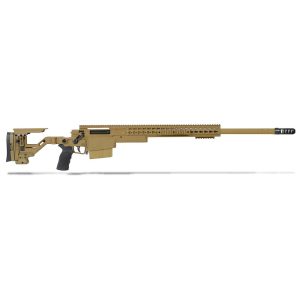
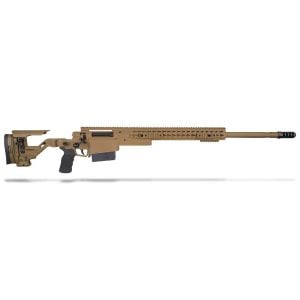
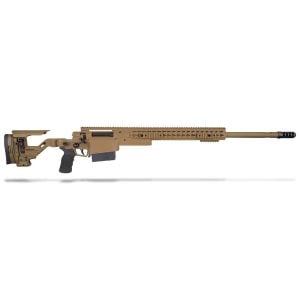
2. Accuracy International AXMC / L115A3 (UK)
- Caliber: .338 Lapua Magnum (multi-caliber capable)
- Action: Bolt-action
- Barrel: 27″ (L115A3), varies by variant
- Weight: 14.3 lbs (unloaded)
- Magazine: 5-round detachable
- Effective Range: 1,750m+
- In Service: 2007 – present (L115A3 variant)
Accuracy International is the gold standard in military precision rifles, and the L115A3 variant proved it in the most dramatic way possible. In November 2009, Corporal of Horse Craig Harrison of the British Army’s Household Cavalry consecutively killed two Taliban machine gunners in Helmand Province, Afghanistan at a range of 2,475 meters (2,707 yards). The .338 Lapua rounds took nearly five seconds to reach their targets, which were 900 meters beyond the rifle’s recommended maximum range. That record stood for nearly eight years.
The AXMC (Accuracy International Chassis Multi-Caliber) represents the current evolution of the platform. It’s a quick-change barrel system that lets operators swap between .338 Lapua, .300 Win Mag, and 7.62 NATO by changing the barrel and bolt head. That kind of flexibility is invaluable for military units that need one rifle system to cover multiple mission profiles.
What sets AI apart from the competition is their obsessive approach to manufacturing tolerances. Every rifle ships with a test target proving sub-MOA accuracy. The chassis system, originally revolutionary when AI introduced it in the 1980s with the PM (Precision Marksman), replaced traditional wood and fiberglass stocks with a rigid aluminum chassis that eliminated bedding issues entirely. Most modern precision rifle chassis owe their existence to AI’s original concept.
Civilian versions are available through the AI AT and AX series, though they command premium prices. If you’re shopping .338 Lapua platforms, check our roundup of the best .338 rifles for more options across price ranges. You can also find AI rifles through EuroOptic, which typically carries the full AI lineup.
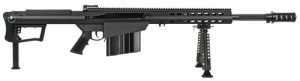
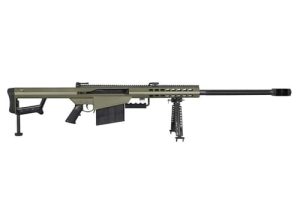
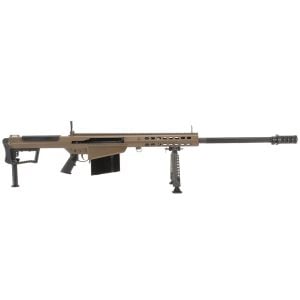
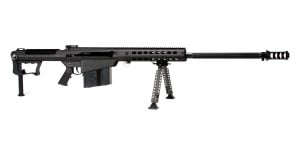
3. Barrett M82A1 / M107 (USA)
- Caliber: .50 BMG (12.7x99mm NATO)
- Action: Semi-automatic, short recoil operated
- Barrel: 29″ (M107), 20″ (M107A1)
- Weight: 30.9 lbs (M107)
- Magazine: 10-round detachable
- Effective Range: 1,800m
- In Service: 1989 – present
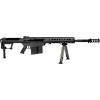
Ronnie Barrett built the first M82 in his garage in the early 1980s because he wanted a shoulder-fired semi-automatic .50 caliber rifle and nobody made one. The U.S. military initially wasn’t interested. Then the Gulf War happened, and soldiers discovered that a .50 BMG semi-auto could disable vehicles, detonate unexploded ordnance from a safe distance, and engage targets at ranges that made conventional sniper rifles look like pistols. The military couldn’t buy them fast enough.
The M82A1 (designated M107 by the U.S. military) fundamentally changed how armed forces think about long-range engagement. It’s classified as an anti-materiel rifle, meaning its primary targets are equipment, not personnel. In practice, it does both. The short-recoil operating system tames the .50 BMG’s brutal recoil enough that a trained shooter can put rapid follow-up shots on target at over a mile, something no bolt-action .50 can match.
The civilian version of the Barrett M82A1 is functionally identical to the military M107. You’re buying the same rifle. The M107A1 is the updated variant with a titanium barrel key, suppressor-ready muzzle brake, and lighter weight. Current street prices for a new M107A1 run around $10,000, which is actually less than it was a few years ago. Not cheap, but for an identical-to-military .50 BMG semi-auto, it’s the real deal. See our full Barrett .50 BMG guide and most powerful rifles roundup for more.
4. McMillan Tac-50 (USA / Canada)
- Caliber: .50 BMG (12.7x99mm NATO)
- Action: Bolt-action, manually operated rotary bolt
- Barrel: 29″
- Weight: 26 lbs
- Magazine: 5-round detachable
- Effective Range: 1,800m+
- In Service: 2000 – present (Canadian C15 designation)
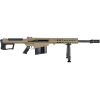
The McMillan Tac-50 holds what was, for years, the undisputed longest confirmed sniper kill in history. In June 2017, an unnamed operator from Canada’s Joint Task Force 2 (JTF2) killed an ISIS insurgent in Iraq from 3,540 meters (3,871 yards). The round was in the air for roughly 10 seconds. That shot shattered the previous record by over a kilometer.
But the Tac-50’s record-breaking history didn’t start in 2017. In March 2002 during Operation Anaconda in Afghanistan, Canadian Corporal Rob Furlong used a Tac-50 to kill an Al-Qaeda fighter at 2,430 meters (2,657 yards), which was the world record at the time. His teammate, Master Corporal Arron Perry, had set his own record of 2,310 meters just days earlier with the same rifle type. The Tac-50 has produced more record-breaking shots than any other rifle in history.
Where the Barrett M107 is semi-automatic and designed for rapid anti-materiel work, the Tac-50 is a precision bolt gun. It sacrifices rate of fire for extreme accuracy at distance. The Canadian military designates it the C15 Long Range Sniper Weapon, and it’s been their primary long-range platform since 2000. McMillan’s fiberglass stock technology (the same company makes stocks for many other military and competition rifles) provides the foundation for a system that has proven itself in conditions from Afghan mountain passes to Iraqi urban corridors.
The civilian Tac-50 is the same rifle. Prices typically fall in the $8,000 to $10,000 range. For more .50 BMG options, see our most powerful rifles guide and best .50 BMG rifles roundup.
5. SIG MCX Spear / M7 (USA)
- Caliber: 6.8x51mm (.277 Fury)
- Action: Semi-automatic, gas-operated, short-stroke piston
- Barrel: 13″ (standard), 10.5″ (updated 2025 variant)
- Weight: ~8.4 lbs (unloaded)
- Magazine: 20-round detachable (SR-25 pattern)
- Effective Range: Extended over 5.56 NATO
- In Service: 2024 – present (fielding began March 2024)
The SIG MCX Spear, designated M7 by the U.S. Army (type classified May 2025), represents the most significant small arms adoption by the American military in decades. It won the Next Generation Squad Weapon (NGSW) contract in April 2022 after 27 months of competitive evaluation against entries from General Dynamics and Textron. The M7 is designed to replace the M4 carbine as the Army’s standard infantry rifle, not the M24 sniper system, but its relevance to long-range precision shooting is profound.
The 6.8x51mm cartridge (commercially known as .277 SIG Fury) uses a hybrid steel-brass case that allows chamber pressures of 80,000 PSI, far beyond what conventional brass cases can handle. The result is dramatically higher muzzle velocities and energy from a cartridge that fits in an AR-10 sized platform. This gives every squad member engagement capability that previously required a dedicated marksman rifle. The XM157 fire control system (essentially a smart optic) paired with the M7 includes a ballistic computer, laser rangefinder, and environmental sensors.
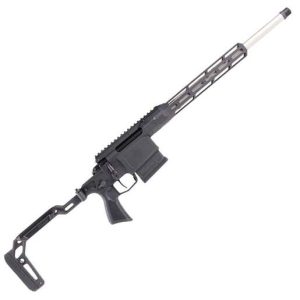
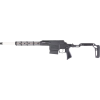
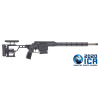
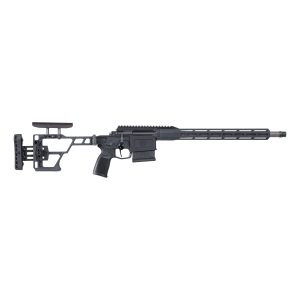
For civilians, SIG offers the MCX Spear in .277 Fury, as well as the SIG Cross bolt-action rifle chambered in .277 Fury, .308 Win, and 6.5 Creedmoor. The Cross is a lightweight bolt gun with a folding precision stock, designed with input from military snipers and long-range shooters. It’s one of the more interesting precision rifle platforms to come out in recent years, bridging the gap between a backcountry hunting rifle and a tactical precision rig. See our SIG Sauer guide for more from the SIG ecosystem.

6. Dragunov SVD (Russia)
- Caliber: 7.62x54R
- Action: Semi-automatic, gas-operated, short-stroke piston
- Barrel: 24.4″
- Weight: 9.5 lbs (with scope and empty magazine)
- Magazine: 10-round detachable
- Effective Range: 800m
- In Service: 1963 – present
The Dragunov SVD is not a sniper rifle in the Western sense. It’s a designated marksman rifle (DMR), issued at the squad level to extend a unit’s engagement range beyond what standard AK-pattern rifles can reach. That distinction matters. Soviet doctrine didn’t produce lone snipers stalking high-value targets from concealed positions. It produced marksmen embedded in infantry squads, providing accurate fire out to 800 meters to support the unit’s advance.
That said, the SVD has been deployed by more countries than any other precision-oriented rifle in history. Over 30 nations have fielded it, and it’s been present in virtually every armed conflict since Vietnam. The 7.62x54R cartridge (essentially the Russian equivalent of .308 Win in terms of ballistics, though it’s a rimmed cartridge dating to 1891) gives it adequate performance for its intended role. The semi-automatic action, fed by a 10-round detachable magazine, allows rapid follow-up shots that bolt-action snipers can’t match.
Designed by Yevgeny Dragunov in the late 1950s and adopted in 1963, the SVD uses a short-stroke gas piston system that’s mechanically unrelated to the AK, despite superficial similarities. The receiver is machined, not stamped, and the barrel is chrome-lined. Accuracy from a military-grade SVD is typically 1.5 to 2 MOA with match ammunition, which is respectable for a semi-auto DMR but nowhere near what Western bolt-action sniper systems deliver.
Civilian imports of the SVD to the United States are extremely rare and expensive due to import restrictions. The Chinese-made NDM-86 (a Norinco copy) and the Romanian PSL (often mistakenly called a Dragunov, but mechanically different) are the most commonly encountered alternatives. A genuine Russian SVD in the U.S. market commands collector prices well north of $5,000.
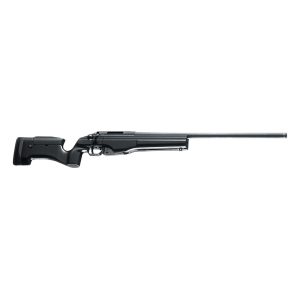
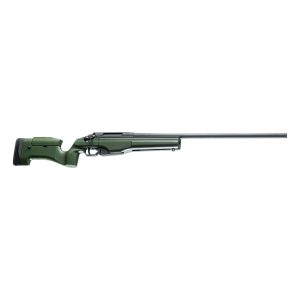
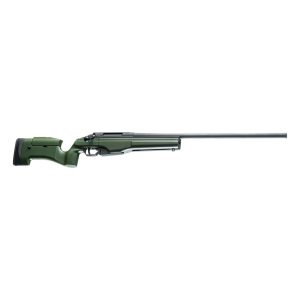
7. Sako TRG-42 (Finland)
- Caliber: .338 Lapua Magnum (also available in .300 Win Mag)
- Action: Bolt-action
- Barrel: 27″ cold hammer-forged
- Weight: 11.4 lbs
- Magazine: 5-round detachable
- Effective Range: 1,500m+
- In Service: 2000 – present
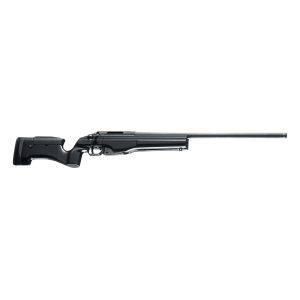
Finland has a sniper tradition that extends back to the Winter War, when Finnish marksmen inflicted devastating casualties on Soviet forces in sub-zero conditions. Sako (now part of the Beretta family) built on that heritage with the TRG series, and the TRG-42 in .338 Lapua has become one of the most widely adopted military sniper rifles among NATO and allied forces.
The TRG-42 is a purpose-built sniper platform, not a modified hunting rifle. The cold hammer-forged barrel, adjustable two-stage trigger, and aluminum-reinforced polyurethane stock with fully adjustable cheek piece and buttpad are all designed from scratch for long-range precision. Sako’s barrel-making reputation is legendary in the shooting world, and the TRG-42 showcases it. Sub-MOA accuracy with quality match ammunition is the standard, not the exception.
What makes the TRG-42 interesting from a civilian perspective is that the rifle you can buy is essentially the same rifle that military and law enforcement units around the world carry. There’s no demilitarized version or watered-down civilian variant. The Sako TRG-42 on the shelf at your local dealer has the same barrel, the same action, and the same accuracy guarantee as the ones deployed by special operations forces across Europe. For more .338 Lapua options, see our best .338 rifles roundup.
8. CheyTac M200 Intervention (USA)
- Caliber: .408 CheyTac / .375 CheyTac
- Action: Bolt-action, manually operated rotary bolt
- Barrel: 29″
- Weight: 31 lbs (without optic)
- Magazine: 7-round detachable (5-round optional)
- Effective Range: 2,500 yards (sub-MOA)
- In Service: 2001 – present (limited adoption)
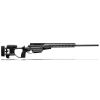
The CheyTac M200 Intervention was purpose-built for one thing: putting rounds on target at extreme distances with surgical accuracy. CheyTac Inc. claims sub-MOA performance out to 2,500 yards, and independent testing has generally backed that up. The .408 CheyTac cartridge was specifically designed to maintain supersonic velocity past 2,000 yards, addressing the transonic instability problems that plague .50 BMG and .338 Lapua at extreme range.
The M200 got its biggest pop culture moment as the rifle used by Mark Wahlberg’s character in the 2007 film “Shooter,” which put it on the radar of a lot of gun enthusiasts who had never heard of CheyTac. But the real-world system is far more interesting than its Hollywood appearance. The complete CheyTac system includes an Advanced Ballistic Computer (ABC) that accounts for temperature, humidity, barometric pressure, wind, altitude, and even the Coriolis effect to calculate firing solutions at distances where the Earth’s rotation becomes a factor.
Military adoption has been limited compared to mainstream platforms like the M24 or Barrett M107, partly because the .408 CheyTac fills a narrow niche between .338 Lapua and .50 BMG. Special operations units in several countries have used it, but it hasn’t achieved widespread procurement. The civilian M200 Intervention is the same rifle, available for purchase, but expect to pay $10,000 to $15,000 depending on configuration. Ammunition availability for .408 CheyTac is also more limited and more expensive than .50 BMG or .338 Lapua.
9. Heckler & Koch G28 / M110A1 CSASS (Germany)
- Caliber: 7.62x51mm NATO (.308 Winchester)
- Action: Semi-automatic, gas-operated, short-stroke piston
- Barrel: 16.5″ (M110A1)
- Weight: 8.4 lbs (unloaded, M110A1)
- Magazine: 10 or 20-round detachable
- Effective Range: 800m
- In Service: 2012 (Bundeswehr), 2016 (U.S. Army CSASS)
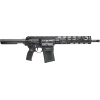
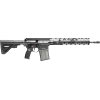
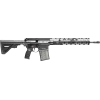
Heckler & Koch’s G28 started life as a designated marksman variant of the HK417 battle rifle, developed for the German Bundeswehr’s deployment to Afghanistan. When the U.S. Army needed a replacement for the aging Knight’s Armament M110, HK submitted a lighter version of the G28 and won the Compact Semi-Automatic Sniper System (CSASS) contract in 2016. The U.S. designation is M110A1, carrying forward the M110 name despite being a completely different rifle.
The M110A1 CSASS is significantly lighter and shorter than the original M110, weighing 8.4 lbs unloaded versus the M110’s 15+ lbs with accessories. It uses HK’s proven short-stroke gas piston system (shared with the G36 and HK416 family), a Geissele M-LOK handguard, and pairs with a Schmidt & Bender 3-20×50 scope. The OSS suppressor is integral to the system. That weight savings matters enormously for soldiers carrying the rifle on dismounted patrols alongside their other kit.
The civilian equivalent is the HK MR762A1, which shares the core operating system and barrel with the military G28/M110A1. It’s one of the finest semi-automatic .308 rifles money can buy, with HK’s characteristic over-engineering and reliability. The MR762 isn’t cheap (expect $3,500 to $4,500 depending on the package), but it’s a genuine mil-spec DMR platform adapted for the civilian market. For more semi-auto .308 options, check our best semi-auto .308 rifles roundup.
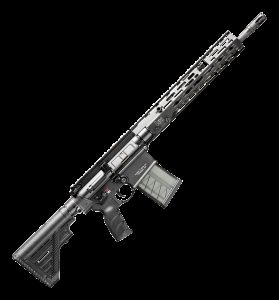
10. M40A5/A6 (USMC)
- Caliber: 7.62x51mm NATO (.308 Winchester)
- Action: Bolt-action (Remington 700 short action)
- Barrel: 24″ (M40A5), 20″ (M40A6), Schneider match-grade
- Weight: ~14.5 lbs (loaded, with scope)
- Magazine: Detachable (AI 10-round on M40A6)
- Effective Range: 800m
- In Service: 1966 – present (M40 series)
Every rifle in the M40 series starts life as a Remington 700 short action. From there, USMC armorers at the Precision Weapons Section in Quantico, Virginia hand-build each rifle to exacting specifications. The M40 is not a factory rifle. It’s a custom-built precision weapon assembled by Marine armorers from components sourced across the industry, all fitted to that Remington 700 action.
The M40 has been the backbone of USMC Scout Sniper operations since the original M40 was adopted in 1966, during the Vietnam War. Carlos Hathcock, arguably the most famous American sniper in history, used early M40 variants. The rifle has evolved through multiple iterations: the M40A1 in the 1970s, the M40A3 in the 2000s, the M40A5 in 2009, and the current M40A6 which began fielding in 2016.
The M40A5 introduced a detachable magazine (Badger Ordnance system) and a suppressor-ready threaded barrel, replacing the internal magazine of earlier variants. The M40A6 takes the further step of using a shorter 20-inch Schneider barrel with a 1:10 twist rate and Accuracy International 10-round magazines. It also moved to a more modern modular stock system. Both variants are optimized for M118LR match ammunition.
The M40 and the Army’s M24 both start with Remington 700 actions, but they’re different rifles built to different specs by different organizations. The M40 uses the short action, while the M24 uses the long action. The stocks, barrels, triggers, and optics are all different. What they share is proof of just how good the Remington 700 action is as a foundation for precision rifle building. If you want to build your own M40-style rifle, a Remington 700 in .308 Win is where you start.
Longest Confirmed Sniper Kills in History
The record books have been rewritten dramatically in recent years. The war in Ukraine has produced two new world records, both using Ukrainian-made anti-materiel rifles with drone and AI-assisted targeting. Here are the top confirmed kills by distance.
| Rank | Distance | Sniper | Rifle | Caliber | Year | Country |
|---|---|---|---|---|---|---|
| 1 | 4,000m (4,374 yd) | Unnamed (“Pryvyd” unit) | Snipex Alligator | 14.5x114mm | 2025 | Ukraine |
| 2 | 3,800m (4,156 yd) | Viacheslav Kovalskyi | Volodar Obriyu | Multi-caliber AM | 2023 | Ukraine |
| 3 | 3,540m (3,871 yd) | Unnamed JTF2 operator | McMillan Tac-50 | .50 BMG | 2017 | Canada |
| 4 | 2,815m (3,079 yd) | Unnamed (2nd Commando Rgt) | Barrett M82A1 | .50 BMG | 2012 | Australia |
| 5 | 2,475m (2,707 yd) | Craig Harrison | AI L115A3 | .338 Lapua | 2009 | UK |
| 6 | 2,430m (2,657 yd) | Rob Furlong | McMillan Tac-50 | .50 BMG | 2002 | Canada |
| 7 | 2,300m (2,515 yd) | Brian Kremer | Barrett M82A1 | .50 BMG | 2004 | USA |
The Ukrainian entries are particularly significant because they represent a shift in how long-range shooting is conducted. The 4,000-meter shot by a member of the “Pryvyd” (Ghost) sniper unit used AI-calculated ballistic solutions and drone-based spotting to correct fire in real time. The 3,800-meter shot by 58-year-old SBU sniper Viacheslav Kovalskyi used the Ukrainian-made Volodar Obriyu (“Horizon’s Lord”) rifle with a Bartlein barrel. These are system-level achievements, not just marksmanship feats.
For more on the history of military sniping and the people behind these shots, see our guide to the most famous military snipers in the world.
Civilian Versions You Can Buy
One of the best things about military sniper rifles is that most of them have civilian equivalents. In many cases, the civilian version is functionally identical to the military rifle. Here’s what’s available and what you can expect to pay.
Remington 700 (M24/M40 base platform): The foundation of both the Army’s M24 and the Marine Corps’ M40. Street price starts around $700 for a base model and runs up to $2,500+ for premium configurations. The aftermarket ecosystem is the largest of any bolt-action rifle in existence. This is the most accessible entry point into precision shooting. See our Remington 700 / .308 roundup.
Barrett M82A1 / M107A1: The exact same rifle the military uses. New M107A1 prices currently average around $10,000. The older M82A1 can save you $3,000 or more. Either way, you’re getting a genuine semi-automatic .50 BMG anti-materiel rifle. Full Barrett guide here.
Accuracy International AT/AX: AI’s civilian lineup offers the same chassis system and manufacturing quality as their military rifles. Prices start around $4,000 for the AT and climb to $7,000+ for the AXMC. Available through specialty dealers like EuroOptic and Brownells.
SIG Sauer Cross: A lightweight bolt-action available in .308 Win, 6.5 Creedmoor, and .277 Fury. Prices range from $1,600 to $2,200 depending on configuration. The MCX Spear (semi-auto, closer to the military M7) runs significantly more.
Sako TRG-42: The civilian version is the military version. Expect to pay $3,500 to $5,000. Finnish precision at its finest. See our .338 roundup.
HK MR762A1: HK’s civilian semi-auto .308 based on the G28/M110A1 platform. Street price is $3,500 to $4,500. Exceptional reliability and build quality. See our semi-auto .308 roundup.
McMillan Tac-50: Available to civilians for $8,000 to $10,000. The same bolt-action .50 BMG that holds multiple long-range records.
CheyTac M200 Intervention: Available for $10,000 to $15,000 depending on configuration. The .408 CheyTac ammunition is harder to source and more expensive per round than .50 BMG.
For a full civilian-focused roundup with live pricing, head to our best sniper rifles for sale guide.
Military Calibers for Long Range
Military sniper calibers are purpose-built for specific engagement envelopes. Each one fills a distinct role, and understanding these calibers helps explain why certain rifles exist and what they’re designed to do.
.308 Winchester / 7.62x51mm NATO
The workhorse. Effective to roughly 800 meters in trained hands, and the most common military sniper cartridge in the world. Every NATO member fields at least one sniper system in 7.62 NATO. It’s accurate, relatively mild in recoil, affordable to train with, and available everywhere. The M24, M40, G28/M110A1, and dozens of other platforms use it. For most military sniping tasks inside 800 meters, nothing has replaced it. Our 6.5 Creedmoor vs .308 Win comparison covers how these two popular long-range rounds stack up, and our best .308 ammo guide covers the top loads.
.338 Lapua Magnum (8.6x70mm)
Developed in the 1980s specifically for military long-range sniping, the .338 Lapua bridges the gap between 7.62 NATO and .50 BMG. Effective range extends past 1,500 meters, with confirmed kills beyond 2,400 meters. The AI L115A3, Sako TRG-42, and Barrett MRAD all chamber it. It’s become the standard military cartridge for engagement distances between 800 and 1,750 meters. The rifles are lighter and more portable than .50 BMG platforms, which matters enormously in the field.
.50 BMG (12.7x99mm NATO)
Originally designed by John Browning for the M2 machine gun in the late 1910s, the .50 BMG found new life as a long-range precision cartridge starting in the 1980s. Effective range exceeds 1,800 meters, and it’s the standard anti-materiel cartridge for disabling vehicles, equipment, and hardened positions. The Barrett M82/M107 and McMillan Tac-50 are the premier platforms. The downside is weight: rifles chambered in .50 BMG typically weigh 25 to 35 lbs, and the ammunition is heavy and bulky. See our .50 BMG buyer’s guide for more.
.408 CheyTac
A niche cartridge designed specifically for extreme long-range accuracy. The .408 CheyTac maintains supersonic velocity past 2,000 yards, which is critical because bullets become unstable as they transition through the transonic zone (roughly Mach 1.0 to 1.2). By staying supersonic longer, the .408 avoids the accuracy degradation that plagues .338 Lapua and .50 BMG at extreme distance. The tradeoff is limited platform and ammunition availability.
6.8x51mm (.277 SIG Fury)
The newest military cartridge on this list. Selected as part of the NGSW program, the 6.8x51mm uses a hybrid steel-brass case to handle 80,000 PSI chamber pressures, delivering .308-level energy from a 6.8mm projectile at dramatically higher velocities. It’s designed for the M7 rifle (replacing the M4 carbine) and the M250 automatic rifle (replacing the M249 SAW). While it’s not a dedicated sniper cartridge, its extended effective range over 5.56 NATO gives every soldier improved engagement capability. The civilian .277 Fury version uses standard brass cases at conventional pressures.
Related Guides
Frequently Asked Questions
What sniper rifle does the US military use?
The US Army uses the M24 SWS (Remington 700 based) and is transitioning to the M7 (Sig MCX Spear) for general infantry, with the M110A1 CSASS (HK G28) as a semi-auto designated marksman rifle. The USMC uses the M40A6 (also Remington 700 based). For anti-materiel, the Barrett M107A1 in .50 BMG is the standard.
What is the longest confirmed sniper kill?
As of 2026, the longest confirmed sniper kill is approximately 4,000 meters by a Ukrainian Pryvyd unit sniper using a Snipex Alligator anti-materiel rifle in August 2025. The previous record was 3,540 meters by a Canadian JTF2 operator using a McMillan Tac-50 in Iraq in 2017.
Can civilians buy military sniper rifles?
Most military sniper rifles have civilian equivalents. The Remington 700 (M24/M40 base) starts at ~$800. The Barrett M82A1/M107 is available for ~$9,000-10,000. Accuracy International rifles start at ~$6,000. The Sako TRG-42 runs ~$3,000-4,000. Semi-auto versions like the HK MR762 cost ~$3,500. All are available through standard FFL dealers.
What caliber do military snipers use?
.308 Win (7.62 NATO) is the standard for engagements to 800 meters. .338 Lapua Magnum extends effective range to 1,500+ meters. .50 BMG is used for anti-materiel and extreme range (1,800m+). The new 6.8x51mm (.277 Fury) is entering service with the US military. .408 CheyTac is used by some special operations units for extreme long-range work.
What is the best sniper rifle in the world?
The Accuracy International AXMC is widely considered the best military sniper rifle currently in service. It offers multi-caliber capability (.308, .338 Lapua, .300 Win Mag with barrel swaps), sub-0.5 MOA accuracy, and proven service with dozens of military and LE agencies worldwide. For civilians, the AXMC starts at approximately $7,000.
How far can a military sniper shoot?
Effective range depends on the caliber and rifle. A .308 sniper can reliably engage targets to 800-1,000 meters. A .338 Lapua extends to 1,500-1,750 meters. A .50 BMG can reach 1,800+ meters. Confirmed kills have been made beyond 3,500 meters, but these are exceptional shots by elite marksmen under ideal conditions.
6,216+ Gun & Ammo Deals
Updated daily from 200+ top retailers. Filter by category, caliber, action type, and price.