
Last updated and checked October 28, 2026 · By Nick Hall
USA Gun Shop is reader-supported. When you buy through links on our site, we may earn an affiliate commission at no extra cost to you. Full disclosure here.
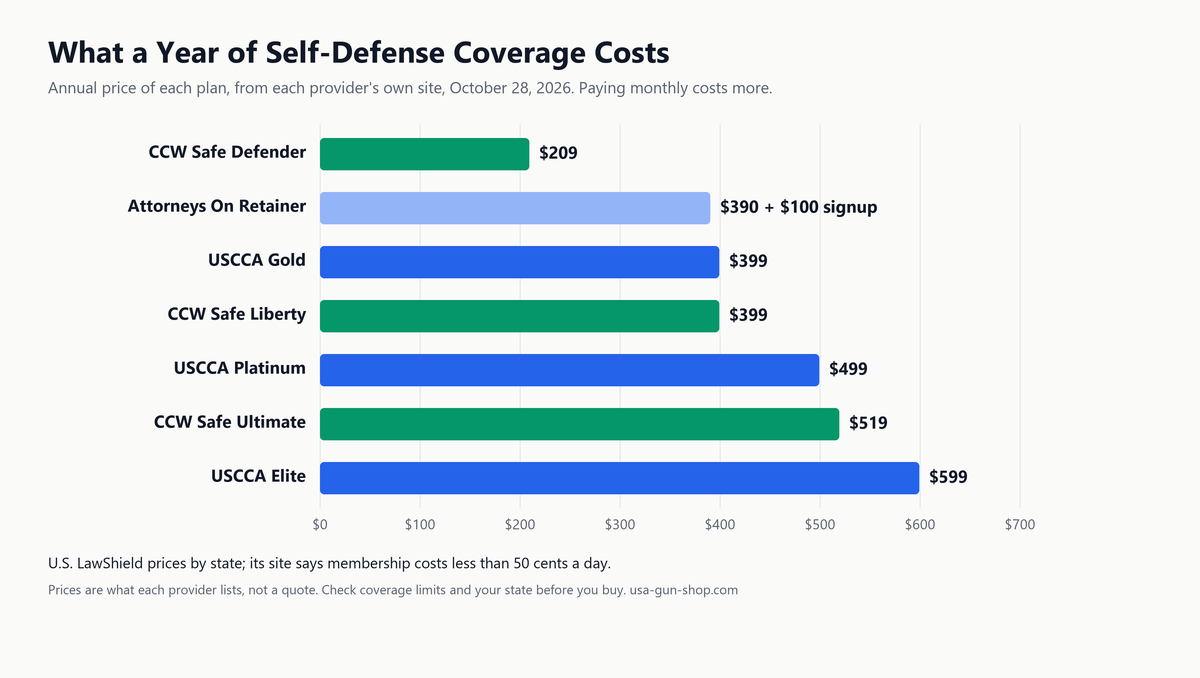
Quick answer: CCW Safe is the strongest pure legal-defense plan in 2026. Every carry plan puts no cap on criminal or civil defense costs, and the Defender plan starts at $209 a year. USCCA is the best fit for newer carriers who want training and a big support team alongside self-defense liability insurance, from $399 a year. U.S. LawShield is the lowest-cost entry, at less than 50 cents a day by its own pricing. Attorneys On Retainer is the newer option built around a single self-defense law firm, at $390 a year plus a $100 signup fee.
The biggest mistake buyers make is choosing on price alone. Check three things before you sign up: whether your state allows the plan at all, who picks your attorney, and what the written exclusions say. All four providers changed their plans in the last few years, so if you read a comparison that still talks about a USCCA “$1 million cap”, it is out of date.
Table of Contents
If you carry a gun for self-defense, this decision matters almost as much as which gun you carry. Legal bills after a justified shooting can reach six figures. USCCA’s own example member faced “over $175,000 in legal bills” before he was acquitted. Nobody wants to think about it, but you should.
Four programs lead this space: USCCA, CCW Safe, U.S. LawShield and Attorneys On Retainer, and this USCCA vs CCW Safe vs US LawShield comparison adds AOR because more carriers are asking about it. They all promise to have your back if you use your gun in self-defense. The details are very different, and the differences matter most on the worst day of your life. This is a straight comparison of what each plan covers, what it costs, and where the fine print bites, using each provider’s own published terms.
At a Glance: USCCA vs CCW Safe vs U.S. LawShield vs AOR
| Provider | Annual cost | Criminal and civil defense | Who picks the lawyer | Where |
|---|---|---|---|---|
| CCW Safe BEST LEGAL DEFENSE | $209 (Defender) to $519 (Ultimate) | No cap on criminal or civil defense costs, paid upfront | CCW Safe vets, hires and coordinates the legal team | Member covered in 47 states; not sold in NJ, NY or WA |
| USCCA BEST FOR NEW CARRIERS | $399 (Gold) to $599 (Elite) | Self-defense liability insurance; USCCA advertises no-limit defense expenses | You choose your own attorney | National coverage per USCCA |
| U.S. LawShield LOWEST COST | Under 50 cents a day; priced by state | Criminal and civil representation, no limits, caps or deductibles for covered events | Independent Program Attorneys in its network | Pick your state at signup |
| Attorneys On Retainer LAW FIRM MODEL | $390 plus a $100 signup fee | Criminal and civil defense through the AFF Law Firm | The firm’s own self-defense attorneys | All 50 states |
Insurance or Legal Plan? Why the Structure Matters
People call all of these “concealed carry insurance” or “CCW insurance”, but only one of the four is built on an insurance policy. That difference decides who makes the coverage call after an incident.
- USCCA: the association buys a self-defense liability insurance policy that covers its members, and Delta Defense, a licensed insurance agency, handles sales and administration. Coverage follows the policy terms.
- CCW Safe and U.S. LawShield: legal service memberships. You are paying for a legal team and its costs, not filing an insurance claim.
- Attorneys On Retainer: you become a client of one law firm, the AFF Law Firm, and the firm decides coverage. AOR says coverage is “determined by lawyers, not insurance adjusters.”
State regulators treat these programs differently. CCW Safe lists New Jersey, New York and Washington as restricted states for its plans. Check your own state before you sign up for any of them.
USCCA: The Biggest Name, With the Most Training
The U.S. Concealed Carry Association is the name most new carriers hear first. It says more than 870,000 members carry its coverage, and it has built a full education business around it: the Concealed Carry Magazine, an on-demand training library, in-person classes and member events. If you are new to carrying and want the education alongside the legal protection, nobody else comes close on volume.
The coverage itself has changed. USCCA now advertises “No Limit Defense Expenses” for attorneys, expert witnesses and anything else needed for your defense, plus bail bond coverage, an annual civil liability limit, lost wages and a 24/7 Critical Response Team. You choose your own attorney. Older comparisons that describe USCCA as capped at $500,000 or $1 million are describing the old plans.
USCCA Plans and Prices
- Gold: $39 a month or $399 a year
- Platinum: $49 a month or $499 a year, USCCA’s most popular plan
- Elite: $59 a month or $599 a year, with the largest training library
- All tiers: self-defense liability insurance, national coverage, choice of attorney, Critical Response Team
Paying yearly saves $69 on Gold, $89 on Platinum and $109 on Elite, according to USCCA’s membership page.
The USCCA Disputes You Will Read About
Because USCCA’s benefit is an insurance policy, the policy terms decide what gets paid, and that has led to public disputes. The best documented is a federal lawsuit filed in Louisiana by Kayla Giles, a member charged with second-degree murder who claimed self-defense. Her complaint says USCCA paid the first $50,000 of her legal expenses and then refused further payment, and it sought the $100,000 remainder of the defense coverage she said her plan carried. A complaint is one side of the story, and that suit was about the older capped plan structure.
The other case people cite is Alan Colie in Virginia. USCCA published a statement, with Colie’s approval, saying it “has never dropped coverage or denied the member’s claim” and that Colie chose a public defender himself. The lesson from both is the same: read the actual policy document, not the marketing, and know which incidents it excludes.
Best for: newer carriers who want training, community and a recognized brand, and who want to pick their own lawyer.
CCW Safe: No Cap, Legal Team First
CCW Safe is a legal service plan built around its legal team, and the headline is simple: every carry plan lists criminal defense costs and civil defense costs as “NO CAP”, paid upfront, including civil trial costs even if you are found guilty in a criminal trial. After an incident, CCW Safe’s National Trial Counsel vets, hires and coordinates your legal team.
CCW Safe Carry Plans and Prices
- Defender: $209 a year or $19 a month. $1M bond. Member covered in 47 states; spouse and children under 18 in the home.
- Liberty: $399 a year or $37 a month. Open to carriers with or without a permit. $1M bond.
- Ultimate: $519 a year or $47 a month. $1.5M bond for member and spouse, spouse covered inside and outside the home, and $1.5M civil liability for the primary member.
- Other plans: Constitutional Carry and Home Defense at $299 a year, Freedom at $609 a year, and plans for law enforcement and church security teams.
The extras are spelled out in CCW Safe’s plan comparison. Red flag law defense is covered up to $5,000 on Defender, $7,500 on Liberty and $10,000 on Ultimate, and lost wages during trial run up to $750 a day ($1,000 on Ultimate). The catch is geography: CCW Safe lists New Jersey, New York and Washington as restricted states, and member coverage runs in 47 states.
Training content is thinner than USCCA’s. CCW Safe is not trying to be an education company. For carriers who already have training squared away, that is fine.
Best for: experienced carriers who want the most legal defense for the money and do not need a training library.
U.S. LawShield: Lowest Cost, Attorney Network
U.S. LawShield sells state by state, so you pick your state when you sign up. Its pitch is cost: the company says members get its coverage “for less than 50 cents a day”. For that, U.S. LawShield lists legal representation for both criminal and civil cases, “zero attorneys’ fees for covered events, no limits, caps or deductibles”, and a 24/7 hotline answered by an attorney.
Your lawyer comes from its network of Independent Program Attorneys rather than a lawyer you pick yourself. In most cases that is fine, since those attorneys handle self-defense cases for a living. If you want to choose your own lawyer, USCCA allows it. Add-ons such as extra states and family members vary by state plan, so price the exact package you need before comparing it to CCW Safe.
Best for: carriers on a tight budget who want an attorney on the phone fast.
Attorneys On Retainer: A Law Firm Instead of an Insurer
Attorneys On Retainer (AOR) is the newest name here and the most different. Members become clients of the AFF Law Firm, which AOR calls the nation’s only self-defense exclusive law firm, with attorney-client privilege and a 24/7 hotline to your trial attorney. It is sold in all 50 states, per AOR’s membership page.
- Individual: $37 a month or $390 a year, plus a $100 one-time signup fee
- Family: $29 a month or $306 a year per person, plus a $75 one-time signup fee
- Bail: $50,000 toward a secured bail bond on a posted bond of up to $500,000, or $50,000 toward a cash-only bail
- Red flag orders: up to $15,000
- Extras: up to 10 counseling sessions (up to $1,500) and $1,000 toward replacing a confiscated firearm
AOR publishes a list of situations it says it covers where others would deny coverage. That is a strong claim, so read its terms side by side with CCW Safe’s before you decide. The bail benefit is also smaller than CCW Safe’s $1M bond. For more on how the retainer model works after an incident, see our guide to legal issues after a defensive shooting.
Best for: carriers who want one dedicated self-defense law firm on retainer rather than an insurer or a network.
Coverage Comparison: The Details
| Feature | USCCA Platinum | CCW Safe Ultimate | U.S. LawShield | AOR Individual |
|---|---|---|---|---|
| Annual price | $499 | $519 | Under 50 cents a day | $390 + $100 signup |
| Defense costs | No-limit defense expenses (per USCCA) | No cap, criminal and civil | No limits for covered events | Criminal and civil via the firm |
| Bail / bond | Bail bond coverage | $1.5M, member and spouse | Check your state plan | $50,000 toward bail |
| Attorney | Your choice | Team hired by CCW Safe | Network attorney | AFF Law Firm |
| Spouse | See USCCA terms | Inside and outside the home | Add-on by state | Family plan per person |
| Red flag defense | See USCCA terms | Up to $10,000 | See state plan | Up to $15,000 |
| Structure | Insurance policy | Legal service plan | Legal service plan | Law firm retainer |
| Training | Extensive | Limited | Legal updates and guides | Online self-defense training |
Real-World Scenarios: Which Plan Fits
Clear-cut home defense. An armed intruder, police respond, and the prosecutor declines to charge. Any of the four handles this. What matters most is fast attorney access in the first hours, and all four run a 24/7 line.
A contested case that goes to trial. A street confrontation, disputed facts, a felony charge and a civil suit after. This is where the money runs out. USCCA’s own example member faced more than $175,000 in legal bills. CCW Safe’s no-cap criminal and civil coverage is built for exactly this case, and USCCA’s no-limit defense expenses aim at the same problem. With U.S. LawShield and AOR, read how bail is handled, because bail can be set in the millions in a serious case.
Your spouse uses the gun. On CCW Safe’s Defender and Liberty plans, a spouse is covered only inside the home unless you buy the $100 add-on; Ultimate covers the spouse inside and outside. AOR sells a family plan per person. Settle this before an incident, not after.
Who Should Choose Which Plan
- Choose CCW Safe if you want the most legal defense per dollar: no cap on criminal or civil costs from $209 a year. This is where I would put my own money, unless you live in New Jersey, New York or Washington.
- Choose USCCA if you are newer to carrying and want training, community and the right to pick your own attorney. Read the policy document before you buy.
- Choose U.S. LawShield if budget is the real limit. It is the cheapest way to get an attorney on the phone and representation in both criminal and civil cases.
- Choose Attorneys On Retainer if you want a single self-defense law firm and broad stated coverage, and you are comfortable with a smaller bail benefit.
What These Plans Do Not Cover
Every plan has exclusions, and they differ more than the marketing suggests. Read the written terms for these situations before you buy:
- Carrying where your permit or state law does not allow it
- Incidents during another crime, or where you were the aggressor
- Alcohol or drug impairment (AOR, for example, excludes alcohol impairment where state law bans firearm possession while intoxicated)
- Weapons other than firearms (CCW Safe covers all legal weapons and physical force in self-defense)
- Family members outside the home
No plan replaces knowing your state’s use-of-force law. Start with our guide to self-defense gun laws, and check the concealed carry reciprocity map before you travel.
The Bottom Line
If you carry and have no legal defense plan, you are accepting a risk that costs as little as $209 a year to cover. That is a bad trade. CCW Safe is our pick for most experienced carriers, USCCA is the best package for newer carriers who want training and their own choice of lawyer, U.S. LawShield is the budget entry, and AOR is the one to read if you like the law-firm model.
Whichever you pick, read the actual terms, not a comparison chart, including this one. Then train. Our concealed carry tips and techniques hub and our list of common concealed carry mistakes are good next steps, and our best concealed carry handguns roundup covers the gun itself.
Carry Gun Deals
Best-priced firearms across 200+ retailers · Updated every 4 hours




Frequently Asked Questions
What is concealed carry insurance?
It is the common name for legal defense plans that pay for your lawyer and related costs after a self-defense incident. Only USCCA is built on an insurance policy; CCW Safe and U.S. LawShield are legal service memberships, and Attorneys On Retainer makes you a client of one law firm.
Which concealed carry insurance is best?
CCW Safe for most experienced carriers: no cap on criminal or civil defense costs, from $209 a year. USCCA is best for newer carriers who want training and their own choice of attorney. U.S. LawShield is the lowest-cost entry, and Attorneys On Retainer suits people who want one self-defense law firm.
Is USCCA worth it?
For newer carriers, yes. Plans run $399 to $599 a year, USCCA now advertises no-limit defense expenses with your choice of attorney, and the training library is the biggest in the business. Read the policy document for exclusions before you join.
USCCA vs CCW Safe: which is better?
CCW Safe gives more legal defense per dollar: no cap on criminal or civil costs from $209 a year, with a $1M to $1.5M bond. USCCA costs more, from $399, but adds the largest training library and lets you pick your own lawyer. CCW Safe is not sold in New Jersey, New York or Washington.
USCCA vs U.S. LawShield: which is better?
U.S. LawShield costs less, under 50 cents a day by its own pricing, and covers criminal and civil representation through its attorney network. USCCA costs more but adds training and your own choice of attorney. If you want to pick your lawyer, choose USCCA.
What is Attorneys On Retainer?
Attorneys On Retainer (AOR) makes members clients of the AFF Law Firm, a self-defense law firm, instead of selling insurance. It costs $37 a month or $390 a year plus a $100 signup fee, is sold in all 50 states, and includes $50,000 toward bail and up to $15,000 for red flag orders.
How much does concealed carry insurance cost?
CCW Safe Defender is $209 a year, Attorneys On Retainer is $390 a year plus a $100 signup fee, USCCA runs $399 to $599 a year, and CCW Safe Ultimate is $519 a year. U.S. LawShield prices by state and says it costs less than 50 cents a day.
Do these plans cover civil lawsuits?
Yes, all four address civil cases. CCW Safe lists no cap on civil defense costs, U.S. LawShield lists representation in civil cases with no caps for covered events, USCCA includes an annual civil liability limit, and AOR covers civil defense through its law firm.
Can a self-defense plan deny coverage?
Yes. Every plan has exclusions, such as being the aggressor or carrying illegally. USCCA has faced public disputes, including a federal lawsuit by member Kayla Giles over halted payments under an older plan; USCCA says it has never dropped coverage in the Alan Colie case. Read the written terms before you buy.
More concealed carry guides: Concealed Carry vs Open Carry · Revolver vs Semi-Auto for CCW · Legal Issues After a Defensive Shooting
3,213+ Gun & Ammo Deals
Updated daily from 200+ top retailers. Filter by category, caliber, action type, and price.