

Last updated September 6th 2026 · By Nick Hall. I have built and shot both platforms across calibers; this comparison pulls from that range time plus manufacturer specs.
Affiliate disclosure: some links below are affiliate links. If you buy through them you still get the best price and you help us keep tracking deals, at no extra cost to you.
Table of Contents
How we tested: Every pick here is ranked against our testing methodology. Minimum round counts, accuracy and reliability protocols, the failures that disqualify a gun.
The Short Answer
Most shooters should buy an AR-15. It is lighter, cheaper to buy and feed, kicks less, and does almost everything most people need a rifle to do. Step up to an AR-10 only when you specifically need .30-caliber power for big-game hunting or accurate hits past 600 yards.
The AR-10 came first. Eugene Stoner designed it at ArmaLite in the 1950s, then scaled it down to .223 to create the AR-15 that became the M16 and the most popular rifle in America. So these are the same basic design at two sizes, built around two very different cartridges, and almost every difference flows from that one choice. They share controls and trigger feel and essentially no parts.
If you are leaning AR-10, read the standardization section before you spend anything. It is the single most expensive mistake people make on this platform and the AR-15 buyer never has to think about it. Also see our cartridge-level comparison, .223 vs .308.
AR-15 vs AR-10: Specs at a Glance
| Spec | AR-15 | AR-10 |
|---|---|---|
| Common chamberings | 5.56 NATO / .223 Rem | .308 Win / 7.62 NATO, 6.5 Creedmoor |
| Typical bullet weight | 55 to 77 gr | 140 to 175 gr |
| Muzzle energy (typical) | ~1,300 ft-lb | ~2,600 ft-lb |
| Practical effective range | ~500 yards | ~800 to 1,000 yards |
| Unloaded weight | ~6 to 7 lb | ~8 to 10 lb |
| Standard magazine | 30 rounds | 20 rounds |
| Recoil | Light | Moderate |
| Parts standardization | Universal mil-spec | Two patterns, not cross-compatible |
| Entry street price | ~$400 | ~$1,050 |
Manufacturer specifications and ANSI/SAAMI cartridge data; entry street pricing tracked live across the retailers we follow, September 2026.
Pros
- Light and fast at 6 pounds
- Cheapest centerfire rifle to feed
- Universal mil-spec parts fit anything
Cons
- Runs out of energy past 500 yards
- Marginal or illegal for big game
- Struggles through heavy barriers
Pros
- Roughly double the muzzle energy
- Reaches 800 to 1,000 yards
- True big-game hunting semi-auto
Cons
- Heavy at 8 to 10 pounds
- Costs more to buy and feed
- Two patterns that share no parts
Caliber and Power: 5.56 vs .308
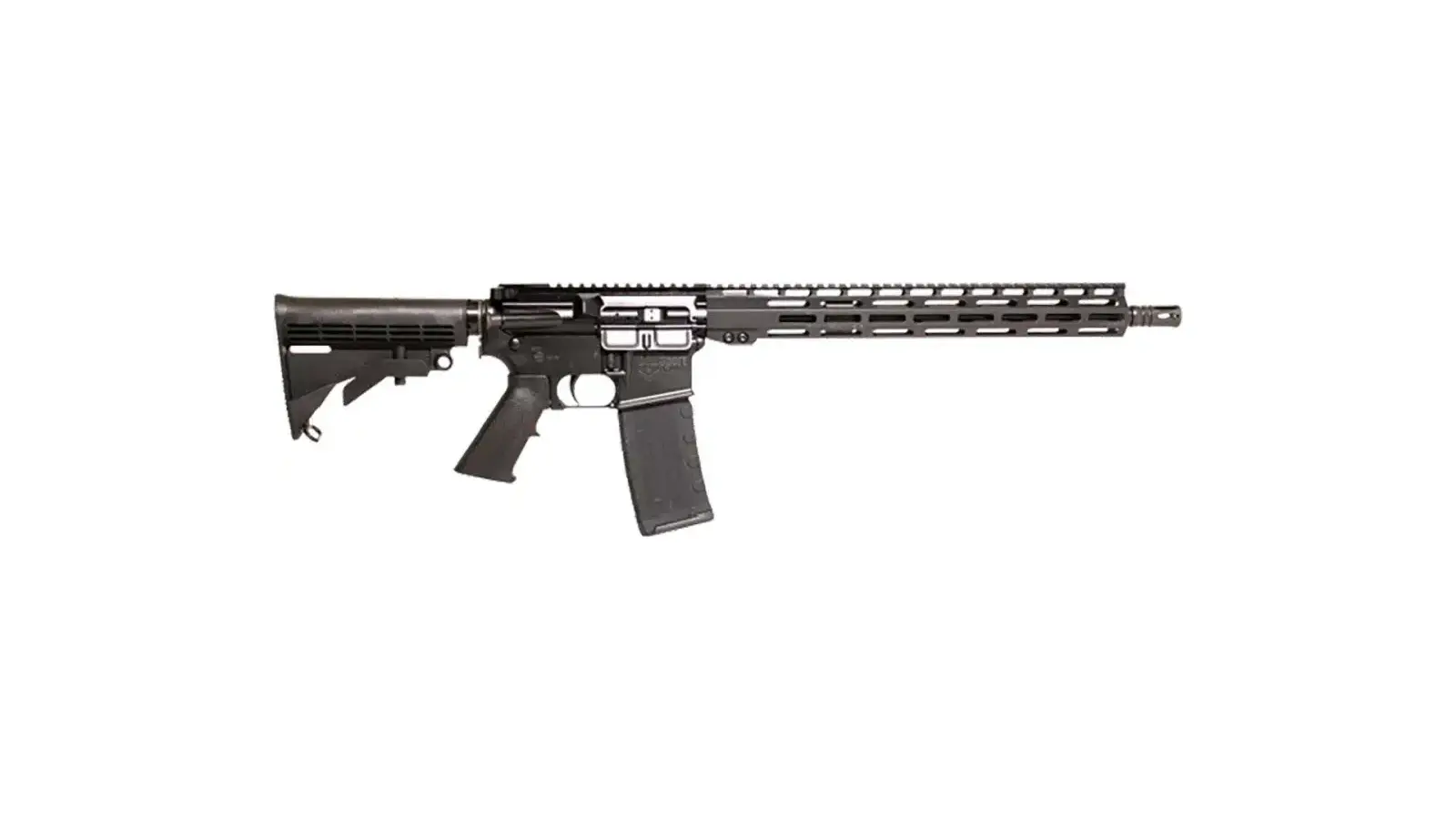
This is the whole comparison in one section. The AR-15’s 5.56 NATO fires a light, fast bullet, 55 to 77 grains, that does its best work inside 300 yards and stays useful to roughly 500. It is devastating on varmints and effective on deer-sized game up close with the right load, and it sheds energy quickly and struggles through barriers.
The AR-10’s .308 Winchester throws a 150 to 175 grain bullet with about double the muzzle energy, and carries that energy much farther downrange. That extra mass is what makes it a genuine big-game and distance rifle where the AR-15 is a close-to-medium-range tool. For feeding the bigger gun, see our guide to the best .308 ammo.
Size, Weight and Handling
An AR-15 carbine wears its weight around 6 to 7 pounds, which is why it points fast, carries easily, and runs through drills without wearing you out. The AR-10 is a bigger machine: larger receivers, a longer bolt carrier and a heavier barrel push it to 8 pounds and up, and a precision .308 or 6.5 build with a heavy barrel and glass can crowd 12 pounds ready to shoot.
For a rifle that lives by the bed, rides in a truck, or gets run hard in a class, the lighter weight is a real advantage on every repetition. For a rifle you shoulder from a bench, a blind or a bipod, the AR-10’s extra mass is welcome, because it soaks up recoil and steadies the gun. Match the build to how you will carry it rather than to how it looks on a table.
Recoil and Controllability
The AR-15 barely moves. A 5.56 in a gas gun produces light, flat recoil that lets you track the dot through fast strings and call your own hits. It is one of the easiest centerfire rifles in the world to shoot well, which matters enormously for new shooters and for anyone who might have to use one under stress.
The AR-10 kicks more and is far from punishing. The .308’s recoil is moderate, and the rifle’s extra weight plus a decent muzzle brake tame most of it. You will not run an AR-10 as fast as an AR-15 on close targets, and for the deliberate shooting it is built for, the recoil is a non-issue.
Effective Range and Accuracy
A general-purpose AR-15 is a confident hitter to about 500 yards, and a quality match upper will stretch that. Past there the light bullet drops fast and gets shoved around by wind.
The AR-10 is built for exactly the distances where the AR-15 gives up. A .308 stays lethal and accurate to 800 yards, and a 6.5 Creedmoor AR-10 will ring steel at 1,000 in capable hands. If semi-auto precision is your interest, this is the platform, and our best sniper rifles guide covers where it sits against bolt guns.
Beyond .308: 6.5 Creedmoor and Other AR-10 Calibers
Part of why the AR-10 has surged in the last decade is that it stopped being only a .308 gun. The same large-frame receiver chambers 6.5 Creedmoor, which flies flatter, fights wind better and recoils less than .308 while keeping nearly the same energy downrange. For a buyer whose main goal is distance, 6.5 Creedmoor is often the smarter pick.
The large frame also opens up .338 Federal and 6mm Creedmoor for specific hunting and competition niches. The AR-15 has its own flexibility through the same magazine well, with .300 Blackout, 6.5 Grendel, .224 Valkyrie and .350 Legend, and none of those match the raw energy of the AR-10’s .30-class chamberings. Both platforms reward caliber shopping, just at different power levels.
The AR-10 Standardization Problem
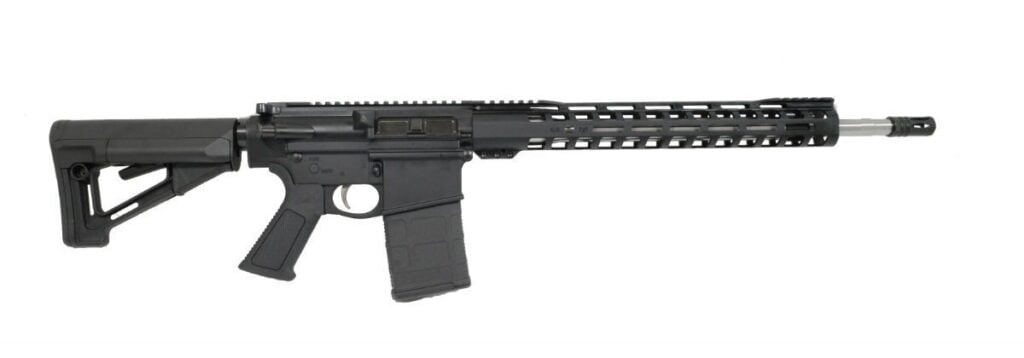
This is the catch that trips up first-time buyers, and it is the most useful thing on this page. The AR-15 is built to a single mil-spec, so a lower from one brand takes an upper, handguard and parts from almost any other. The AR-10 has no such universal standard.
It splits into two families: the original ArmaLite AR-10 pattern, and the DPMS LR-308 pattern that evolved toward the SR-25 footprint. They do not share magazines, handguards, or many small parts. The names on the box do not warn you, because both get sold as “AR-10”, which is why people find out after the parts arrive.
The rule is simple once you know it: decide on a pattern before you buy anything, and buy every component to match. The DPMS and SR-25 family has the widest support, so that is the default unless you have a specific reason. Then check the other three things that catch AR-10 buyers out:
- Weight. A .308 AR-10 with a heavy barrel, optic and loaded magazine hits 11 or 12 pounds. Fine off a bipod, miserable on a long hunt or in a carbine class.
- Gas. AR-10s are more sensitive to gas tuning than AR-15s because the bigger case makes more gas. An adjustable gas block and a quality buffer pay for themselves in reliability and felt recoil, and they become close to mandatory once you add a suppressor.
- Buying range you will never use. If you will not shoot past 300 yards, the AR-10’s reach is wasted and an AR-15 serves you better for less money.
Magazines and Capacity
The AR-15 carries 30 rounds in a standard PMAG, and those magazines are everywhere and cheap. The AR-10 runs 20-round magazines as standard, they cost more, and they are pattern-specific because of the split above. An SR-25 magazine will not solve your DPMS problem.
For volume shooting, training and defense, the AR-15’s higher capacity and cheap magazines are a quiet but real edge. It is also the difference between owning a dozen spare mags and owning three.
What Each Costs: Rifle and Ammo
Money favors the AR-15 twice, and the second half compounds. On the retailers we track as I write this, a complete AR-15 from a trusted seller starts around $400, while the cheapest AR-10 from the same sellers opens near $1,050. That is roughly two and a half times before you have fired a shot.
Then there is ammunition, and the multiple is about the same. 5.56 practice ammo starts around 45 cents a round and comparable .308 around $1.23. Shoot a modest 2,000 rounds in a year and the AR-15 costs you roughly $900 to feed while the AR-10 runs closer to $2,460. Push to 5,000 rounds the way a serious student does and the gap passes $3,500 a year.
None of that makes the AR-10 a bad buy. It does explain why the smart setup for a lot of people is an AR-15 for the high-round-count training and an AR-10 kept for hunting and the occasional long-range session. You build the skill cheaply on one and apply it deliberately on the other. Current stock is in our AR-15 deals roundup and our best .308 rifles guide.
Aftermarket and Customization
Both platforms customize endlessly, and the AR-15 sits on the deepest aftermarket in the firearms world. Triggers, optics mounts, handguards, stocks and furniture are everywhere and cheap, and anything you buy fits.
The AR-10 aftermarket is healthy and growing, especially for the SR-25 pattern, and it is smaller and you have to shop for your specific pattern every single time. If you love building and tinkering, the AR-15 is the more forgiving canvas by a wide margin. For where to start a build, compare the budget brands in our PSA vs Aero Precision breakdown.
Use Cases: Home Defense, Hunting, Competition
Home defense goes to the AR-15 clearly. Lighter, lower-recoil, higher-capacity, and with proper defensive ammunition it over-penetrates interior walls less than many common handgun rounds. The AR-10 is overkill indoors and its barrier performance works against you with rooms behind the target.
Hunting goes to the AR-10 for deer, hogs and elk, where the .308 delivers ethical energy at range and where many states will not let you use a .224 bullet on deer-sized game at all. The AR-15 is the better varmint and predator rifle and fine on hogs up close.
Competition splits by discipline. 3-gun and carbine classes are AR-15 country, because speed, capacity and cheap ammunition decide them. Precision rifle series and long-range gas-gun matches are AR-10 country. If you are not sure which you will end up shooting, the AR-15 is the cheaper way to find out.
Buy the AR-15 if…
You want one rifle for home defense, the range, varmints and training volume. You shoot a lot or watch the budget. You want a light rifle you can carry all day and parts that fit without research. This is most people, and it is the right first rifle for nearly all of them. Start with our best AR-15 rifles, or see how it compares to the other classic option in Mini-14 vs AR-15.
Buy the AR-10 if…
You hunt deer, elk or hogs and want a semi-auto that is legal and ethical on them. You shoot past 600 yards. You need a heavier bullet to work through barriers. You already own an AR-15 and know what you are missing, which is honestly the most common good reason to buy one.
My Recommendation
Start with the AR-15. Not as a compromise, but because it is the rifle that teaches you the platform on ammunition you can afford to shoot in volume, and because the controls and manual of arms carry straight across if you buy an AR-10 later. Nothing you learn is wasted.
Buy the AR-10 when you have a job for it that you can name. Hunting a specific animal, shooting a specific distance, competing in a specific discipline. If you cannot name the job, the honest answer is that an AR-15 and $1,500 of ammunition will make you a better shooter than an AR-10 sitting in a safe.
And when you do buy the AR-10, pick your pattern first and write it on a note in your phone. DPMS or SR-25 for the widest support, ArmaLite only if you have a reason. Every part you order after that gets checked against it. That one habit prevents the most common and most annoying way to waste money on this platform.
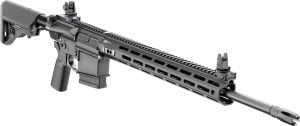
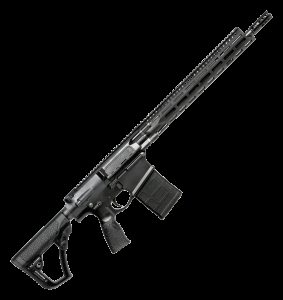
AR-15 Rifles: Live Prices

AR-10 Rifles: Live Prices

FAQ: AR-15 vs AR-10
What is the main difference between an AR-15 and an AR-10?
Caliber and size. The AR-15 is built around the 5.56 NATO / .223 cartridge and is lighter; the AR-10 is built around .308 Winchester or 6.5 Creedmoor and is larger and heavier. The AR-10 hits much harder and reaches farther, while the AR-15 is lighter, cheaper and lower-recoil.
Is the AR-10 better than the AR-15?
No, only for specific jobs. The AR-10 is better for big-game hunting and long-range shooting because of its .30-caliber power and range. For home defense, training, sport and most general use, the AR-15 is the better all-around choice.
Are AR-15 and AR-10 parts interchangeable?
No. The two platforms do not share lowers, uppers, magazines or most parts. Worse, the AR-10 itself has two patterns, the ArmaLite and the DPMS/SR-25 families, which are not compatible with each other. Always match parts to your specific pattern.
Which is better for home defense, AR-15 or AR-10?
The AR-15. It is lighter, has higher magazine capacity, recoils less, and with proper defensive ammunition over-penetrates less than the heavier .308. The AR-10 is unnecessarily large and powerful for indoor defense.
Can an AR-15 be used for hunting?
Yes, for varmints, predators and smaller deer at moderate range with the right load, and some states have caliber minimums that affect this. For elk and larger game or longer shots, an AR-10 in .308 or 6.5 Creedmoor is the more ethical and effective choice.
Is an AR-10 worth the extra cost?
If you need .30-caliber power for hunting or long-range shooting, yes. The AR-10 costs more to buy and feed, but it does jobs the AR-15 cannot. If you do not need that power, the AR-15 gives you more capability per dollar.
Do AR-15 and AR-10 parts interchange?
No, and the AR-10 does not even interchange with itself reliably. The AR-15 is built to a single mil-spec, so a lower from one brand takes an upper and parts from almost any other. The AR-10 splits into two families, the original ArmaLite pattern and the DPMS LR-308 pattern that evolved toward the SR-25 footprint, and they do not share magazines, handguards or many small parts. Both get sold as AR-10, so decide on a pattern before you buy anything and match every component to it. DPMS and SR-25 has the widest support.
How much more does an AR-10 cost to own than an AR-15?
Roughly two and a half times, twice over. On the retailers we track, a complete AR-15 from a trusted seller starts around $400 and the cheapest AR-10 opens near $1,050. Ammunition runs the same multiple, about 45 cents a round for 5.56 against $1.23 for .308. Shoot 2,000 rounds in a year and you are looking at about $900 to feed the AR-15 against $2,460 for the AR-10, and the gap passes $3,500 a year at 5,000 rounds.
3,979+ Gun & Ammo Deals
Updated daily from 200+ top retailers. Filter by category, caliber, action type, and price.
Related Guides