

Affiliate disclosure: This Henry Single Shot review contains affiliate links. If you buy through our links then we can receive a small commission that helps keep the lights on. You don’t pay anything more.
- Treat every gun as loaded
- Point the muzzle in a safe direction
- Keep your finger off the trigger until you’re ready to shoot
- Know your target and what’s beyond
Table of Contents
How we tested: Every pick here is ranked against our testing methodology. Minimum round counts, accuracy and reliability protocols, the failures that disqualify a gun.
Review: Henry Single Shot – One Frame, Sixteen Guns, One Price
Our Rating: 8.1/10
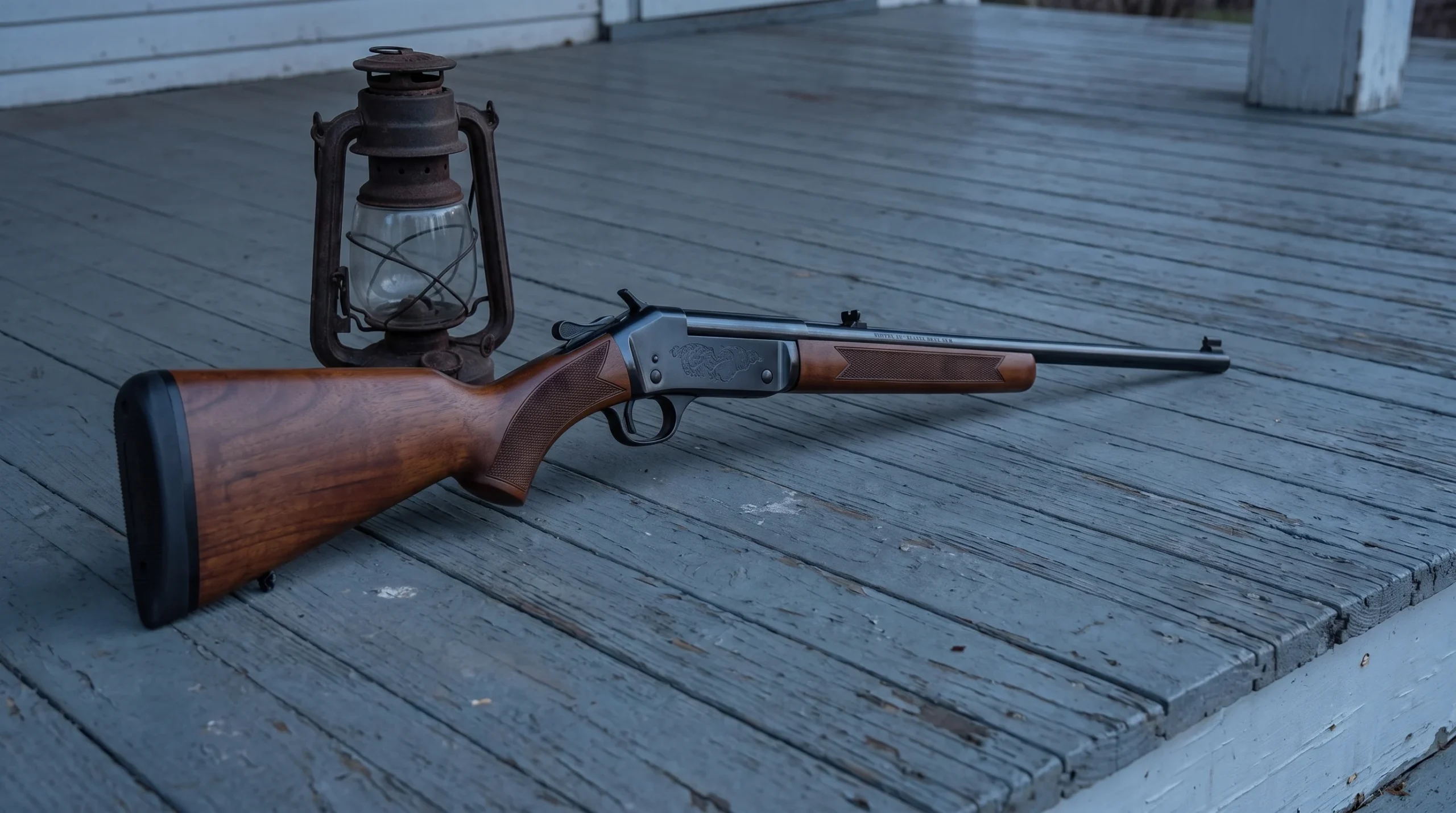
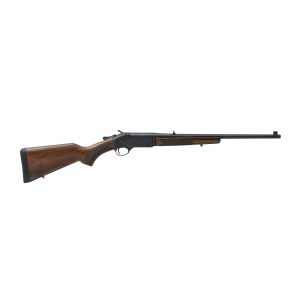
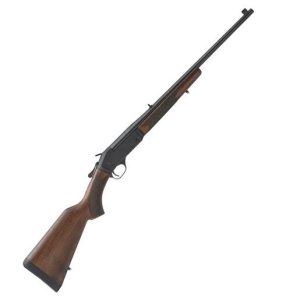
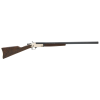
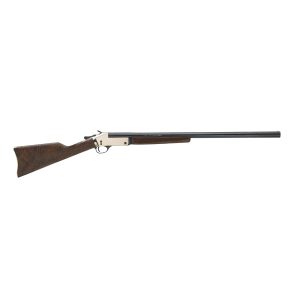
A break action single shot is the most honest gun anyone still builds. There is no magazine to feed, no gas system to foul, no bolt to short stroke. You drop a round in, close it, cock the hammer and shoot. Henry sells this one in ten rifle chamberings and three shotgun gauges off the same receiver, and every steel version carries the same list price whether you buy it in .223 or .45-70. We shot the .45-70 version for four sessions to find out what that money actually buys.
Specifications: H015 Steel Single Shot Rifle
- MSRP: $625.00 steel frame, $770.00 brass frame
- Street Price: from about $445 (Use our live pricing for the best up to date deal)
- Type: Break action single shot, exposed hammer
- Capacity: 1 round
- Barrel: 22 inch round blued steel on every rifle chambering
- Overall Length: 37.5 inches
- Weight: 6.69 to 7.18 lb depending on chambering
- Receiver: Blued steel, or polished brass on the B models
- Rear Sight: Fully adjustable folding leaf
- Front Sight: Brass bead
- Optics: Drilled and tapped, Weaver 82 base
- Stock: American walnut, pistol grip, black solid rubber recoil pad
- Length of Pull: 14 inches
- Safety: Rebounding hammer, no manual safety
- Rifle Chamberings: .223 Rem, .243 Win, .30-30 Win, .308 Win, .350 Legend, .357 Magnum, .360 Buckhammer, .44 Magnum, .450 Bushmaster, .45-70 Government
- Shotgun Gauges: 12, 20 and .410
Pros
- Walnut and bluing beat the price
- Same MSRP in every chambering
- Break action has nothing to fail
Cons
- No manual safety, hammer only
- One round, then you reload
- Kicks hard in the big chamberings
Quick Take
This is a lot of gun for the money, and the money is not what Henry says it is. List price on the steel rifle is $625 and nobody pays it. The cheapest we found at a major retailer was $449.99, and the whole trusted band sits between about $450 and $520. That is a walnut stocked, blued steel, American made rifle for the price of a mid range polymer bolt gun.
What you give up is obvious and you already knew it. One round. No safety catch beyond the rebounding hammer. And in the heavier chamberings, recoil that a 6.8 pound rifle does nothing to soften. What you get back is a gun that has almost nothing in it to break, that swings like a shotgun because it basically is one, and that will still be working when your grandchildren inherit it.
Best For: Deer woods inside 150 yards, a first centerfire for a young shooter in one of the small chamberings, and anyone who wants a Henry without paying Henry lever action money. It is a poor choice for hogs, follow up shots or anything that needs a second round in a hurry.
The Price Nobody Pays
Start here, because it changes the whole conversation. Henry lists the steel frame Single Shot at $625.00 in every rifle chambering and every shotgun gauge. The brass frame versions list at $770.00. Those are the numbers on Henry’s own spec sheets, and in the retailers we track they are close to fiction.
The cheapest steel rifle on our card is about $445, and Brownells and Palmetto State Armory sit near $480 to $490. Across the in-stock listings the steel rifles mostly run about $445 to $495 and the brass guns about $550 to $600. So the real discount off list is somewhere between about $130 and $180, and it is consistent enough that paying anywhere near MSRP means you did not shop.
The other thing worth knowing before you shop: Henry prices this rifle by frame, not by cartridge. A .223 costs exactly what a .45-70 costs. That is unusual, and it means the expensive cartridges are the value buys in this range.
Every Version, and What Each One Costs
One receiver, five families. The differences are the frame material, the barrel, and the stock length.
The brass frame is the one people get wrong. It costs $145 more at list and adds around 0.2 pounds, and it does nothing at all for how the gun shoots. Henry uses hardened brass on the receiver for looks, the same way it does on the Golden Boy. Buy it if you want it on a wall or a mantelpiece. Do not buy it expecting a better rifle.
The Youth version is the sleeper. It runs the same receiver with a shorter stock and a shorter barrel, and it lands at about $480 to $495 at the big retailers, which is inside the adult gun’s band. For a smaller framed adult shooter, not just a kid, it is often the better fit for the same money.

Weight Changes With the Cartridge, Everything Else Does Not
This is a small detail that matters more than it should. Every steel rifle has a 22 inch barrel, a 37.5 inch overall length and a 14 inch length of pull. The only thing that moves is weight, and it moves with bore diameter and wall thickness.
| Chambering | Model | Twist | Weight |
| .30-30 Win | H015-3030 | 1:12 | 6.69 lb |
| .360 Buckhammer | H015-360BH | 1:12 | 6.69 lb |
| .450 Bushmaster | H015-450 | 1:20 | 6.73 lb |
| .45-70 Gov’t | H015-4570 | 1:20 | 6.83 lb |
| .308 Win | H015-308 | 1:10 | 6.94 lb |
| .44 Magnum | H015-44 | 1:20 | 6.96 lb |
| .243 Win | H015-243 | 1:10 | 7.10 lb |
| .223 Rem | H015-223 | 1:9 | 7.18 lb |
| .350 Legend | H015-350 | 1:16 | 7.18 lb |
| .357 Magnum | H015-357 | 1:16 | 7.18 lb |
Read that the wrong way round and you get hurt. The lightest rifles in the range are the hardest kicking ones. A .45-70 at 6.83 pounds and a .360 Buckhammer at 6.69 are the two you least want to be light, and they are. Meanwhile the .223 is the heaviest gun Henry builds on this frame. If recoil is a factor, the .243 and .350 Legend are the sensible middle ground, and we have wider picks in our .350 Legend rifle guide and the .360 Buckhammer guide.
Range Testing: 185 Rounds of .45-70
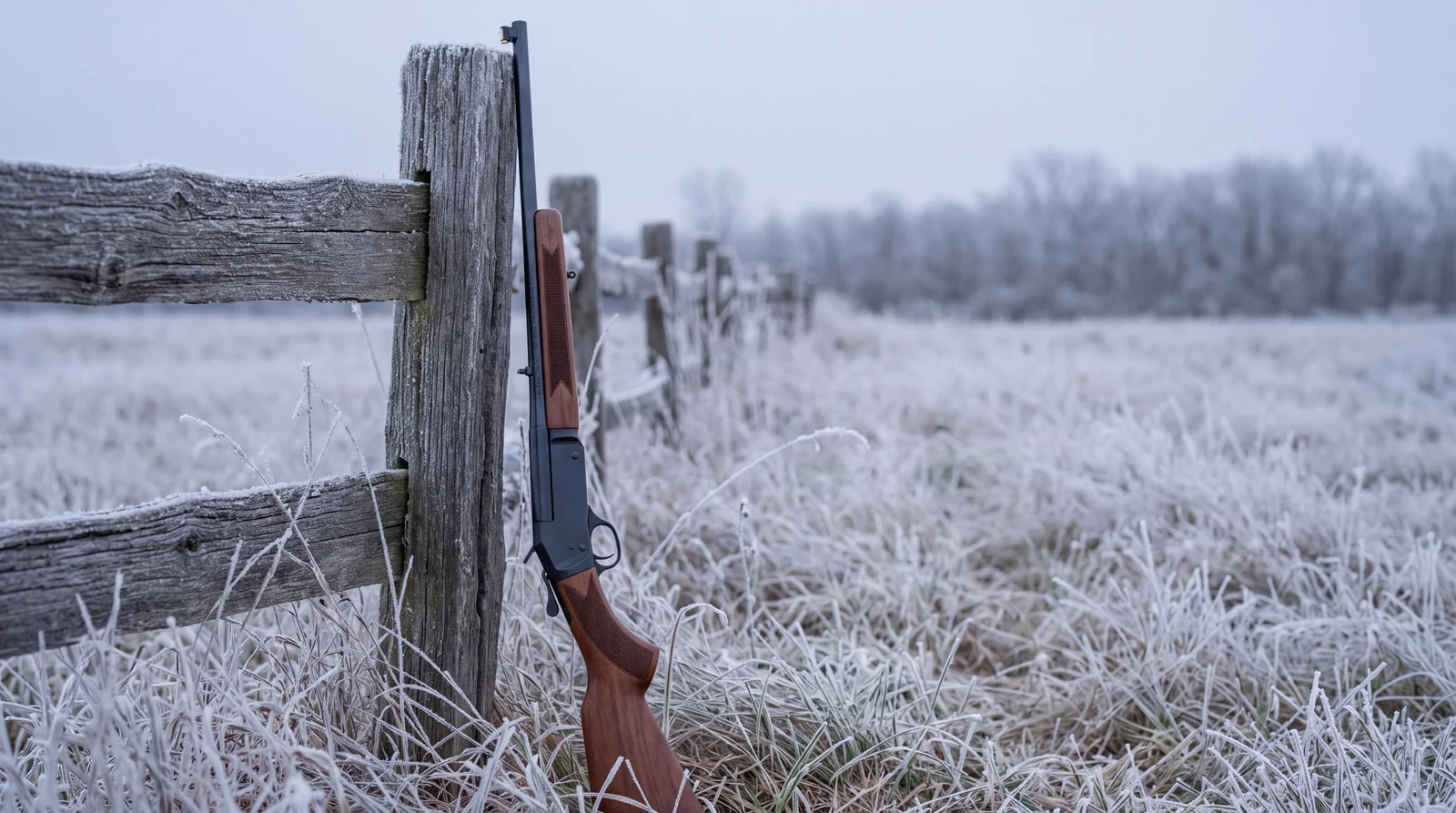
We tested an H015-4570 across four sessions between March and May, in temperatures from 41 to 75 degrees, at 50, 100 and 150 yards. Total round count was 185, which for a single shot is a long afternoon repeated four times. We shot the first session on the factory irons and mounted a 2-7x scope on a Weaver 82 base for the rest.
Reliability
Nothing to report, which is the point. Zero stoppages in 185 rounds. The extractor lifted every case far enough to pinch out by hand and threw about half of them clear on its own. The lockup stayed tight, and there was no more play in the hinge at the end than there was out of the box. A break action with a rebounding hammer has perhaps six moving parts that matter. It is very hard to make one fail.
Accuracy
Scoped, off a bag at 100 yards, our best three shot group was 1.7 inches with Hornady LEVERevolution 325 grain FTX. The average across five groups came to 2.1 inches. Federal Power-Shok 300 grain hollow point ran a little wider at around 2.4 inches, and Buffalo Bore 405 grain hard cast came in at 2.6 with a good deal more punishment attached. That is honest 150 yard accuracy on a deer sized target and nothing more, which matches what this cartridge and this barrel are for.
On the factory irons at 50 yards it printed around 2.5 inches, and the folding leaf rear adjusted easily enough with a small screwdriver. The brass bead front is fine in daylight and useless in the last ten minutes of legal light, which is a fair criticism of every brass bead ever fitted.
Recoil
It hurts. A 6.83 pound rifle firing 325 grain bullets has nowhere to put the energy, and the solid rubber pad Henry fits is a pad rather than a recoil reducer. Twenty rounds of LEVERevolution in a session was my comfortable limit, and the Buffalo Bore loads stopped being fun after about eight. This is not a criticism of the rifle so much as a warning about the pairing. In .30-30 or .350 Legend the same gun is genuinely pleasant.
Ammunition Log
- Hornady LEVERevolution 325 gr FTX: 80 rounds
- Federal Power-Shok 300 gr JHP: 65 rounds
- Buffalo Bore 405 gr hard cast: 24 rounds
- Remington Core-Lokt 405 gr SP: 16 rounds
What This Means for You
- Reliability: As close to a sure thing as a firearm gets. Keep the hinge and the face clean and it will outlive you.
- Accuracy expectation: Around two inches at 100 yards scoped. Plan your shots inside 150 and you will never be short.
- Ammo preference: Ours liked the lighter, faster loads. Heavy hard cast shot wider and hurt more.
- Optics: Mount a low ring set. A tall scope puts the hammer spur somewhere your thumb cannot reach cleanly.
- Chambering choice: Match it to the recoil you actually enjoy, not the biggest number on the shelf.
Technical Deep Dive
The Action
Break the barrel by pushing the lever loop under the receiver to the right. The barrel drops, the extractor lifts the case, and closing it resets nothing except the hinge. There is no cocking on opening, which is worth knowing: the hammer is a separate, deliberate act. That is slower than a shotgun, and it is also why the rifle can sit closed and loaded with the hammer down without being live.
The Rebounding Hammer
There is no crossbolt safety on this gun. The rebounding hammer is the safety. After a shot the hammer springs back off the firing pin and holds there, so the pin cannot touch a primer unless the hammer is deliberately cocked and released. It is a design that goes back to Victorian shotguns and it works, but it puts the responsibility on the shooter’s thumb rather than a button. New shooters need this explained to them properly before they carry it in the woods.
Sights and Optics
Fully adjustable folding leaf rear, brass bead front, and a receiver drilled and tapped for a Weaver 82 base. Folding the leaf down is what makes a scope practical here, and Henry got that right where plenty of budget guns do not. The one ergonomic problem is the hammer spur under a scope tube, which a $20 hammer extension solves completely.
| Component | Specification | Why it matters |
| Action | Break open, single shot | Almost no failure points |
| Safety | Rebounding hammer, no button | Safe when down, but it is on you |
| Scope base | Weaver 82, drilled and tapped | Cheap and available everywhere |
| Rear sight | Adjustable folding leaf | Folds flat so a scope clears it |
| Stock | American walnut, 14 inch pull | Real wood at this price is rare |
| Sling | Swivel studs fitted | No drilling needed |
How It Compares
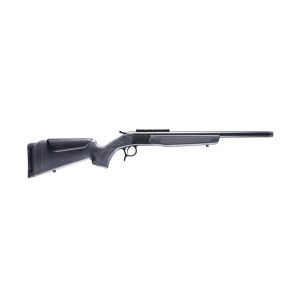
CVA Scout (from about $250)
The Scout is the direct rival and it costs roughly $200 less. It is also the more modern gun in the ways that matter to some buyers: threaded barrels, synthetic stocks, a much wider chambering list including .300 Blackout and 6mm ARC, and a scope rail already fitted. What it does not have is walnut, blued steel, or the feel of something built to be kept. If you want a cheap, threaded, suppressor ready single shot, buy the CVA and save the difference. If you want a gun your kid inherits, buy the Henry.
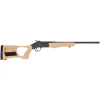
Rossi Tuffy (from about $165)
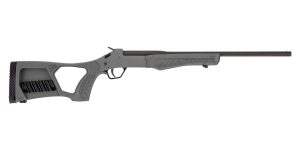
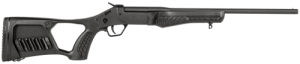
The Tuffy is a .410 and .45 Colt survival gun rather than a hunting rifle, and at under $200 for the basic version it is playing a different game entirely. It is lighter, uglier and far cheaper, and for a truck gun or a pack gun that is exactly right. Put them side by side and the Henry feels like a firearm while the Rossi feels like a tool. Both are honest about what they are.
Henry Single Shot Shotgun ($502.99-$670)
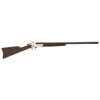
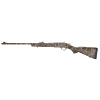
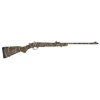
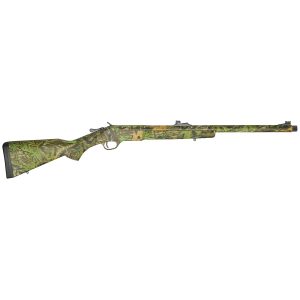
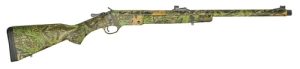
Same receiver, same walnut, same price band, chambered in 12, 20 or .410. The 12 gauge takes 3.5 inch shells on a 28 inch barrel and weighs 6.65 pounds, which tells you everything about what a 3.5 inch turkey load feels like out of it. For a lot of buyers this is the better version of the gun, because a single shot makes far more sense as a shotgun than it does as a rifle. If you want camo and a tighter choke, the Turkey model is the same gun in Mossy Oak.

Verdict: the Henry is the most gun and the least gadget. Nothing here shoots better than the CVA and nothing here costs less than the Rossi, but neither of them will still look this good in thirty years. For more options across the price range, see our best deer hunting rifles and best hunting rifles guides.
Upgrades Worth Making
| Upgrade | Recommended | Why it matters | Cost |
| Hammer extension | Any offset spur for a Henry hammer | Makes the hammer reachable under a scope | $15 – $30 |
| Recoil pad | Limbsaver or Pachmayr Decelerator grind to fit | The one change that matters in .45-70 | $40 – $70 |
| Scope base and rings | Weaver 82 base with low rings | Correct base is cheap and specified by Henry | $30 – $80 |
| Buttstock shell holder | Elastic or leather cuff | On a single shot, the second round should be on the gun | $15 – $35 |
Common Problems and Fixes
- Hammer is hard to reach with a scope fitted: the single most common complaint on this platform. A hammer extension spur costs under $30 and fixes it completely. Fit one before your first hunt, not after.
- Cases sticking on extraction: nearly always a dirty or slightly rough chamber on a new gun. Clean it properly and run a few rounds through. If it persists, Henry’s warranty service handles it.
- Recoil is worse than expected: you probably bought the heaviest cartridge in the lightest rifle. A ground to fit recoil pad and a shooting jacket change the experience more than anything else you can do.
- Point of impact shifts after mounting a scope: the folding leaf rear stays on the barrel. Fold it down properly and confirm it is not touching the objective bell before you blame the mount.
- Expecting a safety catch: there is not one. If you are handing this to a new shooter, teach the rebounding hammer first and check it every time the gun changes hands.
Who Should NOT Buy This Gun
- The hog hunter: hogs come in groups and they do not wait while you reload. Buy a Ruger American Ranch or an AR in .350 Legend and keep the follow up shots.
- The suppressor owner: no Henry Single Shot barrel comes threaded. The CVA Scout does, from the factory, for less money.
- The recoil sensitive buyer eyeing the .45-70: the biggest cartridge sits in one of the lightest rifles here. Take the .350 Legend version, or a Ruger American in the same cartridge if you want more weight.
- Anyone shooting past 200 yards: two inch groups and a brass bead are not a long range package. A Savage 110 or Tikka T3x costs a little more and doubles your effective range.
- The buyer who wants the brass frame for performance: it is a finish, not an upgrade. Buy the steel rifle and put the $145 into glass or a Limbsaver pad.
Final Verdict
The Henry Single Shot is not the most capable rifle you can buy for $450, and it is not trying to be. It is the most gun. Real American walnut, even bluing, an action with nothing in it to go wrong, and a price that sits $150 under a list figure nobody charges. For deer inside 150 yards, for a first centerfire, or for the gun that hangs over a fireplace and still gets carried, it earns its money.
Buy the chambering, not the badge. Every steel version costs the same, so the choice is purely about what you want to shoot and how much recoil you enjoy. The .30-30 and .350 Legend are the sweet spot, the .45-70 is for people who like being hit, and the 12 gauge shotgun version is quietly the most useful gun in the whole family. Skip the brass unless you want it for the look, and shop the street price rather than the sticker.
Specifications and MSRP figures in this review come from the pages Henry publishes for the Single Shot Rifle and the Single Shot Shotgun. Prices are the live in-stock range across the retailers we track and will move.
Final Score: 8.1/10 – More rifle than the price suggests, as long as you can live with one round at a time.
FAQ: Henry Single Shot
Is the Henry Single Shot a good rifle?
Yes, for what it is. We ran 185 rounds of .45-70 through ours across four sessions with zero stoppages, which is what a break action should deliver. Scoped groups averaged 2.1 inches at 100 yards, so it is a 150 yard deer rifle rather than a precision gun. The walnut, the bluing and the wood to metal fit are better than anything else at the price.
How much does a Henry Single Shot cost?
Henry lists the steel frame at $625.00 and the brass frame at $770.00, and almost nobody pays that. The cheapest on our card is about $445, with most steel rifles under about $500 and the brass guns about $550 to $600. Paying list price on this rifle means you did not shop around.
Does the Henry Single Shot have a safety?
There is no crossbolt or lever safety. The rebounding hammer is the safety: after firing, the hammer springs back off the firing pin and holds clear, so the pin cannot reach a primer unless you deliberately cock and release it. It is a proven design, but it puts the responsibility on the shooter rather than a button, so teach it properly before handing the rifle to anyone new.
What calibers does the Henry Single Shot come in?
Ten rifle chamberings: .223 Rem, .243 Win, .30-30 Win, .308 Win, .350 Legend, .357 Magnum, .360 Buckhammer, .44 Magnum, .450 Bushmaster and .45-70 Government. There are also shotgun versions in 12 gauge, 20 gauge and .410. Every steel frame model carries the same $625 list price whichever cartridge you pick.
How much does a Henry Single Shot weigh?
Between 6.69 and 7.18 pounds depending on the chambering, with a 22 inch barrel and a 37.5 inch overall length on every rifle. Worth knowing before you buy: the hardest kicking cartridges sit in the lightest rifles. The .45-70 is 6.83 pounds while the .223 is 7.18.
Is the brass frame Henry Single Shot better?
No, it is a finish rather than an upgrade. The brass receiver costs $145 more at list and adds around two tenths of a pound. It shoots the same, uses the same barrel and carries the same sights. Buy it because you like how it looks, not because you expect it to perform.
Can you put a scope on a Henry Single Shot?
Yes. The receiver is drilled and tapped for a Weaver 82 base and the rear leaf sight folds flat so the tube clears it. Use low rings. The one thing to budget for is a hammer extension spur, because the hammer is hard to reach cleanly with a scope fitted, and one costs under $30.
Henry Single Shot or CVA Scout?
The CVA is roughly $200 cheaper, comes with a threaded barrel and a scope rail from the factory, and offers a wider caliber list. The Henry gives you American walnut, blued steel and build quality the CVA does not attempt. Buy the CVA if you want a suppressor host or a knockabout truck gun. Buy the Henry if you want something worth keeping.
4,021+ Gun & Ammo Deals
Updated daily from 200+ top retailers. Filter by category, caliber, action type, and price.
Related Guides