

Last updated October 2026 · By Nick Hall, who still keeps a paper dope card taped to his scope cap
Some of the links below are affiliate links, meaning at no additional cost to you, we may earn a commission if you click through and make a purchase.
Quick Answer: Pick your cartridge and factory load, or type in your own bullet’s BC, weight and muzzle velocity. Set your zero, sight height and conditions, and the ballistics calculator below gives you drop, scope come-ups in MOA or MIL, wind drift, velocity, energy and time of flight out to any range. It has 45 factory loads across 23 cartridges built in, and it prints a dope card for your scope cap.
I checked it against the makers before I trusted it. Fed the published velocity and BC for ten Hornady and Federal loads, it lands within 0.15 inches of their own 500-yard drop figure on seven of them, and within an inch on all ten. The full comparison is further down.
Table of Contents
How we tested: Every pick here is ranked against our testing methodology. Minimum round counts, accuracy and reliability protocols, the failures that disqualify a gun.
Ballistics Calculator
Ballistics Calculator
Pick a factory load or enter your own, set your zero and conditions, and get drop, wind, velocity and energy out to any range.
Bullet
Rifle and Scope
Conditions
Wind and Angle
Output
Compare a Second Load
How to Use the Calculator
- Pick a load. Choose your cartridge and a factory load and the bullet weight, velocity and BC fill in from the maker’s page. Shooting handloads or something not listed? Pick “Custom load” and type in your own numbers.
- Set your rifle. Sight height is the distance from the center of the bore to the center of the scope, usually 1.5 to 2 inches on a scoped bolt gun and higher on an AR. Hornady’s own 5.56 table starts the bullet 2.4 inches below the sight line. Then enter the range you’re zeroed at and your scope’s click value.
- Set the conditions. Temperature and altitude matter more than most people think. Leave station pressure blank and the calculator works it out from your altitude, or enter the reading from your weather meter.
- Add wind and angle. Enter the wind speed and the clock direction it’s coming from, with 12 o’clock straight downrange. For shots up or down a hill, enter the angle.
- Read, print or share. The tiles give you the big numbers, the chart shows the whole path, and the table has every step. “Print a dope card” gives you a card for your scope cap, and “Copy link” saves the whole setup as a link.
Reading the Results
Drop vs Come-Up
Drop is how far the bullet falls below your line of sight, in inches. Come-up is the same thing turned into the scope adjustment you dial or hold, in MOA or MIL. The clicks column divides that by your scope’s click value, so it tells you exactly how far to turn the turret.
MOA, MIL and Clicks
One MOA is about 1.047 inches at 100 yards, and one MIL is 3.6 inches at 100 yards. Use whichever your scope’s turrets and reticle are in, and don’t mix them. If you’re still choosing a scope, our first vs second focal plane guide explains why it matters for holding over with the reticle.
Wind Drift and the Clock
Wind from 3 or 9 o’clock is full value: it pushes the bullet the most. Wind from 1, 5, 7 or 11 o’clock is about half value, and wind from 12 or 6 barely moves it sideways at all. The calculator handles the angle for you. “L” and “R” show which way the bullet drifts and which way to hold.
Supersonic Range
Once a bullet drops below the speed of sound it can wobble as the shockwave passes over it, and accuracy often falls apart. The calculator shades the subsonic part of the chart and tells you how far your load stays supersonic in the air you entered. Subsonic loads like 300 Blackout Sub-X start out below it, which is the point.
Point-Blank Range
Maximum point-blank range is how far you can hold dead on a target of a given size without the bullet rising above it or falling below it. Set the vital zone, 6 inches is typical for deer, and the calculator finds the best zero and how far it carries.
How Accurate Is It?
The calculator is a standard point-mass solver using the published G1 and G7 drag functions, the same method behind the tables printed on the ammo makers’ own pages. To check it, I ran ten Hornady and Federal loads with each maker’s own velocity, BC and zero, and compared the result with the trajectory table on the product page. 7 of the ten land within 0.15 inches at 500 yards, and the worst is 1.0 inches, about a fifth of an MOA.
| Maker | Load | Zero | Range | Maker drop (in) | Our drop (in) | Maker velocity (fps) | Our velocity (fps) |
|---|---|---|---|---|---|---|---|
| Hornady | 6.5 Creedmoor 140 gr ELD Match | 200 yd | 500 yd | -44.4 | -43.6 | 2,023 | 2,058 |
| Federal | .308 Winchester 168 gr Gold Medal Sierra MatchKing | 200 yd | 500 yd | -51.5 | -51.6 | 1,778 | 1,779 |
| Hornady | .223 Remington 73 gr ELD Match | 200 yd | 500 yd | -49.0 | -49.1 | 1,766 | 1,765 |
| Federal | .223 Remington 69 gr Gold Medal Sierra MatchKing | 200 yd | 500 yd | -51.0 | -50.7 | 1,604 | 1,605 |
| Hornady | .300 Winchester Magnum 200 gr ELD-X Precision Hunter | 200 yd | 500 yd | -39.5 | -39.6 | 2,140 | 2,136 |
| Federal | .300 Winchester Magnum 190 gr Gold Medal Sierra MatchKing | 200 yd | 500 yd | -39.9 | -39.8 | 2,089 | 2,090 |
| Federal | 6.5 Creedmoor 130 gr Terminal Ascent | 200 yd | 500 yd | -43.1 | -43.1 | 2,005 | 2,006 |
| Hornady | 6.5 PRC 147 gr ELD Match | 200 yd | 500 yd | -36.5 | -36.5 | 2,275 | 2,276 |
| Federal | 7mm PRC 155 gr Terminal Ascent | 200 yd | 500 yd | -33.2 | -33.2 | 2,324 | 2,325 |
| Hornady | .338 Lapua Magnum 270 gr ELD-X Precision Hunter | 200 yd | 500 yd | -39.9 | -38.9 | 2,227 | 2,227 |
That proves the math matches the makers. It doesn’t prove it matches your rifle. Your real muzzle velocity, from your barrel, is the single biggest input, and it can easily be 50 to 100 fps off the box. A chronograph fixes that in one range trip.
Bullet Drop Chart for 45 Factory Loads
Here’s every load in the calculator side by side, all zeroed at 100 yards under the same conditions, so you can compare cartridges directly. For your own zero, conditions and wind, use the calculator above. For the background on each cartridge, see our rifle caliber guide.
| Cartridge | Load | Velocity (fps) | BC | Drop at 300 yd (in) | Drop at 500 yd (in) | Drop at 1,000 yd (in) | Energy at 500 yd (ft-lb) |
|---|---|---|---|---|---|---|---|
| 6.5 Creedmoor | Federal Terminal Ascent 130 gr | 2,800 | G1 0.532 | -12.9 | -52.3 | -333.7 | 1,146 |
| 6.5 Creedmoor | Hornady ELD Match 140 gr | 2,710 | G7 0.326 | -13.4 | -53.2 | -319.5 | 1,306 |
| 6.5 Creedmoor | Hornady ELD-X Precision Hunter 143 gr | 2,700 | G7 0.314 | -13.6 | -54.2 | -329.2 | 1,293 |
| .308 Winchester | Federal Gold Medal Sierra MatchKing BTHP 168 gr | 2,650 | G1 0.462 | -15.3 | -62.6 | -422.4 | 1,162 |
| .308 Winchester | Hornady ELD Match 168 gr | 2,700 | G7 0.263 | -14.2 | -57.3 | -369.8 | 1,344 |
| .308 Winchester | Hornady ELD-X Precision Hunter 178 gr | 2,600 | G7 0.278 | -15.4 | -61.4 | -389.0 | 1,360 |
| .223 Remington | Federal Gold Medal Sierra MatchKing BTHP 69 gr | 2,950 | G1 0.301 | -13.4 | -60.1 | -509.3 | 385 |
| .223 Remington | Hornady ELD Match 73 gr | 2,790 | G7 0.2 | -14.0 | -59.1 | -437.6 | 494 |
| 5.56 NATO | Hornady BTHP Superformance Match 75 gr | 2,910 | G1 0.395 | -12.6 | -53.6 | -389.6 | 559 |
| .300 Winchester Magnum | Federal Gold Medal Sierra MatchKing BTHP 190 gr | 2,900 | G1 0.533 | -11.7 | -48.1 | -306.9 | 1,819 |
| .300 Winchester Magnum | Hornady ELD Match 195 gr | 2,930 | G7 0.292 | -11.2 | -45.6 | -283.3 | 2,029 |
| .300 Winchester Magnum | Hornady ELD-X Precision Hunter 200 gr | 2,860 | G7 0.301 | -11.9 | -47.9 | -294.6 | 2,008 |
| 6.5 PRC | Federal Terminal Ascent 130 gr | 3,000 | G7 0.263 | -10.8 | -44.5 | -286.6 | 1,330 |
| 6.5 PRC | Hornady ELD Match 147 gr | 2,910 | G7 0.351 | -11.0 | -44.1 | -260.7 | 1,677 |
| 6.5 PRC | Hornady ELD-X Precision Hunter 143 gr | 2,960 | G7 0.315 | -10.7 | -43.6 | -264.7 | 1,596 |
| 7mm PRC | Federal Terminal Ascent 155 gr | 3,100 | G1 0.586 | -9.6 | -39.8 | -247.3 | 1,839 |
| 7mm PRC | Hornady ELD Match 180 gr | 2,975 | G7 0.401 | -10.2 | -40.6 | -233.7 | 2,302 |
| 7mm PRC | Hornady ELD-X Precision Hunter 175 gr | 3,000 | G7 0.347 | -10.2 | -41.1 | -244.2 | 2,125 |
| .30-06 Springfield | Federal Terminal Ascent 175 gr | 2,730 | G7 0.258 | -13.8 | -56.2 | -365.3 | 1,416 |
| .30-06 Springfield | Hornady ELD-X Precision Hunter 178 gr | 2,750 | G7 0.278 | -13.3 | -53.9 | -340.1 | 1,548 |
| .270 Winchester | Federal Terminal Ascent 136 gr | 3,000 | G7 0.247 | -10.9 | -45.5 | -300.0 | 1,328 |
| .270 Winchester | Hornady ELD-X Precision Hunter 145 gr | 2,970 | G7 0.27 | -11.0 | -45.2 | -288.4 | 1,477 |
| .270 Winchester | Hornady SST Superformance 130 gr | 3,200 | G1 0.46 | -9.4 | -40.0 | -270.7 | 1,395 |
| 7mm Remington Magnum | Federal Terminal Ascent 155 gr | 3,000 | G7 0.3 | -10.5 | -42.7 | -263.6 | 1,732 |
| 7mm Remington Magnum | Hornady ELD-X Precision Hunter 162 gr | 2,975 | G7 0.318 | -10.6 | -42.9 | -260.3 | 1,839 |
| .300 PRC | Federal Terminal Ascent 210 gr | 2,850 | G7 0.341 | -11.7 | -46.7 | -277.5 | 2,251 |
| .300 PRC | Hornady ELD Match 225 gr | 2,810 | G7 0.391 | -11.9 | -46.8 | -269.2 | 2,507 |
| .300 PRC | Hornady ELD-X Precision Hunter 212 gr | 2,860 | G7 0.334 | -11.6 | -46.6 | -278.2 | 2,264 |
| 6mm Creedmoor | Federal Gold Medal Sierra MatchKing BTHP 107 gr | 3,000 | G7 0.271 | -10.7 | -44.1 | -280.8 | 1,118 |
| 6mm Creedmoor | Hornady ELD Match 108 gr | 2,960 | G7 0.27 | -11.1 | -45.6 | -290.7 | 1,091 |
| 6mm Creedmoor | Hornady ELD-X Precision Hunter 103 gr | 3,050 | G7 0.258 | -10.3 | -43.0 | -279.0 | 1,080 |
| .243 Winchester | Hornady ELD-X Precision Hunter 90 gr | 3,150 | G1 0.409 | -10.1 | -43.6 | -311.3 | 840 |
| 6.8 Western | Hornady ELD-X Precision Hunter 176 gr | 2,825 | G1 0.68 | -12.0 | -47.7 | -283.0 | 1,852 |
| .338 Lapua Magnum | Federal Gold Medal Sierra MatchKing BTHP 250 gr | 2,950 | G1 0.587 | -11.0 | -44.8 | -277.3 | 2,656 |
| .338 Lapua Magnum | Hornady ELD Match 285 gr | 2,745 | G7 0.394 | -12.6 | -49.3 | -283.1 | 3,026 |
| .338 Lapua Magnum | Hornady ELD-X Precision Hunter 270 gr | 2,800 | G7 0.381 | -12.0 | -47.4 | -274.5 | 2,947 |
| .300 Blackout (supersonic) | Hornady FTX 135 gr | 2,085 | G1 0.274 | -33.0 | -144.9 | -1065.8 | 331 |
| .300 Blackout (subsonic) | Federal Subsonic Fusion Tipped 190 gr | 1,000 | G1 0.494 | -112.8 | -398.8 | Subsonic | 300 |
| .300 Blackout (subsonic) | Hornady Sub-X Subsonic 190 gr | 1,050 | G1 0.437 | -105.1 | -375.9 | Subsonic | 307 |
| .350 Legend | Hornady FTX American Whitetail TIPPED 165 gr | 2,200 | G1 0.25 | -30.4 | -137.9 | -1064.9 | 398 |
| .350 Legend (subsonic) | Hornady Sub-X Subsonic 250 gr | 1,050 | G1 0.265 | -113.5 | -417.9 | Subsonic | 329 |
| .30-30 Winchester | Hornady FTX LEVERevolution 160 gr | 2,400 | G1 0.33 | -21.8 | -93.4 | -711.8 | 616 |
| .45-70 Government | Hornady FTX LEVERevolution 325 gr | 2,000 | G1 0.23 | -39.7 | -178.3 | -1301.6 | 657 |
| .22 LR | Federal Gold Medal Rimfire Lead Round Nose 40 gr | 1,080 | G1 0.138 | -128.6 | -506.5 | Subsonic | 35 |
| 9mm Luger | Hornady XTP Subsonic 147 gr | 975 | G1 0.212 | -133.1 | -494.3 | Subsonic | 156 |
G1 or G7: Which BC Should You Use?
A ballistic coefficient only means something next to its drag model. G1 is the old flat-base reference and is printed for almost every bullet. G7 matches the long boat-tail shape of modern match and long-range hunting bullets better, so it holds up better past 500 yards. Use G7 when the maker publishes it for a boat-tail bullet, and never type a G1 number with the model set to G7.
Each preset defaults to whichever model reproduced its maker’s own table best. Switch the drag model and the calculator swaps in the maker’s other BC if one is published.
Why Your Rifle Won’t Match the Box
- Barrel length. Factory velocities come from test barrels, usually 24 inches for rifle loads. A 20-inch hunting barrel can easily be 50 to 100 fps slower.
- Temperature. Cold air is denser and slows the bullet more. Many powders also lose velocity in the cold.
- Sight height. Measure it. A wrong sight height throws off the close-range numbers most.
- Your zero. Everything here assumes your zero is true. Confirm it on paper.
Once you’ve got real numbers, confirm the long-range ones on paper or steel before you trust them. A good rangefinder and a solid shooting rest make that trip a lot shorter.
What the Calculator Doesn’t Model
It leaves out spin drift, Coriolis effect and aerodynamic jump. All three are small inside 600 yards and start to add up past 800 to 1,000. At that range, true your velocity and BC against real impacts, which is what serious long-range shooters do anyway.
Prices on the Loads in the Calculator
Live prices on some of the factory loads in the presets, from the retailers we track.
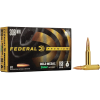
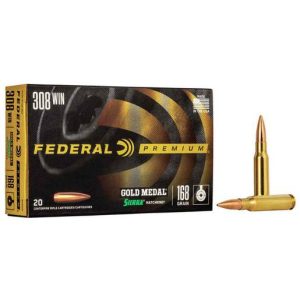
Federal Gold Medal .308 Win 168 gr Sierra MatchKing
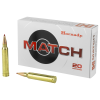
Hornady .300 Win Mag 195 gr ELD Match
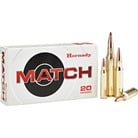
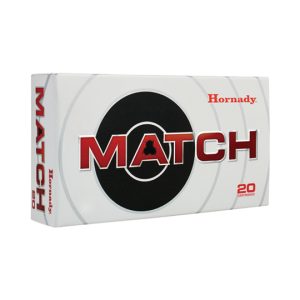
Federal Terminal Ascent 6.5 Creedmoor 130 gr

Hornady .223 Rem 73 gr ELD Match

FAQ: Ballistics Calculator
How does a ballistics calculator work?
It steps the bullet downrange in tiny increments, working out drag from the bullet's BC and a standard drag curve, plus gravity and wind, at each step. From that it gives drop, wind drift, velocity, energy and time of flight at every range for your zero and conditions.
What is a good ballistic coefficient?
Higher is better for long range. Most hunting and match rifle bullets sit between about 0.4 and 0.8 on the G1 scale, or 0.2 and 0.4 on G7. A 6.5 Creedmoor 140 gr ELD Match is 0.646 G1 and 0.326 G7 on Hornady's page.
Should I use G1 or G7 BC?
Use G7 for long, boat-tail match and long-range hunting bullets when the maker publishes it, and G1 for flat-base and shorter bullets. Always set the drag model to match the BC you type in.
How much does a .308 drop at 500 yards?
With Federal Gold Medal 168 gr Sierra MatchKing at Federal's 2,650 fps, zeroed at 100 yards, it drops about 63 inches at 500 yards, roughly 12 MOA. Federal's own table, zeroed at 200 yards, shows 51.5 inches.
How much does a 6.5 Creedmoor drop at 1,000 yards?
With Hornady 140 gr ELD Match at 2,710 fps and a 100-yard zero, about 320 inches, a little under 31 MOA, at sea level and 59 F. Altitude and temperature change that, so put in your own conditions.
What is sight height on a rifle?
It's the distance from the center of the bore to the center of the scope. Most scoped bolt-action rifles run about 1.5 to 2 inches, and AR-15s sit higher. Measure yours: Hornady's 5.56 table uses 2.4 inches, and both Hornady and Federal use 1.5 inches for most bolt-gun loads.
Why doesn't the calculator match where my rifle hits?
Usually because your real muzzle velocity is different from the box. Barrel length, temperature and the lot of ammo all move it. Chronograph your rifle, enter that velocity, and check your sight height and zero.
Does the calculator include spin drift or Coriolis?
No. Both are small inside 600 yards. Past about 800 yards they add up, so true your data against real impacts at distance.
4,005+ Gun & Ammo Deals
Updated daily from 200+ top retailers. Filter by category, caliber, action type, and price.
Related Guides