

Last updated November 26th 2026
Some of the links below are affiliate links, meaning at no additional cost to you, we may earn a commission if you click through and make a purchase.
- Treat every gun as loaded
- Point the muzzle in a safe direction
- Keep your finger off the trigger until you’re ready to shoot
- Know your target and what’s beyond
By Nick Hall.
Table of Contents
The Short Answer
Quick Answer: In the 243 vs 308 matchup, the .243 Win is the better deer and varmint cartridge for most new or recoil-shy hunters, and the .308 Win is the better all-round big-game cartridge. With Hornady’s matched American Whitetail loads, the .243 shoots slightly flatter, 42.5 in. of drop at 500 yards vs 51.3, and kicks a little over half as hard. The .308 carries about 36% more energy at the muzzle and stays above the common elk energy line about 125 to 265 yards further, load for load. Hunting whitetails inside 350 yards? A .243 is plenty. Hunting elk, or want one rifle for everything? Buy the .308.
Below, I compare the 243 Win vs 308 Win on SAAMI specs, Hornady’s matched loads to 500 yards, the deer and elk energy lines, recoil at four rifle weights, twist rate, rifles and ammo prices from our catalog today.
Same Parent Case, Different Bullet
The .243 Winchester is the .308 Winchester case necked down to hold a 6mm bullet. Both share the same .473 in. case head, so both run on the same bolt face and fit a short action. The SAAMI specifications show how close the cases are: 2.045 in. for the .243 and 2.015 in. for the .308. The .243 case is slightly longer, because its shoulder runs further forward to reach the narrower 6mm neck.
The loaded rounds differ more. SAAMI caps the .243 at 2.710 in. overall and the .308 at 2.810 in. Maximum average pressure is 60,000 psi for the .243 and 62,000 psi for the .308.
The real difference is the bullet. The .243 fires a .243 in. bullet, and SAAMI lists loads from 58 gr varmint bullets up to 100 gr deer bullets. The .308 fires a .308 in. bullet, with SAAMI loads from 110 gr up to 200 gr, plus a 55 gr saboted load. Nearly the same powder space, very different payload.
Speed vs Weight: The Matched Hornady Loads
The .243 is faster with a bullet two-thirds the weight. The .308 hits harder. Hornady loads its American Whitetail line in both cartridges with cup-and-core InterLock bullets and tests both in 24 in. barrels, which makes them a fair pair.
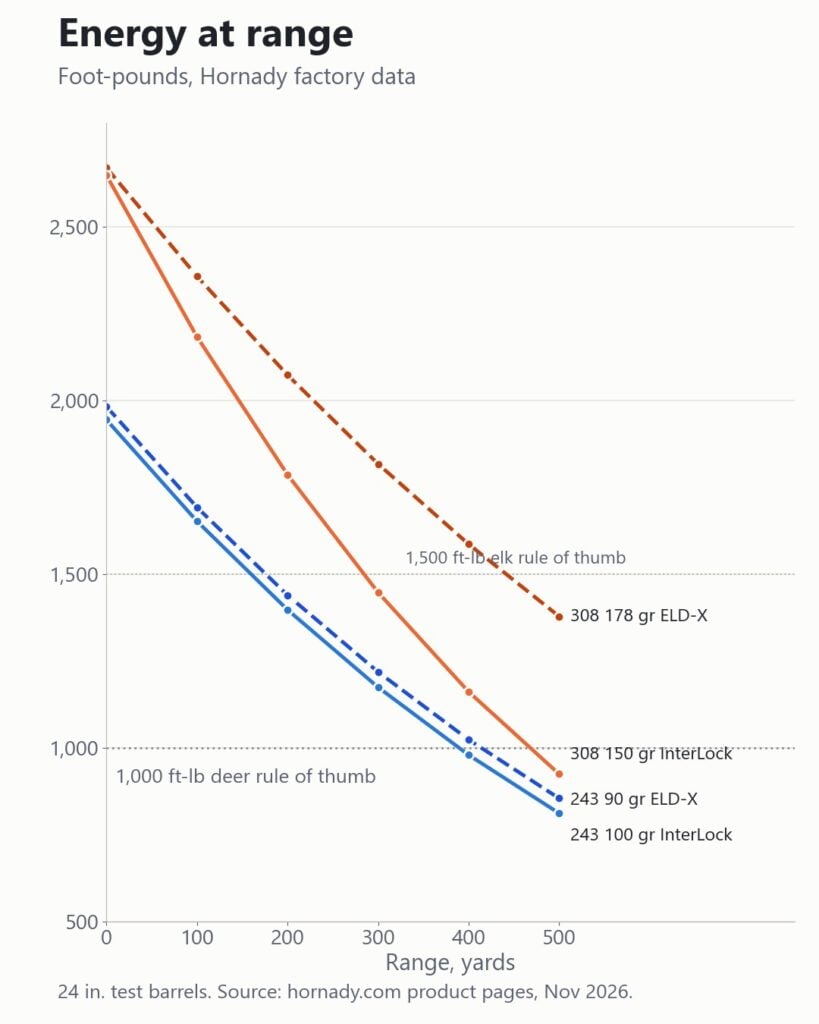
The .243 Win 100 gr InterLock BTSP leaves at 2,960 fps with 1,945 ft-lb. The .308 Win 150 gr InterLock SP leaves at 2,820 fps with 2,649 ft-lb. The .243 is 140 fps faster. The .308 carries 704 ft-lb, or 36%, more energy at the muzzle.
The energy gap closes with range, because the .308’s soft point sheds speed faster than the .243’s boat-tail bullet. By 500 yards, the .308 load has lost 1,153 fps and the .243 load 1,048. At 300 yards, it’s 1,448 ft-lb for the .308 vs 1,175 for the .243, a 23% edge. At 500 yards, it’s 925 vs 812.
243 vs 308 Comparison Table
| 243 Winchester | 308 Winchester | |
|---|---|---|
| Parent case | .308 Win, necked down | Original |
| Case length | 2.045 in. | 2.015 in. |
| Max overall length | 2.710 in. | 2.810 in. |
| Bullet diameter | .243 in. | .308 in. |
| SAAMI bullet weights | 58 to 100 gr | 110 to 200 gr |
| Case head | .473 in. | .473 in. |
| Max average pressure | 60,000 psi | 62,000 psi |
| Standard twist | 1:10 | 1:12 |
| Action | Short | Short |
| Hornady American Whitetail load | 100 gr, 2,960 fps | 150 gr, 2,820 fps |
| Muzzle energy | 1,945 ft-lb | 2,649 ft-lb |
| Energy at 300 yd | 1,175 ft-lb | 1,448 ft-lb |
| Drop at 500 yd, 200 yd zero | 42.5 in. | 51.3 in. |
| Free recoil, 8 lb rifle, estimate | About 8 ft-lb | About 15 ft-lb |
| Holds 1,000 ft-lb for deer to | About 390 to 410 yd | About 470 yd to past 500 |
| Holds 1,500 ft-lb for elk to | About 160 to 195 yd | About 285 to 440 yd |
| Median ammo price, Nov 26 2026 | $2.00 a round | $2.10 a round |
243 vs 308 Ballistics: Energy and Drop to 500 Yards
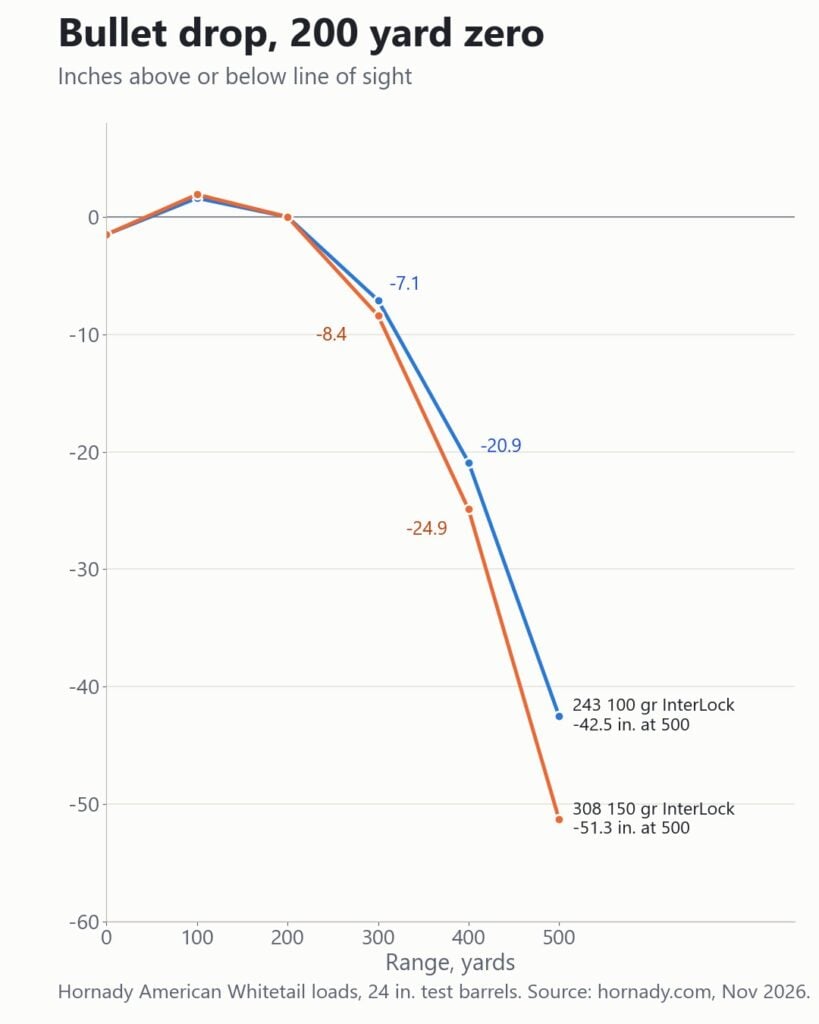
The .243 shoots a little flatter, and the .308 carries more energy all the way out. With both American Whitetail loads zeroed at 200 yards, the .243 is 7.1 in. low at 300 yards and the .308 is 8.4 in. low. At 400 yards, it’s 20.9 vs 24.9 in., and at 500 yards, 42.5 vs 51.3 in. That’s about 9 in. less drop for the .243 at 500.
Premium bullets widen the .243’s edge in drop and the .308’s edge in energy. Hornady’s .243 90 gr ELD-X starts at 3,150 fps and is 36.6 in. low at 500 yards. The .308 178 gr ELD-X starts at 2,600 fps and is 50.2 in. low, but it still carries 1,379 ft-lb at 500, more than the .243 load has at 300.
243 vs 308 for Deer: The 1,000 Foot-Pound Line
Both are proven deer cartridges, and the .308 simply has more range. Many deer hunters use 1,000 ft-lb at impact as a rule of thumb. Here’s where each Hornady load crosses it, from the published tables:
- 243 100 gr InterLock: about 390 yards
- 243 95 gr SST: about 400 yards
- 243 90 gr ELD-X: about 410 yards
- 308 150 gr InterLock: about 470 yards
- 308 150 gr SST: past 500 yards, 1,110 ft-lb at 500
- 308 178 gr ELD-X: past 500 yards, 1,379 ft-lb at 500
Inside 300 yards, every one of these loads has energy to spare. Our best deer hunting rifles list covers both cartridges. Past that, bullet construction matters more than the cartridge name. With the .243, use a bullet built for deer, not a thin-jacketed varmint bullet. Our best .243 Winchester rifles page covers the rifles.
Is 243 Enough for Elk?
It isn’t the right tool, and the numbers show why. A common rule of thumb for elk is 1,500 ft-lb at impact. Every .243 load here falls below it before 200 yards: about 160 yards for the 100 gr InterLock, 175 yards for the 90 gr ELD-X and 195 yards for the 95 gr SST.
The .308 holds it much longer: about 285 yards with the 150 gr InterLock, 340 yards with the 150 gr SST and 440 yards with the 178 gr ELD-X. Load for load, that’s about 125 to 265 yards more reach on the animal that needs it most. If elk are on your list, buy the .308, or step up to a magnum with our 300 Win Mag vs 30-06 comparison and best elk rifle picks.
243 vs 308 Recoil: Why the 243 Is the Classic First Deer Rifle
The .308 kicks about 1.8 times as hard as the .243 from the same rifle. Using the standard free-recoil formula with the two American Whitetail loads, and assuming about 40 gr of powder in the .243 load and 46 gr in the .308, here’s the estimate:
- 6.5 lb rifle: 243 about 10 ft-lb, 308 about 18 ft-lb
- 7 lb rifle: 243 about 9 ft-lb, 308 about 17 ft-lb
- 8 lb rifle: 243 about 8 ft-lb, 308 about 15 ft-lb
- 9 lb rifle: 243 about 7 ft-lb, 308 about 13 ft-lb
A .243 in a light rifle kicks less than a .308 in a heavy one. That’s why it’s the default first centerfire for young and small-framed hunters. Low recoil means more practice, fewer flinches and better shot placement, which matters more on a deer than the extra energy of a bigger cartridge.
The .308 isn’t harsh. In a 7 to 8 lb hunting rifle it’s comfortable for most adults. But if recoil is the worry, the .243 removes it.
Twist Rate, Bullet Weight and Varmints
The .243 does double duty on varmints and deer. The .308 is a big-game round first. SAAMI lists a 1:10 twist for the .243 and 1:12 for the .308. The .243’s faster twist stabilizes its 90 to 100 gr deer bullets, and its 58 to 80 gr varmint bullets fly flat and fast for coyotes and prairie dogs.
The .308 can shoot light bullets, but its sweet spot is 150 to 180 gr. Those are the weights that give it the energy edge, and they’re what you want for elk, hogs and black bear. If you want one rifle for coyotes in winter and deer in fall, the .243 is the better fit. See our best varmint rifle guide for dedicated options.
For long-range target work, the .308’s heavier match bullets and huge range of match ammo make it the classic choice. Our ballistic coefficient explainer covers why bullet shape matters as much as speed at distance.
Same Action, Same Rifles
Because they share a case head and a short action, the popular bolt-action lines come in both, often at the same price. On November 26, 2026, the lowest listed new prices in our catalog were within about $60 of each other in 7 of the 10 lines we checked, and identical in two:
- Savage Axis: 243 from $347, 308 from $347
- Mossberg Patriot: 243 from $300, 308 from $354
- Weatherby Vanguard: 243 from $514, 308 from $514
- Remington 700: 243 from $495, 308 from $484
- Savage 110: 243 from $539, 308 from $512
- Tikka T3x: 243 from $650, 308 from $674
The exceptions were the Ruger American, Bergara B-14 and Winchester Model 70, where the .308 listed $70 to $200 higher.
The shared case head also means a gunsmith can rebarrel one to the other on the same bolt. The choice is the cartridge, not the rifle. For the .308 side, see our best .308 rifles and our 308 vs 30-06 comparison.
Can You Shoot 243 in a 308?
No. Never fire a .243 in a .308 rifle, or a .308 in a .243. They share the same case head and body, so a .243 round can go into a .308 chamber, and firing it there can split the case and vent gas into the action. A .308 round should not let the bolt close on a .243, but never try it.
Fire only the cartridge stamped on the barrel and on the case headstamp, “243 WIN” or “308 WIN”. Keep the boxes apart, and never load a magazine from loose rounds you haven’t identified.
What About 6.5 Creedmoor?
The 6.5 Creedmoor sits between them, and it shares the same .473 in. case head and short action. Hornady’s 6.5 Creedmoor 143 gr ELD-X Precision Hunter starts at 2,700 fps with 2,315 ft-lb, still carries 1,302 ft-lb at 500 yards and is 44.5 in. low there with a 200 yard zero.
Compare the matching Precision Hunter loads at 500 yards: the .243 90 gr ELD-X is 36.6 in. low with 855 ft-lb, and the .308 178 gr ELD-X is 50.2 in. low with 1,379 ft-lb. The 6.5 holds the 1,500 ft-lb elk line to about 385 yards. If you want more than a .243 for elk but less recoil than a .308, read our 6.5 Creedmoor vs 308 comparison.
Ammo Cost and Choice
Hunting ammo costs about the same. The .308 has far more choice. On November 26, 2026, we tracked 381 in-stock .243 listings across 13 retailers at a median of $2.00 a round. The .308 had 832 listings across 13 retailers at a median of $2.10.
The difference is choice. The .308 has more than twice the listings, plus full metal jacket practice ammo and match ammo that the .243 mostly lacks. The .243 is almost all hunting ammo. Check the live price boxes below for today’s lowest prices on each.
Where They Came From
Both are Winchester cartridges from the 1950s, and one is the parent of the other. Winchester introduced the .308 Winchester in 1952, the commercial version of what became the 7.62x51mm NATO. Three years later, in 1955, it necked the same case down to 6mm and released the .243 Winchester.
Both caught on fast. The .308 became the standard short-action big-game and long-range target round, and the .243 became America’s classic light deer and varmint cartridge. Seventy years later, most major bolt-action lines are still chambered for both.
My Recommendation
In the 243 vs 308 decision, buy the .243 if deer and varmints are your hunting, or if recoil is a concern. It’s flatter, gentler and plenty for whitetails inside 350 yards with a good deer bullet.
Buy the .308 if you want one rifle for everything from deer to elk to black bear, or if you’ll shoot long-range targets. It carries more energy at every range, holds the elk energy line far longer and has more than twice as many ammo listings as the .243 in our catalog.
Here’s how I’d match the cartridge to the shooter:
- First deer rifle, youth or small-framed hunter: .243.
- Whitetails and coyotes from the same rifle: .243.
- Whitetails, hogs and black bear: .308.
- Elk: .308 at minimum, with a 165 to 180 gr bullet.
- Long-range target shooting on a budget: .308, for the match ammo.
- Prairie dogs and varmints at distance: .243.
243 Win Ammo Live Pricing
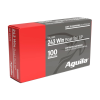
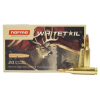
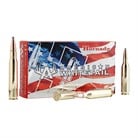

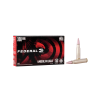
308 Win Ammo Live Pricing

Frequently Asked Questions
Is 243 or 308 better for deer?
Both work. The .243 is flatter and kicks a little over half as hard, which suits new hunters and whitetails inside 350 yards. The .308 carries about 36% more energy at the muzzle and keeps more at long range, so it's the better choice for big-bodied deer and longer shots.
Is 243 enough for elk?
It isn't the right tool. Every Hornady .243 load drops below the common 1,500 ft-lb elk rule of thumb before 200 yards. The .308 holds it to about 285 to 440 yards depending on the load.
How much more recoil does 308 have than 243?
About 1.8 times as much from the same rifle. In an 8 lb rifle, the estimate is about 15 ft-lb for the .308 vs 8 ft-lb for the .243 with Hornady's American Whitetail loads.
Is 243 flatter shooting than 308?
Yes, a little. With Hornady's American Whitetail loads and a 200 yard zero, the .243 is 42.5 in. low at 500 yards vs 51.3 in. for the .308.
Can you shoot 243 in a 308 rifle?
No. The bullets are different diameters and the chambers are cut for one cartridge. Fire only the cartridge stamped on the barrel.
Is 243 a necked-down 308?
Yes. Winchester necked the .308 case down to 6mm to create the .243 in 1955. Both share the same .473 in. case head and short action.
What is the effective range of 243 for deer?
Hornady's .243 deer loads stay above the common 1,000 ft-lb deer rule of thumb to about 390 to 410 yards. Most hunters keep shots well inside that.
Is 243 ammo cheaper than 308?
Not really. On November 26, 2026, the median price we tracked was $2.00 a round for .243 and $2.10 for .308. The .308 has FMJ practice ammo, match ammo and more than twice as many listings.
What twist rate do 243 and 308 use?
SAAMI lists 1:10 for the .243 and 1:12 for the .308.
Is 243 or 308 better for a youth hunter?
The .243, in most cases. Its lower recoil helps a young hunter learn without a flinch, and it has the energy for deer at sensible ranges.
2,799+ Gun & Ammo Deals
Updated daily from 200+ top retailers. Filter by category, caliber, action type, and price.
Related Guides