
Last updated March 28th 2026
Some of the links below are affiliate links, meaning at no additional cost to you, we may earn a commission if you click through and make a purchase.
- Treat every gun as loaded
- Point the muzzle in a safe direction
- Keep your finger off the trigger until you’re ready to shoot
- Know your target and what’s beyond
Introduction: The Right Order to Upgrade Your AR-15
You just bought your first AR-15. Or maybe you’ve had one for a while and finally decided to make it better. Either way, the internet has a million opinions on what to upgrade first, and most of them are wrong. People slap $300 triggers on rifles that don’t have slings or lights. That’s backwards.
I’ve built and upgraded more ARs than I want to admit, and I’ve made every mistake in the book. Bought a fancy stock before I had a decent optic. Dropped $250 on a BCG before I had a weapon light. I’ve since figured out the right order, and it comes down to one principle: upgrade whatever improves your shooting effectiveness the most, first.
This is the definitive upgrade priority guide. We’ll go through eight upgrades in the exact order you should buy them, with budget and premium picks for each. If you’re building from scratch instead, check our AR-15 build guide and complete parts list.
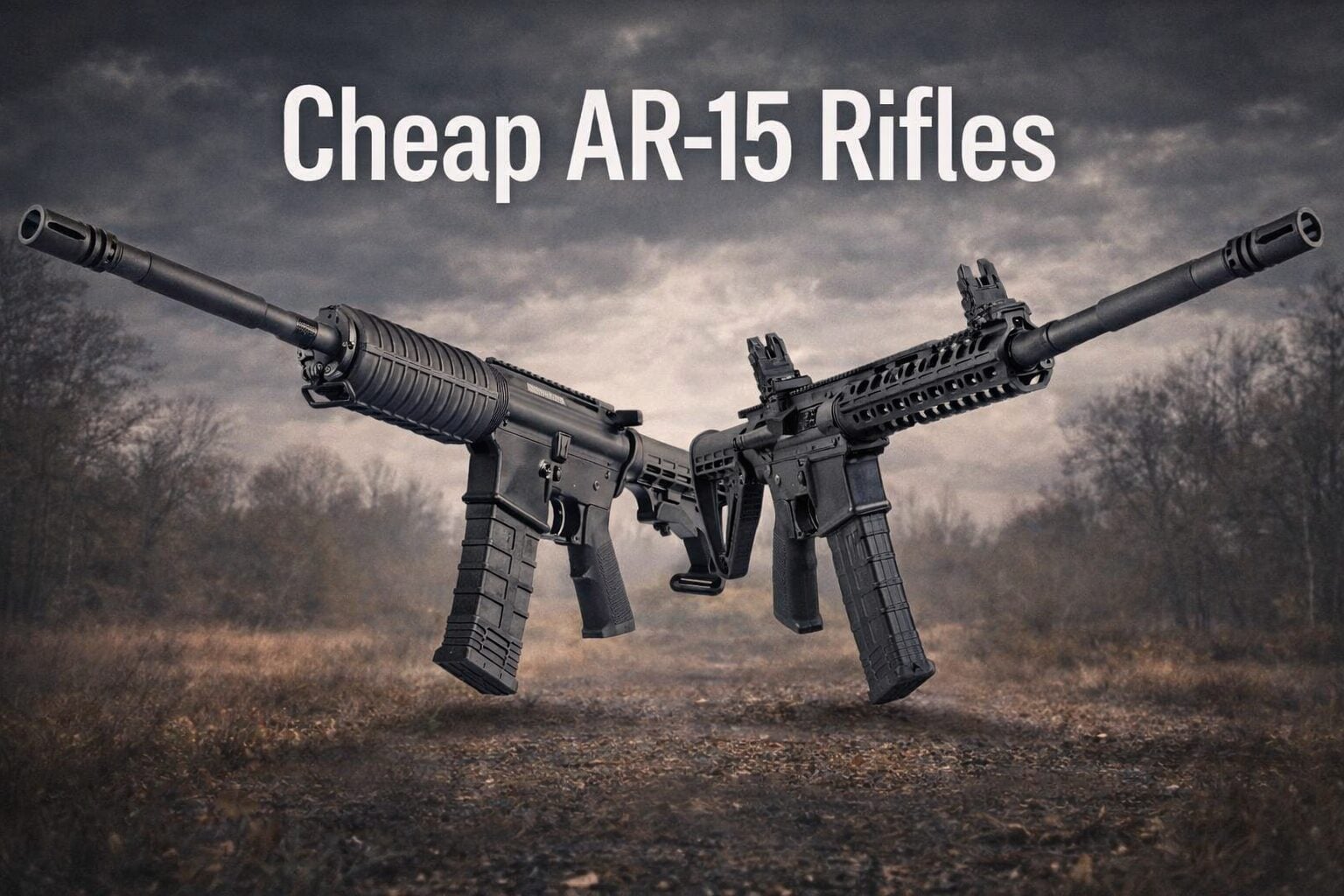
1st Upgrade: Optic or Sight ($150-$400)
This is the upgrade that makes the biggest immediate difference. Your factory AR probably came with a cheap rear flip-up sight or, worse, nothing at all. A quality red dot or LPVO transforms your ability to acquire targets quickly and shoot accurately. Nothing else on this list matters if you can’t see what you’re shooting at.
For a home defense rifle, a red dot is the way to go. Both eyes open, unlimited eye relief, fast target acquisition. The Sig Sauer Romeo5 ($120) is the budget king with motion-activated battery and shake-awake technology. If you can stretch to $350, the Aimpoint Duty RDS is virtually indestructible and the optic that professionals trust.
For a range rifle or anything past 200 yards, consider an LPVO (Low Power Variable Optic). The Vortex Strike Eagle 1-6x ($250) is the budget standard. The Primary Arms SLx 1-6x with ACSS reticle ($290) is my personal favorite for the money. Check out our AR-15 red dot guide for the complete optic breakdown.
Budget Pick: Sig Sauer Romeo5 red dot (~$120). Premium Pick: Aimpoint Duty RDS (~$400).
When to skip: Never. Every AR needs a sighting system. Even if you’re running irons, at least get quality backup sights like the Magpul MBUS set (~$60).
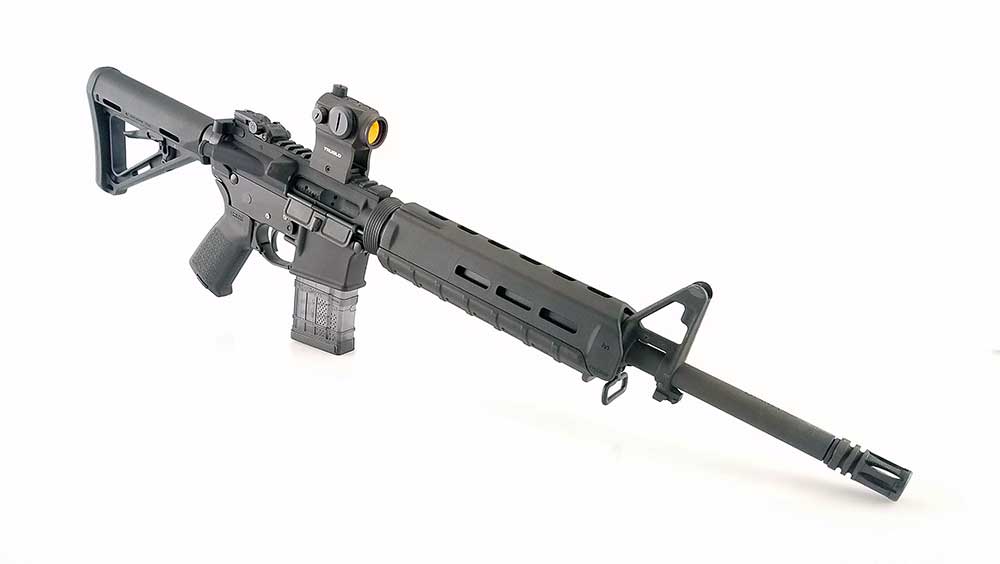
2nd Upgrade: Weapon Light ($100-$300)
If your AR has any defensive purpose at all, a weapon light is non-negotiable. You need to positively identify what you’re pointing a rifle at before you pull the trigger. That’s not just good advice. It’s a legal and moral obligation. Bad things happen in the dark, and “I thought it was an intruder” doesn’t hold up when you shoot your teenager sneaking back in.
The Streamlight ProTac HL-X ($100) is the budget standard. 1,000 lumens, pressure pad compatible, and proven reliable. If you can swing it, the SureFire M600DF ($280) is the gold standard that every serious rifle runs. Modlite is excellent too, but availability and price put them in the “nice to have” category.
Budget Pick: Streamlight ProTac HL-X (~$100). Premium Pick: SureFire M600DF (~$280).
When to skip: Only if this is a dedicated range-only rifle that will never be used defensively. Even then, a light is useful for inspecting chambers and checking targets.

3rd Upgrade: Sling ($30-$60)
The sling is your rifle’s holster. Without one, you’re committed to holding your AR with both hands at all times. Need to open a door? Use a phone? Grab your kid? You need a sling. It’s also a retention device. If someone tries to take your rifle, the sling keeps it attached to your body.
A quality two-point sling costs $30-60 and takes five minutes to set up. There’s no reason not to have one. The Magpul MS1 ($25) is the budget pick, and the Blue Force Gear Vickers ($55) is the premium choice. Both are excellent. Read our complete AR-15 sling guide for all eight picks.
Budget Pick: Magpul MS1 (~$25). Premium Pick: Blue Force Gear Vickers (~$55).
When to skip: Never. A rifle without a sling is like a pistol without a holster.

4th Upgrade: Trigger ($90-$250)
Now we’re getting into the “makes you shoot better” upgrades. A good trigger transforms your AR from a tool that goes bang into a precision instrument. The gritty, heavy mil-spec trigger on most factory ARs adds unnecessary difficulty to every shot. A clean, crisp aftermarket trigger makes accurate shooting significantly easier.
The LaRue MBT-2S ($87) is the best value in the entire AR parts market. Two-stage, crisp break, and it competes with triggers three times its price. If you want the best, the Geissele SSA-E ($240) is the gold standard. Both are covered in detail in our AR-15 trigger guide.
Budget Pick: LaRue MBT-2S (~$87). Premium Pick: Geissele SSA-E (~$240).
When to skip: If your factory trigger is already decent (some Ruger and Springfield ARs come with reasonable triggers) and you’re not a precision-focused shooter. Spend the money on ammo and training instead.
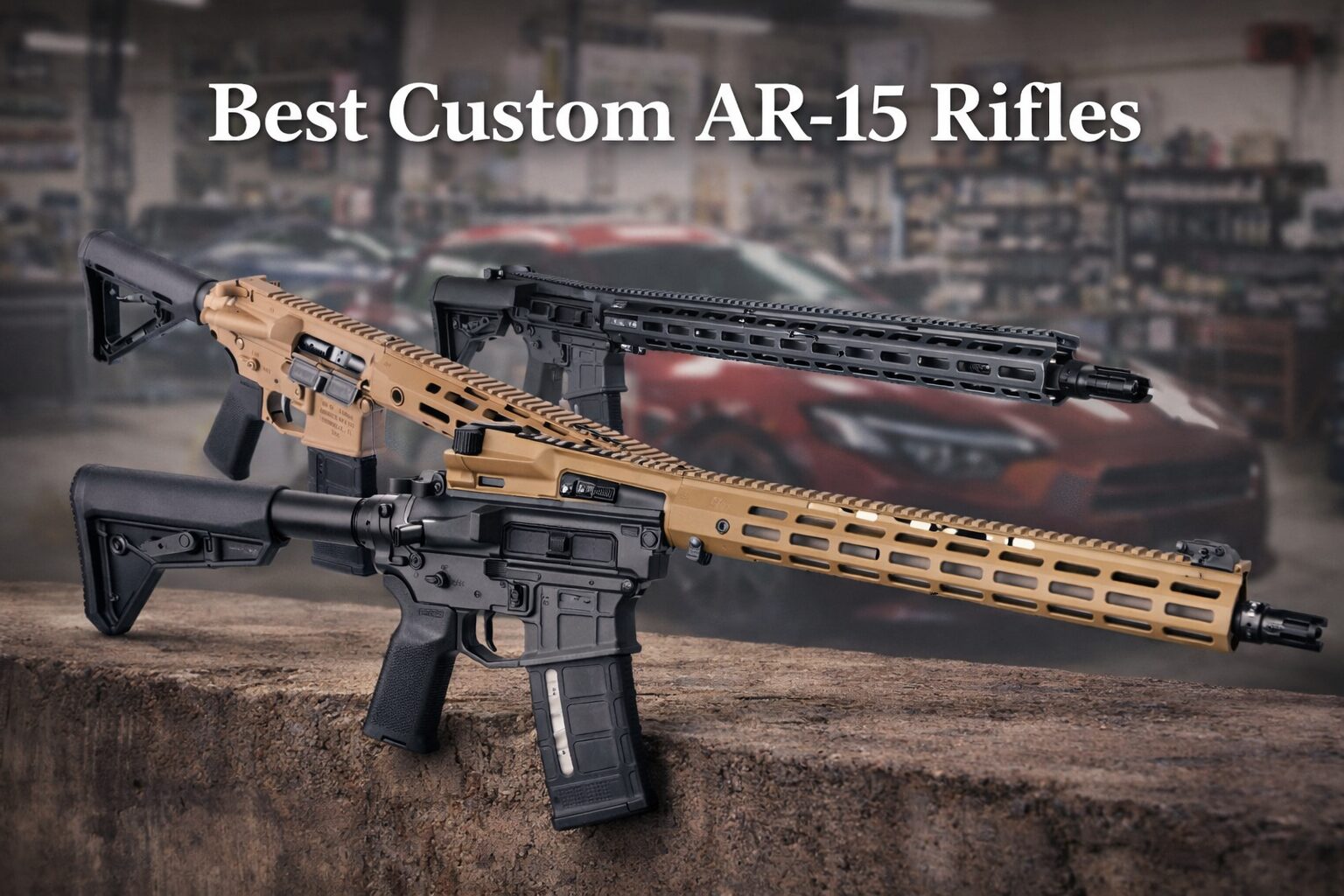
5th Upgrade: Handguard ($100-$250)
Upgrading to a free-float handguard does two things: it improves accuracy (the handguard doesn’t contact the barrel, so your POI won’t shift when you grip or rest the rifle) and it gives you MLOK mounting points for your light, laser, and other accessories. If you’re still running a factory plastic drop-in handguard, this is a game-changing swap.
The Aero Precision Atlas S-ONE ($130) is the value pick. The BCM MCMR ($190) is the best overall. Read our complete handguard roundup and free-float vs drop-in comparison for the full breakdown.
Budget Pick: Aero Atlas S-ONE (~$130). Premium Pick: BCM MCMR (~$190).
When to skip: If your rifle already came with a free-float handguard (most mid-range and above ARs do), this upgrade is unnecessary. Only relevant if you’re upgrading from a drop-in plastic handguard.

6th Upgrade: Muzzle Device ($30-$150)
Most factory ARs come with an A2 flash hider, which is honestly fine for most people. The main reasons to upgrade are: you want a suppressor mount (SureFire SOCOM at $150), you want maximum recoil reduction for competition (VG6 Gamma at $75), or you want a comp for flatter shooting (BCM Mod 0 at $45).
If you’re planning to buy a suppressor eventually, install the suppressor mount now. It saves you from swapping muzzle devices later and means your rifle is ready the day your Form 4 clears. Our muzzle device guide covers all eight options.
Budget Pick: BCM GUNFIGHTER Mod 0 (~$45). Premium Pick: SureFire SOCOM (~$150).
When to skip: If your rifle has an A2 flash hider and you don’t plan on suppressing it, the A2 is genuinely excellent. Don’t fix what isn’t broken.

7th Upgrade: Stock ($40-$80)
A better stock improves cheek weld, comfort, and length of pull. It’s not going to make you a better shooter the way a trigger or optic does, but it makes shooting more comfortable and consistent. The Magpul CTR ($45) is the value play, and the B5 SOPMOD ($60) is the one the military uses.
If your factory stock wobbles on the buffer tube, a Magpul with a friction lock eliminates that annoyance immediately. If your cheek weld is inconsistent with an optic, a SOPMOD-profile stock solves it. Read our AR-15 stock guide for all eight picks. Also make sure you know whether you have a mil-spec or commercial buffer tube before ordering.
Budget Pick: Magpul CTR (~$45). Premium Pick: B5 Systems SOPMOD (~$60).
When to skip: If your factory stock already provides a good cheek weld and doesn’t wobble. Some higher-end rifles come with quality stocks from the factory.

8th Upgrade: Bolt Carrier Group ($70-$200)
The BCG is last because most factory ARs come with BCGs that work fine. Unless your rifle came from a bottom-tier manufacturer, the factory BCG is probably adequate for thousands of rounds. The reason to upgrade is either: your factory BCG is subpar, you want a spare for your parts kit, or you want a premium coating for easier cleaning.
The Toolcraft Nitride ($70) is the best value BCG in existence. The BCM Auto BCG ($170) is the gold standard for duty use. If you’re running a PSA or similar budget rifle, a Toolcraft upgrade is a smart move for peace of mind. For the full breakdown, read our AR-15 BCG guide.
Budget Pick: Toolcraft Nitride (~$70). Premium Pick: BCM Auto BCG (~$170).
When to skip: If your rifle came from BCM, Daniel Defense, SOLGW, or any reputable manufacturer, the factory BCG is already good. Save the money or buy a spare as a backup.
Total Cost: Budget vs Premium Upgrade Path
The budget path (all eight upgrades with budget picks) runs about $500-600 total. That transforms a basic factory AR into a genuinely capable rifle. The premium path costs $1,200-1,500, which is serious money but gives you best-in-class components at every position.
My recommendation for most people: do the budget path first, shoot a lot, and then replace individual components with premium options as your skills improve and you understand what you actually need. A shooter with a $600 upgraded AR and 5,000 rounds of practice will outshoot someone with a $3,000 rifle and 500 rounds of experience every single time.
Don’t forget that ammo and training are upgrades too. A $200 carbine class will improve your shooting more than $200 in parts. Invest in yourself first, then invest in your rifle.
Browse All AR-15 Parts & Upgrades →
FAQ: AR-15 Upgrades
Related Guides
- Best AR-15 Triggers
- Best AR-15 Handguards
- Best AR-15 Bolt Carrier Groups
- Best AR-15 Stocks
- Best AR-15 Muzzle Devices
- Best AR-15 Slings
- Best AR-15 Red Dot Sights
- Best AR-15 Accessories
- Best AR-15 for Beginners
- Best AR-15 Parts & Accessories
What is the first thing I should upgrade on my AR-15?
An optic or sighting system should be your first upgrade. A quality red dot like the Sig Romeo5 at 120 dollars or the Aimpoint Duty RDS at 400 dollars makes the biggest immediate improvement to your shooting.
How much does it cost to fully upgrade an AR-15?
A budget upgrade path with all 8 categories costs 500 to 600 dollars. A premium path runs 1,200 to 1,500 dollars. Most shooters are best served starting with budget picks and upgrading individual components over time.
Is a trigger or optic more important on an AR-15?
An optic is more important and should come first. You need to see your target clearly before trigger quality matters. A red dot or LPVO transforms target acquisition speed while a trigger upgrade refines shot precision.
Do I need a weapon light on my AR-15?
If your AR-15 has any defensive role, a weapon light is mandatory. You must positively identify targets before engaging them. The Streamlight ProTac HL-X at 100 dollars is the budget standard for AR weapon lights.
Should I upgrade my AR-15 or buy ammo and train?
Both matter, but a shooter with a 600 dollar upgraded AR and 5,000 rounds of practice will outshoot someone with a 3,000 dollar rifle and 500 rounds of experience. Invest in training alongside your upgrades.
What AR-15 upgrades are not worth the money?
Skeletonized parts save negligible weight and weaken the component. Novelty dust covers and selector switches add nothing functional. Expensive BCGs are unnecessary if your factory BCG is from a quality manufacturer.
Is a free-float handguard a necessary upgrade?
Only if your rifle has a factory drop-in plastic handguard. Free-float handguards improve accuracy and provide MLOK mounting points. If your rifle already has a free-float rail, this upgrade is unnecessary.
What is the cheapest meaningful AR-15 upgrade?
A sling at 25 to 55 dollars is the cheapest meaningful upgrade, followed by a Magpul stock at 40 to 60 dollars. Both take minutes to install and immediately improve how you use your rifle.
14,528+ Gun & Ammo Deals
Updated daily from 10+ top retailers. Filter by category, caliber, action type, and price.
Related Guides