
Last updated and checked October 29, 2026 · By Nick Hall, AR-15 builder who has installed both free-float and drop-in handguards
This post contains affiliate links. If you click and buy, I may earn a small commission at no extra cost to you. Full disclosure.
- Treat every gun as loaded
- Point the muzzle in a safe direction
- Keep your finger off the trigger until you’re ready to shoot
- Know your target and what’s beyond
Quick Answer: A free-float handguard is the right choice for most AR-15 builds in 2026. By isolating the barrel from any contact with the handguard, free-float keeps your point of impact steady when you load the handguard against a barricade or a bipod, and it is the standard on precision and duty-grade rifles.
Drop-in handguards are still acceptable for budget builds, training rifles, and applications where accuracy is not the priority, they cost less and need no special installation: a Magpul MOE M-LOK drop-in was $34.99 at Sportsman’s Guide on October 29, 2026, against $133.99 for a Wilson Combat M-LOK free-float rail at Palmetto State Armory. Carbon fiber free-float handguards from Faxon and Brigand Arms cut weight further while keeping full M-LOK capability, at a higher price than aluminum.
The biggest mistake AR-15 builders make is assuming any free-float handguard is automatically better than any drop-in. A poorly-installed free-float (loose barrel nut, misaligned anti-rotation tab) can be worse than a quality drop-in. Torque the barrel nut to spec (30 to 80 ft-lb on a mil-spec nut, or the rail maker’s figure), align the gas tube notch, and use a quality M-LOK or KeyMod rail from Aero Precision, Geissele, BCM, or Daniel Defense.
Table of Contents
The handguard debate comes down to a simple question: how much accuracy do you need? A free-float handguard eliminates barrel contact and genuinely improves mechanical accuracy. A drop-in handguard touches the barrel and can shift point of impact under pressure. But “can” doesn’t mean “will,” and the real-world difference depends entirely on how you use your rifle.
I’ve run both extensively. My budget plinking AR wore drop-in handguards for years and shot just fine. My precision guns all wear free-float rails because the accuracy improvement is measurable. Here’s how to decide which one you need.

How we tested: Every pick here is ranked against our testing methodology. Minimum round counts, accuracy and reliability protocols, the failures that disqualify a gun.
How Drop-In Handguards Work
Drop-in handguards mount between the delta ring (at the upper receiver) and the handguard cap (at the front sight base/gas block). They’re two-piece designs: a top and bottom half that snap together over the barrel. The barrel sits inside the handguard with direct contact at the cap and delta ring.
Installation is dead simple. Pull down the delta ring, pop the old handguards off, snap the new ones on. No special tools required. A kindergartner could do it. This simplicity is the primary advantage of drop-in systems.
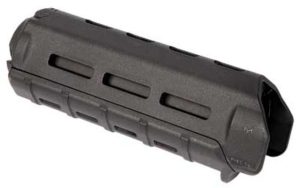
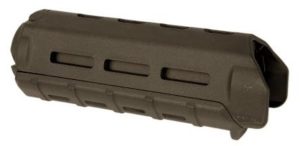
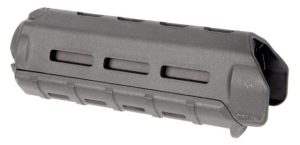
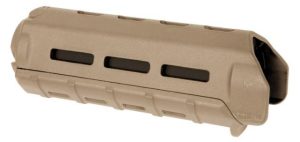
The classic M4 plastic handguards, Magpul MOE handguards, and Midwest Industries drop-in quads are all examples. They’re cheap (the Magpul MOE M-LOK carbine handguard was $34.99 at Sportsman’s Guide), light, and work on any AR-15 with a standard front sight base and delta ring assembly.

How Free-Float Handguards Work
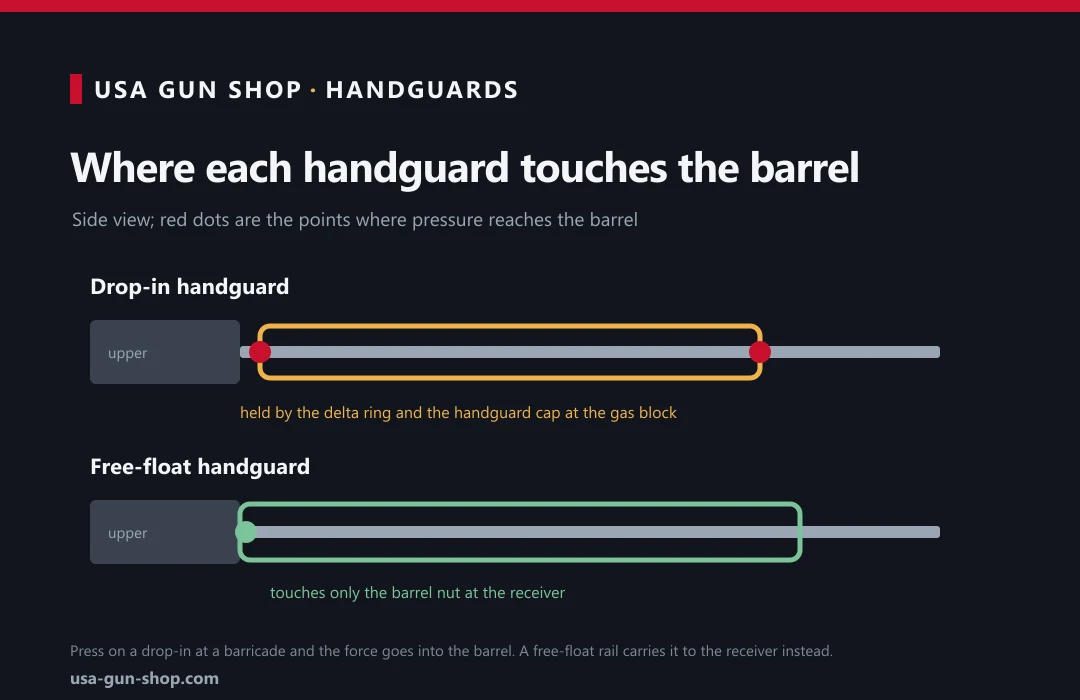
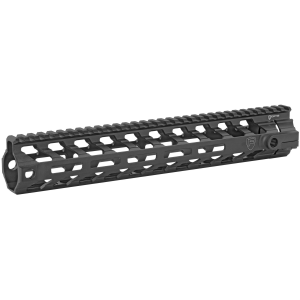
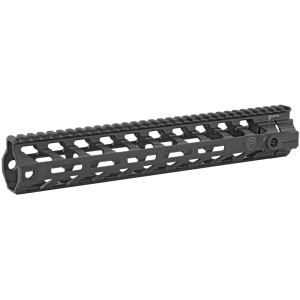
Free-float handguards mount solely to the upper receiver via a barrel nut. They do not touch the barrel at any point. The barrel hangs freely inside the handguard with clearance on every side. Nothing contacts the barrel except the upper receiver and the gas block.
This “floating” design means nothing can push on the barrel and change its harmonics or point of impact. When you lean your rifle against a barricade, rest it on a bag, or grab the handguard firmly, none of that force transfers to the barrel. The barrel vibrates consistently every shot, which means consistent accuracy.
Installation requires removing the delta ring assembly and old barrel nut, then installing the new barrel nut and handguard. You’ll need an armorers wrench, a vise block, and some patience. It’s not hard, but it’s more involved than a drop-in swap. Our AR-15 build guide covers the process step by step.
Accuracy: The Real Difference
Here’s the honest truth on the accuracy difference. From a bench, shooting off bags, with no pressure on the handguard, the difference between free-float and drop-in is minimal. In my testing it was 0.25 to 0.5 MOA with match ammo. Most shooters can’t shoot well enough to tell the difference in that scenario.
The difference shows up when you apply pressure to the handguard. Shooting off a barricade, using a bipod attached to the handguard, or gripping hard during rapid fire. With a drop-in, that pressure transfers to the barrel through the handguard cap. Your point of impact shifts. With a free-float, the barrel is untouched and POI stays consistent.
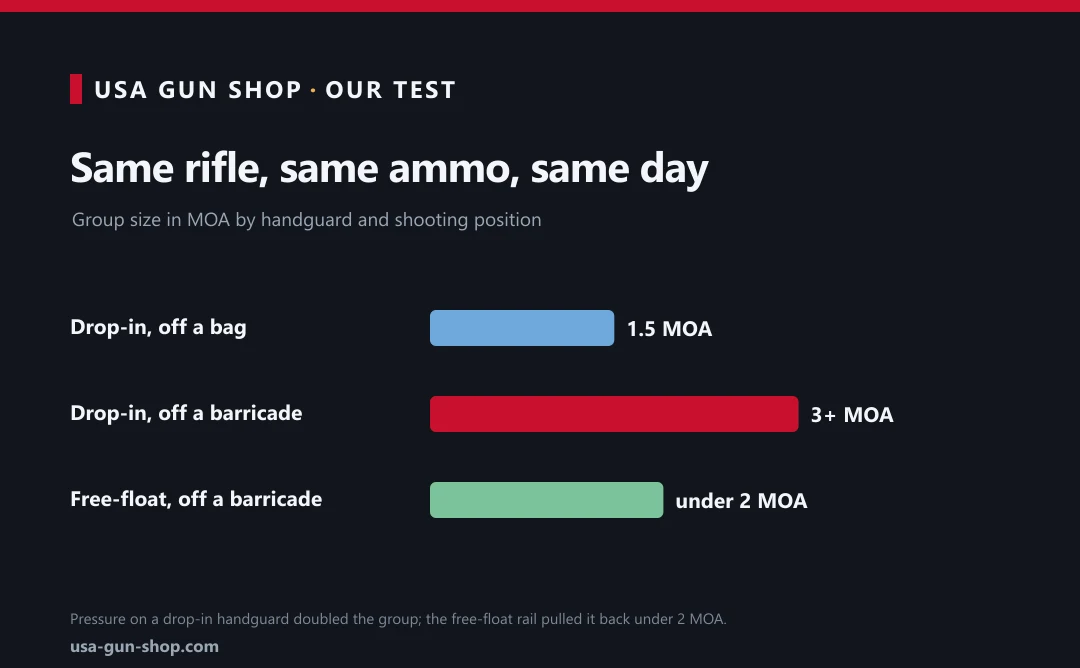
I tested this specifically. Same rifle, same ammo, same day. With drop-in handguards, shooting off a bag gave me 1.5 MOA groups. Shooting off a barricade with forward pressure opened that to 3+ MOA. Swapped to a free-float rail and the barricade groups tightened back to under 2 MOA. That’s a meaningful real-world difference.
Comparison Table
| Feature | Drop-In | Free-Float |
|---|---|---|
| Mounting | Delta ring + handguard cap | Barrel nut only |
| Barrel Contact | Yes (at cap) | None |
| Accuracy Impact | POI shift under pressure | Consistent POI |
| Installation Difficulty | Easy (no tools) | Moderate (armorers wrench) |
| Weight | Light (polymer), plus delta ring and cap | Varies with length and material |
| Accessory Mounting | Limited (no MLOK/pic) | Full MLOK or Picatinny |
| Heat Management | Poor (thin plastic) | Good (aluminum, vented) |
| Example price, Oct 29, 2026 | $34.99 (Magpul MOE M-LOK) | $133.99 (Wilson Combat M-LOK) |
| Requires FSB Removal? | No | Yes, on most rails |
| Best For | Budget builds, plinking | Accuracy, accessories, serious use |
MLOK vs Picatinny
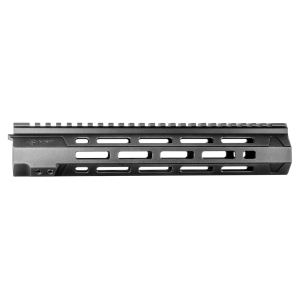
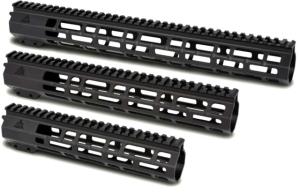
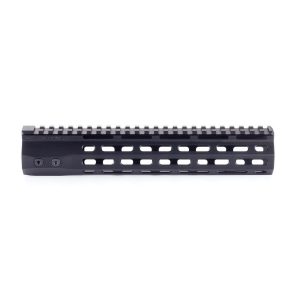
Most modern free-float handguards use the MLOK attachment system. It’s lighter than full picatinny rails because the slots are cut directly into the handguard. You only add rail sections where you need them, which saves weight and keeps a slim profile.
Picatinny (mil-std-1913) quad rails are the old-school approach. They put rail on all four sides of the handguard. They’re heavier but offer unlimited mounting options without adapters. The KAC RAS and Daniel Defense RIS II are classic quad rails that are still popular for clone builds and duty rifles.
For most builds in 2026, MLOK is the way to go. It’s lighter, slimmer, and just as strong as picatinny for mounting lights, lasers, grips, and bipods. The best AR-15 parts guide covers top MLOK handguard picks from Aero, BCM, Midwest Industries, and Geissele.
The strength question was settled by testing. In a study Naval Surface Warfare Center Crane ran for US Special Operations Command, released in 2017, M-LOK beat KeyMod on repeatability, drop and failure-load tests across rails from Aero Precision, Midwest Industries and Seekins, and SOCOM adopted M-LOK for its programs (test summary at Soldier Systems).
Heat Management
Drop-in handguards, especially plastic ones, get hot fast. Two or three magazines of rapid fire and you’ll be looking for gloves. The thin plastic doesn’t insulate well, and direct barrel contact transfers heat quickly. This is the second-biggest practical downside after accuracy.
Free-float handguards handle heat better for two reasons. First, aluminum dissipates heat more effectively than plastic. Second, the air gap between the barrel and handguard provides insulation. Your hand is separated from the barrel by an inch or more of air. After heavy shooting sessions, the handguard still gets warm, but it takes much longer.
If you shoot high volume (classes, competition, extended range sessions), the heat advantage of a free-float rail is significant. Rail covers and hand stops also help. For casual range trips where you’re shooting a magazine every few minutes, heat isn’t a factor with either type.
Weight Comparison
A polymer drop-in is lighter than most aluminum free-float rails of the same length, and a four-sided quad rail is the heaviest option of all. If you’re building a lightweight AR-15, every ounce matters.
However, the weight comparison isn’t always straightforward. Drop-in handguards require a delta ring assembly and handguard cap, which add a couple ounces. Free-float handguards eliminate those parts, so the real gap is smaller than the rail weights suggest, and most people won’t notice it in practical use.
Carbon fiber free-float handguards from companies like Faxon and Brigand Arms are the lightest way to get full MLOK capability. They cost more than aluminum rails, but they are the best of both worlds for weight-conscious builds.
Installation: What’s Involved
Drop-In Installation
Pull the delta ring back (use a delta ring tool or have a buddy help). Pop off the existing handguard halves. Snap the new ones in place. Release the delta ring. Done. Five minutes, no tools required. This is as simple as AR-15 modifications get.
Free-Float Installation
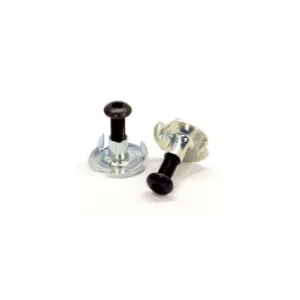
Secure the upper in a vise block. Remove the flash hider and existing handguard. Remove the delta ring assembly (snap ring pliers and a punch). Remove the old barrel nut (armorers wrench, may need heat for thread-locked nuts). Install the new barrel nut (torque to spec with wrench). Slide on the handguard and tighten the mounting hardware.
If your rifle has a pinned front sight base (FSB), you’ll also need to remove or replace it with a low-profile gas block to clear the handguard. This requires punching out taper pins, which can be stubborn. A bench vise, pin punch set, and brass hammer are essential tools.
It’s not difficult, but it’s a real project. Budget an hour your first time. Once you’ve done it a couple times, it’s a 20-minute job. If you’re not comfortable doing it yourself, any gunsmith can install a free-float rail for you; ask for the price before you drop it off. Our build guide has detailed handguard installation instructions.
Cost Comparison
Drop-in handguards are cheaper. The Magpul MOE M-LOK carbine handguard was $34.99 at Sportsman’s Guide on October 29, 2026, and aluminum drop-in quad rails cost a little more.
Free-float handguards cost more. On October 29, 2026, Palmetto State Armory had a Wilson Combat 15-inch M-LOK rail at $133.99 and Brownells its Gen-2 Enhanced 10.7-inch rail at $144.99, while premium rails from Geissele, BCM and KAC cost more again. Rails from Aero Precision, Midwest Industries and BCM are the sweet spot for quality without breaking the bank.
Factor in the cost of tools if you don’t already have them: an armorer’s wrench, a vise block and a torque wrench. These are one-time purchases that you’ll use for future builds too. For budget considerations, see our cheap AR-15 guide.
Browse All Drop-In Handguards →
When Drop-In Is Fine
- Budget builds: Save the money for ammo and training
- Plinking and casual range use: Accuracy difference is irrelevant at 50-100 yards
- Temporary or loaner rifles: Not worth investing in a nice rail
- A2/retro builds: Period-correct aesthetics require drop-in
- You don’t mount accessories: If you don’t need MLOK/picatinny, why pay for it?
When Free-Float Is Worth It
- Accuracy matters: Precision shooting, hunting, competition
- You mount accessories: Lights, lasers, bipods, grips need mounting slots
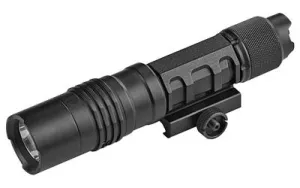
- Home defense: A weapon light is mandatory and needs a mounting point
- Extended shooting sessions: Better heat management
- Serious use: Duty, competition, training classes
- Aesthetics: Modern free-float rails look good, there’s no denying it
Browse All Free-Float Handguards →
My Recommendation
If you’re building a new AR-15 or upgrading an existing one, go free-float. The price difference has shrunk over the years, and the benefits are clear. A Wilson Combat M-LOK rail was $133.99 at Palmetto State Armory on October 29, 2026, $99 more than a Magpul MOE drop-in, and that $99 buys a stable point of impact and real accessory mounting.
If you already have a drop-in setup and you’re happy with your rifle’s accuracy, don’t feel pressured to switch. The upgrade is nice-to-have, not need-to-have, for most shooters. Spend that money on ammo and training instead. A good shooter with drop-in handguards will outshoot a poor shooter with a free-float rail every single time.
Check out our best AR-15 rifles guide for complete rifles that come with quality free-float handguards from the factory. And for the full rundown on every component, our AR-15 parts list explains what each piece does and where to spend your money.
Shop AR-15 Handguards
Best-scored accessories across 200+ retailers · Updated every 4 hours



Facts and Figures
- Our barricade test: drop-in 1.5 MOA off a bag, 3+ MOA off a barricade; free-float under 2 MOA off a barricade
- Drop-in price, October 29, 2026: Magpul MOE M-LOK carbine handguard $34.99 (Sportsman’s Guide)
- Free-float price, October 29, 2026: Wilson Combat 15-inch M-LOK $133.99 (Palmetto State Armory), Brownells Gen-2 Enhanced 10.7-inch $144.99
- Mil-spec barrel nut torque: 30 to 80 ft-lb, turned to align the gas tube
- M-LOK vs KeyMod: M-LOK won NSWC Crane’s repeatability, drop and failure-load tests for SOCOM (released 2017)
Frequently Asked Questions
Will a free-float handguard make my AR-15 more accurate?
Yes, most of all when pressure goes on the handguard. In our test the same rifle shot 3+ MOA off a barricade with a drop-in and under 2 MOA with a free-float rail. From a bench with no contact, the gain was 0.25 to 0.5 MOA with match ammo.
Can I install a free-float handguard myself?
Yes, with basic tools and mechanical aptitude. You need an armorer's wrench, a vise block, a torque wrench and possibly pin punches. Budget an hour the first time.
Do I need to remove my front sight base for a free-float rail?
In most cases, yes. Most free-float handguards are too narrow inside to clear a front sight base, so you replace it with a low-profile gas block.
Is M-LOK strong enough?
Yes. In testing Naval Surface Warfare Center Crane ran for US Special Operations Command, released in 2017, M-LOK beat KeyMod on repeatability, drop and failure-load tests, and SOCOM adopted M-LOK.
How much does a free-float handguard cost?
On October 29, 2026, Palmetto State Armory had a Wilson Combat 15-inch M-LOK rail at $133.99 and Brownells a Gen-2 Enhanced 10.7-inch rail at $144.99. A Magpul MOE M-LOK drop-in was $34.99 at Sportsman's Guide.
Can I put a bipod on a drop-in handguard?
You can, but the bipod's force goes through the handguard into the barrel and shifts your point of impact. For bipod use, get a free-float rail.
Do drop-in handguards get hotter than free-float?
Yes. Drop-in handguards touch the barrel at the cap and delta ring and pass heat to your hand faster. A free-float rail leaves an air gap between the barrel and your hand.
Is a free-float handguard necessary for a home defense AR-15?
Not strictly, but we recommend one. A home defense rifle needs a weapon light, and a free-float M-LOK rail gives you the best places to mount it.
3,152+ Gun & Ammo Deals
Updated daily from 200+ top retailers. Filter by category, caliber, action type, and price.
Related Guides