

The Vortex Precision Matched Rings are the best scope rings for most shooters, and they are the only model that appears on every expert list we checked while rebuilding this guide. If you want the same quality for a third of the money, the Vortex Pro Series Rings do it. If your rifle needs its scope aligned or canted, the Burris XTR Signature Rings are the only rings here that can do it without a new base.
Below are twelve mounting solutions split into two jobs that people constantly conflate: seven rings for bolt guns and precision rifles, and five one-piece and cantilever mounts for ARs and LPVOs. Every height, weight, price and torque figure comes from the manufacturer’s own published specification, and where a manufacturer does not publish one, this page says so. For where mounts sit in the wider optics picture, start with our complete gun optics guide.
Some of the links below are affiliate links, meaning at no additional cost to you, we may earn a commission if you click through and make a purchase.
Table of Contents
How we tested: Every pick here is ranked against our testing methodology. Minimum round counts, accuracy and reliability protocols, the failures that disqualify a gun.
Best Scope Rings and Mounts 2026 at a Glance
Prices are the manufacturer’s MSRP where they publish one. The live cards further down show what each is actually selling for today, which in most cases is well below it.
| Model | Type | Best for | Tube sizes | Ring cap torque | Price |
|---|---|---|---|---|---|
| Vortex Precision Matched Rings | Rings | Overall | 1 in, 30, 34, 35 mm | 15 to 18 in-lb | $259.99 |
| Vortex Pro Series Rings | Rings | Value | 1 in, 30, 34 mm | 15 to 18 in-lb | about $80 |
| Burris XTR Signature Rings | Rings | Alignment and cant | 1 in, 30, 34 mm | 20 in-lb | $126 to $208 |
| Seekins Precision Scope Rings | Rings | Heavy recoil | 30, 34, 35 mm | 18 to 20 in-lb | $149 to $159 |
| Area 419 MATCH Rings | Rings | Premium | 30, 34, 35, 36 mm | 18 in-lb | $220 |
| Leupold Mark 4 Rings | Rings | Mid-tier | 1 in, 30, 34, 35 mm | 15 to 20 in-lb | about $120 |
| Warne Maxima Horizontal | Rings | Budget | 1 in, 30 mm | 18 in-lb max | $74.99 |
| Geissele Super Precision | Mount | AR and LPVO | 30, 34 mm | not published | about $335 |
| Leupold Mark IMS | Mount | One-piece with cant | 30, 34, 35 mm | 15 to 20 in-lb | about $400 |
| Midwest Industries MK2 QD | Mount | Quick-detach | 30, 34 mm | not published | $244.95 |
| Talley Lightweight Alloy | Mount | Lightweight one-piece | 1 in, 30 mm | 17 to 20 in-lb | about $60 |
| Vortex Sport Cantilever | Mount | Budget AR mount | 1 in, 30 mm | 15 to 18 in-lb | $50 to $140 |
Look down the torque column. Those numbers are not interchangeable, they are not close to each other, and the base torque figures further down this page spread even wider. That is the subject of the first chart below, and it is the single most expensive thing to get wrong here.
The Best Scope Rings
The best scope rings are two-piece, clamped to a rail or to bases. This is what goes on a bolt gun, a precision rifle, and anything where you are not reaching forward over a flat-top receiver to get eye relief.
1. Vortex Precision Matched Rings. Best Scope Rings Overall
Pros
- The only model on every expert list we checked while rebuilding this guide
- Bores held to 0.0005 inch and the pairs are serialised, so the two halves belong together
- Available in 1 inch, 30 mm, 34 mm and 35 mm, which covers essentially every scope
- Type III hard coat anodising over a vibratory tumbled and bead blasted body
- Ships with the Torx wrench, so there is no hunting for the right bit
Cons
- $259.99 MSRP is the highest ring price in this guide bar the Area 419
- Vortex publishes a 15 to 18 in-lb cap figure but no base clamp torque at all
- No alignment or cant adjustment, so a misaligned receiver stays misaligned
The Precision Matched Rings are the consensus answer and it is not close. Of the three current expert ring round-ups we read while rebuilding this page, this is the only model that appears on all three, and two of them make it the outright winner. That is a rare thing in an optics category where every publication has a favorite.
To match these rings to a Vortex scope line and its tube size, see our Vortex scopes explained guide.
What you are paying for is the bore. Vortex holds these to 0.0005 inch and serialises the pairs, so the two rings you receive were machined and matched together rather than picked out of a bin. That is what stops a ring from stressing a scope tube, and it is why these are the rings people put on a scope that costs more than the rifle. The body is Type III hard coat anodized over a tumbled and bead blasted finish, and the set covers 1 inch, 30, 34 and 35 mm.
Two honest caveats. At $259.99 MSRP this is expensive, although street pricing runs far below that and the card below shows today’s. And Vortex publishes a 15 to 18 in-lb cap torque but no clamp figure, which matters because the Seekins rings three slots down want 50 to 55 in-lb on the clamp and there is no way to infer one from the other. If you want the rings to fix an alignment problem rather than just hold a scope, that is the Burris below.
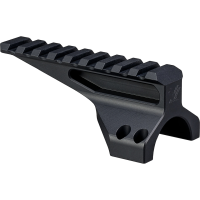
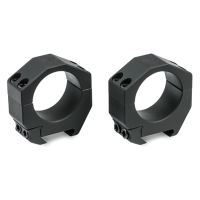
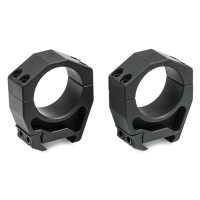
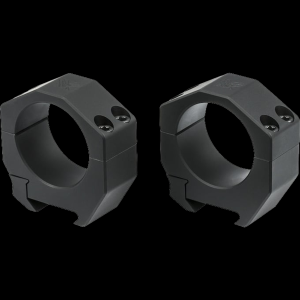
Best for: Anyone mounting a scope they care about on a precision rifle and not trying to correct anything.
2. Vortex Pro Series Rings. Best Value Rings
Pros
- About $80, roughly a third of what the Precision Matched rings cost
- Same 15 to 18 in-lb cap torque, so one wrench setting covers both Vortex ring lines
- 1 inch, 30 mm and 34 mm, in low through high, so most builds are covered
- Vortex VIP warranty on a mounting component, which almost nobody offers
- Widely stocked, so you are not paying a single-merchant premium
Cons
- No serialised matched bore, which is exactly what the Precision Matched money buys
- No alignment inserts and no built-in cant
- Aluminum rather than the steel of the budget Warne rings below
The Pro Series is the rings most people should actually buy. At roughly $80 a set they cost about a third of the Precision Matched rings, they take the same 15 to 18 in-lb cap torque, and they come in 1 inch, 30 mm and 34 mm across low to high heights. For a hunting rifle or a range gun wearing a $400 scope, the difference between these and the flagship rings is not something you will ever measure.
One outlet that tested 47 different mounts made the Pro Series its overall pick for most shooters specifically on the price-to-performance argument, and having mounted plenty of them, that is the right read. They clamp square, they hold, and they are made in the USA at a price where most competition is not.
What you give up is the matched bore. The Precision Matched rings are lapped and serialised as a pair; these are not, so on an unlucky set you may find you want to lap them, and a lapping kit erases some of the saving. For a scope with a thin tube and a long body, that matters more than it does on a compact hunting scope. Know which one you are mounting.
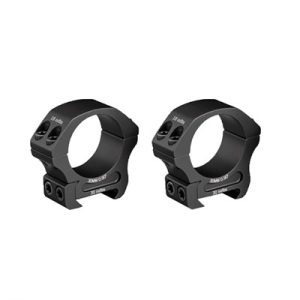
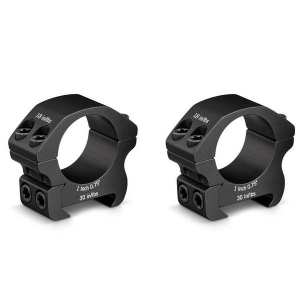
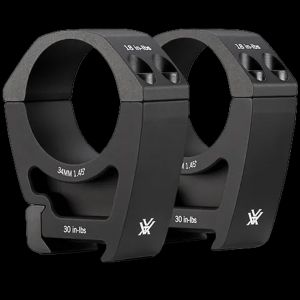
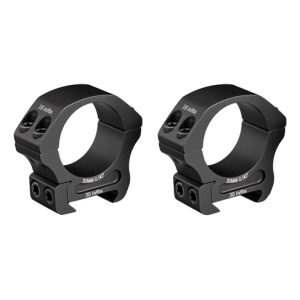
Best for: The hunting or range rifle where the scope costs less than the rifle and the rings should not cost more than either.
3. Burris XTR Signature Rings. Best for Alignment and Cant
Pros
- Pos-Align inserts build in 0, 5, 10, 15, 20, 25, 30 or 40 MOA of cant with no canted base
- The same inserts correct left and right misalignment on a receiver that is not true
- Polymer inserts give full contact on the tube, so no ring marks and no tube stress
- On all three expert lists we checked, the only rings besides the Vortex to manage it
- 1 inch, 30 mm and 34 mm in 1, 1.25 and 1.5 inch heights
Cons
- The highest cap torque in this guide at 20 in-lb, and 45 in-lb on the cross-bolts
- Insert sets add a fiddly step to what is otherwise a ten minute job
- $126 to $208 MSRP puts them above the Vortex Pro Series for most configurations
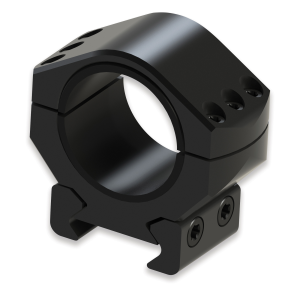
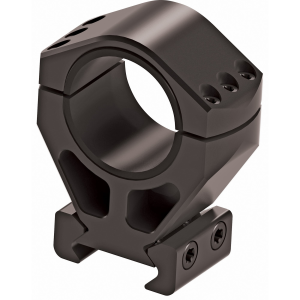
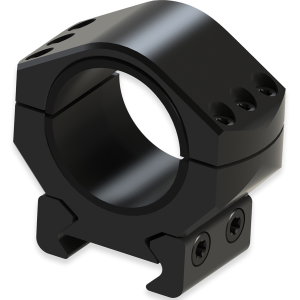
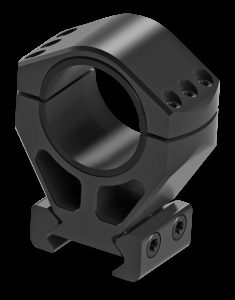
The XTR Signature is the one set of rings here that does a job the others cannot. Burris supplies Pos-Align inserts in matched offset pairs, and by combining them you can build 0, 5, 10, 15, 20, 25, 30 or 40 MOA of cant directly into the rings. That is elevation you did not have to buy a canted base to get, and it is the difference between running out of turret at 1,000 yards and not.
The same inserts solve the other problem nobody talks about: a receiver whose holes are not perfectly in line. Turn the inserts to correct left and right and the scope sits straight in rings that are not. Because the inserts are polymer and wrap the tube, contact is total rather than two thin steel edges, which means no ring marks and no tube stress. This is the rebuilt version of what the old page listed as the Burris Signature Zee, and every expert list names the XTR, not the Zee.
Watch the torque, because these are the outlier in this guide. Burris publishes 20 in-lb on the top-cap screws and 45 in-lb on the cross-bolts. That cap figure is higher than every other ring here and the cross-bolt figure is nearly double the Warne’s. Set the wrench for these rings specifically and reset it afterwards.
Best for: A rifle that needs cant it does not have, or a receiver that is not quite true.
4. Seekins Precision Scope Rings. Best for Heavy Recoil
Pros
- 50 to 55 in-lb on the scope clamp, double what most rings here specify
- 7075-T6 aluminum machined in serialised pairs with Grade 8 T25 Torx fasteners
- 0.8 inch wide four-screw caps spread the clamping load over more tube
- Integral center lug to the 1913 Picatinny standard, so it indexes into the slot
- Heights from 0.82 inch low to 1.40 inch AR high in 30, 34 and 35 mm
Cons
- One merchant stocks them in our catalogue, so there is no price competition
- Seekins publishes no weight figure at all
- 18 to 20 in-lb caps and 50 to 55 in-lb clamp means two different wrench settings
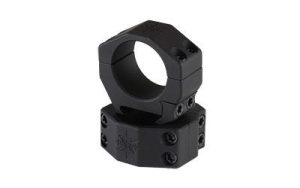
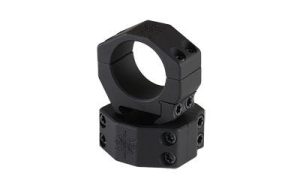
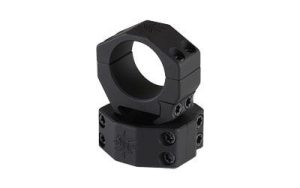
Seekins rings are the answer when the rifle kicks hard enough to move a scope. The reason is in the published numbers: the scope clamp torques to 50 to 55 in-lb, where Warne specifies 25 and Burris 45. That is a genuinely different amount of clamping force holding the ring to the rail, and it is the joint that fails first under magnum recoil.
They are machined from 7075-T6 in serialised pairs, use Grade 8 T25 Torx hardware, and the cap is 0.8 inch wide with four screws, which spreads the load across more of the tube than a narrow two-screw cap. The integral center lug indexes into a Picatinny slot instead of relying on the clamp alone. Heights run 0.82 inch low to 1.40 inch AR high across 30, 34 and 35 mm, so there is a fit for a heavy-barrel magnum and for a flat-top build.
Two things to weigh. Only one merchant in our catalogue stocks them, so the price is whatever that merchant says it is on the day, and Seekins publishes no weight specification, which is unusual for a 7075 component and unhelpful if you are counting ounces on a mountain rifle. If weight is the priority rather than recoil, the Area 419 rings below publish 6.6 oz a set and the Talley mount publishes lighter still.
Best for: Magnums, big bores and anything that has already walked a scope out of zero once.
5. Area 419 MATCH Rings. Best Premium Rings
Pros
- 6.6 oz a set in 34 mm medium, one of only two models here that publishes a weight
- Final-bored as a matched serialised pair with the internal bore left raw for grip
- 30, 34, 35 and 36 mm, the widest tube coverage of any rings in this guide
- 7075 billet with stainless hardware and Type 3 hard coat outside
- 18 in-lb caps and 45 in-lb to the rail, both stated as required tooling
Cons
- $220 a set, the joint most expensive rings here
- Heights are published in millimeters while every other brand uses inches
- A raw internal bore is deliberate but it will mark a scope tube over time
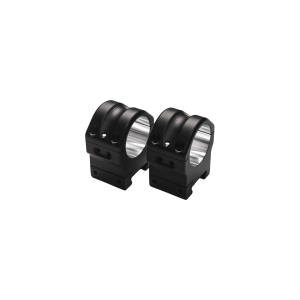
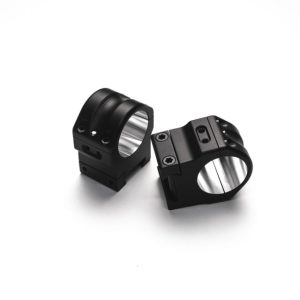
Area 419 build these the way a machinist would. The rings are final-bored as a matched, serialised pair, meaning the bore is cut after assembly so the two halves are round together rather than round separately, and the internal bore is left raw aluminum rather than anodized, because bare aluminum grips a scope tube better than a hard coat does.
They also publish the number almost nobody does. A 34 mm medium set is 6.6 oz, and Area 419 give per-ring and per-set figures rather than making you guess. The body is 7075 billet with stainless hardware, and the tube range is the widest here: 30, 34, 35 and 36 mm, which is the only way to mount some of the very large-tube European scopes.
Two frictions. At $220 a set they are the joint most expensive rings on this page, and Area 419 publish their heights in millimeters, in Low 24, Medium 28, High 32 and X-High 39, while everyone else uses inches. Their “Low” is 0.945 inch. Seekins call 0.82 inch low. Those are not the same ring and the chart further down this page shows exactly how far apart the brands are on that word.
Best for: Competition rifles, very large tubes, and anyone who wants a published weight before they buy.
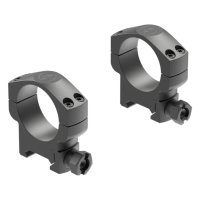
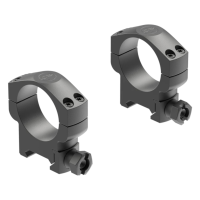
6. Leupold Mark 4 Rings. Best Mid-Tier Rings
Pros
- Around $120 a set, sitting neatly between the $80 Vortex and the $220 Area 419
- 1 inch, 30, 34 and 35 mm in heights from medium to super high
- Leupold’s lifetime guarantee applies to the mounting hardware, not just the glass
- 65 in-lb on the cross bolts, the firmest base clamp figure published in this guide
- A design that has been on duty rifles long enough that the failure modes are known
Cons
- 15 to 20 in-lb caps and 65 in-lb bolts is the widest torque split here, so two settings
- Leupold publishes no weight for the rings
- No alignment inserts, no cant, no matched bore, so it is competent rather than clever
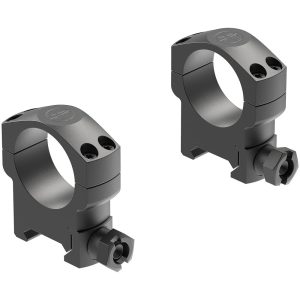
The Mark 4 rings are the unglamorous middle of this list and that is the point. Around $120 a set puts them between the Vortex Pro Series and the Area 419, they cover 1 inch through 35 mm in heights up to super high, and they carry Leupold’s lifetime guarantee. They have been bolted to duty and precision rifles long enough that if they had a failure mode, it would be well documented by now.
The number worth knowing is the base torque. Leupold specifies 65 in-lb on the cross bolts with 15 to 20 in-lb on the ring caps. That 65 is the highest base figure of anything in this guide, more than double Warne’s 25, and it is why these rings do not shoot loose. It is also why they need a proper torque wrench rather than a screwdriver and optimism.
What they do not do is anything clever. There is no matched serialised bore, no alignment insert and no built-in cant. If you need those, the Area 419 and the Burris respectively are the answers, and both cost more. If you want rings that clamp hard, fit almost any tube and are backed for life, this is a very easy recommendation.
Best for: A working precision rifle where the rings should be the thing you never think about again.
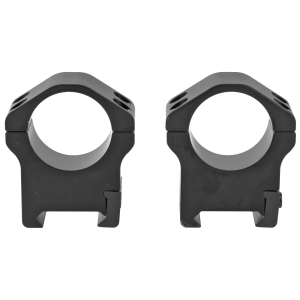
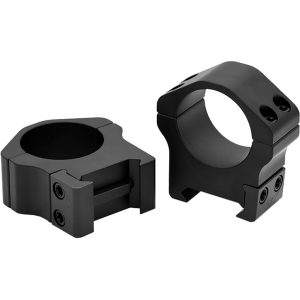
7. Warne Maxima Horizontal. Best Budget Rings
Pros
- $74.99 MSRP and street prices in the sixties, the cheapest rings in this guide
- Steel rather than aluminum, at a published 6.0 oz for a 30 mm medium set
- Warne publishes a full torque spec, 18 in-lb maximum caps and 25 in-lb clamps
- Available as fixed or quick-detach on the same Picatinny footprint
- 1 inch and 30 mm in low, medium and high
Cons
- 25 in-lb on the clamp is the lightest base figure here, so check it after a season
- No 34 mm option, which rules out most modern long-range scopes
- Warne explicitly says dry threads and no threadlocker, which not everyone will like
The Maxima Horizontal is the budget answer and it is a steel one, which is unusual at this money. Warne publishes 6.0 oz for a 30 mm medium set and an MSRP of $74.99, with street pricing in the sixties. For a hunting rifle that will wear a $300 scope for twenty years, this is enough ring and then some.
Warne also do the thing most of this industry does not: they publish the whole torque spec, in plain language, on the product page. Cap screws in a criss-cross pattern to 18 in-lb maximum, clamp screws to 25 in-lb, and they specifically say those figures are for dry threads with no threadlocker, because a lubricated screw reaches a higher real clamping force at the same wrench reading. That is the clearest mounting instruction of any brand in this guide.
The limits are real though. Twenty-five in-lb is the lightest clamp figure on this page, a third of Leupold’s 65, so this is not the ring for a magnum, and it is worth a torque check at the end of a season. There is also no 34 mm option in the Horizontal line, which rules out a large share of modern long-range scopes. Buy them for a 1 inch or 30 mm hunting scope, which is exactly what they are for.
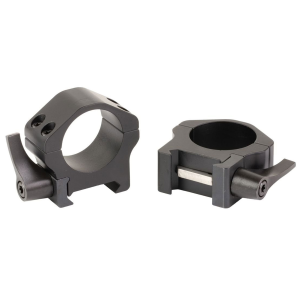
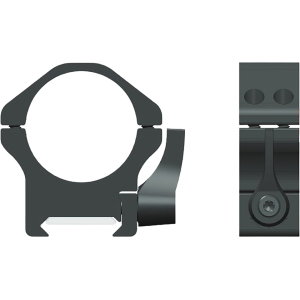
Best for: A hunting rifle in 1 inch or 30 mm where the rings should cost less than the ammunition.
The Best One-Piece and Cantilever Scope Mounts
A single machined body carrying both rings. On an AR the cantilever pushes the scope forward so you can get eye relief over a flat-top receiver, which is exactly what an AR-15 LPVO needs, and on a bolt gun a one-piece removes the risk of two separate rings being out of line with each other. This is also where quick-detach lives. Short scopes make the case for a one-piece: our Nightforce NX8 review shows the 2.5-20 power NX8 has only 1.3 inches of tube ahead of its turrets.
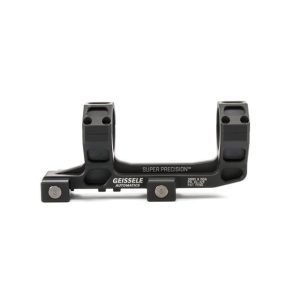
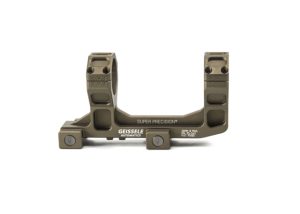
8. Geissele Super Precision. Best AR and LPVO Mount
Pros
- Machined from a single billet of 7075-T6, so the two rings cannot be out of line
- Available in a 1.93 inch height for passive night vision aiming as well as standard
- 30 mm and 34 mm, covering essentially every LPVO worth buying
- Named as the bombproof fixed mount on the LPVO round-ups we checked
- Return to zero good enough that people pull it and refit it without re-zeroing
Cons
- Geissele publishes no torque specification anywhere we can reach
- About $335, roughly seven times the cheapest mount in this guide
- Fixed, not quick-detach, so a scope swap means a hex key
The Super Precision is the mount people buy when the rifle matters. It is cut from a single billet of 7075-T6, which removes the failure that two-piece rings can have entirely: the two ring bores were machined in one setup, on one part, so they physically cannot be out of line with each other. On the LPVO round-ups we read while rebuilding this page it is consistently named the bombproof fixed option, and it is the one mount here whose return to zero people genuinely rely on.
It comes in 30 mm and 34 mm, and crucially in a 1.93 inch height as well as the standard. That taller option exists so you can aim passively under night vision, with the tube high enough to see under a helmet-mounted device, and it has become the default height on serious AR builds for that reason. If you do not run night vision, the standard height gives a more natural cheek weld.
Here is what we could not verify and will not invent. Geissele publishes no torque specification we can reach. Their site blocks automated access entirely and the installation sheet is not retrievable, so the figures circulating on forums are not something this page will state as a manufacturer spec. The values ship printed in the box. Read them before you fit it, because at this price guessing is an expensive way to find out.
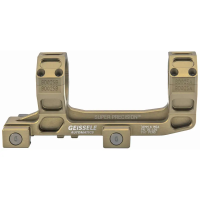
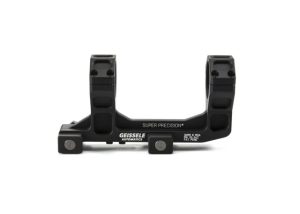
Best for: A duty or hard-use AR where the mount should outlive the rifle, especially with night vision.
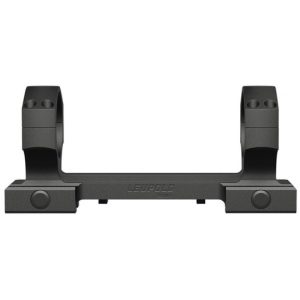
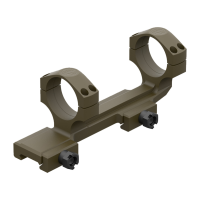
9. Leupold Mark IMS. Best One-Piece With Built-In Cant
Pros
- Available with 20 MOA of cant built into the mount, so the turret keeps its range
- One-piece body in 30, 34 and 35 mm, with bolt-action and MSR versions
- 1.5 inch height option suits a bolt gun without stacking a rail on a rail
- Leupold’s published 65 in-lb cross bolt figure, the firmest base spec here
- Lifetime guarantee on the mount
Cons
- About $400, the most expensive item in this guide
- The 20 MOA version is useless on a rifle that does not need the elevation
- Bolt-action and MSR variants look similar and are not interchangeable, so read the SKU
The Mark IMS solves the elevation problem in the mount rather than in the rings. The 20 MOA version tips the scope down relative to the bore, which hands you back that much elevation travel in the turret. On a rifle that runs out of dial before it runs out of cartridge at distance, that is the fix, and it is a cleaner one than stacking a canted base under separate rings.
It is a genuine one-piece in 30, 34 and 35 mm, sold in both bolt-action and MSR versions, and the bolt-action 1.5 inch height is the right number for a conventional stock without building a tower. Leupold’s 65 in-lb cross bolt figure applies here, which is the firmest base clamp specification on this page.
Two warnings. At about $400 this is the most expensive single item in this guide, more than the Geissele. And the bolt-action and MSR variants are not interchangeable despite looking alike in a listing photo, so buy on the SKU and not the picture. If you do not need cant, the Geissele above is stronger for an AR and the Talley below is a quarter of the weight and a sixth of the price for a hunting rifle.
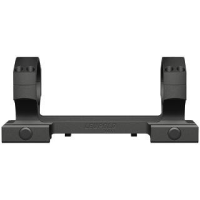
Best for: A long-range rifle that needs 20 MOA of cant without adding a separate canted base.
10. Midwest Industries MK2 QD. Best Quick-Detach Mount
Pros
- Quick-detach levers, so the optic comes off and goes back on without tools
- Midwest publishes exact ring center heights, 1.550 inch standard and 1.930 inch high
- 30 mm and 34 mm in both heights, so night vision height is a stock option
- 7.9 oz standard and 8.5 oz high, both figures published
- $244.95, well under the Geissele for a mount that also detaches
Cons
- 6061 aluminum rather than the 7075 the Geissele and Area 419 use
- Midwest publishes no torque specification
- QD levers are one more thing that can be knocked loose in a scabbard
The MK2 QD replaces the quick-detach pick this guide used to carry, and it does so for a simple reason: it is the QD scope mount our merchants actually stock. It puts the optic on and off the rail without tools, which matters if you share a rifle between a scope and a red dot, or if you travel with the optic separated.
Midwest also publish the number the rest of this category hides. The ring centreline sits 1.550 inch above the rail on the standard and 1.930 inch on the high, and they give 7.9 oz and 8.5 oz respectively. Almost nobody states the ring center height in plain inches, and it is the figure that decides whether you get a cheek weld or a chin weld. Both heights are available in 30 mm and 34 mm.
The compromises are honest ones. It is 6061 aluminum where the Geissele is 7075, so it is a softer part, and Midwest publish no torque specification for the caps or the levers. At $244.95 it is a hundred dollars less than the Geissele and it detaches, which the Geissele does not. Pick on whether you will actually take the optic off.
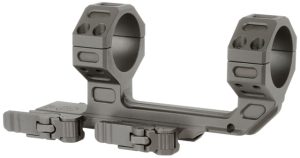

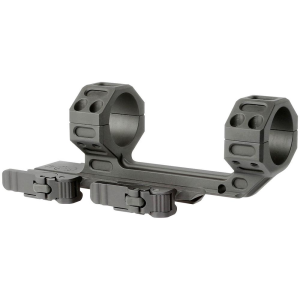
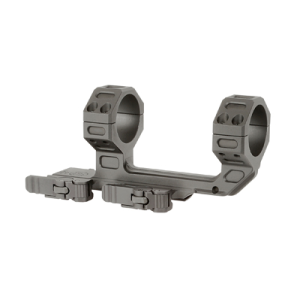
Best for: A rifle whose optic comes off, and anyone who wants the 1.93 inch height without Geissele money.
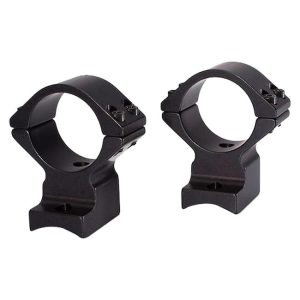
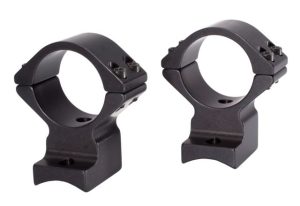
11. Talley Lightweight Alloy. Best Lightweight One-Piece
Pros
- Ring and base machined as one piece, so there is no base to come loose
- About $60, and it replaces both the rings and the bases you would otherwise buy
- Model-specific fits for Ruger, Weatherby, Remington and dozens more
- Talley publish a full torque table by ring type, 17 to 20 in-lb on these
- The lightest way to mount a scope on a mountain rifle
Cons
- Model-specific, so it fits one action and is worthless on the next rifle
- No windage or elevation adjustment of any kind
- Base screw torque depends on your receiver, so Talley cannot give you one number
The Talley Lightweight is a different idea from everything else here: the ring and the base are one piece of alloy, screwed straight to the receiver. There is no rail, no separate base and therefore no joint between base and ring to work loose. It is the lightest way to put a scope on a hunting rifle and at about $60 it replaces two purchases with one. Pair it with something from our best rifle scopes guide and the whole optic package stays light.
Talley are also the best documented brand in this guide on torque. They publish a full table by ring type: 17 to 20 in-lb on the Lightweight ring screws, 30 in-lb bottom and 20 in-lb top on their steel fixed rings, 20 in-lb caps and 65 in-lb locking nut on their Tactical rings. They also state plainly that all of those are dry torque, and warn that Loctite acts as a lubricant so the real clamping force ends up much higher than the wrench reading. They recommend blue threadlocker on receiver screws and against it on ring screws.
The catch is the whole design. Because it is machined for one action, a Talley mount for a Ruger 10/22 is scrap on a Weatherby Mark V. Check the fit against your exact model before ordering, and accept that if you sell the rifle the mount goes with it. Talley also cannot give a receiver screw torque, because that depends on your action, so check with the rifle maker.
Best for: A mountain rifle where every ounce counts and the scope is never coming off.
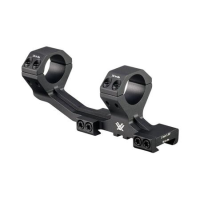
12. Vortex Sport Cantilever. Best Budget Mount
Pros
- From about $50, the cheapest way onto a flat-top AR in this guide
- Sold in absolute co-witness and lower one-third heights, so you pick the sight picture
- A 3 inch offset cantilever version for scopes that need to sit well forward
- 1 inch and 30 mm, which covers the LPVOs most people actually own
- Vortex VIP warranty even at this price
Cons
- Heights are quoted in millimeters, 37 mm and 40 mm, while the rest of the AR world uses inches
- Aluminum at a price point where it is not the 7075 of the premium mounts
- No quick-detach and no cant
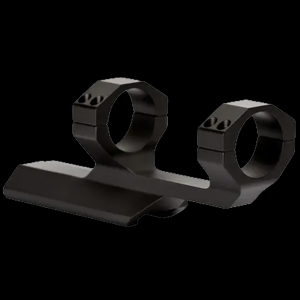
The Sport Cantilever is how you get an LPVO onto a flat-top without spending more on the mount than the optic. It starts around $50 for a single cantilever ring and runs to about $140 for the full Picatinny mount, and it comes in 1 inch and 30 mm, which is what most people’s glass actually is.
Vortex sell it in two named sight pictures rather than by ring height: absolute co-witness at 37 mm and lower one-third co-witness at 40 mm, plus a 3 inch offset version at 1.59 inch for scopes that need to sit further forward. Absolute puts your iron sights dead center in the optic; lower one-third parks them at the bottom of the glass and gives a more comfortable head position. That choice matters more day to day than any material spec on this page.
Note what Vortex have done with the units, though, because it is a small trap. They quote 37 mm and 40 mm where the whole AR market talks in inches, and those convert to 1.46 inch and 1.57 inch. So the lower one-third Sport sits between the 1.5 inch Leupold and the 1.55 inch Midwest, and nowhere near a 1.93. If you are trying to match a height you already like on another rifle, do the conversion first.
Best for: A first LPVO build, or any AR where the mount budget is what is left over.
Every Published Torque Spec, Side by Side
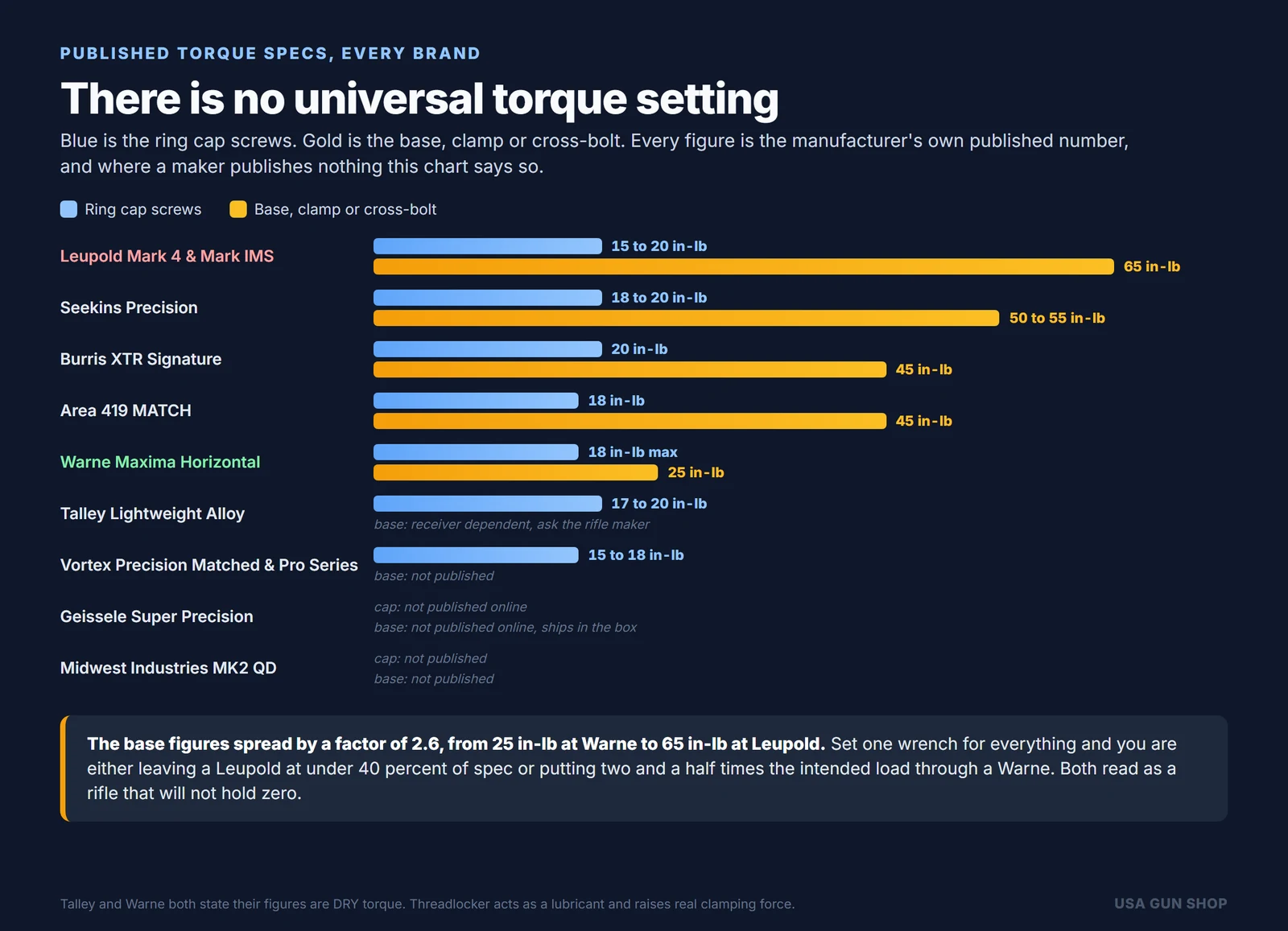
More scopes are ruined by a torque wrench than by recoil, and the best scope rings in the world will not save you from the wrong setting. Over-tighten a ring cap and you dent the tube and bind the erector; under-tighten a base and the whole thing walks under recoil and you blame the scope. Every manufacturer publishes numbers for this, and almost nobody puts them next to each other, because when you do it becomes obvious they are not interchangeable.
Here is every figure we could source from the maker itself, and an honest blank where we could not.
| Model | Ring cap screws | Base, clamp or cross-bolt | Source |
|---|---|---|---|
| Vortex Precision Matched and Pro Series | 15 to 18 in-lb | not published | vortexoptics.com |
| Burris XTR Signature | 20 in-lb | 45 in-lb cross-bolts | Burris support |
| Seekins Precision | 18 to 20 in-lb | 50 to 55 in-lb | seekinsprecision.com |
| Area 419 MATCH | 18 in-lb | 45 in-lb to the rail | area419.com |
| Leupold Mark 4 and Mark IMS | 15 to 20 in-lb | 65 in-lb | Leupold |
| Warne Maxima Horizontal | 18 in-lb maximum | 25 in-lb | warnescopemounts.com |
| Talley Lightweight Alloy | 17 to 20 in-lb | receiver dependent | talleymanufacturing.com |
| Geissele Super Precision | not published online | not published online | ships in the box |
| Midwest Industries MK2 QD | not published | not published | midwestindustriesinc.com |
The base figures spread by a factor of 2.6. Warne want 25 in-lb on the clamp. Leupold want 65. If you set a wrench once and mount everything with it, you are either leaving a Leupold mount at under 40 percent of its specified clamping force or trying to put two and a half times the intended load through a Warne. Both of those show up as a rifle that will not hold zero, and both get blamed on the optic.
The cap figures look close and are not. Fifteen to twenty in-lb is only a five point spread, but Burris specify 20 at the top of the range for their inserts to seat properly and Vortex cap out at 18 for a bare aluminum bore. Using the Burris number on Vortex rings is a 10 percent overtorque on a scope tube, and scope tubes are thin.
Two brands here publish nothing at all. Geissele’s documentation is not publicly reachable and Midwest simply do not list a figure, which on a $335 mount and a $245 mount respectively is a strange gap. Both ship the number in the box. Do not throw the paper away.
One more thing every table like this leaves out. Talley and Warne both state their figures are dry torque, and Talley go further: any liquid on the threads, threadlocker included, acts as a lubricant, lowers the friction and means the actual clamping force ends up much higher than your wrench reading. Talley recommend blue threadlocker on receiver screws and specifically advise against it on ring screws. Warne say the same, more bluntly: dry threads, no compound.
Why Low, Medium and High Mean Nothing Across Brands
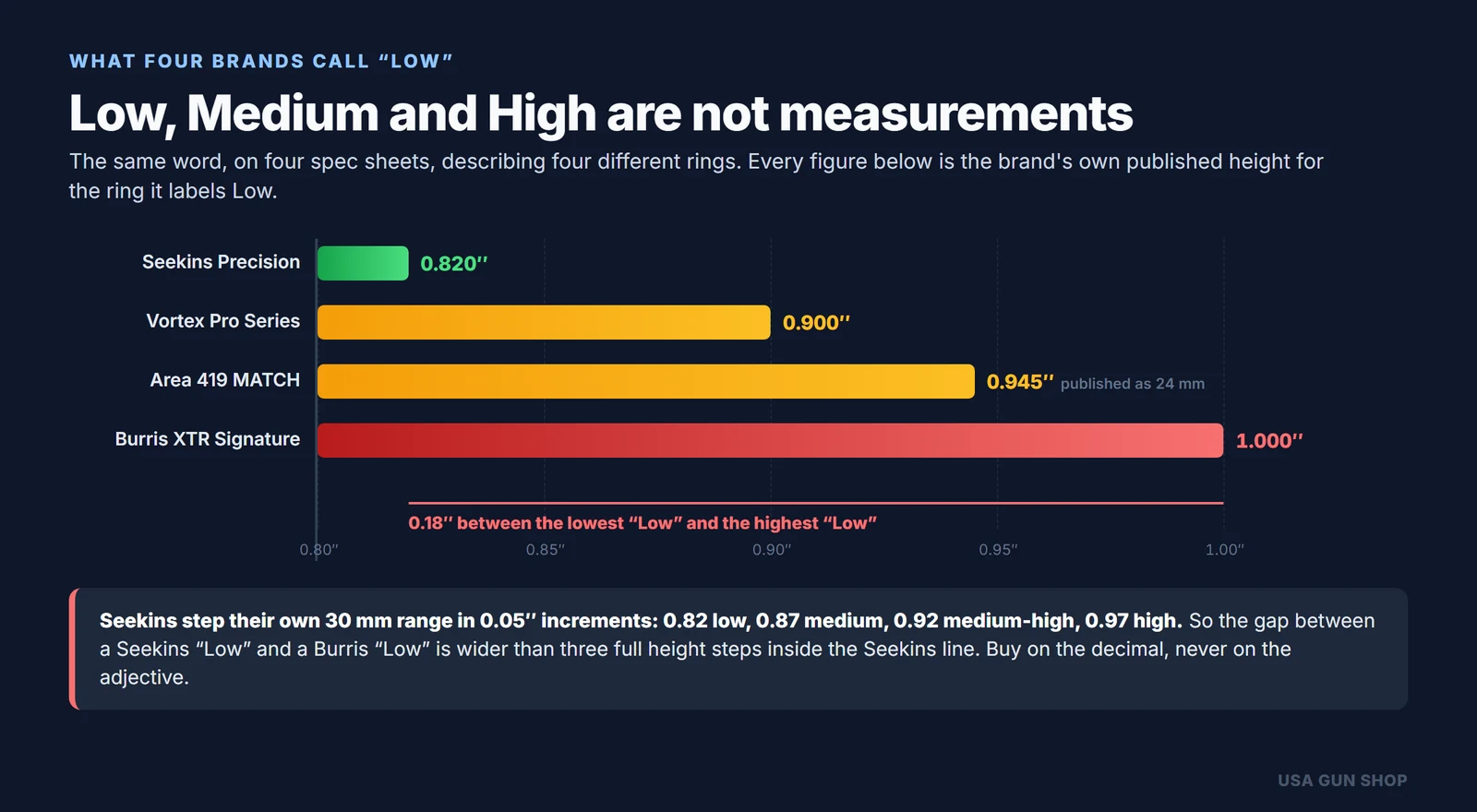
Ring height is the specification people get wrong most often when shopping for the best scope rings, and the industry does not help. Every brand sells rings called Low, Medium and High, and no two brands mean the same thing by any of those words. Here is what “Low” actually measures at four of the brands in this guide.
| Brand | What they call Low | In inches | How they publish it |
|---|---|---|---|
| Seekins Precision | 0.82 in | 0.820 | inches |
| Vortex Precision Matched and Pro Series | 0.90 in | 0.900 | inches |
| Area 419 MATCH | 24 mm | 0.945 | millimeters |
| Burris XTR Signature | 1 in (lowest offered) | 1.000 | inches |
That is a 0.18 inch spread on one word. To put it in perspective, Seekins step their own 30 mm range in increments of 0.05 inch, from 0.82 low to 0.87 medium to 0.92 medium-high to 0.97 high. So the gap between a Seekins “Low” and a Burris “Low” is bigger than three full height steps inside the Seekins line. Ordering by the adjective rather than the number is how you end up with an objective bell resting on the barrel.
Area 419 publish in millimeters across the whole line, at Low 24, Medium 28, High 32 and X-High 39, which convert to 0.945, 1.102, 1.260 and 1.535 inches. Vortex do the same thing on the Sport Cantilever mount, quoting 37 mm and 40 mm co-witness heights in a market that otherwise speaks inches. Neither is wrong. Both will catch you if you compare a number to a number without checking the unit.
The practical rule is simple: buy on the decimal, never on the adjective. Work out the height you need from your objective bell, convert everything to one unit, and then find whichever brand’s product happens to be that number. The word on the box is marketing.
AR Mount Heights, and What Each One Is For
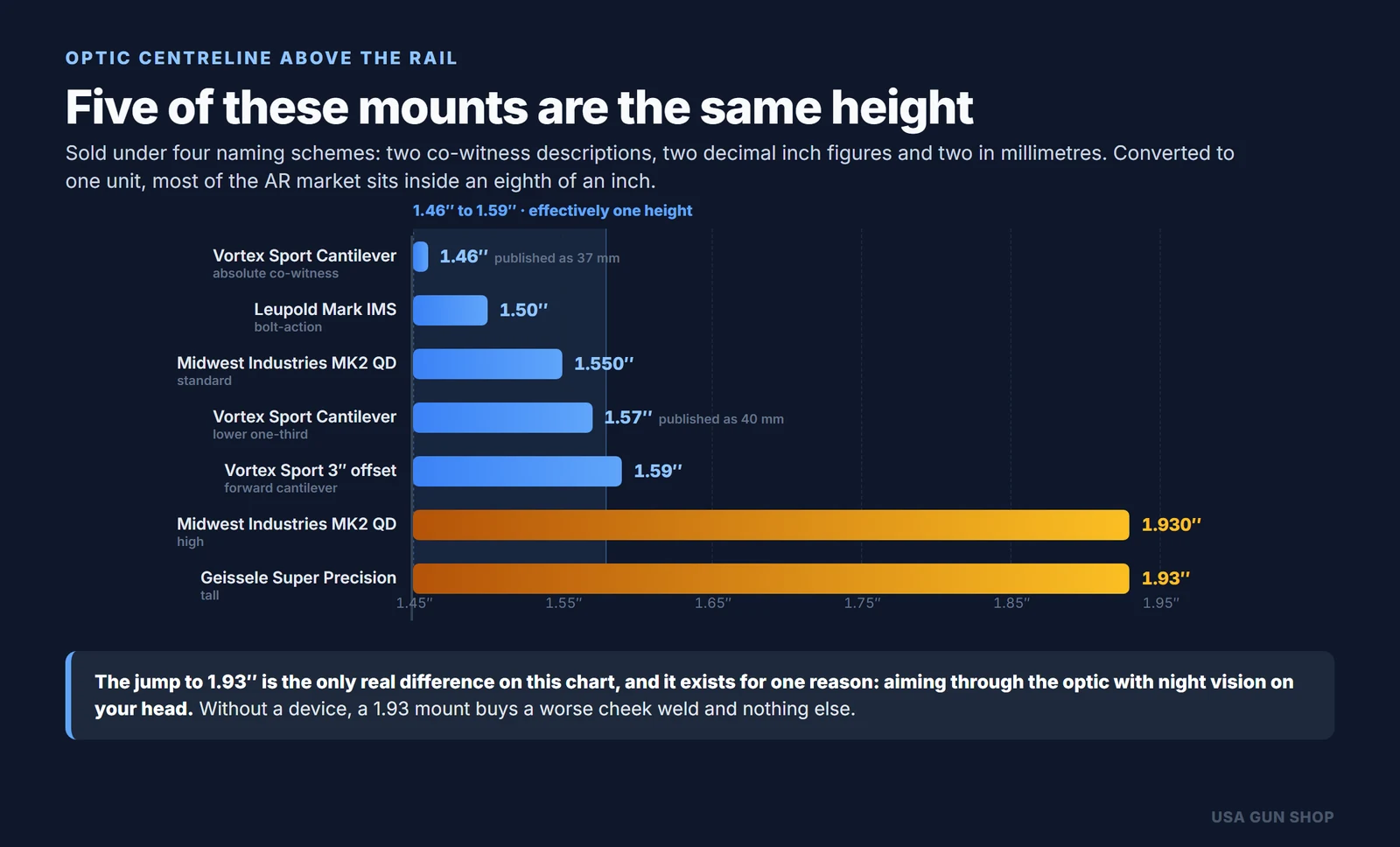
On an AR the number that matters is not ring height, it is how far the optic’s centreline sits above the rail. That decides your cheek weld, whether your iron sights appear in the glass, and whether you can aim under a night vision device. Very few makers state it in plain inches. These do.
| Mount | Centreline above rail | What that height is for |
|---|---|---|
| Vortex Sport Cantilever, absolute co-witness | 37 mm (1.46 in) | Irons sit dead center in the optic |
| Leupold Mark IMS, bolt-action | 1.50 in | Conventional stock, no rail stacking |
| Midwest Industries MK2 QD standard | 1.550 in | Lower one-third, comfortable cheek weld |
| Vortex Sport Cantilever, lower one-third | 40 mm (1.57 in) | Irons at the bottom of the glass |
| Vortex Sport 3 inch offset | 1.59 in | Scopes needing to sit well forward |
| Midwest Industries MK2 QD high | 1.930 in | Passive aiming under night vision |
| Geissele Super Precision high | 1.93 in | Passive aiming under night vision |
Read the middle of that table. Five of these seven mounts land between 1.46 and 1.59 inches, a spread of about an eighth of an inch, and they are sold under four different naming schemes: two co-witness descriptions, two decimal inch figures and two millimeter figures. They are, for practical purposes, the same height. The marketing suggests otherwise.
Then there is the jump to 1.93 inches, and that one is real. It exists so you can aim through the optic with a night vision device on your head, which needs the sight line raised above where a helmet-mounted tube sits. If you do not run night vision, a 1.93 mount buys you a worse cheek weld and nothing else. Buy the tall mount for the reason it was designed, or do not buy it.
How to Choose the Best Scope Rings or Mount
The mount is the cheapest part of the system and the one most likely to be blamed on something else when it fails. If you are still choosing the glass, our best rifle scopes guide comes first. Everything below is the order the decisions actually matter in.
Rings or a one-piece mount
On a bolt gun with a rail or bases, two-piece rings are lighter, cheaper and easier to position for eye relief. On a flat-top AR you almost always want a one-piece cantilever, because the scope has to sit forward of the receiver to give you eye relief and a cantilever is the only way to get it there without hanging a ring off the end of the rail. A one-piece also removes the possibility of the two rings being out of line with each other, which is the Geissele’s entire argument.
Match the tube diameter exactly
One inch, 30 mm, 34 mm, 35 mm and occasionally 36 mm. There is no adapting between them and no shimming. Check the scope’s specification, not the box it came in. Note that the Warne Maxima Horizontal in this guide has no 34 mm option, which rules it out for most modern long-range glass, while the Area 419 covers all the way to 36 mm.
Work out the height from the objective, then buy on the decimal
The best scope rings for your rifle are the ones tall enough that the objective bell clears the barrel and any iron sight, and no taller, because every extra fraction of an inch raises the sight line above the bore and worsens your cheek weld. Measure or look up the outer diameter of the objective bell, not the stated objective size, since the housing is always larger than the lens. Then, as the chart above shows, ignore the words Low, Medium and High entirely and buy the actual number.
Decide whether you need cant
A canted mount tips the scope down relative to the bore so that more of the turret’s travel is available for elevation at distance. Twenty MOA is the common figure, and it is standard kit on the glass in our best PRS scopes guide. You can get it three ways: a canted base, a canted one-piece like the Leupold Mark IMS, or the Burris XTR Signature’s Pos-Align inserts, which build in anything from 0 to 40 MOA. If your longest shot is inside 500 yards you do not need any of it, and cant will only cost you zero adjustment at close range.
Mounting interface: Picatinny, Weaver and proprietary
Picatinny slots are a defined width and spacing, Weaver slots are narrower and irregularly spaced. A Weaver ring will often sit on a Picatinny rail; a Picatinny ring with a recoil lug will not fit a Weaver base. The Seekins rings here use an integral center lug cut to the 1913 Picatinny standard, which indexes positively into a slot rather than relying on friction. Talley’s Lightweight mounts skip the whole question by screwing directly to the receiver, which is why they are model-specific.
Levelling, lapping and why alignment matters
A scope that is rotated relative to the rifle puts your elevation adjustments off vertical, so the further you shoot the more your point of impact drifts sideways. Level the rifle first, then the scope to the rifle, using a level on the turret cap and one on the rail, ideally with the rifle sitting in a bipod rather than your hands. Misaligned rings are the other half of the problem: they stress the tube and can bind the erector. Lapping fixes it mechanically, matched serialised rings like the Vortex Precision Matched and the Area 419 avoid it by manufacture, and the Burris Pos-Align inserts correct it without either.
Quick-detach, and whether you actually want it
QD levers let the optic come off without tools, which is genuinely useful if you swap between a scope and a red dot or travel with the optic separated. The cost is a lever that can be knocked, and a return to zero that is good but never quite as certain as a fixed mount. If the optic is never coming off, buy fixed and save the money and the worry.
How I Chose the Best Scope Rings and Mounts
Rings and mounts are almost impossible to rank on feel, because a good one and a bad one both look like a piece of black aluminum until something moves. So this guide is built on published specifications and on arithmetic anyone can repeat, and it says where each number came from.
Torque, height, weight, material and price figures come from the manufacturers themselves: the Seekins Precision scope ring page, Talley’s published torque table, Warne’s per-product mounting instructions, Area 419’s MATCH ring specification, Burris on the XTR Signature inserts, and Midwest Industries on the MK2 QD heights. Where a manufacturer publishes nothing, the tables above say so instead of borrowing a figure from a forum.
The comparisons are then arithmetic. The torque spread is one division. The height comparison is unit conversion, at 25.4 millimeters to the inch, applied to figures the makers publish themselves. Nothing in the charts above is an opinion.
The candidate list came from what the field currently recommends. We read the current expert round-ups for both precision rings and LPVO mounts, counted how many picks each carries, and noted which models appear on all of them. Stock was then checked against live retailer inventory, because a recommendation you cannot buy is not a recommendation, and that check removed two names this page used to carry.
Mistakes to Avoid When Buying Scope Rings and Mounts
Using one torque setting for everything. The base figures on this page run from 25 in-lb to 65 in-lb. There is no universal number and setting the wrench once will under-clamp half your rifles and over-clamp the other half.
Buying height by the adjective. Low means 0.82 inch at Seekins and 1.00 inch at Burris. Work out the number you need and order that.
Putting threadlocker on ring screws. Talley are explicit that it acts as a lubricant, so the same wrench reading produces a much higher real clamping force on the tube. Blue threadlocker belongs on receiver screws, not ring caps.
Buying a 1.93 inch mount because it looks serious. That height exists for passive aiming under night vision. Without a device on your head it is a worse cheek weld for no benefit.
Spending less on the mount than the scope deserves. A $60 ring set under a $2,000 scope is a false economy, and so is the reverse: $260 rings under a $300 hunting scope is money that should have gone into glass.
Ignoring the tube diameter until the parts arrive. There is no adapter between 30 mm and 34 mm. Check the scope specification before you order anything.
What We Removed From This Guide, and Why
The previous version of this page carried six picks. Two have been dropped.
The Scalarworks LEAP is gone because you cannot buy the thing this page was describing. Scalarworks make excellent mounts, but across our merchant inventory the LEAP line returns only red dot mounts for the EOTech and flip-to-side magnifier mounts, with no riflescope mount at all. Recommending a quick-detach scope mount and then linking to a magnifier mount is worse than recommending nothing. The Midwest Industries MK2 QD takes that slot because it is a real quick-detach scope mount our merchants actually stock.
The Burris Signature Zee is gone in favour of the Burris XTR Signature. They use the same Pos-Align insert idea, but the XTR is the version that appears on all three expert ring round-ups we checked, it is built on a Picatinny footprint rather than Weaver, and it offers the full 0 to 40 MOA insert range. The Zee remains a decent cheap way to get self-aligning inserts; it simply is not the one to recommend first.
Three models that the expert lists do recommend are also absent, and it is worth saying why. The Nightforce X-Treme Duty Ultralite and the Spuhr Unimount appear on every ring round-up we read, and both are carried by a single merchant in our inventory, with the Spuhr listings being Sako TRG specific at $495. The Badger Ordnance Condition One is the top pick on the LPVO lists and the only matching item in our inventory is a 45 degree J-arm accessory, not the mount. We do not list what we cannot price properly.
The Bottom Line: the Best Scope Rings to Buy
The best scope rings for most people are the Vortex Pro Series at around $80. They take the same 15 to 18 in-lb as the flagship Vortex rings, they come in every tube size that matters, and on a hunting or range rifle nothing about the $260 Precision Matched rings will show up on paper. Buy the Precision Matched instead when the scope is genuinely expensive and you want a matched serialised bore, because that is what the extra money is.
Spend differently for a specific reason. The Burris XTR Signature is the only set here that corrects alignment or adds up to 40 MOA of cant without a new base. The Seekins rings clamp at 50 to 55 in-lb, double most of this field, which is what a magnum wants. On an AR, the Geissele Super Precision is the mount that outlives the rifle and the Midwest MK2 QD is the one that comes off, publishes its heights honestly and costs a hundred dollars less.
And whatever you buy, look up its torque figures before the wrench comes out. On this page they run from 25 in-lb to 65 in-lb on the base alone, and the number that is right for one of these mounts will damage another.
Last updated August 24th 2026
What torque should scope rings be tightened to?
There is no universal figure and the published numbers are not close. Ring caps run 15 to 18 in-lb at Vortex, 17 to 20 at Talley, 18 at Area 419 and 20 at Burris. Base and clamp screws spread far wider: 25 in-lb at Warne, 45 at Burris and Area 419, 50 to 55 at Seekins and 65 at Leupold. Look up the figure for the specific rings in your hand, because a single wrench setting will under-clamp half of these and over-clamp the rest.
What are the best scope rings?
The Vortex Precision Matched Rings, which were the only model to appear on all three current expert round-ups we checked. They are serialised matched pairs bored to 0.0005 inch, in 1 inch through 35 mm, at $259.99 MSRP. If that is more than the job needs, the Vortex Pro Series does the same work for about $80 and takes the same 15 to 18 in-lb cap torque.
Do Low, Medium and High mean the same thing across brands?
No, and it is the most common mounting mistake. Seekins call 0.820 inch Low, Vortex call 0.900 inch Low, Area 419 call 24 mm Low, which is 0.945 inch, and the lowest Burris XTR Signature is 1.000 inch. That is a 0.18 inch spread on one word, wider than three full height steps inside the Seekins range. Work out the height you need and buy on the decimal.
Should I use rings or a one-piece cantilever mount?
On a bolt gun, two-piece rings are lighter, cheaper and easier to position for eye relief. On a flat-top AR you almost always want a one-piece cantilever, because the scope has to sit forward of the receiver to give eye relief. A one-piece also removes the possibility of two rings being out of line with each other, which is the whole argument for the Geissele Super Precision being machined from a single billet.
What is a 1.93 inch scope mount for?
Passive aiming under night vision. It raises the optic centreline high enough to see through with a helmet-mounted device in the way. Both the Geissele Super Precision and the high Midwest Industries MK2 QD offer it. Without night vision it buys you a worse cheek weld and nothing else, so the standard heights, which cluster between 1.46 and 1.59 inches across the whole market, are the ones most shooters want.
Which scope rings can correct alignment or add cant?
The Burris XTR Signature, which is the only set in this guide that can. Its Pos-Align inserts come in matched offset pairs and combine to build 0, 5, 10, 15, 20, 25, 30 or 40 MOA of cant into the rings without a canted base, and the same inserts correct left and right misalignment on a receiver that is not true. Because the inserts are polymer and wrap the tube, contact is total, so there are no ring marks.
Should you put threadlocker on scope ring screws?
Not on the ring caps. Talley state their torque figures are dry values and warn that any liquid on the threads, threadlocker included, acts as a lubricant, so the same wrench reading produces a much higher real clamping force on the scope tube. Warne say the same thing: dry threads, no compound. Talley do recommend blue threadlocker on receiver screws, which is a different joint.
How much should you spend on scope rings?
Match the mount to the optic rather than to a rule. Rings in this guide run from about $63 for the steel Warne Maxima Horizontal to $220 for the Area 419 MATCH, and mounts from $50 to about $400. A $60 ring set under a $2,000 scope is a false economy, and $260 rings under a $300 hunting scope is money that should have gone into glass.
Do you need to lap scope rings?
Only if they are not aligned to begin with. Matched serialised rings like the Vortex Precision Matched and the Area 419 MATCH are bored as a pair so alignment is handled in manufacture, and the Burris XTR Signature corrects it with inserts instead. Cheaper unmatched rings can benefit from lapping, though a lapping kit erases part of the saving that made them attractive.
4,021+ Gun & Ammo Deals
Updated daily from 200+ top retailers. Filter by category, caliber, action type, and price.
Related Guides