
Last updated March 28th 2026
Some of the links below are affiliate links, meaning at no additional cost to you, we may earn a commission if you click through and make a purchase.
- Treat every gun as loaded
- Point the muzzle in a safe direction
- Keep your finger off the trigger until you’re ready to shoot
- Know your target and what’s beyond

Can Your Floor Handle It? Probably.
This is one of the most common questions in gun safe forums, and the answer is almost always yes. But “almost always” isn’t the same as “definitely,” so let’s break down the actual engineering behind it. Most residential floors can handle a gun safe if you place it correctly.
The average second-floor room in a modern home is built to support 40 pounds per square foot of live load. That’s the standard building code (per the International Building Code). Older homes built before the 1970s might be 30 PSF. Either way, a 500-pound safe on a 4-square-foot footprint is only 125 PSF in that specific spot. That sounds like a problem. But it’s not that simple.
How Floor Load Capacity Actually Works
The 40 PSF rating is for distributed load across the entire room. A safe is a point load, which behaves differently. The weight transfers through the floor sheathing into the joists below. Two or three joists typically share the load, spreading it along their span.
Standard 2×10 floor joists spaced 16 inches on center can handle significant point loads, especially near a bearing wall. The key factors are joist size, spacing, span (distance between supports), and wood species. A 2×10 spanning 12 feet is much stronger than a 2×10 spanning 16 feet.
Think about it this way: a full bathtub with a person in it weighs 600-700 pounds, sits on a much smaller footprint than a gun safe, and nobody worries about bathtubs falling through the floor. Your 500-pound safe spread across a 2×3 foot base is less concentrated than bathwater.
Where to Place It on the Second Floor
Location matters more than the safe’s total weight. Place the safe against a load-bearing wall whenever possible. Load-bearing walls run perpendicular to the floor joists and transfer weight directly down to the foundation. This is the strongest spot on any floor.
Corner placement is even better. Two load-bearing walls meet at a corner, and the joists are shortest (strongest) near their support points. A 700-pound safe in a corner against a bearing wall is basically a non-issue structurally.
The worst spot? Dead center of the room, in the middle of a long joist span. That’s where joists are weakest and deflection is greatest. Avoid this. If your only option is mid-room, orient the safe so it spans across multiple joists rather than sitting on just one.
Weight Limits: When to Worry
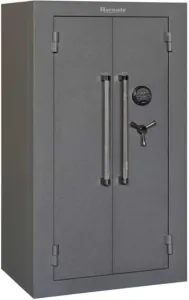
Safes under 600 pounds are almost never a problem on any standard second floor, regardless of placement. Just put it against a wall and don’t think about it. This covers most safes under $1,000 and many mid-range options.
Safes between 600-1,000 pounds should go against a load-bearing wall, ideally in a corner. If you can position the safe perpendicular to the joists so it spans across two or three, you’re distributing the load well. This is where most 24-gun safes fall.
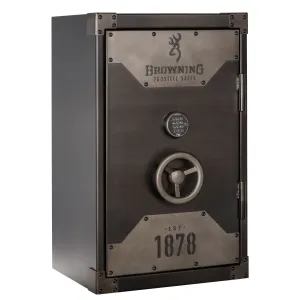
Safes over 1,000 pounds on a second floor? That’s when I’d recommend talking to a structural engineer. A quick consultation runs $200-400 and gives you a definitive answer. Some of the big Liberty and Browning units hit 1,200+ pounds. That’s a lot of weight for residential floor joists.
Reinforcing Your Floor (If Needed)
If an engineer says your floor needs help, the fix is usually straightforward. Adding a piece of 3/4-inch plywood under the safe distributes the weight across more joists. A contractor can also sister additional joists alongside the existing ones from the basement or first-floor ceiling below.
Steel jack posts in the basement or crawl space can support the joists directly under the safe location. This is the most common retrofit and costs $100-300 in materials. If you have access to the underside of the floor, it’s a weekend project.
Getting It Up There
The bigger challenge isn’t whether the floor can hold the safe. It’s getting a 500-pound steel box up a flight of stairs. Stairs are typically 36 inches wide, and most gun safes are 24-28 inches deep. It’ll fit, but barely.
Professional safe movers are the smart call here. They have stair-climbing dollies, straps, and experience. A second-floor delivery runs $200-$500 depending on the safe weight and number of stairs. Check out our how to move a gun safe guide for the full breakdown.
If you’re dead set on DIY, at least remove the door first. That can cut 30-40% of the weight. Use an appliance dolly with stair-climbing wheels, move slowly, and have at least two strong helpers. And please, for the love of your spine, don’t try to muscle a 600-pound safe up a staircase with just one buddy.
Lighter Alternatives for Upstairs
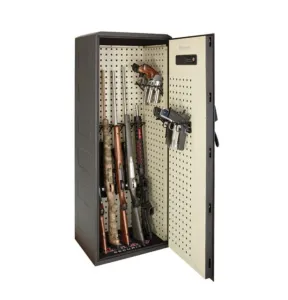
If the weight genuinely concerns you, there are options. A gun cabinet typically weighs 100-200 pounds, well within any floor’s capacity. You sacrifice security, but if second-floor placement is non-negotiable and weight is the limiting factor, it’s a compromise worth considering.
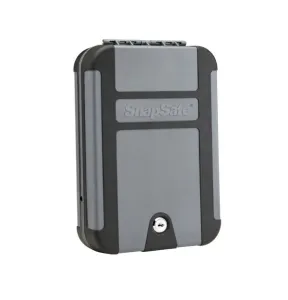
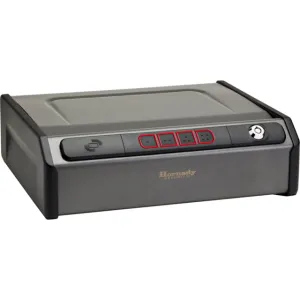
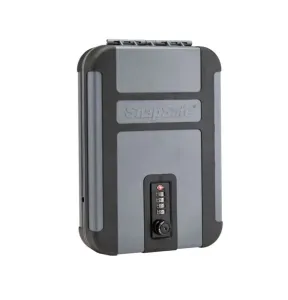
Wall-mounted safes transfer weight directly into the wall studs, bypassing the floor entirely. They’re smaller, but for a bedroom nightstand gun setup, they work great. And compact handgun safes weigh 20-50 pounds. Put them wherever you want.
The bottom line: your second floor can almost certainly handle a gun safe if you use common sense about placement. Stick it near a wall, ideally in a corner, and you’re good. For anything over 1,000 pounds, spend the $300 on an engineer’s opinion and sleep easy.
Shop Gun Safes
Best-scored accessories across 80+ retailers · Updated every 4 hours
FAQ: Gun Safe on Second Floor
Can my second floor support a gun safe?
Most modern second floors can support gun safes under 600 pounds without any modifications. Place the safe against a load-bearing wall, preferably in a corner, where floor joists are strongest.
How much weight can a second floor hold?
Standard residential second floors are rated for 40 pounds per square foot of distributed live load. Point loads from a gun safe transfer across multiple joists, so the actual capacity at any one spot is higher than the PSF rating suggests.
Where should I place a gun safe on the second floor?
Place it against a load-bearing wall, ideally in a corner where two walls meet. This is where floor joists are shortest and strongest. Avoid placing heavy safes in the center of a room over long joist spans.
Do I need to reinforce my floor for a gun safe?
For safes under 600 pounds on a standard floor, reinforcement is usually unnecessary. For safes over 1,000 pounds, consult a structural engineer. Common reinforcements include sistering joists and adding steel jack posts.
How do I get a heavy gun safe upstairs?
Professional safe movers with stair-climbing equipment charge 200-500 dollars for second-floor delivery. For DIY, remove the door first to reduce weight by 30-40 percent, use an appliance dolly, and recruit at least three helpers.
Is a bathtub heavier than a gun safe?
A full bathtub with a person weighs 600-700 pounds on a smaller footprint than most gun safes. If your floor supports a bathtub, it can likely support a similarly weighted gun safe placed near a wall.
What alternatives exist for second-floor gun storage?
Wall-mounted safes transfer weight to wall studs instead of the floor. Gun cabinets weigh 100-200 pounds. Compact handgun safes weigh 20-50 pounds. All are lighter alternatives for weight-sensitive second floors.
Should I bolt down a gun safe on the second floor?
Yes. Bolting down improves security and prevents the safe from tipping. On a second floor with a wood subfloor, use lag bolts into the floor joists. This also helps distribute the weight more evenly.
14,528+ Gun & Ammo Deals
Updated daily from 10+ top retailers. Filter by category, caliber, action type, and price.
Related Guides