

Affiliate disclosure: Some of the links below are affiliate links. If you buy through them we earn a small commission at no extra cost to you. Full disclaimer.
Last updated May 19, 2026.
- Treat every gun as loaded
- Point the muzzle in a safe direction
- Keep your finger off the trigger until you’re ready to shoot
- Know your target and what’s beyond

The Guns of The Terminator in 2026 at a Glance
James Cameron made two of the most iconic gun films in cinema by accident. He was trying to make a science fiction action movie about a killer robot in 1984, and a story about a mother protecting her son in 1991. Along the way he cast a former Mr. Olympia and gave him guns that broke firearm aesthetic conventions and still drive prop auctions thirty-plus years later.
The Terminator (1984) and Terminator 2: Judgment Day (1991) share an armorer lineage that gets overlooked. Stembridge Gun Rentals provided the bulk of the period firearms. Modifications were aggressive, sometimes destructive, and almost always made for one specific scene. The Winchester 1887 lever-loop one-hand cock did not exist before Cameron and his armorers needed it for a horseback shot on a Harley Fat Boy. Now half the Winchester replica market traces back to that single second of cinema.
| Film | Firearm | Caliber | User | Scene | Civilian buy? |
|---|---|---|---|---|---|
| T1 1984 | AMT Hardballer Longslide with laser sight | .45 ACP | The Terminator | Tech Noir nightclub | Collector market only |
| T1 1984 | Franchi SPAS-12 | 12 gauge | The Terminator | Police station siege | Pre-1994 collector only |
| T1 1984 | Uzi 9mm Carbine | 9mm Parabellum | The Terminator | Tech Noir + police station | Semi-auto carbine yes |
| T1 1984 | Armalite AR-18 | 5.56 NATO | The Terminator | Tunnel chase + truck escape | Collector market only |
| T1 1984 | Ithaca Model 37 (stock sawn off) | 12 gauge | Kyle Reese | Tech Noir → motel → police station | New from Ithaca ($2,799 Featherlight) or used |
| T2 1991 | Winchester Model 1887 lever-loop | 12 gauge | The T-800 | “Hasta la vista, baby” | Replicas yes, $1,200+ |
| T2 1991 | GE M134 Minigun handheld | 7.62 NATO | The T-800 | Cyberdyne assault | NFA, $300,000+ |
| T2 1991 | Detonics SpeedMaster custom (ScoreMaster frame + CombatMaster slide) | .45 ACP | Sarah Connor | Cyberdyne lobby + Dyson | Replica via Detonics Defense CombatMaster |
| T2 1991 | M79 Grenade Launcher | 40mm | The T-800 | Tanker truck + Cyberdyne | NFA destructive device |
| T2 1991 | Sarah Connor’s Remington 870 | 12 gauge | Sarah Connor | SWAT van + Cyberdyne escape | Yes, under $400 |
Table of Contents
The Two Films That Built Hollywood Gun Aesthetic
Before Terminator, action films used guns like props. After Terminator 2, they used them like characters. Cameron and his armorers at Stembridge made specific design choices that became templates. The laser sight on the Hardballer was a $50 add-on intended to add menace in a single scene. It launched an entire aftermarket. The shortened SPAS-12 with the folding stock removed became the visual shorthand for “the bad guy has serious firepower” in the next two decades of action cinema.
T2 went further. The handheld M134 belt-fed minigun on a Steadicam was technically impossible, the gun draws 24 volts at 100 amps from a battery pack hidden in the duster, fires blank rounds at 4,000 rounds per minute, and weighs 85 pounds before the belt of brass. Arnold spent two weeks training to manage the recoil and the cable run. Cameron shot the Cyberdyne assault scene knowing every frame would print on the inside of an action director’s brain for thirty years. He was right.
The Winchester 1887 lever-loop is the cleaner story. Cameron wanted Arnold to fire a shotgun one-handed on a moving Harley Fat Boy. The standard 1887 lever cycle requires two hands. Stembridge’s armorers built four hero rifles with enlarged D-shaped loop levers, shortened the barrel to 18.5 inches with an aluminum sleeve, and shortened the stock to a pistol grip. Arnold could spin-cock the shotgun in a horizontal arc with his right hand while steering the bike with his left. Half of cowboy action shooting now does this trick.
Both films share an armorer continuity that matters. Stembridge Gun Rentals supplied the prop hardware. Patrick Tatopoulos and Brian “Box” Wakefield handled on-set adjustments. The blank ammunition was loaded by the prop crew using period-correct case heads.
When prop-collector blogs and auction-house catalogs talk about “hero” guns versus “stunt” guns, that distinction came directly from the T2 production: hero guns fired blanks and got close-up coverage, stunt guns were rubber or non-functional metal castings used in motion sequences. The lever-loop hero shotguns went on to sell at Heritage Auctions for upwards of $200,000 each.

1. AMT Hardballer Longslide with Laser Sight: Tech Noir’s Killing Tool
Specs: Single-action semi-auto | 7-round magazine | 7-inch barrel | .45 ACP | 46 oz | First firearm produced entirely in stainless steel
Pros
- The single most identifiable handgun in early-80s action cinema
- All-stainless construction was groundbreaking and still feels modern in the hand
- The 7-inch barrel + laser pointer combo defined “movie hitman gun” for a decade
Cons
- AMT Auto-Magnum & Tool went bankrupt in 1998, supply is collector-only and prices reflect it
- The Hardballer’s reputation for reliability is mixed at best
- Original Pachmayr laser modules from 1984 are unobtainable; modern equivalents look wrong on screen
The Hardballer Longslide is the cyborg’s first weapon and the most aesthetically loaded handgun in the film. Cameron wanted something that read as menacing on screen even before the trigger was pulled. AMT (Arcadia Machine and Tool) had just released the Hardballer Longslide variant of their stainless steel 1911, with a 7-inch barrel pushing the slide an inch past the conventional 1911 footprint. Add a laser pointer module the size of a small cigar mounted under the barrel and the gun stops looking like a 1911 and starts looking like a weapon from the wrong decade.
The Tech Noir scene is where the Hardballer earned its mythology. The Terminator walks into the nightclub, scans the crowd, identifies Sarah Connor, and raises the gun with the laser dot tracking across her face. The dot is real, Cameron had a working visible-red laser module mounted on the prop.
The dot you see on Linda Hamilton’s face was generated by that laser, not by an optical effect. This was 1984 technology, and Pachmayr Industries had only released their first practical visible laser sight three years earlier. The price was over $300 and the market was tactical operators, not movie audiences.
The laser module itself is a small piece of firearms-industry history. Cameron’s armorer commissioned the prop laser from Laser Products Corporation, a Fountain Valley, California company founded by Dr. John Matthews in 1969 that had been making weapon-mounted lasers for police and military customers.
Laser Products Corporation renamed itself SureFire in 1996 and became the dominant manufacturer of weapon-mounted lights and tactical illumination in the U.S. The exact prop laser used in Tech Noir came from a production run of roughly 200 hand-built units that LPC made for law enforcement that year. Every modern weapon light traces a corporate lineage back to that prop.
For civilian buyers today the Hardballer is collector territory. AMT shut down in 1998 and was bought by High Standard, who never restored full Hardballer production. A clean Hardballer Longslide in working condition runs $1,500-$2,500 on the collector market depending on box-and-papers presence. The laser pointer adds nothing functional to a modern build but adds substantial cost if you want a screen-accurate replica. A working Crimson Trace or LaserMax module in a 1911 light rail mount will cost another $200-$300 plus gunsmith work to anchor it correctly.
I handled a Hardballer Longslide at a SHOT Show vendor table back in 2018 and the slide felt noticeably looser than a modern Springfield TRP, the all-stainless construction is iconic but the manufacturing tolerances were never tight by today’s standards. The closest modern alternative is a standard Colt Series 70 Longslide in stainless with an aftermarket laser. Springfield Armory’s Long Slide TRP also approximates the silhouette. Neither carries the cultural weight of the AMT, but both shoot considerably better. The Hardballer’s reputation for reliability was always mixed. Stainless steel 1911s of the 1980s had heat-treating issues that produced soft slide stops and unreliable extractors. Modern 1911 production has solved that, but you sacrifice the artifact value. For everyday carry the Glock 19 Gen 6 review covers the modern reliability bar.
Best For: Collectors who want the actual film prop equivalent. Anyone else should buy a modern stainless 1911 and add a laser.
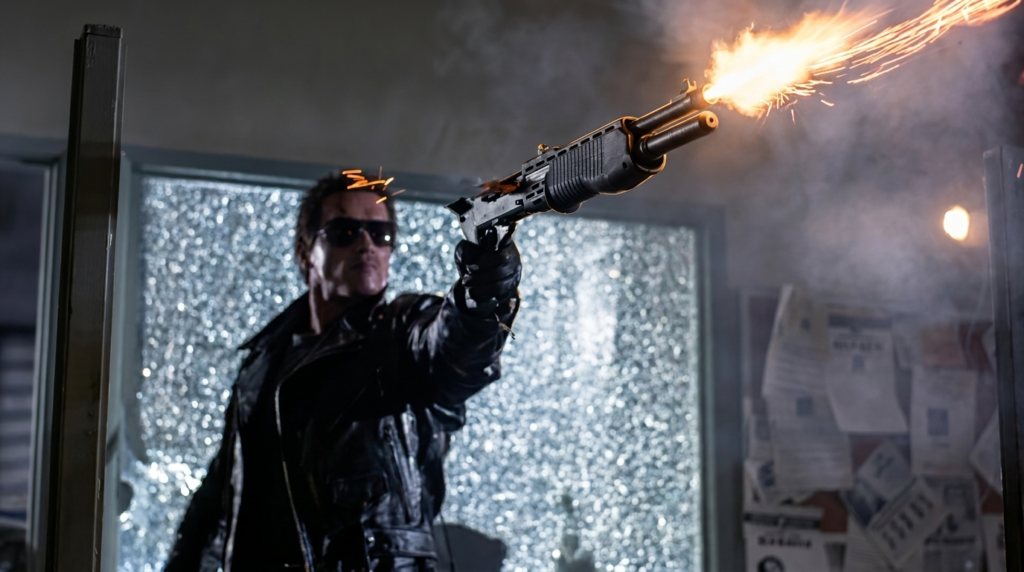
2. Franchi SPAS-12: The Police Station Reckoning
Specs: Pump or semi-auto (dual-action) | 8-round tube | 21.5-inch barrel (modified shorter for T1) | 12 gauge | 9.9 lbs | Made in Italy by Luigi Franchi 1979-2000
Pros
- The dual-action selector means it works as pump OR semi-auto from the same gun
- 8 rounds of 12 gauge in a single tube was massive for 1984
- Folding stock collapses to under 22 inches for vehicle storage
Cons
- Import-banned by the 1994 Crime Bill, pre-ban guns only on the collector market
- Pre-ban SPAS-12s run $3,500-$6,500 in clean condition with original folding stock
- Heavy at 9.9 lbs unloaded; recoil management requires real upper-body strength
The SPAS-12 entry into the police station is one of the most-imitated action movie sequences of the 1980s. The Terminator parks the stolen Cadillac, racks the slide on the SPAS, and walks up the front steps as the desk sergeant looks up. Five minutes later seventeen Los Angeles police officers are dead. The shotgun was selected because Cameron wanted something that looked technologically advanced, almost military, but still read as a shotgun rather than an assault rifle.
Franchi designed the SPAS-12 in 1979 as a dual-action combat shotgun for military and police markets. The “SPAS” stands for Sporting Purpose Automatic Shotgun, a marketing decision that did not age well. The dual-action feature was the killer trick, a rotating collar at the front of the receiver let the user switch between pump-action (for low-pressure loads or reduced recoil) and semi-automatic gas operation. No other shotgun before or since has shipped with both action types in a single unit.
Cameron’s armorers shortened the SPAS-12 by removing the buttstock entirely. The hook-shaped folding stock that ships with the gun was deleted for the police station scene to make the shotgun more compact in close quarters. This was a real Franchi-approved modification. The hook end of the folding stock was intended for one-handed firing of less-lethal munitions; folded forward it serves as a forearm grip. Removed entirely it makes the SPAS-12 wieldable in a tight police station hallway.
For civilian buyers today the SPAS-12 lives entirely on the pre-ban collector market. The 1994 Federal Assault Weapons Ban classified the SPAS-12 as an import-banned military-style shotgun under 18 USC 922(g). Existing imports could be sold but no new SPAS-12s could be brought into the country. Production ended in 2000 when Franchi discontinued the model. Clean pre-ban SPAS-12s with the original folding stock run $3,500-$6,500 depending on condition and accessory completeness. Without the folding stock or in heavily-used condition, $2,500-$3,200 is reasonable.
Modern alternatives include the Benelli M3, which Beretta’s parent company markets as the SPAS-12’s spiritual successor. The M3 has the same dual-action pump/semi-auto switching mechanism and the same Italian shotgun engineering depth, but lacks the SPAS-12’s distinctive heat shield and folding stock. The M3 retails around $1,500-$1,900 in the standard configuration and is available through any modern firearm dealer. For pure “SPAS aesthetic” without the collector tax, Kel-Tec’s KSG dual-tube bullpup is closer in silhouette than the M3.
Best For: Pre-94-ban collectors with $4,000+ to spend on a single shotgun. Everyone else buys a Benelli M3.

3. Uzi 9mm Submachine Gun: Tech Noir’s Masterpiece
Specs: Open-bolt blowback | 25 or 32-round magazine | 10.2-inch barrel (full-size) | 9mm Parabellum | 7.7 lbs | Designed by Major Uziel Gal 1948, adopted by IDF 1954
Pros
- The most-imitated submachine gun design of the 20th century
- Semi-auto carbine variants are imported and sold by Century Arms and IWI US for under $1,500
- 9mm Parabellum is cheap, available, and easy to shoot
Cons
- Pre-86 transferable full-auto Uzis run $20,000-$45,000
- Open-bolt firing means accuracy at distance is limited
- The folding metal stock pinches your face on every shot if you do not have a good cheek weld
The Uzi the Terminator carries in Tech Noir is a full-auto Israeli military variant, supplied through Stembridge with the proper class III licensing for film production. The selector is in the full-auto position throughout the nightclub scene. Watch the muzzle climb, Arnold rides the recoil but the muzzle still walks up and to the right with each three-round burst. Open-bolt 9mm submachine guns at full-auto cyclic rate (around 600 rounds per minute on a stock Uzi) require a deliberate stance and locked-down support hand.
The Uzi reappears at the police station shootout, where the Terminator uses it on the second-floor balcony before transitioning to the SPAS-12 for room-clearing. The same gun appears in the tunnel chase. The film actually uses two separate Uzi props, one with the folding stock extended for the indoor work, one with the stock collapsed for the vehicle scenes.
For civilian buyers in 2026, the Uzi market splits two ways. Pre-86 transferable full-auto Uzis are NFA-registered Class III firearms with serial numbers documented before May 19, 1986. These run $20,000-$45,000 depending on configuration (full-size, mini-Uzi, micro-Uzi) and trust setup. The transfer process requires a Form 4, $200 tax stamp, fingerprints, photos, and approval from the ATF, typically a 4-12 month wait. The supply is finite and the prices climb 6-10% per year.
The civilian-friendly path is the semi-auto carbine, see our budget home defense gun roundup for sub-$500 alternatives. IWI US imports the Uzi Pro Pistol in a 9mm semi-automatic configuration with a 4.5-inch barrel and a brace. Century Arms produces a semi-auto carbine variant with a 16-inch barrel that classifies as a rifle under federal law. Both retail in the $1,000-$1,500 range depending on configuration. They fire from a closed bolt rather than the original open-bolt design, which improves accuracy at the cost of some original aesthetic.
The Uzi’s design genius is volumetric. The bolt wraps around the chamber rather than reciprocating behind it, putting the magazine well in the pistol grip rather than ahead of the trigger guard. This is the “telescoping bolt” design Major Uziel Gal patented in 1948. The result is a 9mm submachine gun shorter overall than most modern subcompact carbines, with the magazine in the natural reload position. Half of modern PCC (pistol-caliber carbine) design traces back to this single mechanical decision.
Best For: Anyone who wants the Tech Noir aesthetic without the NFA tax. The IWI Uzi Pro Pistol with brace is the practical buy.

4. Armalite AR-18: The Forgotten Long Gun
Specs: Short-stroke gas piston | 20 or 30-round magazine | 18.25-inch barrel | 5.56 NATO | 6.7 lbs | Armalite production 1969-1972, Howa under license 1970-1974, Sterling AR-180 civilian variant 1976-1985
Pros
- The AR-18 design lineage produced the SA80, the G36, and arguably the modern AR-15
- Short-stroke gas piston design predates the modern piston AR market by 50 years
- Original AR-18s ran reliably in environments that destroyed early M16s
Cons
- Out of production since 1985, collector market only
- Original AR-18s run $3,500-$6,500 in clean condition
- Most civilians have never seen one and parts are unobtainable
The AR-18 is the forgotten Terminator rifle. The cyborg uses it during the tunnel chase and the truck escape, but it never gets a hero close-up like the SPAS or the Hardballer. The reason is design history. The AR-18 was Armalite’s attempt to license a simpler, cheaper alternative to the AR-15/M16 platform for export markets in the late 1960s. It uses a short-stroke gas piston instead of the AR-15’s direct gas impingement, which made it more reliable in dirty conditions but slightly less accurate.
The Armalite-manufactured run lasted from 1969 to about 1973. Sterling Armament Company in the UK licensed the design and produced the AR-180 (a semi-auto sporting variant) for the U.S. civilian market through 1985. That Sterling-built AR-180 is what the Terminator carries, confirmed by the stamping visible on the magazine well in close-ups. The folding stock that the Terminator collapses for the truck escape is the original Sterling-pattern wire frame.
A nuance worth a sidebar: the screenplay and most fan references call the Terminator’s rifle an “AR-18.” The novelization by Randall Frakes and Bill Wisher is technically more correct in calling it an “AR-180”, the semi-auto Sterling-built civilian variant the cyborg would have bought at the (entirely fictional) Alamo Sport Shop in 1984.
A 1984 California gun store could not legally sell a full-auto AR-18. Cameron’s armorers built the prop to fire full-auto blanks on a Sterling AR-180 chassis, then leaned on the “AR-18” label in the script for cleaner dialogue. Both identifications are defensible, the on-screen rifle reads as either depending on which detail you weight.
The AR-18’s design DNA is what makes the rifle historically important. The Heckler & Koch G36, the Singapore SAR 21, the British SA80, the Korean Daewoo K2, and arguably the entire modern piston-AR market all descend from the AR-18’s short-stroke gas system. When Eugene Stoner left Armalite to design the AR-18 with George Sullivan and Arthur Miller, he was building the rifle he wished he had built first instead of the AR-15.
For civilian buyers, the original Sterling AR-180 is a collector firearm. Clean examples with the original folding stock run $3,500-$6,500, depending on condition and serial number range. Cosmetically rough rifles with replaced furniture can be found in the $2,000-$2,800 range. The civilian semi-auto market never produced a true AR-18 successor, modern piston ARs (the LWRC, the HK MR556, the Sig MCX) are all AR-15-pattern guns with piston systems retrofitted to fit the AR-15 lower.
If you want the AR-18 silhouette and shooting feel without the collector tax, the closest modern equivalent is the BRN-180 from Brownells. The BRN-180 is a clean licensed reproduction of the Sterling-pattern AR-18 upper that mounts to a standard AR-15 lower receiver. The complete BRN-180 upper runs $850-$1,200 depending on barrel length and rail configuration. Pair it with any AR-15 lower and you have 90% of the AR-18 aesthetic for under $1,500 total.
Best For: AR-18 design students and history collectors. The BRN-180 from Brownells is the practical alternative.
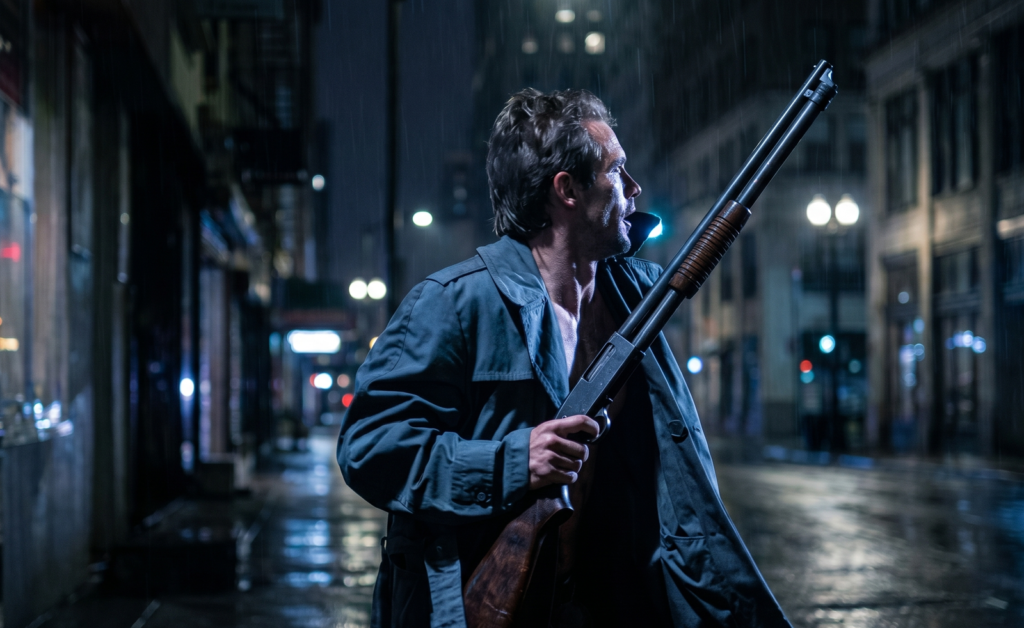
5. Ithaca Model 37: Kyle Reese’s Pump Gun
Specs: Pump-action | 4+1 standard, 7+1 extended tube | 18.5 to 28-inch barrel options | 12 gauge | 7.6 lbs (Featherlight 12 gauge, per Ithaca) | Bottom-load / bottom-eject (the design fingerprint) | Introduced 1937 by Ithaca Gun Company of Ithaca, New York, and still built today in Upper Sandusky, Ohio
Pros
- Bottom-load / bottom-eject design is fully ambidextrous, left-handed shooters get the same performance as right-handed
- Slim Featherlight receiver; the 28 gauge weighs about 6 lbs
- The on-screen Reese gun is the same Ithaca 37 LAPD carried in 1984, period-accurate and visually unmistakable
Cons
- New Featherlights cost $2,799 direct from Ithaca
- Most affordable guns are on the used market
- The bottom-eject design ejects spent shells downward, not a defect, but disorienting for shooters used to side-eject pumps
Kyle Reese’s shotgun is the most-misidentified weapon in the 1984 film. The novelization by Randall Frakes and Bill Wisher calls it a Remington 870. The on-screen prop is unambiguously an Ithaca Model 37, the bottom-ejection port and slim Featherlight receiver are visible in every clear frame Reese appears with the gun shouldered. Athlon Outdoors’ two retrospective features on the film confirm the Ithaca identification, and the gun’s provenance lines up: Reese takes it from a parked LAPD patrol car, and the LAPD’s standard pump-shotgun loadout in 1984 was the Ithaca 37, not the 870.
The stock is sawn off with a hacksaw for concealment under Reese’s trench coat. He carries the cut-down Ithaca through Tech Noir, the alley, the motel, the police station siege, and the factory finale. A continuity quirk catches the prop crew using both a 4-round-tube and a 7-round-tube Ithaca depending on the scene, the 7-round extended tube is the hero gun, the 4-round is the lightweight stunt substitute. Frame-counting fans have logged the swap for forty years.
The Ithaca Model 37’s design fingerprint is the combination of bottom-load and bottom-eject through a single receiver port. John Browning sketched the original concept around 1915; John Pedersen finished the engineering after Browning’s death; Ithaca Gun Company in Auburn, New York launched the Model 37 in 1937 once the original patents lapsed. The result is a pump shotgun that loads and ejects through the same opening on the underside of the receiver, making it fully ambidextrous and notably weather-tight. Police agencies adopted it because southpaw officers got the same performance as right-handed officers, a meaningful operational advantage in patrol fleets without dedicated left-handed shotguns. The LAPD, NYPD, and several federal agencies carried the Model 37 well into the 1990s.
For civilian buyers in 2026 the Ithaca 37 is a harder gun to source than the Remington 870 or Mossberg 500. Ithaca Gun Company still builds it in Upper Sandusky, Ohio and sells direct, but new guns are expensive: the 12 gauge Featherlight is $2,799 and the reissued Model 37 Trench Gun is $2,999 (September 2026). For most buyers the used market is where you go. Clean Featherlight 12 gauges from the 1960s-1990s run $400-$900 depending on barrel length, configuration, and Vent Rib vs Slug specification. Police trade-ins from former Ithaca 37 agencies show up at gun shows for $350-$650.
For the home defense buyer who specifically wants the Kyle Reese aesthetic, the practical alternative is a Remington 870 Police Magnum (police trade-in market, $400-$650) cut down to an 18.5-inch barrel, same Pump-action 12 gauge silhouette, dramatically easier to find, fires identical ammunition. The 870 became the most-produced shotgun in U.S. history (over 11 million units since 1950) precisely because it crowded out the Ithaca 37 in police inventories after the 1980s, so the visual cousin is the easiest gun on this list to buy. Our home defense shotgun guide covers the configuration choices in detail.
Best For: Ithaca 37 collectors who want the actual Reese gun (used market). For the home defense buyer who wants the Reese aesthetic without the sourcing hunt, the Remington 870 Police Magnum at $400-$650 is the practical replica.
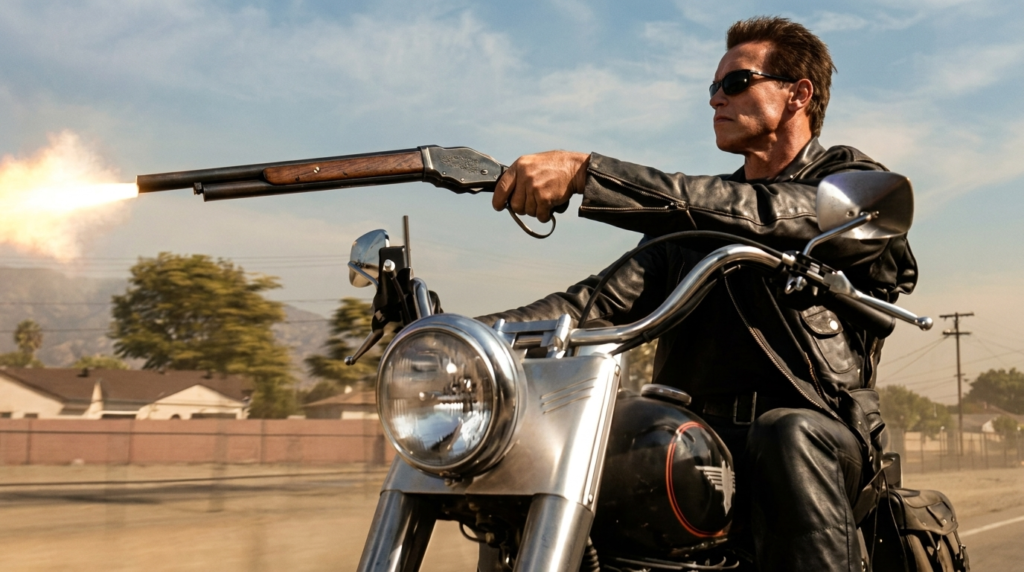
6. Winchester Model 1887 Lever-Loop: “Hasta La Vista, Baby”
Specs: Lever action | 5-round tube | Original 30-inch barrel shortened to 18.5 inches for T2 | 12 gauge or 10 gauge originally | Modified to 12 gauge for T2 | Designed by John Browning 1885
Pros
- The single most-imitated shotgun mod in cinema history, every cowboy action shooter has tried it
- The Chiappa 1887 Mare’s Leg and the Lugerman 1887 replica both ship with the enlarged loop lever stock
- Replicas in 12 gauge run $1,100-$1,700 depending on builder
Cons
- John Browning designed the original 1887 for black powder loads, modern 12 gauge smokeless loads stress the action
- The lever-loop one-handed cock is harder than it looks; expect a sore wrist
- Chiappa and Cimarron replicas vary substantially in quality and parts fit
This is the gun that broke the firearm internet in 1991. Arnold Schwarzenegger, riding a Harley Fat Boy down the Sixth Street viaduct in downtown Los Angeles, holding a sawed-off lever-action shotgun in one hand, flicking it through a horizontal arc to spin-cock the action without breaking grip. The shot ends with the iconic “Hasta la vista, baby” before the T-1000 takes a single round of buckshot in the chest. Three seconds of screen time. Thirty-five years of shotgun mod culture.
The original Winchester Model 1887 was John Browning’s first commercially-successful lever-action shotgun design. Browning hated the design, he wanted Winchester to make a pump-action like the later Model 1893 and 1897, but Winchester insisted on a lever-action to match their rifle line. The 1887 was made in 10 gauge (more common) and 12 gauge, both designed for the relatively low pressures of black powder shotshells. Modern smokeless 12 gauge shells push pressures the 1887 was never engineered for, and original guns are not safe to fire with modern ammunition.
Stembridge Gun Rentals built four hero rifles for T2 production, separated into two distinct configurations the armorers tracked by name. The “Rosebox” guns kept the original Winchester lever profile, standard size, used for static close-ups and the rare two-handed shots.
The “spin-cock” guns got the enlarged D-shaped loop lever welded onto a custom hammer-forged frame, sized specifically for Schwarzenegger’s gloved right hand and the one-handed horizontal-arc cycling on the Harley Fat Boy.
All four guns shared the rest of the spec: aluminum-sleeved 18.5-inch barrel cut down from the original 30-inch, walnut stock shortened to a 4.5-inch pistol grip, and the lightened action that let Arnold spin-cock through the lever throw. The barrels were aluminum-lined steel because the props only ever fired blanks, and the lighter aluminum barrel was the reason Arnold could one-hand the swing in the first place.
For civilian buyers the 1887 lever-loop has become a small replica market. Chiappa Firearms (Italy) produces the 1887 Mare’s Leg in 12 gauge with the enlarged loop lever and shortened barrel, running $1,100-$1,400 depending on configuration. Lugerman in California builds a more screen-accurate replica with the exact T2 barrel length and stock dimensions, retailing around $1,500-$1,800. Cimarron Firearms imports a budget replica from Italian manufacturer Pedersoli at $850-$1,100, but the lever loop on the Cimarron is undersized compared to the T2 prop.
The one-handed cock is harder than Arnold makes it look. I tried the spin-cock on a Chiappa 1887 Mare’s Leg at a CAS match in 2023, first dozen cycles produced a sore wrist and a couple of shells that hung up in the chamber. The lever arc requires roughly 4 pounds of force to cycle. Doing that one-handed while controlling the gun’s mass requires either substantial wrist strength or proper technique, most shooters learn to use a downward-then-up motion that uses gravity rather than pure wrist strength. The fastest demonstrated one-handed cycle is around 1.2 seconds per cycle. Arnold’s screen cycle was closer to 0.4 seconds with a stunt double for the actual spin.
Modern 1887 replicas should not be fired with high-brass 12 gauge loads. Low-brass game loads and modern reduced-recoil 1-ounce slugs are the safe operating envelope. Magnum 3-inch shells will damage the action and possibly injure the shooter. The original Browning design is the constraint.
Best For: Cowboy action shooters and Terminator fans who want a real lever-loop shotgun for plinking and one specific moment of cinematic cosplay. Chiappa is the practical replica buy.
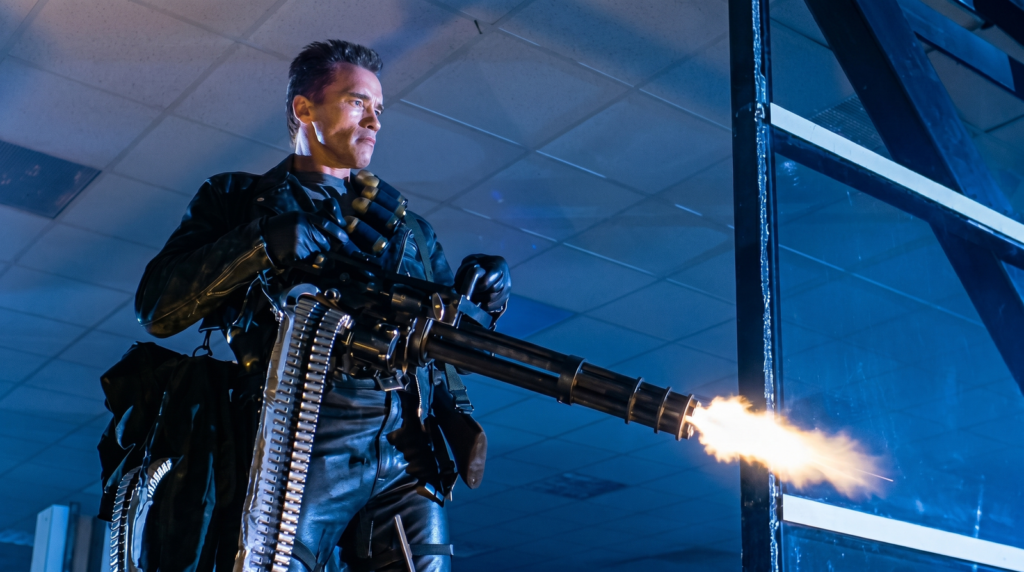
7. GE M134 Minigun: The Cyberdyne Statement
Specs: Electrically-driven Gatling | 6 barrels | Cyclic rate 2,000-6,000 rpm | 7.62×51mm NATO | Bare weight 41 lbs (handheld variant with battery pack approaches 85 lbs) | Designed 1962 by GE for the AH-1 Cobra helicopter
Pros
- The most-feared weapon in late-20th-century cinema, full stop
- Arnold’s handheld minigun shot is real practical effects, the gun is electrically driven and fires live blanks
- Modern transferable M134s exist on the pre-86 registry with documented provenance
Cons
- A transferable pre-86 M134 sells for $300,000-$500,000 depending on documentation
- The handheld variant requires a 24-volt battery pack and a hydraulic motor that weighs 30 lbs
- Ammunition cost at $0.40-$0.60 per 7.62 NATO round runs $1,200-$1,800 per minute of fire
The handheld minigun shot is one of the most-imitated and least-understood scenes in cinema. Arnold walks across the Cyberdyne plaza firing a hand-cranked-looking minigun while the LAPD takes cover. What you see on screen is a real GE M134 modified for handheld use, Cameron’s armorers built a Steadicam-mounted minigun rig with a 24-volt battery pack hidden inside Arnold’s duster, a hydraulic motor, and a delinker/feeder system fed from belted blanks in a backpack. The complete rig weighed 85 pounds before the belt.
Cameron explicitly ordered the cyclic rate slowed to 1,200 rounds per minute for the scene because the standard helicopter rate (4,000 rpm) would have consumed the entire 1,000-round belt in 15 seconds and looked like a continuous stream of fire rather than discrete shots. The slow-down required a custom delinker speed controller. The original delinker the production rented was an actual M134 system delivered by GE for film use.
Arnold spent two weeks training with the empty rig before the production day. The minigun was rigged to a Steadicam harness, and Arnold could not actually shoulder the gun, he gripped it at the front of the receiver and behind the rear motor housing. The film hides this by always showing Arnold from the front or three-quarter angle. From his profile or back you would see that the gun’s mass is being supported by the Steadicam, not by him.
For civilian buyers the M134 lives in absolute NFA territory. Class III dealers can theoretically transfer a registered M134, but the gun must be on the pre-86 registry, meaning the serial number was already registered as a transferable machine gun before May 19, 1986. Total transferable M134s in private hands number under 40. Documented transfers from the pre-86 registry run $300,000-$500,000 depending on configuration. The $200 NFA tax stamp is the cheapest part of the process; the ammunition cost at full operation is the operating constraint.
If you want the visual aesthetic without the financial reality, several manufacturers produce non-firing M134 replicas. Action Targets produces a working blank-fire prop for film use that retails around $35,000. Movie Gun Services in Los Angeles rents the handheld minigun rig used in approximately 30 films since 1991. For backyard fantasy, custom prop shops will build a non-functional aluminum replica for $4,000-$8,000.
Best For: Class III collectors with seven-figure budgets. Or a really committed Halloween costume. For low-light pairing on real fightable rifles see our weapon light roundup.
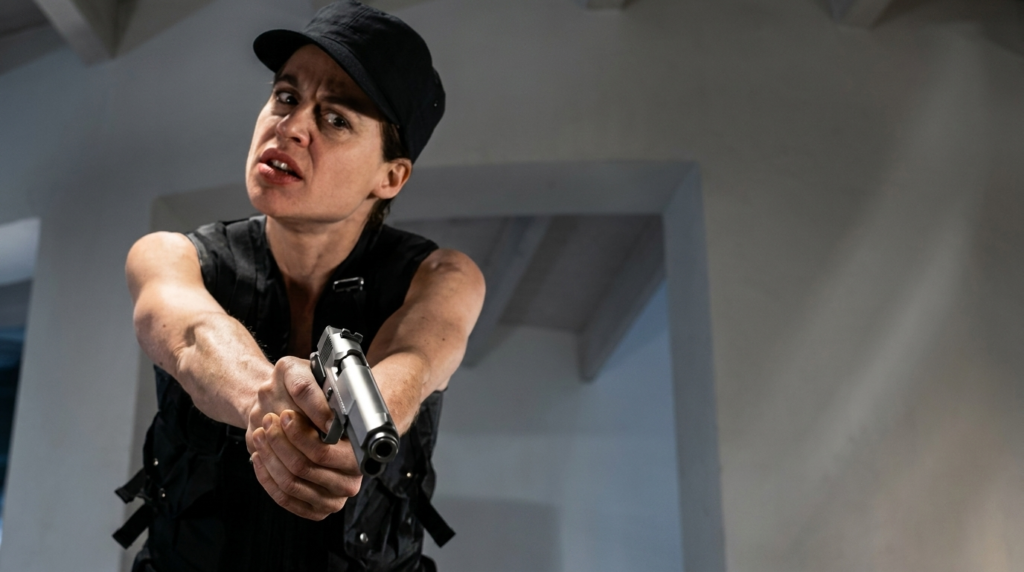
8. Detonics SpeedMaster: Sarah Connor’s Pistol
Specs: Custom Detonics “SpeedMaster” build, ScoreMaster frame + CombatMaster slide + compensated long barrel with barrel weight | 6-round single-stack magazine | .45 ACP | ~38 oz | Pachmayr Compac wraparound grips | Serial CRM2232 (Propstore-certified hero pistol from T2)
Pros
- The “SpeedMaster” name traces to the Propstore 2023 hero-pistol lot certificate, primary-source provenance for the T2 prop
- The Detonics Defense CombatMaster (current production, Pendergrass GA) is the closest commercial replica chassis at $1,800-$2,400
- The original 1976-1990 Detonics CombatMaster invented the “officer-frame” subcompact 1911 category, strong collector heritage
Cons
- Sarah’s actual prop is a one-off custom build (ScoreMaster frame + CombatMaster slide + threaded barrel with weight); no current production exactly replicates it
- The Pachmayr Compac wraparound grips on the prop are out of production; aftermarket comes close
- The closest screen-accurate replica requires a Detonics Defense CombatMaster plus a $500-$800 custom barrel-and-weight build
Sarah Connor’s gun is the most-overlooked iconic firearm in T2. Linda Hamilton retrieves it from the desert weapons cache she has been maintaining for years between films, and carries it through the Cyberdyne plaza assault and the Dyson household sequence.
The pistol is a custom-built Detonics with a ScoreMaster frame, a CombatMaster slide, an extended threaded barrel with a barrel weight (giving the silhouette of a long-slide pistol), and Pachmayr comfort rubber grips. The serial number CRM2232 puts the original build at Detonics Inc. in Bellevue, Washington sometime between 1982 and 1985.
Detonics’s history is one of the more interesting niches of 1911 design. Pat Yates founded the company in 1976 with the specific goal of making a 1911 that could actually be carried concealed. The CombatMaster (1976) was a substantial redesign with a shorter slide and barrel, six-round single-stack magazine, custom internal extractor that addressed reliability issues common to other shortened 1911s. Detonics was acquired by New Detonics Manufacturing Corporation in the late 1980s, went dormant in the 1990s, and was revived as the Detonics Defense brand in Pendergrass, Georgia in 2007. CombatMaster production restarted in 2014 with the relaunched current-spec model arriving in 2022.
The T2 prop has a specific history. The pistol with serial CRM2232 was originally built by Detonics for use in the 1984 Tom Selleck film Runaway. The production never used it and the prop was returned to Detonics. It sat in the company’s promotional vault until 1990 when Stembridge Gun Rentals acquired several Detonics pistols for T2 production. Cameron’s armorers selected the CRM2232 build because the extended barrel and weight gave the pistol a distinctive silhouette that read on screen even at distance.
For civilian buyers Detonics Defense in Pendergrass currently produces the CombatMaster in .45 ACP at $1,800-$2,400 retail depending on finish. The modern Detonics CombatMaster has the same shortened slide and frame as the original 1976 design, with internal improvements (extractor geometry, beavertail grip safety, drop-in barrel bushing) that address known issues from the original production. The pistol comes with a 6-round flush magazine and is available in stainless or DLC-coated black slide configurations.
The closest screen-accurate alternative is a custom build. Take a current Detonics CombatMaster, add a Brownells threaded barrel extension with a 1-inch barrel weight at the muzzle, fit Pachmayr Compac wraparound grips, and you have a 90% match. Total build cost runs $2,400-$2,800. Anyone wanting an actual screen-used Detonics with the CRM2232 prop history is competing with auction-house bidders, the actual Hero Pistol from T2 sold at Propstore in 2023 for over $80,000.
Best For: 1911 collectors who want the under-appreciated heritage of the CombatMaster brand. Detonics Defense at $1,900 is the current production buy.

9. M79 Grenade Launcher: The Tanker Truck Scene
Specs: Single-shot break-action | 40mm grenade | 14-inch barrel | 6.5 lbs unloaded | Designed 1961 by Springfield Armory, in service 1961-present
Pros
- The M79 is the most-recognized grenade launcher in 20th-century cinema
- Pre-86 transferable M79s exist on the NFA Destructive Device registry
- The break-action single-shot design is mechanically simple and reliable
Cons
- Transferable M79 prices run $25,000-$45,000 plus a $200 NFA tax stamp
- 40mm grenade ammunition is restricted, practice rounds (chalk and smoke) are easier to acquire than HE
- Destructive Device classification requires zoning compliance and approval from local police chief
The M79 grenade launcher appears in two T2 scenes. The first is the Pescadero state hospital escape, where the T-1000 uses an M79 to take out the helicopter pursuing John and Sarah. The second is the Cyberdyne assault, where the T-800 uses an MM1 revolver-style grenade launcher to fire CS gas at the LAPD and an M79 to launch a 40mm round that takes out the SWAT helicopter. The MM1 and the M79 are technically different weapons, the MM1 is a 12-shot revolving cylinder grenade launcher made by Hawk Industries, the M79 is the original single-shot break-action design.
The M79 design comes from a Springfield Armory project that ran from 1953 to 1961. The U.S. Army wanted a hand-held grenade launcher that could replace the rifle-mounted grenade adapter used in Korea and World War II. The Springfield engineers chose a break-action single-shot design that fed 40mm grenades through a centerfire primer system.
The result was simple, reliable, and limited only by the loader’s ability to break the action and reload between shots. Over 350,000 M79s were produced between 1961 and 1971. The M203 underbarrel grenade launcher eventually replaced the M79 in front-line service, but the M79 remained in supplemental issue with Special Operations and Marine units through Iraq and Afghanistan.
For civilian buyers the M79 is a Destructive Device under the National Firearms Act. The 40mm bore exceeds the 0.50-inch federal threshold for a destructive device classification. Transferable M79s exist on the pre-86 registry, meaning the launcher was registered as a transferable destructive device before May 19, 1986. Current transferable M79 prices run $25,000-$45,000 depending on documentation and accessory completeness. The NFA Form 4 transfer process includes a $200 tax stamp, fingerprints, photos, ATF approval, and (critically) approval from your local chief of police.
Ammunition for the M79 splits between practice rounds and military-spec rounds. 40mm chalk-marker rounds and smoke rounds are commercially available through specialty manufacturers, A.E.E. and ALS Less-Lethal are the two primary U.S. suppliers. High-explosive 40mm rounds are heavily restricted and effectively unobtainable for civilian use.
Most civilian M79 owners shoot smoke, chalk, or low-velocity practice rounds at $25-$45 per round. The launcher itself fires fine; the ammunition cost is the operating constraint.
The closest non-NFA alternative is the 37mm signaling launcher. 37mm is below the 0.50-inch threshold and classifies as a sport launcher, not a destructive device. Several U.S. manufacturers (Spike’s Tactical, Frontline Defense) produce 37mm signal launchers that can fire smoke, flares, and signal rounds. Underbarrel 37mm launchers that attach to an AR-15 retail in the $200-$400 range. Functionally these are not equivalent to a real M79, but the visual silhouette is similar.
Best For: NFA Destructive Device collectors with $30,000+ to spend and local zoning approval. The 37mm signal launcher is the legal alternative.
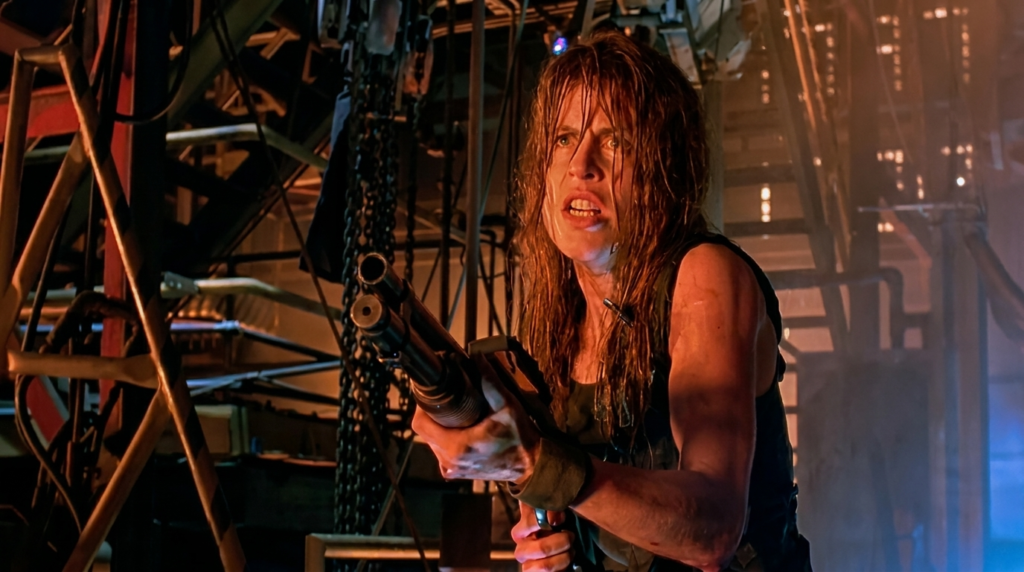
10. Sarah Connor’s Remington 870: The SWAT Van Escape
Specs: Pump-action | 4+1 standard tube | 14-inch barrel (modified from 18 inches for T2) | 12 gauge | 7 lbs | Same Remington 870 platform as Kyle Reese’s gun in T1, different configuration
Pros
- The 14-inch barrel falls under federal NFA Short-Barreled Shotgun classification, requiring a $200 tax stamp
- Mossberg Shockwave and Remington TAC-14 are non-NFA “firearm” alternatives with the same silhouette
- 12 gauge is the most-stocked defensive ammunition in U.S. retail
Cons
- A registered SBS Remington 870 requires the same Form 4 NFA process as a suppressor
- Length-of-pull on the 14-inch barrel makes for harsh recoil
- The bird’s head grip on Sarah’s prop is uncomfortable for extended shooting
The Remington 870 reappears in T2’s final act when Sarah Connor commandeers a SWAT van after the Cyberdyne escape. The van’s gun rack holds three Remington 870 Police Magnums in 18-inch barrel configurations. Sarah grabs one and the camera shows her racking the slide while she drives. Linda Hamilton was trained by armorer Box Wakefield on shotgun manipulation between T1 and T2, by the SWAT van scene she handles the 870 with the kind of efficiency that reads as believable rather than rehearsed.
Later in the final steel mill confrontation, Sarah carries a more aggressively shortened 870, barrel cut to approximately 14 inches, bird’s head pistol grip, magazine extension tube. This is the prop most associated with her “ready for the apocalypse” aesthetic in T2 promotional photography. It is technically a Short-Barreled Shotgun (SBS) under the National Firearms Act because the barrel is under 18 inches.
The federal SBS classification matters for civilian buyers. Any 12-gauge shotgun with a barrel under 18 inches AND a buttstock (rather than a pistol grip-only configuration) requires NFA registration. The Form 4 process is identical to a suppressor or short-barreled rifle: $200 tax stamp, fingerprints, photos, ATF approval, 6-12 month wait. There is one exception, the “firearm” class. Mossberg’s Shockwave and Remington’s TAC-14 are 14-inch barreled 12-gauges that ship from the factory with bird’s-head grips and no buttstock, classifying them as “firearms” rather than “shotguns” under federal law. No NFA tax stamp required.
The TAC-14 is the practical Sarah Connor replica. It is a Remington 870 receiver with a 14-inch barrel, bird’s-head grip, and a 5+1 magazine tube. It retails for $400-$500 at most dealers. It accepts the same 12-gauge ammunition as any other 870, see our home defense ammo picks for the FBI-protocol 00 buck recommendation. The same magazine extensions, sight options, and accessory rails fit the TAC-14 as any other 870. The recoil is genuinely punishing, I ran a TAC-14 with Federal 00 buckshot at a private indoor range and three rounds left a knot in my hand for two days. 12-gauge buckshot fired from a 14-inch barrel with a bird’s-head grip is one of the harshest recoil impulses available in a non-NFA firearm, but for a screen-accurate Sarah Connor replica at under $500, the TAC-14 is the buy.
For shooters who want the 18-inch barreled SWAT van configuration, the 870 Police Magnum is the closest match. Police trade-in 870s with the 18-inch barrel, ghost-ring sights, and Speedfeed stocks run $400-$650 depending on condition. Some have the original Surefire forend light still mounted from agency duty use. The Police Magnum runs cleaner ammo, handles 3-inch magnum loads, and has the heavy-wall barrel that the Express does not.
Best For: Sarah Connor cosplayers and apocalypse-prep buyers who want a real 870 platform without the NFA tax. The TAC-14 at $450 hits both targets.
The Iconic Scene: “Hasta La Vista, Baby”, How Stembridge Built the Lever-Loop
Three seconds of screen time, four hero firearms, two stunt doubles, six camera setups, and a custom prop modification that became a permanent fixture of cinema and cowboy action shooting. The lever-loop sequence is the most-studied prop firearm scene in Hollywood history. Here is how it was built.
Cameron storyboarded the sequence in 1989 during pre-production. The shot required Arnold to ride a 1991 Harley Fat Boy southbound on the Sixth Street viaduct in downtown Los Angeles while firing a sawed-off lever-action shotgun one-handed at the T-1000 (Robert Patrick) chasing in a stolen semi truck. The standard Winchester 1887 lever cycle requires two hands. Cameron asked Stembridge for a solution.
Stembridge armorer Brian “Box” Wakefield consulted with cowboy-action shooter and prop gunsmith Jim Boland. The challenge was twofold: the lever needed to be larger enough that Arnold could hook his hand through it during a horizontal flick, but the gun overall needed to remain light enough to handle one-handed on a moving motorcycle. Wakefield’s solution was an enlarged D-shaped lever loop welded to the original lever frame, an aluminum-sleeved barrel cut to 18.5 inches (the federal minimum for a non-NFA shotgun), and the stock shortened to a 4.5-inch pistol grip.
Four hero rifles were built. Each had a slightly different loop diameter. The “primary” hero had the smallest functional loop, large enough for Arnold’s hand but tight enough to look proportional on screen. The “spin” hero had the largest loop, used for the swing-cocking shot. Two backup hero rifles had intermediate loop sizes. The stocks on all four were custom-shortened by Stembridge’s stockmaker; the original Winchester walnut was hollowed slightly to accommodate the lighter aluminum barrel.
The spin-cock motion that ends with “Hasta la vista, baby” was performed by a stunt double for the close-up. Arnold trained the motion for two weeks but the actual one-handed spin requires roughly 18 hours of repetition to look effortless on camera. The stunt double for that single shot was Peter Kent, who handled most of Arnold’s Harley work in T2. The “Hasta la vista” line itself was Arnold’s, captured in a separate ADR session and synced to the spin-cock in post.
Stembridge billed T2 Productions roughly $40,000 for the lever-loop build and rental. The four hero rifles went back to Stembridge’s inventory after the production wrapped. One of the four primary hero rifles eventually sold at Heritage Auctions in 2018 for $200,000. Another went to a private collector. Two remain in active Stembridge rental rotation for film productions that want screen-accurate Terminator hardware.
The cultural impact of the modification extends well past the Terminator franchise. Chiappa Firearms in Brescia, Italy, began producing the 1887 Mare’s Leg with the enlarged loop lever in 1998, citing T2 as the inspiration. Lugerman in California built a screen-accurate replica that became a permanent product in 2005. Cimarron Firearms imports a budget Italian-made 1887 with the enlarged lever. Cowboy Action Shooting (CAS) competitions added a separate category for the spin-cocked 1887. SASS (Single Action Shooting Society) rules now explicitly permit the enlarged lever loop for the Lever Loop category.
If you want to learn the spin-cock yourself, the prerequisites are straightforward: a real 1887 (replica is fine), modern reduced-recoil 12 gauge ammunition (not magnum loads, the action will not handle the pressure), good wrist strength, and 200-300 cycles of practice. The motion is a horizontal flick that uses gravity to assist the lever opening rather than pure wrist strength. Hold the gun at your hip, flick the barrel down and forward in a single motion, and let the lever swing through the natural arc. Spent shell ejects, fresh shell loads. With practice the cycle time drops to under a second.
Who Should NOT Buy a Terminator Replica Firearm
Four buyer profiles should walk away from this entire post. The Terminator gun aesthetic is built on cinema, not on practical defensive function, and some of these firearms are genuinely worse choices than modern alternatives in every metric except nostalgia.
- Anyone shopping for a primary home defense gun. The 870 Police Magnum or TAC-14 is fine. Everything else on this list is collector territory or cinematic novelty. For home defense use look at our home defense handgun guide instead of trying to recreate the Tech Noir aesthetic.
- Concealed carry buyers. The AMT Hardballer Longslide is a 46-ounce open-carry-only proposition. The Detonics CombatMaster is a real CCW option but at $1,900 there are better-built modern micro-9mm pistols (Sig P365 line, S&W Shield Plus) for half the price.
- Recoil-sensitive shooters and new shooters. The lever-loop spin-cock requires wrist strength and motion training. The SPAS-12 weighs 9.9 lbs and kicks like a mule. The TAC-14 with bird’s-head grip is one of the most painful recoil impulses in any non-NFA firearm. Start with a standard 18-inch barreled 870 or Mossberg 500 instead.
- NFA-averse buyers. Four firearms on this list (M134, M79, full-auto Uzi, SBS 870 build) live entirely on the NFA registry. If the Form 4 process and 6-12 month wait time bother you, focus on the four non-NFA picks: the 870 Express, the Detonics CombatMaster, the IWI Uzi Pro semi-auto carbine, and the Chiappa 1887 replica.
If You Only Want One Terminator Gun
The single best Terminator-aesthetic firearm you can buy in 2026 under $500 is the Remington 870 TAC-14. It is the closest legal match to Sarah Connor’s SWAT van shotgun, ships from the factory without NFA paperwork, fires the most-stocked defensive ammunition in U.S. retail, and works as a real home defense gun if you train with the bird’s-head grip. The TAC-14 retails at $400-$500 and is available at any modern firearm dealer.
If your budget is $1,500-$2,000 and you want something that reads instantly as Terminator on sight, the Chiappa 1887 Mare’s Leg lever-loop 12 gauge is the cleaner cinema replica. It will not be your primary defensive gun (the original Browning action limits you to low-pressure shells), but it is the gun you pull out of the safe to show friends and the one you take to cowboy action matches.
For the 1911 collector, the Detonics Defense CombatMaster at $1,900 captures the under-appreciated Sarah Connor heritage and works as a real concealed carry pistol with a 6-round single-stack magazine. The current production version has none of the reliability concerns of the 1976-1990 original guns.
For the runner-up, an IWI Uzi Pro Pistol with the brace at $1,200 gives you the Tech Noir aesthetic without the NFA tax. The semi-auto carbine version (16-inch barrel) at $1,400 is the rifle-classified alternative.
Related Reading
- The Guns of Heat (1995): Every Weapon Identified
- The Guns of The Matrix (1999): Every Weapon Identified
- The Guns of Die Hard (1988): Every Weapon Identified
- The Guns of Scarface (1983): Every Weapon Identified
- Best Home Defense Shotgun 2026
- Best Home Defense Ammo: Every Caliber Ranked
- Best Home Defense Handgun
Frequently Asked Questions
What gun does the Terminator use in the Tech Noir nightclub scene?
The Terminator carries an AMT Hardballer Longslide in stainless .45 ACP with a Pachmayr visible laser sight module mounted under the 7-inch barrel. He uses it to track Sarah Connor through the nightclub before transitioning to a full-auto Uzi when the Phoenix Records bouncer fights back.
What is the lever-loop shotgun in Terminator 2 called?
It is a modified Winchester Model 1887 lever-action 12 gauge with an enlarged D-shaped loop lever, aluminum-sleeved 18.5-inch barrel, and a shortened pistol-grip stock. Stembridge Gun Rentals built four hero rifles for the production. Chiappa, Lugerman, and Cimarron sell civilian replicas in the $850-$1,800 range.
How can I buy a Winchester 1887 lever-loop replica?
The Chiappa 1887 Mare's Leg in 12 gauge ($1,100-$1,400) is the most-imported replica. Lugerman in California builds a more screen-accurate version with the exact T2 barrel length ($1,500-$1,800). Cimarron imports a budget Italian replica from Pedersoli ($850-$1,100), though the lever loop is undersized. Modern reduced-recoil 12 gauge shells only, magnum loads will damage the action.
Was the M134 minigun in Terminator 2 real?
Yes. The handheld minigun rig was a real GE M134 with a 24-volt battery pack hidden inside Arnold's duster, a hydraulic motor, and a delinker fed from belted blanks in a backpack. The cyclic rate was slowed from 4,000 rpm to 1,200 rpm for the Cyberdyne scene. The complete rig weighed 85 pounds, Arnold could not actually shoulder the gun; it was supported by a Steadicam harness.
Can civilians buy an M134 minigun?
Only as a pre-86 transferable NFA machine gun. Under 40 transferable M134s exist in private hands in the U.S. Documented transfers run $300,000-$500,000 plus a $200 NFA tax stamp. Ammunition cost at full operation is roughly $1,200-$1,800 per minute of fire at $0.40-$0.60 per 7.62 NATO round.
What pistol does Sarah Connor carry in Terminator 2?
A one-off custom Detonics build documented in Propstore's 2023 hero-pistol lot certificate as the "Detonics SpeedMaster", it pairs a ScoreMaster frame with a CombatMaster slide and a compensated extended barrel with a barrel weight, fitted with Pachmayr Compac wraparound grips. Serial number CRM2232 traces the original build to Detonics Inc. in Bellevue, Washington in the early 1980s, originally produced for the 1984 Tom Selleck sci-fi film Runaway. Stembridge Gun Rentals rented the pistol to the T2 production in 1990. Detonics Defense in Pendergrass, Georgia, currently produces the CombatMaster (the closest commercial chassis) at $1,800-$2,400; a screen-accurate replica adds $500-$800 in custom barrel-and-weight work on top of that.
Is the SPAS-12 legal to buy in 2026?
Only pre-94-ban specimens. The 1994 Federal Assault Weapons Ban classified the SPAS-12 as import-banned. Existing pre-ban guns can be transferred between licensed dealers and individuals. Production ended in 2000 when Franchi discontinued the model. Clean pre-ban SPAS-12s with the original folding stock run $3,500-$6,500.
What is the best Terminator gun to actually buy for home defense?
The Remington 870 TAC-14 at $400-$500. It is the closest legal match to Sarah Connor's SBS shotgun without requiring NFA paperwork, the bird's-head grip classifies it as a "firearm" rather than a "shotgun" under federal law. Same Remington 870 receiver as Kyle Reese's police station shotgun. Fires standard 12 gauge defensive loads. The recoil is harsh but the platform is rock-solid.
The SPAS-12 is a collector gun now, but the Hardballer is an ordinary 1911 and the Ithaca 37 is an ordinary pump. See cheap 1911 pistols under $500 and shotgun deals for the current numbers.
4,659+ Gun & Ammo Deals
Updated daily from 200+ top retailers. Filter by category, caliber, action type, and price.