

Affiliate disclosure: This Springfield Armory Kuna review contains affiliate links. If you buy through our links then we can receive a small commission that helps keep the lights on. You don’t pay anything more.
- Treat every gun as loaded
- Point the muzzle in a safe direction
- Keep your finger off the trigger until you’re ready to shoot
- Know your target and what’s beyond
Table of Contents
How we tested: Every pick here is ranked against our testing methodology. Minimum round counts, accuracy and reliability protocols, the failures that disqualify a gun.
Review: Springfield Kuna – Roller-Delayed Recoil at Half the B&T Price
Our Rating: 8.8/10
- RRP: $1,179 (KN9069B)
- Street Price: $989.99 (Use our live pricing for the best up to date deal)
- Caliber: 9mm Luger
- Action: Roller-delayed blowback, semi-automatic
- Barrel Length: 6″
- Barrel Type: Cold radial hammer forged, Melonite finish
- Rifling/Twist Rate: 1:10
- Thread Pitch: 1/2×28
- Muzzle Device: Multi-port muzzle brake
- Capacity: 30+1, two magazines included
- Upper Receiver: Monolithic aluminum, Type III hardcoat anodized
- Lower Receiver: Injection molded glass-filled polymer
- Handguard: Integral, M-Lok
- Overall Length: 15.5″
- Weight: 4 lbs 10 oz
- Sights: Hybrid flip-up, adjustable
- Safety: Ambidextrous switch
- Charging Handle: Reversible, non-reciprocating
- Grip: AR-pattern with Adaptive Grip Texture
- Receiver End Plate: Picatinny
Pros
- Roller-delayed action cuts felt recoil hard
- Genuinely flat shooting at speed
- Ambi controls that actually work left-handed
- Undercuts the MPX by $500 and the APC9 by $1,600
Cons
- Muzzle brake is brutal on anyone beside you
- No brace or stock on the base model
- Proprietary magazines, no Glock or CZ commonality
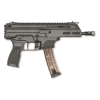
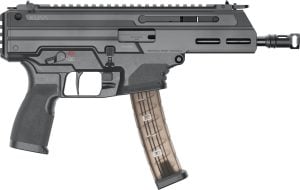
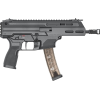
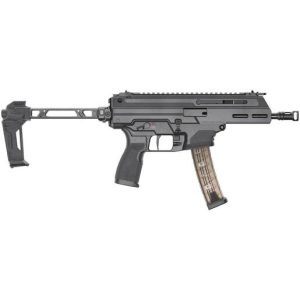
Quick Take
Roller-delayed 9mm guns used to start around $2,500. That was the deal for most of the last decade: if you wanted the soft, flat, almost lazy recoil impulse that a roller-delayed bolt gives you, you paid B&T or you paid for a well-built MP5 clone. Springfield’s Kuna lands at $949 on the street and does the same trick.
I put roughly 900 rounds through one across five range sessions this summer, mostly in Arizona heat that sat between 95 and 105 degrees. Two stoppages, both inside the first hundred rounds, and nothing after that. It shoots flatter than any blowback PCC I’ve handled, the trigger is better than it needs to be at this price, and the fit and finish would not embarrass a gun costing twice as much.
The short answer: yes, it earns the hype, and it’s the first roller-delayed 9mm I’d recommend to somebody who isn’t already deep into the platform.
Best For: Shooters who want MP5-style soft recoil without MP5-clone money, home defense buyers who plan to run a can, and PCC competitors who’d rather spend their budget on optics than on the host gun. Skip it if you need a shoulder stock out of the box or you’re committed to Glock-magazine commonality.
Why Springfield Built It This Way
Look at the pistol-caliber market before April 2025 and there’s an obvious hole in it. At the bottom you had straight blowback guns, the CZ Scorpion and every AR-9 on the shelf, all of which work fine and all of which buck more than a 9mm has any business bucking. At the top you had roller-delayed and short-recoil designs from B&T and SIG, priced past $1,500 and often well past $2,500. Nothing sat in between.
Blowback is cheap because it’s simple. The bolt is heavy, the spring is stiff, and the whole thing stays shut long enough by sheer mass. That mass is exactly what you feel: a hard rearward shove followed by the bolt slamming home. Roller-delayed does the same job with geometry instead of weight. Two rollers cam into recesses in the barrel extension and have to be squeezed back out before the bolt can travel, which spreads the unlocking over time and lets the designer use a much lighter bolt.
Springfield didn’t engineer this alone. The Springfield Kuna is built by HS Produkt in Croatia, the same partner behind the XD and Hellcat lines, and HS Produkt has been iterating on roller-delayed 9mm designs for years. Springfield’s contribution reads like a list of American market corrections: AR-pattern grip so the controls feel familiar, ambidextrous safety, reversible charging handle, a full-length top rail, and M-Lok instead of a proprietary accessory system.
The positioning is aggressive on purpose. At $1,179 MSRP and roughly $950 real-world, Springfield is betting that a lot of people wanted the MP5 shooting experience and balked at the price. Based on how fast these moved through distribution, that bet looks correct.
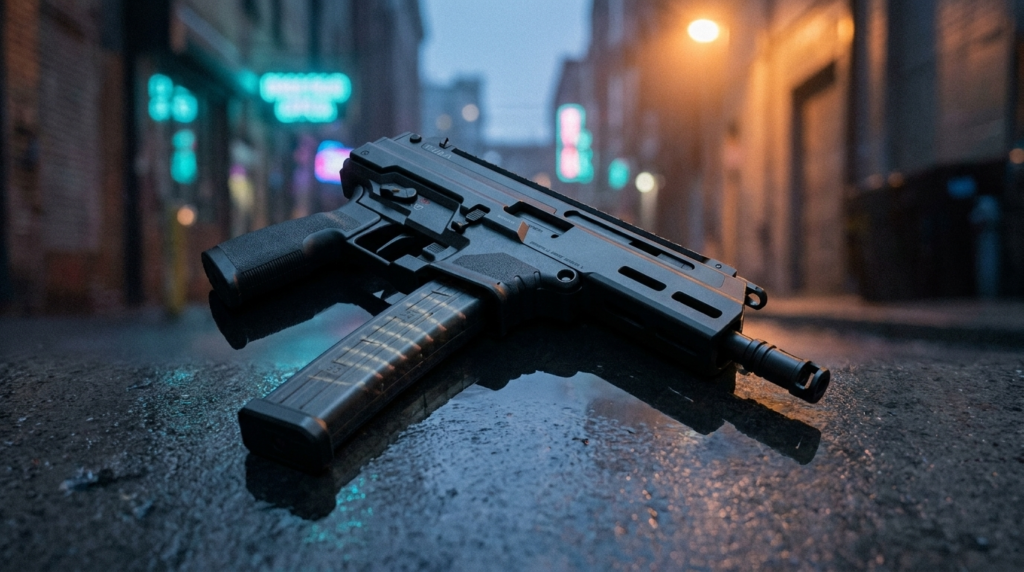
How the Kuna Compares
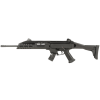
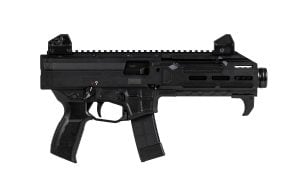
CZ Scorpion 3+ ($630–$1,360)
The Scorpion is the default recommendation in this space and it’s still the value pick. CZ replaced the old EVO 3 S1 with the Scorpion 3+, which fixed the two things everyone complained about, namely the awful factory trigger and the ergonomics of the safety. You can find a base 3+ for around $630, which is three hundred dollars under a Kuna.
Shoot them back to back and the difference is not subtle. The Scorpion is straight blowback and it feels like it, with a sharper impulse and noticeably more muzzle rise between shots. The Kuna settles faster. On a 3-shot drill at 10 yards I was consistently a quarter second quicker with the Springfield, and that gap came almost entirely from the second and third shots. If your budget stops at $700, buy the Scorpion and don’t feel bad. If you can stretch, the Kuna is the better shooting gun. Our full CZ Scorpion review goes deeper on the platform.
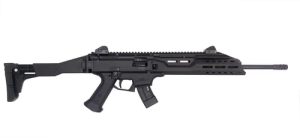
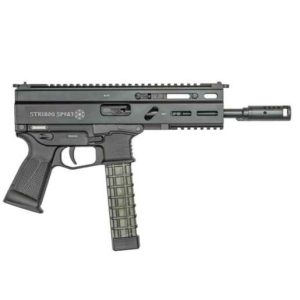
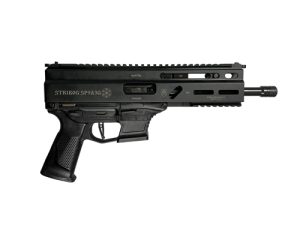
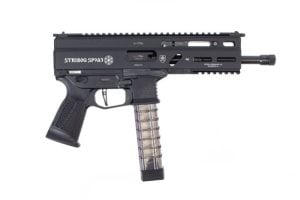
Grand Power Stribog SP9A3 ($1,059–$1,159)
This is the closest fight on the list. The Stribog SP9A3 is also a delayed design, also sits right around a grand, and has a devoted following among people who shoot a lot of pistol-caliber matches. Its 8″ barrel gives up a little velocity to nothing and gains a slightly longer sight radius if you’re running irons.
Where the Kuna wins is finish quality and controls. The Stribog’s safety is stiff out of the box and the charging handle placement takes acclimation. Springfield’s ambi setup is better thought out and the monolithic upper has no discernible flex. Where the Stribog wins is magazine pricing and aftermarket depth, since it’s been on the market long enough to have real support. Call it a coin flip weighted slightly toward the Kuna if you’re buying one gun and keeping it stock.
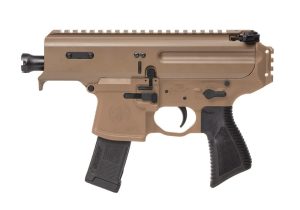
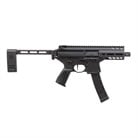
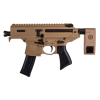
SIG MPX ($1,500–$1,839)
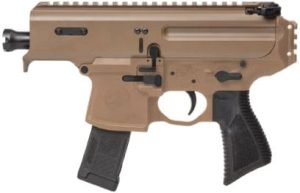
The MPX is short-stroke gas piston rather than roller-delayed, and it remains the smoothest-shooting 9mm I’ve fired. It also costs $550 to $900 more depending on which configuration you land on, and the Copperhead variants that show up most often at retail are short-barreled guns aimed at a different job.
Honestly, the MPX is still slightly better. The recoil impulse is a touch softer, the trigger is better, and SIG’s aftermarket is enormous. The question is whether it’s five hundred dollars better, and for most buyers it isn’t. The Kuna gets you about ninety percent of the way there. See our SIG MPX review for the full breakdown.
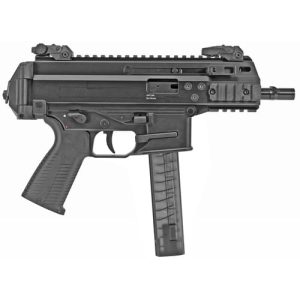
B&T APC9 Pro ($2,570–$2,580)
The APC9 Pro is the gun the Kuna is quietly aimed at, and it’s the benchmark for a reason. It’s hydraulically buffered, it’s issued to agencies that test things properly, and the build quality is on another level. It’s also $2,570.
Nobody cross-shopping a $949 Springfield is seriously considering a $2,570 B&T. The reason it belongs here is scale: the Kuna delivers a recoil impulse close enough to the APC9 that you have to shoot them side by side to rank them confidently. That’s a remarkable thing to say about a gun costing a third as much.
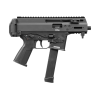
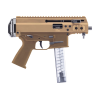
Verdict: The Scorpion 3+ is the budget answer and the MPX is the premium one. The Kuna sits between them and, for the money, gives up less to the MPX than it should. Against the Stribog it’s a genuine toss-up that comes down to whether you value finish or aftermarket depth.
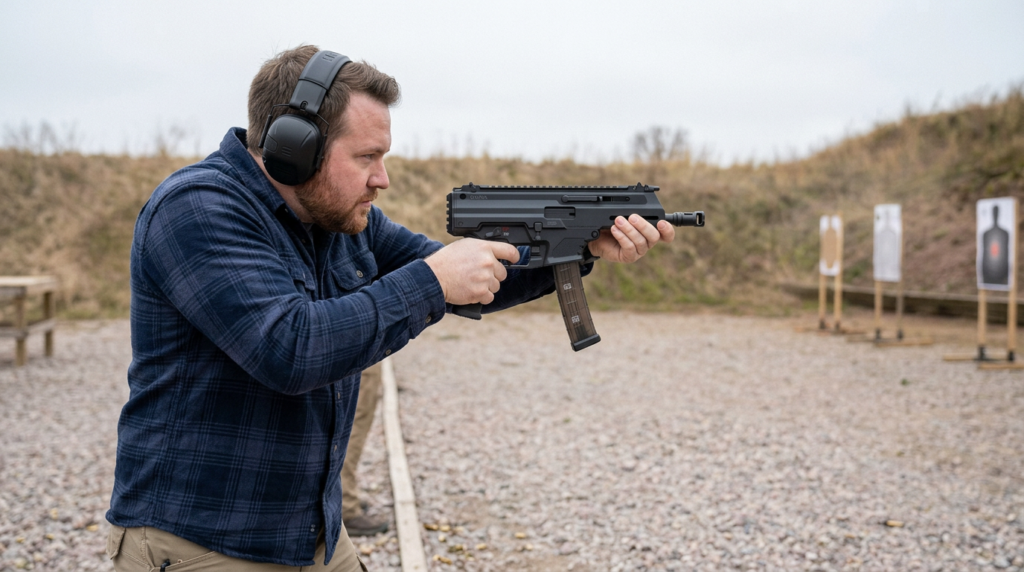
Testing Protocol
Phase 1: Break-In
First 150 rounds were Blazer Brass 115gr, shot in one sitting on a 98-degree afternoon with the gun straight out of the box and no additional lubrication beyond what Springfield ships it with. Two failures to fully return to battery, one at round 34 and one at round 71, both cleared with a light forward push on the charging handle. Both happened with the same magazine. After that first session I stripped it, wiped the bolt group, and ran a light coat of oil on the rollers and the bolt rails.
Phase 2: Reliability
Sessions two through five covered 750 rounds across a deliberately mixed diet: Federal American Eagle 124gr, Winchester white box 115gr, Sellier & Bellot 124gr, Magtech 115gr, plus a hundred rounds of defensive ammo split between Speer Gold Dot 124gr +P and Federal HST 147gr. Temperatures ranged from a 72-degree morning session to two afternoons above 100.
Zero stoppages across all 750. That includes the 147gr subsonic HST, which is where blowback guns in this class sometimes get lazy about cycling. The roller-delayed system doesn’t seem to care much what you feed it, and the 147gr load actually produced the softest impulse of anything I ran.
Ejection was consistent at roughly four o’clock, throwing brass six to eight feet in a tight cluster. That consistency is worth noting because it tells you the system is unlocking at the same point every time rather than fighting the ammo. The bolt stayed noticeably cleaner than a blowback gun would after the same round count, which follows from the lighter bolt and the delayed unlocking keeping more gas forward.
Phase 3: Accuracy
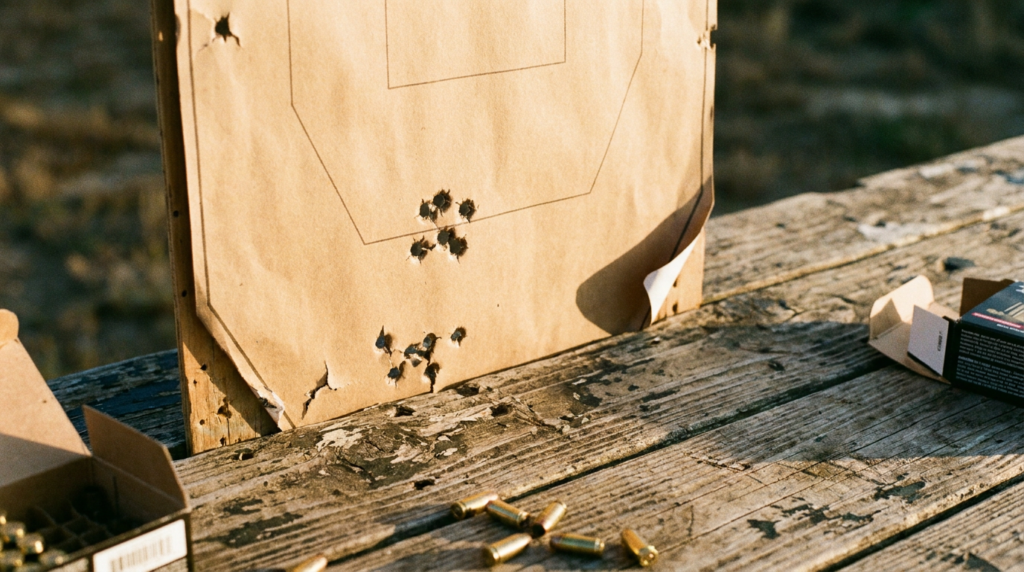
Accuracy testing was done at 25 yards off a bag with a Holosun 507C on the top rail, five-shot groups, three groups per load. Federal American Eagle 124gr was the best performer at a 1.6″ average. Blazer Brass 115gr opened up to 2.3″. The Speer Gold Dot 124gr +P split the difference at 1.9″ and had the sharpest report by a wide margin.
The flat aluminum trigger deserves credit here. It breaks at a measured 5.5 pounds with a short, clean wall and a reset you can feel through gloves. That’s not a match trigger, but it’s dramatically better than the Scorpion’s factory unit and it’s not the limiting factor on these groups. The 1:10 twist stabilizes 147gr without complaint, which is what you want if suppressor use is in your plans.
Ammunition Log
- CCI Blazer Brass 115gr FMJ, 300 rounds
- Federal American Eagle 124gr FMJ, 250 rounds
- Winchester White Box 115gr FMJ, 150 rounds
- Sellier & Bellot 124gr FMJ, 60 rounds
- Magtech 115gr FMJ, 40 rounds
- Speer Gold Dot 124gr +P, 50 rounds
- Federal HST 147gr, 50 rounds
Total: 900 rounds, 2 stoppages, both inside the first 100. If you’re stocking up, our guide to the best 9mm ammo covers what’s worth buying in bulk.
Tracking & Observations
Stripping the gun at 900 rounds turned up less wear than I expected. The rollers show even contact marks on both sides with no galling or peening, which is the thing you watch for on a roller-delayed gun. Carbon buildup on the bolt face was moderate and wiped off without solvent. The Melonite barrel finish is unmarked. The polymer lower shows a faint wear line where the bolt group rides, cosmetic only.
What This Means for You
- Break-in: Budget the first 100 rounds. Both of my stoppages happened there and neither recurred.
- Reliability: Clean across 750 consecutive rounds and five ammo types, including 147gr subsonic.
- Ammo preference: 124gr shoots tightest. 115gr bulk runs fine but groups open up.
- Maintenance: Keep the rollers and bolt rails lightly oiled. Everything else is forgiving.
- Accuracy expectation: 1.5″ to 2″ at 25 yards with a red dot and decent ammo is realistic.
Performance Testing Results
Reliability (9/10)
Two stoppages in 900 rounds is a good number, and the fact that both landed in the first 71 rounds and both traced to one magazine makes it better. I swapped that magazine into the rotation deliberately for the rest of the test and it never repeated the fault, so I’d file it under break-in rather than a defect.
What keeps this from a 10 is simply time. This design has been on the American market since April 2025. The APC9 has a decade of agency abuse behind it and the Scorpion has sold in enormous numbers. The Kuna looks excellent at 900 rounds. Ask me again at 10,000.
Accuracy (9/10)
A 1.6″ five-shot average at 25 yards from a 6″ barrel is genuinely good, and the consistency across three separate groups mattered more to me than the headline number. The cold hammer forged barrel is doing real work. Where you notice it most is at distance: ringing a 12″ steel plate at 75 yards was routine rather than lucky, which is not something I’d say about most blowback PCCs.
Ergonomics & Recoil (9/10)
This is the headline. Recoil is soft and, more usefully, it’s flat. The muzzle doesn’t climb so much as shift, and the sight picture comes back on its own. Splits that take deliberate effort on a Scorpion happen naturally here.
The AR-pattern grip and familiar control layout mean there’s no learning curve if you’ve shot an AR. Ambidextrous safety works properly rather than being an afterthought lever, and the reversible charging handle is a genuine convenience for left-handed shooters. The one honest complaint is balance: at 4 lbs 10 oz with a monolithic aluminum upper and a polymer lower, the weight sits forward. Shooting it one-handed off a Picatinny end plate with no brace is awkward, and that’s a real consideration on the base model.
Fit, Finish, and Quality Control (9/10)
The monolithic upper is the standout. There’s no upper-to-lower wobble because there’s no multi-piece upper to wobble, and the top rail runs unbroken from the rear sight to the handguard so an optic stays where you zeroed it. Type III hardcoat anodizing is even with no thin spots at the edges. Polymer-to-metal fit at the lower is tight. The magazines feel better than the translucent construction suggests, with metal feed lips where it counts.
Technical Deep Dive
The Roller-Delayed System
The mechanism is the whole reason to buy the Springfield Kuna, so it’s worth understanding. On firing, the bolt head wants to move rearward immediately. Two rollers sitting in recesses in the barrel extension block that movement, and the only way they retract is by camming inward against an angled locking piece behind them. That camming action forces the much heavier bolt carrier to accelerate rearward faster than the bolt head, which is the “delay.”
The practical effect is that peak pressure has dropped before anything meaningful moves, and the energy that would have hit your shoulder as one sharp shove instead gets spread across a longer window. It also means the bolt can be far lighter than a blowback bolt, which cuts reciprocating mass and therefore muzzle rise.
Barrel and Muzzle Device
Six inches of cold radial hammer forged barrel with a 1:10 twist and a Melonite finish. Hammer forging work-hardens the bore and usually buys you a longer accuracy life than a button-rifled barrel at this price. The 1:10 twist is the right call for a 9mm expected to see 147gr subsonic loads under a suppressor. SAAMI sets 9mm Luger maximum average pressure at 35,000 psi, and that is the load the roller system has to hold shut.
The multi-port muzzle brake is effective and antisocial in equal measure. It flattens what little rise the roller system leaves, and it redirects a lot of gas and noise sideways. Shooting next to somebody at an indoor range, expect comment. The 1/2×28 threads mean swapping it for a linear compensator is a fifteen-dollar fix, and that’s the first change I’d make. If a can is the plan, our suppressor guide is the place to start.
Sights and Optics Mounting
The hybrid flip-up sights are a genuinely clever piece of design. Flipped up, you get a precision aperture rear with a ring post front. Folded down, the same units become a pistol-style U-notch rear and white dot front. That means the irons stay useful as a backup with an optic mounted, which is more than most factory folding sights manage. The full-length top rail takes anything, and a compact red dot is the obvious pairing. Our red dot guide covers the options.
Magazines
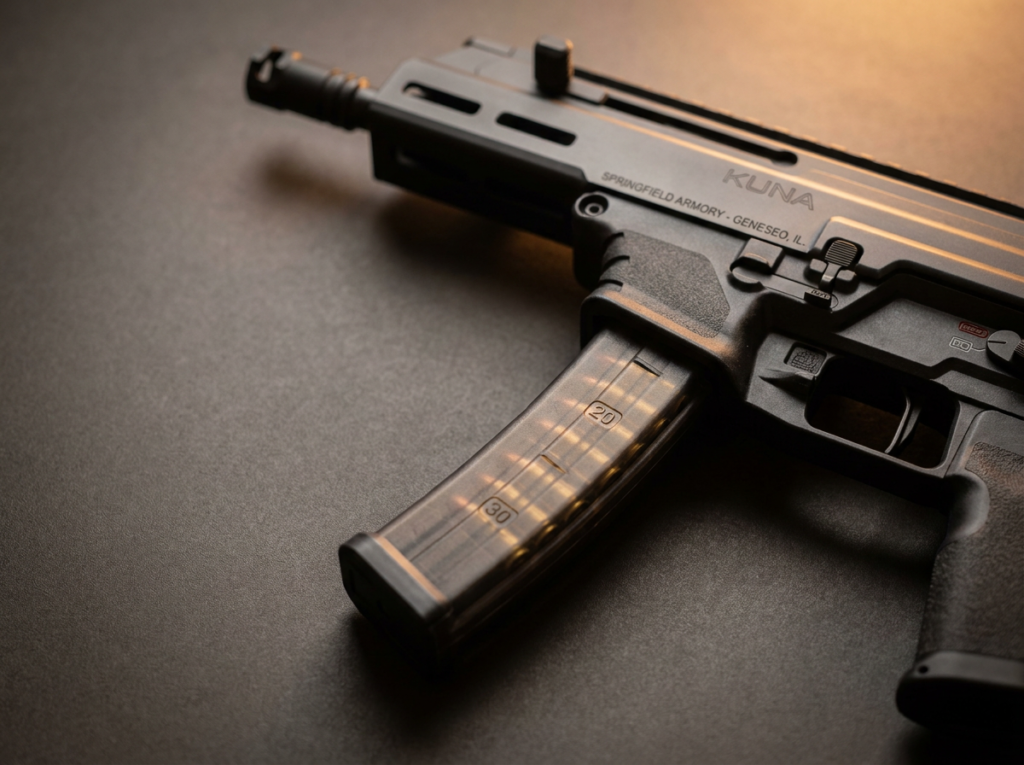
Proprietary, translucent, 30 rounds, metal feed lips, two in the box. The translucent body is legitimately useful for checking your round count at a glance. The proprietary part is the drawback: no Glock commonality, no CZ commonality, and spares cost more than the aftermarket alternatives you’d buy for an AR-9. If you’re building a match rig that needs eight magazines, factor that in.
| Component | Specification | Benefit |
| Operating System | Roller-delayed blowback | Flatter, softer recoil than any blowback PCC at this price |
| Barrel | 6″ cold radial hammer forged, 1:10, Melonite | Stabilizes 147gr subsonic; long accuracy life |
| Upper Receiver | Monolithic aluminum, Type III anodized | No wobble, unbroken optic rail, holds zero |
| Trigger | Flat aluminum, 5.5 lb measured | Short wall and tactile reset; far better than class average |
| Muzzle Threads | 1/2×28 | Standard pitch for cans and comps, no adapter needed |
| Controls | Ambi safety, reversible charging handle | Genuinely left-hand friendly out of the box |
Kuna Variants
Springfield ships the Kuna in three configurations that matter to buyers, and the difference between the first two is the single biggest decision you’ll make on this gun.
Kuna KN9069B (Picatinny End Plate) $949
The base gun and the one I tested. Picatinny receiver end plate instead of a brace, which keeps the price down and leaves the configuration decision to you. MSRP $1,179, but street pricing has settled around $949. Best pick if you already own a brace you like, or if you plan to SBR it.
Kuna KN9069B-FSA (Strike Industries Brace) $1,099
Ships with the Strike Industries FSA folding brace fitted. Roughly $150 more than the base gun, which is close to what the brace costs on its own, so this is the sensible buy for most people. Folding brace also drops overall length substantially for storage.
Kuna KN9069BLC (10-Round Compliant) $1,110
Ten-round magazines for restricted states. Mechanically identical to the base gun. Worth knowing this exists so you don’t accidentally order a 30-round model you can’t legally take delivery of, and worth knowing it often costs more than the standard version.
You’ll also see “First Line” or “-FL” suffixes at some retailers. That’s a distributor program rather than a different gun, so don’t pay extra for the letters.
Upgrades Worth Making
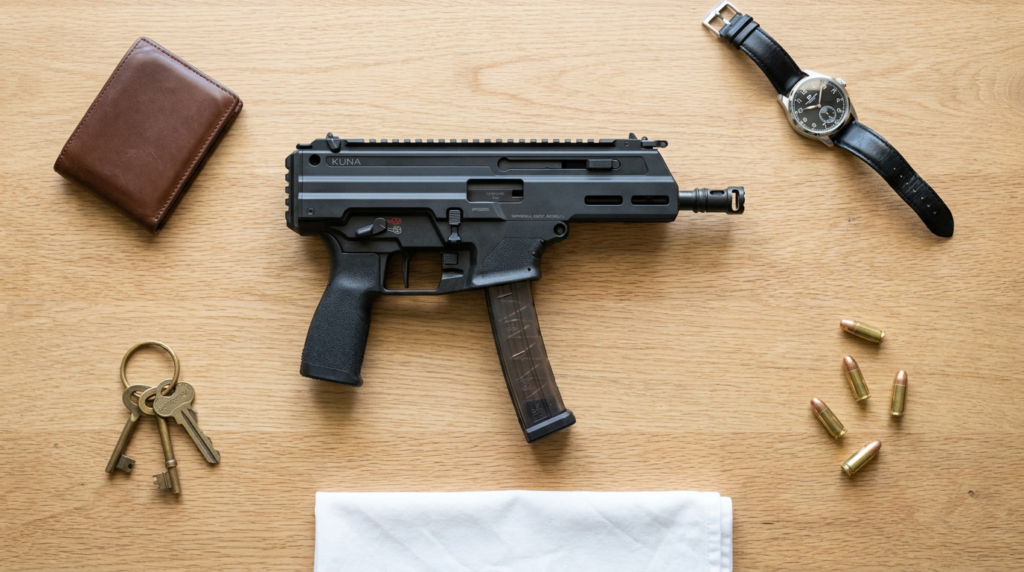
The Kuna needs less help than most guns at this price. Two changes are worth making immediately, the rest are optional.
| Upgrade Category | Recommended Component | Why It Matters | Cost Estimate |
| Muzzle Device | Linear compensator, 1/2×28 | Pushes blast forward and makes you tolerable to shoot beside | $40 – $90 |
| Optic | Holosun 507C or 510C | The gun is accurate enough to justify a real dot, not a budget one | $250 – $370 |
| Brace | Strike Industries FSA (if you bought the base model) | Turns an awkward one-handed gun into a stable two-point hold | $150 – $190 |
| Magazines | Factory Springfield 30-round | Proprietary pattern, so factory is the only reliable option today | $40 – $55 each |
| Weapon Light | Streamlight TLR-1 HL on M-Lok mount | Home defense use demands target identification | $130 – $180 |
Common Problems & Solutions
- Failure to return to battery during break-in: Common in the first 100 rounds and reported widely by early owners. Add a light coat of oil to the rollers and bolt rails, then shoot through it. If it persists past 200 rounds, isolate the magazine before blaming the gun.
- Excessive blast at indoor ranges: The multi-port brake is the culprit. Swap to a linear compensator for around $50 and the problem disappears.
- Magazine availability and cost: Proprietary pattern with no aftermarket yet. Buy spares when you see them in stock rather than when you need them.
- Awkward handling on the base model: A Picatinny end plate with nothing attached is not a shooting position. Either budget for a brace or buy the FSA version outright.
- Optic height confusion: The top rail sits high relative to the bore. A standard pistol-height dot mount works, but a 1.93″ riser will feel wrong. Mount low.
Who Should NOT Buy This Gun
- Budget-first buyers: If $949 is a stretch, the CZ Scorpion 3+ starts around $630 and does 85% of the job. The Kuna is better, but it isn’t $320 better if that $320 is your optic budget.
- Anyone committed to Glock magazine commonality: The Kuna is proprietary. If your pistols and your PCC share magazines today, an AR-9 or a Glock-fed carbine keeps that going and the Kuna breaks it. Start with our 9mm AR pistol roundup instead.
- Shooters who want a rifle, not a pistol: This is legally a pistol with a 6″ barrel and no stock. If you want a shoulder-fired 16″ gun without paperwork, look at a 9mm carbine like the Ruger PC Carbine.
- People who need deep aftermarket support now: Triggers, handguards and magazine options for the Kuna are thin because the gun is barely a year old. The Scorpion and the AR-9 platform both have a decade of parts behind them.
- Restricted-state buyers who haven’t checked: The standard gun ships with 30-round magazines. Confirm your state allows delivery before ordering, and look at the KN9069BLC if it doesn’t.
Final Verdict
The Springfield Kuna fills a real gap, and it fills it properly. Roller-delayed 9mm guns were a $2,000-plus proposition until the Springfield Kuna landed in April 2025, and the Kuna delivers most of that shooting experience for under a thousand dollars. The recoil impulse is the selling point and it holds up: this is a flat, fast, easy gun to shoot well, and the difference against a blowback PCC is obvious within one magazine.
It isn’t perfect. The brake is obnoxious, the magazines are proprietary and pricey, the base model needs a brace to make sense, and the aftermarket hasn’t caught up yet. None of those are dealbreakers and three of the four are fixable with money you were probably going to spend anyway.
Buy the FSA version, put a linear comp on it, mount a decent dot, and you have a home defense and range gun that shoots like something twice the price. That’s a straightforward recommendation.
Final Score: 8.8/10 – The first roller-delayed 9mm that most shooters can actually justify buying.
FAQ: Springfield Kuna
Is the Springfield Kuna a pistol or a rifle?
It's a pistol. The Kuna has a 6" barrel and ships with a Picatinny receiver end plate or a Strike Industries FSA brace, not a shoulder stock, so it's sold and transferred as a handgun. That matters for how you can transport it and whether you can take it across state lines. If you want a 16" shoulder-fired 9mm without NFA paperwork, look at a carbine instead.
Who makes the Springfield Kuna?
The Kuna is manufactured by HS Produkt in Croatia and imported by Springfield Armory of Geneseo, Illinois. HS Produkt is the same partner behind Springfield's XD and Hellcat lines, so this is a long-running relationship rather than a one-off contract build.
What does roller-delayed blowback actually do for the shooter?
It cuts felt recoil and muzzle rise. Two rollers lock into the barrel extension and have to cam inward before the bolt can travel rearward, which delays unlocking until pressure has dropped. The practical result is a softer, flatter impulse than a straight blowback gun like a CZ Scorpion, and it lets the designer use a much lighter bolt so there's less reciprocating mass to throw the muzzle around.
How much does a Springfield Kuna cost?
MSRP is $1,179 for the base KN9069B, but street pricing has settled closer to $949. The KN9069B-FSA with the Strike Industries folding brace runs about $1,099. Check the live pricing above, since availability and discounting on this model move quickly.
Does the Kuna take Glock magazines?
No. The Kuna uses proprietary translucent 30-round magazines with metal feed lips, and two ship with the gun. There's no Glock or CZ commonality and no meaningful aftermarket yet, so spares cost more than what you'd pay for an AR-9 or Glock-fed carbine. Buy them when you see them in stock.
Is the Kuna suppressor ready?
Yes. The barrel is threaded 1/2x28, which is the standard pitch for 9mm cans, so no adapter is needed. The 1:10 twist also stabilizes 147gr subsonic loads properly. Removing the factory multi-port brake is worthwhile either way, since it's loud and throws a lot of blast sideways at anyone next to you.
Springfield Kuna vs CZ Scorpion, which should I buy?
The Kuna is the better shooting gun and the Scorpion 3+ is the better value. A base Scorpion starts around $630 against $949 for the Kuna. The Kuna's roller-delayed action is noticeably flatter and faster on follow-up shots, which you'll feel within one magazine. If your budget stops at $700, the Scorpion is still a good gun. Note that the old EVO 3 S1 has been replaced by the Scorpion 3+.
Is the Springfield Kuna reliable?
In our testing, yes. We ran 900 rounds across seven ammo types and recorded two stoppages, both inside the first 71 rounds and both traced to a single magazine. The following 750 rounds were clean, including 147gr subsonic loads that some blowback guns in this class struggle to cycle. Expect a short break-in period and keep the rollers lightly oiled.
5,492+ Gun & Ammo Deals
Updated daily from 200+ top retailers. Filter by category, caliber, action type, and price.
Related Guides