

Last updated August 22nd 2026 · By Nick Hall, who has fed a Barrett M82A1 enough of this stuff to care about the price per round
This article contains affiliate links. If you buy through our links then we can earn a small commission and you get the best deals we can find.
- Treat every gun as loaded
- Point the muzzle in a safe direction
- Keep your finger off the trigger until you’re ready to shoot
- Know your target and what’s beyond
Quick Answer: For accuracy, Hornady Match 750gr, item 8270, at a published 2,815 fps and 13,196 ft-lb from a 36 inch barrel. For everything else, PMC Bronze 660gr FMJ-BT at around $4.29 a round, which is the cheapest thing on our cards you can shoot at a normal range. Federal American Eagle XM33C sits between them.
Be warned that the commercial .50 BMG market is far smaller than the internet suggests. Across every retailer in our live feed there are three loads you can reliably buy, plus two linked options. Most of the famous names return nothing at all.
Table of Contents
On-sale 50 BMG from 200+ retailers · Updated every 4 hours

How we tested: Every pick here is ranked against our testing methodology. Minimum round counts, accuracy and reliability protocols, the failures that disqualify a gun.
Best .50 BMG Ammo in 2026 at a Glance
| Load | Use | Price |
|---|---|---|
| BEST MATCHHornady Match 750gr (8270) The only true match load you can buy off a shelf, and the only one with a full ballistics table. | Match / Long range | Check Price ↓ |
| BEST VALUEPMC Bronze 660gr FMJ-BT (50A) Cheapest round on our cards you can actually shoot at a range, at about $4.29. | Range | Check Price ↓ |
| BEST BRASS BUDGETFederal American Eagle XM33C Federal quality control on M33-pattern ball, in boxes of ten. | Range | Check Price ↓ |
| BEST BULKPMC Bronze 100rd Linked Same 660gr load in a linked hundred. Read the cost section before you assume bulk is cheaper. | Bulk / Belt-fed | Check Price ↓ |
| CHEAPEST PER ROUNDFederal M33 Ball / M17 Tracer 4:1 About $3.85 a round, and most ranges will not let you fire it. | Belt-fed / Tracer | Check Price ↓ |
Cost Per Round Is the Whole Decision
In most calibers ammunition choice is about terminal performance. In .50 BMG it is about money, because nobody is shooting this cartridge at anything that requires a specific bullet construction. You are punching paper, ringing steel or seeing how far you can reach. What separates the loads is what a day at the range costs.
These are the per-round figures from the live listings on our own cards as this was written. Prices move daily, so the cards below are the truth and this table is the shape of the market.
| Load | Box | Price | Per round |
|---|---|---|---|
| Federal M33 Ball / M17 Tracer 4:1, linked | 100 | $385.24 | $3.85 |
| PMC Bronze 660gr FMJ-BT | 10 | $42.94 | $4.29 |
| Federal American Eagle XM33C 660gr | 10 | $49.99 | $5.00 |
| PMC Bronze 660gr FMJ-BT, linked | 100 | $529.50 | $5.30 |
| PMC Bronze 660gr FMJ-BT | 100 | $581.79 | $5.82 |
| Hornady Match 750gr (8270) | 10 | $83.71 | $8.37 |
| Hornady Match 750gr (8270), dearest listing | 10 | $107.99 | $10.80 |
Three things in that table are worth stopping on.
Buying a hundred at a time can cost you more
The cheapest 100-round PMC listing works out at $5.82 a round. The cheapest 10-round PMC listing works out at $4.29. Same load, same item number, and the bulk box is 36 percent dearer per round. Those are different retailers rather than one seller charging more for volume, but the shopping lesson holds: in this caliber you cannot assume the big box is the better buy. Work out the per-round figure every time.
The cheapest ammunition is the stuff you probably cannot shoot
Linked M33 ball with tracer every fifth round is the cheapest thing here at $3.85. To use it you need either a belt-fed gun or the patience to strip a hundred rounds out of the links by hand, and most commercial ranges ban tracer outright for fire risk. It is genuinely the best value on the page and genuinely unusable for most buyers.
Match ammunition costs roughly double range ammunition
Hornady Match at $8.37 against PMC Bronze at $4.29 is a little under 2 to 1. Put in terms that matter, a hundred rounds of match is $837 and a hundred rounds of PMC is $429. Neither is a casual purchase, and the gap is the reason most .50 owners zero with match and practice with ball.
What the Makers Publish, and Where It Does Not Add Up
Only three commercial .50 BMG loads on our cards publish anything worth calling a specification. Here is all of it, taken from the manufacturers own pages.
| Load | Bullet | Velocity | Energy | Test barrel |
|---|---|---|---|---|
| Hornady Match (8270) | 750gr | 2,815 fps | 13,196 ft-lb | 36 inch |
| PMC Bronze (50A) | 660gr FMJ-BT | 2,950 fps | 13,688 ft-lb | 36 inch |
| Federal American Eagle (XM33C) | 660gr FMJ | 2,940 fps | not published | not stated |
Two things fall out of that, and the second one is a genuine error in a manufacturer datasheet.
The cheap ball beats the match load on paper
PMC Bronze publishes 13,688 ft-lb against Hornady Match at 13,196. The $4.29 range round claims more muzzle energy than the $8.37 match round. That is not a misprint in the direction you would expect, it is what a lighter bullet driven faster does. Match ammunition is not built for muzzle energy, it is built for ballistic coefficient and consistency, which is why the 750gr bullet is still ahead at a thousand yards while being behind at the muzzle.
PMC’s own velocity and energy do not reconcile
Run the standard arithmetic on PMC published figures and they do not agree with each other. Muzzle energy in foot-pounds is bullet weight in grains multiplied by velocity squared, divided by 450,240.
- 660 grains at 2,950 fps works out to 12,757 ft-lb, not 13,688.
- To produce the 13,688 ft-lb PMC prints, the bullet would have to be leaving at about 3,056 fps.
- PMC own packaging settles it. The front of the Bronze box, photographed further down this page, prints 3080 FPS MV. Several retailers quote the same 3,080. The 2,950 fps on the website is the odd figure out.
We have quoted PMC website figure of 2,950 fps throughout, because a website is easier for a reader to check than a box, and flagged the discrepancy rather than quietly picking whichever number suited. Treat 3,080 fps as the more likely real figure. Run the same check on Hornady and it passes cleanly: 750 grains at 2,815 fps is 13,200 ft-lb against the 13,196 they print.
Why .50 BMG Numbers Never Quite Agree
There is a reason the published figures for this cartridge refuse to line up, and it is not that anyone is lying to you. It is that .50 BMG has no commercial standard behind it.
SAAMI, the body that publishes the American ammunition standards, does not standardize .50 BMG at all. We checked all four of its documents, the centerfire rifle, centerfire pistol, rimfire and shotshell standards. The phrase “Browning Machine Gun” appears in none of them. The centerfire rifle cartridge index runs up through 470 Nitro Express to 500 Nitro Express 3 inch and stops there.
| What SAAMI publishes | .223 Rem | .308 Win | .50 BMG |
|---|---|---|---|
| Maximum average pressure | 55,000 psi | 62,000 psi | Nothing |
| Standard test barrel length | 24.000 in | Published | Nothing |
| Proof load pressure | 73,500 to 78,500 psi | Published | Nothing |
| Velocity measurement convention | Published | Published | Nothing |
| Cartridge and chamber drawing | Published | Published | Nothing |

Compare that to any cartridge you can buy at a counter. Our .223 Remington guide quotes a maximum average pressure of 55,000 psi, a 24 inch test barrel and a proof load of 73,500 to 78,500 psi, because SAAMI prints all three. For .50 BMG there is no equivalent to quote.
What that means when you read a box
Every velocity and energy figure on .50 BMG packaging is the manufacturer’s own number, produced on the manufacturer’s own barrel, by whatever method that manufacturer chose. There is no agreed barrel length to normalize against and no agreed distance at which to take the reading.
That is the whole explanation for the mismatch picked apart further up this page. Two makers quoting different velocities for a 660 grain ball round are not necessarily disagreeing about the ammunition. They may simply be measuring differently, and nothing obliges them to do otherwise.
So compare like with like or do not compare at all. A figure is worth something when the same maker publishes it for two of its own loads. Across makers it is close to meaningless, and the only number on this page we would put weight on is cost per round, because that one is measured the same way by everybody.
This is a military cartridge that civilians happen to buy
The reason for the gap is history. .50 BMG was designed for the M2 machine gun and it lives under military specification, not a commercial one, which is why the loads on this page carry designations like M33 ball and M17 tracer rather than commercial product names.
It is the same situation as 5.56 NATO, which SAAMI also leaves alone while standardizing its commercial twin .223 Remington. The difference is that .50 BMG has no commercial twin. There is nothing for SAAMI to standardize alongside it, so it does not appear anywhere in the American standards at all.
Match and Long Range .50 BMG Ammo
There is exactly one true match load you can buy off a shelf in this caliber. That is not an editorial judgement, it is what the market has.

1. Hornady Match 750gr: Best Overall
Hornady Match 750gr, item 8270, runs $83.71 to $107.99 for ten. Hornady publishes 2,815 fps and 13,196 ft-lb from a 36 inch test barrel, along with a full trajectory table, which nothing else in this caliber offers.
- Bullet: 750gr match bullet
- Muzzle Velocity: 2,815 fps published by Hornady
- Muzzle Energy: 13,196 ft-lb published by Hornady
- Test Barrel: 36 inches, stated by Hornady
- At 500 yards: 2,393 fps and 9,538 ft-lb, from Hornady own table
| Value | Accuracy | Data | Availability | Reputation |
| 2/5 | 5/5 | 5/5 | 5/5 | 5/5 |
Pros
- The only load here with published downrange velocity, energy and trajectory
- Hornady states the 36 inch test barrel, so the figures mean something
- Heavier 750gr bullet holds velocity far better than 660gr ball past 500 yards
- Its published velocity and energy reconcile exactly, which is not true of the competition
Cons
- Roughly double the price of range ammunition, at $8.37 to $10.80 a round
- Lower published muzzle energy than PMC Bronze, which costs half as much
- Overkill if you are ringing steel at 300 yards
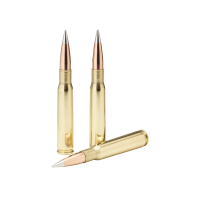
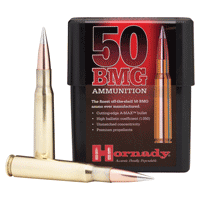
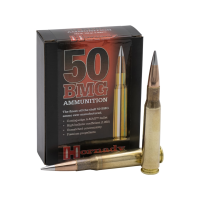
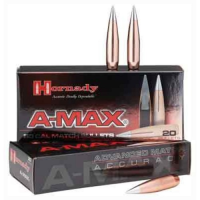
If you bought a .50 to shoot at distance, this is the ammunition the rifle was built around. A 750 grain bullet with a high ballistic coefficient is what makes four-figure yardages possible, and Hornady is the only manufacturer publishing the data you need to dial it.
The trajectory table is the real product here. Hornady lists velocity, energy and drop at every hundred yards from a stated 36 inch barrel, so you can build a solution rather than guess. Every other load on this page gives you a muzzle number and nothing else.
One shopping note worth knowing. Retailers list item 8270 as A-MAX, while Hornady current product pages show a 750gr A-Tip under the same item number with identical published figures. If the exact bullet matters to your load data, check the box before you buy rather than trusting the listing title.
Best For: Long range work, load development, and anyone who needs a trajectory table rather than a guess.
Range and Bulk .50 BMG Ammo
This is where almost all .50 BMG ammunition is actually bought. Both loads below are 660 grain full metal jacket to the M33 ball pattern, both are brass cased and Boxer primed so the cases are worth keeping, and both do the same job. The difference is price and who made it.

2. PMC Bronze 660gr FMJ-BT: Best Value
PMC Bronze 660gr FMJ-BT, item 50A, starts around $42.94 for ten, about $4.29 a round. It is the cheapest .50 BMG on our cards that you can take to an ordinary range.
- Bullet: 660gr full metal jacket boat tail
- Muzzle Velocity: 2,950 fps published by PMC
- Muzzle Energy: 13,688 ft-lb published by PMC, which implies about 3,056 fps rather than 2,950
- Test Barrel: 36 inches, stated by PMC
- Case: Brass, Boxer primed and reloadable, item 50A
| Value | Accuracy | Data | Availability | Reputation |
| 5/5 | 3/5 | 3/5 | 5/5 | 4/5 |
Pros
- Cheapest per round of anything here you can shoot at a normal range
- Boxer primed brass, so the cases are worth money if you reload or sell them
- PMC publishes a downrange velocity table out to 500 yards
- Widely stocked, which cannot be said for most of this caliber
Cons
- PMC published energy figure does not match its published velocity
- Boat tail ball is not a match bullet and will not group like one
- The 100-round listings on our cards work out dearer per round than the 10-round ones
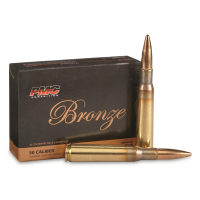
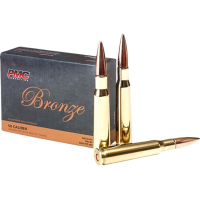
This is the default .50 BMG round and has been for years. A 660 grain boat tail full metal jacket to the M33 ball pattern, in brass, at the lowest price anyone consistently offers. If you are shooting steel at 500 yards or introducing somebody to the cartridge, buy this.
The case is worth more attention than the bullet. Boxer primed .50 BMG brass has real resale value and is entirely reloadable, which matters when the components cost what they do. A lot of owners treat the brass as part of the purchase price rather than range litter.
Accuracy is what you would expect from ball ammunition, which is to say adequate rather than impressive. Somewhere between one and two MOA out of a good rifle is normal. That is fine for everything except the long range work the cartridge is famous for.
Best For: Range days, steel at moderate distance, and anyone who wants to shoot their .50 more than twice a year.

3. Federal American Eagle XM33C: Best Brass Budget
Federal American Eagle XM33C is 660gr FMJ at a published 2,940 fps, and the cheapest listing on our cards is $49.99 for ten, about $5.00 a round. It is Federal quality control on the same M33 ball pattern.
- Bullet: 660gr full metal jacket
- Muzzle Velocity: 2,940 fps published by Federal
- Muzzle Energy: Federal publishes no energy figure for this load
- Pattern: M33 ball specification
- Item: XM33C, also sold as XM33CX
| Value | Accuracy | Data | Availability | Reputation |
| 4/5 | 3/5 | 2/5 | 4/5 | 5/5 |
Pros
- Federal manufacturing and quality control at close to commodity prices
- Same 660gr M33 ball pattern as the PMC, so it shoots to a similar zero
- Brass cased and reloadable
- Federal ammunition is stocked by more retailers than most .50 BMG
Cons
- About $5.00 a round, dearer than PMC for a comparable load
- Federal publishes velocity and nothing else, no energy and no downrange table
- Sold under two item numbers, XM33C and XM33CX, which confuses stock searches
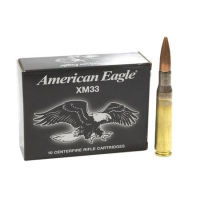
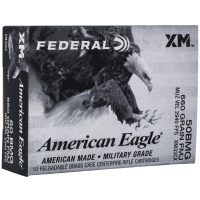
American Eagle is Federal doing volume ammunition properly, and in .50 BMG it is the sensible alternative when PMC is out of stock or when you would rather have the Federal name on the box. The load is the same idea, 660 grains of full metal jacket to the M33 pattern at a published 2,940 fps.
What you do not get is data. Federal lists the velocity on the product page and stops there. No muzzle energy, no downrange table, no test barrel. For a range load that is survivable, but it puts this behind both the Hornady and the PMC on anything you might want to calculate.
Watch the item numbers when you shop. The same load appears as XM33C and XM33CX depending on packaging, and retailers use the two interchangeably. Search both or you will miss stock.
Best For: Range use when PMC is unavailable, and buyers who prefer a Federal box.

4. PMC Bronze 100-Round Linked: Best Bulk Buy
PMC Bronze 660gr FMJ-BT in a linked hundred runs about $529.50, which is $5.30 a round. It is the sensible bulk option, with one large caveat about what bulk actually saves you here.
- Bullet: 660gr FMJ-BT, the same 50A load as the boxed version
- Quantity: 100 rounds, linked
- Cost: About $5.30 a round at the listing on our cards
- Compare: The 10-round boxes work out at about $4.29 a round
- Links: M9 links, which come off with a linking tool or firm hands
| Value | Accuracy | Data | Availability | Reputation |
| 3/5 | 3/5 | 3/5 | 3/5 | 4/5 |
Pros
- One purchase covers a serious range day rather than three boxes
- Linked ammunition suits a belt-fed and de-links easily for a bolt gun
- Comes in an ammo can, which is worth having in this caliber
- Same PMC load and same brass as the boxed version
Cons
- At $5.30 a round it is dearer than buying the same load in tens
- You have to strip the links if your rifle is not belt-fed
- A hundred rounds of .50 BMG is heavy enough to matter when you carry it

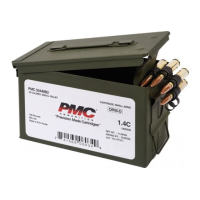

Bulk .50 BMG is a different purchase from bulk anything else. A hundred rounds is over $500 and about 30 pounds of ammunition, so this is a considered buy rather than a top-up.
The honest thing to say is that it is not cheaper per round. At the listings on our cards the linked hundred is about $5.30 a round against $4.29 for the same load in tens, and the unlinked hundred is dearer still at $5.82. What you are buying is convenience, an ammo can, and one transaction instead of ten.
If your rifle is belt-fed, the links are the point and this is exactly what you want. If it is a bolt gun, budget half an hour to de-link a hundred rounds, or buy boxes and save the money.
Best For: Belt-fed guns, and bolt-gun owners who value one purchase over the lowest per-round price.
Linked and Tracer .50 BMG Ammo
One more category exists and it is the cheapest ammunition in the caliber, with the biggest string attached.
5. Federal M33 Ball with M17 Tracer 4:1: Cheapest Per Round
Federal .50 BMG M33 ball linked with M17 tracer every fifth round, 100 rounds for about $385.24. That is $3.85 a round, the cheapest .50 BMG on our cards, and most ranges will not let you fire a single one of them.
- Mix: M33 ball with M17 tracer in a 4 to 1 ratio
- Quantity: 100 rounds, linked
- Cost: About $3.85 a round
- Restriction: Most commercial ranges ban tracer ammunition outright
- Fire risk: Tracer is a genuine ignition source in dry conditions
| Value | Accuracy | Data | Availability | Reputation |
| 5/5 | 3/5 | 2/5 | 2/5 | 4/5 |
Pros
- Cheapest per round of anything in this caliber on our cards
- Tracer every fifth round makes long-range spotting genuinely easier
- Linked and canned, so it is ready for a belt-fed
- M33 ball is the pattern the cartridge was standardized around
Cons
- Most commercial ranges prohibit tracer, so check before you buy
- Real fire risk on dry ground, and that liability is yours
- No published ballistics beyond the M33 ball specification
- Tracer is restricted or banned outright in some states
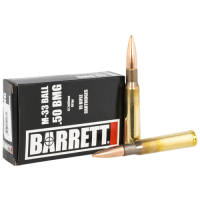
This is the best value in .50 BMG and the hardest to use. A hundred linked rounds of M33 ball with a tracer every fifth round works out at $3.85, comfortably under the cheapest boxed ammunition, and there is a real argument for tracer beyond the spectacle: at extreme range, watching the trace is a faster way to find your correction than waiting for a spotter to call it.
The problem is where you fire it. Commercial ranges ban tracer almost universally because a burning composition landing in dry grass starts fires, and that risk sits with whoever pulled the trigger. Private land, wet ground and a clear backstop are the conditions this needs.
Check your state law as well as your range rules. Tracer ammunition is restricted or prohibited in several states, and the rules are separate from the ones covering the rifle itself. Our .50 BMG buyers guide goes through the legal position in more detail.
Best For: Private land, belt-fed guns, and long range spotting where the trace earns its keep.
What We Could Not Rank, and Why
The .50 BMG market has more famous names than it has buyable products. Every one of these comes up constantly and none of them returns a single in-stock listing across our retailer feed.
- Barrett factory match ammunition. Barrett has loaded its own 661gr and 750gr match ammunition and it is the obvious partner to a Barrett rifle. Nothing in our feed carries it under any spelling.
- Magtech .50 BMG. Magtech has made a 624gr FMJ in this caliber. It returns nothing.
- Lake City M33 ball surplus. The cheap surplus everyone remembers has largely dried up. What is left is linked, which is why the linked options above are the closest thing to a surplus price.
- Lake City M8 armor piercing incendiary. This is real ammunition, sold by specialist retailers, and it is not a Hornady product despite what a lot of the internet says. Hornady does not manufacture API. It returns nothing in our feed, it is restricted or banned in several states, and virtually no range permits incendiary. We are not ranking it.
If a page tells you there are eight or ten distinct .50 BMG loads to choose from, check whether you can actually put any of them in a basket. Three commercial loads and two linked options is what this market currently holds.
Steel Case vs Brass Case .50 BMG
Short version: it is not a decision you get to make. Unlike 7.62×39 or 5.56, where steel cased ammunition is everywhere, the .50 BMG market is almost entirely brass. No major commercial manufacturer offers a steel cased load.
Where steel does appear is in the links holding belted ammunition together, which is the metal joining the rounds rather than the cartridge case itself. If a listing mentions steel and .50 BMG in the same sentence, that is nearly always what it means.
Treat it as good news. Brass cases in this caliber are worth real money, they are Boxer primed and reloadable, and picking up your empties is a sensible habit rather than a chore.
How to Actually Spend Less on .50 BMG
- Work out the per-round price every time. The table above shows a 100-round box costing 36 percent more per round than a 10-round box of the same load. Bulk is not automatically cheaper in this caliber.
- Keep your brass. Boxer primed .50 BMG cases have genuine resale value, and that is money back on every box whether or not you reload yourself.
- Zero with match, practice with ball. Both the 660gr loads here are the same M33 pattern, so they shoot close enough to each other to make this workable. Save the $8 rounds for the distance you actually care about.
- Shoot fewer, better shots. A .50 BMG barrel is a consumable and every round through it costs money twice, once for the ammunition and once toward the barrel. Nobody has ever improved at long range by shooting faster.
How We Choose the Best .50 BMG Ammo
Every velocity and energy figure here is the manufacturer own published number for that exact item number, linked where we quote it. Where a maker publishes nothing, as Federal does for energy on the XM33C, we say so rather than computing a figure and presenting it as theirs. Where a maker published figures contradict each other, as PMC do, we print both and show the arithmetic.
Loads only appear on this page if they return live in-stock listings across our retailer feed. That is why this list is five items long rather than the eight or ten you will see elsewhere. Barrett, Magtech and Lake City surplus all return nothing, and a load you cannot buy is not a recommendation.
Per-round costs are calculated from the cheapest live listing on our own cards at the time of writing, and prices in this caliber move faster than most. The cards are live, the table is a snapshot, and the cards win.
Related Reading
- .50 BMG Explained: Ammo, Ballistics, History and the Law
- Best .50 BMG Rifles
- Barrett .50 BMG Rifles
- Barrett M82A1 Review
- Barrett M99 Review
- Best .338 Win Mag Rifles
- Cheapest Online Ammo Stores
FAQ: .50 BMG Ammo
What is the best .50 BMG ammo?
Hornady Match 750gr, item 8270, for anything involving distance. Hornady publishes 2,815 fps and 13,196 ft-lb from a stated 36 inch barrel plus a full trajectory table, which no other .50 BMG load offers. For range use, PMC Bronze 660gr FMJ-BT at about $4.29 a round is the sensible buy.
How much does .50 BMG ammo cost per round?
On our live cards it runs from about $3.85 for linked M33 ball with tracer up to $10.80 for the dearest Hornady Match listing. The realistic working range is $4.29 for PMC Bronze to $8.37 for Hornady Match. A hundred rounds of match ammunition is therefore an $837 purchase.
Is buying .50 BMG in bulk cheaper?
Not necessarily, and that surprises people. On our cards the cheapest 100-round PMC listing works out at $5.82 a round while the cheapest 10-round box of the same load is $4.29. Those are different retailers rather than one seller penalising volume, but it means you have to calculate the per-round price every time rather than assume.
Why do so few companies make .50 BMG ammo?
The market is small and the barriers are high. Across every retailer in our feed there are three commercial loads reliably in stock, from Hornady, PMC and Federal, plus two linked options. Barrett, Magtech and Lake City surplus all return nothing. If a list offers you eight or ten distinct choices, check whether you can add any of them to a basket.
Does Hornady make .50 BMG armor piercing incendiary?
No. Hornady does not manufacture API ammunition, despite how often the internet says otherwise. The 647 grain API round people mean is Lake City M8, sold by specialist retailers. It is restricted or banned in several states, virtually no range permits incendiary ammunition, and it returns nothing across our retailer feed.
Is match .50 BMG ammo worth double the price?
If you shoot past 500 yards, yes. The 750gr match bullet has a far higher ballistic coefficient than 660gr ball, so it holds velocity and resists wind in a way ball ammunition cannot, and Hornady publishes the trajectory data you need to dial it. Inside 500 yards on steel, ball is fine and costs half as much.
Can you reload .50 BMG brass?
Yes, and it is worth doing at these prices. Both the PMC and Federal loads here are Boxer primed brass, which is fully reloadable, and .50 BMG cases have real resale value even if you do not reload yourself. Treat picking up your empties as part of the purchase rather than a chore.
Why is the cheapest .50 BMG ammo the hardest to use?
Because it is linked and it contains tracer. The Federal M33 ball with M17 tracer at 4 to 1 works out at about $3.85 a round, but you need a belt-fed gun or the patience to de-link a hundred rounds, and most commercial ranges ban tracer outright over fire risk. It is the best value here and unusable for most buyers.
Find the Best Price in Seconds
Search once, compare 200+ trusted retailers instantly.
Deals of the Day
Today's best discounts · Updated 3x daily
Gun Deals
See All →

Ammo Deals
See All →


Bottom Line: Which .50 BMG Ammo Should You Buy?
For distance work, Hornady Match 750gr. It is the only load in the caliber with a published trajectory table, its figures reconcile, and the heavier bullet is what makes long range possible. It costs about double range ammunition and it is worth it for the shots that matter.
For everything else, PMC Bronze 660gr at about $4.29 a round, or Federal American Eagle XM33C when PMC is out of stock. They are the same M33 ball pattern and shoot close enough to each other that either will do.
Before you buy a hundred rounds because it feels like the cheaper option, divide the price by a hundred and compare it with the ten-round box. On our cards today the small box wins, which is the opposite of nearly every other caliber.
Related Guides