

Affiliate disclosure: This Beretta M9A1 review contains affiliate links. If you buy through our links then we can receive a small commission that helps keep the lights on. You don’t pay anything more.
- Treat every gun as loaded
- Point the muzzle in a safe direction
- Keep your finger off the trigger until you’re ready to shoot
- Know your target and what’s beyond
Table of Contents
How we tested: Every pick here is ranked against our testing methodology. Minimum round counts, accuracy and reliability protocols, the failures that disqualify a gun.
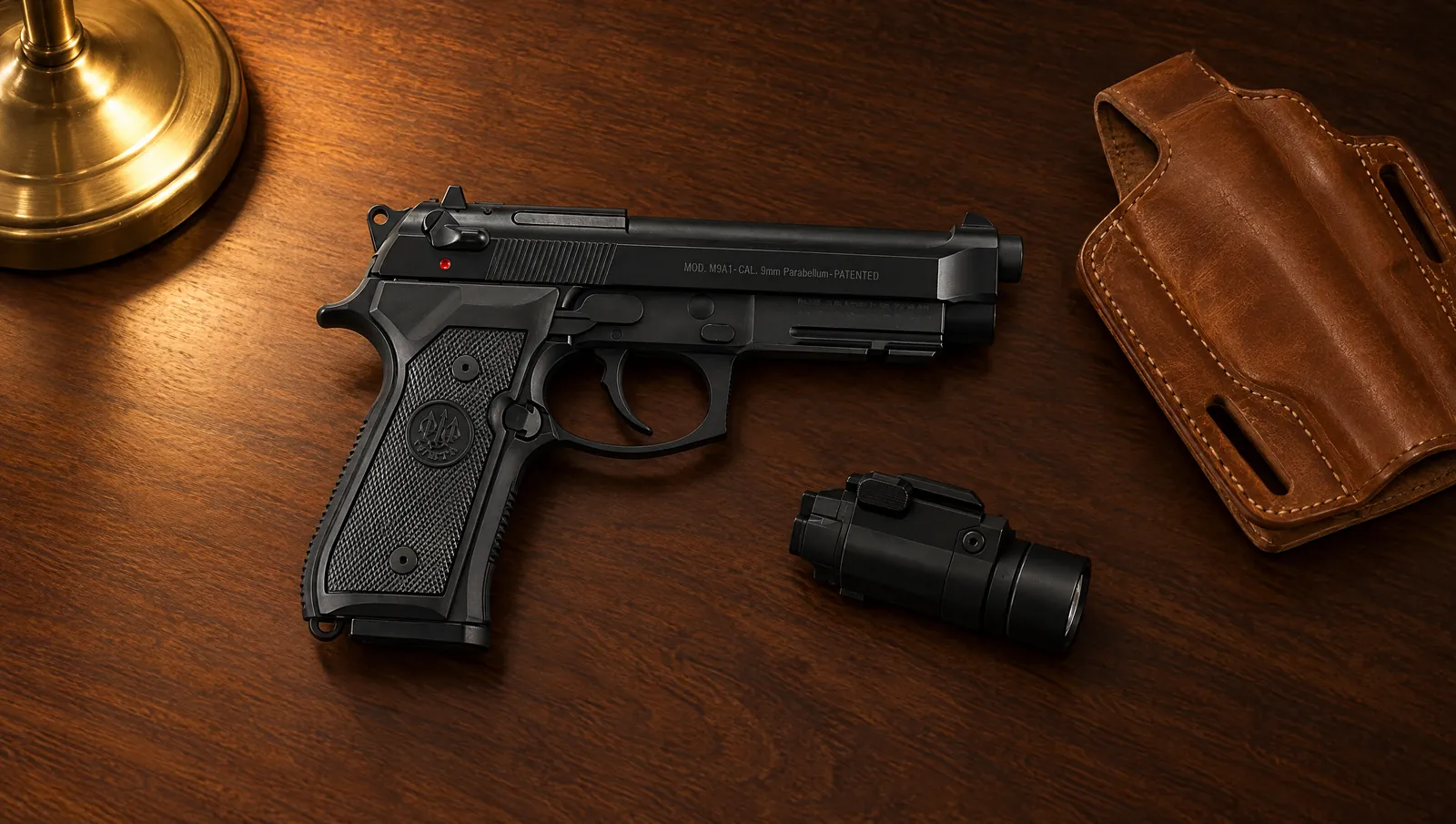
Review: Beretta M9A1, the Marine Corps M9 With a Rail
Our Rating: 7.8/10
- MSRP: From $869.00 for all three 9mm models (JS92M9A1, JS92M9A1M, JS92M9A1CA)
- Street Price: Our live card starts at about $765 for the 10-round gun and about $790 for the 15-round JS92M9A1M (Use our live pricing for the best up to date deal)
- Caliber: 9mm Luger (9×19)
- Action: Double action/single action, hammer fired
- Barrel Length: 4.9 in.
- Overall Length: 8.5 in.
- Height: 5.5 in.
- Width: 1.49 in.
- Weight (unloaded): 33.9 oz
- Capacity: 15 rounds (JS92M9A1M) or 10 rounds (JS92M9A1 and JS92M9A1CA)
- Frame Material: Aluminum, with a MIL-STD-1913 accessory rail
- Sight Radius: 6.1 in., 3-dot sights
- Safety: Ambidextrous slide-mounted safety and decocker
- Trigger Pull (DA/SA): 11 lb 4 oz / 5 lb 2 oz on our gun, with the short-reset trigger bar
- Grip: Checkered front strap and backstrap, beveled magazine well
Pros
- Accessory rail for a weapon light
- 700 rounds without a stoppage
- Checkered straps and beveled magazine well
Cons
- About $100 to $190 more than an M9 in stores
- Most store guns hold 10 rounds
- No optics cut
Quick Take
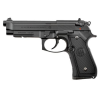
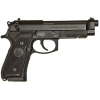
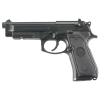
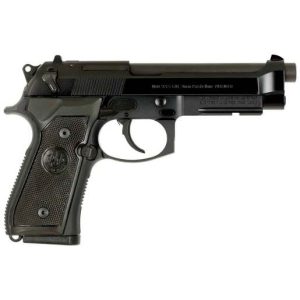
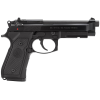
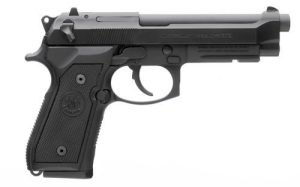
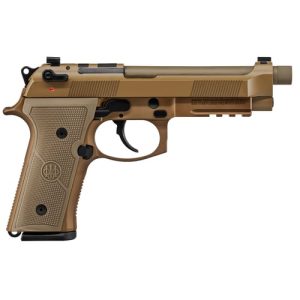
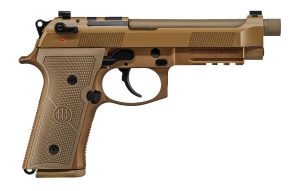
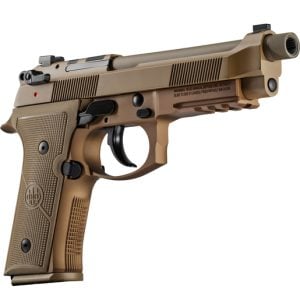
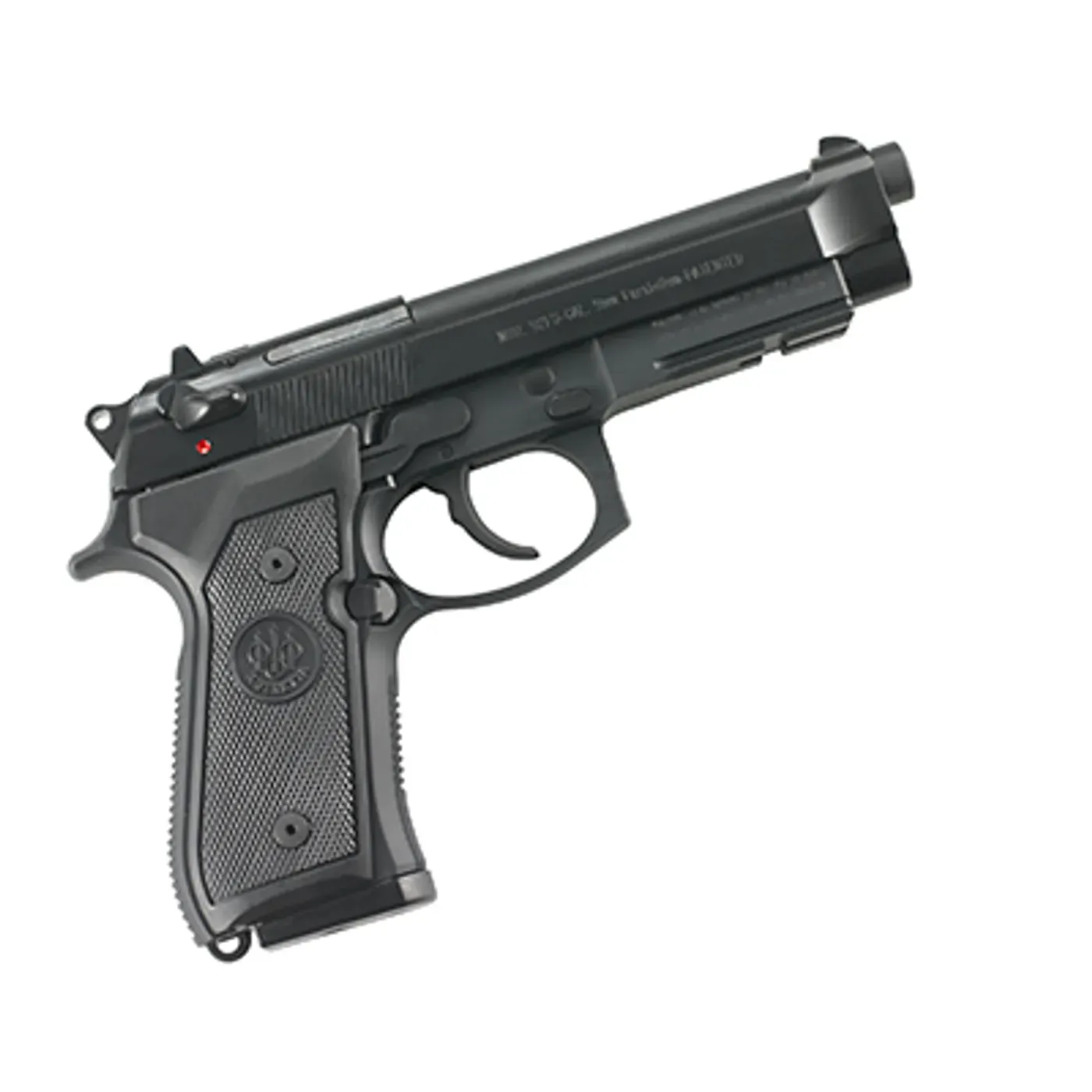
The Beretta M9A1 is the M9 service pistol with an accessory rail under the barrel. It was developed for the U.S. Marine Corps, and Beretta USA has put it back in the catalog. You also get checkering on the front strap and backstrap, a beveled magazine well and a short-reset trigger bar. Everything else is M9: a 4.9 in. barrel, an open-top slide, a double action first shot and a safety on the slide.
I shot 700 rounds through a 15-round JS92M9A1M. It never stopped. From a rest at 25 yards it put five rounds of Federal HST into 2.0 in., and it ran a weapon light on the rail for a full low-light session without a problem.
The gun is easy to recommend. The price takes more thought. Beretta lists the M9A1 only $50 above the plain M9, but in stores the gap is about $100 to $190. And most of the M9A1s on sale are the 10-round model, at the same list price as the 15-round one. Read the SKU before you pay.
Best For: Home defense buyers who want a Beretta 92 with a light on it, and anyone who carried an M9A1 in the service. Not for red dot shooters, and not for buyers who’d be just as happy with the cheaper M9.
M9A1 vs M9 vs 92FS vs M9A4: What the Money Buys
Beretta sells four full-size 92-pattern guns that look alike from across the counter. The specs below come from Beretta’s M9A1 page and its M9 and M9A4 pages. The 92FS figures are from our own review gun. Street prices are from October 2, 2026.
| Model | Rail | Capacity | Weight | Beretta List | Street |
| M9 (J92M9A0M) | No | 15 | 33.3 oz | $819 | About $675 |
| 92FS | No | 15 | 33.3 oz | $699 when we reviewed it | About $620 |
| M9A1 (JS92M9A1, 10-round) | Yes | 10 | 33.9 oz | $869 | About $765 |
| M9A1 (JS92M9A1M, 15-round) | Yes | 15 | 33.9 oz | $869 | About $790 |
| M9A4 Full Size | Yes | 10, 15 or 18 | 33.4 oz | $1,249 | $1,149 |
At list, the rail costs $50 and 0.6 oz. That’s a fair price for being able to hang a light on the gun. In stores it’s a different story. Palmetto State Armory has the 15-round M9 at $676.99 and the 15-round M9A1 at $869.99, a $193 gap for the same magazine and the same barrel. Even the 10-round guns at Sportsman’s Warehouse are $100 apart, $699.99 against $799.99.
The capacity trap is the part nobody mentions. Beretta lists three 9mm M9A1s at the same $869: the JS92M9A1 with 10-round magazines, the JS92M9A1M with 15-round magazines and the JS92M9A1CA for California. Of the new M9A1 listings we track, most are the 10-round guns. If your state allows 15, look for the M at the end of the SKU.
Design Intent: Why Beretta Built It This Way
Beretta’s own M9 page describes the M9A1 as “a version of the classic M9 modified to meet the specific requirements of the US Marine Corps.” The headline change was a rail on the dust cover for lights and lasers. The checkering and the beveled magazine well came along with it.
The gun went away for a while and came back. Shooting Illustrated’s first look at the relaunch quotes Beretta USA pistol product manager Broxton Carlile saying the company was “excited to make it available again.” The same piece notes that the frame keeps the original 92 shape, with the full-size grip and radiused backstrap, and that the M9A1 uses the same parts as any other M9, locking block included.
That’s the appeal. This isn’t a modernized 92 like the M9A4. It’s the plain service pistol with one useful change, and it uses the same magazines and parts as the M9.
Beretta M9A1 Variants
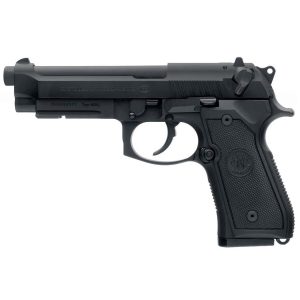
The .22 LR M9A1 is on the same Beretta page as the 9mm guns, at $469 and 26.08 oz. It’s a trainer that shares the look and the controls. Our pricing card above excludes it so the two don’t get mixed up.
Competitor Comparison
The M9A1’s toughest competition comes from its own family, and from a Brazilian copy that costs $300 less.
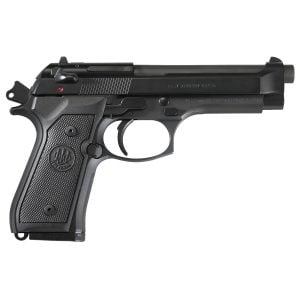
Beretta M9 (about $675 to $720)
The same pistol without the rail, the checkering or the beveled magazine well. Our card starts the 15-round M9 at about $675, about $90 less than the cheapest 10-round M9A1. If you won’t mount a light, this is the smarter buy.
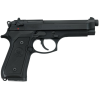
Beretta 92FS (about $600 to $720)
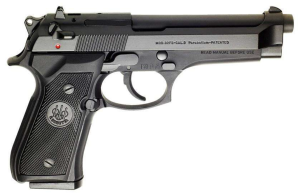
The commercial twin of the M9. Sportsman’s Outdoor Superstore listed a black 92FS at $599, Palmetto State Armory had an OD green one at $649.99, and Guns.com had the black gun at $717.99. It has no rail either. Our Beretta 92FS review covers 1,000 rounds with it.

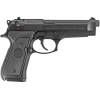
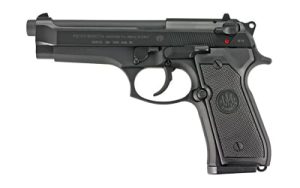
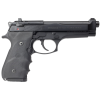
Beretta M9A4 ($1,149 to $1,150.99)
The modern one. The M9A4 adds an optics-ready slide, tritium night sights, a Vertec frame and an 18-round magazine, and it lists at $1,249. Guns.com had it at $1,149, about $385 more than the cheapest M9A1. If you want a red dot on a 92, this is the gun. Our Beretta M9A4 review has the details.
Taurus 92 (about $460 to $535)
The Taurus 92 is built on the same pattern, has a rail, holds 17+1 and has an ambidextrous safety and decocker. Our card starts it at about $460, about $305 under the cheapest M9A1. The Beretta is better finished and has the service history. The Taurus is the value. See our Taurus 92 review.
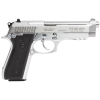
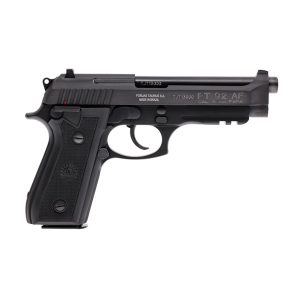
Verdict: The M9A1 is about $90 to $190 over an M9 and about $385 under an M9A4. Buy it if the rail matters and the optics cut doesn’t. For the rest of the field, see our best DA/SA 9mm pistols and best Beretta pistols.
Testing Protocol
We shot one gun, a 15-round M9A1 (JS92M9A1M), for 700 rounds over four sessions in September. Three were at an outdoor range between 62°F and 86°F. The fourth was an evening session with a weapon light on the rail.
Ammunition Log
- Practice, 550 rounds: Federal American Eagle 124 gr FMJ (250), Blazer Brass 115 gr FMJ (200), Winchester 124 gr NATO FMJ (100)
- Defensive, 150 rounds: Federal HST 124 gr (50), Speer Gold Dot 147 gr (50), Hornady Critical Duty 135 gr (50)
Phase 1: Break-In
I wiped the packing oil off, put a drop on each rail and on the locking block, and started with American Eagle. The first 100 rounds ran clean. The slide is easy to rack for a full-size gun, and the magazines dropped free every time.
Phase 2: Reliability
All 700 rounds fed, fired and ejected. That includes three hollow point loads from 124 to 147 gr and 100 rounds of hotter NATO-spec ball. I didn’t clean the gun during the test. Brass went out the open top and landed about eight feet to my right, in the same spot all day.
The light session was the reason to buy this model, so I ran 150 rounds with a full-size weapon light clamped to the rail. The light stayed tight, and the extra weight out front made the gun shoot a little flatter.
Phase 3: Accuracy
From a rest at 25 yards, single action, five-shot groups averaged 2.0 in. with Federal HST 124 gr, 2.4 in. with American Eagle 124 gr and 2.9 in. with Blazer 115 gr. The 6.1 in. sight radius helps, and so does 33.9 oz of gun.
Our trigger gauge read 11 lb 4 oz in double action and 5 lb 2 oz in single action. The double action pull is long and smooth. The single action pull has some take-up and a clean break, and the short-reset trigger bar does what Beretta says: the reset is shorter than on my older 92FS, and you can feel it.
Tracking & Observations
After 700 rounds without cleaning, the gun was dirty and nothing else. The locking block showed even wear on both lugs. The finish on the slide and frame had no marks beyond a little holster shine at the muzzle. The one habit you have to learn is the safety. It sits on the slide, and if you rack the gun with an overhand grip you can sweep it down to safe without meaning to. Check it after every reload until it’s a reflex.
What This Means for You
- Reliability: No stoppages in 700 rounds, dirty.
- Ammo Preference: 124 gr loads shot best. 115 gr was fine for practice.
- Accuracy Expectation: 2 to 3 in. at 25 yards from a rest in single action.
- Maintenance: Oil the rails and the locking block. Check that the safety is off after you rack the slide.
- Upgrade Impact: A weapon light is the whole point of the rail. Buy that first.
Performance Testing Results
Reliability (9/10)
Seven hundred rounds, six loads, no cleaning and no stoppages. It’s what you expect from a 92, and it delivered.
Accuracy (8/10)
A 2.0 in. group at 25 yards is very good for a service pistol with plain 3-dot sights. The first double action shot is where most people throw one, and that takes practice.
Ergonomics & Recoil (7/10)
Recoil is soft. This is a big, heavy 9mm and it shoots like one. The checkering on both straps locks the gun in your hand better than the smooth M9. The grip is wide at 1.49 in., and shooters with small hands will find the double action reach long. The slide-mounted safety is the other complaint.
Fit, Finish, and Quality Control (9/10)
The slide runs like it’s on bearings, the finish is even and the markings are crisp. I couldn’t find a machining mark worth pointing at.
Value (6/10)
At list the M9A1 is $50 over an M9, and that would be a 9. At about $100 to $190 over in stores, it’s a 6. The Taurus 92 at about $460 doesn’t help.
Features (7/10)
A rail, checkered straps, a beveled magazine well and a short-reset trigger bar. No optics cut and no night sights. For those you need the M9A4.
Technical Deep Dive
Slide and Barrel
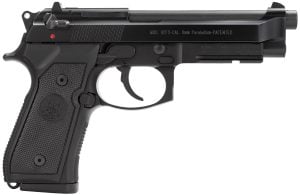
The open-top slide and 4.9 in. barrel are standard 92. Beretta gives a 6.1 in. sight radius and 3-dot sights. The right side of the slide on Beretta’s product photo is marked with the model and caliber on one line.
Frame
An aluminum frame with a MIL-STD-1913 rail on the dust cover, checkering on the front strap and backstrap, and a beveled magazine well. Beretta lists the gun at 5.5 in. tall and 1.49 in. wide, against 5.4 in. for the M9.
Trigger System
Double action for the first shot and single action after that, with an exposed hammer. Beretta fits a short-reset trigger bar. For how this compares with a striker gun, see striker fired vs hammer fired.
Safety and Controls
| Component | Specification | Benefit |
| Safety | Ambidextrous, slide mounted, also decocks | Works with either hand; lowers the hammer safely |
| Rail | MIL-STD-1913 on the dust cover | Takes a weapon light or laser |
| Grip straps | Checkered front and back | More hold with wet or gloved hands |
| Magazine well | Beveled | Faster, surer reloads |
| Trigger bar | Short reset | Less travel between shots |
Parts, Accessories and Upgrades
| Upgrade Category | Recommended Component | Why It Matters | Cost Estimate |
| Weapon light | A full-size rail light | It’s the reason to buy the M9A1 over the M9 | $100 to $300 |
| Holster | A 92-series holster cut for a railed frame and your light | A light-bearing gun needs a light-bearing holster | $60 to $120 |
| Magazines | Factory 92-series 15-round magazines | Turns a 10-round gun into a 15, where that’s legal | $25 to $40 each |
| Trigger | Beretta’s Xtreme-S trigger group for the 92 series | Beretta lists it as compatible on the M9A1 page | See Beretta’s price |
Our Beretta 92 parts and accessories guide covers what fits a railed frame, and our best weapon lights list has the lights. For ammunition, see best 9mm ammo.
Common Problems & Solutions
- Safety goes on when you rack the slide: It’s the slide-mounted lever. Rack from the rear serrations with your thumb clear, or sweep the lever up as part of every reload.
- You bought a 10-round gun by accident: The JS92M9A1 and the JS92M9A1M cost the same. Check the SKU and the round count in the listing before you order.
- Old holster doesn’t fit: The rail changes the dust cover. Buy a holster made for a railed 92.
- First shot goes low: That’s the 11 lb double action pull. Dry fire the first shot until it’s smooth.
- Got the .22 by mistake: The M9A1-22 looks the same in a thumbnail and costs about half. Read the caliber line.
From the M9 to the M9A1
Beretta’s M9 page tells the backstory in its own words: the M9 “won the historic contract with the US military in 1985” and then won a renewal “after more than two decades of hard use.” The same page calls the M9A1 “a version of the classic M9 modified to meet the specific requirements of the US Marine Corps.” The visible change is the rail on the dust cover. The less visible ones are the checkered front strap and backstrap and the beveled magazine well.
Shooting Illustrated’s report on the relaunch notes that the M9A1 frame keeps the original 92 contours, with the full-size grip and radiused backstrap, rather than the straighter Vertec shape used on the M9A4. That’s why an M9A1 feels like an M9 in the hand. If you learned on the issued pistol, the controls, the reach and the balance are exactly what you remember, with a place to hang a light.
Which Ammo the M9A1 Liked
Every load ran, which is what you expect from a 92. The groups separated them. All of these are five-shot averages from a rest at 25 yards in single action.
| Load | Rounds | Group | Notes |
| Federal HST 124 gr | 50 | 2.0 in. | Best group; what I’d carry in it |
| Federal American Eagle 124 gr FMJ | 250 | 2.4 in. | The practice load to buy |
| Winchester 124 gr NATO FMJ | 100 | About 2.6 in. | Hotter, ran perfectly |
| Hornady Critical Duty 135 gr | 50 | About 2.3 in. | Good second choice for defense |
| Speer Gold Dot 147 gr | 50 | About 2.5 in. | Softest recoil of the hollow points |
| Blazer Brass 115 gr FMJ | 200 | 2.9 in. | Cheapest, widest groups |
The 124 gr weight suited this barrel best, and that’s handy, because 124 gr is the most common 9mm practice and defense weight. For picks, see our best 9mm ammo guide.
Running a Light on the Rail
The rail is the reason to buy an M9A1 over an M9, so I spent a whole session on it. With a full-size weapon light clamped on, the pistol balanced further forward and the muzzle settled faster between shots. I shot 150 rounds with it in the evening session and the light stayed tight on the rail the whole time.
Two things to plan for. First, the holster: a light-bearing gun needs a holster made for that gun and that light together, so buy them as a pair. Second, the switch: practice reaching the light’s switch with your support hand without changing your grip. On a DA/SA pistol with a slide-mounted safety, adding one more control is fine, as long as you train with it. Our best weapon lights list has options that fit a 1913 rail.
The Slide Safety, Explained
The M9A1’s safety is on the slide and it’s ambidextrous, and Beretta lists it as a combined safety and decocker. Push it down and the hammer drops safely and the trigger disconnects. Push it up and the gun is ready to fire double action. Most M9 shooters carry it with the lever up, so the first shot is a long double action pull and the safety doesn’t need to be touched.
The catch is that an overhand slide rack can sweep the lever down by accident. It happened to me twice on day one. The fix is a habit: after every reload or malfunction clearance, run your thumb up the lever as you come back on target. If you’d rather not deal with it, the M9A4 is a decocker-only design that springs back up on its own.
Cleaning and the Locking Block
The M9A1 field strips like any 92: magazine out, slide locked back, chamber checked, then press the disassembly button and rotate the lever, and the slide comes forward off the frame. The barrel and locking block lift out together. I cleaned ours once, at the end of the 700 rounds, and it had run fine dirty.
Pay attention to the locking block. It’s the part that wears on high-round-count 92s, and checking it costs nothing: look at the two lugs for cracks or uneven wear every time you clean. Ours showed even wear after 700 rounds. Put a drop of oil on each rail and on the locking block, and the open-top slide will keep running.
Who Should NOT Buy This Gun
The M9A1 is a fine pistol with a narrow reason to exist. Plenty of buyers should pick something else.
- Buyers who won’t mount a light: The Beretta M9 Standard is about $90 to $190 less and shoots the same.
- Red dot shooters: The M9A1 has no optics cut. The Beretta M9A4 does.
- Buyers on a budget: The Taurus 92 has a rail and 17+1 for about $460.
- People who dislike a slide-mounted safety: The Beretta M9A4 is a decocker-only gun, and our Beretta 92XI review covers the 92 with its safety on the frame.
Final Verdict
The Beretta M9A1 ran 700 rounds without a stoppage, shot 2.0 in. at 25 yards and carried a light without complaint. It’s the M9 with the one feature a home defense pistol needs most, and it’s built as well as any 92 I’ve handled.
Whether to buy it comes down to two questions. Will you put a light on it? If not, the M9 does the same job for about $90 to $190 less. And is the one in your cart the 15-round JS92M9A1M? If it’s the 10-round gun and you don’t live in a restricted state, keep looking, or plan on buying magazines.
Final Score: 7.8/10. The right 92 for a light, at a price that’s hard to love.
FAQ: Beretta M9A1
Is the Beretta M9A1 a good gun?
Yes. Our M9A1 fired 700 rounds without a stoppage and shot a 2.0 in. group at 25 yards. It is a heavy, soft-shooting service pistol with a rail for a light.
What is the difference between the Beretta M9 and the M9A1?
The M9A1 adds an accessory rail, checkering on the front strap and backstrap, a beveled magazine well and a short-reset trigger bar. Beretta lists it at 33.9 oz and $869, against 33.3 oz and $819 for the M9.
How much does a Beretta M9A1 cost?
Beretta lists all three 9mm M9A1 models from $869. On October 2, 2026, our live card started at $765.22 for a 10-round gun, Sportsman's Warehouse had one at $799.99 and Palmetto State Armory had the 15-round JS92M9A1M at $869.99.
How many rounds does the Beretta M9A1 hold?
It depends on the SKU. The JS92M9A1M ships with 15-round magazines. The JS92M9A1 and the California JS92M9A1CA ship with 10-round magazines at the same list price.
Is the Beretta M9A1 still made?
Yes. Beretta USA reintroduced the M9A1, and it is on Beretta's website with a current list price.
Does the Beretta M9A1 have an optics cut?
No. The M9A1 has 3-dot iron sights and no optics cut. The Beretta M9A4 has an optics-ready slide.
Is the M9A1 the same as the 92FS?
It is the same basic pistol. The M9A1 has a railed frame, checkered straps and a beveled magazine well that the 92FS and the M9 do not have.
3,213+ Gun & Ammo Deals
Updated daily from 200+ top retailers. Filter by category, caliber, action type, and price.
Related Guides