

Last updated October 26th 2026
Some of the links below are affiliate links, meaning at no additional cost to you, we may earn a commission if you click through and make a purchase.
By Nick Hall, who wrote our .32 ACP ammo guide and best concealed carry ammo rankings.
Handgun calibers run from the tiny .25 Auto, with a .251 inch bullet, to the .500 S&W Magnum, with a half-inch bullet and 60,000 psi of chamber pressure. The chart below covers the 15 pistol and revolver cartridges you’re most likely to see on a box of ammo, with the bullet diameter, case length, overall length, velocity and maximum pressure for each.
Every figure comes from one place: ANSI/SAAMI Z299.3-2022, the industry standard for centerfire pistol and revolver ammunition. SAAMI is the body that sets the dimensions and pressure limits American ammo makers load to. The other caliber charts in the search results don’t cite it, and that’s how some of their numbers drift. A few of these figures surprised me, starting with the fact that a .38 Special bullet isn’t .38 inches.
Table of Contents
How we tested: Every pick here is ranked against our testing methodology. Minimum round counts, accuracy and reliability protocols, the failures that disqualify a gun.
Handgun Calibers Chart
| Caliber | Bullet diameter (in.) | Case length (in.) | Overall length (in.) | Sample bullet | SAAMI velocity | Energy | Max pressure |
|---|---|---|---|---|---|---|---|
| .25 Auto | .2510 | .615 | .860 to .910 | 50 gr | 755 fps | 63 ft-lb | 25,000 psi |
| .32 Auto (.32 ACP) | .3125 | .680 | .890 to .984 | 71 gr | 900 fps | 128 ft-lb | 20,500 psi |
| .380 Auto (.380 ACP) | .3565 | .680 | .910 to .984 | 95 gr | 945 fps | 188 ft-lb | 21,500 psi |
| 9mm Luger | .3555 | .754 | 1.000 to 1.169 | 115 gr | 1,135 fps | 329 ft-lb | 35,000 psi |
| .357 SIG | .3555 | .865 | 1.100 to 1.140 | 125 gr | 1,350 fps | 506 ft-lb | 40,000 psi |
| .40 S&W | .4005 | .850 | 1.085 to 1.135 | 180 gr | 985 fps | 388 ft-lb | 35,000 psi |
| 10mm Auto | .4005 | .992 | 1.240 to 1.260 | 180 gr | 1,030 fps | 424 ft-lb | 37,500 psi |
| .45 Auto (.45 ACP) | .4530 lead / .4520 jacketed | .898 | 1.190 to 1.275 | 230 gr | 830 fps | 352 ft-lb | 21,000 psi |
| .38 Special | .3590 lead / .3580 jacketed | 1.155 | 1.275 to 1.550 | 158 gr | 900 fps | 284 ft-lb | 17,000 psi |
| .357 Magnum | .3590 lead / .3580 jacketed | 1.290 | 1.405 to 1.590 | 158 gr | 1,545 fps | 837 ft-lb | 35,000 psi |
| .327 Federal Magnum | .3130 | 1.200 | 1.275 to 1.475 | 100 gr | 1,600 fps | 568 ft-lb | 45,000 psi |
| .44 S&W Special | .4325 | 1.160 | 1.415 to 1.615 | 240 gr | 800 fps | 341 ft-lb | 15,500 psi |
| .44 Remington Magnum | .4320 lead | 1.285 | 1.535 to 1.610 | 240 gr | 1,175 fps | 736 ft-lb | 36,000 psi |
| .45 Colt | .4560 | 1.285 | 1.515 to 1.600 | 250 gr | 750 fps | 312 ft-lb | 14,000 psi |
| .500 S&W Magnum | .500 | 1.625 | 1.900 to 2.250 | 400 gr | 1,800 fps | 2,877 ft-lb | 60,000 psi |
Bullet diameter, case length and overall length are SAAMI’s maximum cartridge dimensions, read from its drawings. Velocity is SAAMI’s nominal figure for the sample bullet weight, measured 15 feet from the muzzle of a standard test barrel, and where SAAMI lists several velocities for one weight, I used the first. Energy is calculated from that weight and velocity. Pressure is SAAMI’s maximum average pressure for standard loads, measured with a piezo transducer.
The Name on the Box Is Not the Bullet Size
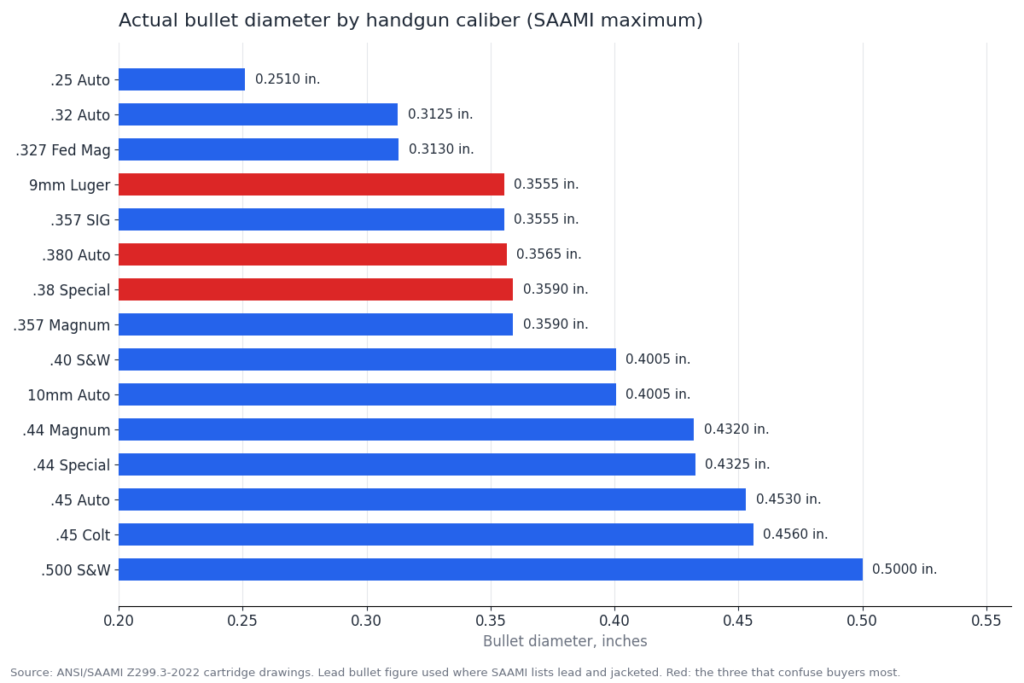
Handgun cartridge names are marketing and history, not measurements. Three examples straight from SAAMI’s drawings:
- .38 Special is a .357 bullet. SAAMI draws it at .3590 inch for lead and .3580 for jacketed, exactly the same as the .357 Magnum. The “.38” came from the old heeled bullets of the 1800s, when the bullet’s outside diameter matched the case.
- .380 Auto fires a slightly wider bullet than 9mm Luger. SAAMI’s maximum is .3565 inch for the .380 and .3555 for the 9mm. They aren’t interchangeable, because the .380 case is .680 inch long and the 9mm case .754.
- .44 Magnum is a .43. SAAMI draws the lead bullet at .4320 inch, and the .44 Special at .4325.
This is why handloaders buy bullets by diameter, not by caliber name, and why “.357” bullets work in both .38 Special and .357 Magnum. For rifle cartridges, see our rifle caliber guide.
How to Read the Caliber on a Box or Headstamp
SAAMI publishes an official full name and abbreviated name for every cartridge, and it says those names “should be used on cartridge headstamps and on firearm markings to properly identify the caliber.” That’s why the same round shows up under different labels:
| What you might see | SAAMI full name | SAAMI abbreviation |
|---|---|---|
| 9mm, 9×19, 9mm Parabellum | 9mm Luger | 9mm Luger |
| .380 ACP, 9mm Kurz, 9mm Short | 380 Automatic | 380 Auto |
| .32 ACP, 7.65 Browning | 32 Automatic | 32 Auto |
| .45 ACP | 45 Automatic | 45 Auto |
| .40 Cal, .40 S&W | 40 Smith & Wesson | 40 S&W |
| .44 Mag | 44 Remington Magnum | 44 Rem Mag |
| .38 Spl | 38 Special | 38 Spl |
The rule that keeps you safe is simple: the name stamped on the barrel or slide has to match the headstamp on the case. “9mm” alone isn’t enough, because 9×18 Makarov and 9×23 Winchester are separate SAAMI cartridges with their own chambers, and .380 Auto is a 9mm too. When in doubt, read the full name.
Bullet Weight: What the Grain Number Means
The grain figure on a box is bullet weight, not powder, and there are 7,000 grains in a pound. Every caliber is loaded in a range of weights, and SAAMI lists a separate velocity for many of them. The 9mm Luger table alone runs from 88 grains at 1,500 fps to 150 grains at 900 fps. Lighter bullets go faster and kick with a sharper snap. Heavier bullets go slower, hit with more momentum and feel more like a push. The sample weights in the chart above, like 115 grain 9mm and 230 grain .45, are the common practice loads, which is why they’re also the cheapest boxes on the shelf.
Same Bullet, Different Cartridge
Several handgun calibers share a bullet and differ only in the case behind it. SAAMI’s drawings make the families easy to see:
| Bullet diameter | Cartridges that use it | What changes |
|---|---|---|
| .3555 in. | 9mm Luger, .357 SIG | The .357 SIG is a bottlenecked case, .865 inch long, loaded to 40,000 psi against the 9mm’s 35,000 |
| .4005 in. | .40 S&W, 10mm Auto | The 10mm case is .992 inch long against the .40’s .850, and SAAMI allows it 37,500 psi |
| .3580 to .3590 in. | .38 Special, .357 Magnum | Same rim and body, but the Magnum case is 1.290 inch against 1.155, and 35,000 psi against 17,000 |
| .4320 to .4325 in. | .44 Special, .44 Magnum | The Magnum case is 1.285 inch against 1.160, and 36,000 psi against 15,500 |
The revolver pairs matter most. The Magnum cases were made longer on purpose, so a Magnum round won’t drop into the shorter chamber of a .38 Special or .44 Special revolver built for far lower pressure. Going the other way, a .357 Magnum revolver is commonly listed by its maker as able to fire .38 Special, and a .44 Magnum revolver .44 Special, which is why so many people practice with the softer round. Check your gun’s manual before you try it.
Which Handgun Calibers Run the Hottest?
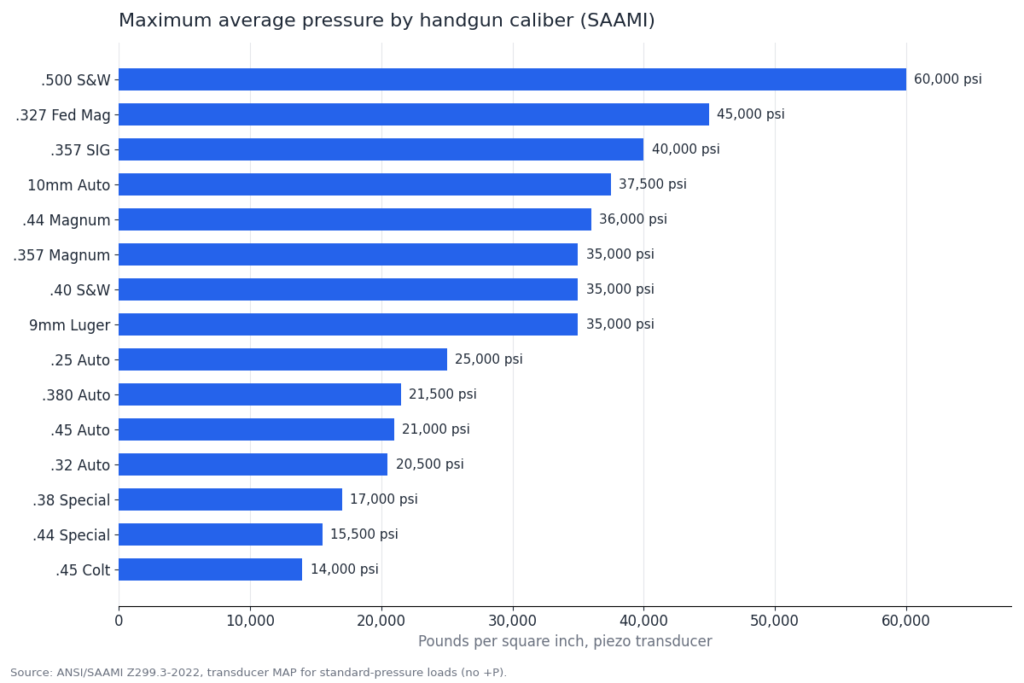
Pressure is what the gun has to contain, and it ranges more than fourfold across handgun calibers. The .45 Colt and .44 Special, both from the black-powder and early smokeless era, sit at 14,000 and 15,500 psi. Modern autoloader cartridges like 9mm and .40 S&W sit at 35,000. The .500 S&W Magnum is loaded to 60,000, as high as many rifle cartridges.
+P is a separate, higher limit, and only some calibers have one. SAAMI lists +P pressures for four handgun cartridges:
| Cartridge | Standard max | +P max |
|---|---|---|
| 9mm Luger | 35,000 psi | 38,500 psi |
| .38 Special | 17,000 psi | 20,000 psi |
| .45 Auto | 21,000 psi | 23,000 psi |
| .38 Super Auto | Not listed | 36,500 psi (sold only as +P) |
SAAMI’s own footnote says +P ammunition should be used “only in firearms especially designed for this cartridge and so recommended by the manufacturer.” There’s no SAAMI +P for .380, .40 S&W, 10mm or .32 Auto, so a +P label on those boxes is the ammo maker’s own claim. Our .32 ACP ammo guide covers what that means in practice.
Why Your Revolver Is Slower Than the Box
SAAMI measures revolver ammunition two ways: in a solid test barrel, and in a vented barrel that leaks gas at the gap like a real revolver’s cylinder. The vented numbers are lower, sometimes by a lot:
| Load | Solid test barrel | Vented test barrel | Difference |
|---|---|---|---|
| .38 Special, 158 gr | 900 fps | 750 fps | 150 fps |
| .357 Magnum, 158 gr | 1,545 fps | 1,220 fps | 325 fps |
| .44 Magnum, 240 gr | 1,500 fps | 1,150 fps | 350 fps |
SAAMI notes that vented barrels “are used for the establishment of catalog velocity values for cartridges normally chambered in revolvers,” and it also warns that you shouldn’t expect to duplicate its velocities from a real gun. Short barrels lose more again. When a box of .357 says 1,450 fps and your snub-nose chronographs 1,150, nothing is wrong with the ammo.
Pocket and Backup Calibers: .25, .32 and .380
These three are blowback-pistol cartridges built for small guns. The .25 Auto throws a 50 grain bullet at 755 fps for about 63 foot-pounds, which is why few people carry one now. The .32 Auto roughly doubles that, and the .380 Auto at 95 grains and 945 fps gets about 188 foot-pounds, close to three times the .25. All three are loaded to modest pressures, 20,500 to 25,000 psi, which is what lets them work in light, simple pistols. If you’re choosing a gun, see our best .380 pistols and best .32 ACP pistols.

Service Pistol Calibers: 9mm, .40 S&W, .45 ACP, 10mm and .357 SIG
These are the duty and carry calibers most people mean when they say “handgun.” The 9mm Luger is the default: a .3555 inch bullet at 35,000 psi, cheap to shoot and the easiest pistol round to find. The .45 Auto fires a much heavier, wider bullet at far lower pressure, 21,000 psi, and SAAMI’s 230 grain figure starts at 830 fps. The .40 S&W shares its bullet with the 10mm and sits between 9mm and 10mm in energy. For the head-to-heads, read 9mm vs .45 ACP, 9mm vs .45 vs .40 and 9mm vs 10mm.


Revolver Calibers: .38 Special to .500 S&W
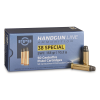
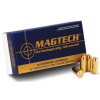
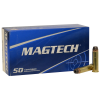
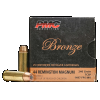
Revolver cartridges are rimmed and straight-walled, and they span the widest range on the chart. The .38 Special is the soft-shooting classic at 17,000 psi. The .357 Magnum doubles that pressure and, from SAAMI’s solid test barrel, pushes a 158 grain bullet at 1,545 fps for about 837 foot-pounds. The .327 Federal Magnum runs the highest pressure of the mid-size revolver rounds, 45,000 psi. The .44 Magnum and .500 S&W are hunting and bear-country cartridges, and the .45 Colt and .44 Special are the low-pressure classics for older and cowboy-style guns.



Which Handgun Caliber Should You Buy?
- First gun, carry or home defense: 9mm Luger. It’s the cheapest to practice with, it’s in every gun store, and modern defensive loads perform well. See our concealed carry ammo and home defense ammo rankings.
- Smallest pocket gun: .380 Auto, or .32 Auto if recoil or racking the slide is a problem.
- Revolver for the house or the truck: .357 Magnum, which also shoots .38 Special for practice in most revolvers.
- Woods and bear country: 10mm Auto in a pistol, .44 Magnum or bigger in a revolver.
- Already own a .45 or .40: keep shooting it. The ballistics haven’t gotten worse, though the ammo costs more than 9mm.
What About .22 LR?
The .22 Long Rifle is a rimfire cartridge, so it lives in a different SAAMI standard, Z299.1, with its own test barrels, and isn’t on this chart. It’s the cheapest round to learn on, but it’s a training and small-game cartridge first. All SAAMI standards are free from the SAAMI standards page.
Frequently Asked Questions
What are the most common handgun calibers?
The most common are 9mm Luger, .380 Auto, .45 Auto (.45 ACP), .40 S&W, .38 Special and .357 Magnum. 10mm Auto, .44 Magnum, .32 Auto and .357 SIG are less common, and .25 Auto, .44 Special and .45 Colt are mostly found in older or specialty guns.
What is the actual bullet diameter of a 9mm?
SAAMI draws the 9mm Luger bullet at .3555 inch maximum. The .357 SIG uses the same diameter, and the .380 Auto is slightly wider at .3565 inch.
Is a .38 Special bullet .38 inches?
No. SAAMI draws the .38 Special bullet at .3590 inch for lead and .3580 inch for jacketed, the same as the .357 Magnum. The .38 name comes from older heeled bullets.
Can you shoot .38 Special in a .357 Magnum?
Most .357 Magnum revolver makers say yes, because the cartridges share the same bullet, rim and body, and the .38 Special case is just shorter. You cannot fire .357 Magnum in a .38 Special gun, since the longer Magnum case is made not to fit. Always check your gun's manual.
Which handgun caliber has the highest pressure?
Of the common calibers, the .500 S&W Magnum, at a SAAMI maximum average pressure of 60,000 psi. The .327 Federal Magnum is next at 45,000 psi, then the .357 SIG at 40,000.
What does +P mean on handgun ammo?
It means the ammo is loaded to a higher pressure than standard. SAAMI lists +P limits for 9mm Luger (38,500 psi), .38 Special (20,000 psi), .45 Auto (23,000 psi) and .38 Super Auto (36,500 psi). Use it only in guns the manufacturer approves for +P.
Why is my ammo slower than the box says?
Box velocities come from standard test barrels, and SAAMI says not to expect them from a real gun. Revolvers lose more because gas escapes at the cylinder gap. SAAMI lists a 158 grain .357 Magnum at 1,545 fps in a solid test barrel and 1,220 fps in a vented one.
What is the best handgun caliber for beginners?
9mm Luger for most people. It is affordable, easy to find and manageable to shoot. If recoil is a problem, .380 Auto or .38 Special in a heavier gun are softer options.
3,976+ Gun & Ammo Deals
Updated daily from 200+ top retailers. Filter by category, caliber, action type, and price.