

Last updated November 21st 2026
Some of the links below are affiliate links, meaning at no additional cost to you, we may earn a commission if you click through and make a purchase.
By Nick Hall, who wrote our best AR-15 handguard guide.
Table of Contents
The Short Answer
For a new AR-15 handguard, buy M-LOK. Keep Picatinny where it still wins: the top rail, where your optic lives. Picatinny vs M-LOK is mostly settled by one layout. Almost every modern M-LOK handguard has a continuous Picatinny rail on top, and M-LOK slots everywhere else, so you get a solid base for a red dot or scope and a slim, light handguard for your hand, light and sling.
Pick a full Picatinny quad rail only if you already own a drawer full of Picatinny accessories and don’t want to buy rail sections, or if you’re building a retro or military-clone rifle that should look the part. For everyone else, M-LOK is lighter, slimmer and kinder to your hands, and when US special operations tested it, it held zero and stayed attached better than its last rival.
What Picatinny Actually Is
A Picatinny rail is a raised rail with cross slots along its whole length, standardized by the US military as MIL-STD-1913 in 1995, which is why you’ll also see it called a 1913 rail. The name comes from Picatinny Arsenal in New Jersey, and the design grew out of the older Weaver mount. Accessories clamp over the rail and a recoil lug drops into one of the slots, so the part can’t slide under recoil.
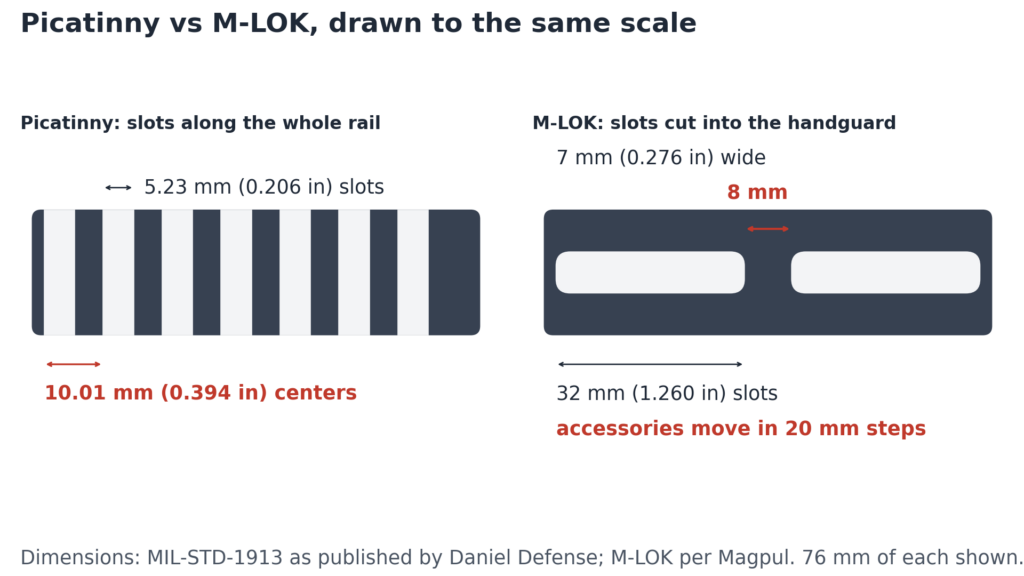
The numbers are fixed by the standard. The locking slots are 0.206 in. (5.23 mm) wide, on centers 0.394 in. (10.01 mm) apart, 0.118 in. (3.00 mm) deep. That shared spacing is why a scope ring or light mount built to the standard fits any rail cut to it. NATO later adopted a metric update of the same idea as STANAG 4694, approved in May 2009.
The recoil lug does the real work. When a scope mount’s lug sits against the front wall of a slot, the gun recoils into it rather than away from it, so the optic can’t creep forward shot after shot. Put an optic back in the same slot it came off and you give it the best chance of holding zero, so note the slot before you pull a scope.
You’ll find Picatinny everywhere, not just on AR-15 handguards. It’s the top rail on nearly every flat-top upper receiver, the scope base on many bolt guns, and the accessory rail on many pistol frames. That reach is the reason it isn’t going anywhere.
How M-LOK Works
M-LOK, short for Modular Lock and often typed MLOK, is a slot system cut into the handguard itself, where accessories bolt straight on with a T-nut that turns 90 degrees and locks. Magpul designed it as an evolution of the MOE slot it had used since 2007 and released it in 2014 as a free licensed standard, so any maker can build to it once Magpul approves them. Magpul calls it a negative-space mount: the accessory locks into a hole instead of clamping onto a rail.
The slots run about 1.260 in. long and 7 mm wide, with 8 mm between them. Magpul says accessories can be positioned in 20 mm increments, half a slot, because a part can sit inside one slot or bridge two. There’s no rail sticking out, so the handguard stays round and smooth wherever you haven’t mounted anything.
Mounting takes simple tools. Magpul lists a 7 mm box wrench, a 1/8 in. hex key, ideally 4 in. or longer for clearance, and a 5/32 in. hex key. Because the T-nut goes in from the outside and turns to lock, you never need to reach inside the handguard. That’s the big change from Magpul’s older MOE slot, which needed a nut placed on the inside and was never suited to free-float tubes.
Picatinny vs M-LOK Comparison Table
M-LOK vs Picatinny at a glance:
| Picatinny (MIL-STD-1913) | M-LOK | |
|---|---|---|
| What it is | Raised rail with cross slots | Slots cut into the handguard |
| Introduced | Standardized in 1995 | Released by Magpul in 2014 |
| Who controls it | US military standard, NATO version STANAG 4694 | Magpul, free license on approval |
| Slot size | 0.206 in. wide on 0.394 in. centers | About 1.260 in. long, 7 mm wide, 8 mm apart |
| Fine adjustment | One slot, about 0.394 in. | 20 mm, half a slot |
| Handguard profile | Bulky, sharp edges, rails all round | Slim and smooth between accessories |
| Weight | Heavier, rail everywhere | Lighter, rail only where you add it |
| Best for | Optics, top rails, legacy accessories | Lights, slings, grips, bipods on the handguard |
| Tool-free quick detach | Yes, with a QD-lever mount | No, hex key and re-torque |
| Takes the other’s parts? | No, not without an adapter | Yes, with a Picatinny rail section |
Weight, Bulk and Your Hands
The day-to-day difference is how the handguard feels: a quad rail is fat and sharp, and an M-LOK handguard is slim and smooth. A quad rail carries four full-length rails whether you use them or not, and every one of those ridges is pressing into your support hand. That’s why quad-rail rifles wore rail covers and ladder panels for years. On an M-LOK handguard, slot covers do the same job and weigh next to nothing.
M-LOK handguards “weigh less than their Picatinny counterparts because they don’t require the extra mass of external rails,” and a quad rail needs a larger outer diameter to make room for the rails and the accessories on them. Less metal out front also makes the rifle swing faster and feel lighter than the scale says.
M-LOK’s downsides are small but real. T-nuts take more care to line up than a Picatinny clamp, a dropped nut can rattle around inside the handguard, and moving a mount means re-torquing it.
The open slots help with heat too. An M-LOK handguard is open between slots, so air moves around the barrel, while a quad rail wraps it in metal. Smooth sides also snag less on slings, gear and door frames.
What the Military Found When It Tested M-LOK
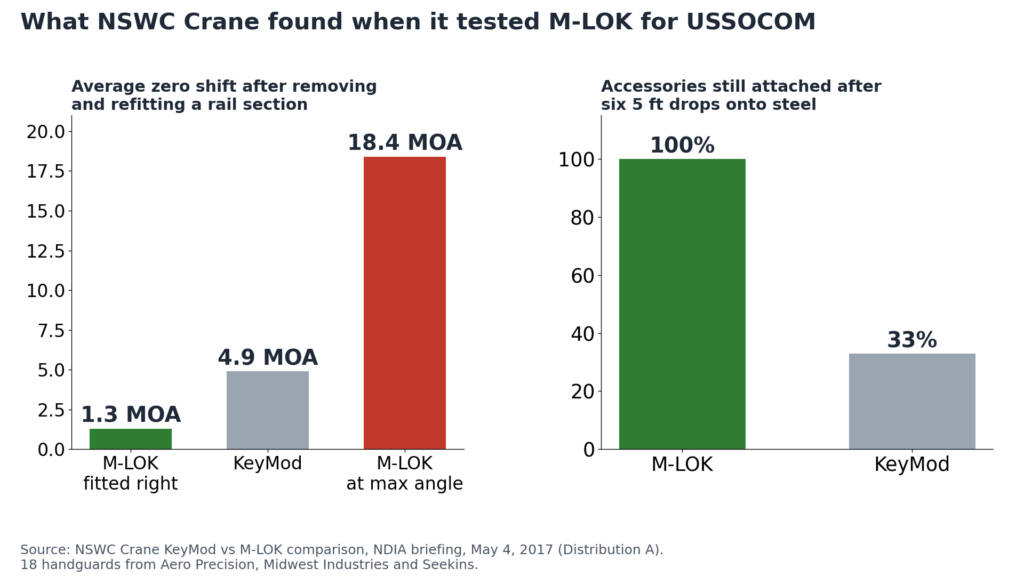
When NSWC Crane tested M-LOK against KeyMod for US Special Operations Command, M-LOK held zero better, kept every accessory attached in drop tests and took over three times the failure load. Between that test and the market, the slot war is over, and it’s worth knowing the numbers before you trust a light or laser to an M-LOK slot.
In a briefing dated May 4, 2017, Crane laid out the test: 18 handguards from Aero Precision, Midwest Industries and Seekins, the same model in both systems from each maker. Removing and refitting a rail section with a laser on it, M-LOK averaged 1.3 MOA of zero shift against 4.9 MOA for KeyMod. In six drops from 5 feet onto steel, 100% of the M-LOK accessories stayed attached, against 33% of KeyMod. Both systems passed the endurance test, 10,200 simulated full-auto rounds per handguard on a cyclic load machine, and the vibration test without a loose fastener.
The test was built to be harder than real use. Crane said outright that its tests were designed to compare the two systems “in situations that may far exceed standard field conditions.” In the pull test, a simulated weapon light was dragged off the handguard by a machine until something broke. KeyMod failed the way it did in the drop test, with the handguard cracking between slots and the rail section separating. Every M-LOK failure happened at the light mount instead, and M-LOK’s average failure load came out over three times KeyMod’s.
Picatinny wasn’t part of that test, so it doesn’t tell you M-LOK beats a quad rail. What it does tell you is that a properly made M-LOK handguard is a serious duty-grade mount, not a lightweight compromise. The Army’s URG-I upper, first fielded in 2018, uses a Geissele M-LOK handguard.
The Install Mistake That Costs You Your Zero
An M-LOK accessory that isn’t seated square in its slot can shift your zero by more than 18 MOA, against about 1.3 MOA when it’s installed correctly. It comes from the same Crane test. Testers deliberately refit rail sections at the maximum angle the slot allowed, and the average zero shift jumped to 18.4 MOA.
- Thread the T-nuts onto the screws with the nut’s stem facing up.
- Set the gap between the accessory and the nut just wider than the handguard wall.
- Turn the nuts in line with the slot and drop the accessory in at the position you want.
- Make sure the accessory sits flush on the handguard, square to the slot.
- Push down on the screw and turn. The nut rotates 90 degrees, stops, then tightens.
- Torque to Magpul’s maximum or below, never above.
Magpul’s maximum torque is 35 in-lb (4.0 N-m) for metal accessories on a metal handguard and 15 in-lb (1.7 N-m) whenever polymer is involved. A torque driver, blue medium-strength thread locker and a paint-pen witness mark on each screw cost less than a lost zero.
Can You Put Picatinny Accessories on M-LOK?
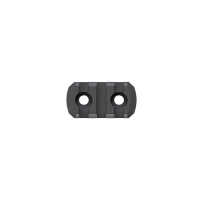
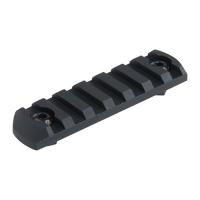
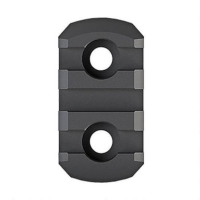
Yes. Bolt an M-LOK Picatinny rail section to the handguard and any Picatinny accessory clamps onto it. Magpul makes them in aluminum and polymer in several lengths, and so do most handguard makers. Searching for an “M-LOK to Picatinny adapter” gets you the same part. It’s the cheapest way to keep using a favorite light mount, bipod or grip on a new M-LOK handguard.
I’d skip polymer for anything that has to hold zero, like a laser or a backup sight, and torque an aluminum section to Magpul’s number. Polymer sections are fine for a grip or a hand stop.
Grips and bipods follow the same rule. An M-LOK vertical or angled foregrip bolts straight into the slots, and a Picatinny grip clamps onto a rail section. For a bipod, it comes down to how often it comes off: an M-LOK bipod mount bolts direct and stays put, while a short Picatinny section lets a QD-lever bipod swap between rifles.
Placement matters more than people expect. I’d put a light rail section far enough forward that the light’s head clears the muzzle device’s blast but stays behind the muzzle, and set a hand stop where your support hand naturally lands before you torque anything. Then mark each section with a paint pen so you can see at a glance if one has moved.
Can You Put M-LOK Accessories on Picatinny?
Not directly. An M-LOK accessory needs slots to grip, and a Picatinny rail doesn’t have them. In practice you just buy the Picatinny version of the light mount, grip or sling point, since almost every accessory maker sells both. If you have a lot of M-LOK gear and a quad-rail rifle, swapping the handguard costs less than adapting every accessory.
The Third Option: An M-LOK Handguard With a Picatinny Top Rail
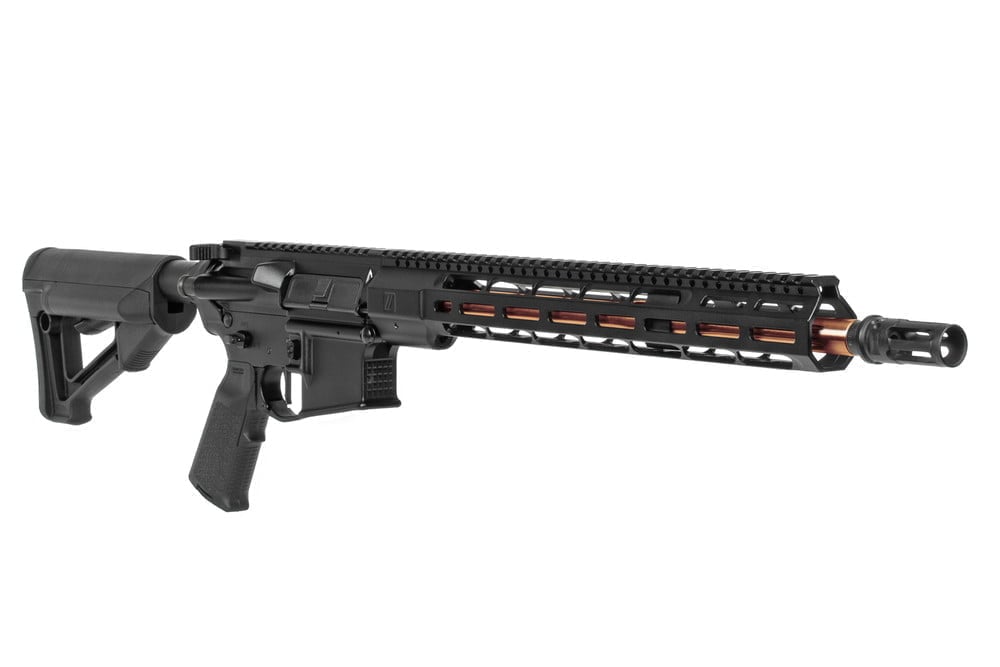
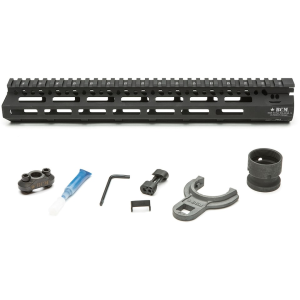
The best setup for most rifles is both: a continuous Picatinny rail on top for optics and M-LOK slots everywhere else. That’s how the BCM MCMR, the Daniel Defense RIS III and most other modern free-float handguards are built. Your red dot, magnifier or scope rings get the full-length Picatinny rail they were designed for, lined up with the upper receiver’s rail, and the rest of the handguard stays slim.
It also settles the debate for optics. Scope rings and red dot mounts are made for Picatinny, and they belong on a continuous top rail, not bolted across M-LOK slots.
When a Picatinny Quad Rail Still Makes Sense
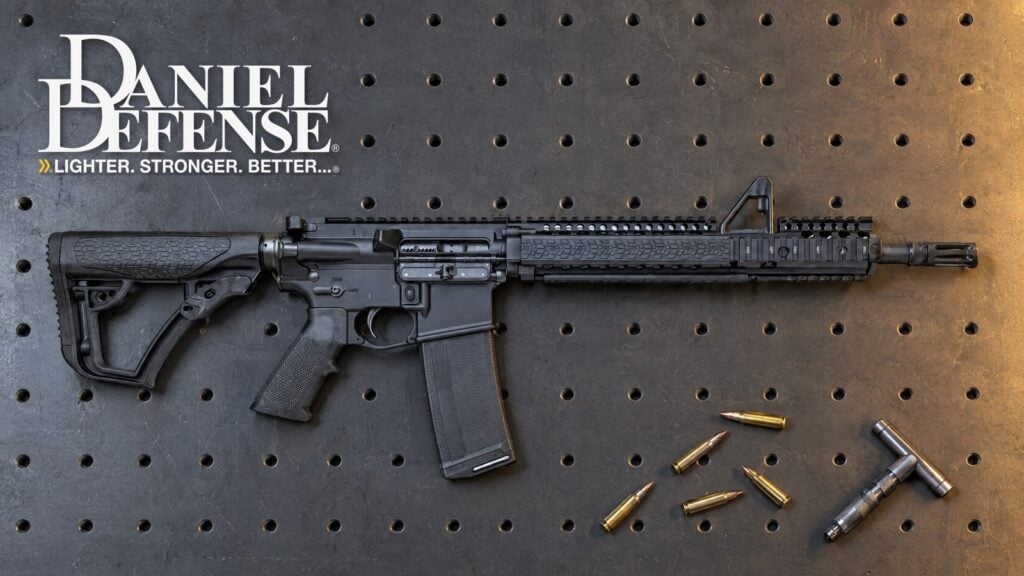
A quad rail still makes sense for clone builds, for rifles that will wear a lot of accessories at once, and for anyone who already owns the Picatinny gear. If you’re building a Block II or MK18-style rifle, the Daniel Defense RIS II is the rail that defined it, and an M-LOK handguard would look wrong. Quad rails also keep one real edge: a QD-lever mount comes off one Picatinny rail and clamps onto another in seconds, while an M-LOK mount needs a hex key and a re-torque every time it moves. And if the plan is a light, laser, grip and bipod all at once, a quad rail gives you room for all of it without buying a single rail section.
The trade-off is the one above: weight, a fat profile and sharp edges you’ll want to cover with rail panels. Many quad rails are also drop-in two-piece designs that clamp to the front sight base, so pressure on the handguard reaches the barrel, and our free float vs drop-in handguard guide explains why that costs accuracy.
What About KeyMod and Weaver?
KeyMod lost to M-LOK and Weaver is an older, narrower cousin of Picatinny. VLTOR released KeyMod in 2012, and NSWC Crane’s 2017 test for SOCOM found M-LOK beat it on zero retention, drops and failure load. You’ll still find KeyMod handguards used, and they work, but new accessories are thin on the ground.
Weaver rails look like Picatinny but have narrower slots, about 0.180 in. against 0.206 in., and only a few of them at uneven spacing. Weaver accessories fit a Picatinny rail, but a Picatinny accessory with a full-size recoil lug won’t fit a Weaver rail, because the lug is too wide for the slot. If you’re not sure what you have, measure the slot. Our Weaver vs Picatinny guide has the full dimensions and the fit rules.
How to Tell What Your Rifle Has
Before you settle Picatinny vs M-LOK for a new build, check what your rifle already has.
- Raised ridges with cross slots, even spacing: Picatinny. Slots measure about 0.206 in. wide.
- Long, flat-sided rectangular slots with rounded ends, cut through the handguard: M-LOK. Each slot is about 1.26 in. long.
- Keyhole-shaped holes, a wide circle with a narrow tail: KeyMod.
- Ridges like Picatinny but only a few narrower slots, about 0.180 in. wide, at uneven spacing: Weaver.
If you’re still unsure, measure a slot with calipers. A Picatinny slot is about 0.206 in. wide, and the slot centers repeat every 0.394 in. An M-LOK slot is about 0.276 in. wide and 1.26 in. long. Those numbers don’t overlap, so one measurement settles it.
Older Magpul MOE handguards have slots that look like M-LOK but aren’t. They need a plate on the inside, and Magpul’s newer M-LOK accessories only fit them with an adapter.
My Recommendation
I’d build every new AR-15 on an M-LOK handguard with a full-length Picatinny top rail. It’s lighter, it’s comfortable, it takes every modern light and sling mount directly, and a $20 to $40 rail section lets it carry anything Picatinny. That’s my answer to Picatinny vs M-LOK for most builds. The only rifles I’d put a quad rail on are clones and rifles that need four rails of gear.
- Home defense AR: M-LOK handguard with a Picatinny top rail, a light mounted direct to M-LOK, and a red dot on the top rail.
- Competition rifle: M-LOK, for the light weight and a slim handguard you can clamp your hand around.
- Precision or hunting AR: M-LOK with a short bottom rail section for a Picatinny bipod.
- Military clone build: Picatinny quad rail, because that’s what the original wore.
Whichever you pick, buy quality. Crane’s results came from good handguards installed correctly, and a cheap handguard with sloppy slots won’t hold a zero no matter which system it uses. Our best AR-15 handguard roundup covers the ones worth buying, and if you’re mounting a light, see our best weapon lights.
Picatinny Quad Rail Live Pricing
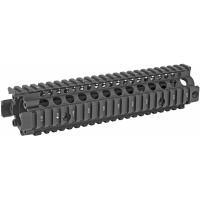
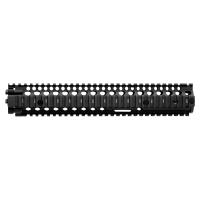
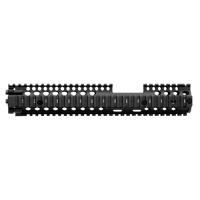
The Daniel Defense RIS II is the quad rail most people picture when they hear “Picatinny handguard.”
M-LOK Handguard Live Pricing
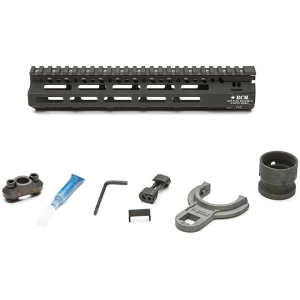
The BCM MCMR is a free-float M-LOK handguard with a full-length Picatinny top rail, the layout I’d pick for most builds.
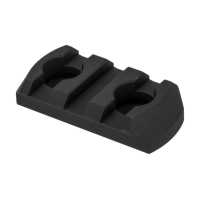
And to run Picatinny accessories on it, a Magpul M-LOK aluminum rail section:
Frequently Asked Questions
Is M-LOK better than Picatinny?
For a handguard, yes for most people. M-LOK is lighter, slimmer and smoother because it only adds rail where you mount something. Picatinny is still the right choice for a top rail that carries an optic.
What is the difference between Picatinny and M-LOK?
Picatinny is a raised rail with cross slots that accessories clamp onto, standardized as MIL-STD-1913 in 1995. M-LOK is a set of slots cut into the handguard that accessories bolt into with a rotating T-nut, released by Magpul in 2014.
Can you put Picatinny accessories on an M-LOK handguard?
Yes. Bolt an M-LOK Picatinny rail section to the handguard and any Picatinny accessory clamps onto it. Use aluminum sections for lasers, lights and sights that need to hold zero.
Can you put M-LOK accessories on a Picatinny rail?
Not directly, because an M-LOK accessory needs a slot to lock into. Buy the Picatinny version of the accessory instead, or swap to an M-LOK handguard.
Is M-LOK strong enough for duty use?
Yes. In NSWC Crane's test for US Special Operations Command, every M-LOK accessory stayed attached through six 5 ft drops onto steel, and M-LOK took over three times KeyMod's failure load.
What torque should M-LOK screws be?
Magpul lists a maximum of 35 in-lb for metal accessories on a metal handguard and 15 in-lb whenever a polymer accessory or polymer handguard is involved.
Does M-LOK hold zero?
When it's installed correctly. NSWC Crane measured 1.3 MOA average zero shift after removing and refitting M-LOK rail sections, but 18.4 MOA when they were refitted at the slot's maximum angle.
Is KeyMod better than M-LOK?
No. NSWC Crane's 2017 test for SOCOM found M-LOK beat KeyMod on zero retention, drop testing and failure load, and most new handguards and accessories now use M-LOK.
Are Picatinny and M-LOK the same?
No. Picatinny is a raised rail that accessories clamp onto, and M-LOK is a slot cut into the handguard that accessories bolt into. Neither takes the other's parts without an M-LOK Picatinny rail section.
3,972+ Gun & Ammo Deals
Updated daily from 200+ top retailers. Filter by category, caliber, action type, and price.
Related Guides