
Last updated November 2026 · By Nick Hall
Some of the links below are affiliate links, meaning at no additional cost to you, we may earn a commission if you click through and make a purchase.
- Treat every gun as loaded
- Point the muzzle in a safe direction
- Keep your finger off the trigger until you’re ready to shoot
- Know your target and what’s beyond
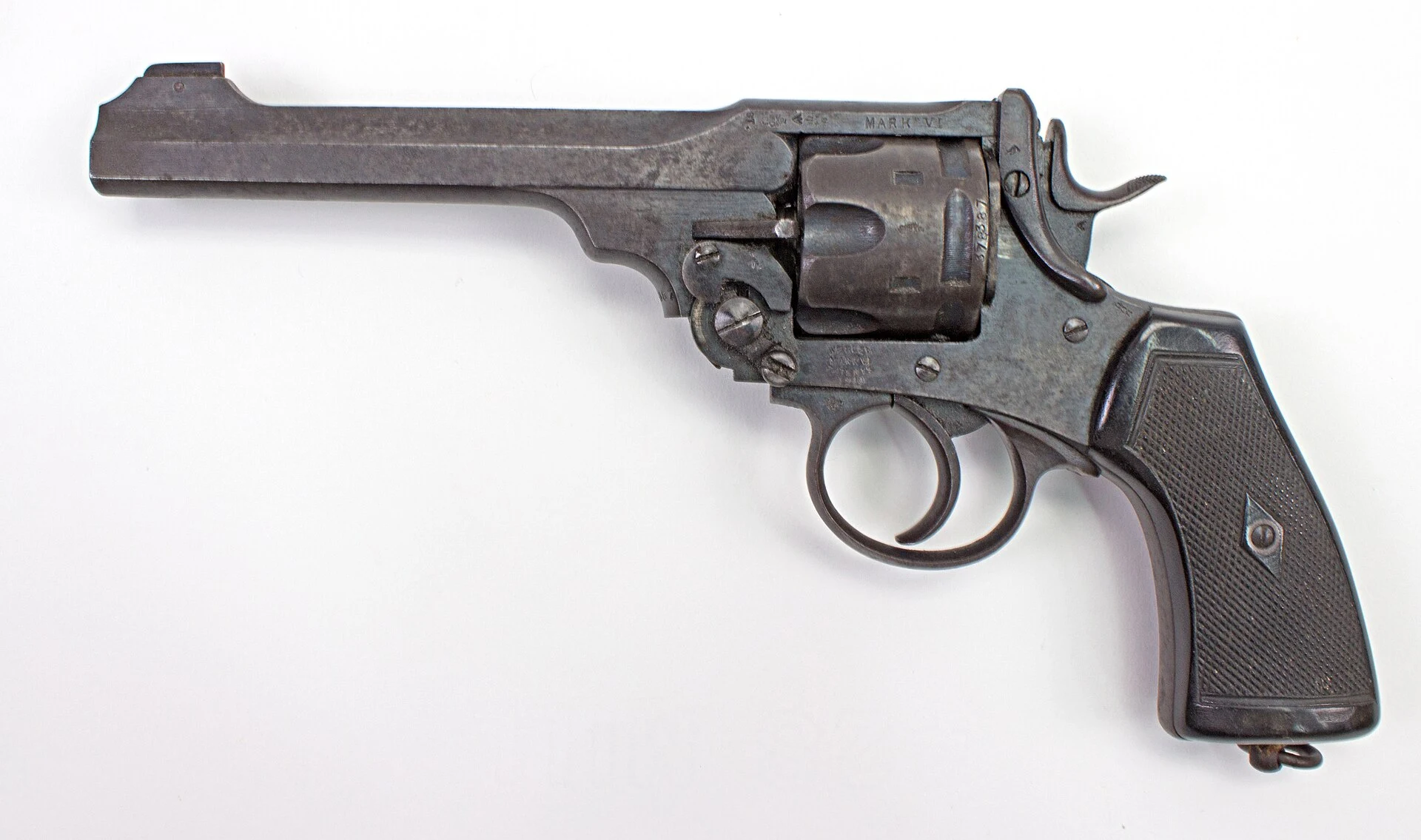
The Webley Mk VI is the revolver that went over the top with British officers in the First World War. Adopted on May 24, 1915, it fired the big, slow .455 Webley cartridge from a 6-inch barrel, and its top-break frame let a soldier dump all six empties at once and reload in seconds. Webley and the Royal Small Arms Factory at Enfield built about 300,000 of them, and they served in two world wars before the .38-caliber Enfield No. 2 replaced them.
Today the Webley is one of the most interesting service revolvers a collector can buy, and one of the easiest to get wrong. About half the Mk VIs sold in the U.S. have had their cylinders shaved to take .45 ACP in moon clips, and those guns are worth far less and can’t safely fire standard .45 ACP. This guide covers what each Mark is worth, using 455 completed sales, how to tell the Marks apart, how to spot a shaved cylinder, which Webleys count as antiques under U.S. law, what ammo to buy, and how they shoot.
Quick take
Buy an unconverted .455 Webley Mk VI if you want the real thing; it sells for about $1,325 when the seller confirms it’s original, against about $690 for a shaved .45 ACP gun. Check the cylinder before you pay, and never fire standard factory .45 ACP in a shaved Webley. For a cheaper shooter, a .38 Mk IV sells for about $555 and an Enfield No. 2 for about $482.
- Typical used price (Dec 2025 to Nov 2026 sales): about $788 for a Mk VI of any kind, $1,325 for a Mk VI sold as unconverted, $690 for a shaved Mk VI, $1,780 for a Mk I and $555 for a .38 Mk IV
- Caliber: .455 Webley (Mk I to Mk VI); .38 S&W, also called .38/200 (Mk IV .38 and Enfield No. 2)
- Made: Mk I adopted 1887; Mk VI adopted 1915; Webley stopped making firearms in 1979
- Legal: Mk I, II and III guns made in or before 1898 can be antiques; every Webley service revolver is a curio or relic by age
How we tested: Every pick here is ranked against our testing methodology. Minimum round counts, accuracy and reliability protocols, the failures that disqualify a gun.
Webley Revolver Pros and Cons
Pros
- Iconic British service revolver
- Top-break ejects all six at once
- Original .455 guns hold value
- Early Marks can be federal antiques
- Reliable and simple to strip
- Mk IV .38 costs about $555
Cons
- Shaved cylinders can’t take factory .45 ACP
- .455 ammo is scarce and costly
- Heavy double-action trigger
- Fixed sights often shoot high
- Shaved guns sell for about half
- Over-shaved cylinders misfire .455
Webley Revolvers at a Glance
| Mark | Adopted | Barrel and grip | Cartridge | Typical sale |
|---|---|---|---|---|
| Mk I | November 8, 1887 | 4 in., bird’s-beak grip | .455 (early guns .476 Enfield) | About $1,780 |
| Mk II | May 21, 1895 | 4 in., bird’s-beak grip | .455 | About $1,512 |
| Mk III | October 5, 1897 | 4 in., bird’s-beak grip | .455 | Too few sales |
| Mk IV | July 21, 1899 | 4 in. standard, bird’s-beak grip | .455 | About $998 |
| Mk V | December 9, 1913 | 4 in., bird’s-beak grip, wider cylinder for cordite loads | .455 | About $822 |
| Mk VI | May 24, 1915 | 6 in., square-butt grip, removable front sight | .455 | About $788 |
| Mk IV .38 | Offered 1928, made 1929 to 1982 | 4 or 5 in. | .38 S&W (.38/200) | About $555 |
Table of Contents
What It’s Actually Like to Shoot a Webley: Myth vs. Truth
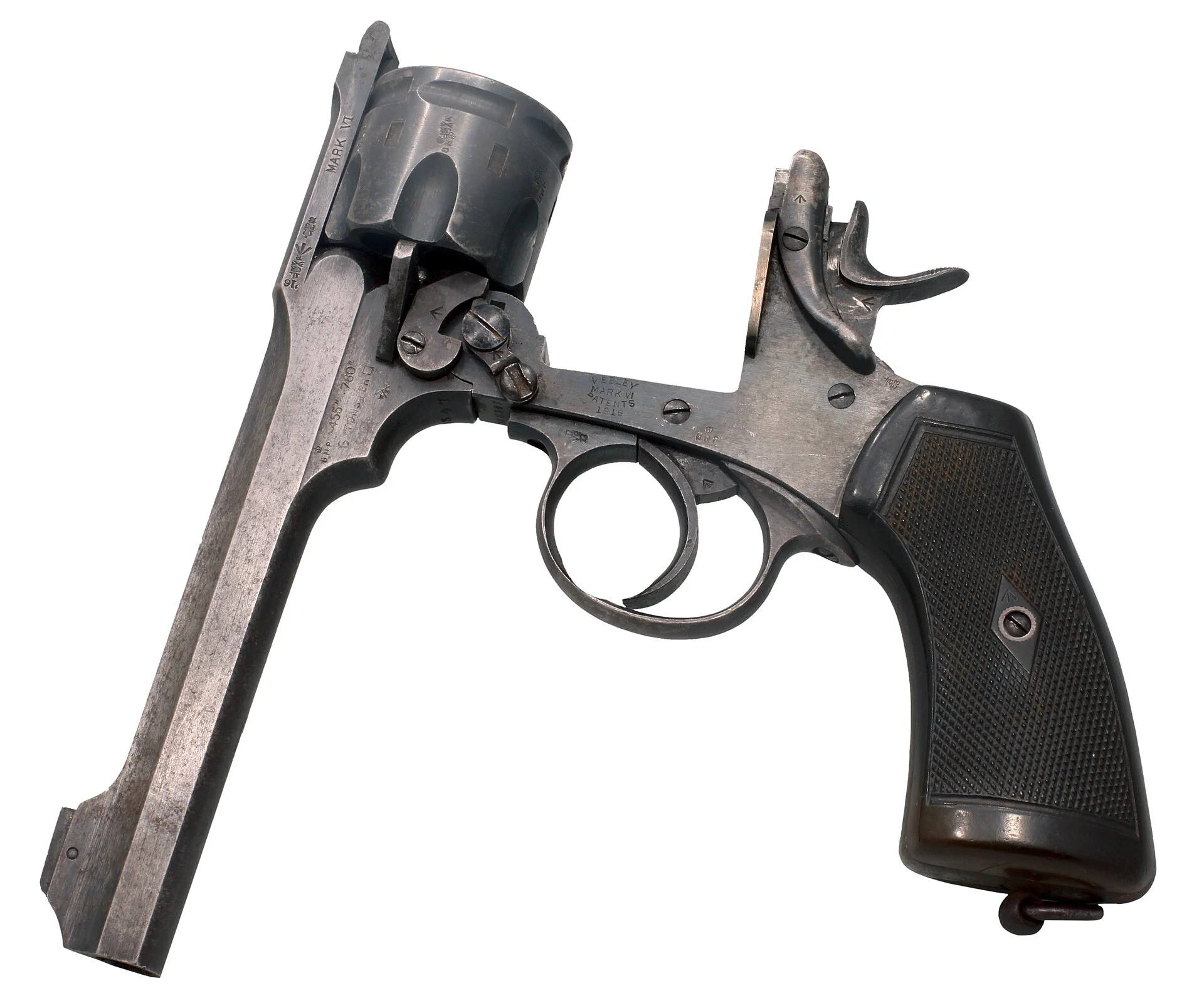
We shot an unconverted 1918 Mk VI in .455, a Mk VI with a shaved cylinder using reduced-pressure .45 ACP loads made for these guns, and a .38 Mk IV. Before shooting, we checked each gun’s lockup at the top latch, the cylinder gap and the cylinder face for signs of shaving.
Shooting from a rest at 15 to 20 yards, the .455 Mk VI averaged about 2.4 inches for five shots, and about 2 inches with Fiocchi’s 262-grain lead load. The big surprise was velocity: Fiocchi’s box claims 850 fps, but from the 6-inch barrel it ran about 600 fps, right where the original .455 service load was rated. Recoil is a slow push, not a snap. Like most Mk VIs, ours shot high and a little left of the sights, and there’s no windage adjustment to fix it.
The shaved gun with downloaded .45 ACP averaged about 2.6 inches at 15 yards at about 640 fps. The .38 Mk IV grouped about 3 inches at 15 yards, and its single-action pull broke at about 5.5 lb; the double action ran past the 12 lb limit of our gauge. Light 145-grain .38 S&W loads hit well below the sights, while 200-grain loads, like the wartime service round, hit close to the point of aim. None of the guns had a malfunction, which matches the Webley’s reputation, but the triggers are the weak spot on all of them.
| The myth | What we found | Evidence |
|---|---|---|
| “A shaved Webley is fine with any .45 ACP.” | Standard .45 ACP runs about 21,000 psi, while the .455 is rated about 13,000 psi. Use only reduced loads made for these guns. | American Rifleman; CIP; SAAMI |
| “The top-break frame is weak.” | The latch isn’t the limit; the cartridge’s low pressure rating and the steel in early Marks are. Over-shaved cylinders are the real problem. | Our inspection; Handloader |
| “The Webley is a target gun.” | It’s a combat revolver. Groups around 2 inches at 15 to 20 yards are good for a fixed-sight service gun, but it isn’t a target pistol. | Our range session |
| “Fiocchi .455 is a hot load.” | It ran about 600 fps from our 6-inch Mk VI, close to the original service load. | Our chronograph |
| “Every Webley is an antique.” | Only guns made in or before 1898 qualify. A military Mk IV, adopted in July 1899, cannot be a pre-1899 antique. | 18 U.S.C. 921(a)(16) |
Who the Webley Is For (and Who Won’t Enjoy It)
- The military collector: the Mk VI is a cornerstone of any World War I collection, and dated, marked guns tell a story.
- The antique buyer: early Marks made in or before 1898 can be bought without a federal transfer in most states.
- The shooter who handloads: .455 and reduced .45 ACP loads are easy to tailor to the Webley’s low pressure rating.
- The fan of film and TV: Webleys star in everything from war films to Peaky Blinders.
- Anyone who wants cheap, plentiful ammo: .455 is scarce and costs about 80 cents a round or more.
- Shooters who want a smooth trigger: the double-action pull is heavy and long.
- Anyone planning to feed a shaved gun factory .45 ACP: it isn’t safe.
- Buyers who want a carry or defense gun: buy something modern.
What a Webley Revolver Costs in 2026
These are completed-sale prices, not asking prices. We tracked 455 Webley and Enfield service revolver sales: 420 GunBroker sales from December 2025 to November 2026 plus older Connecticut and Rock Island auction results. Air guns, Bulldogs, RIC models, the Webley-Fosbery and parts are left out. We only give a median where we found at least three sales.
Prices by Mark
| Mark | Median sale | Middle half of sales | Sales tracked |
|---|---|---|---|
| Mk I .455 | $1,780 | $1,612 to $2,038 | 19 |
| Mk II .455 | $1,512 | $1,500 to $1,598 | 8 |
| Mk IV .455 | $998 | $711 to $1,043 | 28 |
| Mk V .455 | $822 | $630 to $1,206 | 20 |
| Mk VI .455 (all) | $788 | $612 to $1,019 | 126 |
| Mk IV .38/200 | $555 | $478 to $705 | 130 |
| Enfield No. 2 | $482 | $400 to $605 | 123 |
Original .455 vs. shaved .45 ACP
| Type | Median sale | Sales tracked |
|---|---|---|
| Mk VI sold as unconverted .455 | $1,325 | 9 |
| Mk VI in .455, conversion not stated | $948 | 56 |
| Mk VI shaved for .45 ACP | $690 | 65 |
| Any .455 Mark sold as unconverted | $1,388 | 16 |
| Any .455 Mark, shaved | $700 | 89 |
| Mk V unconverted | $1,500 | 5 |
| Mk V shaved | $573 | 8 |
| Pre-1899 antiques (any Mark) | About $1,650 | n/a |
The pattern is clear. A shaved cylinder roughly halves a Webley’s value, and about half of all Mk VIs sold are shaved. A WWI date on its own doesn’t lift a Mk VI’s price, because so many WWI-dated guns for sale are shaved; an unconverted, dated gun is what collectors pay for. Antiques sell for about double a later gun, and unit or service markings add a little to .455 guns. Among the .38s, WWII-dated Mk IVs sell slightly higher, about $605 against $532.
Webley & Scott stopped making firearms in 1979, so every Webley revolver for sale is used. The card below shows current listings, and you can also browse used Webley revolvers on Guns.com.
How to Tell the Webley Marks Apart
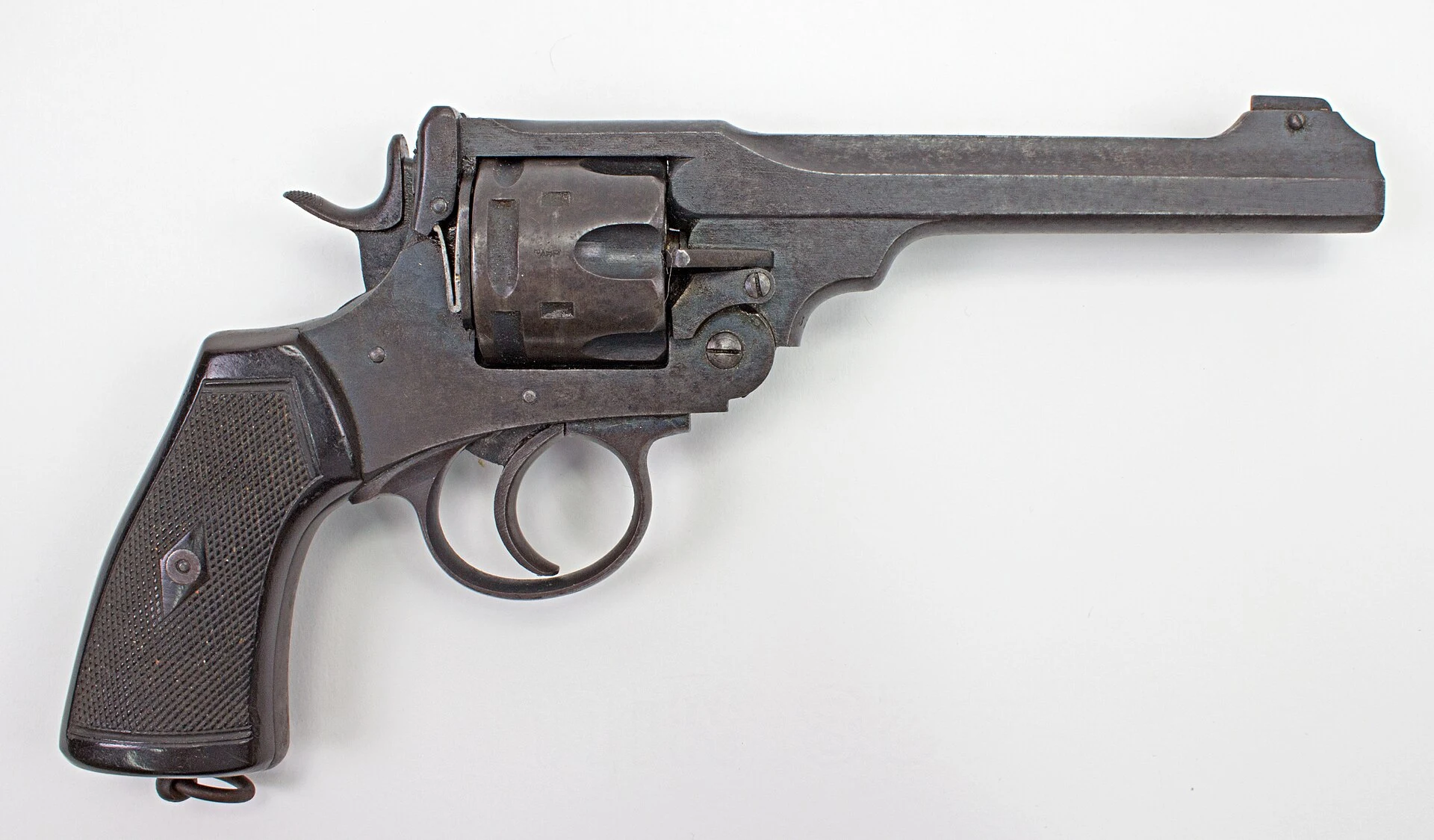
The Mk I through Mk V all have 4-inch barrels as standard and a rounded “bird’s-beak” grip. The Mk VI has a 6-inch barrel, a square-butt grip with vulcanite panels and a front sight blade that can be removed and replaced. “MARK VI” and the year of manufacture are stamped on the left side of the frame, and Mk VIs made at Enfield say “ENFIELD.” Enfield built Mk VIs from 1921 to 1926.
Mk I to Mk IV
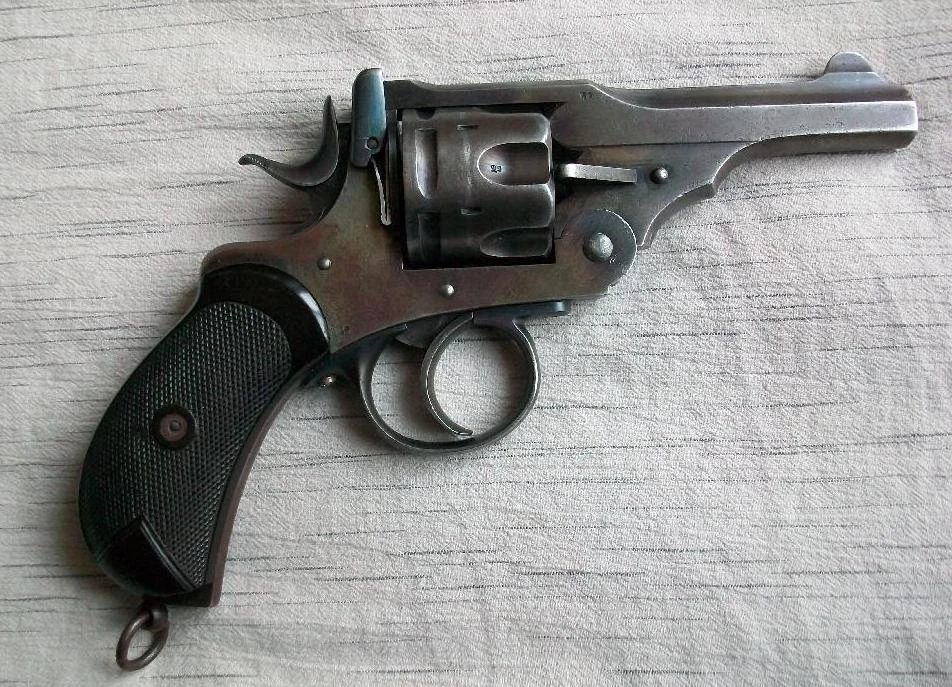
The Mk I was adopted on November 8, 1887, and early guns fired the .476 Enfield cartridge before the .455 became standard. The Mk II of 1895 changed the hammer and grip and added a hardened recoil shield, the Mk III of 1897 changed the cylinder cam, and the Mk IV of 1899, the Boer War gun, used better steel and a redesigned recoil shield. Early Marks were built in the black-powder era, so have any of them checked by a gunsmith before shooting, and keep them to mild loads. Early Marks are scarce and valuable: about $1,780 for a Mk I and $1,512 for a Mk II.
Mk V
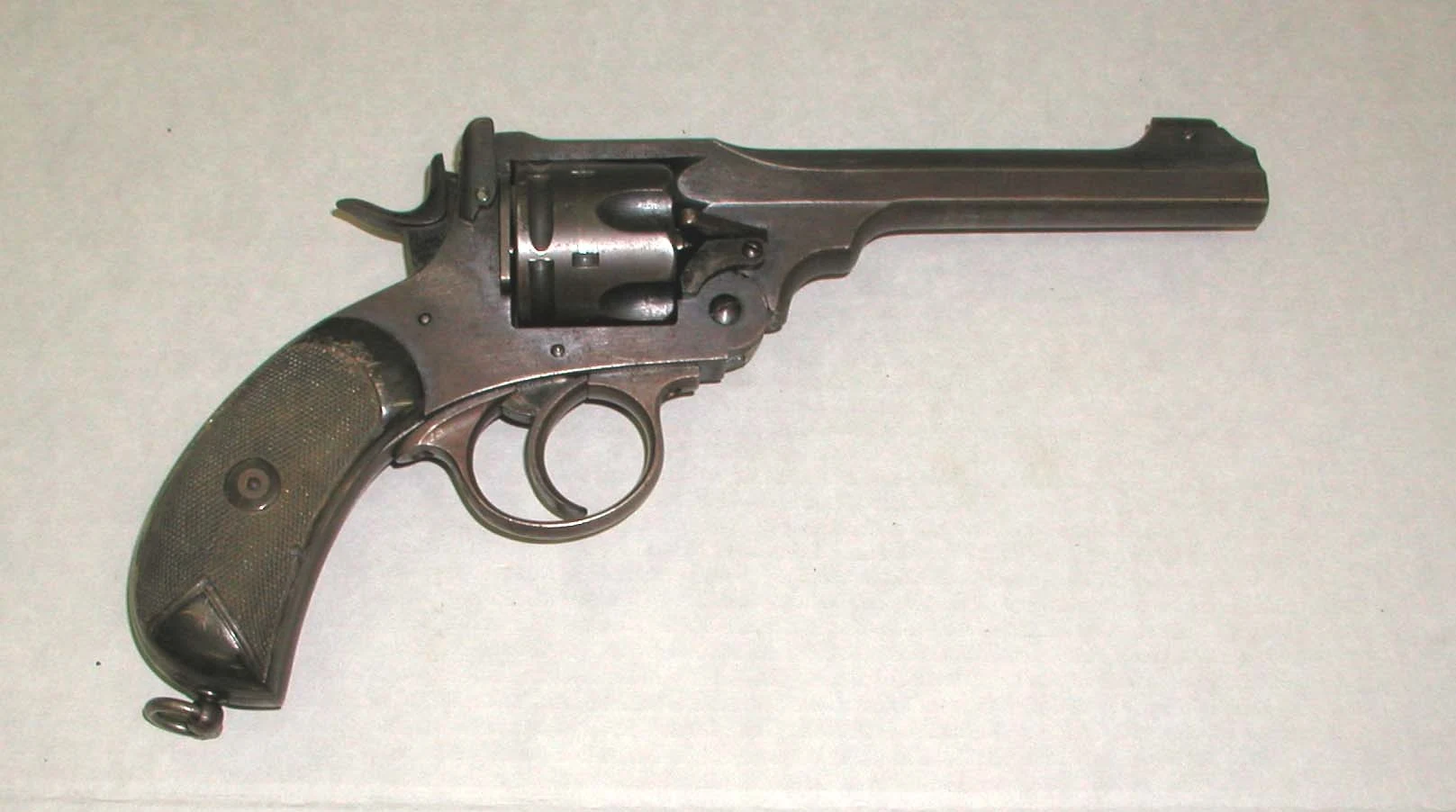
The Mk V of December 1913 added a slightly wider cylinder to handle the higher pressure of cordite smokeless loads. It’s a short-lived bridge between the 4-inch guns and the Mk VI, and unconverted Mk Vs sell well, about $1,500, while shaved ones sell for about $573.
Mk VI
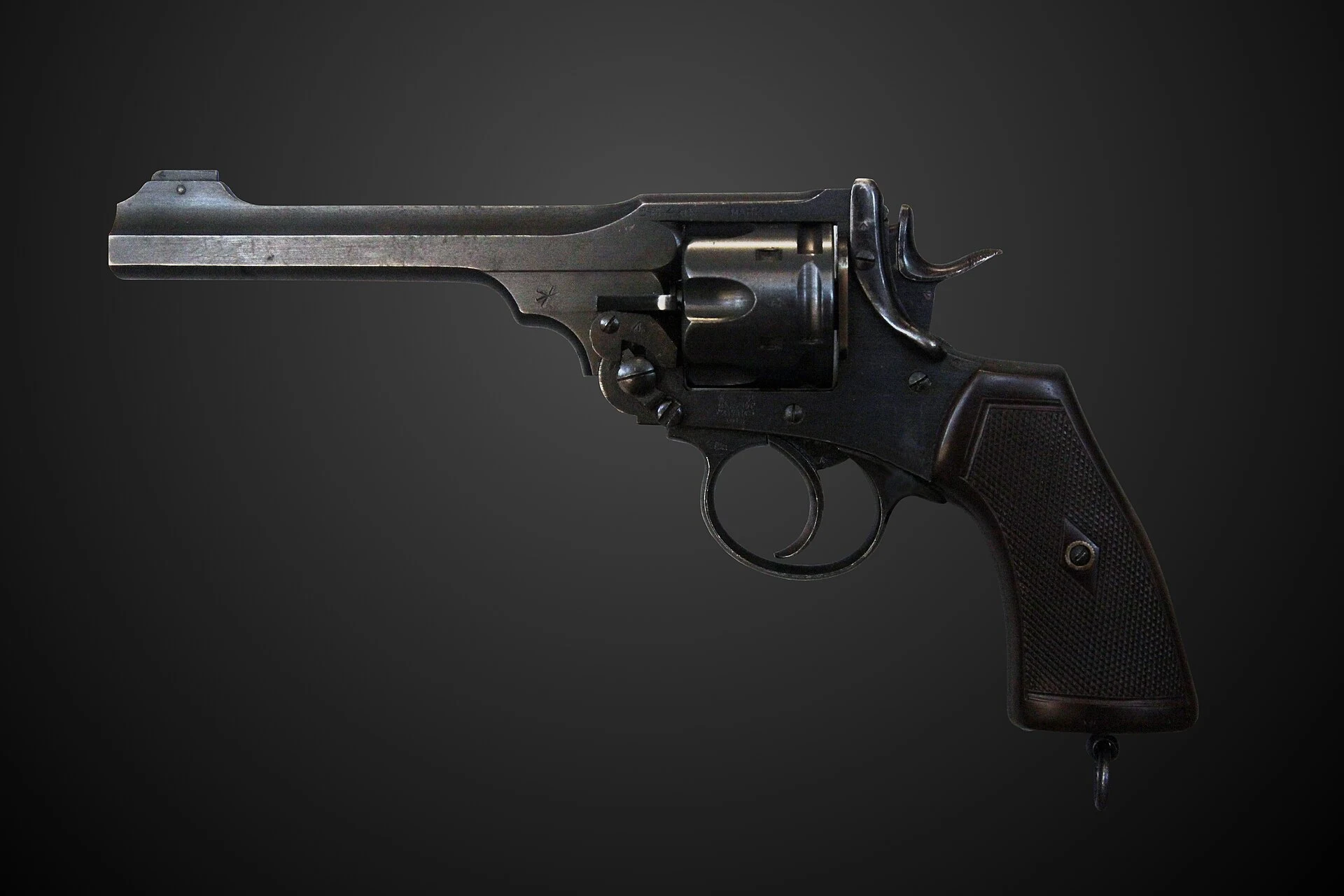
The Mk VI was adopted on May 24, 1915, and became the standard British officer’s revolver of the First World War. About 300,000 were made, with estimates ranging from 280,000 to 310,000. It stayed in British service until the .38 Enfield No. 2 took over in the early 1930s, and many were pressed back into service in World War II.
The .38 Mk IV and the Enfield No. 2
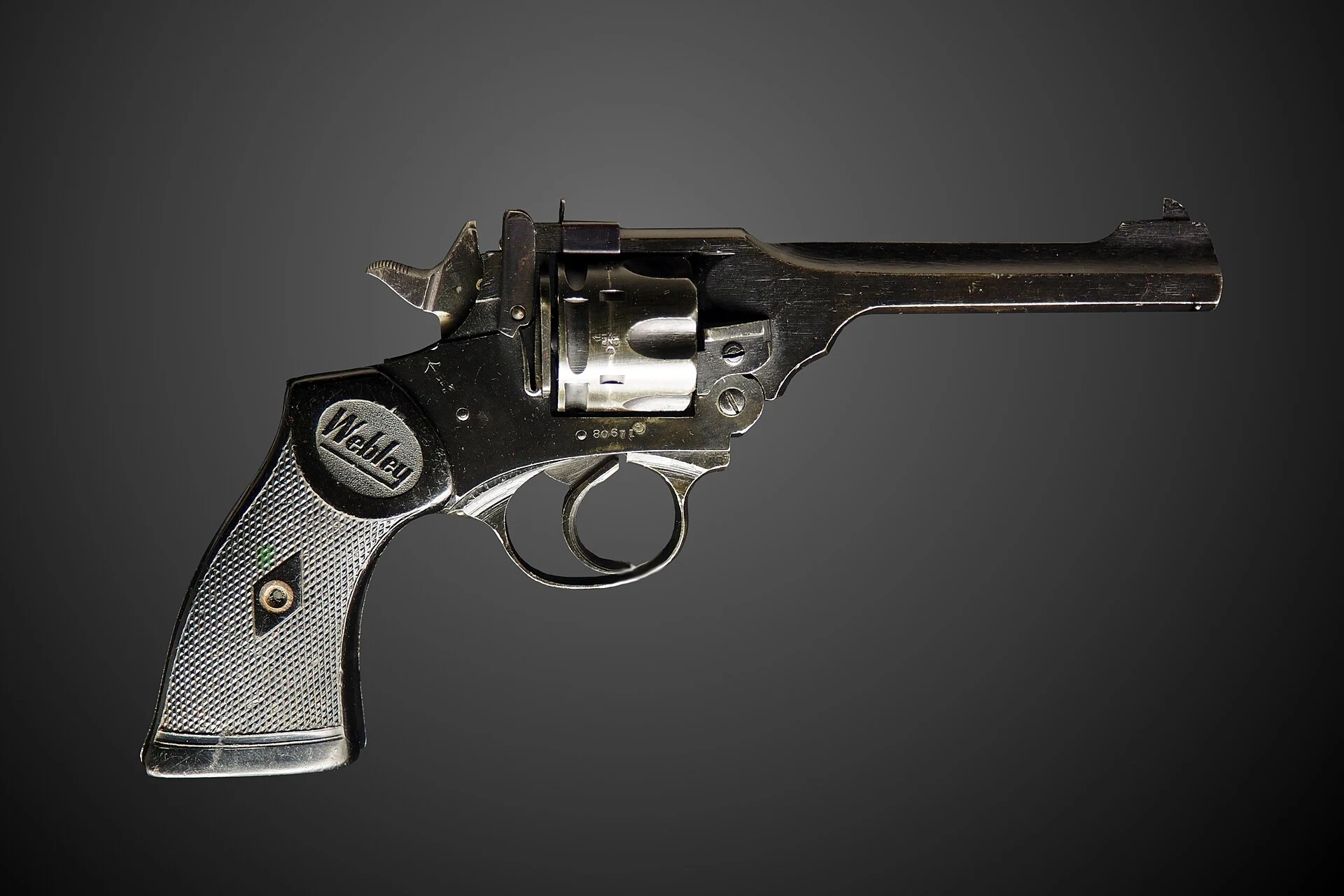
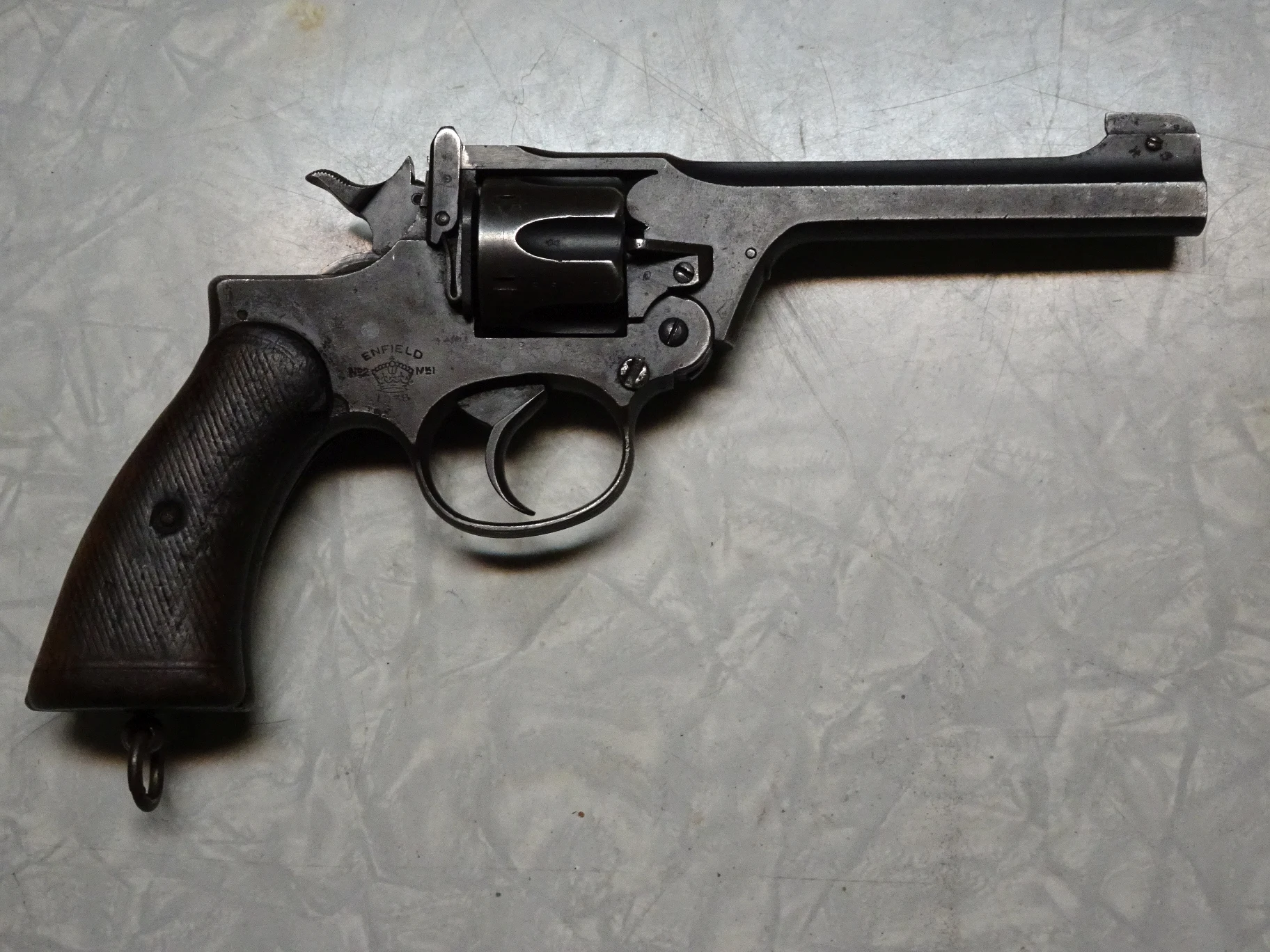
Webley offered the .38 Mk IV in 1928 and made it from 1929 to 1982. It fires .38 S&W, which the British called .38/200 for its 200-grain service bullet, not .38 Special. The Enfield No. 2, adopted in 1932, is a different design built at Enfield, and no parts swap between the two. Both are the budget way into a British service revolver, at about $555 for a Mk IV and $482 for a No. 2.
Shaved Cylinders: How to Spot One and What to Shoot
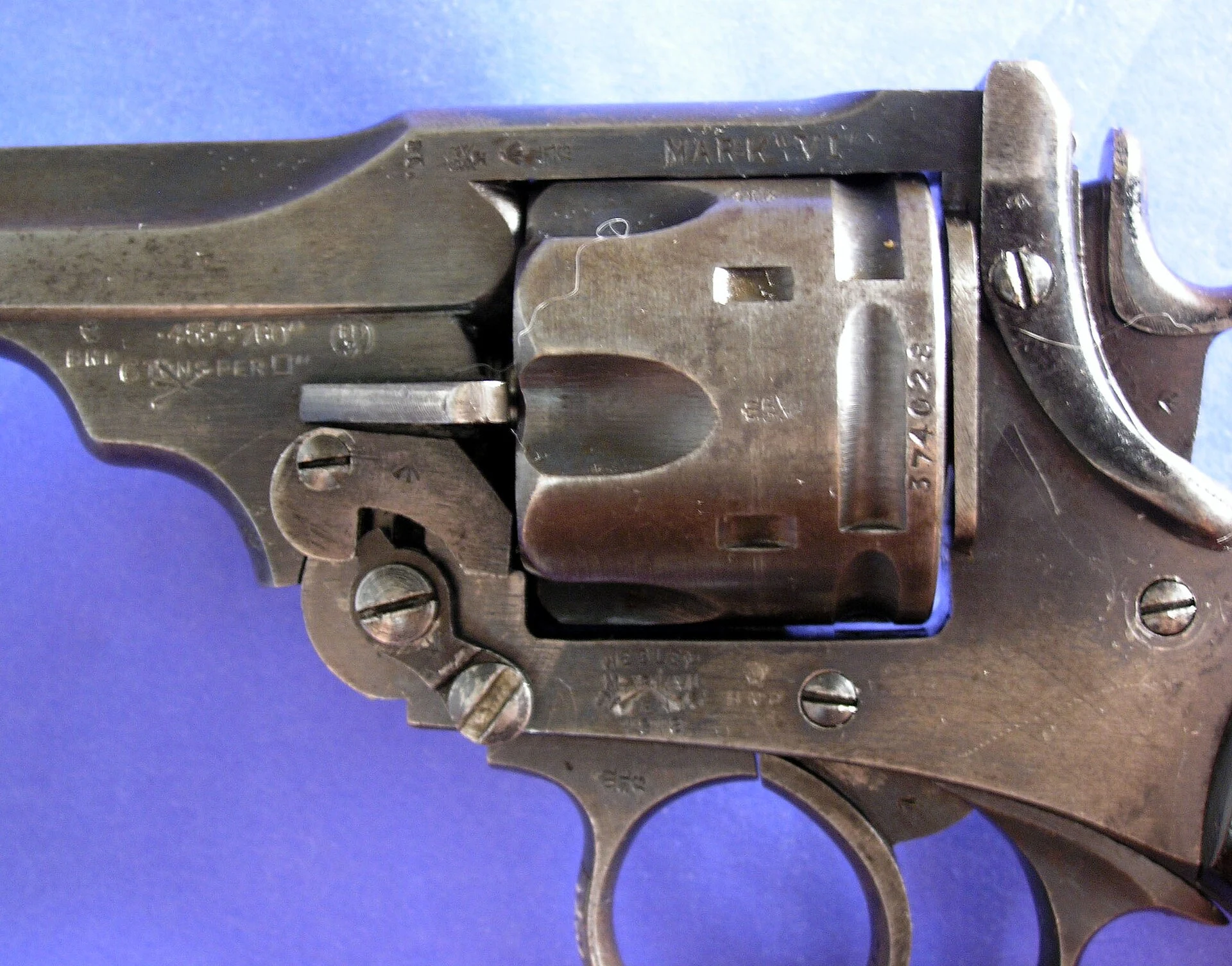
After both world wars, surplus Mk VIs flooded the U.S. market, and because .455 ammunition was scarce, importers machined the rear face of the cylinder so it would take .45 ACP in half-moon clips or the rimmed .45 Auto Rim. It worked mechanically, but it created a problem that still matters. As American Rifleman puts it, “factory-loaded .45 ACP rounds are of too high a pressure to be fired in the Webley.”
The numbers explain why. Europe’s CIP rates the .455 Webley Mk II at 900 bar, about 13,000 psi. Standard .45 ACP runs to 21,000 psi under SAAMI, and +P to 23,000 psi. A shaved Webley fed factory .45 ACP is running well above what it was built for, and failures have been reported. If you own a shaved gun, shoot only reduced-pressure .45 ACP or .45 Auto Rim loads made for these revolvers, or handloads kept to .455 pressures.
- Look at the rear face of the cylinder: British proof marks normally sit between the chambers. If they’re missing or cut through, the cylinder has been shaved.
- Check the cylinder serial: on many shaved guns the bottom of the stamped number is clipped by about 1/16 inch.
- Try a .455 case: on an original cylinder the rim sits flush; on a shaved one it sits deep or the gun won’t fire it reliably.
- Try a .45 ACP moon clip: if a loaded clip drops in and the cylinder closes, it has been shaved.
An over-shaved cylinder can also misfire with .455, because the rims sit too far forward for the firing pin. Some owners fit a thicker .455 rim or use .45 Auto Rim, but a shaved gun will never be original again. Our .45 ACP ammo guide covers standard loads, which belong in modern guns, not Webleys.
Ammo Options for a Shaved Webley
If you already own a shaved Mk VI, you can still shoot it safely, but the rule is simple: keep the pressure down to where the .455 lives. There are three practical routes.
- Reduced-pressure .45 ACP for Webleys: a few small ammunition makers load .45 ACP down to .455 pressures specifically for shaved cylinders. It’s the easiest option if you don’t handload. Use it in half-moon or full-moon clips.
- .45 Auto Rim handloads: the rimmed case headspaces on its rim, so it doesn’t need clips, and handloaders can keep it at .455 pressure with a soft lead bullet.
- .455 with a thicker rim: some owners use .455 brass or cast-bullet loads with rims thick enough to sit right in a shaved cylinder. On an over-shaved gun, standard .455 rims sit too far forward and misfire.
Whatever you shoot, avoid jacketed .45 ACP hardball at factory pressure and any +P load. Soft lead bullets sized to the bore are kinder to an old barrel and match the original 265-grain service load more closely. Our tests with downloaded .45 ACP ran about 640 fps, close to the .455 service load, and grouped well enough to enjoy.
Which Webley Should You Buy?
If you want one Webley, make it an unconverted Mk VI. It’s the classic, it’s the one most collectors want, and an original .455 gun holds its value far better than a shaved one. Expect to pay about $1,000 to $1,400 for a sound gun with legible markings and a clean cylinder face, and more for a gun with documented unit markings or a WWI date in excellent shape.
If you mainly want to shoot, a shaved Mk VI at about $690 is a reasonable buy, as long as you accept that it will never be original and you feed it only reduced loads. A .38 Mk IV or an Enfield No. 2, at about $480 to $555, is the cheapest way to own a British service revolver, and .38 S&W is easier to find than .455.
If you collect early guns, the Mk I and Mk II are the prizes, at about $1,500 to $1,800, and guns made in or before 1898 can be bought as antiques. A Mk V is a good middle ground: scarcer than a Mk VI, but less than a Mk I. Whatever Mark you choose, buy the cylinder, not the story; a shaved cylinder cuts value in half no matter how good the rest of the gun looks.
Webleys on Screen
The Webley’s silhouette is instantly recognizable, and it shows up in war films, period dramas and gangster shows set in Britain and the Empire. The Shelby family in Peaky Blinders carry Webleys throughout the series, from Tommy’s Mk VI to Aunt Polly’s little Bulldog; our guns of Peaky Blinders guide covers them in detail. Screen popularity is one reason demand for unconverted Mk VIs stays strong, and it’s also why replica and air-pistol Webleys are common; make sure a listing is for a real firearm.
Webley Condition Guide
Most Webleys for sale are 80 to 110 years old and saw hard service, so condition varies widely. The NRA’s condition standards are the common language, and our gun values guide explains them in full.
| Condition | What you see on a Webley | Effect on price |
|---|---|---|
| Excellent | Most of the original blue, crisp markings, tight latch, unconverted cylinder | Top of the range |
| Very good | Worn blue, light pitting, all markings legible, original grips | Above the median |
| Good | Little blue left, pitting, worn grips, still unconverted | Near the median |
| Fair | Heavy pitting, replaced parts, loose latch, or a shaved cylinder | Shooter price, about $600 to $700 |
| Poor | Broken parts, bad bore, refinished, mismatched | Parts or wall-hanger price |
Many Webleys were refinished or arsenal-reworked over their service lives. A dull, even gray finish with sharp markings is often original arsenal blue gone thin, while a bright, glossy finish over softened edges is a later refinish. Look for “SOLD OUT OF SERVICE” or condemned marks, which show a gun left government service, and U.S. import marks on guns brought in after 1968.
Markings, Proofs and Dating
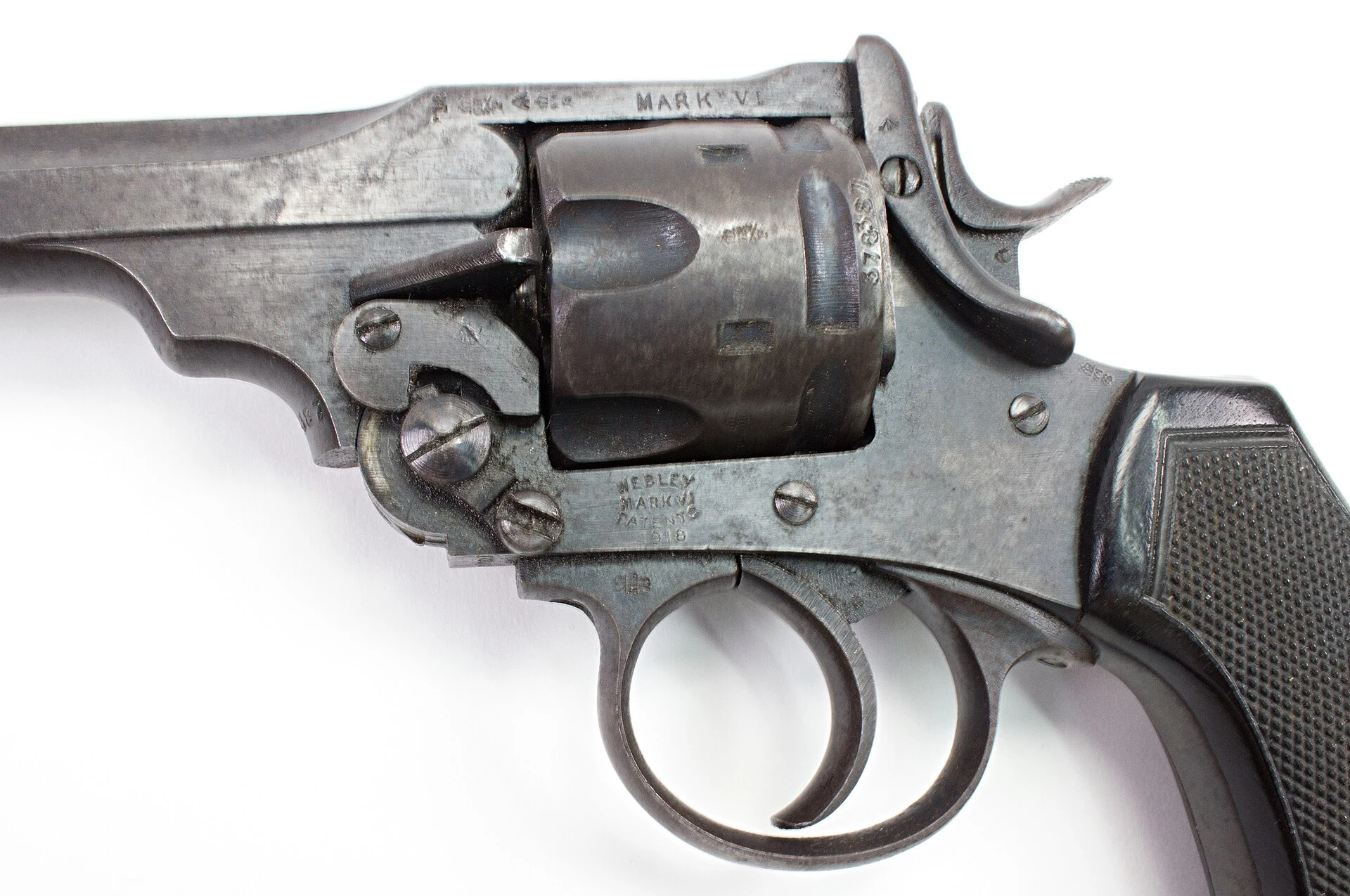
Dating a Webley is easier than dating most revolvers, because service guns carry the Mark and often the year right on the frame. Birmingham proof and view marks appear on the barrel and cylinder, a broad arrow marks government ownership, and guns sold off later often carry extra commercial proofs. Serial numbers run in separate sequences by Mark and maker, and no single public table covers them reliably, so the frame date is your best guide. Unit markings on the grip strap or frame add interest and, on .455 guns, a little value.
Is a Webley an Antique? U.S. Law Explained
Under federal law, a firearm made in or before 1898 is an antique and is not regulated as a firearm, as long as it doesn’t take ammunition that’s readily available. That definition is in 27 CFR 478.11. Webley Mk I, Mk II and Mk III guns made in or before 1898 can qualify, so check the date on the frame. A military Mk IV, adopted in July 1899, cannot be a pre-1899 antique, even though some sellers list them that way.
Every Webley service revolver is more than 50 years old, so each counts as a curio or relic, which ATF ties to guns that are at least 50 years old and in their original configuration. Whether a shaved cylinder takes a gun out of its original configuration for curio and relic transfers isn’t settled, so check with ATF or your dealer before shipping one directly to a C&R license. State laws still apply. Our antique firearms guide and curio and relic guide explain the rules.
Pre-Purchase Inspection Checklist
- Read the frame markings to confirm the Mark, the maker and the year.
- Check the rear of the cylinder for proof marks between the chambers; missing marks mean a shaved cylinder.
- Try a .455 case and a .45 ACP moon clip to confirm what the cylinder takes.
- With the gun unloaded, open and close the top latch and check it locks tightly with no wobble at the hinge.
- Cock the hammer on each chamber and check that the cylinder locks up.
- Check the cylinder gap and look for gas cutting under the top strap.
- Look down the bore; many are pitted from corrosive wartime ammo.
- Check that the extractor star returns fully when the gun is closed.
- Look for refinish signs: softened edges, washed-out markings and a glossy finish.
- Check that serial numbers on the frame, cylinder and barrel match.
- For an antique, confirm the frame date is 1898 or earlier.
- Ask what ammo a shaved gun has been fed, and pass on one with a history of factory .45 ACP.
Shooting and Caring for a Webley
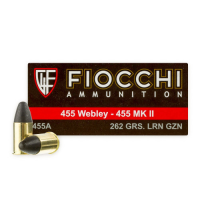
Feed an unconverted Webley .455 Webley ammunition. Fiocchi’s 262-grain lead round-nose is the main factory load, though it’s often out of stock, and a few smaller makers load .455 and low-pressure .45 ACP for shaved guns. All six Marks were chambered for the longer .455 Mk I case, so both the Mk I and the shorter Mk II cartridge fit an unconverted cylinder. The Mk V and Mk VI were built for cordite smokeless loads. Handloaders keep loads at the .455’s low pressure and often use soft lead bullets sized for the bore. The .38 Mk IV and Enfield No. 2 take .38 S&W, not .38 Special, and 200-grain loads hit closest to the sights.
Clean the bore and cylinder after every session, especially if you shoot lead. Many Webleys have bores pitted by corrosive wartime ammunition, so don’t expect a mirror. Keep the hinge and latch lightly oiled, and don’t snap the action shut hard; close it firmly and let the latch engage. Never dry-fire an old gun without snap caps, since firing pins and hands are hard to replace.


Webley Revolver History
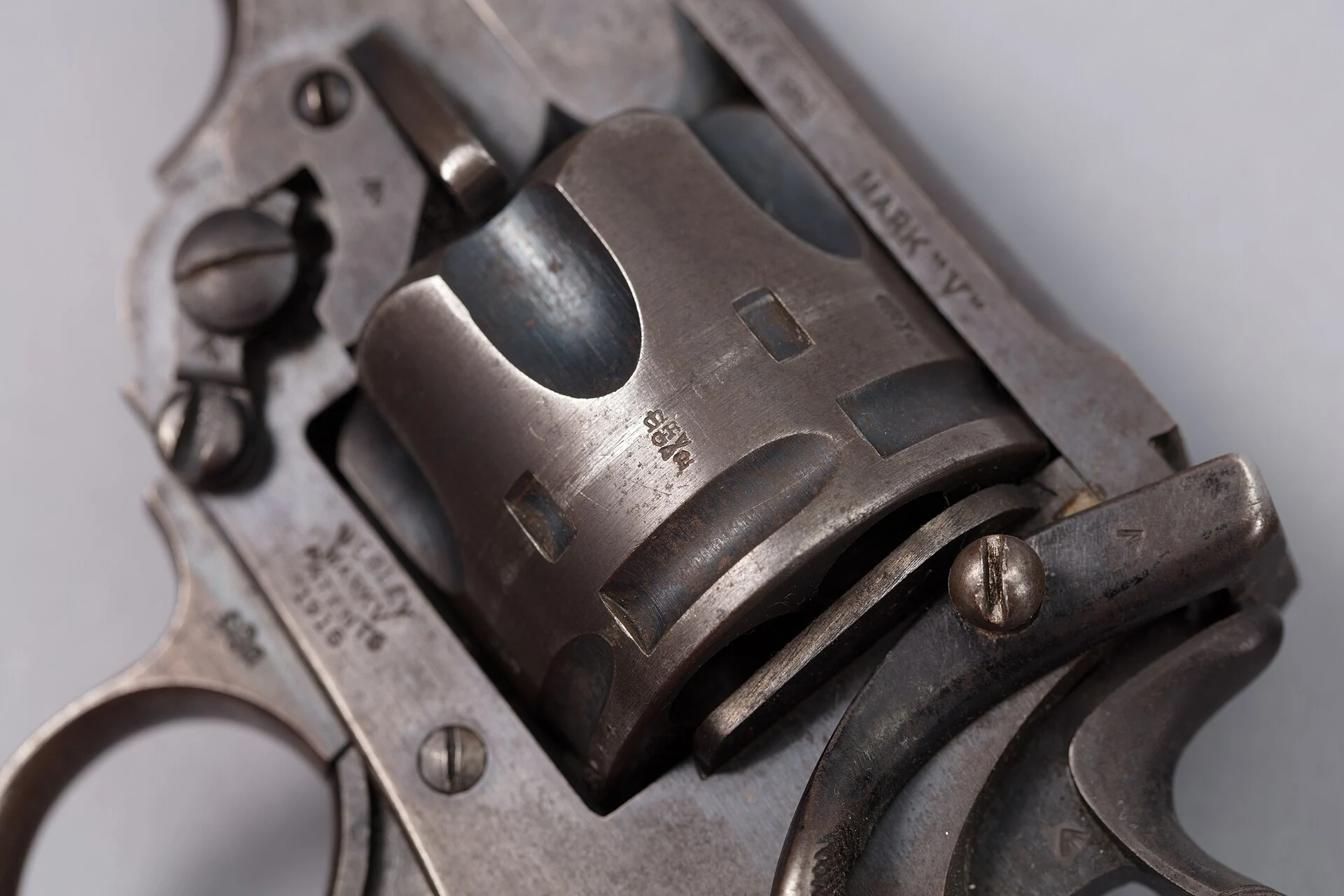
Webley & Son of Birmingham had built revolvers for decades before the British Army adopted its first Webley on November 8, 1887. The design’s big advantage was the top-break: a latch released the barrel, which tipped down while an extractor star pushed out every case at once. In the cavalry and among officers who might have to reload on horseback or under fire, that speed mattered.
Each Mark refined the design, and the .455 cartridge stayed the same, a heavy, slow lead bullet that hit hard at short range. The Mk VI of 1915 became the officer’s revolver of the Western Front. After the war, the British moved to the lighter .38/200 cartridge in the Enfield No. 2, adopted in 1932, and Webley sold its own .38 Mk IV to police and governments worldwide. Webley & Scott made its last firearms in 1979 and today makes shotguns and air guns.
The Webley’s service life didn’t end in 1932. When war came again in 1939, Britain didn’t have enough .38 revolvers to go around, and Mk VIs were pulled from storage and issued alongside Webley Mk IV .38s and Enfield No. 2s. The .38 revolvers served on into the 1950s and early 1960s before the Browning Hi-Power finally replaced them, and Enfield No. 2s were still turning up in service around 1970. That long career is why so many Webleys reached the U.S. surplus market after both wars, and why so many were shaved: in the 1950s and 1960s, U.S. importers sold them for $14.95 to $19.95, converted to take the .45 ACP ammunition American shooters could actually buy. Those cheap conversions are the reason an untouched .455 cylinder is now the most valuable feature a Mk VI can have.
Why the Webley Is Still So Popular
The Webley is one of the great military revolvers, with a look nobody mistakes for anything else and a history that runs from the Boer War to World War II. It’s mechanically interesting, reliable and still affordable next to many U.S. service guns of the same era. It also turns up on screen constantly, which keeps new collectors arriving. The catch, and the reason a guide matters, is that so many have been altered. An unconverted Webley is the one that holds its value.
Where to Buy a Webley Revolver
GunBroker, Guns.com, auction houses and military surplus dealers all list Webleys. Rock Island and other auction houses add a buyer’s premium on top of the hammer price. Many listings don’t say whether a cylinder is shaved, so ask, and assume a gun is shaved unless the seller shows the cylinder face. Our used guns guide explains how buying online works, and our World War I guns and World War II guns guides put the Webley in context.
- Ask for a clear photo of the rear face of the cylinder.
- Ask what the cylinder takes: .455, .45 ACP in clips or .45 Auto Rim.
- Ask for photos of the frame markings and date.
- For an antique, ask for proof of the date before paying antique money.
Webley vs. Its Rivals
| Gun | Cartridge | Action | Used price | Best for |
|---|---|---|---|---|
| Webley Mk VI (unconverted) | .455 Webley | Top-break | About $1,325 | WWI collectors |
| Webley Mk VI (shaved) | .45 ACP, reduced loads only | Top-break | About $690 | Budget shooters who handload |
| Webley Mk IV .38 | .38 S&W | Top-break | About $555 | Affordable British service revolver |
| Enfield No. 2 | .38 S&W | Top-break | About $482 | Cheapest British service revolver |
| Smith & Wesson and Colt M1917 | .45 ACP | Swing-out cylinder | Higher | American WWI collectors |
For more military and classic handguns, see our classic revolvers guide and our best revolvers list.
Final Verdict
The Webley Mk VI is one of the great collectible revolvers, as long as you know what you’re buying. An unconverted .455 gun at about $1,325 is the one to want, and it will hold its value. A shaved gun at about $690 is a fine shooter if you feed it only reduced loads made for it, but it will never be original again. For a cheaper way in, a .38 Mk IV or an Enfield No. 2 costs about $500. Check the cylinder face, read the frame date, and never fire standard .45 ACP in a Webley.
Webley Revolver FAQ
How much is a Webley Mk VI worth?
In completed sales from December 2025 to November 2026, a Webley Mk VI sold for a median of about $788. Guns sold as unconverted .455 sold for about $1,325, while Mk VIs with shaved cylinders for .45 ACP sold for about $690.
Can I shoot .45 ACP in a Webley?
Only in a shaved cylinder, and only with reduced-pressure loads made for Webleys. Standard factory .45 ACP runs about 21,000 psi, while the .455 Webley is rated about 13,000 psi, and American Rifleman warns factory .45 ACP is too high a pressure for the Webley.
How do I tell if a Webley cylinder has been shaved?
Look at the rear face of the cylinder. Original cylinders have British proof marks between the chambers; shaved ones often have them cut away, and the bottom of the cylinder serial may be clipped. A loaded .45 ACP moon clip that drops in is a sure sign.
Is a Webley revolver an antique?
Only if it was made in or before 1898. Webley Mk I, Mk II and Mk III guns from those years can qualify. A military Mk IV was adopted in July 1899, so it cannot be a pre-1899 antique. Every Webley service revolver is a curio or relic by age.
What is the difference between the Webley Marks?
The Mk I to Mk V have 4-inch barrels and bird's-beak grips, with the Mk V adding a wider cylinder for cordite loads. The Mk VI of 1915 has a 6-inch barrel, a square-butt grip and a removable front sight. The Mark and year are stamped on the frame.
Does a Webley .38 take .38 Special?
No. The Webley Mk IV .38 and the Enfield No. 2 fire .38 S&W, which the British called .38/200. Don't fire .38 Special in them.
Where can I buy .455 Webley ammo?
Fiocchi makes the main factory .455 Webley load, a 262-grain lead round-nose, though it is often out of stock. A few smaller makers load .455 and low-pressure .45 ACP for shaved Webleys, and many owners handload.
Is Webley & Scott still in business?
Webley & Scott stopped making firearms in 1979. The name now appears on shotguns and air guns, so be careful not to confuse Webley air pistols with the service revolvers.
3,502+ Gun & Ammo Deals
Updated daily from 200+ top retailers. Filter by category, caliber, action type, and price.
Related Guides