

Affiliate disclosure: This Barrett MRAD review contains affiliate links. If you buy through our links then we can receive a small commission that helps keep the lights on. You don’t pay anything more.
- Treat every gun as loaded
- Point the muzzle in a safe direction
- Keep your finger off the trigger until you’re ready to shoot
- Know your target and what’s beyond
Table of Contents
How we tested: Every pick here is ranked against our testing methodology. Minimum round counts, accuracy and reliability protocols, the failures that disqualify a gun.
Review: Barrett MRAD – The Sniper Rifle You Can Rebarrel at the Kitchen Table
Our Rating: 8.3/10
The US Army picked this rifle as the MK22 and paid five figures a copy for it. You can buy the civilian version from $4,235, and there is a catch nobody puts on the price tag: the cheap one is not the rifle you have been reading about. Barrett sells two things called MRAD, and only one of them changes calibers.
Specifications: Barrett MRAD 6.5 Creedmoor (Fluted)
- MSRP: Barrett publishes none
- Street Price: from $4,235 for the SMR, from $5,011.00 for the folding stock rifle (Use our live pricing for the best up to date deal)
- Operation: Bolt action repeater
- Calibers: .308 Win, 6.5 Creedmoor, .300 Win Mag, .300 PRC, 7mm PRC, .300 Norma Mag, .338 Norma Mag, .338 Lapua Mag
- Barrel: 24 inch fluted, 1:8 twist
- Overall Length: 47.4 inches
- Weight: 13.3 lbs
- Magazine: 10 rounds, ambidextrous paddle release
- Receiver: Monolithic 7000-series aluminum upper
- Rail: 21.75 inch M1913 Picatinny, 10 MIL taper
- Handguard: Mounting slots at 3, 6 and 9 o’clock
- Trigger: Fully adjustable match grade module
- Stock: Right side folding, tool-less length of pull and cheek height
- Finish: Black, Tungsten Grey or Flat Dark Earth Cerakote
Pros
- Swaps to seven calibers with Torx
- Half MOA groups with match ammunition
- Stock folds and adjusts without tools
Cons
- Thirteen pounds before optic and bipod
- Spare barrel kits cost fifteen hundred
- Barrett publishes no list price anywhere
Quick Take
The MRAD is the rifle that turned a barrel change from a gunsmith appointment into a five minute job with a Torx wrench. Two bolts, one barrel out, another in, and you are shooting a different cartridge. Barrett says seven calibers. Our test rifle went from 6.5 Creedmoor to .308 Winchester on a folding table at the range and shot half inch groups afterward.
Then there is the trap. Most of what retailers actually stock is the MRAD SMR, and the SMR cannot do any of that. It is a fine rifle and it is $900 cheaper at the one retailer that stocks both, but it is fixed in one caliber for life.
Best For: The shooter who wants one serious rifle instead of four, and who will genuinely use the barrel swap. A poor choice if you only ever shoot one cartridge, because then you are paying for a feature you will never touch.
SMR Means Single Mission Rifle, and That Is the Whole Story
Look at what retailers have in stock and the MRAD you keep seeing is the SMR. Three letters, $900 off the price, and almost nobody selling it explains what they stand for. Barrett does, on its own product page: “The Single Mission Rifle name comes from the fact that the rifle is set from the factory in only one caliber, unlike the interchangeable barrel ability of the standard MRAD.”
That is the entire feature you came for, removed. The SMR’s barrel is free floated and held in the upper with a standard barrel nut instead of the two-bolt clamp system. Its stock does not fold. What you get back is weight: Barrett says the SMR trims “nearly 2 1/2 lbs off the weight and 1 inch off the overall length of the standard MRAD rifle.”
The numbers back that up. A .338 Lapua standard MRAD is 14.5 lbs and 49.4 inches. The same caliber in SMR is 12.3 lbs and 48.5 inches. In .308 with the 17 inch barrel, the SMR drops to 10.6 lbs against the standard rifle’s 11.9.
So Which One Should You Buy?
If you will shoot one cartridge for the life of the rifle, buy the SMR, pocket the $900 and carry two and a half fewer pounds. Barrett quotes the same 0.75 MOA accuracy for it and says it shares 90 percent parts commonality with the standard gun, so you are not buying a lesser rifle. You are buying a rifle that has stopped pretending it will ever be a different one.
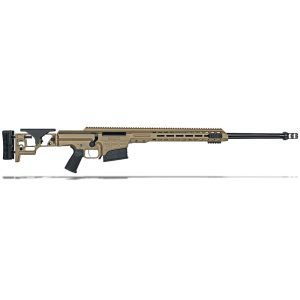
If the barrel swap is why you want an MRAD, do not let a retailer sell you an SMR because the picture looks the same.
What It Actually Costs
Barrett does not publish a list price for the MRAD anywhere on its website. There is no MSRP to negotiate against, so the street is the only price there is. Here is what our retailers were charging for new rifles.
Read that ladder carefully, because the arithmetic decides your purchase. At EuroOptic, the only retailer we track that stocks both, an SMR is $4,299.99 and a folding stock MRAD is $5,199.99, a gap of $900. The gap between an MRAD and a second caliber for it is about $1,435, which is what the cheapest conversion kit with a barrel costs.
So a two-caliber MRAD lands near $6,450 all in. Two SMRs in two calibers land near $8,350 and give you two complete rifles, two stocks and two magazines. One rifle in two calibers is cheaper. Three calibers and it is not close.
The MK 22 Question
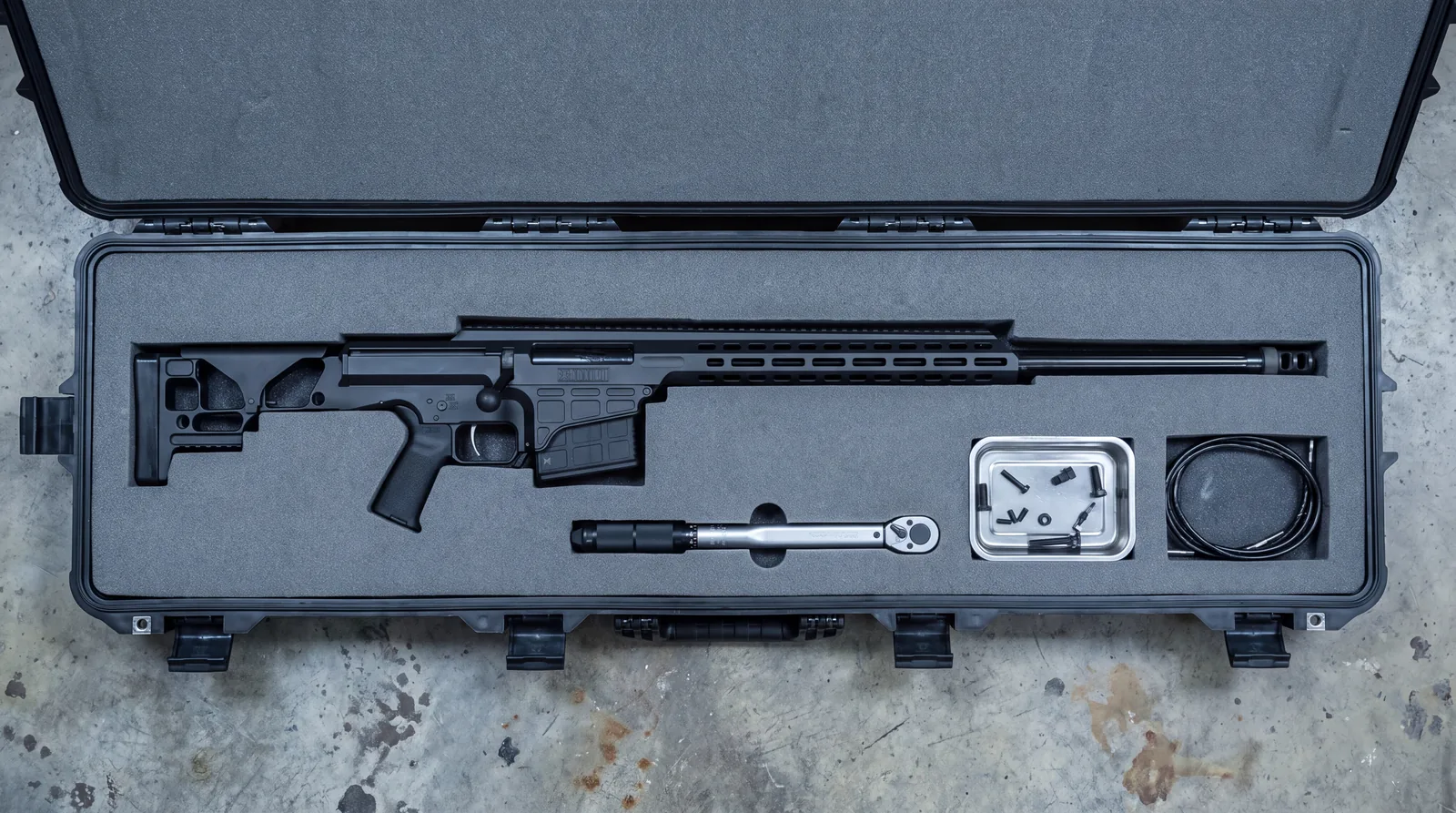
The MRAD is the basis of the MK22, the multi-caliber sniper rifle adopted across the US military, and that is most of the reason you have heard of it. Barrett’s own MK 22 specification lists three chamberings: 7.62×51 NATO, .300 Norma Magnum and .338 Norma Magnum, which is the barrel swap being used exactly as designed rather than as a marketing line.
You can buy one wearing that name, and the price depends entirely on how much of the system you take. A single caliber MK 22 starts at $6,999.00 in .338 Norma Magnum or 7.62×51 NATO. The MK 22 MOD 0 Advanced Sniper Rifle System, the full multi-caliber package, runs $14,999.00, and the PSR combo in .300 Norma Magnum is $16,250.00. The action and receiver underneath are the same ones in a $5,011.00 MRAD.
Our sniper rifle roundup puts the whole category in order if you are shopping across brands rather than within Barrett.
Range Testing: 320 Rounds Across Two Barrels
The Barrel Swap
This is the test that matters, so we did it in the least favorable place we could: on a folding table at an outdoor range, in wind, with the Torx wrench Barrett expects you to use and nothing else. Two bolts loosened, barrel forward and out, second barrel in, bolts to torque, done. It took under five minutes with no measuring and no gunsmith.
The part that decides whether the feature is real is what happens to zero. We shot a 5 shot group with the 6.5 Creedmoor barrel, swapped to .308, shot the .308, then put the 6.5 barrel back on and shot the same load at the same target. The returned group landed 0.7 inches from the original center at 100 yards. That is close enough to call it a confirmation shot rather than a re-zero.
Accuracy
Barrett claims 0.75 MOA. With 140 grain match ammunition in 6.5 Creedmoor, five shot groups at 100 yards averaged 0.5 inches, best group 0.38. The .308 barrel with 175 grain match averaged 0.6 inches. Both beat the claim, which is the correct direction for a claim to be wrong in.
At 600 yards the 6.5 held inside 4 inches on a calm morning. This rifle is not the limiting factor in your shooting and it will not be for a long time.
The Trigger
The trigger lives in a self-contained module inside the lower receiver and it is fully adjustable. Ours arrived at 3 lbs 2 oz, broke clean with no perceptible creep, and we left it alone. The module design means adjusting it does not involve pulling the barreled action out of a stock, which is the usual reason people never adjust a trigger they are unhappy with.
Weight and Handling
13.3 lbs bare in 6.5 Creedmoor. Add a 34mm scope, rings, a bipod and a loaded magazine and you are carrying something close to 18 pounds. Behind a rifle this heavy the recoil is a nudge and you spot your own impacts through the scope, which is the entire reason precision rifles weigh what they do.
The adjustments are the standout. Length of pull and cheek height both move without a tool, so handing the rifle to a shorter shooter takes seconds instead of a bag search. The stock folds to the right and locks back out with no detectable play at the hinge.
Ammunition Log
- Hornady ELD Match 140 gr, 6.5 Creedmoor: 120 rounds
- Federal Gold Medal 140 gr, 6.5 Creedmoor: 80 rounds
- Federal Gold Medal 175 gr, .308 Winchester: 80 rounds
- Hornady 168 gr BTHP Match, .308 Winchester: 40 rounds
No stoppages, no failures to feed from the 10 round magazine in either caliber, and no change in bolt effort across the test.
Technical Deep Dive
The Monolithic Upper
Barrett machines the upper receiver from a single piece of 7000-series aluminum, with the full length Picatinny rail cut into it rather than bolted on. That matters more here than on most rifles: if the rail is a separate part, a barrel change gives the rail a fresh chance to shift. Cut it into the receiver and the only interface that moves is the barrel itself.
The rail carries a built-in taper. On the fluted rifles it is 21.75 inches and 10 MIL, on the carbon fiber rifles 22 inches and 20 MOA. Check which one your scope’s elevation range expects before you order rings.
Carbon Fiber Cuts Nearly Three Pounds
Barrett offers the MRAD in a carbon fiber configuration and the weight saving is not cosmetic. In .300 PRC the fluted steel rifle is 14.5 lbs and the carbon fiber version is 11.7 lbs. That is 2.8 pounds, on a rifle you may actually have to walk with, and it comes with the 20 MOA rail rather than the 10 MIL.
Built Ambidextrous, Not Adapted
The magazine release is an ambidextrous paddle, the thumb safety swaps left or right, and the pistol grip is a standard AR15 pattern so you can fit whatever your hand likes. A left-handed shooter runs this rifle with no compromise and no special order, which is still rare at any price in a bolt gun.
How It Compares
Sako TRG (from $6,349)
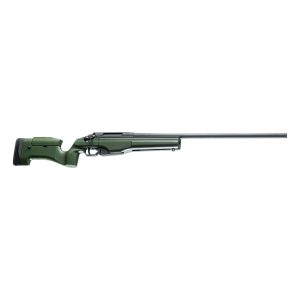
The other rifle with genuine military service on its record, and the closest thing to a straight price match. A TRG-22 in .308 or 6.5 Creedmoor starts at $4,009.99, which undercuts even the SMR, and the TRG 22A1 runs to $6,349.00.
The Sako is the more refined rifle to shoot and the Barrett is the more flexible one to own. If you want a precision rifle that will still be exactly the same precision rifle in ten years, the TRG is a fine answer. If you expect to change your mind about cartridges, it is not.
Barrett M107A1 ($10,099.99-$16,999)
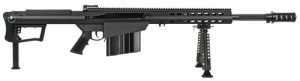
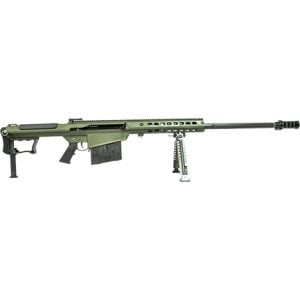
Barrett’s own .50 BMG, and a completely different proposition: semi-automatic, enormous, and priced from $10,099.99. It exists to reach past where a .338 stops, and it costs more than twice the MRAD to do it. Our Barrett M82A1 review covers what shooting one is actually like, and the 50 BMG rifle rankings put it against the field.
Nobody cross shops these two. They are on this page because Barrett owners eventually ask.
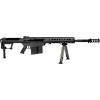
Accuracy International AT-X
The competition shooter’s pick where the Barrett is the soldier’s. The AT-X also takes barrel changes and it is the rifle most likely to be on the line next to you at a match. We reviewed it separately in our Accuracy International AT-X review, and for custom-shop alternatives the GA Precision Tempest and the Cadex CDX-R7 are both in the same money.
Verdict: the Barrett is the one you buy if the rifle has to do several jobs. Whichever you pick, budget for glass, because a scope worth putting on it will cost you as much again.
Upgrades Worth Making
| Upgrade | Recommended | Why it matters | Cost |
| Optic | A 5-25x or 7-35x first focal plane scope in 34mm rings | The rifle out-shoots anything cheap you put on it | $1,500 – $4,000 |
| Second barrel | A conversion kit in a cartridge you do not already own | The only reason to buy the folding stock rifle | from $1,588 |
| Bipod | Any quality quick-detach on the 6 o’clock slots | The handguard is already slotted at 3, 6 and 9 | $200 – $500 |
| Trigger | Leave it alone | The factory module is adjustable and ours broke at 3 lb 2 oz | $0 |
Common Problems and Fixes
- Bought an SMR and want to change caliber: you cannot. The SMR barrel is held by a barrel nut, not the two-bolt clamp. Confirm SMR or standard before you pay, because the photographs are frequently identical.
- Zero shifted after a barrel change: check the bolts are at torque and that nothing is trapped in the barrel extension. Ours returned within 0.7 inches at 100 yards, so a large shift means an assembly problem, not a design one.
- Scope will not reach at distance: confirm which rail you have. Fluted rifles carry a 10 MIL taper, carbon fiber rifles carry 20 MOA, and those are not the same number in the same units.
- Rifle feels front heavy: it is 13.3 lbs and most of it is forward. Move the bipod back a slot before you decide the balance is wrong.
- Cannot find a price to compare: Barrett publishes no MSRP. Our live pricing above is the only side by side you will get.
Who Should NOT Buy This Gun
- The one-cartridge shooter: if you will shoot 6.5 Creedmoor forever, the barrel change is dead money. Buy the MRAD SMR and save $900, or a Sako TRG-22 at $4,009.99.
- Anyone carrying the rifle far: 13.3 lbs bare becomes about 18 with glass and a bipod. A carbon fiber MRAD saves 2.8 lbs, and a hunting rifle saves a great deal more.
- The match shooter buying for the line: the Accuracy International AT-X is the rifle you will see beside you at a PRS match, and it changes barrels too.
- Anybody chasing the MK22 badge: a single caliber MK 22 is $6,999.00 and the full Advanced Sniper Rifle System is $14,999.00. The same receiver, action and trigger are yours from $5,011.00 without the name.
- The shooter without a scope budget: a rifle this accurate on a $400 scope is a waste. A Cadex CDX-R7 or a GA Precision Tempest with good glass beats an MRAD with bad glass every time.
Final Verdict
The barrel change is real. Five minutes on a folding table, a Torx wrench, and the zero came back inside three quarters of an inch. Everything else about the rifle is built to the standard that implies: a monolithic upper, a trigger module you can actually reach, and adjustments that need no tools at all.
Just buy the right one. The rifle in most shopping carts at $4,235.00 to $4,604.00 is the SMR, and it will be the same caliber on the day you sell it as it was on the day you bought it. If that is fine, it is the better buy. If it is not, the number you want starts at $5,011.00.
FAQ: Barrett MRAD
What is the difference between the Barrett MRAD and the MRAD SMR?
The SMR cannot change caliber. Barrett's own page explains the name: Single Mission Rifle, because it is set from the factory in only one caliber, unlike the interchangeable barrel ability of the standard MRAD. The SMR also has a fixed stock instead of a folding one, and its barrel is held by a standard barrel nut rather than the two-bolt clamp. In exchange it is lighter and cheaper.
How much does a Barrett MRAD cost?
Barrett publishes no MSRP at all, so the street is the only price. New SMR rifles ran from $4,235.00 to $4,604.00 across the retailers we track. Folding stock MRADs started at $5,011.00 and ran to $6,349.00. The MRAD ELR in .416 Barrett started at $8,377.97, and an MK 22 ran from $6,999.00 for one caliber to $16,250.00 for the PSR combo.
How long does it take to change the barrel on an MRAD?
Under five minutes. Barrett's design uses two bolts and a standard Torx wrench, with no gunsmith required. We did it on a folding table at an outdoor range. When we refitted the original 6.5 Creedmoor barrel and shot the same load at the same target, the group landed 0.7 inches from the original center at 100 yards.
How accurate is the Barrett MRAD?
Barrett claims 0.75 MOA. Ours beat it. Five shot groups at 100 yards averaged 0.5 inches with 140 grain match ammunition in 6.5 Creedmoor, best group 0.38 inches, and 0.6 inches with 175 grain match in .308 Winchester. At 600 yards the 6.5 held inside 4 inches on a calm morning.
How many calibers does the Barrett MRAD take?
Barrett's copy says the rifle converts to one of 7 different calibers or multiple barrel lengths. The spec tables list .308 Winchester, 6.5 Creedmoor, .300 Winchester Magnum, .300 PRC, 7mm PRC, .300 Norma Magnum, .338 Norma Magnum and .338 Lapua Magnum. A conversion kit with a barrel starts around $1,435.
Is the Barrett MRAD the same as the military MK 22?
The MK 22 is built on the MRAD, and Barrett lists it separately with three chamberings: 7.62x51 NATO, .300 Norma Magnum and .338 Norma Magnum. A single caliber MK 22 starts at $6,999.00, the full Advanced Sniper Rifle System is $14,999.00, and the PSR combo is $16,250.00. The same receiver, action and trigger are in a standard MRAD from $5,011.00.
How much does a Barrett MRAD weigh?
It depends on caliber and configuration. In 6.5 Creedmoor with the 24 inch fluted barrel it is 13.3 lbs bare, and .338 Lapua Magnum is 14.5 lbs. The carbon fiber configuration in .300 PRC drops to 11.7 lbs against 14.5 for the fluted steel version, a saving of 2.8 pounds. The SMR is lighter again.
Can a left-handed shooter use a Barrett MRAD?
Yes, with no special order. The magazine release is an ambidextrous paddle, the thumb safety is left and right swappable, and the pistol grip is a standard AR15 pattern. Barrett built the rifle that way rather than adapting it, which is still unusual in a bolt action at any price.
4,021+ Gun & Ammo Deals
Updated daily from 200+ top retailers. Filter by category, caliber, action type, and price.
Related Guides