

Last updated November 20, 2026 · By Nick Hall, .22 LR shooter who has chronographed every round on this list through multiple barrels
This post contains affiliate links. If you buy through our links then we can earn a small commission and you get the best deal from a range of national gun dealers.
- Treat every gun as loaded
- Point the muzzle in a safe direction
- Keep your finger off the trigger until you’re ready to shoot
- Know your target and what’s beyond
Quick answer: CCI Mini-Mag is the best all-round .22 LR: it feeds in nearly every semi-auto, runs clean and is accurate enough to hunt with. For accuracy on a budget, buy CCI Standard Velocity or SK Standard Plus, which held about 1 inch at 25 yards from my SW22 Victory. For bulk, Federal Champion or CCI Blazer; for small game, CCI Velocitor; and with a suppressor, CCI Subsonic HP.
The biggest mistake .22 LR buyers make is zeroing with one load and shooting another. Rimfire point of impact moves more between brands than most people expect, so buy bulk for practice, keep a box of something accurate for zeroing and the shots that matter, and test any load in your semi-auto before you buy a case.
Table of Contents
How we tested: Every pick here is ranked against our testing methodology. Minimum round counts, accuracy and reliability protocols, the failures that disqualify a gun.
All 18 .22 LR Loads Compared
Not one of the pages currently ranking for this term publishes a comparison table, so here is the whole list in one place. Every figure below is the manufacturer’s published spec, checked against CCI, Federal and Remington directly rather than copied between review sites.
| Load | Bullet | Published velocity | Energy | Best at |
|---|---|---|---|---|
| Federal Champion | 40gr LRN | 1,240 fps | 137 ft-lb | Bulk plinking |
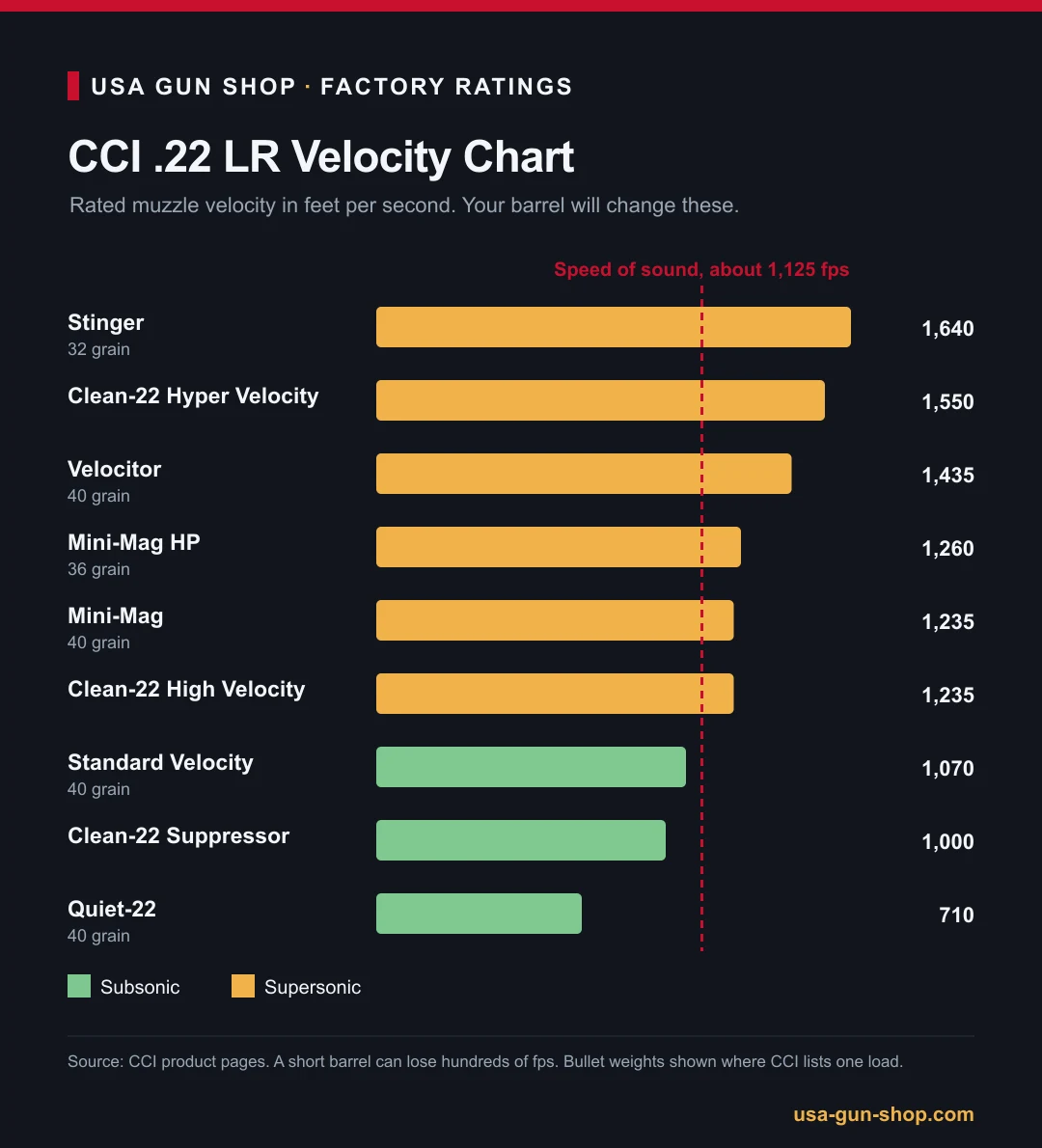
| CCI Stinger | 32gr CPHP | 1,640 fps | 191 ft-lb | Small game, flattest shooting |
| CCI Velocitor | 40gr CPHP | 1,435 fps | 183 ft-lb | Small game hunting |
| Remington Thunderbolt | 40gr LRN | 1,255 fps | 140 ft-lb | Cheapest bulk |
| CCI Mini-Mag | 40gr CPRN | 1,235 fps | 135 ft-lb | All-round, cleanest semi-auto feed |
| Federal Punch | 29gr nickel flat nose | 1,080 fps | 75 ft-lb | .22 defensive carry |
| Winchester Wildcat | 40gr LRN | 1,255 fps | 140 ft-lb | Budget bulk |
| Remington Golden Bullet | 36gr BPHP | 1,280 fps | 131 ft-lb | Bulk hunting |
| CCI Blazer | 40gr LRN | 1,235 fps | 135 ft-lb | Cheap and consistent |
| Federal AutoMatch | 40gr LRN | 1,200 fps | 128 ft-lb | Semi-auto reliability |
| Aguila Super Extra | 40gr CPRN | 1,255 fps | 140 ft-lb | High-volume plinking |
| CCI Standard Velocity | 40gr LRN | 1,070 fps | 102 ft-lb | Accuracy on a budget |
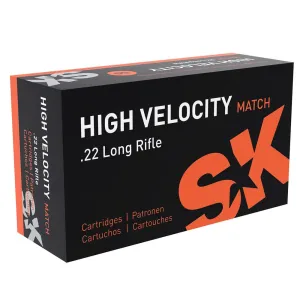
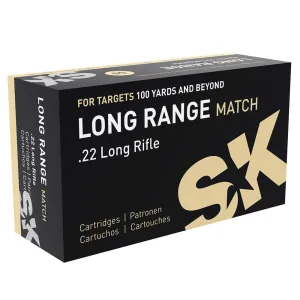
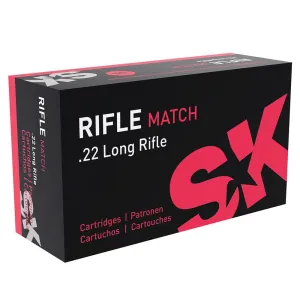
| SK Standard Plus | 40gr LRN | 1,073 fps | 102 ft-lb | Match accuracy for less |
| Winchester Super-X Power-Point | 40gr CPHP | 1,300 fps | 150 ft-lb | Small game |
| Eley Tenex | 40gr EPS flat nose | 1,085 fps | 105 ft-lb | Competition |
| CCI Subsonic HP | 40gr LHP | 1,050 fps | 98 ft-lb | Suppressed hunting |
| CCI Suppressor | 45gr LHP | 970 fps | 94 ft-lb | Suppressed semi-autos |
| CCI Quiet-22 | 40gr LRN | 710 fps | 45 ft-lb | Backyard pest, no can needed |
The spread is the story. From 710 fps to 1,640 fps and from 45 ft-lb to 191 ft-lb, these are not interchangeable products that happen to share a case. Pick the row that matches what you are doing, not the one at the top.
On-sale 22 lr from 200+ retailers · Updated every 4 hours

What .22 LR Actually Costs Per Round
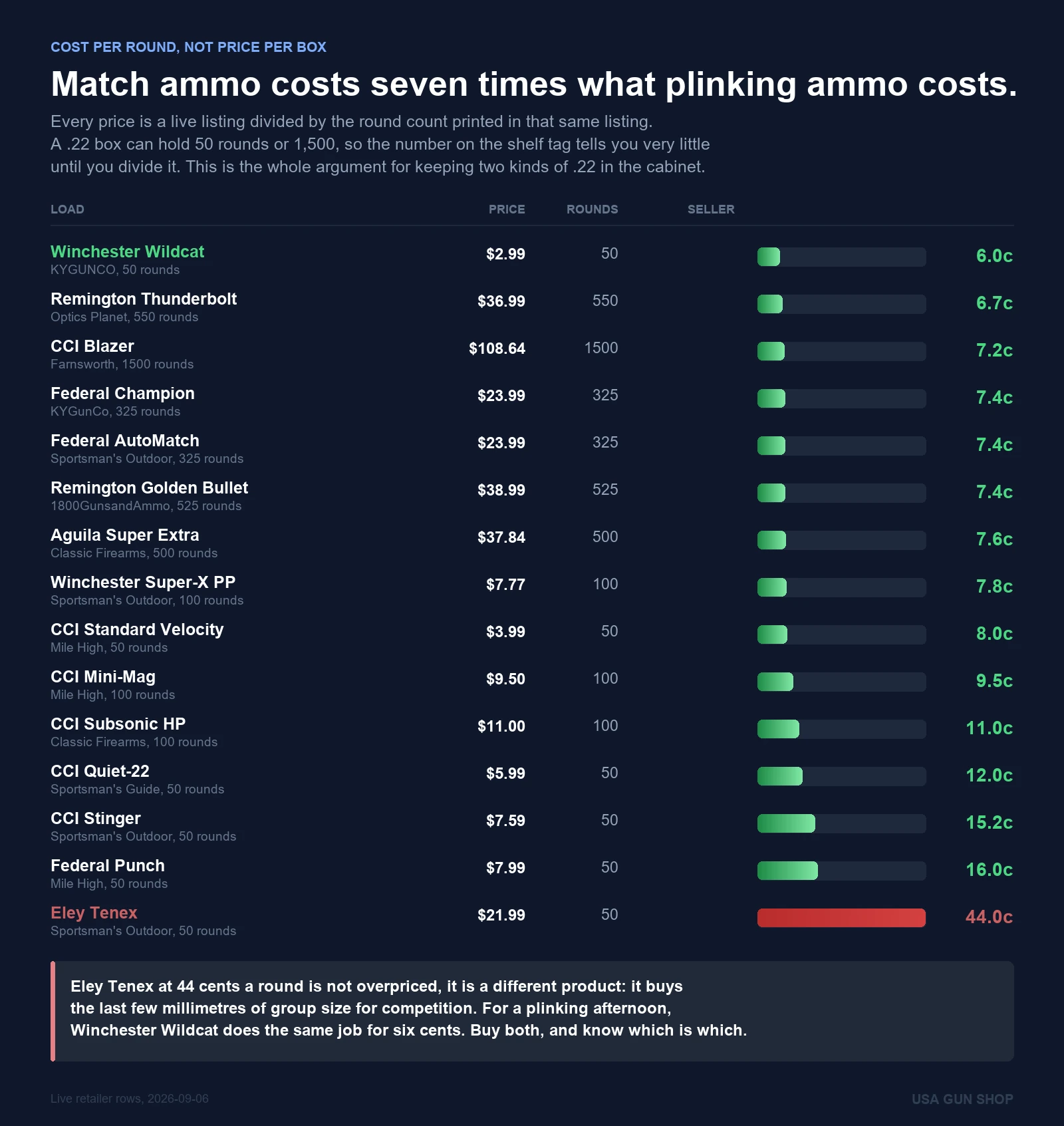
Rimfire is the one cartridge where the price on the shelf tag tells you almost nothing. A box of .22 might hold 50 rounds, 100, 325, 525 or 1,500, so two boxes at the same price can be four times apart in what they actually cost you to shoot. Every figure on the chart was a live listing in September 2026 divided by the round count printed in that same listing; the cards below show today’s prices.
The spread runs from about 6 cents a round for Winchester Wildcat to 44 cents for Eley Tenex, which is a little over seven times. That gap is not a value judgement. Tenex is buying you the last fraction of a group size at 50 meters, and it is the correct purchase if you are shooting for score. It is a waste of money if you are knocking cans over.
The practical takeaway is to run two loads rather than one. Buy bulk at 6 to 8 cents for volume practice, keep a hundred rounds of something accurate for zeroing and for the shots that matter, and never let a bulk brick be the ammo you sight in with. Rimfire point of impact moves between brands more than most people expect.
One buying note that applies to every row above. Bulk pricing is where the value is, but it is also where quality control loosens, so a 500-round brick of budget ammo will give you the odd dud or a light strike. That is a fair trade at 7 cents. It is not a fair trade in a match, or on a hunt. Our Savage 64 review shows the pattern: four jams on Remington Golden Bullet, none on CCI.
What SAAMI Actually Specifies for .22 Long Rifle
Every .22 LR guide ranks the same fifteen boxes. Almost none of them open the standard those boxes are built to. The figures below are read off ANSI/SAAMI Z299.1, the rimfire standard, in the revision approved on 8 May 2026.
| Specification | .22 Long Rifle | Why it matters to you |
|---|---|---|
| Rim thickness | 0.043 to 0.051 in | This is the headspace dimension, and it is the accuracy story |
| Maximum average pressure | 24,000 psi | The ceiling every commercial .22 LR load is built under |
| Max probable lot mean | 24,600 psi | What a whole production lot is allowed to average |
| Max probable sample mean | 25,500 psi | The outlier ceiling for a single tested sample |
| Standard twist | 1:16 right hand | Optional in the standard, and near universal in practice |
| Bore and groove | 0.217 in and 0.222 in | Minimum bore and groove area is fixed at 0.0382 sq in |
| Cartridge overall length | 0.950 to 1.000 in | A fiftieth of an inch of permitted variation in length |
| Velocity measurement | 15 feet from the muzzle | Not at the muzzle, which is why your chronograph disagrees |
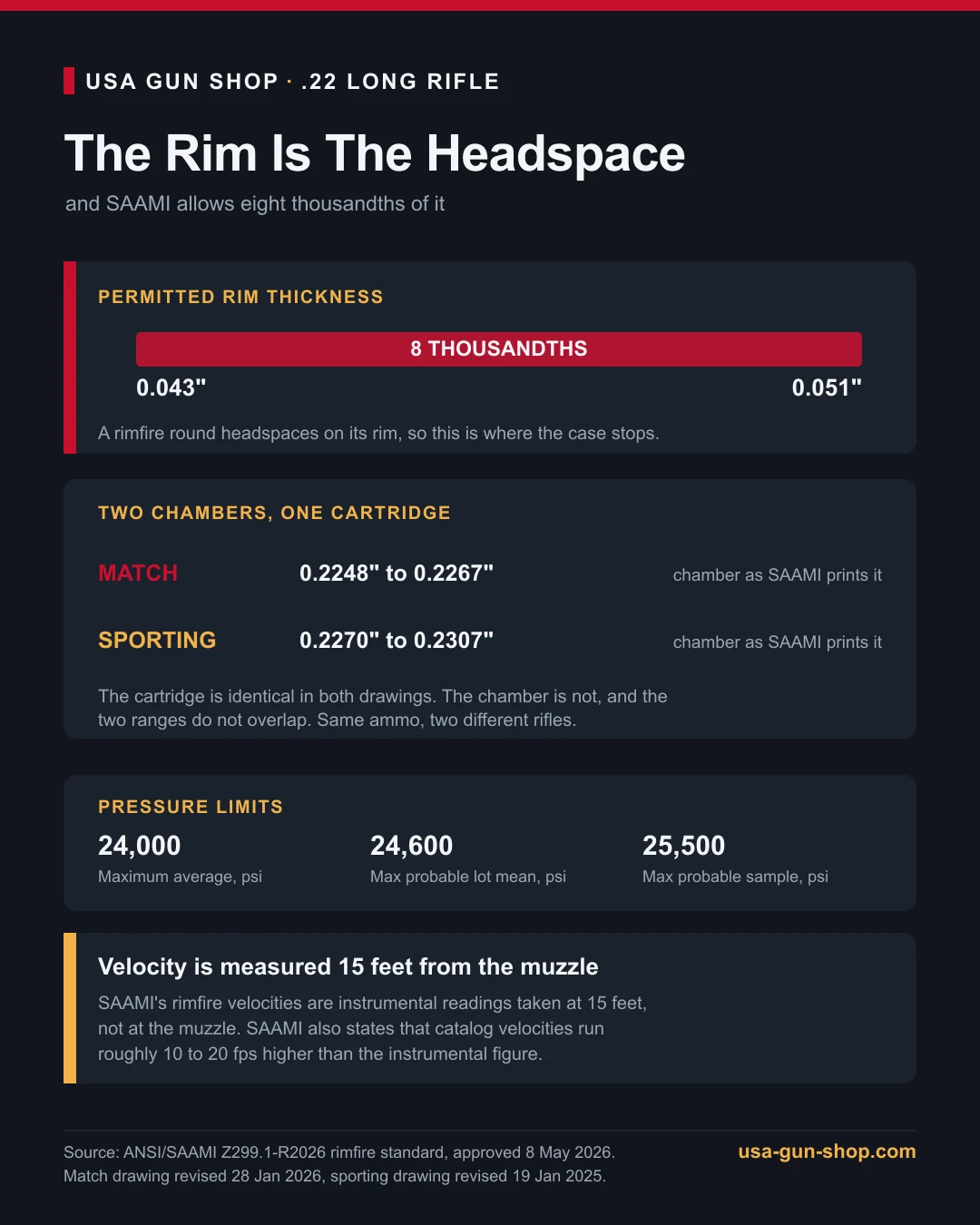
The rim is the headspace, and that is the whole accuracy story
A centerfire case stops on its shoulder or its case mouth. A rimfire case has neither job to do, so it stops on the rim, and SAAMI’s drawing marks that rim as the headspace dimension. The permitted range is 0.043 inch to 0.051 inch. Our rimfire vs centerfire guide shows how that same rim holds the priming compound.
That is 8 thousandths of an inch of legal variation in the one dimension that decides how far the cartridge sits from the rifling and how hard the firing pin has to squash the rim before the priming compound goes off. Two rounds out of the same box can sit at opposite ends of that range and both meet the standard.
This is why rimfire benchrest shooters sort ammunition by rim thickness with a gauge before a match, and it is the honest answer to why a box of Eley Tenex costs what a brick of Thunderbolt costs. You are not paying for a better bullet. You are paying for a tighter slice of that 8 thousandths, and for the lot consistency that goes with it.
Two chambers, one cartridge
SAAMI publishes two separate .22 LR drawings, one headed Match and one headed Sporting. The cartridge is identical on both: same rim, same 1:16 twist, same 0.217 inch bore, same 0.950 to 1.000 inch length. The chamber is not.
The match chamber is printed at 0.2248 to 0.2267 inch. The sporting chamber is printed at 0.2270 to 0.2307 inch. The two ranges do not overlap at all. Every box on this page fits both, and the same box will not shoot the same in both, which is the part nobody tells you before you buy match ammunition for a plinking rifle and wonder why it did not help.
If your .22 came from a rack at a big-box store, assume the sporting chamber. That is not a criticism of the rifle. It just means CCI Standard Velocity at a fifth of the price is the more sensible experiment than a box of Tenex.
The velocity on the box was not measured at the muzzle
SAAMI’s rimfire velocities are instrumental velocities taken 15 feet from the muzzle, over a 20 foot screen spacing. The standard says so in the equipment section and prints the test layout.
SAAMI goes further and states plainly that catalog velocities run roughly 10 to 20 feet per second higher than the instrumental figure. So the number on the box is neither what leaves the barrel nor what your chronograph will read at the bench, and the gap is a documented convention rather than anyone cheating. Every published velocity in the table above is that kind of number.
What a .22 LR chamber may also safely fire
SAAMI keeps a published table of the chamber and cartridge combinations that may be swapped, and introduces it with the words limited to only the following. There are 20 chamberings on it, and 22 Long Rifle is one of them. A rifle chambered in 22 LR may safely fire 22 Short, 22 Long and 22 Long Rifle Shot.
The pressures line up with that. 22 Short is held to 21,000 psi against 22 LR’s 24,000 psi, so the shorter round is working well inside what the chamber is built for. Feeding and cycling are a separate question, and a semi-auto will not run 22 Short at all. A lever action built for it will: the Browning BL-22 feeds Shorts, Longs and Long Rifle mixed in one magazine.
Worth knowing how unusual that is. .223 Remington and 5.56 NATO are not on that list, despite being the pair most people assume is interchangeable. The rimfire round your grandfather bought by the brick has a clearer safety answer than the most popular centerfire cartridge in America.
1. Federal Champion: Best Bulk Value

- Bullet: 40gr LRN
- Published velocity: 1,240 fps
- Muzzle energy: 137 ft-lb
Pros
- Cheap enough to shoot all day
- Sold in 325 and 525 packs
- Cleaner than most bulk loads
Cons
- Not match accurate
- Occasional dud in bulk packs
- Lead round nose only
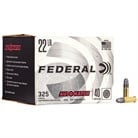
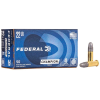
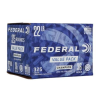
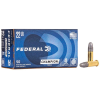
Federal Champion is the bulk brick I keep in the truck. The 40-grain lead round nose leaves at a published 1,240 fps with 137 ft-lb, it runs clean enough that a 10/22 goes a long session before it needs attention, and the 325 and 525-round packs drive the per-round cost down to plinking money.
Expect the odd dud in a big brick; that is the trade for the price. Do not zero your rifle with it and do not hunt with it. For both of those, buy a box of Mini-Mag or Standard Velocity. Federal also sells Champion as a 36-grain hollow point, the box pictured here.
Best For: High-volume plinking and teaching new shooters.
2. CCI Stinger: Fastest .22 LR

- Bullet: 32gr CPHP
- Published velocity: 1,640 fps
- Muzzle energy: 191 ft-lb
Pros
- Fastest factory .22 LR
- Real terminal effect on pests
- Flattest trajectory to 75 yards
Cons
- Longer case than standard .22
- Hard on some match chambers
- Costs triple bulk ammo
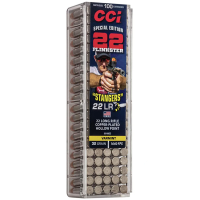

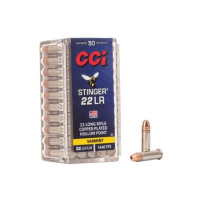
Stinger is the hot rod of .22 LR: a 32-grain copper-plated hollow point at a published 1,640 fps and 191 ft-lb, the most energy on this list. The light bullet expands hard, which makes it a strong choice for prairie dogs, ground squirrels and pests out to about 75 yards.
The case is a little longer than standard .22 LR, which can be tight in a match chamber, and the light bullet is not the accurate choice. For small game where you want a clean, quick result, it is the box to buy.
Best For: Varmints and pests where energy matters more than group size.
3. CCI Velocitor: Best Hunting Hollow Point
- Bullet: 40gr CPHP
- Published velocity: 1,435 fps
- Muzzle energy: 183 ft-lb
Pros
- Full 40-grain bullet at hypervelocity
- Bonded-style hollow point holds together
- More energy than Mini-Mag
Cons
- Costs about as much as Stinger
- Not the most accurate load
- Overkill for paper
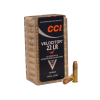
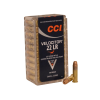
Velocitor is the hunting load I would pick over Stinger for anything bigger than a squirrel. It keeps a full 40-grain plated hollow point and still leaves at a published 1,435 fps with 183 ft-lb, so it penetrates better than the light Stinger while expanding well on rabbits and raccoons.
It costs about what Stinger does, and it is not a target round. Zero with it and keep a box for the season.
Best For: Rabbits, squirrels and raccoons where you want penetration and expansion.
4. Remington Thunderbolt: Cheapest Bulk

- Bullet: 40gr LRN
- Published velocity: 1,255 fps
- Muzzle energy: 140 ft-lb
Pros
- Among the cheapest per round
- Stocked almost everywhere
- Fine for casual plinking
Cons
- Dirty, fouls barrels fast
- More duds than CCI
- Not ideal for semi-autos
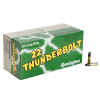
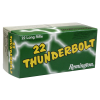
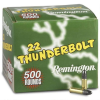
Thunderbolt is a 40-grain lead round nose at a published 1,255 fps and 140 ft-lb, and it has been on gun-shop shelves for decades because it is cheap. It shoots fine for tin cans.
It is also dirty and less consistent than CCI or Federal, so semi-autos tend to choke on it sooner. Buy it for a bolt gun or revolver plinking session, not for a rifle you care about.
Best For: The cheapest plinking in a bolt action or revolver.
5. CCI Mini-Mag: Best All-Round

- Bullet: 40gr CPRN
- Published velocity: 1,235 fps
- Muzzle energy: 135 ft-lb
Pros
- Feeds in nearly every semi-auto
- Plated bullet runs clean
- Accurate enough to hunt with
Cons
- Costs more than bulk bricks
- Not match accurate
- Plated, so no lead-free
If you only buy one .22 LR, buy Mini-Mag. The 40-grain copper-plated round nose leaves at a published 1,235 fps with 135 ft-lb, and it runs in more semi-autos than anything else I have shot. Over 300 rounds through my Ruger 10/22 it never stopped once, and from a rest at 25 yards my SW22 Victory held about 1.5 inches with it.
It costs a few cents more a round than bulk bricks, and match ammo groups tighter, but nothing else on this list does as many jobs as well. The box pictured is the 36-grain Mini-Mag hollow point at 1,260 fps, the varmint version of the same line.
Best For: One box that does plinking, hunting and reliable semi-auto feeding.
6. Federal Punch: Best .22 for Defense

- Bullet: 29gr nickel flat nose
- Published velocity: 1,080 fps
- Muzzle energy: 75 ft-lb
Pros
- Built for short-barrel handguns
- Nickel case feeds smoothly
- Penetration tuned for defense
Cons
- .22 LR is a weak defense round
- Expensive per round
- Low energy at 75 ft-lb
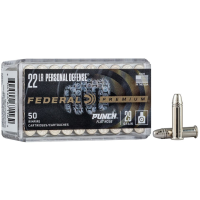
Punch is Federal’s .22 LR made for carry guns: a 29-grain nickel-plated flat nose bullet tuned to penetrate from short barrels, at a published 1,080 fps and 75 ft-lb. It is the right box if a .22 pistol or revolver is what you can shoot well.
Be honest about the cartridge. If you can carry a 9mm or .380, carry that. If arthritis or recoil rules them out, Punch is the .22 to put in the gun.
Best For: Shooters who carry a .22 handgun for defense.
7. Winchester Wildcat: Budget Bulk

- Bullet: 40gr LRN
- Published velocity: 1,255 fps
- Muzzle energy: 140 ft-lb
Pros
- About the cheapest per round
- Widely available
- Fine for bolt-action plinking
Cons
- Dirty bullet lube
- Inconsistent lot to lot
- Some semi-autos dislike it
Wildcat is Winchester’s bulk lead round nose, 40 grains at a published 1,255 fps and 140 ft-lb. On our cost chart it was the cheapest per round on the list, at about 6 cents.
That price buys plinking, not precision. It is dirty and varies more lot to lot than Federal or CCI, so test a box in your semi-auto before you buy a case.
Best For: The cheapest high-volume plinking.
8. Remington Golden Bullet: Bulk Hollow Point

- Bullet: 36gr BPHP
- Published velocity: 1,280 fps
- Muzzle energy: 131 ft-lb
Pros
- Cheap hollow point in bulk
- Plated bullet runs cleaner
- Fine for pests at short range
Cons
- Jammed four times in my Savage 64
- Inconsistent accuracy
- Bucket packs hide duds
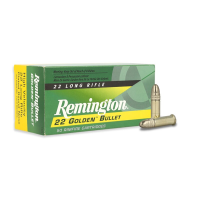
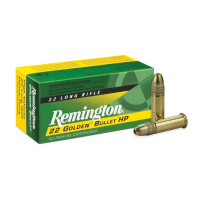
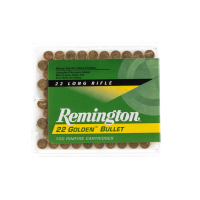
Golden Bullet is a cheap 36-grain plated hollow point at a published 1,280 fps and 131 ft-lb, sold in big packs and buckets. It is the cheapest way to shoot hollow points at pests.
It is also the load my Savage 64 liked least: four jams on Golden Bullet, none on CCI in the same session. Use it in a bolt gun or a semi-auto you have already tested it in.
Best For: Cheap hollow points for pests, in a gun that runs them.
9. CCI Blazer: Cheap and Consistent
- Bullet: 40gr LRN
- Published velocity: 1,235 fps
- Muzzle energy: 135 ft-lb
Pros
- CCI quality at bulk prices
- Consistent lot to lot
- Runs well in most semi-autos
Cons
- Lead round nose only
- Not match accurate
- Less common than Mini-Mag
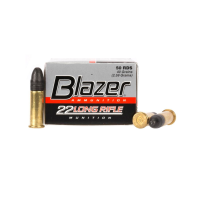
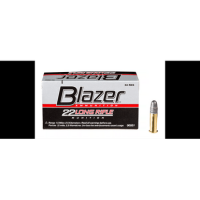
Blazer is CCI’s budget line: a 40-grain lead round nose at a published 1,235 fps and 135 ft-lb. You get CCI priming and consistency for close to bulk-brick prices, which makes it the bulk load I trust most in a semi-auto.
It is not a match round and not a hunting round, but for practice that does not jam, it is the sweet spot between Thunderbolt and Mini-Mag.
Best For: Reliable practice ammo at near-bulk prices.
10. Federal AutoMatch: Best for Semi-Autos

- Bullet: 40gr LRN
- Published velocity: 1,200 fps
- Muzzle energy: 128 ft-lb
Pros
- Built to cycle semi-autos
- Sold in 325-round packs
- Cleaner than most bulk
Cons
- Not true match ammo
- Plain lead round nose
- Packs, not boxes of 50
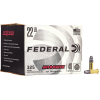
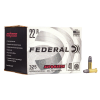
AutoMatch is Federal’s answer to the jam-prone bulk brick: a 40-grain lead round nose at a published 1,200 fps and 128 ft-lb, tuned to run semi-autos like the 10/22 and Mark IV. It comes in 325-round packs.
Despite the name, it is not match ammo. It is reliable practice ammo, and that is exactly what most .22 shooters need.
Best For: High-volume shooting in semi-auto rifles and pistols.
11. Aguila Super Extra: High-Volume Plinking

- Bullet: 40gr CPRN
- Published velocity: 1,255 fps
- Muzzle energy: 140 ft-lb
Pros
- Plated bullet at bulk prices
- Hotter priming helps reliability
- Good in semi-autos
Cons
- Less common in stores
- Not match accurate
- Price swings with stock
Aguila Super Extra is a 40-grain copper-plated round nose at a published 1,255 fps and 140 ft-lb, made in Mexico and often the cheapest plated .22 you can buy. Plated bullets run cleaner than bare lead, so it is a smart bulk choice for semi-autos.
It is not on every shelf, so buy it when you see a good price.
Best For: Plated bulk ammo for semi-autos on a budget.
12. CCI Standard Velocity: Accuracy on a Budget

- Bullet: 40gr LRN
- Published velocity: 1,070 fps
- Muzzle energy: 102 ft-lb
Pros
- Match-like accuracy for little money
- Subsonic in most rifles
- Quiet with a suppressor
Cons
- May not cycle some semi-autos
- Less energy for hunting
- Lead round nose only
Standard Velocity is the best-value accuracy load on this list. It is a 40-grain lead round nose at a published 1,070 fps and 102 ft-lb, which keeps it subsonic in most rifles. My SW22 Victory held about 1.2 inches at 25 yards with it, it grouped best in my Savage 64, and suppressed in a 10/22 it stayed under an inch at 50 yards.
Slower ammo makes less gas, so a few stiff semi-autos may short-stroke on it. In a bolt gun or a tuned semi-auto, it is the box to zero with.
Best For: Accurate practice and suppressed shooting for little money.
13. SK Standard Plus: Best Value Match
- Bullet: 40gr LRN
- Published velocity: 1,073 fps
- Muzzle energy: 102 ft-lb
Pros
- Match-level groups for half Tenex
- Made in Lapua and Eley’s league
- Subsonic, quiet suppressed
Cons
- Rarely stocked in stores
- Not for hunting
- Some semi-autos short-stroke
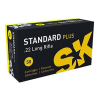
SK Standard Plus is the cheapest load I would call match accurate. It is a 40-grain lead round nose at a published 1,073 fps and 102 ft-lb, made by SK in Germany. From a rest at 25 yards my SW22 Victory printed five-shot groups around 1 inch with it, the best of anything I fed it, and out of a CZ 457 it shot ragged half-inch groups at 50 yards.
It costs about two and a half times what CCI Standard Velocity does and under half what Eley Tenex costs. For most rimfire competitors and serious plinkers, that is the right spot.
Best For: Rimfire matches and precision practice without paying Tenex prices.
14. Winchester Super-X Power-Point: Best for Small Game

- Bullet: 40gr CPHP
- Published velocity: 1,300 fps
- Muzzle energy: 150 ft-lb
Pros
- Full-weight hollow point
- Expands reliably on small game
- Good price for a hunting load
Cons
- Not match accurate
- Dirtier than CCI
- Bulk packs vary
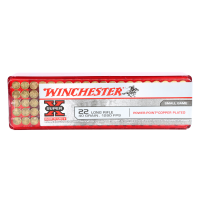
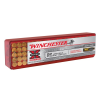
Power-Point is a 40-grain copper-plated hollow point at a published 1,300 fps and 150 ft-lb, a classic squirrel and rabbit load. The full-weight bullet holds together better than light hyper-velocity rounds while still expanding.
It is the cheaper alternative to Velocitor for small game. Zero with it before the season.
Best For: Squirrels and rabbits on a budget.
15. Eley Tenex: Best Competition

- Bullet: 40gr EPS flat nose
- Published velocity: 1,085 fps
- Muzzle energy: 105 ft-lb
Pros
- The benchmark for match .22
- Tightest lot consistency
- Proven in Olympic shooting
Cons
- About 42 cents a round
- Wasted in sporting chambers
- Hard to find in stock
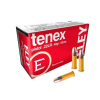
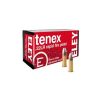


Tenex is the round serious smallbore shooters buy: a 40-grain EPS flat nose at a published 1,085 fps and 105 ft-lb, built to the tightest rim and lot consistency on this list. At about 42 cents a round on November 20, 2026, it costs seven times bulk ammo.
It earns that in a match chamber. In a sporting chamber, buy SK Standard Plus or CCI Standard Velocity instead; see the SAAMI section above for why.
Best For: Smallbore competition in a match-chambered rifle.
Subsonic and Suppressor .22 LR
SAAMI publishes a suppressor standard, Z299.6, and it names the .22 LR load the industry tests cans with. For long-gun sound measurement it specifies a 16.25 inch barrel and 40 grain lead round nose at a catalog velocity of 1,035 plus or minus 35 feet per second. For handguns it specifies a 4.5 inch barrel.
That is a useful number to carry into a purchase. If a load is advertised above about 1,070 fps it sits outside the window the industry uses to measure suppression, and the bullet is close enough to the speed of sound that you risk a crack downrange no matter which can is on the end. The two picks below sit either side of that line on purpose.
Here is the gap in almost every .22 LR round-up. The .22 LR is the caliber most people suppress first, and standard high-velocity ammo defeats the point of a can entirely. Anything over about 1,125 fps goes supersonic and cracks on the way downrange no matter what is screwed to your muzzle. These two are what I actually run behind a suppressor.
16. CCI Subsonic HP: Best Suppressed Hunting
- Bullet: 40gr LHP
- Published velocity: 1,050 fps
- Muzzle energy: 98 ft-lb
Pros
- Stays subsonic in long barrels
- Hollow point for small game
- Quiet without being weak
Cons
- Will not cycle some semi-autos
- Costs double bulk ammo
- Sold in boxes of 100
This is the one to buy if you want a suppressed .22 that still kills things properly. At a published 1,050 fps it stays under the sound barrier in a rifle-length barrel, and the 40-grain lead hollow point still opens on small game.
Subsonic loads make less gas, so a semi-auto tuned for high-velocity ammo may short-stroke. In a bolt gun or a revolver it is a non-issue.
Best For: Suppressed small-game hunting and pest control.
17. CCI Suppressor: Heaviest Subsonic
- Bullet: 45gr LHP
- Published velocity: 970 fps
- Muzzle energy: 94 ft-lb
Pros
- Heavy 45-grain bullet keeps momentum
- Built to cycle suppressed semi-autos
- Quiet with a can
Cons
- Pricier than Standard Velocity
- Rainbow trajectory past 75 yards
- Overkill without a suppressor
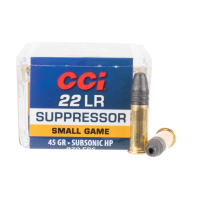
CCI Suppressor is built for a can on a semi-auto. The heavier 45-grain hollow point leaves at a published 970 fps with 94 ft-lb, and the extra bullet weight gives a suppressed 10/22 enough recoil impulse to cycle where lighter subsonics short-stroke.
It drops fast past 75 yards, so it is a close-range small-game and pest load.
Best For: Suppressed semi-auto rifles and pistols.
18. CCI Quiet-22: Quietest Without a Can
- Bullet: 40gr LRN
- Published velocity: 710 fps
- Muzzle energy: 45 ft-lb
Pros
- Genuinely quiet, no suppressor needed
- Perfect for backyard pests
- Almost no recoil
Cons
- Will not cycle semi-autos
- Short effective range
- Only 45 ft-lb of energy
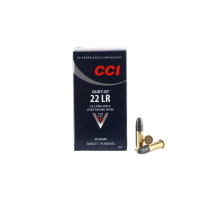
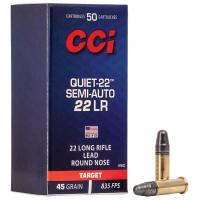
Quiet-22 is the surprising one. At a published 710 fps it is roughly as loud as an air rifle from an unsuppressed barrel, so it is quiet without a can. CCI quotes about a 75 percent reduction in report against standard .22.
You give up most of the energy to get there: 45 ft-lb is a third of a Mini-Mag. It is a rat and squirrel round at close range, and it will not cycle a semi-auto.
Best For: Backyard pest control and quiet practice.
How I Tested These .22 LR Loads
I shot these loads through the rimfires we review: a Ruger 10/22, a CZ 457, a Savage 64, a Ruger Mark IV and an S&W SW22 Victory with a red dot. Groups are five shots from a rest at 25 yards for the pistols and 50 yards for the rifles. Velocities and energies in the table are the makers’ published figures, which SAAMI measures 15 feet from the muzzle, so a chronograph at the bench will read a little lower. Load data comes from the makers, including CCI, Federal and Eley.
FAQ: .22 LR Ammo
What is the best .22 LR ammo?
CCI Mini-Mag 40gr is the best all-around .22 LR. It feeds in nearly every semi-auto, runs clean, and held about 1.5 inches at 25 yards from my SW22 Victory. For accuracy on a budget, CCI Standard Velocity and SK Standard Plus did better, about 1 to 1.2 inches. For bulk plinking, Federal Champion or CCI Blazer.
How much does .22 LR ammo cost?
Bulk .22 LR ammo costs about $0.05 to $0.08 per round (roughly $25-40 per 500). Premium target ammo costs $0.10 to $0.20 per round. Match ammo like Eley Tenex runs about 42 cents a round. That makes .22 LR far and away the cheapest way to put rounds downrange, which is the whole reason it has outlived every cartridge invented to replace it. It is a rimfire, not a centerfire, and SAAMI standardizes it in a separate document, Z299.1.
Is .22 LR good for self-defense?
.22 LR is not recommended as a primary self-defense caliber. It lacks the stopping power of 9mm, .380, or .38 Special. However, any gun is better than no gun, and a .22 LR you can shoot well is better than a larger caliber you cannot control. For dedicated self-defense, choose 9mm at minimum.
What is the difference between .22 LR and .22 WMR?
.22 WMR (Winchester Magnum Rimfire) is significantly more powerful than .22 LR, with roughly twice the muzzle energy. .22 WMR ammo costs about 3-4 times more per round. .22 LR is better for plinking and target shooting. .22 WMR is better for hunting small game at longer distances.
Is .22 LR good for hunting?
Yes, for small game and pest control it is ideal. A .22 LR cleanly takes squirrels, rabbits and similar game at moderate range with cheap ammo and almost no recoil, and high-velocity hollow points like the CCI Velocitor extend its reach. It is not a big-game cartridge, but for its intended quarry it is hard to beat.
What is the most accurate .22 LR ammo?
Match ammo wins. Eley Tenex is the benchmark, but SK Standard Plus is the value pick: it printed about 1-inch groups at 25 yards from my SW22 Victory and half-inch groups at 50 yards from a CZ 457. CCI Standard Velocity is close behind for much less money. Test a few loads in your gun, because every barrel has a preference.
Why does my .22 keep jamming?
Most of the time it is the ammo. Bulk loads are dirtier and less consistent: my Savage 64 jammed four times on Remington Golden Bullet and not once on CCI in the same session. Switch to a clean plated load like CCI Mini-Mag or Federal AutoMatch, keep the action clean, and check your magazines.
Is bulk .22 LR ammo worth buying?
For high-volume plinking, yes, bulk packs make .22 shooting wonderfully cheap, but the cheapest bulk loads run dirtier and less consistently, which can cause jams in picky semi-autos. Keep bulk ammo for casual fun and reserve a quality load for hunting or accuracy work. Buying bulk when prices dip is the smart play.
3,419+ Gun & Ammo Deals
Updated daily from 200+ top retailers. Filter by category, caliber, action type, and price.