
Last updated March 9th 2026
I have carried concealed every day for over a decade — through four states, dozens of holsters, and more carry guns than I care to admit. This guide is built from years of daily carry experience, professional training courses, and real conversations with hundreds of new concealed carriers. Some links are affiliate links that support our independent testing. Read our editorial policy.
Quick Guide: Concealed Carry Essentials
If you want the short version, here is what you need to start carrying concealed:
- Best overall carry gun: Sig Sauer P365 — 10+1 in a micro-compact frame, $499
- Best compact carry gun: Glock 19 Gen 5 — 15+1, the do-everything pistol, $549
- Best budget carry gun: Taurus G3C — 12+1, reliable, under $250
- Best holster position: Appendix IWB (AIWB) — fastest draw, best concealment
- Best carry ammo: Federal HST 124gr or Speer Gold Dot 124gr
- Training requirement: Minimum 200 rounds live fire + weekly dry-fire practice
- Legal first step: Check your state’s concealed carry laws
Is Concealed Carry Right for You?
Carrying a concealed firearm is a serious commitment. It is not just about buying a gun and a holster — it is a lifestyle change that affects how you dress, how you interact with people, and how you think about situational awareness every single day. Before you invest the time and money, ask yourself these questions honestly:
- Are you willing to train regularly? A concealed carry gun you have not practiced with is worse than no gun at all. It creates a false sense of security while adding the risk of a negligent discharge or a missed shot. Budget for at least 200 rounds per month of practice during your first year.
- Can you maintain emotional discipline? Carrying a firearm means you lose every argument. You walk away from every confrontation. You de-escalate every situation. The gun is for when all other options have failed and your life or the life of an innocent person is in imminent danger. If road rage gets to you or you tend to escalate verbal conflicts, address that before carrying.
- Will you carry consistently? The gun you leave at home is useless. If you are not willing to carry daily — including to the grocery store, to dinner, to your kid’s soccer game — then concealed carry may not be for you. Consistency matters.
- Are you prepared for the legal consequences? Even a justified defensive shooting will change your life. You will likely be arrested, questioned, and potentially charged. You will spend tens of thousands on legal defense. Your name will be in the news. This is the reality, and you need to accept it before strapping on a holster. Concealed carry insurance is essentially mandatory.
If you answered yes to all of those, concealed carry is a profoundly empowering decision. Let me show you how to do it right.
Concealed Carry Laws: What You Need to Know
The legal landscape for concealed carry has shifted dramatically in recent years. As of 2026, 29 states have constitutional carry (also called permitless carry), meaning legal gun owners can carry concealed without a government-issued permit. The remaining 21 states require a permit, which typically involves a background check, training course, and application fee ranging from $25 to $200+.
Permit vs. Permitless Carry States
Even if you live in a constitutional carry state, I strongly recommend getting a permit anyway. Here is why:
- Reciprocity. A permit from your home state may be recognized by 25-35+ other states. Without one, your right to carry ends at the state line.
- NICS bypass. In many states, a carry permit serves as an alternative to the NICS background check when purchasing firearms — no more waiting or delays.
- Training requirement. Most permit courses include basic legal education and marksmanship testing. This is valuable even if your state does not require it.
- Legal credibility. In the aftermath of a defensive shooting, having a carry permit demonstrates to prosecutors and juries that you took concealed carry seriously enough to get formally licensed.
Where You Cannot Carry
Regardless of your permit or constitutional carry status, federal law prohibits concealed carry in: federal buildings (courthouses, post offices, IRS offices), schools and school zones (Gun-Free School Zones Act — some states allow with a permit), airports (past TSA security checkpoints), and military installations. State laws add additional prohibited locations — commonly bars, churches (varies by state), hospitals, and government buildings.
Know your state’s laws before you carry. Ignorance is not a defense. We maintain a comprehensive, regularly updated gun laws by state guide covering carry requirements, prohibited locations, reciprocity, and use-of-force laws for all 50 states.
Use-of-Force Laws
Every state defines when deadly force is legally justified, and the specifics matter enormously. Key concepts you must understand:
Castle Doctrine: Most states provide strong legal protection for using deadly force within your home against an intruder. Some extend this to your vehicle and workplace.
Stand Your Ground vs. Duty to Retreat: In “Stand Your Ground” states (roughly 30 states), you have no legal obligation to retreat before using deadly force if you are in a place you have a lawful right to be. In “Duty to Retreat” states, you must attempt to retreat safely before using deadly force (except in your home under Castle Doctrine). Knowing which framework your state follows is critical.
The standard for deadly force: In nearly all jurisdictions, deadly force is justified only when a reasonable person would believe they faced an imminent threat of death or great bodily harm. “He was threatening me” is not enough. “He punched me once” is generally not enough. “He was advancing toward me with a weapon and I could not escape” — that is the threshold.
Choosing the Best Concealed Carry Gun
Your carry gun needs to balance four factors: shootability (can you hit your target under stress?), concealability (can you hide it in your normal wardrobe?), capacity (do you have enough rounds?), and reliability (will it fire every single time?). No single gun maximizes all four — carry is about trade-offs.
Size Classes for Concealed Carry
Understanding the size spectrum helps you pick the right trade-off:
Micro-compact (Sig P365, Springfield Hellcat, Kimber Mako): The smallest 9mm pistols with double-stack capacity (10-15 rounds). Best for deep concealment, summer carry, and smaller body frames. Trade-off: shorter sight radius and snappier recoil. See our best micro-compact 9mm pistols guide.

Subcompact (Glock 43X, Glock 26, S&W Shield Plus): Slightly larger than micro-compacts, with improved ergonomics and sight radius. The Glock 43X with Shield Arms S15 magazines gives you 15 rounds in a slim single-stack-width frame. See the best subcompact 9mm handguns.
Compact (Glock 19, Sig P320 Compact, S&W M&P 2.0 Compact): The do-everything size. 15-17 rounds, good sight radius, manageable recoil. Concealable for most body types with a quality holster, especially in AIWB position. My personal daily carry is a compact-size pistol. See the best compact 9mm pistols.
For the complete breakdown of every size class and my specific model recommendations at every budget, see our handgun buyer’s guide. For the full list of our top carry gun picks, read the best concealed carry handguns.
Top 5 Concealed Carry Guns in 2026
After years of daily carry, training courses, and tens of thousands of rounds, these are the five carry guns I recommend most:
1. Sig Sauer P365 / P365X ($499-$599) — The gun that redefined concealed carry. 10+1 (flush) to 15+1 (extended) capacity in a package barely larger than a Glock 43. The P365X variant adds a flat trigger and slightly larger grip. Optics-ready. Read our full P365 review and see the P365 vs. Glock 43X head-to-head.
Sig Sauer P365
2. Glock 19 Gen 5 ($549-$599) — The most popular concealed carry pistol in America for a reason. 15+1, proven reliability, unmatched aftermarket support. Slightly larger than a micro-compact, but the 15-round capacity and superior shootability are worth the size trade-off. Our 2,000-round review details why it is still the standard.
Glock 19 Gen 5
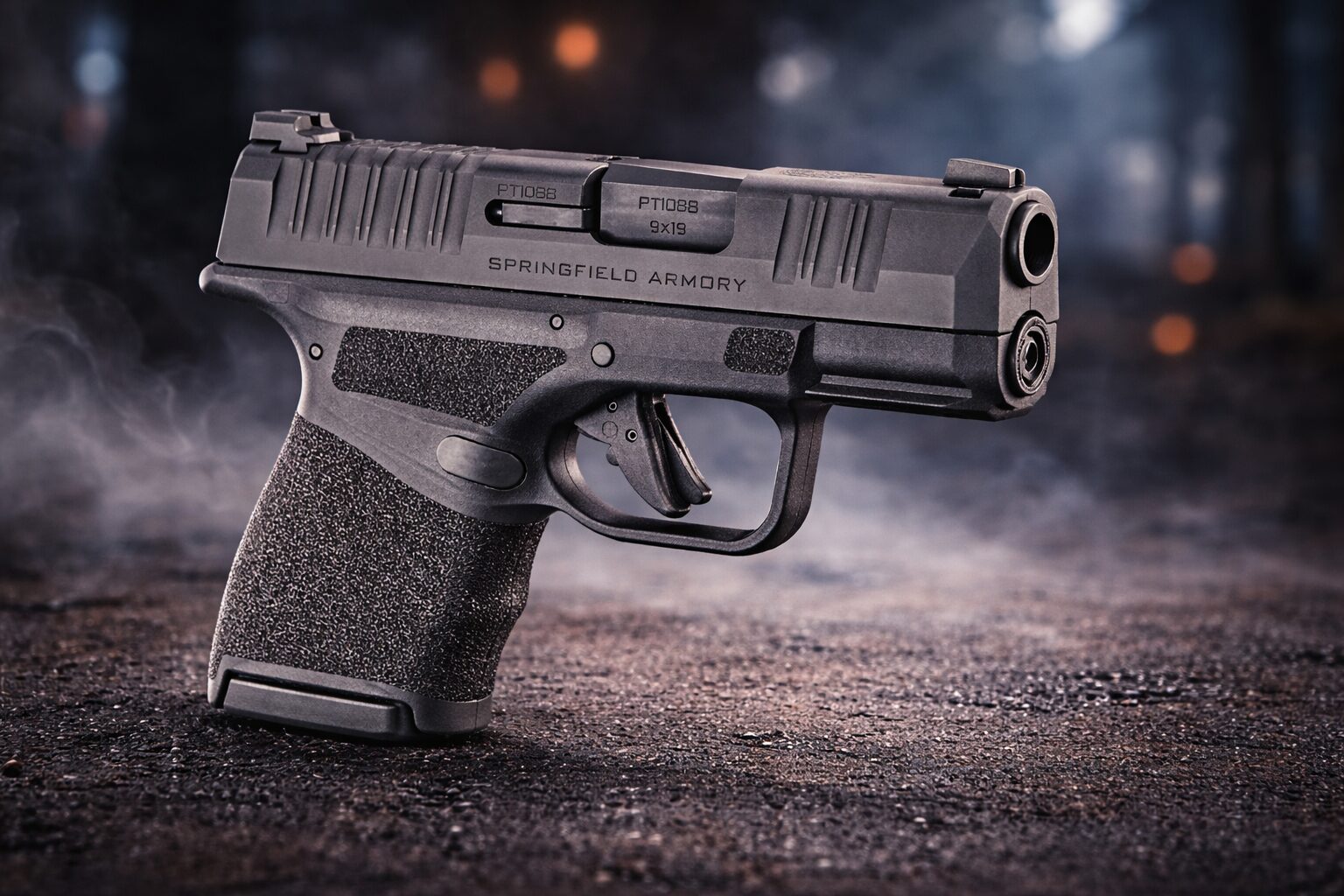
3. Springfield Hellcat / Hellcat Pro ($499-$579) — The Hellcat crammed 11+1 rounds into the smallest micro-compact frame on the market. The Hellcat Pro stretches the grip to 15 rounds and adds a 3.7-inch barrel — bridging the gap between micro-compact and compact. Read our 1,500-round Hellcat review.
Springfield Hellcat
4. S&W M&P Shield Plus ($399-$449) — Smith & Wesson’s answer to the micro-compact revolution. 10+1 or 13+1 rounds, excellent trigger for the price, and it fits perfectly in hands that find the P365 too small. At under $450, it is a superb value.
S&W M&P Shield Plus
5. Glock 43X ($449-$499) — A slim, single-stack-width 9mm that holds 10+1 standard — or 15+1 with Shield Arms S15 magazines. The slim profile makes it one of the most comfortable carry guns on the market, especially at the 3-5 o’clock position. Upgrade with a Holosun 507K red dot for faster target acquisition. See the Glock 43X vs. P365 comparison and the best Glocks for concealed carry.
Glock 43X
Budget tight? The best CCW guns under $400 includes reliable carry options starting at $229.
Find the Best Price in Seconds
Search once, compare 100+ trusted retailers instantly.
Holster Selection: The Most Important Decision After the Gun
Your holster matters as much as your gun — arguably more. A great gun in a terrible holster will not get carried. A good gun in a great holster gets carried every day. I have tried dozens of holsters over the years and thrown away most of them. Here is what I have learned:
Holster Materials
Kydex is the gold standard for concealed carry holsters. It is a thermoplastic that is molded to the exact shape of your specific gun. It provides positive retention (the gun “clicks” in and stays put), protects the trigger guard completely, and allows a consistent, repeatable draw stroke. Every holster I recommend is Kydex or a Kydex hybrid.
Leather holsters look beautiful and are comfortable against the skin, but they lose shape over time, can collapse when you reholster (forcing you to look down and use two hands — dangerous), and do not retain as precisely as Kydex. High-quality leather from companies like Milt Sparks and Galco are the exception, but they cost $150+ and have multi-month wait times.
Nylon/universal holsters should be avoided entirely. They do not protect the trigger guard adequately, provide no real retention, and fit nothing well. I do not care how cheap they are — do not use them.
Carry Positions
Where you carry the gun on your body changes everything about concealability, draw speed, and comfort:
Appendix IWB (AIWB) — 12:00 to 1:00 position. This is my primary carry method and what I recommend to most people. The gun sits in front of your hip, just to the right of your belt buckle (for right-handed shooters). Advantages: fastest draw to the target, easiest to conceal (the gun sits in the natural crease of your body), and you can monitor the gun’s security by simply looking down. The holster is between you and anyone in front of you, making gun grabs extremely difficult. Disadvantage: some people find it uncomfortable when sitting, especially with larger guns or larger waistlines. A wedge on the holster and a proper gun belt solve this for most body types.
Strong-side IWB — 3:00 to 4:30 position. The traditional carry position. The gun rides on your dominant-side hip, behind the hip bone. Advantages: comfortable for most body types, easy to conceal under an untucked shirt or jacket, less position-sensitive than appendix. Disadvantage: slower draw, printing is more visible when bending or reaching, and the gun is more accessible to someone behind you.
Pocket carry. For small revolvers (.38 snubs) or micro-compact pistols only. The gun rides in a pocket holster in your front pocket. Advantages: extremely discreet, requires no special clothing. Disadvantage: very slow draw, limited to small guns, lint and debris can accumulate.
Ankle carry. A backup gun position. The gun rides in an ankle holster on your support-side leg. Advantages: deeply concealed, useful for seated professionals (desk workers, drivers). Disadvantage: extremely slow draw, requires pants with enough room, uncomfortable for walking. I use ankle carry for a backup gun only.
For more practical tips on holster selection and carry positions, read our concealed carry tips and techniques guide.
Top Holster Recommendations
These are holsters I have personally worn for extended periods:
- Tier 1 Concealed Axis Elite ($120-$150) — The best appendix holster on the market. Integrated sidecar magazine carrier, adjustable ride height, and a built-in wedge for comfort. This is what I carry in daily.
- T.Rex Arms Sidecar 2.0 ($100-$130) — Excellent appendix holster with a modular sidecar design. Slightly less refined than the Axis Elite but very good.
- Tenicor Velo4 ($80-$100) — The best minimalist AIWB holster. No sidecar, just the gun — slim, comfortable, and the retention is dialed perfectly out of the box.
- JM Custom Kydex Wing Claw 2.5 ($90-$110) — Best strong-side IWB holster. The wing presses against the belt to tuck the grip into your body. Works beautifully at 3:30-4:00.
- DeSantis Nemesis ($25-$35) — The best pocket holster for a micro-compact. Sticky outer material stays in place, non-descript shape breaks up the gun’s outline.
The Gun Belt: Do Not Skip This
A dedicated gun belt is the unsung hero of comfortable concealed carry. Your regular department store belt will sag, shift, and make your gun feel twice as heavy. A proper gun belt is stiffer and distributes the weight of the gun evenly around your waist.
Nylon/reinforced belts: The Blue Alpha Gear EDC Belt ($40) is the best value — lightweight, infinitely adjustable, and stiff enough to support a full-size pistol. The Kore Essentials Ratchet Belt ($60) uses a track system for micro-adjustments, which is perfect for appendix carry where you need to loosen slightly when sitting.
Leather gun belts: The Hanks Gunner Belt ($60-$80) is a thick, full-grain leather belt that looks professional enough for business casual. It takes a few weeks to break in but lasts years.
Dressing Around the Gun
Concealment is 80% wardrobe and 20% equipment. Here is how to conceal a handgun in different situations:
Casual Wear
An untucked button-down shirt, flannel, or even a slightly oversized t-shirt covers most compact and subcompact pistols in AIWB with no visible printing. Dark colors and patterns (plaid, prints) break up any outline better than solid light colors. Going up one size in your pants (or buying pants with a slightly larger waist) accommodates the holster without looking baggy.
Business/Professional
A tucked dress shirt with a sport coat or blazer conceals virtually anything. If you must carry without a jacket, a deep-concealment holster like the PHLster Enigma (which uses its own belt system under your pants) lets you carry with a tucked shirt. The Enigma was a game-changer for professionals who need business attire concealment.
Summer/Light Clothing
Summer carry is the hardest. Shorts and a t-shirt leave little room for concealment. This is where micro-compacts (P365, Hellcat) shine — their small footprint disappears under a slightly oversized tee. AIWB is the best position for summer carry. Alternatively, cargo shorts with a pocket holster work for deep concealment. Athletic shorts with an Enigma chassis are another option for gym or outdoor activities.
Gym and Athletic Wear
The PHLster Enigma or similar chassis-based systems work under gym shorts and athletic wear. Belly bands are another option, though I find them less secure. For running specifically, a deep-concealment belly band with a micro-compact is the most practical solution. Accept that you may need to downsize your carry gun for athletic activities.
Concealed Carry Ammunition
The ammunition loaded in your carry gun is the most important equipment decision after the gun itself. You need modern hollow-point (JHP) ammunition designed for self-defense — not the full-metal-jacket (FMJ) ammo you practice with.
What Makes Good Defensive Ammo
The FBI protocol tests defensive ammunition for penetration (12-18 inches in calibrated ballistic gel) and expansion (at least 1.5x bullet diameter) through multiple barrier types (bare gel, heavy clothing, auto glass, plywood, drywall, sheet metal). Ammunition that passes these tests has been proven to perform in real-world defensive scenarios.
My Top Defensive Ammo Picks (9mm)
- Federal HST 124-grain — The gold standard. Used by more law enforcement agencies than any other round. Consistent 14-16″ penetration, .55-.65″ expansion, reliable through all barriers. My primary carry load.
- Speer Gold Dot 124-grain — The original bonded hollow-point. Uni-Cor jacket prevents core-jacket separation. Excellent through barriers, especially auto glass. My backup choice.
- Hornady Critical Duty 135-grain +P — Designed to defeat barriers that cause other hollow-points to plug and fail. The FlexLock bullet uses a rubber insert to prevent clogging. Best choice for people who may need to shoot through intermediate barriers.
- Hornady Critical Defense 115-grain — Specifically designed for short-barreled carry guns. The FTX bullet expands reliably at the lower velocities produced by 3-inch barrels. Best choice for micro-compacts.
Critical rule: Carry at least 200 rounds of your chosen defensive load through your carry gun before trusting your life to it. Some guns are finicky with specific hollow-point profiles — you need to verify 100% reliability. For more options and detailed ballistic data, see our best 9mm ammo guide. For .45 ACP carriers, read our best .45 ACP ammo guide. And check our daily ammo deals for the best prices on both practice and defensive ammunition.
Concealed Carry Training: What You Need
The state-mandated concealed carry course (where required) is a starting point, not a destination. Most state courses cover basic safety and legal overview but do not adequately prepare you for a defensive encounter. Here is the training progression I recommend:
Level 1: Fundamentals (Months 1-3)
- Concealed carry permit course — Even if your state does not require it, take one. $75-$200 for a day of instruction.
- Basic pistol course — NRA Basic Pistol or equivalent. Focus on grip, sight alignment, trigger control, and safety.
- Live-fire practice — 200 rounds per month minimum. Focus on draw from concealment (if your range allows), accuracy at 3-7 yards, and consistent grip acquisition.
- Dry-fire practice — 15 minutes daily. Practice your draw stroke, trigger press, and sight alignment with a verified empty gun. Dry fire builds muscle memory faster than live fire and costs nothing.
Level 2: Defensive Skills (Months 3-12)
- Defensive pistol course — Learn shooting on the move, use of cover, multiple targets, and low-light techniques. Companies like Gunsite, Thunder Ranch, Sig Sauer Academy, and many local instructors offer excellent 1-2 day courses.
- Force-on-force training — Simunitions or UTM provide the stress inoculation that paper targets cannot. Nothing teaches you about threat assessment faster than having another person shooting back (with marking rounds).
- First aid / Stop the Bleed — If you carry a gun, carry a tourniquet and know how to use it. The skills apply to car accidents, workplace injuries, and any emergency — not just gunfights.
Level 3: Ongoing Maintenance
- Monthly range sessions — Run drills, not just target practice. The Bill Drill, El Presidente, and Failure Drill test real-world skills.
- Weekly dry fire — 10-15 minutes of draw practice, trigger press, and reloads.
- Annual refresher course — Take at least one professional training class per year to keep your skills sharp and learn new techniques.
For a broader look at getting into competitive shooting (which dramatically improves defensive skills), read our beginner’s guide to competitive shooting.
Concealed Carry Insurance: Non-Negotiable

If you carry a firearm for self-defense, you need legal protection. Even a completely justified defensive shooting will involve arrest, interrogation, and potentially criminal charges. The legal fees alone can exceed $100,000. Concealed carry insurance provides immediate access to attorneys, bail bond coverage, and legal defense funding.
The major providers — USCCA, CCW Safe, US Law Shield, and Second Call Defense — offer different coverage structures and price points. I strongly recommend carrying insurance from day one. It costs $20-$50 per month and could save you from financial ruin. Our complete concealed carry insurance guide compares the major providers and explains what to look for in a policy.
Situational Awareness and Threat Avoidance
The best gunfight is the one you avoid. Carrying a gun does not mean looking for trouble — it means being prepared if trouble finds you despite your best efforts to avoid it. Here are the principles I live by:
Cooper’s Color Code: Developed by Col. Jeff Cooper, this mental framework ranges from White (unaware, unprepared) to Red (engaged in a fight). Most people live in White — headphones in, eyes on their phone, oblivious. As a concealed carrier, your baseline should be Yellow — relaxed but alert. You are aware of your surroundings, you have identified exits, and you have a general sense of who is around you. This is not paranoia; it is awareness.
Avoid, de-escalate, disengage. Do not go to stupid places with stupid people at stupid times doing stupid things. That eliminates 90% of violent encounters. If confronted verbally, de-escalate — apologize, agree, walk away. Your ego is not worth a life (yours or theirs). If you are followed, change direction and move toward populated, well-lit areas. Call 911 before drawing your weapon.
Pre-attack indicators. Learn to recognize the behaviors that precede violence: target glancing (repeatedly looking at you or your belongings), flanking (positioning multiple people around you), concealed hand (one hand hidden behind the back or in a waistband), and rapid closing of distance. These are not guarantees of an attack, but they warrant your full attention and a plan.
Everyday Carry (EDC) Gear Beyond the Gun
A well-rounded EDC setup extends beyond just the firearm. Here is what I carry every day:
- Spare magazine. Not because I expect a 30-round gunfight, but because the most common cause of pistol malfunction is a magazine-related issue. A spare magazine is a malfunction-clearance tool. Carry it in a Kydex mag carrier or a NeoMag clip in your support-side pocket.
- Flashlight. A quality handheld light (Streamlight ProTac 2L-X, Surefire Stiletto, or Modlite PLHv2 handheld) serves multiple purposes: navigation, signaling, threat identification, and temporary blinding. More defensive encounters happen in low light than in daylight.
- Medical kit. A compact IFAK (Individual First Aid Kit) with a CAT tourniquet, compressed gauze, chest seal, and nitrile gloves. The CAT tourniquet fits in a pocket or on a belt. Statistically, you are far more likely to use medical equipment than your firearm.
- Phone. Your most important tool. Call 911 before, during, or immediately after any defensive encounter. Record interactions when safe to do so. Have your attorney’s number saved.
- Less-lethal option. Pepper spray (POM OC) gives you an intermediate force option for situations that do not warrant deadly force — aggressive panhandlers, unleashed dogs, situations where you feel threatened but your life is not in imminent danger. Read our non-lethal self-defense tools guide for more options.
Interacting with Law Enforcement While Armed
Getting pulled over or interacting with police while carrying requires specific protocols. Some states have “duty to inform” laws requiring you to immediately tell an officer you are armed. Even in states without this requirement, informing the officer is generally the right move.
During a traffic stop: Keep your hands visible on the steering wheel. When the officer approaches, calmly state: “Officer, I want to let you know that I have a valid concealed carry permit and I am currently carrying a firearm on my [right hip / appendix / etc].” Let the officer direct you from there. Do not reach for your gun, your permit, or your wallet until the officer tells you to. Follow instructions precisely.
After a defensive shooting: Call 911 immediately. When officers arrive, follow verbal commands exactly. Do not have a weapon in your hand when police arrive. State clearly: “I was attacked. I was in fear for my life. I will cooperate fully, but I need to speak with my attorney before making a detailed statement.” Then stop talking. Anything you say in the adrenaline-fueled minutes after a shooting can and will be used against you — even innocent statements can be misinterpreted.
Frequently Asked Questions
What is the best caliber for concealed carry?
9mm Luger. It offers the best combination of capacity, shootability, and terminal performance with modern hollow-point ammunition. The FBI, virtually every US police department, and most military special operations units use 9mm. Higher capacity means more rounds on target under stress. Lower recoil means faster follow-up shots. Read our deep dive on why everybody uses 9mm.
Can I carry in all 50 states?
No. There is no single permit that covers all 50 states. Reciprocity varies — some state permits are recognized by 35+ states, while others are recognized by fewer than 10. States like California, New York, New Jersey, and Hawaii have restrictive permit processes. Check reciprocity maps before traveling armed, and always verify current laws — they change frequently. Our gun laws by state guide is regularly updated.
Should I carry with one in the chamber?
Yes. A concealed carry gun should be carried with a round chambered, in a quality holster that covers the trigger guard. Racking the slide under stress is unreliable — you may not have both hands available, you may short-stroke the slide under adrenaline, and the extra second it takes could be the difference between life and death. Modern striker-fired pistols with proper holsters are safe to carry chambered. The gun will not fire unless the trigger is pulled.
How do I conceal a full-size pistol?
A quality holster (AIWB with a wedge and claw), a stiff gun belt, and clothes one size up in the waist. A Glock 17 or Sig P320 Full disappears under an untucked button-down with a T1C Axis Elite holster and Blue Alpha Gear belt. It is easier than most people think — the key is the holster and belt, not the gun size.
Do I need a red dot on my carry gun?
You do not need one, but I recommend one for anyone willing to train with it. A red dot allows you to focus on the target (rather than the front sight), improves accuracy at distance, and is dramatically faster for older shooters with presbyopia (age-related difficulty focusing on near objects like iron sights). The Holosun 507C or 407C are the best values. Budget 500-1,000 rounds of dedicated practice to become proficient with a pistol red dot. See our best pistol red dot sights guide.
How often should I practice?
Dry fire daily (10-15 minutes). Live fire at least monthly (100-200 rounds minimum). Take a professional training course at least once a year. The shooting skills required for defensive use are perishable — they degrade without regular practice. If budget is a concern, dry fire is free and more effective per minute than live fire for building draw speed and trigger control.
What about carrying a backup gun?
Carrying a backup gun (BUG) is a personal choice. Many law enforcement officers and experienced carriers keep a small .38 revolver or micro-compact on their ankle or in a pocket as insurance against primary weapon failure or disarming. For most civilian carriers, a spare magazine is more practical than a backup gun — it solves the most likely malfunction scenario (magazine failure) without the added weight and complexity.
For women-specific recommendations on grip size, holster options, and carry guns for smaller hands, see our guide to the best guns for women.
Final Thoughts
Concealed carry is not about the gun. It is about the commitment to protect yourself and the people you love, backed by the training, legal knowledge, and emotional discipline to do it responsibly. The gun is a tool — your mindset, your awareness, and your preparation are what actually keep you safe.
Start with a quality carry gun from a reputable manufacturer. Get a Kydex holster made for your specific model. Invest in training. Understand your state’s laws. Carry every day or not at all.
Ready to find the best price on your carry gun? Use our price comparison tool to search across dozens of retailers, or browse the latest gun deals. For help choosing between models, our handgun buyer’s guide walks through every decision in detail. And if you are also considering a home defense rifle, check out our AR-15 buyer’s guide.
Keep your firearms running reliably. Our complete gun cleaning and maintenance guide covers step-by-step cleaning for handguns, rifles, and shotguns — plus storage, rust prevention, and recommended supplies.
Concealed Carry & Self-Defense Resources
Best Carry Guns
- Best Concealed Carry Handguns — top picks across all calibers
- Best Compact 9mm Pistols — the most popular carry size
- Best Micro Compact 9mm Pistols — ultra-small, high-capacity
- Best Subcompact 9mm Pistols
- Best Glocks for CCW | G43X vs P365 Comparison
- Cheap CCW Guns Under $400 — budget carry guns that work
- Best Guns for Women — carry options for smaller hands
- Best Custom Carry Guns — premium CCW options
Carry Calibers & Ammo
- Best .380 Pistols | Best .380 Ammo
- Best 9mm Self-Defense Ammo | Best .45 ACP Ammo
- Best .357 Carry Pistols | Best .38 Revolvers for CCW
Self-Defense Knowledge
- Home Defense Firearms Guide — shotguns vs handguns vs AR-15s
- Choosing a Gun for Self-Defense
- Self-Defense Gun Laws
- Ethics of Lethal Force
- Non-Lethal Self-Defense Tools
- Why You Need CCW Insurance
Buying Guides
- How to Choose Your First Handgun — our complete buyer’s guide
- Best Websites to Buy Handguns Online
- FFL Transfer Guide — how buying online works
- Best Pistol Red Dot Sights