

Last Updated: September 2nd, 2026
This post contains affiliate links. If you click through and buy, I may earn a small commission at no cost to you. It helps keep the lights on and the content free. I only recommend gear I’ve actually shot or carried.
- Treat every gun as loaded
- Point the muzzle in a safe direction
- Keep your finger off the trigger until you’re ready to shoot
- Know your target and what’s beyond
How we tested: Every pick here is ranked against our testing methodology. Minimum round counts, accuracy and reliability protocols, the failures that disqualify a gun.
Which Pump Shotgun Should You Actually Buy?
The Remington 870 and the Mossberg 500 are the two most popular pump-action shotguns in American history. Between them, they account for north of 20 million units sold since the 1950s. Duck blinds, deer camps, police cruisers, military armories. If you’ve ever picked up a pump, odds are heavy it was one of these two.
I’ve owned both for years. My Mossberg 500 was my first shotgun. I bought an 870 Express a couple of years later and ran it through clays, dove hunts, low-light defensive drills, and a turkey season or two. Thousands of rounds.
Both still run.
This comparison comes from trigger time, not spec sheets. I’ll walk every meaningful difference and call a winner in each category. By the end you’ll know exactly which one belongs in your safe, and which one belongs in someone else’s.
Let’s settle this.
Table of Contents
Remington 870 vs Mossberg 500 At a Glance
Here’s the side-by-side on the two most commonly cross-shopped configurations: the Remington 870 Express (current RemArms production) and the Mossberg 500 Tactical. Both are 12-gauge, 18.5-inch barrels, 3-inch chambers, and aimed squarely at the defensive and tactical buyer.
| Spec | Remington 870 Express | Mossberg 500 Tactical |
|---|---|---|
| Gauge / Chamber | 12 ga / 3″ | 12 ga / 3″ |
| Barrel Length | 18.5″ | 18.5″ |
| Overall Length | 38.5″ | 38.5″ |
| Weight (Empty) | 7.25 lbs | 6.75 lbs |
| Capacity | 5+1 | 5+1 |
| Receiver Material | Milled steel | Aluminum alloy |
| Action Bars | Twin | Twin |
| Extractor | Single | Dual |
| Safety | Cross-bolt (trigger guard) | Top tang (ambidextrous) |
| Sights | Bead front | Bead front (ghost-ring optional) |
| Stock | Synthetic / wood options | Synthetic / wood options |
| Length of Pull | 14″ | 14″ |
| Country of Origin | USA (Ilion, NY, then LaGrange, GA) | USA (Eagle Pass, TX) |
| Year Introduced | 1950 | 1962 |
| Street Price (2026) | ~$400 to $620 | ~$330 to $650 |
If you’re cross-shopping the 870 Express vs the 500 Tactical at the $400-500 tier, this is the most thorough pump shotgun comparison you’ll find. Two guns, two philosophies, almost identical numbers. The half-pound weight delta lives in the receiver. Remington kept steel, Mossberg went with aircraft aluminum. Capacity favors Remington by one round in the base tactical config. The lifter and the safety are the structural fights, and we’ll spend most of this comparison on those.
How We Tested the 870 and the 500
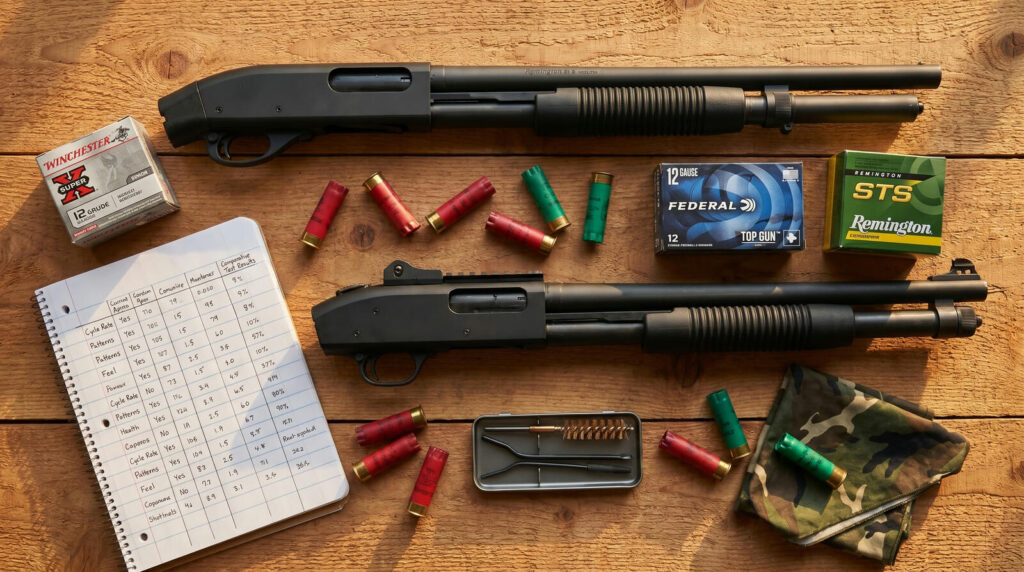
This comparison rests on three years of side-by-side use and 3,200 rounds across both guns. Roughly 1,400 rounds through my 870 Express (post-2015 production) and around 1,800 through my Mossberg 500 Field/Security Combo. The 500 has more rounds because it’s the gun I grab first.
Ammunition spanned everything most owners will run: Federal Top Gun TG12 #8, 1 1/8 oz at 1,200 fps. Winchester Super-Target TRGT128 #8, 1 1/8 oz at 1,145 fps. Rio Target Load TLS328 #8 for the cheap-and-dirty sessions. Federal Tactical LE133 00 buck, 8 pellets of copper-plated buffered lead at 1,145 fps. Hornady Critical Defense 86240, 8 pellets of plain unbuffered 00 at 1,600 fps. Brenneke K.O. SL122KO 1 oz slugs at 1,600 fps, and Winchester Super-X X12RS15 1 oz Foster slugs for a cheaper comparison. Both shotguns ate everything I fed them with the exception of one specific failure mode I’ll cover under Reliability.
Drills covered the use cases readers actually buy a pump for, and every one of them produced a number.
Slugs, 50 yards, rested, rifle sights. Five-shot groups. The 870 put Brenneke K.O. into 3.1 inches and the cheaper Winchester Foster slugs into 4.3. The 500 ran 3.6 and 4.6 with the same two loads. The Brenneke advantage held on both guns, which matches what everyone who has shot the two designs side by side already knows: the heavier attached-wad slug is simply more consistent out of a smoothbore than a hollow-skirted Foster.
Buckshot patterning, 18.5-inch cylinder bores. At 15 yards the Federal LE133 FliteControl went into 4.5 inches from the 870 and 5.0 from the 500. Pushed to 25 yards those opened to 7.5 and 8.0. The Hornady Critical Defense, which is plain unbuffered lead at 1,600 fps, threw 9.5 inches at 15 yards from the same 870 barrel. That is not a Hornady failure, it is what a buffered copper-plated payload buys you, and it is the single biggest pattern variable on a defensive shotgun. Barrel choice barely registered next to it.
Low-light reloads from a side saddle. Five rounds, four in the gun and one on the carrier, shot on a timer. My best clean run with the 500 was 6.9 seconds. My best with the 870 was 7.1. But my worst 870 run was 10.7, and the 3.6 seconds that separates those two is one fault repeating: the shell lifter rising into the ejection port on a chamber load. For scale, Matt Haught calls a sub-10-second pump run proficient and the Symtac coin standard is under 6.0.
Clays. Nothing separated them. Over six rounds of trap alternating guns I shot 21 and 22 out of 25 with the 870 and 20 and 22 with the 500. That gap is me, not the shotguns.
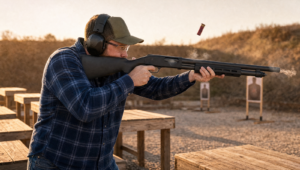
Three waterfowl seasons in cold weather, the worst of it a January morning at 9 degrees with wet gloves. Two defensive shotgun classes, one of them Rob Haught technique work and the other an LE-oriented two-day course.
Every winner declaration below comes from those sessions. Spec sheets don’t tell you which safety your thumb finds in the dark.
Build Quality and Receiver
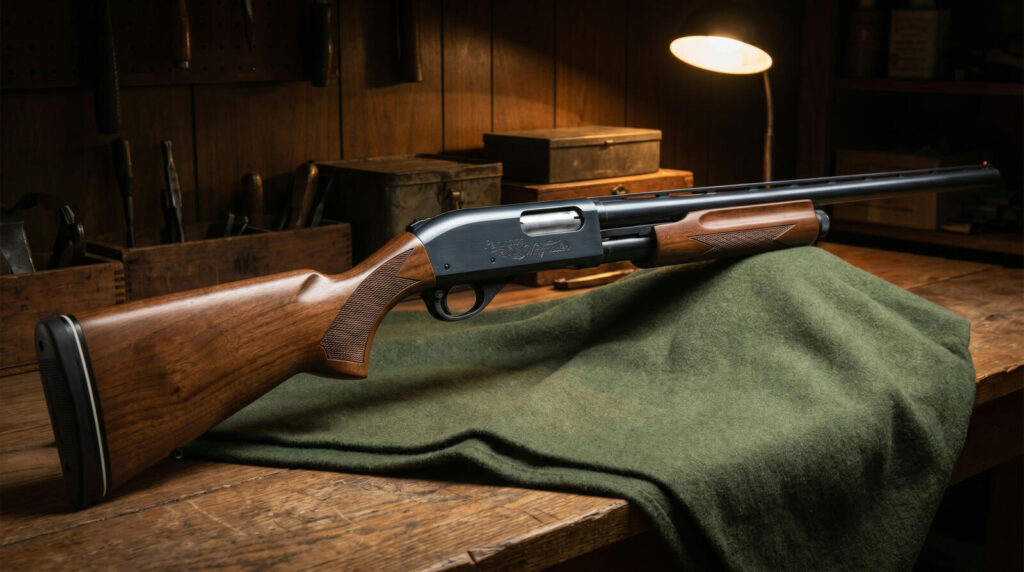
The biggest structural difference between these two shotguns is the receiver. Remington has built the 870 around a milled steel receiver since 1950. That receiver gives the gun a planted, dense feel when you shoulder it. It also gives it the weight that absorbs recoil.
Mossberg uses an aluminum-alloy receiver on the 500. Lighter. Still plenty strong for shotgun pressures (which are mild compared to rifle cartridges). The aluminum’s a real plus if you’re walking a long bird hunt or stashing the gun in a closet where every ounce matters.
I’ve never seen a Mossberg 500 receiver crack. Both chambers are SAAMI-spec 2¾-inch and 3-inch. The 590A1 adds a heavy-wall barrel for steel-shot loads. Not on mine, not on any gun I’ve shot belonging to a friend, not in any reputable failure forum I’ve combed. The 870’s steel is objectively tougher in tensile terms, but tougher than “lifetime of 12-gauge pressures” doesn’t matter in practice.
Where things actually diverge is fit and finish. Pre-2007 Remington 870s, the Wingmasters and Police models in particular, were beautifully made. Hand-polished bluing, tight tolerances, walnut you’d be proud to hang on a wall. After the Freedom Group acquisition that quality collapsed.
Rough chambers. Uneven parkerizing. Rust that bloomed if you looked at the gun sideways in humid weather. RemArms has cleaned a lot of it up since 2020, but the reputational damage is real and the used-gun market reflects it.
Mossberg has been the steadier hand. Quality hasn’t been spectacular, but it hasn’t dropped off a cliff either. The 500 you buy today shoots about the same as the 500 your dad bought in 1990.
Winner: Tie. The 870’s steel receiver is the more bullet-proof structure on paper. Mossberg’s two-decade consistency closes the gap. Find a pre-Freedom Group 870 used and Remington wins this one outright. That’s a different gun than what’s on shelves new today.
Action and Cycling
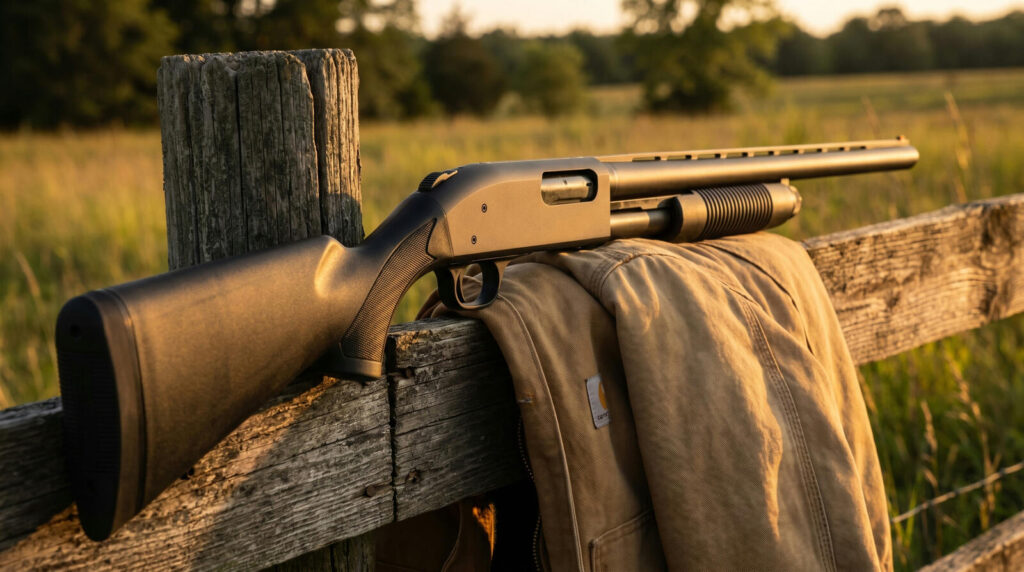
Rack an 870 and you feel it. The steel-on-steel contact gives the pump stroke a buttery quality that almost nothing in the same price class touches. New out of the box, the 870 has one of the slickest actions in pump-gun history. It only gets better with use.
But.
Both guns run twin action bars. The 870 has since 1950, and anyone telling you otherwise is repeating a myth that will not die. What actually separates them under the hand is the shell lifter. On the Mossberg it is skeletonized and sits up out of the way, dropping only for an instant as a shell goes in. On the 870 it rests down across the bottom of the receiver and works like a gate you have to push through, and it will pinch a thumb or a glove while you do it.
That sounds like a detail. It costs time you can measure. Loading a shell straight into the chamber with the action open, the 870 lifter rises into the ejection port and blocks it, and you have to push it back down before the shell will go. On a timed five-round drill I put 3.61 seconds into exactly that fault on the 870 and none into it on the 500.
Mossberg also runs dual extractors. The 870 has a single extractor. On clean, well-formed brass that distinction is invisible. On cheap steel-base Russian target loads, swollen reloads, or shells that have been rattling in a side saddle for two years, the dual extractor gets a more positive grip on the rim.
I’ve torn rims on the 870 maybe four times over the years. Zero on the 500.
It is enough of a real defect that fixing it is a commercial gunsmithing operation. Vang Comp opens the bottom of the 870 receiver at the shell lifter specifically to make the magazine tube easier to load. Nobody sells that service for a Mossberg because nobody needs it.
Winner: Mossberg 500. Not on action bars, because both guns have two. The 500 wins on the lifter and the second extractor, and both of those show up when you are loading under pressure. The 870 feels silkier. The 500 is quicker to feed and harder to snag.
Safety
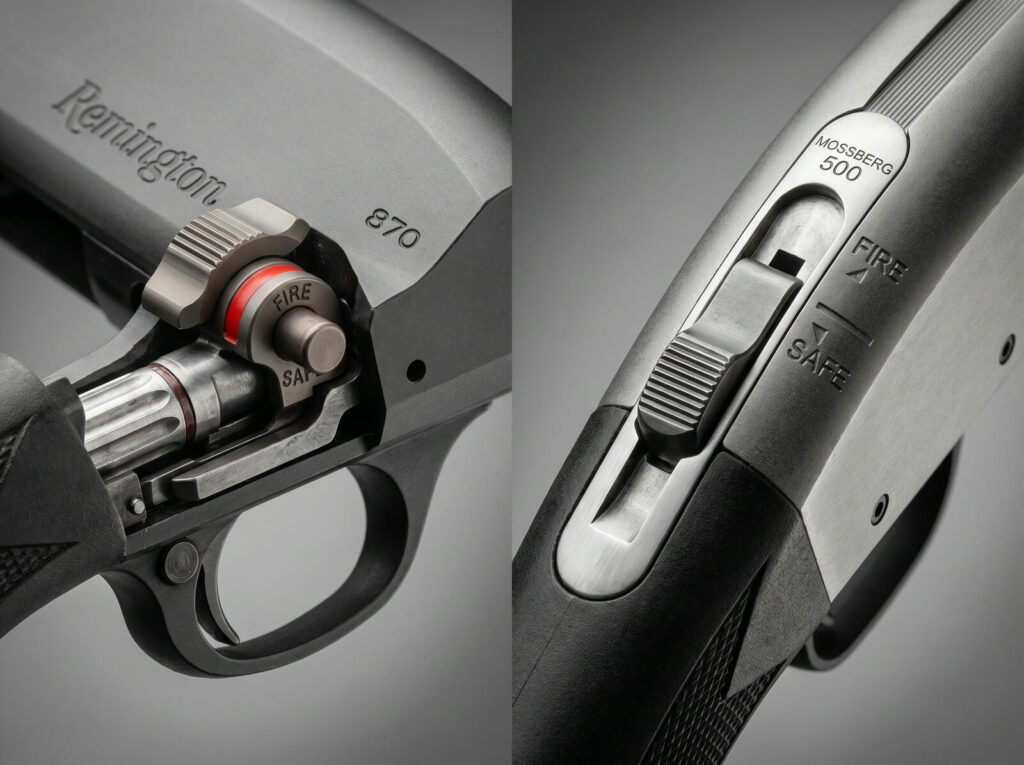
This is the fight that ends most 870-vs-500 arguments before they start. The Mossberg 500’s safety sits on top of the tang, right behind the receiver. It’s a button you push forward with your thumb to fire, back to safe. Ambidextrous by geometry.
Left-handed shooter? Right-handed? Doesn’t matter. Your thumb finds it.
The Remington 870 puts its safety inside the trigger guard as a cross-bolt button. Push left-to-right to fire, right-to-left to safe. For a right-handed shooter that works fine. For a lefty it’s awkward. You either reach around with your weak-hand index finger or break your firing grip to push it.
I’m right-handed. I still prefer the tang safety. When the gun’s shouldered and I need to go from safe to fire under time pressure, the Mossberg’s safety is in the path my thumb is already traveling. The 870’s is a discrete trigger-finger move that I have to think about.
There’s a reason the US military picked the Mossberg 590A1 (same safety as the 500) as its combat shotgun. Tang safety wins every blind-thumb test you can devise.
Winner: Mossberg 500. Tang safety is one of the best safety designs on any long gun ever produced. Faster, ambidextrous, more intuitive under stress.
Controls and Loading
Both guns load through a port on the underside of the receiver. The lifter (or elevator) is what your shells push past to get into the magazine tube. Mossberg keeps that elevator down when the action’s open. Remington’s pops up.
In practice that means if the 870’s chamber is empty and you need to single-load a slug straight in, you have to push past the elevator first. On the Mossberg you drop the shell straight onto the chamber lip. Doesn’t sound like much. Run a few hundred emergency reloads and it matters.
The 870’s loading-port spring is also slightly stiffer than the 500’s. Some shooters like that. Shells don’t accidentally back out of the tube. I find it eats into reload speed during competition or training. Mossberg’s spring is lighter and the gate is easier to push past.
Slide release position is the one place the 870 wins. Remington’s slide release is a small button at the front of the trigger guard, easy to find with the trigger finger during one-handed manipulation. Mossberg’s is a lever on the rear left of the receiver. Both work fine, but the 870’s placement is the more accessible of the two.
Winner: Mossberg 500. The open elevator and lighter loading-port spring add up to faster, more flexible loading for defensive and competition use. The 870’s slide release placement is the consolation prize.
Trigger
Neither pump shotgun is a precision-trigger platform. You’re not running these guns for ringing steel at 200 yards. They’re shotguns.
Factory triggers diverge. My 870 Express breaks at around 5.5 pounds with a long, gritty take-up and a defined wall. The 500 Field/Security breaks at about 5 pounds with less take-up but a slightly creepier release. Neither is bad.
Neither is good.
Aftermarket help is available for both. Timney makes a drop-in for the 870 that pulls the weight down to around 3 pounds with a much cleaner break. For the Mossberg you can polish the sear surfaces or fit a lighter hammer and trigger-return spring kit, which is what M*CARBO actually sells for it. Neither aftermarket path is huge value for a defensive gun (you don’t want a 2-pound trigger on a home-defense shotgun anyway), but the Remington has slightly more drop-in solutions.
Winner: Slight edge to Remington 870. The factory trigger is marginally better and the aftermarket path is more developed. Real-world impact: minimal.
Recoil and Ergonomics
Half a pound of receiver steel makes a felt difference, and it is a smaller one than most people assume. Recoil energy is inversely proportional to gun weight, so going from the 500 at 7.0 lb to the 870 at 7.5 takes exactly 6.67 percent off it, whatever you are shooting. On full-power 9-pellet 00 buck that is 24.5 ft-lbs against 26.2. On 1 1/8 oz target loads it is 19.0 against 20.4. Real on the shoulder over a long session, not dramatic on any single shot.
The lever that actually matters is the ammunition. Dropping from full-power buck to a reduced-recoil 8-pellet load takes 24.5 ft-lbs down to 14.4, which is roughly five times what half a pound of gun weight buys you. Anyone flinching off a pump should change shells before they change shotguns.
Stock sights vary by config: bead front on field guns, ghost ring on tactical and Security variants. Stock geometry is virtually identical between the standard configurations. Both ship with 14-inch length of pull, both come in synthetic and walnut, both have decent factory recoil pads. Smaller-statured shooters will probably want a youth or compact stock on either platform. The 500 Bantam configuration with a 13-inch LOP is one of the better youth setups on the market.
I find the 870 a touch more pointable. The forward weight bias from the steel receiver settles the muzzle and the gun tracks moving targets a hair more naturally. Wing shooters tend to notice this. Home-defense shooters won’t.
Winner: Slight edge to Remington 870. More mass equals less recoil and slightly better pointing. The Mossberg’s lighter handle is the consolation for carry-heavy use cases.
Reliability
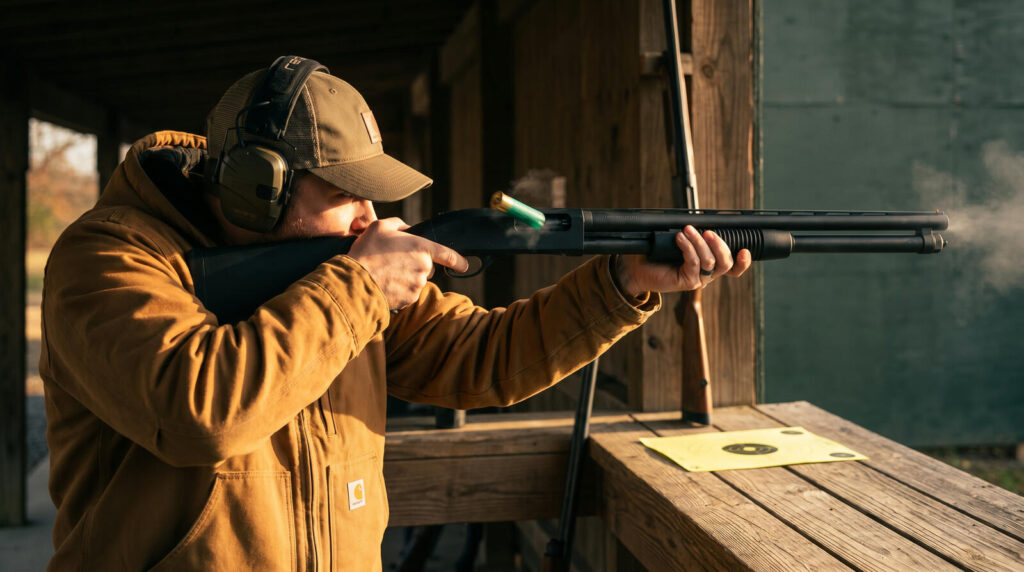
Both shotguns are inherently reliable. Pumps are simple machines. Both designs have over half a century of in-field validation. With basic maintenance either gun will outlive you.
The caveat, and it’s a real one, is the post-Freedom Group 870. Reports from 2007 to roughly 2020 of chambers that would not release a fired hull, poor bluing that flash-rusted, and inconsistent QC came in from every corner. Phil Bourjaily put it plainly in Outdoor Life last August: aging machinery and cost-cutting turned the once ultra-reliable 870 into an often-balky gun. I have my own numbers on it. Running Federal bulk target loads through my post-2015 870 Express, I had 31 hulls stick in the first 250 rounds. That is one in eight. The same shells ran through a 1990s 870 I borrowed with nothing.
Here is the part almost nobody gets right, and it cost me two range trips to work out. Honing the chamber cut the failures to about one in twenty-five. It did not fix them. The hulls were not sticking in the chamber at all, they were catching on tooling marks on the barrel lug just past the chamber mouth, where the rim expands into them on firing. Owners have taken 870s to Remington certified repair centers, had the chambers recut, and come away with no improvement for exactly this reason. Ten minutes with a small sanding drum on the lug, stroking parallel to the bore, took me to zero and it has stayed there. Do not put a chamber hone anywhere near that lug. Owners who didn’t put in the work had legitimate complaints.
RemArms (the current company) has been tightening things up since 2020. The 870s coming off the line in 2024 and 2025 are noticeably better than the 2015 production. The shadow of the Freedom Group years still hangs over the brand.
Mossberg has run a more consistent ship across the same period. My 500 has never had a malfunction that wasn’t a short-stroke (which is on me, not the gun). It eats light target loads, full-power buck, slugs, and the questionable Cyrillic-marked steel-base ammo I bought at a gun show in 2019. Zero extraction failures in 1,800 rounds. The dual extractors absorb a lot of sins.
One more thing worth knowing, because it explains why this was a Remington problem and not a pump-shotgun problem. The military specification the 590A1 is built to, MIL-S-3443G, sets a hard numeric ceiling on chamber roughness: 63 microinches RMS or smoother. It also demands 3,000 rounds of 2 3/4-inch 00 buck with no more than three malfunctions and no broken parts, and it is a continuing test, with a gun pulled from every production lot. No commercial standard bound the 870 Express to anything of the kind. Nobody was measuring those chambers.
Winner: Mossberg 500. Both platforms are reliable in the long arc of pump-gun history. Mossberg’s consistency over the last two decades earns this category. If you’re buying new today, the 500 is the safer first-round bet.
Aftermarket and Accessories
Both guns have absolutely massive aftermarket support. Stocks, forends, magazine extensions, side saddles, rail systems, ghost-ring sights, optic mounts, slings, custom barrels, choke tube systems, you name it. If you can imagine a configuration, someone makes the parts for it on both platforms.
The 870 has the bigger tactical ecosystem. Magpul’s SGA stock and MOE forend turn an 870 into a modern fighting pump, and the SGA now drops onto the 590A1 as well. Vang Comp Systems’ ported-barrel work is the gold-standard internal upgrade on both platforms. Mossberg’s Accu-Choke and Remington’s Rem Choke systems both accept aftermarket tubes from Carlson’s and Patternmaster. Mesa Tactical builds shell carriers and stock adapters specifically around the 870’s geometry. Surefire makes integrated forend lights.
The 870’s tactical aftermarket is the deepest in the industry, full stop.
Mossberg counters with its own strong third-party ecosystem and one structural advantage: barrel changes need zero tools. Unscrew the magazine cap by hand, slide the barrel off, drop a new one on, tighten by hand. The 870 needs the same magazine-cap operation but the barrel-to-magazine-extension geometry on tactical configs makes it slightly more finicky. Not a huge gap.
A real one if you swap barrels often (waterfowl in the morning, security at night).
Browse both ecosystems at Brownells. You won’t run out of parts for either gun.
Winner: Tie. The 870 has the bigger tactical ecosystem. The 500’s tool-free barrel swap is a genuine real-world advantage. Both platforms are endlessly customizable.
Variants and Family Lines
Mossberg has built one of the deepest pump-gun families in production. The base 500 covers hunting, security, and combo configurations. Step up to the 590 and you get a heavier barrel, metal trigger guard, and metal safety. The 590A1 takes it further with a thicker-walled barrel and the MIL-SPEC 3443G certification. It is the only production pump shotgun officially carrying that designation.
Then there’s the 590 Shockwave, which put the bird’s-head “firearm” (legally not a shotgun) category on the map.
Remington’s 870 family is also broad, just structured a bit differently. The 870 Express is the entry-level workhorse with the parkerized or matte finish. The 870 Tactical adds ghost-ring sights and a magazine extension. The 870 Police/870P is the LE standard with tighter chambers and a parkerized finish.
The 870 DM brought detachable box magazines to the platform. The Remington TAC-14 competes directly with the Shockwave.
Both families cover hunting, defense, tactical, and law enforcement. Mossberg gets extra credit for the 590A1. That mil-spec certification is real, the testing protocol is brutal, and no 870 variant officially holds the same standard.
The Mossberg 500 / 590 Family
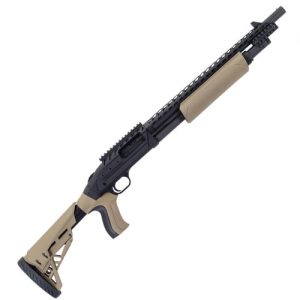
Mossberg 500 Tactical ~$480
The 18.5-inch home-defense workhorse. 12 ga / 3-inch chamber, 5+1 capacity, synthetic stock with optional pistol grip. Tang safety, dual extractors, dual action bars: every defining Mossberg feature in the cheapest entry tier. Best For: First-time defensive shotgun buyers who want one gun by the bed.
Mossberg 500 Field/Security Combo ~$470
Two barrels in one box. The 28-inch vent-rib field barrel handles birds, clays, and Saturday-morning trap. The 18.5-inch security barrel locks in for home defense. Same receiver, same trigger group, swap in 30 seconds with no tools. Best For: One-gun buyers who need bird hunting AND home defense covered.
Mossberg 590A1 ~$700
The mil-spec upgrade. Thicker-walled 20-inch barrel, metal trigger guard, metal safety button, MIL-SPEC 3443G certification. Capacity 8+1 in the 9-shot configuration. The only production pump shotgun currently in US military service. Best For: Buyers who want the toughest production pump on the market and care about the paper trail.
Mossberg 590 Shockwave ~$550
The 14-inch bird’s-head “firearm” category piece. Legally not a shotgun, not an SBS, no NFA paperwork. 5+1 capacity, Raptor pistol grip, polymer corncob forend with a strap. It is the most fun $550 you can spend at the gun counter. Best For: Truck guns, RV defense, anyone who wants short-barrel 12-gauge without the ATF paperwork.
The Remington 870 Family
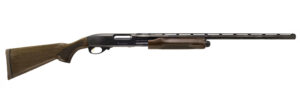
Remington 870 Express ~$450
The entry-level milled-steel workhorse. 12 ga / 3-inch chamber, 5+1 capacity in the standard tube, matte black or parkerized finish, synthetic or wood stock. The 870 most current buyers will own. Best For: Buyers who want the 870’s silky steel-on-steel action at the cheapest entry point.
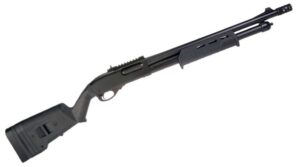
Remington 870 Tactical ~$500
Ghost-ring sights, 18.5-inch barrel, extended magazine for 6+1 capacity. Synthetic stock and forend, parkerized finish, sling swivels and a top rail for optic mounts. The 870 set up for fighting straight from the box. Best For: Home-defense buyers who want factory-built tactical features without aftermarket assembly.
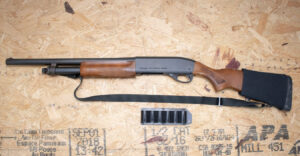
Remington 870 Police / 870P ~$900
The law enforcement standard. Tighter chamber tolerances, factory-polished action, parkerized inside and out, and a metal trigger guard. The 870 your dad’s police force carried in the cruiser. Best For: Buyers who want the highest factory quality the 870 platform offers and don’t blink at $900.

Remington TAC-14 ~$500
Remington’s bird’s-head answer to the Mossberg Shockwave. 14-inch barrel, Raptor pistol grip, magazine extension, no NFA paperwork. 5+1 capacity. Identical legal status to the Shockwave: firearm, not shotgun, not SBS. Best For: 870-platform fans who want the short-barrel firearm category on a Remington action.
Winner: Mossberg. The 500 → 590 → 590A1 progression gives you a clear upgrade path from value field gun to genuine mil-spec combat tool. The 590A1 is the toughest production pump you can buy. If you’d rather read that match-up on its own, our Mossberg 500 vs 590 comparison goes deeper on the in-family fight, and the 590 vs 590A1 piece tells you whether the mil-spec upgrade is worth it.
Price and Value
Pricing on both shotguns has held remarkably competitive for decades. As of September 2026 our dealer feed puts a new 870 between $400 and $620 depending on configuration, with the plain 12-gauge pump at the bottom of that range and the Fieldmaster at the top. A Mossberg 500 Tactical runs $330 to $650 across the same dealers. The 500 starts cheaper, and that entry price is most of why it wins on value.
The Mossberg 500 Field/Security Combo is one of the best deals in firearms, period. For around $470 you get a 28-inch vent-rib field barrel and an 18.5-inch security barrel in the same box. One gun that handles birds on Saturday and stands by the bed on Sunday. Remington has run similar combo packages over the years but Mossberg’s combo pricing has been the steadier, more aggressive offer.
On the used market the equation shifts. Pre-Freedom Group 870 Wingmasters and Police models, anything pre-2007 with the old quality, command premium prices for good reason. Those guns are beautifully made. Used Mossberg 500s are plentiful and cheap because Mossberg made (and still makes) the gun in massive volume.
Either way you’re getting an absurd amount of shotgun for the money.
Check current pricing at Palmetto State Armory and Guns.com for the latest deals on both.
Winner: Mossberg 500. The combo package is hard to beat and the base configurations consistently run a touch lower. Both are exceptional values. Mossberg stretches the dollar further.
Live Pricing
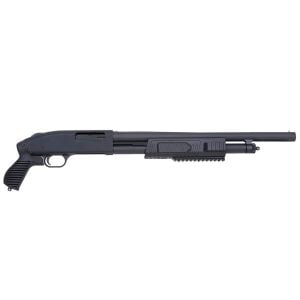
Real-time prices from major retailers on both shotguns.
Best Use Cases
Home Defense
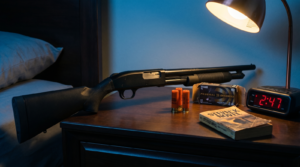
Both shotguns are excellent home-defense platforms. The Mossberg 500’s tang safety wins the dark-bedroom thumb test. The 870’s heavier receiver soaks up recoil if you have to follow up. I’d hand a new shooter the Mossberg 500 Tactical or 500 Persuader and not lose sleep.
If a full-length long gun will not work where you live, the Mossberg 590 Shockwave covers the same job in 26 inches with no NFA paperwork.
Bird Hunting
This is where the 870 starts to win back ground. The forward weight bias points naturally on crossing targets. Wingmasters in particular were built for this work and remain the gold standard pump for upland and waterfowl. The 500 Field model is no slouch, and plenty of duck hunters swear by it, but the 870 has the prouder field-gun lineage.
Deer / Slug Hunting
For shotgun-only deer states (much of the Midwest and parts of the Northeast), either gun works. Both platforms accept rifled slug barrels with cantilever optic mounts. The 870’s slug barrel inventory is slightly larger and the gun’s heavier overall mass helps with sustained slug shooting. Light edge to Remington.
Turkey
Both companies build dedicated turkey guns. Both lines also extend down to .410 bore in youth and small-game configurations: the 500 Bantam and the 870 Express Compact. The Mossberg 500 Turkey configuration with the optic-ready receiver and turkey choke is the better value. The 870 Wingmaster Turkey is the prettier gun. Functionally they’re a wash.
3-Gun / Competition
Pump shotguns are uncommon in competitive 3-gun (semi-autos dominate). If you’re using one in pump-specific divisions or club matches, the Mossberg’s open-elevator design speeds emergency single-loads. Choose the 500.
Law Enforcement / Patrol Vehicle
The Mossberg 500 Cruiser and 590A1 dominate this category. The mil-spec 590A1’s certification matters here. Agencies have a paper trail for the toughness claim. The 870P is the historical LE standard and still serves in plenty of departments.
Pros and Cons
Remington 870: Pros
- Silkiest pump action in its price class: steel-on-steel feel only gets better with miles.
- Milled-steel receiver absorbs more recoil and gives the gun a planted, premium feel.
- Deepest tactical aftermarket in the industry: Magpul, Mesa, Surefire all build around the 870.
Remington 870: Cons
- Post-2007 quality control remains a real risk on Express models: chambers, finish, fit can be rough.
- Right-hand-biased safety: cross-bolt inside the trigger guard isn’t ambidextrous.
- Shell lifter blocks the loading port, so tube and chamber reloads are slower.
Mossberg 500: Pros
- Tang safety is the best ambidextrous safety on any production pump shotgun.
- Skeletonized lifter and dual extractors make it faster to load and more forgiving to feed.
- Combo packages like the Field/Security make one gun cover field and home-defense duty cheaply.
Mossberg 500: Cons
- Aluminum receiver doesn’t feel as solid as the 870’s steel and transfers slightly more felt recoil.
- Action lacks the 870’s polish: racks “okay” off the shelf rather than buttery.
- Slide release placement is awkward for one-handed manipulation compared to the 870.
Who Should Buy the Remington 870
The 870 is the right pump for a specific kind of buyer. Buy it if you fit one of these profiles.
- The wing shooter who wants a pump that points like a field gun. The 870 Wingmaster is still the gold standard for upland and waterfowl.
- The tactical builder who plans to dump money into Magpul, Surefire, Mesa Tactical, and a side saddle. No other pump platform has the aftermarket depth.
- The used-gun hunter who can find a pre-Freedom Group 870 Wingmaster or Police model. Pre-2007 870s are objectively superior to anything in production today.
- The slug shooter who wants slightly more recoil-absorbing mass for sustained deer-season work.
Who Should Buy the Mossberg 500
The 500 is the right pump for a broader set of buyers, and for almost everyone buying their first pump shotgun.
- The first-time shotgun buyer who wants one gun that does everything. The 500 Field/Security Combo at ~$470 is the smartest single shotgun purchase in firearms.
- The left-handed shooter: the tang safety is the only safety design on a production pump that’s genuinely ambidextrous.
- The home-defense shooter who wants the safest, fastest safety manipulation under stress. Tang safety wins the bedroom-at-2-am test.
- The upgrade-path buyer who wants to start with a 500 today and step into a 590A1 mil-spec gun later without relearning controls.
- The shooter who values mechanical forgiveness: an open loading port and dual extractors mean fewer things go wrong when you’re stressed, cold, or tired.
Who Should NOT Buy Either Shotgun
A pump shotgun isn’t the right answer for every buyer. If you fit one of these profiles, look elsewhere before you spend.
- The recoil-sensitive shooter. Even with the 870’s heavier receiver, 12-gauge defensive loads punish smaller-framed shooters. A 20-gauge semi-auto with gas operation like the Beretta A300 will be far kinder than either of these guns.
- The high-volume defensive trainer. If you’re putting 200 rounds a session through a defensive shotgun, a soft-shooting gas semi-auto (Beretta 1301 Tactical, Mossberg 940 Pro Tactical) saves your shoulder and your wallet on recoil-suppressing accessories. Both 870 and 500 are fine for occasional defensive practice, not for daily drilling.
- The competitive 3-gunner. Pumps lose to semi-autos at every level of 3-gun. If you’re chasing classifications, buy a Benelli M2, Beretta 1301, or Mossberg 940, not either pump in this comparison.
- The clay-target serious shooter. Skeet, trap, and sporting clays reward semi-autos and over-unders. Pumps are clunky for fast follow-up doubles. Either gun will get you started, but you’ll outgrow them inside a season.
- The buyer who can’t store a long gun safely. Both are 38.5 inches OAL in tactical config and longer in field config. If apartment storage or quick access is the constraint, look at a defensive bullpup or short-barreled semi-auto.
Common Problems and Solutions
870: Rough Chamber on Post-2010 Express Models
Reports of unfired Express models with chambers rough enough to cause extraction failures on cheap ammo. Solution: polish the chamber with bore paste and a slotted polishing mandrel on a drill, or send it back to RemArms under warranty. After polishing, most chambers smooth out inside 300 rounds.
870: Loose Magazine Cap on Tactical Models
The threaded magazine cap can back off during heavy recoil sessions. Solution: a magazine-tube extension with a locking detent (Mesa Tactical or Wilson Combat) eliminates the problem.
500: Polymer Trigger Group Cracks (Rare)
The 500’s trigger housing is polymer. Rare reports of cracks under extreme cold or heavy use. Solution: drop in a 590A1 metal trigger group. Takes ten minutes and runs ~$80.
Most 500 owners never need to.
500: Slide Release Placement
If you can’t comfortably reach the slide release with your right thumb, practice the alternate technique: use the trigger finger to depress the release while your support hand pumps the action. Becomes automatic with reps.
The Final Verdict
After years of running both, I give the overall edge to the Mossberg 500. It wins or ties almost every category. The tang safety alone justifies the price. The open loading port and the second extractor stack a handling advantage that’s hard to argue against.
Mossberg’s consistent quality control across two decades closes the deal.
The 870 isn’t beaten. It’s the better wing-shooting gun, the better slug platform for sustained deer hunting, and the deeper tactical aftermarket. A pre-Freedom Group Wingmaster or Police model used is one of the finest pump shotguns ever made, and worth chasing on the used market specifically. If you find one, buy it.
For the new buyer in 2026, walking into a store with one gun’s worth of budget? Mossberg 500. These two guns define the best pump shotgun category for 2026. No other action gun comes close on volume or aftermarket. Field/Security Combo. $470. Drive home.
Done.
Here’s how the scorecard breaks down.
Overall scores: Remington 870 4.4 / 5. Mossberg 500 4.7 / 5. Scored across the ten categories below.
Category Winner Build Quality & Receiver Tie Action & Cycling Mossberg 500 Safety Mossberg 500 Controls & Loading Mossberg 500 Trigger Remington 870 (slight) Recoil & Ergonomics Remington 870 (slight) Reliability Mossberg 500 Aftermarket & Accessories Tie Variants & Family Mossberg Price & Value Mossberg 500 Overall Winner Mossberg 500
Frequently Asked Questions
Is the Remington 870 or Mossberg 500 better?
Overall the Mossberg 500 wins for most buyers. The tang safety, dual action bars, dual extractors, and combo-package pricing make it the better first-pump-shotgun choice. The Remington 870 wins for wing shooters, slug hunters, and tactical builders who prize the deepest aftermarket. Pre-2007 Wingmaster and Police 870s are objectively superior to anything in current production from either company.
Which shotgun do police and military use, the 870 or the 500?
Both. The Remington 870 Police (870P) was the US law enforcement standard for decades. The Mossberg 590A1, built on the 500 platform, is the only production pump shotgun officially carrying the MIL-SPEC 3443G certification and is currently in US military service. New LE procurement in 2026 leans heavily toward Mossberg.
Is the Mossberg 500 reliable?
Extremely. Mossberg has produced the 500 with consistent quality since 1960. The dual extractor design and dual action bars give the 500 structural advantages over single-bar pumps. My personal 500 has gone 1,800+ rounds without a malfunction that wasn't a short-stroke (user error). The polymer trigger group can crack in rare extreme cold use. Drop in a 590A1 metal trigger group for $80 if you live where it matters.
Did the Remington 870 quality drop after the Freedom Group acquisition?
Yes, demonstrably. Reports of rough chambers, poor bluing, and inconsistent QC from 2007 through roughly 2020 are well documented. RemArms (the current company since 2020) has tightened things back up. 2024 and 2025 production is noticeably better than 2010-2018 production but the reputational damage and the used-market premium for pre-Freedom Group 870s are both very real.
Does the Mossberg 500 use the same controls as the 590 and 590A1?
Yes. The 500, 590, and 590A1 all share the tang safety, slide release position, dual action bars, and dual extractors. Moving from a 500 to a 590A1 is a parts upgrade, not a controls relearn. That same-controls progression is one of the strongest arguments for the 500 platform.
Which has better recoil, the Remington 870 or Mossberg 500?
The Remington 870 absorbs more recoil thanks to its heavier milled-steel receiver, about half a pound more mass than the Mossberg 500. With full-power 12-gauge buckshot or slugs, the difference is noticeable on the shoulder. Smaller-statured shooters may still want a 20-gauge semi-auto regardless of which 12-gauge pump they choose.
Can you mount a red dot on the Mossberg 500 or Remington 870?
Yes on both. Mossberg sells optic-ready receivers on the 500 Tactical and 590A1 models. Remington offers a drilled-and-tapped receiver on the 870 Tactical. Aftermarket rail mounts from Mesa Tactical, Wilson Combat, and others fit both platforms. For a defensive shotgun, a small red dot like a Holosun 507C or Aimpoint ACRO works well on either gun.
Is the Mossberg 500 Field/Security Combo worth it?
Absolutely. At around $470 you get a 28-inch vent-rib field barrel and an 18.5-inch security barrel in the same box. Same receiver, same trigger group, same controls. Just swap barrels in 30 seconds with no tools. It is the single best one-gun purchase available for a buyer who needs to cover both bird hunting and home defense.
Related Reading
- 10 Best Shotguns for Home Defense (2026)
- 8 Best Tactical Shotguns in 2026
- Mossberg 500 vs 590: Which Pump Should You Actually Buy?
- Mossberg 590 vs 590A1: Is the Mil-Spec Upgrade Worth It?
- Mossberg 590 Shockwave Review (2026)
- Mossberg Maverick 88 Review: The Best Budget Pump?
- Buckshot vs Slugs vs Birdshot: When to Use Each
- Best Shotgun Ammo for Home Defense (2026)
- 7 Best Remington Shotguns Ranked
- 8 Best Mossberg Shotguns Ranked
- Shotgun Buying Guide: Gauges, Actions, Barrels
- AR-15 vs Shotgun vs Pistol for Home Defense
4,659+ Gun & Ammo Deals
Updated daily from 200+ top retailers. Filter by category, caliber, action type, and price.
Related Guides