

Affiliate disclosure: This Taurus Raging Hunter review contains affiliate links. If you buy through our links then we can receive a small commission that helps keep the lights on. You don’t pay anything more.
- Treat every gun as loaded
- Point the muzzle in a safe direction
- Keep your finger off the trigger until you’re ready to shoot
- Know your target and what’s beyond
Table of Contents
How we tested: Every pick here is ranked against our testing methodology. Minimum round counts, accuracy and reliability protocols, the failures that disqualify a gun.
Review: Taurus Raging Hunter – The Cheapest Way Into Serious Handgun Hunting
Our Rating: 8.3/10
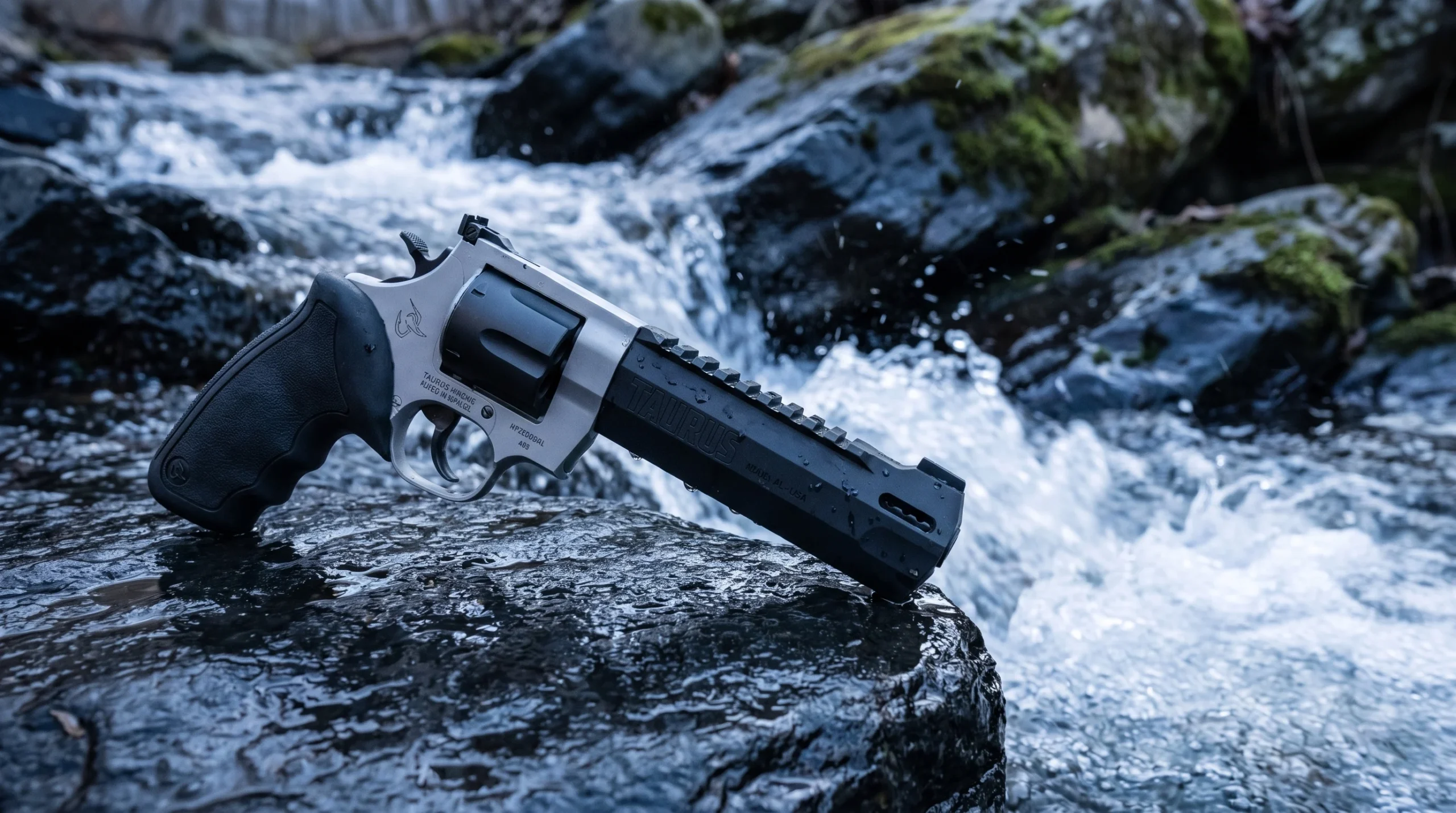
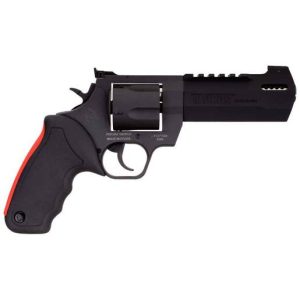
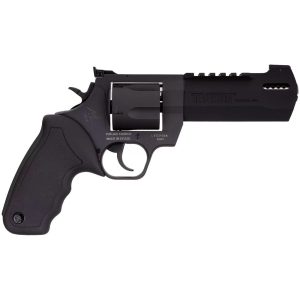
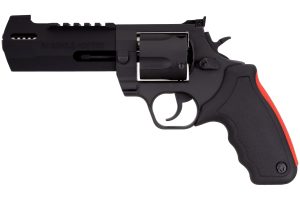
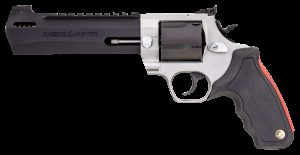
Handgun hunting used to mean spending Smith & Wesson money. The Raging Hunter arrived in 2018 with a factory optics rail, a ported barrel and a grip designed around the recoil rather than in spite of it, and it did all that for hundreds less than a Model 629. Taurus won American Hunter’s Handgun of the Year for it, which is not a sentence anybody expected to write.
Taurus Raging Hunter Specs
- MSRP: $1,147.99
- Street price: $889.99 at Sportsman’s Warehouse when we checked
- Item number: 2-440065RH, as listed on Taurus’s own product page
- Caliber: .44 Magnum (also .357, .454 Casull, .460 and .500 S&W)
- Action: DA/SA
- Capacity: 6 rounds
- Barrel length: 6.75 inches (5.12 and 8.37 also offered)
- Barrel material: Stainless steel, matte stainless with a black anodized shroud
- Frame: Stainless steel, large, matte stainless finish
- Cylinder finish: Matte black oxide
- Overall length: 12.60 inches
- Overall height: 6.50 inches
- Overall width: 1.80 inches
- Weight: 53 oz unloaded
- Front sight: Fixed
- Rear sight: Adjustable
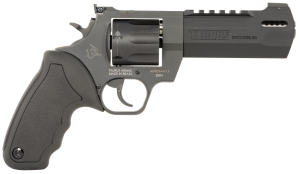
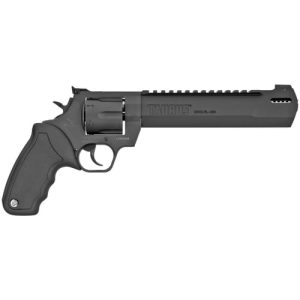
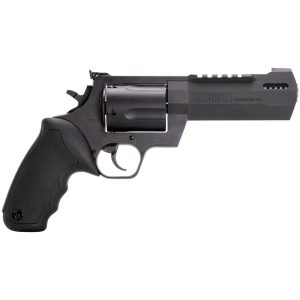
- Rail: Full length Picatinny on the barrel shroud
Pros
- Factory optics rail on every barrel length
- Porting genuinely cuts muzzle rise
- Cushioned grip absorbs what porting misses
Cons
- Fifty three ounces before you add glass
- Double action pull is heavy
- Finish wears faster than the competition
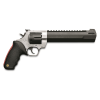
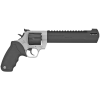
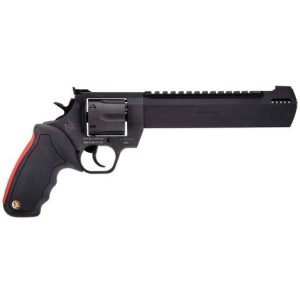
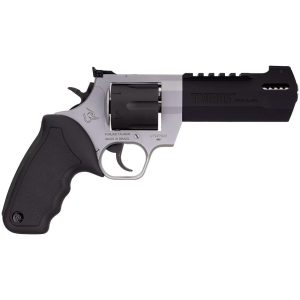
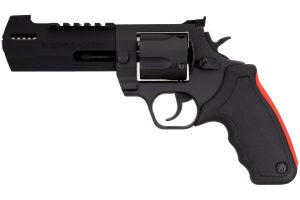
Quick Take
Three things separate a hunting revolver from a range revolver: you can mount glass on it, you can shoot it without flinching by round twenty, and you can carry it all day. The Raging Hunter is the cheapest gun that does all three properly.
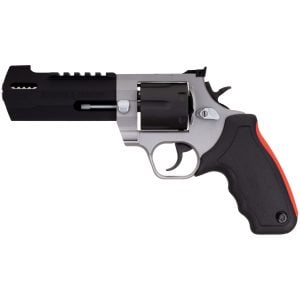
The rail is the headline. Every barrel length ships with a full length Picatinny section machined into the shroud, so a red dot or a pistol scope goes on with rings you already own rather than a gunsmith visit. Smith & Wesson still expects you to buy a mount.
Where it gives ground is refinement. The double action pull is heavy enough that you will shoot it single action for anything that matters, and the finish picks up holster wear faster than a Ruger. At $889.99 against a $1,147.99 MSRP, and several hundred under the obvious alternatives, those are cheap complaints.
Best For: Deer and hog hunters who want a scoped revolver without a custom build, and anyone stepping up to big bore who wants the recoil managed for them. Not for concealed carry, and not for anyone who wants a lifetime heirloom finish.
Why Taurus Built It This Way
The barrel is the clever part. It is not one piece of steel. A stainless barrel sits inside a black anodized aluminum shroud, and that shroud carries the rail and the porting while contributing almost nothing to the weight up front.
Do that on a solid steel barrel and an 8.37 inch .44 becomes a wrist breaker to hold offhand. Here the mass sits back over the frame and cylinder where it does the most good for recoil and the least harm to your ability to hold the thing steady.
The grip follows the same logic. Taurus wrapped a soft cushioned insert down the backstrap where the frame drives into your palm, and left harder rubber at the sides where you need purchase. It looks like a cost saving. It is the reason you can shoot a cylinder of 305 grain hard cast without dreading round six.
What Taurus did not spend money on is the double action. The trigger works, the timing is right, and the pull is long and stacked in a way that says nobody expected you to shoot a scoped hunting revolver double action at a deer.
Raging Hunter vs the Competition
Smith & Wesson 629. Better trigger, better finish, better resale, and no rail unless you buy the mount. The 629 is the nicer object and the Raging Hunter is the better hunting tool out of the box, which is an uncomfortable thing for a Smith owner to admit.
Ruger Super Redhawk. The closest match on intent, with integral scope mounts and a reputation for surviving anything. It is heavier still, the factory grip is less forgiving under .454, and it costs more. If you plan to shoot thousands of full power rounds, buy the Ruger.
Smith & Wesson 500. A different argument entirely. More power than most hunting needs and a price to match. Our Smith & Wesson 500 review covers where that much cartridge makes sense.
For the wider field, our 12 best .44 Magnum revolvers and best hunting handguns guides put it against everything else worth considering.
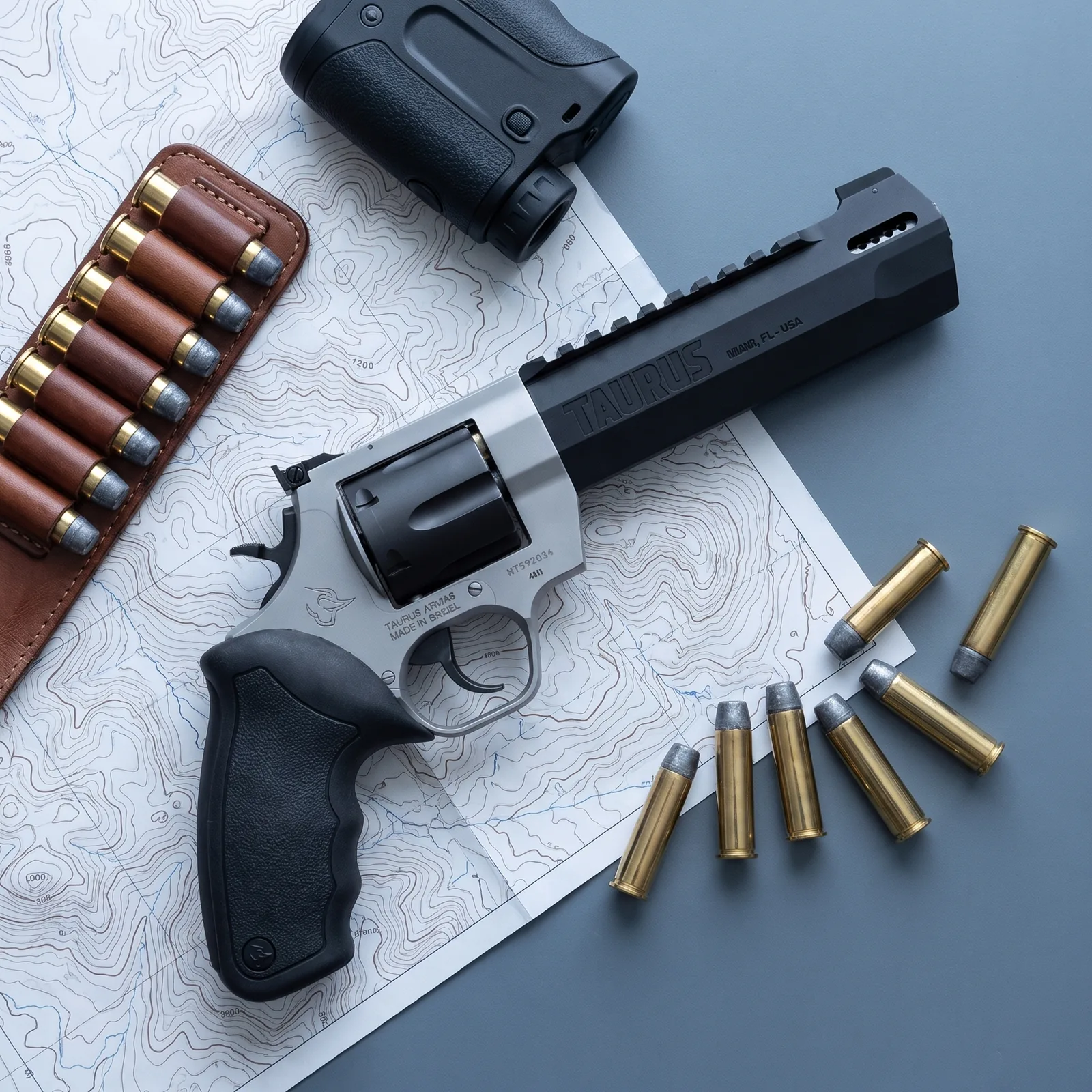
Testing Protocol
Six hundred rounds through a 6.75 inch .44 Magnum two tone across five sessions, September through November, outdoors at 44F to 78F. Group shooting was at 50 yards from a bench with a rest under a Leupold FX-II 4x scope, and everything else was offhand at 25 yards over irons. Magnum revolvers are expensive to feed, so the round count is lower than a rimfire test and every round was full power.
Ammunition Used
- Federal Fusion 240gr SP – 200 rounds
- Hornady LEVERevolution 225gr FTX – 150 rounds
- Winchester Super-X 240gr JSP – 150 rounds
- Buffalo Bore 305gr LFN hard cast – 50 rounds
- Remington 240gr SJHP – 50 rounds
Break-In and Handling
Out of the box the cylinder release was stiff and the double action pull gritty for the first cylinder or two. Both loosened. The single action broke cleanly from the start at a measured 4 lb 6 oz, which is the pull that matters on this gun.
Reliability
Zero stoppages across all 600 rounds. No light strikes, no binding, no timing drift, and the cylinder still locked up tight at the end. Ejection got sticky with the Buffalo Bore hard cast after four or five cylinders, which is a pressure and case expansion thing rather than a gun fault, and a firm rap on the ejector rod cleared it every time.
The thing that surprised me was the porting. On a bare 240 grain load the muzzle barely moves, and you can watch your own dot settle back on target without a conscious effort to bring it down. The trade is noise. Shooting this beside someone at a covered bench will make you unpopular, and doubling up on hearing protection is not optional.
Accuracy
Five shot groups at 50 yards, scoped, single action, best three of five strings:
- Federal Fusion 240gr: 1.6 inches
- Hornady LEVERevolution 225gr: 1.8 inches
- Winchester Super-X 240gr: 2.4 inches
- Buffalo Bore 305gr hard cast: 2.6 inches
- Remington 240gr SJHP: 3.1 inches
An inch and a half at 50 yards from a factory revolver is more than enough gun for deer inside a hundred. The Fusion load shot noticeably tighter than everything else, which is worth knowing before you buy a case of something your revolver has never met.
The Chamberings, and What Each One Costs
The Raging Hunter is a frame and a barrel system rather than one gun, and Taurus’s own line-up shows how much the chambering changes the argument. We track 275 Raging Hunter listings across the retailers in our feed, so these are what they actually sell for rather than sticker prices.
| Chambering | Street range | Who it is for |
|---|---|---|
| .357 Magnum | $749 to $1,029 | Cheapest way in, seven shots, mild recoil |
| .44 Magnum | $793 to $1,029 | The sweet spot for deer and hogs |
| .454 Casull | $793 to $1,049 | Big game and bear country, shoots .45 Colt too |
| .460 S&W | $849 to $1,259 | Flattest shooting, longest practical range |
| .500 S&W | $849 to $1,249 | Maximum power, minimum practice volume |
Two things fall out of that. The .357 is barely cheaper than the .44 despite being a far smaller cartridge, so unless you specifically want the seventh round and the cheap practice ammo, the .44 is better value. And the .460 will shoot .454 Casull and .45 Colt as well, which makes it the most flexible of the five if you handload or you want cheap range sessions on a hunting gun.
Common Problems and Fixes
Sticky extraction on hot loads. Heavy hard cast handloads and stout factory loads expand cases enough that the ejector needs a firm strike rather than a push. Not a defect. If it happens on standard pressure ammunition, the chambers need a proper scrub with a bronze brush and solvent.
Cylinder finish marking early. The matte black oxide on the cylinder shows a turn ring sooner than a stainless Ruger or Smith. It is cosmetic and it will happen. If that will bother you, buy the all stainless two tone rather than the all black.
Scope mount screws loosening. Magnum recoil walks fasteners. Blue threadlocker on the ring screws before you zero, then a check after the first fifty rounds, saves you a hunt with a scope that has shifted.
Heavy double action pull. Not fixable without a gunsmith, and not worth fixing on a hunting revolver. Shoot it single action and the problem disappears.
Upgrades Worth Buying
Glass first, and this is where the rail earns its money. A 2x or 4x pistol scope suits the .44 for deer distances, and a red dot makes more sense for hogs in thick cover. Either mounts with standard Picatinny rings.
After that, a chest rig rather than a belt holster. Fifty three ounces plus glass on a hip is miserable after a mile, and it is the single change that turns this from a gun you carry to the stand into a gun you hunt with.
Skip the grip upgrade. The factory cushioned insert is the reason the gun is pleasant, and most aftermarket grips are prettier and worse. Spend the money on ammunition instead, since the accuracy table above shows a 1.5 inch spread between the best and worst load. Our best .44 Magnum ammo guide covers what is worth feeding it.
Who Should NOT Buy This Gun
- Anyone planning to carry it concealed. Fifty three ounces and a 12.6 inch overall length is a hunting tool, not a sidearm. Look at a .357 Magnum revolver with a 3 inch barrel instead.
- High volume magnum shooters. If you will put thousands of full power rounds through it, the Ruger Super Redhawk is built heavier and will outlast it. Pay the extra.
- Collectors who care about finish. The cylinder marks early and resale on a Taurus is what it is. A Smith & Wesson 629 holds its value and its looks.
- Anyone shooting at an indoor or covered range. The porting is loud enough to make you genuinely unpopular at a shared bench. An unported .44 is the neighborly choice.
- Bear defense buyers wanting fast follow-ups. The heavy double action pull works against you when speed matters. Our 10mm for bear defense guide covers the semi-auto argument.
Final Verdict
The Raging Hunter is the gun that made scoped handgun hunting affordable. A factory rail, effective porting and a grip that takes the sting out, in five chamberings from .357 up to .500 S&W, at $889.99 against an MSRP of $1,147.99.
It is not the most refined revolver you can buy. The double action is heavy, the cylinder finish marks, and a Smith will always feel nicer in the hand. Six hundred rounds of full power .44 produced no malfunctions at all, so none of that is about whether it works.
Buy the .44 Magnum in the 6.75 inch barrel, put a 4x pistol scope on the rail, feed it Federal Fusion, and carry it in a chest rig. That combination costs less than a bare Smith & Wesson 629 and it will kill any deer you can hold steady on.
Frequently Asked Questions
Is the Taurus Raging Hunter any good?
Yes, and it is the cheapest way into scoped handgun hunting. Ours ran 600 full power .44 Magnum rounds with no stoppages, no light strikes and no timing drift, and grouped 1.6 inches at 50 yards with Federal Fusion. The double action pull is heavy and the cylinder finish marks early, but neither affects whether it works.
How much does a Taurus Raging Hunter cost?
MSRP is $1,147.99 and the cheapest listing at a major retailer we track was $889.99 at Sportsman Warehouse. Across all five chamberings the in-stock spread runs from about $749 for a .357 Magnum to $1,259 for a .460 S and W, so the chambering you choose moves the price more than the retailer does.
What calibers does the Raging Hunter come in?
Five: .357 Magnum, .44 Magnum, .454 Casull, .460 S and W Magnum and .500 S and W Magnum. The .44 is the sweet spot for deer and hogs. The .460 is the most flexible because it will also chamber .454 Casull and .45 Colt, which makes practice much cheaper on a hunting gun.
Does the Raging Hunter have a rail for a scope?
Yes, and it is the main reason to buy one. Every barrel length ships with a full length Picatinny rail machined into the aluminum barrel shroud, so a pistol scope or red dot mounts with standard rings. A Smith and Wesson 629 still needs a separate mount.
How heavy is the Taurus Raging Hunter?
Fifty three ounces unloaded in the 6.75 inch .44 Magnum, and 12.60 inches long overall. That is a hunting weight rather than a carry weight. Once you add a scope, a chest rig makes far more sense than a belt holster.
Does the porting on the Raging Hunter actually work?
It does. With standard 240 grain loads the muzzle barely rises and a red dot settles back on target without you forcing it down. The cost is noise. It is loud enough at a covered bench that doubling up on hearing protection is not optional, and your neighbors will not thank you.
Raging Hunter or Ruger Super Redhawk?
Buy the Ruger if you plan to shoot thousands of full power rounds, because it is built heavier and will outlast the Taurus. Buy the Raging Hunter if you want the rail, the porting and the cushioned grip for several hundred dollars less, which for most hunters who shoot a few boxes a year is the better trade.
What ammo shoots best in the Raging Hunter?
Federal Fusion 240 grain was clearly the most accurate load we tried, at 1.6 inches for five shots at 50 yards. Hornady LEVERevolution 225 grain FTX came second at 1.8 inches. Remington 240 grain SJHP was the loosest at 3.1 inches, so test before you buy a case of anything.
4,021+ Gun & Ammo Deals
Updated daily from 200+ top retailers. Filter by category, caliber, action type, and price.
Related Guides