

Last updated August 2026 · By Nick Hall, AR-15 historian familiar with Eugene Stoner’s design journey from the AR-10 through the AR-15
Some of the links below are affiliate links, meaning at no additional cost to you, we may earn a commission if you click through and make a purchase.
- Treat every gun as loaded
- Point the muzzle in a safe direction
- Keep your finger off the trigger until you’re ready to shoot
- Know your target and what’s beyond
Table of Contents
Eugene Stoner designed the most influential firearm of the 20th century. That is not an exaggeration, and it is not up for debate. The AR-15 platform and its descendants (the M16, M4 Carbine, AR-10, and dozens of variants) are used by more military forces, law enforcement agencies, and civilian shooters than any other rifle family in human history.
NSSF’s 2025 production report puts more than 32 million modern sporting rifles in American civilian hands, the overwhelming majority of them AR-pattern, up from 24.4 million in its 2022 count. The M4 Carbine is the standard-issue infantry weapon for the United States military and most NATO allies. Every major firearms manufacturer on Earth either builds AR-platform guns or builds rifles that borrow directly from Stoner’s engineering principles.
And yet, most people who own an AR-15 could not tell you who designed it. Stoner never became a household name the way John Browning or Mikhail Kalashnikov did. He was a quiet, self-taught engineer from Indiana who changed the world from a drafting table in Hollywood, California.
This is the story of the man behind the gun. How a Marine with no engineering degree created the most successful firearms platform ever built, lost control of it, watched it nearly fail in Vietnam, and then lived long enough to see it become the most popular rifle in America.
How we tested: Every pick here is ranked against our testing methodology. Minimum round counts, accuracy and reliability protocols, the failures that disqualify a gun.
Early Life and Career
Eugene Morrison Stoner was born on November 22, 1922, in Gosport, Indiana, a tiny town about 40 miles southwest of Indianapolis. He grew up in the rural Midwest during the Depression, and like a lot of kids in that era, he learned to work with his hands early. There was nothing in his childhood that screamed “future weapons designer.” He was just a sharp kid who liked to build things.
When World War II broke out, Stoner enlisted in the United States Marine Corps. He did not serve as an infantryman. Instead, he was assigned to aviation ordnance, serving in the South Pacific and later in northern China, maintaining and installing weapons systems on Marine aircraft. This turned out to be the pivotal experience of his life. Working on aircraft guns exposed him to lightweight materials, gas-operated mechanisms, and the engineering challenges of making weapons function reliably under extreme conditions.
After the war, Stoner settled in Southern California and worked in machine shops around the Los Angeles area. He had no formal engineering degree, no university credentials, nothing on paper that said he should be designing firearms. What he had was an intuitive understanding of how metal, gas pressure, and mechanical systems worked together. He was a tinkerer, an inventor, the kind of guy who saw problems differently than trained engineers did.
In 1954, he was hired as chief engineer of ArmaLite, a small division of Fairchild Engine and Airplane Corporation based in Hollywood, California. ArmaLite’s mission was to develop next-generation military rifles using modern materials like aluminum and fiberglass instead of traditional wood and steel. The company was founded by George Sullivan, a patent attorney with a vision for modernizing small arms, and it operated out of a small facility that looked more like a machine shop than a defense contractor. For a self-taught engineer with ideas about lightweight weapons, it was the perfect place to land.
Stoner was 32 years old. He had no formal degree, no published papers, no academic pedigree. What he brought to ArmaLite was something harder to quantify: a deep, intuitive understanding of how firearms worked at a mechanical level, combined with an aviation-industry mindset that prioritized weight savings and material science over tradition. The firearms industry in the 1950s was deeply conservative. Military rifles were made of steel and walnut because that is how they had always been made. Stoner looked at that and asked a simple question: why?
The AR-10: Where It All Started
Stoner’s first major design at ArmaLite was the AR-10, and it was revolutionary from the first prototype. Designed between 1955 and 1956, the AR-10 broke nearly every convention in military rifle design. Where the standard infantry rifles of the era (the M1 Garand, the FN FAL, the G3) used heavy steel receivers and wooden stocks, Stoner built his rifle around a forged aluminum receiver and a composite fiberglass stock.
The AR-10 chambered the standard NATO 7.62x51mm cartridge (.308 Winchester) but weighed significantly less than its competitors. Stoner also introduced the inline recoil system, where the barrel, bolt carrier, and buffer tube sat in a straight line with the shooter’s shoulder. This meant recoil pushed straight back instead of flipping the muzzle upward, making follow-up shots faster and more accurate. It was an elegant solution that no one else had thought of.
The gas system was another Stoner innovation, and the one he patented, US patent 2,951,424, filed in 1956. Instead of a traditional long-stroke or short-stroke gas piston, Stoner used a system where gas traveled through a tube directly into the bolt carrier key, pushing the bolt carrier rearward to cycle the action. This eliminated the heavy piston assembly, saving weight and reducing the number of moving parts. It was simpler, lighter, and (contrary to what critics would later claim) remarkably reliable when properly maintained.
ArmaLite submitted the AR-10 for the U.S. military’s rifle trials in 1957, competing against the Springfield Armory’s T44 (which became the M14) and the FN FAL. The AR-10 performed well in testing, but a last-minute barrel failure during demonstrations (caused by an experimental aluminum/steel composite barrel, not the rifle’s core design) gave the Army the excuse it needed. The military selected the M14. It was a decision driven more by institutional politics and the Army’s preference for a traditional-looking rifle than by the AR-10’s actual performance.
Fairchild eventually sold the AR-10 manufacturing license to a Dutch company, Artillerie Inrichtingen, which produced the rifle for several foreign militaries including Portugal and Sudan. The design would later be produced by various manufacturers, and the AR-10’s influence spread far beyond the rifles that bore its name. Every semi-automatic .308 rifle that uses a rotating bolt and an aluminum receiver owes something to what Stoner drew up in that Hollywood shop.
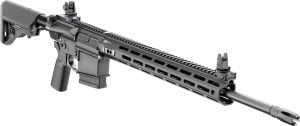
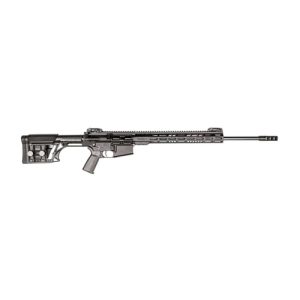
Today, the AR-10 platform is the foundation of nearly every semi-automatic .308 rifle on the market. Companies like Aero Precision, PSA, Daniel Defense, and DPMS all build AR-10 pattern rifles. If you own a modern AR-10 or a semi-auto .308, you are holding a direct descendant of Stoner’s 1956 design. The rifle that lost the military trial went on to win the market.
The AR-15: Changing Everything
After the AR-10 lost the military trials, Stoner did not go back to the drawing board. He went forward. Between 1957 and 1959, he scaled the AR-10 design down to fire a smaller, lighter cartridge: the .223 Remington (which would later become the 5.56x45mm NATO). The result was the AR-15, and it changed infantry warfare forever.
The logic was simple but brilliant. A smaller cartridge meant a lighter rifle, less recoil, and the ability for a soldier to carry significantly more ammunition for the same weight. The AR-15 weighed about 6 pounds unloaded, compared to the M14’s 9.2 pounds. A loaded 20-round magazine of .223 weighed roughly half what a 20-round magazine of 7.62 NATO weighed. Do the math across a full combat load and you are talking about pounds of weight savings per soldier, which translates directly into speed, endurance, and the ability to carry more ammunition into a fight.
The recoil reduction was equally significant. The 5.56mm round produced roughly half the felt recoil of 7.62 NATO, which meant soldiers could fire faster, more accurately, and with better control on full-auto or burst fire. In the jungles of Southeast Asia, where the U.S. was increasingly deploying troops, those advantages mattered enormously. Engagements were close, visibility was limited, and volume of accurate fire won firefights.
In 1959, Fairchild/ArmaLite sold the AR-15 rights to Colt’s Manufacturing Company. Stoner moved on from ArmaLite, but his design was about to become the most consequential military rifle of the Cold War. Colt began marketing the AR-15 aggressively to the U.S. military, and the rifle found its first champion in General Curtis LeMay of the U.S. Air Force. In July 1960, then Vice Chief of Staff, LeMay watched an AR-15 demonstration at a Fourth of July party thrown by ArmaLite’s parent-company president, the one where watermelons stood in for targets, and ordered 8,500 rifles for Air Force security police on the spot. Congress promptly put the purchase on hold, and it took until 1962 for the rifles to be cleared.
The Army was slower to adopt. But as American involvement in Vietnam escalated in the early 1960s, reports from the field made it clear that the M14 was too heavy and too hard to control on full-auto in jungle conditions. In 1964, the Army began issuing the Colt M16 (the military designation for the select-fire AR-15) to troops in Vietnam. And then things went badly wrong.
The early M16s in Vietnam were plagued by reliability failures. Soldiers reported constant jamming, failures to extract, and corroded chambers. The problems were not caused by Stoner’s design. They were caused by the Army’s decision to change the propellant powder from the IMR stick powder Stoner had specified to a cheaper ball powder that produced more fouling. The Army also failed to chrome-line the chamber and bore, did not issue cleaning kits, and told soldiers the rifle was “self-cleaning.” It was a bureaucratic disaster that cost American lives.
A Congressional investigation led by Representative Richard Ichord confirmed what Stoner had been saying all along: the problems were caused by the ammunition change and lack of maintenance provisions, not by the rifle’s design. Once the fixes were implemented (chrome-lined chambers and bores, proper cleaning kits, a forward assist, and improved ammunition), the M16A1 proved to be exactly what Stoner had designed: a lightweight, accurate, reliable infantry rifle that gave American soldiers a significant advantage over the AK-47-armed adversaries they faced.
The platform has been the backbone of the U.S. military ever since, evolving through the M16A2 (heavier barrel, improved sights, three-round burst), the M16A4 (flat-top receiver with Picatinny rail), and the M4 Carbine (14.5-inch barrel, collapsible stock) that troops carry today. Each variant refined the platform, but none of them changed Stoner’s fundamental operating system. The bolt, the carrier, the gas tube, the buffer, the two-pin receiver takedown: it is all still Stoner, 60-plus years later.
If you are looking to buy an AR-15 today, you are choosing from the most developed rifle platform in history. Check out our best AR-15 rifles roundup, our AR-15 buyer’s guide, or our guide on how to build an AR-15 from scratch.

The Direct Impingement Debate
If you spend any time in the AR-15 world, you will inevitably run into the “direct impingement vs. gas piston” debate. Critics of Stoner’s gas system argue that it is inherently flawed because it vents hot, dirty gas directly into the receiver, fouling the bolt carrier group and requiring more frequent cleaning. Piston-driven systems (like those in the AK-47, HK416, or SIG MCX) keep the gas and fouling up front, near the gas block, resulting in a cleaner-running action.
There is some truth to the criticism. Stoner’s system does run dirtier than a piston gun. But what the critics often leave out is everything that the direct impingement system does better. It is lighter, because there is no heavy piston assembly adding weight to the front of the rifle. It has fewer moving parts, which means less that can break. And because the mass is centered closer to the receiver, DI guns tend to be more accurate and have better balance than their piston counterparts.
The U.S. military has tested piston alternatives repeatedly over the decades and keeps coming back to the DI system. The M4A1 that American soldiers carry right now still uses Stoner’s basic gas system, updated but fundamentally unchanged from what he designed in the 1950s. That is not an accident. It works. For a deeper dive on this topic, check out our breakdown of direct impingement vs. gas piston AR-15s.
I will say this: I have thousands of rounds through DI guns and thousands through piston guns. For a general-purpose rifle, especially one you are going to use for home defense, range shooting, or competition, the DI system is lighter, simpler, and accurate. If you are running suppressed in harsh environments for days without cleaning, piston has an edge. For 99% of civilian shooters, Stoner got it right the first time.
After ArmaLite: Knight’s Armament and the SR-25
After leaving ArmaLite, Stoner worked as a consultant for Colt and then moved to Cadillac Gage, where he designed the Stoner 63 system (more on that below). He spent the 1970s and early 1980s working on various military contracts, mostly out of the public eye. But his most significant late-career work came through his partnership with C. Reed Knight Jr. at Knight’s Armament Company (KAC) in Titusville, Florida.
Knight was a firearms collector, engineer, and businessman who recognized Stoner’s genius and gave him something rare: the resources and freedom to keep innovating without bureaucratic interference. The two men shared a workshop mentality. Knight provided the manufacturing capability and military contacts; Stoner provided the design brilliance. It was one of the most productive partnerships in modern firearms history.
The crown jewel of the Stoner-Knight collaboration was the SR-25. The name is often misexplained as “Stoner Rifle, 25th design”, it is not. The SR stands for Stoner Rifle, and the 25 is simply 10 plus 15: the AR-10 and the AR-15 added together, because that is exactly what the rifle is. It is a modernized, perfected AR-10 in 7.62x51mm NATO, wearing the AR-15’s lower receiver ergonomics and controls.
The parts commonality was the whole point. Roughly 60% of the SR-25’s components interchange with the AR-15 and M16, everything except the receivers, hammer, barrel assembly and bolt carrier group. Stoner wanted a .308 battle rifle that any soldier trained on the M16 could pick up and run with almost no retraining.
The U.S. military adopted the SR-25 as the M110 Semi-Automatic Sniper System (SASS) in 2008, and it has served as a designated marksman rifle with Army and Marine units ever since. The M110 gave squad-level units a precision .308 capability that complemented the M4 Carbine, and it saw extensive combat use in Iraq and Afghanistan. Variants of the SR-25 remain in service today. If you are interested in the best semi-auto .308 rifles or the best military sniper rifles, the SR-25/M110 belongs on every list.
The Stoner 63: The Gun That Was Ahead of Its Time
Between the AR-15 and the SR-25, Stoner designed one of the most ambitious weapons systems ever conceived: the Stoner 63. Developed in the early 1960s at Cadillac Gage, the Stoner 63 was a modular weapons system that could be reconfigured as a standard rifle, a carbine, a top-fed light machine gun, or a belt-fed squad automatic weapon, all from the same basic receiver and operating system. You literally swapped components to change the weapon’s role.
The Stoner 63 found a devoted following among U.S. Navy SEALs in Vietnam, who used the belt-fed LMG configuration extensively in the Mekong Delta. The SEALs called it the “Stoner” and loved it for its light weight (around 11 pounds in the LMG configuration, compared to 23 pounds for the M60) and its devastating volume of fire. SEAL teams carried the Stoner LMG on ambush operations, river patrols, and direct action missions where suppressive firepower from a lightweight package meant the difference between getting out alive and not.
But the system was too complex and maintenance-intensive for widespread military adoption. Converting between configurations required trained armorers and specialized parts management. The Army evaluated it and passed. It was a brilliant concept that the manufacturing technology and military logistics of the 1960s simply could not support at scale.
The Stoner 63’s legacy, though, is enormous. The idea of a modular weapons platform that could be reconfigured for different roles is exactly what drives modern systems like the SIG MCX, the FN SCAR, and the Army’s new XM7. Every time a manufacturer advertises “modularity” as a selling point, they are building on a concept Stoner proved viable 60 years ago.
Eugene Stoner’s Legacy in 2026
Eugene Stoner died on April 24, 1997, at the age of 74, in Palm City, Florida. He spent his final years working with Reed Knight at Knight’s Armament, still designing, still refining, still pushing the platform forward. The U.S. Army inducted him into its Ordnance Corps Hall of Fame in 1977, citing him as the designer of the M16 and the 5.56mm cartridge and crediting him with advancing the state of the art in weaponry worldwide. But Stoner never sought fame. He did not write memoirs. He did not do speaking tours. He was an engineer, not a showman, and his work spoke louder than any interview ever could.
The numbers in 2026 speak for themselves. The AR-15 is the most popular rifle in America, and NSSF now counts more than 32 million modern sporting rifles in circulation, still climbing. The M4 Carbine is the standard infantry weapon for the U.S. military, and variants of Stoner’s platform arm the militaries of over 80 countries. Every year, millions of new AR-15s are manufactured by companies ranging from Palmetto State Armory to Daniel Defense to Knights Armament.
What is remarkable about Stoner’s legacy is how many of his core innovations remain unchanged. The aluminum forged receiver. The inline recoil system. The rotating bolt with its multi-lug lockup. The direct impingement gas system. The upper/lower receiver split that makes the AR-15 infinitely modular. These were all Stoner’s ideas, conceived in the mid-1950s, and they are still the foundation of the platform 70 years later. Modern AR-15s have better triggers, better barrels, better optics, and better furniture, but the bones are still Stoner’s.
I think about this sometimes when I am building an AR or swapping an upper receiver in my garage. The fact that I can take an upper from one manufacturer, slap it on a lower from another, and have a functioning rifle is not an accident. Stoner designed the platform to be modular and standardized. He could not have predicted the civilian market that exploded decades after his original design, but the engineering decisions he made in 1956 are the reason the aftermarket exists. Every rail, every trigger, every handguard, every barrel you can buy exists because Stoner built a platform that invited modification.
Compare Stoner to John Moses Browning and Mikhail Kalashnikov, the other two titans of 20th-century firearms design. Browning gave us the 1911, the M2 machine gun, the Hi-Power, and the operating principles behind most modern semi-auto pistols. Kalashnikov gave us the AK-47, the most produced firearm in history and the weapon of choice for insurgencies and developing-world militaries for 75 years. Stoner gave us the AR-15/M16 family, which is arguably the most technically advanced and widely adopted military small arms platform ever fielded by professional armies. All three men changed the world. Stoner just did it more quietly.
The two men finally met on 15 May 1990, when Kalashnikov landed at Washington Dulles at the invitation of the Smithsonian Institution. The photographs from that trip, the pair at Quantico, each holding the other’s rifle, are among the great images in firearms history. Two men from opposite sides of the Cold War, linked by the fact that they each designed the infantry weapon that defined their nation’s military identity. They got on well, and Kalashnikov came back to the States repeatedly through the 1990s, appearing alongside Stoner at SHOT Show. Stoner did not just design a gun. He designed the gun that stood opposite the AK-47 for the rest of the century.
For more on the rifles and manufacturers carrying Stoner’s legacy forward, check out our guides to America’s most popular rifles, the best Palmetto State Armory guns, and our Aero Precision buyer’s guide.
Buy the Guns Stoner Designed
Eugene Stoner’s designs are not museum pieces. They are the most actively manufactured, most widely available rifles on the American market. Whether you want a budget build or a top-tier fighting rifle, the AR platform has something at every price point.
AR-15 Rifles
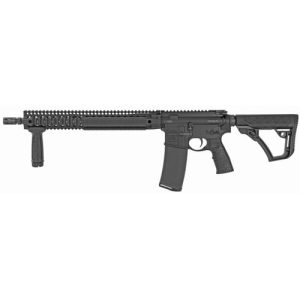
The AR-15 is available from under $500 to well over $3,000, with options at every price point in between. At the entry level, Palmetto State Armory’s PA-15 delivers a reliable, mil-spec rifle for around $400. It is proof that Stoner’s design has been refined to the point where a quality AR-15 costs less than many handguns.
At the top end, Daniel Defense, Bravo Company Manufacturing, and Knights Armament build rifles that are trusted by military special operations and law enforcement units worldwide. In between, companies like Aero Precision, Smith and Wesson (M&P15), Springfield Armory (SAINT), and Ruger (AR-556) offer excellent mid-range options. For full recommendations, see our best AR-15 rifles guide, our top AR-15s for sale, and our roundup of the best cheap AR pistols.
AR-10 Rifles
Stoner’s original .308 design is alive and well. AR-10 pattern rifles start around $850 with PSA’s PA-10 Gen3 and run to roughly $2,300-$2,800 for premium options like the Daniel Defense DD5. The AR-10 is the go-to platform for hunters and long-range shooters who want semi-auto capability in a full-power cartridge. See our best AR-10 rifles guide and our PSA PA-10 review.
AR Pistols
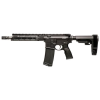
The AR platform adapted for close-quarters use. AR pistols with shorter barrels and stabilizing braces offer the AR-15’s modularity and firepower in a compact package. Stoner probably never imagined a 7.5-inch barreled AR, but the platform’s flexibility made it possible. These are popular for home defense and truck guns where compactness matters. Check out our best AR pistols roundup for our top picks.
Parts and Accessories
One of Stoner’s greatest (if unintentional) gifts to the firearms world was designing a platform that is endlessly customizable. The AR-15 aftermarket is the largest of any firearm in history. Build your own Stoner design from the ground up with parts from Brownells, Palmetto State Armory, and Aero Precision. See our best AR-15 parts and accessories guide and Aero Precision buyer’s guide.
Related Guides
More AR-15 & AR-10 Guides from USA Gun Shop
- Best AR-15 Rifles
- Best AR-10 Rifles
- Best AR Pistols
- AR-15 Buyer’s Guide
- How to Build an AR-15
- Best AR-15 Parts & Accessories
- Aero Precision Buyer’s Guide
- Best Palmetto State Armory Guns
- PSA AR-15 Review
- Best AR-15 Ammo (5.56 & .223)
- Direct Impingement vs. Gas Piston AR-15
- America’s Most Popular Rifles
Frequently Asked Questions
Who invented the AR-15?
Eugene Stoner designed the AR-15 at ArmaLite (a division of Fairchild Aircraft) between 1957 and 1959. He scaled down his earlier AR-10 design from .308 Winchester to .223 Remington, creating a lighter, lower-recoil rifle with higher ammunition capacity. Colt purchased the rights in 1959 and began commercial and military production.
What does AR stand for in AR-15?
AR stands for ArmaLite Rifle, the company where Eugene Stoner designed the platform. It does NOT stand for Assault Rifle or Automatic Rifle. ArmaLite numbered its designs as model designations rather than a running count, which is why the series jumps around: AR-1, AR-5, AR-7, AR-10, AR-15, AR-18 and so on. The AR-15 was not the fifteenth rifle the company drew up.
Did Eugene Stoner design the M16?
Yes. The M16 is the military designation of the AR-15. Eugene Stoner designed the AR-15 at ArmaLite, Colt purchased the rights and sold it to the US Air Force and Army. The military designated it the M16 (Rifle, Caliber 5.56mm, M16). The M4 Carbine is a shortened version of the same Stoner design.
What is the difference between the AR-15 and AR-10?
The AR-10 came first (1956) and fires .308 Winchester / 7.62 NATO. The AR-15 (1959) is a scaled-down version firing .223 Remington / 5.56 NATO. The AR-15 is lighter, has less recoil, and holds more ammunition. The AR-10 hits harder and is effective at longer range. Both use Stoner's direct impingement gas system and aluminum receiver design.
When did Eugene Stoner die?
Eugene Stoner died on April 24, 1997, at age 74 in Palm City, Florida. He lived to see the AR-15 become the standard military rifle for the US and NATO, but died before the civilian AR-15 market exploded in the 2000s. The U.S. Army had inducted him into its Ordnance Corps Hall of Fame in 1977, twenty years before his death.
Did Stoner and Kalashnikov ever meet?
Yes. Eugene Stoner and Mikhail Kalashnikov (designer of the AK-47) met in May 1990 at a private gathering arranged by the Smithsonian Institution. By all accounts, the two men respected each other enormously. Stoner reportedly admired the simplicity of the AK, while Kalashnikov admired the precision of the AR platform.
Who was Eugene Stoner?
Eugene Stoner was the American firearms designer behind the AR-10 and AR-15, the rifle that became the M16 and the foundation of the modern sporting rifle. A self-taught engineer, his work at ArmaLite in the 1950s reshaped small arms with lightweight materials and an innovative gas system that still defines the platform today.
What did Eugene Stoner invent?
Stoner designed the AR-10 and AR-15 rifles and their direct-impingement gas system, along with later designs like the Stoner 63 and the SR-25. His AR-15 became the M16 and the most influential rifle of the modern era, making him one of the most important firearms designers of the 20th century.
3,976+ Gun & Ammo Deals
Updated daily from 200+ top retailers. Filter by category, caliber, action type, and price.