

Last updated September 5, 2026 · By Nick Hall. For the big picture, start with our complete air rifle buying guide.
The best air rifle in the world shoots badly with the wrong ammo. Pellets vary more than most people expect, not just in shape and weight but in head diameter, tin count and how consistently they are made, and every barrel has favorites. I have ranked these by job rather than by brand, and I have put the real cost per shot next to each one, because a $3.59 tin and a $17.49 tin are not remotely the comparison they look like.
Some of the links below are affiliate links, meaning at no additional cost to you, we may earn a commission if you click through and make a purchase.
Quick Answer: JSB Exact domed pellets are the accuracy benchmark and the safest first buy for almost any rifle. H&N Field Target Trophy is the hunting dome, RWS R10 Match is the target wadcutter you can actually find in stock, Crosman Premier is the value plinker, JSB Knock Out slugs are for powerful PCPs shooting long, and Crosman Piranha hollowpoints are the pest pick at under a cent a shot. Buy three tins, shoot groups, and let the rifle pick.
| Pellet | Why it is here | Check price |
|---|---|---|
| Best OverallJSB Exact (Diabolo) | The domed pellet most barrels shoot best, and the one every other pellet gets measured against. Sold in graded head sizes. |
Check Price ↓3.25c per shot |
| Best for HuntingH&N Field Target Trophy | A heavier domed hunting pellet with tight weight consistency. Hits harder than a .177 dome and still groups. |
Check Price ↓3.20c per shot |
| Best for TargetRWS R10 Match | A true match wadcutter that punches clean, scorable holes, and unlike most match pellets it is actually stocked in the US. |
Check Price ↓2.73c per shot |
| Best ValueCrosman Premier | Accurate enough for real work, cheap enough to shoot all afternoon, and stocked absolutely everywhere. |
Check Price ↓1.60c per shot |
| Best for PestsCrosman Piranha | A deep hollowpoint that opens up on impact. The cheapest pellet here per shot by a wide margin. |
Check Price ↓0.90c per shot |
Table of Contents
How we tested: Every pick here is ranked against our testing methodology. Minimum round counts, accuracy and reliability protocols, the failures that disqualify a gun.
What a Tin Actually Costs You

Pellet tins are not sold in a standard count. Some hold 500, some 400, some 250, and slugs often come 200 to a tin. That makes the sticker price close to meaningless, and it is the single easiest way to talk yourself into the wrong purchase.
Take the two JSB slug tins above. The MKII at $16.49 looks like the cheaper buy against the MK3 at $17.49. It holds 200 pellets instead of 500, so it costs you 8.24 cents a shot against 3.50, which is 2.4 times more for what looks like a dollar saved. At the other end, Crosman Piranha works out at 0.90 cents. You can shoot nine Piranha for the price of one .216 slug.
None of that means the slug is bad value. It means the two are not competing for the same money, and a price comparison that stops at the tin will tell you they are. If you shoot a few hundred pellets a month, the gap between a 1 cent pellet and a 3.3 cent pellet is real money over a season, so it is worth being deliberate about which rifle gets the expensive stuff.
1. JSB Exact (Diabolo): Best Overall Airgun Pellet
- Head shape: Domed (diabolo)
- Calibers: .177, .20, .22, .25, .30
- Weight: 8.44 gr in .177, up to 33.95 gr in .25 King
- Head size: Graded, 4.50 to 4.53 mm in .177
- Tin count: 500 in .177, 350 in .25 King
- Cost per shot: About 3.25 cents
| Accuracy | 5 / 5 |
| Consistency | 5 / 5 |
| Value | 3 / 5 |
| Availability | 3 / 5 |
| Range of options | 5 / 5 |
Pros
- The accuracy benchmark in most barrels
- Graded head sizes for real tuning
- Every caliber and weight covered
Cons
- Costs roughly double budget pellets
- Stock comes and goes
- Head size choice confuses first buyers
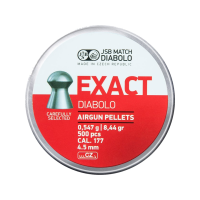
If someone hands me an unfamiliar rifle and asks what to feed it, the answer is JSB Exact until proven otherwise. It is the pellet that turns up in more winning field target scores than anything else, and the reason is boring rather than glamorous: the weight varies less tin to tin than almost anything at the price.
The domed head is what makes it a default. Domes are the most forgiving shape at airgun velocities, they hold their line better than a wadcutter past about 20 yards, and they penetrate well enough to hunt with. In .177 the standard Exact runs 8.44 grains, which suits most springers and mid-power PCPs. Step up to .22 and the Exact Jumbo family covers everything from 14 to 18 grains.
The catch is the head size, and it is the thing nobody warns you about. JSB sells the same weight in several head diameters, and retailers list them as separate products. The .177 8.44 grain tin most commonly stocked here is the 4.53 mm head. If your rifle shot beautifully on one tin and merely acceptably on the next, that number is the first thing to check, before the barrel and before yourself.
At roughly 3.25 cents a shot it is not a plinking pellet. I keep a tin for zeroing, for load development and for anything that matters, and shoot something cheaper for volume.
Best For: Anyone who wants one tin that will probably shoot well in their rifle without a test program, and every serious accuracy job after that.
2. H&N Field Target Trophy: Best for Hunting
- Head shape: Domed
- Calibers: .177, .20, .22, .25
- Weight: 8.64 gr in .177, 14.66 gr in .22, 19.91 gr in .25
- Head size: 5.53 mm and 5.55 mm in .22
- Tin count: 250 in .22, 500 in .177
- Cost per shot: About 3.20 cents
| Accuracy | 5 / 5 |
| Terminal effect | 4 / 5 |
| Consistency | 5 / 5 |
| Value | 3 / 5 |
| Availability | 4 / 5 |
Pros
- Excellent weight consistency tin to tin
- Heavy enough to hunt cleanly
- Sold in two head sizes
Cons
- Only 250 per tin in .22
- Dearer per shot than it looks
- Lead-free version is a different pellet
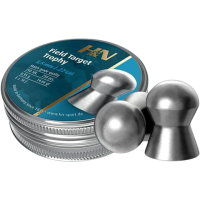
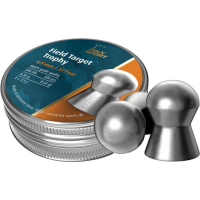
Field Target Trophy is the pellet I reach for when the shot has to count on something alive. The name says target, and it does shoot targets very well, but the useful version of it is the .22 at 14.66 grains, which carries enough weight to put a rabbit down properly instead of wounding it.
H&N grade these tightly and it shows on the chronograph. Extreme spread over a string comes down to the pellet more often than the rifle at this level, and FTT is one of the few production pellets where the tin is not the weak link. Groups stay round at 40 yards in a decent PCP, and it is one of the rare hunting pellets that a springer will also shoot well.
Watch two things when you buy. The .22 comes in both 5.53 mm and 5.55 mm heads, sold under nearly identical names, so note which one your rifle liked. And Field Target Trophy Green is a lead-free pellet that happens to share the name. It is much lighter, it flies differently and it is not a substitute, so I have filtered it out of the card above.
The 250-count tin is the annoyance. At $8.49 that is 3.40 cents a shot, which is JSB money for a tin that runs out twice as fast.
Best For: Hunting and pest control at real range in .22, where a clean kill matters more than the cost of the pellet.

3. RWS R10 Match: Best for Target Shooting
- Head shape: Flat wadcutter
- Caliber: .177
- Weight: 7.0 gr (Light) or 8.2 gr (Heavy)
- Tin count: 500
- Best range: 10 meters to about 25 yards
- Cost per shot: About 2.73 cents
| Paper accuracy | 5 / 5 |
| Consistency | 5 / 5 |
| Value | 4 / 5 |
| Availability | 4 / 5 |
| Range beyond 25 yards | 2 / 5 |
Pros
- Cuts clean, easily scored holes
- Two weights for different power levels
- Actually stocked in the US
Cons
- Sheds speed badly past 25 yards
- Wrong shape for hunting
- Only made in .177
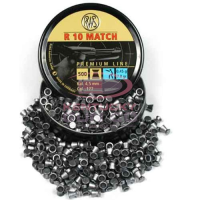
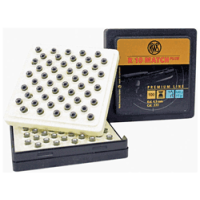
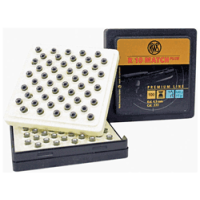
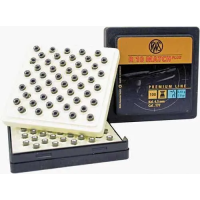
Every best-pellets list recommends H&N Finale Match for target work, and it is a lovely pellet. It is also almost impossible to buy from a mainstream US retailer. Search for it and you will be shown Baracuda Match instead, which is a heavy hunting dome and about as far from a match wadcutter as the catalogue gets. That substitution catches people out constantly.
RWS R10 is the answer to that problem. It is a genuine match wadcutter, made to the same idea as the Finale, and it sits on shelves here in both the 7.0 grain Light and the 8.2 grain Heavy. Pick the Light for a low-powered target pistol or a 10 meter rifle, the Heavy for anything with a bit more behind it.
The flat face is the whole point. It punches a clean circle through paper so the scoring ring is unambiguous, which matters when a hole that clips the line is worth a point. That same flat face is why it falls apart past about 25 yards. Wadcutters bleed velocity fast, so a pellet that is drilling one hole at 10 meters will be wandering at 40 yards. Do not take them hunting.
At about 2.73 cents a shot in a 500 tin it is cheaper than the domed premium pellets, which is a pleasant surprise for something this consistent.
Best For: Paper at 10 meters to 25 yards, club shooting, and anyone who has been trying to buy Finale Match and keeps being sold something else.

4. Crosman Premier: Best Value Pellet
- Head shape: Domed
- Calibers: .177 and .22
- Weight: 10.5 gr Ultra Magnum in .177, 14.3 gr in .22
- Head size: 4.5 mm in .177, 5.5 mm in .22
- Tin count: 500
- Cost per shot: About 1.60 cents
| Accuracy | 4 / 5 |
| Consistency | 3 / 5 |
| Value | 5 / 5 |
| Availability | 5 / 5 |
| Cleanliness | 3 / 5 |
Pros
- Half the price of premium domes
- Stocked by almost every retailer
- Heavy enough for pest work
Cons
- Weight varies more than premium tins
- Leaves more lead in the barrel
- Skirts dent easily in the tin
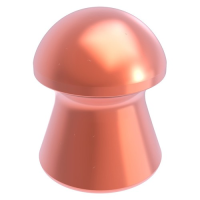
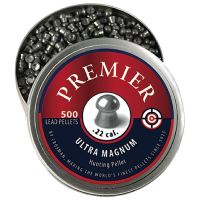
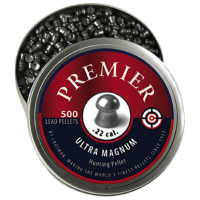
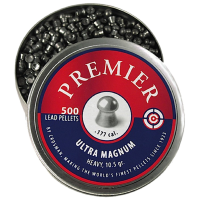
Crosman Premier is the pellet you shoot when you want to shoot a lot. Around 1.6 cents a shot at the low end, 500 to a tin, and available in every shop that sells air rifles at all. That combination is why it has been the default American plinking pellet for decades.
It is genuinely accurate, which people forget because it is cheap. Plenty of rifles shoot Premiers as well as they shoot anything, and the .22 at 14.3 grains is a perfectly capable pest pellet inside 30 yards. The trade is consistency: sort a tin on a scale and you will find more spread than in a JSB or H&N tin, and a handful of dented skirts near the bottom.
The lead is also softer and less well finished, so barrels lead up faster. That is not a problem, it just means running a pull-through through the bore more often than you would on a diet of premium pellets.
One buying note. Premier comes as the standard Premier and as the heavier Ultra Magnum, and shops list both simply as Premier Domed. The Ultra Magnum in .177 is 10.5 grains against 7.9 for the standard, which is a big difference in a springer. Read the grain weight, not the name.
Best For: Backyard plinking, practice by the hundred, and anyone who wants a competent pellet without thinking about it.
5. JSB Knock Out Slugs: Best for Long-Range PCPs
- Head shape: Solid slug, hollow point
- Calibers: .177 MK3, .22, .216 MKII, .25, .30
- Weight: 10.03 gr in .177 MK3, 25.39 gr in .216 MKII
- Head size: 4.51 mm on the .177 MK3
- Tin count: 500 in .177, 200 in .216
- Cost per shot: 3.50 cents in .177, 8.24 cents in .216
| Long-range retention | 5 / 5 |
| Terminal effect | 5 / 5 |
| Accuracy in the right rifle | 4 / 5 |
| Accuracy in the wrong rifle | 1 / 5 |
| Value | 2 / 5 |
Pros
- Holds energy far past pellet range
- Serious terminal effect on game
- Several calibers and weights
Cons
- Needs a fast twist barrel
- Up to 8 cents a shot
- Useless in a low-powered rifle
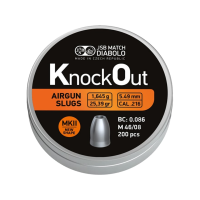
Slugs are the one item on this page that will disappoint you if you buy them for the wrong rifle. A diabolo pellet is drag stabilised: the waist and flared skirt keep it pointing forwards the way a shuttlecock does, and it will fly straight out of almost any barrel. A slug is a solid projectile that has to be spin stabilised, so it needs a barrel with a twist rate fast enough to do that.
Put slugs through a standard springer or an older PCP with a slow twist and the groups will open up in a way that looks like the ammo is defective. It is not. It is the wrong tool. Check your rifle’s twist rate first, and check that it makes enough power to push a heavier projectile properly.
Get that right and the difference is dramatic. A Knock Out holds its energy far past the range where a pellet has gone lazy, so shots that were guesswork at 80 yards become realistic. That is the whole reason to own them.
Budget accordingly. The .177 MK3 in a 500 tin is 3.50 cents a shot, which is reasonable. The .216 MKII comes 200 to a tin and works out at 8.24 cents, and that is not a pellet you shoot at cans.
Best For: Powerful, fast-twist PCPs shooting past 60 yards, and hunters who need energy on target at distance. Skip them entirely on a break barrel.

6. Crosman Piranha: Best for Pest Control
- Head shape: Deep hollow point
- Calibers: .177 and .22
- Weight: 10.5 gr in .177, 14.3 gr in .22
- Head size: 4.5 mm in .177
- Tin count: 400
- Cost per shot: About 0.90 cents
| Expansion | 5 / 5 |
| Value | 5 / 5 |
| Accuracy to 25 yards | 4 / 5 |
| Accuracy past 35 yards | 2 / 5 |
| Penetration | 2 / 5 |
Pros
- Cheapest pellet here per shot
- Opens up reliably on small pests
- Keeps energy inside the target
Cons
- Loses accuracy past 35 yards
- Poor penetration on tough game
- Needs decent power to expand
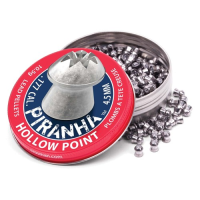
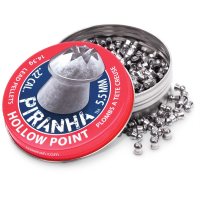
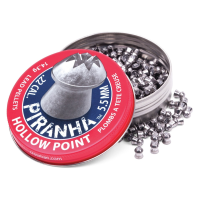
Piranha is the pest pellet, and at 0.90 cents a shot it is the cheapest thing on this page by a distance. The deep hollow point is aggressive enough that it actually opens at airgun velocity, which a lot of hollowpoints do not, and that is the entire argument for using one.
Expansion matters in a garden or a barn for a reason beyond terminal effect. A pellet that opens up dumps its energy into the target rather than carrying on through a fence, a wall or a greenhouse. On rats and pigeons at 20 to 25 yards it does exactly that.
Push it further and the shape works against you. Hollowpoints are draggy and they shed velocity quickly, so accuracy falls off past about 35 yards and expansion stops happening once the speed has gone. On anything tougher than a rat, penetration is the limit. For squirrels and rabbits at range I would take the Field Target Trophy dome instead.
One naming trap worth knowing. Crosman sells this as both Piranha and Premier Piranha Hollow Point, and separately sells a plain Premier Hollow Point that is a different, shallower design. The card above is filtered to the Piranha specifically.
Best For: Close-range pest control where you want the energy to stop in the target, and cheap enough that you will actually practice.
Head Size: The Number Nobody Puts in a Pellet Guide

Premium pellets are sorted by head diameter and sold as separate products, and hardly anybody mentions it. The chart above is five real .22 listings sitting side by side on retailer shelves right now. Field Target Trophy is stocked at both 5.53 and 5.55 mm. Baracuda Match is stocked at both 5.51 and 5.52 mm. The names are near enough identical that you would never notice.
Five hundredths of a millimeter sounds like nothing. It is the difference between a pellet that seats snugly in your barrel and one that is a fraction loose, and that fit decides how well the pellet seals and how consistently it leaves the muzzle. It is the usual explanation for the thing every airgunner has experienced: one tin groups beautifully, the next tin of supposedly the same pellet is merely fine.
So do two things. When a tin shoots well, write the head size on the lid before you forget, because the reorder will not remember for you. And if you are testing pellets properly, test head sizes as well as brands. Buying 4.52 and 4.53 in the same JSB Exact tells you more than buying two different brands does.
Crosman helpfully prints theirs on the lid, as you can see on the Ultra Magnum tin above. Most makers put it in the small print on the side, and most retailers bury it at the end of a long product name. If you want to check what head sizes a pellet is made in before you order, the makers list them: H&N Sport and Crosman both publish full specifications.

How to Choose the Right Pellet
- Match the head to the job: domed for all-around use and hunting, wadcutter for close target work, hollowpoint for expansion on pests, pointed for penetration. See our pellets vs BBs vs slugs guide.
- Weight follows power: heavier pellets buck wind and hit harder but shoot slower, lighter pellets shoot flatter but drift more. A powerful PCP stabilises heavy pellets and slugs, a modest springer does better with something mid-weight.
- Check the count before the price: tins run from 200 to 500. Divide the price by the count and compare that number instead, or you will keep buying the expensive one by accident.
- Note the head size: premium pellets come in graded diameters listed as separate products, and it is the most common reason two tins of the same pellet shoot differently.
- Do not buy slugs for a springer: slugs need a fast twist barrel and real power. In the wrong rifle they group badly and it is not the ammo’s fault.
- Test in YOUR barrel: the rule that beats all the others. Buy three tins, shoot five groups of five with each at your normal range, and let the rifle decide. Then re-zero with our sighting-in guide.
Pick your caliber first with our .177 vs .22 vs .25 guide, then match pellets to a rifle from our best PCP air rifles or best break-barrel air rifles guides. Hunting specifically? Start with best air rifles for hunting.
Airgun Pellet FAQ
What are the best airgun pellets?
JSB Exact domed pellets are the best all-around choice and the accuracy benchmark most barrels shoot well. H&N Field Target Trophy is the best hunting dome, RWS R10 Match is the best target wadcutter you can reliably buy in the US, and Crosman Premier is the best value pellet for high-volume shooting.
What pellet shape is best for hunting?
Domed pellets are the best all-around hunting choice for accuracy and penetration, while hollowpoints expand on impact for more knockdown on small game and pests at moderate range. Avoid wadcutters for hunting beyond very close range, because they shed velocity quickly.
What does pellet head size mean?
Premium pellets are graded by the diameter of the head and sold as separate products, so the same pellet in the same weight can be stocked at several sizes. H&N Field Target Trophy in .22 is sold at both 5.53mm and 5.55mm, and JSB Exact in .177 commonly at 4.52mm and 4.53mm. Head size changes how the pellet fits the bore, and it is the usual reason one tin groups better than the next.
How much do airgun pellets cost per shot?
Roughly 1 to 3.5 cents for pellets and up to about 8 cents for slugs, based on current retailer prices divided by the tin count. Crosman Piranha works out near 0.90 cents a shot in a 400 tin, JSB Exact around 3.25 cents in a 500 tin, and a 200-count tin of .216 JSB Knock Out slugs around 8.24 cents. Tin counts vary from 200 to 500, so compare cost per shot rather than the price on the tin.
Are expensive pellets worth it?
Yes, for accuracy. Premium pellets like JSB and H&N are far more consistent in weight and shape than cheap bulk pellets, which directly tightens groups. For casual plinking, budget pellets like Crosman Premier are fine, and at roughly half the cost per shot you can afford to shoot far more of them.
What is the difference between pellets and slugs?
Pellets are waisted diabolo projectiles that are drag-stabilized and shoot accurately out of almost any airgun barrel. Slugs are solid projectiles that must be spin-stabilized, so they need a fast-twist barrel and a powerful rifle, in practice a PCP. Slugs hold energy much further downrange, but in the wrong rifle they group badly and that is not a fault of the ammunition.
Why does my air rifle shoot some pellets better than others?
Every barrel has pellets it prefers, based on how the pellet fits the bore and stabilizes at that rifle's velocity. Brand, weight, head shape and head size all shift point of impact and group size, so testing a few tins in your own rifle is essential. If a pellet that used to shoot well suddenly does not, check the head size on the new tin first.
What pellet weight should I use?
Match weight to your rifle's power and your goal. Heavier pellets buck wind and hit harder but shoot slower, while lighter pellets fly flatter but drift more. Powerful PCPs stabilize heavier pellets and slugs, and lower-powered guns do better with mid-weight pellets.
3,976+ Gun & Ammo Deals
Updated daily from 200+ top retailers. Filter by category, caliber, action type, and price.
Related Guides