

Last updated July 26, 2026 · By Nick Hall, who has shot PCP, break-barrel, and big-bore airguns across pest control, backyard plinking, and small-game hunting.
Airguns have quietly become one of the most exciting corners of the shooting world. Modern pre-charged pneumatic (PCP) rifles rival rimfires for accuracy, big-bore airguns can take deer and hogs, and a good break-barrel still puts backyard pest control and cheap practice within anyone’s reach. This guide is the hub for everything we cover on air rifles: how they work, which caliber to buy, and the best models for every job and budget.
Some of the links below are affiliate links, meaning at no additional cost to you, we may earn a commission if you click through and make a purchase.
Quick Answer: The best all-around air rifle in 2026 is the Umarex Origin in .22, a shrouded multi-shot PCP that ships with its own hand pump so you do not need a tank to get started. The best budget PCP is the Gamo Arrow, the best self-contained break-barrel is the Gamo Swarm Maxxim G2 with its ten-shot magazine, and the cheapest rifle here worth owning is the Crosman 362 multi-pump. For deer and hogs you need a big bore: the Benjamin Gunnar in .45.
Choose your power plant first: PCP for the best accuracy and multi-shot convenience (needs a tank or pump to fill), break-barrel for a self-contained gun with no extra gear, or CO2 for cheap plinking. Then choose caliber: .177 for targets and small pests, .22 as the do-everything hunting caliber, .25 for bigger small game, and .30-caliber and up for medium game.
Table of Contents
How we tested: Every pick here is ranked against our testing methodology. Minimum round counts, accuracy and reliability protocols, the failures that disqualify a gun.
Best Air Rifles in 2026 at a Glance
Ten rifles, every one of them in stock somewhere we can price today. Tap a name to jump straight to the live prices for it.
| Rifle | Best for | Caliber and power plant | Street price |
|---|---|---|---|
| Umarex Origin | Best overall | .22, PCP | around $310 to $350 |
| Umarex Notos | Best compact PCP | .22, PCP | around $260 to $300 |
| Gamo Arrow | Best budget PCP | .177 and .22, PCP | around $190 to $230 |
| Gamo Swarm Maxxim G2 | Best break barrel | .177, Break barrel, gas piston | around $300 |
| Gamo Swarm Whisper | Best for pest control | .177 and .22, Break barrel, gas piston | around $200 |
| Crosman Mag-Fire Xtreme | Best value break barrel | .177 and .22, Break barrel, nitro piston | around $200 to $280 |
| Benjamin Prowler NP | Best cheap break barrel | .177 and .22, Break barrel, nitro piston | around $140 to $170 |
| Crosman 362 | Best multi-pump | .22, Multi-pump pneumatic | around $130 |
| Benjamin Gunnar | Best big bore | .45, PCP big bore | around $970 |
| Seneca Dragon Claw | Most powerful | .50, PCP big bore | around $720 |
Is an Air Rifle Actually a Firearm?
This is the first thing people ask me about air rifles and almost nobody writing about them answers it properly. The answer decides whether the rifle turns up at your door in a cardboard box or whether you have to go and stand at a gun counter, so it is worth two minutes of your time.
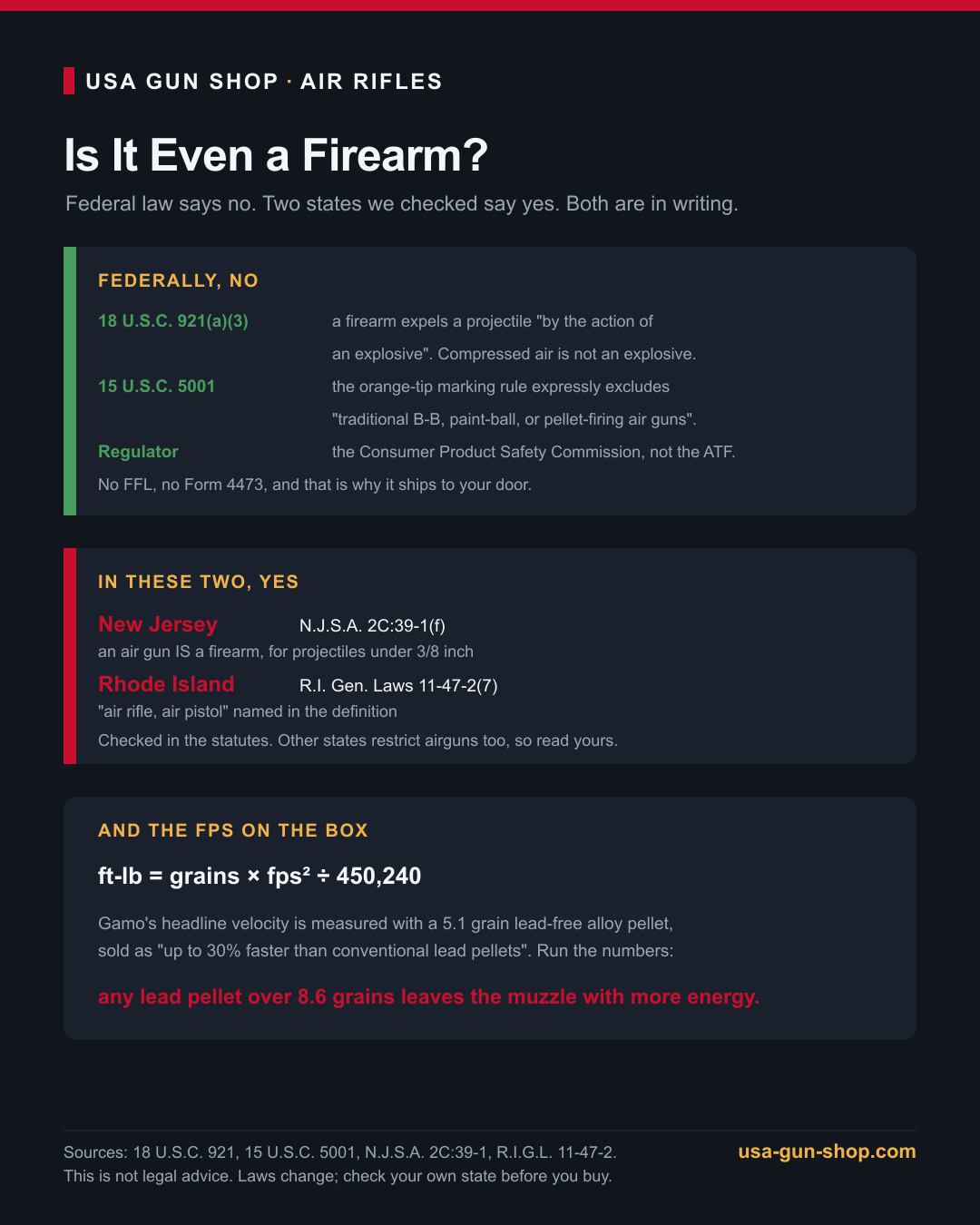
Federally, an air rifle is not a firearm, and the reason is one phrase in the statute. Title 18, section 921(a)(3) defines a firearm as a weapon that expels a projectile by the action of an explosive. Compressed air is not an explosive. That single clause is why there is no background check, no Form 4473 and no dealer transfer, and why the brown truck can leave an air rifle on your porch.
There is a second piece of federal law that catches people out, and it works in your favor. Title 15, section 5001 is the rule that puts the orange muzzle plug on toy guns. It requires a marking approved by the Consumer Product Safety Commission, then expressly carves out traditional B-B, paint-ball, or pellet-firing air guns that expel a projectile through the force of air pressure. That is why a modern air rifle is allowed to look exactly like a hunting rifle with no blaze orange anywhere on it. It also tells you who the regulator is: an air rifle is a consumer product under the CPSC, not a firearm under the ATF.
Two States Where That Is Simply Not True
State law can and does override all of the above, and in two states I checked it flatly reverses it.
- New Jersey: N.J.S.A. 2C:39-1(f) folds air guns into the definition of a firearm outright, naming weapons in which the propelling force is a spring, elastic band, carbon dioxide, compressed or other gas or vapor, air or compressed air. Read the clause closely and it turns on the projectile: it covers a bullet or missile smaller than three-eighths of an inch in diameter, with sufficient force to injure a person. Three-eighths of an inch is .375, which sits above every common airgun caliber, so .177, .22 and .25 are all inside it.
- Rhode Island: R.I. Gen. Laws 11-47-2(7) does not bother with a mechanism test. It lists air rifle, air pistol in the definition of firearm, right alongside machine guns, pistols and rifles.
Those are the two I read in the statute, and I am not going to tell you they are the only two, because I have not read all fifty. Plenty of other states and a great many cities restrict where you can shoot, what you can hunt and how old you have to be. Our air rifle laws guide goes further, and none of this is legal advice. Check your own state before you spend money.
How I Chose These Ten
I shoot air rifles for pest control around the yard and outbuildings, for small game, and because a tin of pellets costs less than a box of rimfire and I can shoot in the garden without anyone calling anybody. That is the lens here. This is not a bench rest field target list and it is not a list of the most expensive airguns made.
Three things decided the ten. First, the rifle has to be buyable. I ran every candidate through our own live pricing before it went on the page, and anything that came back with no rows, or with the wrong product attached, came straight off. That is stricter than it sounds and it cost some genuinely great rifles their place. Second, the power plant has to match a real job, which is why there are four break barrels, three PCPs, a multi-pump and two big bores rather than ten variations on one gun. Third, the price has to make sense against what else that money buys.
What I deliberately did not do is rank them by advertised velocity. Read the energy section below and you will see why that number tells you almost nothing useful, and once you stop sorting by it the list rearranges itself around what each rifle is actually for.
The Ten Air Rifles I Would Actually Buy
Every rifle below is one you can put in a basket today, because I checked our own live pricing against the retailers we track before writing a word about any of them. That is a deliberately narrower list than you will see elsewhere. Plenty of excellent air rifles, the Air Arms TX200 and the Weihrauch springers among them, are simply not carried by the shops we can price, and a recommendation you cannot act on is not much of a recommendation.
1. Umarex Origin: Best overall
- Caliber: .22
- Power plant: PCP
- Street price: around $310 to $350
Pros
- Ships with its own hand pump
- Shrouded barrel, genuinely quiet
- Rotary magazine, not single shot
Cons
- Pumping is still real work
- No open sights fitted
- Heavier than a break barrel
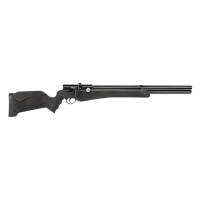
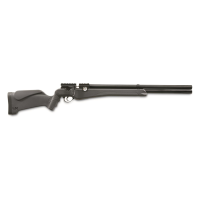
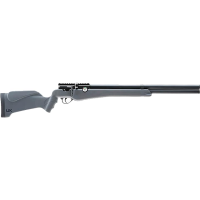
The Origin is the rifle I point almost everyone at, and the reason is the pump. Umarex builds a pre-pressurized tank into it, and their own product page puts a full-power shot at thirteen pumps of the included three-stage hand pump. That matters more than any number on the box, because the usual reason a new PCP owner gives up is that filling the thing turns into a project. This one arrives with what it needs, the barrel is shrouded so the neighbors stay friendly, and it feeds from a rotary magazine.
2. Umarex Notos: Best compact PCP
- Caliber: .22
- Power plant: PCP
- Street price: around $290 to $300
Pros
- Genuinely compact carbine
- Cheapest stocked PCP here
- Handles well in tight spaces
Cons
- Small reservoir, fewer shots
- No pump in the box
- Short barrel costs velocity
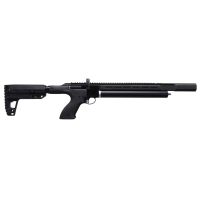
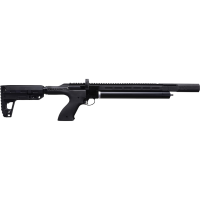
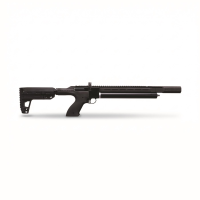
A short carbine built on the same idea, and the cheapest PCP here that a trusted retailer actually stocks. Buy it if your shooting happens in a barn, along a fence line or out of a truck window, where a full length rifle is a nuisance. You trade air capacity for the size, so plan on fewer shots between fills.
3. Gamo Arrow: Best budget PCP
- Caliber: .177 and .22
- Power plant: PCP
- Street price: around $190 to $230
Pros
- Cheapest way into PCP
- Ten-shot magazine included
- No recoil to fight
Cons
- Fill gear sold separately
- Basic trigger and stock
- Small air reservoir
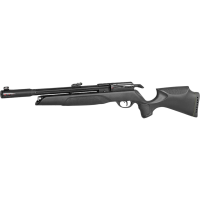

The Arrow is how you get into pre-charged shooting for less than the price of a decent scope. Plain rifle, synthetic stock, ten-shot magazine, and it does the thing that matters: it puts pellets in the same hole without the hold sensitivity that makes a springer hard work. You still need a pump or a tank, and that is the real cost of entry.

4. Gamo Swarm Maxxim G2: Best break barrel
- Caliber: .177
- Power plant: Break barrel, gas piston
- Street price: around $250
Pros
- Ten-shot magazine on a springer
- Completely self-contained
- Nothing to charge or fill
Cons
- Hold sensitive, needs technique
- Recoils in both directions
- Heavy cocking effort
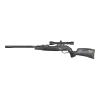
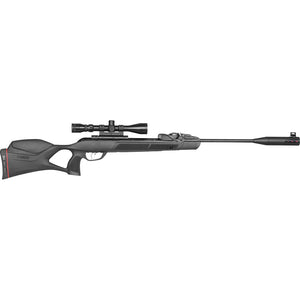
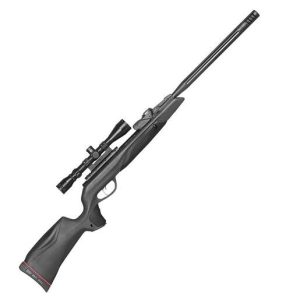
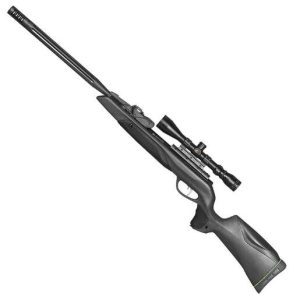
Break barrels are single shot by nature, and Gamo’s Swarm mechanism is the neatest way round that I have used: a ten-round magazine indexes as you cock the barrel. No tank, no pump, no compressor, nothing to charge. It is the right answer for someone who wants an air rifle in the cupboard that works whenever they pick it up.
5. Gamo Swarm Whisper: Best for pest control
- Caliber: .177 and .22
- Power plant: Break barrel, gas piston
- Street price: around $200
Pros
- Sound dampened, genuinely quiet
- Ten-shot magazine, not single shot
- Trusted retailer stock at $200
Cons
- Still loud enough indoors
- Hold sensitive like any springer
- .22 version harder to find
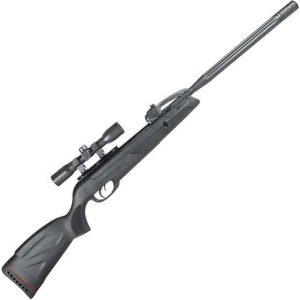
The Whisper is the same ten-shot break barrel with a sound-dampened muzzle, and quiet is the thing that matters most for pest control. Shooting rats off a feed bin at seven in the morning is a different job from punching paper, and a rifle the neighbors cannot place is worth more than another fifty feet per second. Buy the .22 if you can find it, because a heavier pellet hands over more of what it has on impact.
6. Crosman Mag-Fire Xtreme: Best value break barrel
- Caliber: .177 and .22
- Power plant: Break barrel, nitro piston
- Street price: around $200 to $280
Pros
- Twelve-round magazine
- Nitro piston, less spring buzz
- Two calibers, four configurations
Cons
- Plasticky furniture
- Trigger needs learning
- Loud without a moderator
Crosman’s answer to the Swarm, with a twelve-shot magazine and a nitro piston in place of a coil spring. Gas pistons hold their power sitting cocked and they buzz less on firing. The Diamondback sits at the cheap end of this family and the Xtreme at the top, and the catalog carries both, in both calibers.
7. Benjamin Prowler NP: Best cheap break barrel
- Caliber: .177 and .22
- Power plant: Break barrel, nitro piston
- Street price: around $140 to $170
Pros
- Lowest price worth having
- Nitro piston, not a spring
- Simple, little to go wrong
Cons
- Single shot only
- Bundled scope is basic
- Crude two-stage trigger
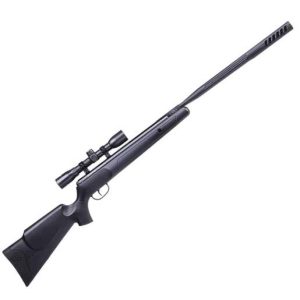
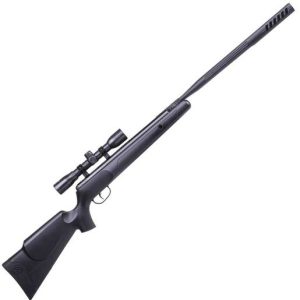
The cheapest rifle on this page I would hand to somebody without apologizing for it. Single shot, and the scope that comes with it is the scope that comes with it, but neither of those stops it being a perfectly good first air rifle. If the budget is under two hundred dollars, buy this and put the difference into decent pellets.
8. Crosman 362: Best multi-pump
- Caliber: .22
- Power plant: Multi-pump pneumatic
- Street price: around $130
Pros
- Power you can dial down
- Cheapest rifle on this list
- Ideal for teaching beginners
Cons
- Pumping between every shot
- Lowest power here
- Single shot, bolt action
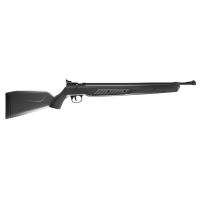
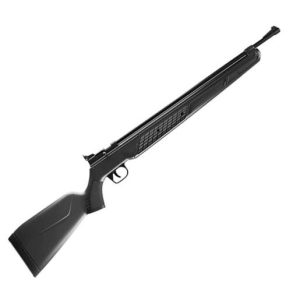
The multi-pump is the format everybody’s grandfather had, and it is still the most useful gun on this list for teaching someone to shoot. You set the power with the pump handle, so three strokes is a backyard plinker and eight is a pest gun. It is the cheapest thing here and it does something none of the others do.
9. Benjamin Gunnar: Best big bore
- Caliber: .45
- Power plant: PCP big bore
- Street price: around $970
Pros
- Genuine big game capability
- Bullpup, short for the barrel
- Shrouded and manageable
Cons
- Close to a thousand dollars
- Very few shots per fill
- Needs a tank, not a pump
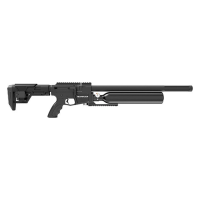
A .45 caliber bullpup PCP, and a completely different proposition from everything above it. This is a deer and hog rifle, it is legal for hunting in a growing number of states, and it will do things no .22 pellet gun can. It is also close to a thousand dollars before you have bought any way to fill it, which is the part nobody puts in the headline.
10. Seneca Dragon Claw: Most powerful
- Caliber: .50
- Power plant: PCP big bore
- Street price: around $720
Pros
- Half inch bore, cheapest route
- Huge energy on target
- Proven, long-running design
Cons
- Two full power shots per fill
- Rainbow trajectory past 50 yards
- Slugs are expensive
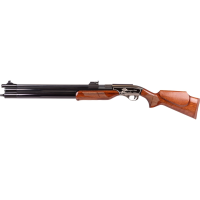
Half an inch of bore with a 500cc bottle slung underneath. The Dragon Claw is the cheapest route into fifty caliber airgunning and it has been the default answer in that corner for years. Know what you are buying: a couple of full power shots per fill, a rainbow trajectory, and a rifle that is entirely about what happens when the slug arrives rather than how it gets there.
Types of Air Rifles: Which Power Plant Is Right for You?
Every air rifle uses one of a few power plants, and picking the right one matters more than any other decision. We break them all down in our spring vs gas-piston vs PCP vs CO2 guide, but here is the short version.
- PCP (pre-charged pneumatic): the most accurate and powerful, with multi-shot magazines and almost no recoil. The trade-off is you need a hand pump, tank, or compressor to fill it. Start with our best PCP air rifles guide, and learn how they work in what is a PCP air rifle.
- Break-barrel (spring or gas-piston): fully self-contained, cock the barrel to load each shot. No extra gear, but single-shot and more sensitive to hold. See our best break-barrel air rifles.
- CO2: powered by 12-gram or 88-gram cartridges. Cheap and fun for plinking and pistols, but temperature-sensitive.
- Multi-pump pneumatic: you pump the forearm several times per shot to set the power. Classic, kid-friendly, and variable-power.
Air Rifle Calibers Explained
Airgun caliber choice drives everything from trajectory to knockdown power. Our full .177 vs .22 vs .25 caliber guide covers it in detail; the quick version:
- .177: fastest and flattest-shooting, cheapest pellets. Best for target shooting, plinking, and small pests like starlings and mice.
- .22: the do-everything hunting caliber. More energy and knockdown than .177 with a still-manageable trajectory. The best first air rifle caliber for most people.
- .25: heavier pellets and more knockdown for bigger small game like rabbits, squirrels, and raccoons at closer range.
- .30 and up (big-bore): .30, .357, .45, and .50 caliber airguns deliver enough energy for deer, hogs, and predators. See our best big-bore airguns guide.
Best Air Rifles by Use Case
- Hunting: for small game and predators, you want energy and accuracy. See our best air rifles for hunting guide, and for deer and hogs, our big-bore airguns ranking.
- Pest control & backyard: a quiet, accurate .22 PCP or break-barrel handles rats, pigeons, and garden pests without disturbing the neighbors.
- Plinking & practice: cheap pellets make air rifles the most affordable way to shoot. A break-barrel or CO2 gun is all you need.
- Raw power: if you just want the hardest-hitting airguns made, see our most powerful air rifles ranking.
How Much Power (FPE) Do You Need?
Airgun power is measured in foot-pounds of energy, and it is a far better predictor of what a rifle can ethically do than the velocity printed on the box. As a rough guide: 3 to 6 ft-lb is fine for tin cans and paper; 12 ft-lb is the accepted minimum for small game like squirrels and rabbits; 20 to 30 ft-lb, which is where a good .22 PCP lives, is comfortable pest control and small game territory; and big bore airguns making 100 ft-lb and up are what deer-sized animals need. Check your state, because some set a minimum caliber or energy for hunting.
You do not have to take anyone’s word for an energy figure, because you can work it out. Energy in foot-pounds is the pellet weight in grains, multiplied by the velocity in feet per second squared, divided by 450,240. That is the standard constant, and you can sanity check it against something familiar: a 40 grain .22 Long Rifle at 1,200 fps comes out at 128 ft-lb, which is exactly what the ammunition makers print on the box.
Now point that at the headline velocity on an air rifle. Gamo gets its big numbers with PBA Platinum, a lead-free alloy pellet that weighs 5.1 grains in .177 and is sold on being up to 30 percent faster than conventional lead pellets. Square that 30 percent and you find the crossover: 5.1 grains multiplied by 1.3 squared is 8.6 grains. Any lead .177 pellet heavier than 8.6 grains leaves the muzzle with more energy than the alloy pellet the headline number was measured with, and most serious hunting pellets in that caliber sit at or above that weight. The fast number is real. It is just not the number that puts anything in the bag, which is why the rifles above are ranked on what they are for rather than on feet per second.
Four Mistakes People Make Buying Their First Air Rifle
Buying the biggest number on the shelf
The rifle advertising 1,650 feet per second is not the best rifle in the rack, it is the rifle with the lightest pellet in the test barrel. Those velocities come from alloy pellets that shed speed fast and rarely group as well as lead. Worse, a springer pushed that hard is harsh to shoot and awkward to hold consistently. A .22 making a sensible 20 ft-lb will out-hunt a .177 screaming past the sound barrier every time, and it will be quieter doing it.
Trusting the scope in the box
Almost every break barrel under $300 arrives with a scope and mounts, and almost none of those scopes are worth the cardboard. The problem is not magnification, it is that a spring piston rifle recoils forward as well as back, and a scope not built for that will lose its zero or come apart inside a few hundred shots. Budget for a scope rated for springers, and read our air rifle scope guide before you spend anything.
Forgetting that a PCP needs air
A pre-charged rifle is the most accurate thing on this page and on its own in the box it is useless. You need a hand pump, a scuba or carbon fiber tank, or a compressor, and that can cost as much again as the rifle. It is the single most common reason a new PCP gets sold on six months later. The Umarex Origin is on this list partly because it solves that problem in the box.
Shooting whatever pellets were cheapest
Air rifles are far pickier about ammunition than firearms are. The same rifle can group an inch at 30 yards with one pellet and a quarter of that with another, and there is no way to know which without trying. Buy three or four tins from different makers in the right weight range, shoot them in one session, and let the target decide. Our airgun pellet guide covers what to start with.
Air Rifle FAQ
What is the best air rifle to buy in 2026?
The best all-around air rifle is the Umarex Origin in .22, a shrouded multi-shot PCP that ships with its own hand pump, so you do not need a tank to get started. The best budget PCP is the Gamo Arrow, the best self-contained break barrel is the Gamo Swarm Maxxim G2 with its ten-shot magazine, and the Crosman 362 multi-pump is the cheapest rifle here worth owning. For deer and hogs, step up to a big bore like the Benjamin Gunnar in .45.
What is the difference between PCP and break-barrel air rifles?
A PCP (pre-charged pneumatic) is filled from a tank, pump or compressor and offers the best accuracy, multi-shot magazines and almost no recoil, but needs fill equipment. A break-barrel is fully self-contained, cocked by breaking the barrel for each shot, so it needs no extra gear but is single-shot and more sensitive to hold.
What air rifle caliber should I buy?
Choose .177 for target shooting and small pests, .22 as the do-everything hunting caliber with more knockdown, .25 for bigger small game, and .30 caliber or larger big-bore airguns for deer and hogs.
How much power do I need to hunt with an air rifle?
Airgun power is measured in foot-pounds of energy (FPE). About 12 FPE is the accepted minimum for small game like squirrels and rabbits, 20-30 FPE is comfortable pest-control and small-game territory, and big-bore airguns making 100 FPE or more are needed for deer-sized animals. Always check your state's regulations.
Can you hunt deer with an air rifle?
Yes, with a big-bore air rifle. Airguns in .30, .357, .45 or .50 caliber can produce enough energy to ethically take deer and hogs at appropriate ranges, and a growing number of states allow big-bore airgun hunting. Check your local regulations first.
Are air rifles legal?
Federally, an air rifle is not a firearm. Title 18, section 921(a)(3) defines a firearm as a weapon that expels a projectile by the action of an explosive, and compressed air is not an explosive, which is why there is no background check and an air rifle can ship to your door. State law can reverse that. New Jersey folds air guns into its firearm definition at N.J.S.A. 2C:39-1(f), and Rhode Island names air rifles and air pistols outright at R.I. Gen. Laws 11-47-2(7). Those are the two statutes we read; other states and many cities restrict airguns in other ways, so check yours.
Are air rifles good for pest control?
Yes. A quiet, accurate .22 PCP or break-barrel is one of the best tools for humane backyard pest control on rats, pigeons and garden pests, because it is low-noise and has limited range compared to a firearm.
How accurate are modern air rifles?
Very. A good PCP air rifle can rival a .22 rimfire for accuracy at typical airgun ranges, printing tight groups thanks to their smooth, recoilless firing cycle and quality barrels.
Ready to pick a rifle? Start with the power plant that fits how you want to shoot: the best PCP air rifles for ultimate accuracy, the best break-barrel air rifles for grab-and-go simplicity, or the best big-bore airguns for hunting big game.
More Airgun Guides
- Best .22 Air Rifles and Best Air Rifles for Pest Control
- Best Airguns for Beginners and Best Air Rifle Scopes
- Best Air Pistols and Best CO2 Pistols
- Air Rifle Hunting Guide, Are Air Rifles Legal?, and How to Sight In an Air Rifle
- Pellets vs BBs vs Slugs
Best Airgun Pellets covers the ammo side of the hobby.
3,976+ Gun & Ammo Deals
Updated daily from 200+ top retailers. Filter by category, caliber, action type, and price.
Related Guides