

Affiliate disclosure: This Walther P22 review contains affiliate links. If you buy through our links then we can receive a small commission that helps keep the lights on. You don’t pay anything more.
- Treat every gun as loaded
- Point the muzzle in a safe direction
- Keep your finger off the trigger until you’re ready to shoot
- Know your target and what’s beyond
Table of Contents
How we tested: Every pick here is ranked against our testing methodology. Minimum round counts, accuracy and reliability protocols, the failures that disqualify a gun.
Review: Walther P22 – Brilliant Trainer, Fussy Eater
Our Rating: 7.8/10
- Street Price: $242 (Use our live pricing for the best up to date deal)
- Caliber: .22 LR
- Action: Double action / single action, hammer fired
- Barrel Length: 87 mm (3.42″)
- Overall Length: 160 mm (6.3″)
- Height: 114 mm (4.5″)
- Width: 28 mm (1.1″)
- Weight (unloaded): 480 g (16.9 oz)
- Capacity: 10 rounds
- Trigger Pull: 4,900 g double action, 1,800 g single action (10.8 lb / 4.0 lb)
- Sights: 3-dot, adjustable rear
- Safety: Manual hammer-block, magazine safety, firing pin safety
- Grip Circumference: 112 mm
- Bore Axis to Hand: 23 mm
- Frame: Polymer, interchangeable backstraps
Pros
- Cheapest real .22 pistol from a major maker
- Small grip fits shooters other guns don’t
- Adjustable rear sight and accessory rail standard
- Interchangeable backstraps in the box
Cons
- Genuinely picky about ammunition
- Zinc alloy slide, not steel
- Magazine safety blocks dry fire without a mag
Quick Take
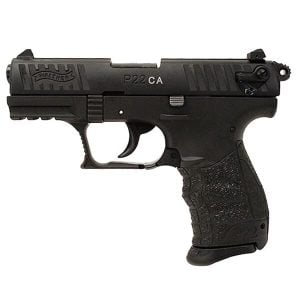
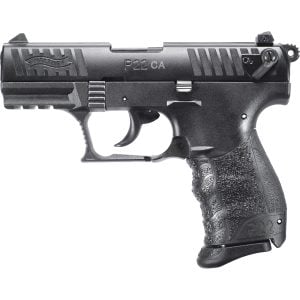
The Walther P22 has sold in enormous numbers for one straightforward reason. It’s a small, light, genuinely well-shaped .22 pistol that costs about $242, and it fits hands that a Ruger Mark IV swallows whole. For a new shooter, a young shooter, or anybody with small hands, that combination is hard to beat at any price.
It also has the most persistent reputation for ammunition pickiness of any rimfire pistol I’ve handled, and after 800 rounds I can tell you that reputation is earned rather than internet folklore. Feed it high-velocity ammunition and it runs. Feed it the cheapest bulk pack on the shelf and you’ll be clearing stoppages every magazine.
Buy it understanding that, and it’s an excellent trainer. Buy it expecting to shoot whatever is cheapest that week, and you’ll hate it.
Best For: New shooters, small hands, cheap trigger time and teaching kids to shoot safely. Skip it if you want a bulk-ammo blaster or a competition rimfire, where a Ruger Mark IV or a Taurus TX22 will serve you far better.
Why Walther Built It This Way
Look at the P22 next to the rimfire pistols that dominated before it and the design brief becomes obvious. A Ruger Mark series is a heavy, steel, target-shaped pistol with a grip angle borrowed from a Luger. A Browning Buck Mark is similar. Both are superb, both are built around the bullseye shooter, and neither feels remotely like the centerfire pistol a new shooter will eventually carry.
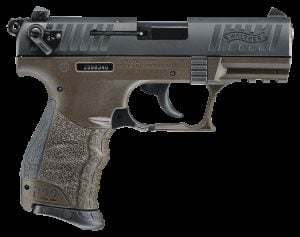
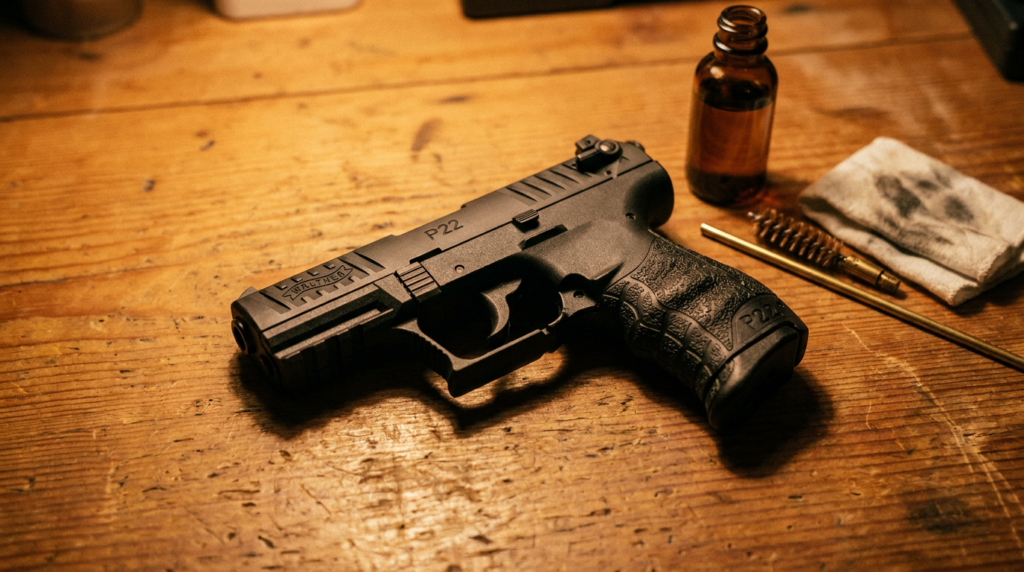
Walther went the other way. The P22 is shaped like a compact duty pistol, scaled down. Polymer frame, DA/SA hammer, decocker, accessory rail, interchangeable backstraps, adjustable sights. Everything about the manual of arms is deliberately transferable to a full-size gun, which is exactly what you want in a trainer.
The Carl Walther spec sheet lists grip circumference at 112 mm and bore-axis-to-hand at 23 mm. Those two numbers are the whole product. Most .22 pistols are built around the mechanism and the grip is whatever is left over. This one was built around the hand.
The compromise sits in the slide. To hit the weight and the price, it’s zinc alloy rather than steel, and that decision drives most of the criticism the gun attracts. It also explains the ammunition sensitivity, since a light slide needs a decent shove to cycle properly.
How the P22 Compares
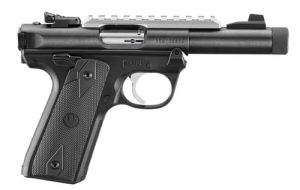
Ruger Mark IV ($329–$416)
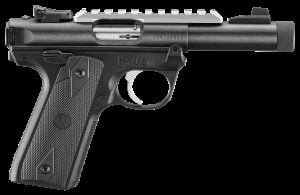
The Mark IV is the better pistol and roughly $90 to $175 more. Steel construction, a superb single-action trigger, and an appetite for ammunition that borders on indiscriminate. The one-button takedown fixed the only real complaint anyone had about the older Marks.
Where the P22 answers is size and shape. A Mark IV is a big pistol with a grip angle that suits target shooting and confuses anyone coming from a Glock. If you’re buying a rimfire to shoot a lot and shoot well, buy the Ruger. If you’re buying one to teach somebody, the Walther is easier to put in their hand. Our Ruger Mark IV review covers it properly.
Taurus TX22 ($265–$412)
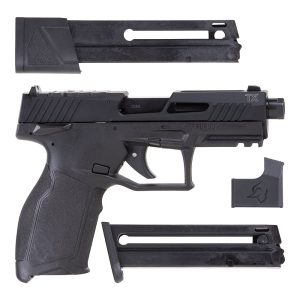
This is the P22’s real problem. The TX22 holds 16 rounds to the Walther’s 10, has a considerably better trigger, and has built a reputation for eating bulk ammunition that the P22 will choke on. Street prices start around $265, which is close enough to matter.
The Walther keeps two advantages. It’s smaller, so it suits small hands and younger shooters better, and it’s a DA/SA hammer gun, which makes it a more honest trainer for anyone whose eventual carry pistol works the same way. On pure shooting though, the Taurus wins. See our Taurus TX22 review.
Glock 44 ($359–$360)
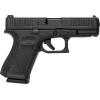
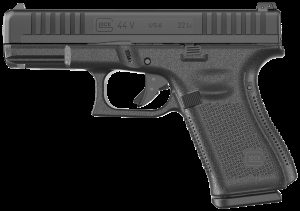
The G44 exists to train Glock shooters, and at that job it’s unbeatable because the manual of arms is identical to a G19. It’s also around $360 and it shares the P22’s ammunition fussiness, which is a harder sell at that price.
Buy the Glock if your carry gun is a Glock. Buy the Walther if it isn’t, or if $120 matters. Our Glock 44 review has the detail.
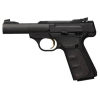
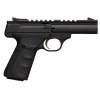
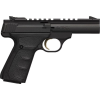
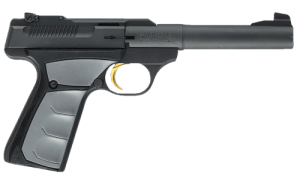
Browning Buck Mark ($284–$334)
The Buck Mark is the other classic answer, and like the Mark IV it’s a target pistol first. Excellent trigger, steel build, tack-driving accuracy from the bull-barrel versions, and a grip angle that suits deliberate shooting rather than fast work.
It costs $40 to $90 more than the Walther and it is not a trainer for a modern polymer carry gun. It is, however, the more satisfying pistol to shoot at a bench.
Verdict: The TX22 is the better shooter and the Mark IV is the better pistol. The P22 wins on size, price and shape, which is exactly the buyer it was designed for. Its closest DA/SA rival is covered in our Ruger SR22 review. Our best .22 LR pistols guide ranks the wider field.
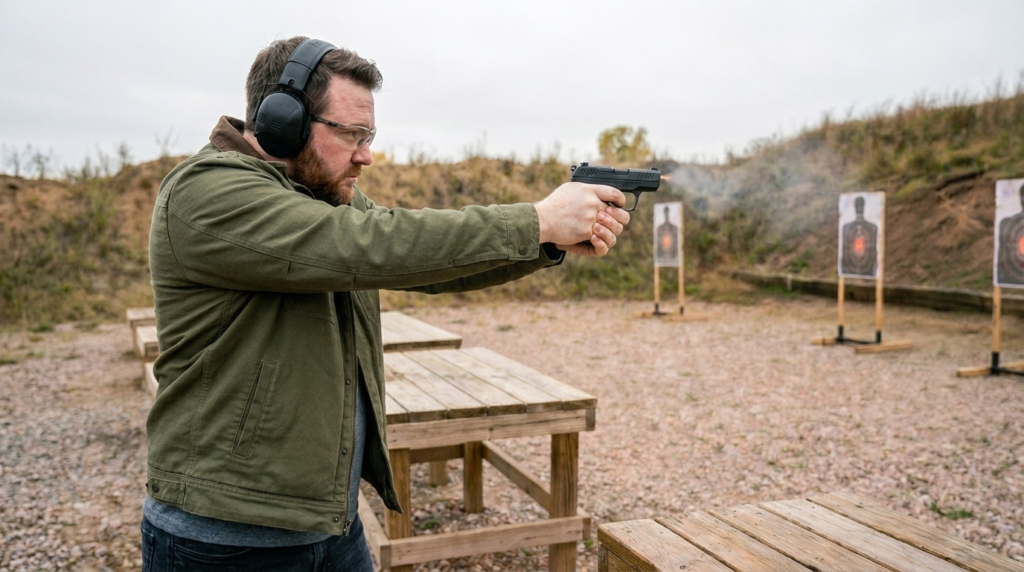
Testing Protocol
Phase 1: Break-In
First 200 rounds were CCI Mini-Mag 40gr, shot across two sessions on mild mornings around 70 degrees. Three failures to eject inside the first 50 rounds, then nothing for the remaining 150. The gun ships fairly dry, so I stripped it after the first session and ran a light coat of oil on the slide rails and the barrel.
Phase 2: Reliability
This is where the P22 shows its character, so I deliberately split the next 600 rounds by velocity rather than by brand. High-velocity loads: CCI Mini-Mag 40gr, CCI Stinger 32gr, Federal Punch 29gr. Standard-velocity and bulk: Federal Champion 36gr bulk, Remington Golden Bullet 36gr bulk, Winchester M-22 40gr.
The high-velocity 300 produced two stoppages, both failures to feed with the Stingers, which are a shorter case and a known edge case in a lot of .22 pistols. That’s a good result.
The bulk-ammo 300 produced twenty-six. Mostly failures to eject, some failures to fully return to battery, spread across all three loads and both magazines. Federal Champion was the worst offender at roughly one stoppage every magazine and a half. Nothing was damaged and nothing needed a tool to clear, but it is not a shooting experience anybody enjoys.
That gap is the whole review in one paragraph. Same gun, same day, same magazines, same shooter. The only variable was the ammunition, and the difference was thirteen to one.
Phase 3: Accuracy
Accuracy testing at 15 yards off a bag, five-shot groups, single action. CCI Mini-Mag averaged 1.8 inches. Federal Punch came in at 2.1. The bulk Federal Champion opened to 3.4, though with that many stoppages the sample is not worth much.
The adjustable rear sight is a genuine advantage at this price and it let me get point of impact centered properly, which several rivals in this bracket simply do not allow. The single-action break at a measured 4 pounds is clean enough that the sights, not the trigger, are the limit.
Ammunition Log
- CCI Mini-Mag 40gr high velocity, 320 rounds
- CCI Stinger 32gr, 80 rounds
- Federal Punch 29gr, 100 rounds
- Federal Champion 36gr bulk, 120 rounds
- Remington Golden Bullet 36gr bulk, 100 rounds
- Winchester M-22 40gr, 80 rounds
Total: 800 rounds, 31 stoppages, 26 of them from bulk standard-velocity. Our .22 LR ammo guide covers what actually runs.
Tracking & Observations
Rimfire is filthy and 800 rounds showed it. Carbon had built up heavily around the breech face and under the extractor, which is where most of the bulk-ammo stoppages were originating by the end. The zinc slide shows light wear on the rails, normal for the material. Nothing is loose, nothing rattles, and the barrel looks unmarked.
What This Means for You
- Ammo choice is not optional: high-velocity 36-40gr runs, cheap bulk standard-velocity does not. Budget for it.
- Cleaning interval: every 300 rounds or so. It degrades noticeably when dirty in a way a Mark IV does not.
- Break-in: expect a handful of stoppages in the first 50 rounds, then it settles.
- Accuracy expectation: about 1.8 inches at 15 yards with good ammunition.
- Magazine safety: it will not fire or dry fire without a magazine seated. Worth knowing before you panic.
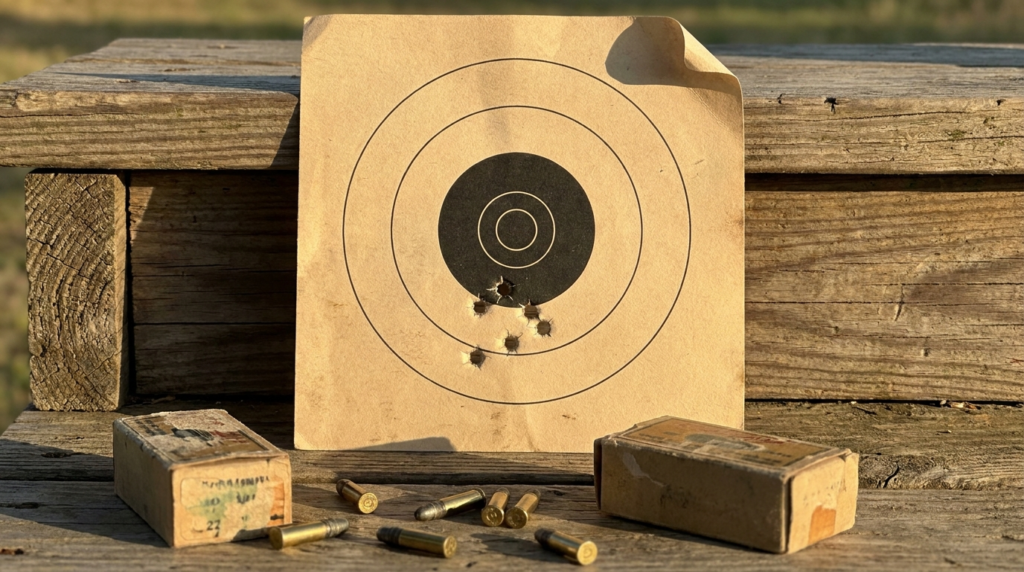
Performance Testing Results
Reliability (7/10)
Judged on high-velocity ammunition alone this is an 8 or a 9. Two stoppages in 300 rounds is fine for a rimfire, and both were Stingers, which plenty of guns dislike.
The score lands at 7 because most people buying a $242 rimfire are buying it to shoot cheaply, and cheap is exactly what it handles worst. A gun that only works on ammunition costing twice as much per round has an asterisk on its running costs, and pretending otherwise would be dishonest.
Accuracy (8/10)
A 1.8 inch average at 15 yards from a 3.42 inch barrel is genuinely good, and better than I expected given the price and the sight radius. The adjustable rear sight matters more than the number does. Being able to zero properly is the difference between a trainer that builds confidence and one that teaches a new shooter they can’t aim.
Ergonomics & Recoil (9/10)
This is the gun’s real achievement. At 480 grams with a 112 mm grip circumference, it fits shooters who physically cannot get a proper firing grip on a Mark IV or a Buck Mark. I’ve handed this pistol to teenagers and to adults with small hands and watched the difference immediately.
Recoil in .22 LR is barely worth discussing, but the low 23 mm bore axis and the deep beavertail mean it sits in the hand naturally. Controls are where a modern shooter expects them. The one ergonomic misstep is the slide-mounted safety, which is stiff out of the box and takes a deliberate thumb to sweep.
Fit, Finish, and Quality Control (7/10)
For $242 it’s tidy. Panel gaps are consistent, the finish is even, and the slide-to-frame fit has no perceptible play. The zinc alloy slide is the honest limitation. It’s the correct engineering call for the weight and the price, and it is also why nobody is going to be shooting a hundred thousand rounds through one of these.
Technical Deep Dive
Why It Cares About Ammunition
A .22 LR pistol is straight blowback. Nothing locks. The only things holding the breech shut are the mass of the slide and the recoil spring, and the cartridge has to generate enough energy to overcome both, cycle fully, and pick up the next round.
The P22’s slide is zinc alloy and light. That’s good for felt handling and bad for margin, because the spring has to be matched fairly tightly to the expected impulse. High-velocity loads sit in that window. SAAMI specifies .22 Long Rifle at a maximum average pressure of 24,000 psi, and the gap between a high-velocity load and cheap bulk is wide enough to sit either side of what this slide needs. Cheap bulk standard-velocity ammunition, which is also the most variable ammunition made, frequently does not. That’s the mechanism behind every forum thread about this pistol.
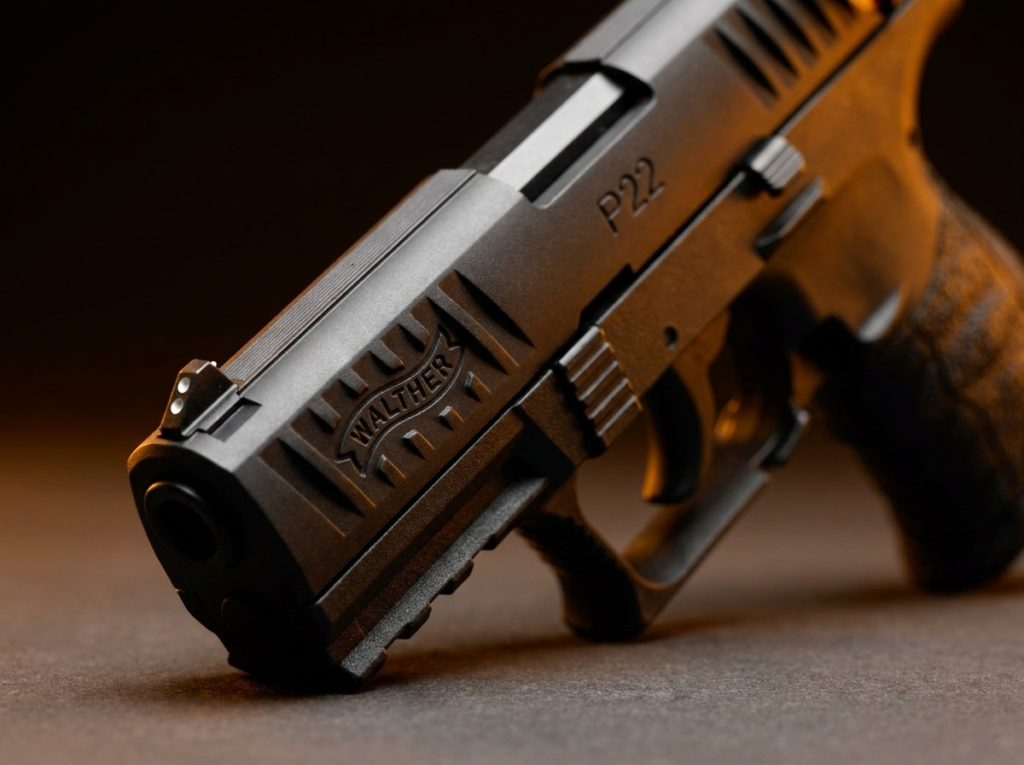
The DA/SA Trigger
Walther publishes the pull weights, which is more than most makers in this bracket do: 4,900 grams double action and 1,800 grams single action, or roughly 10.8 and 4.0 pounds. The double-action pull is long and heavy, the single action is clean.
As a training tool that split is the point. A new shooter learns the difference between a deliberate first shot and a light follow-up on a gun that costs pennies per round to feed, which is the same lesson a DA/SA carry pistol will demand later at considerably greater expense.
Sights, Rail and Backstraps
Three-dot sights with an adjustable rear, an accessory rail under the dust cover, and interchangeable backstraps in the box. None of that is remarkable on a $600 pistol. On a $242 rimfire it’s unusually generous, and the backstraps in particular extend the range of hands the gun suits.
| Component | Specification | Benefit |
| Action | Straight blowback, DA/SA hammer | Manual of arms transfers to a DA/SA carry pistol |
| Slide | Zinc alloy | Keeps weight at 480 g and price at $242; costs cycling margin |
| Grip circumference | 112 mm, interchangeable backstraps | Fits hands most .22 pistols do not |
| Trigger | 4,900 g DA / 1,800 g SA | Teaches the DA-to-SA transition cheaply |
| Rear sight | 3-dot, adjustable | Can actually be zeroed, unlike most rivals at this price |
| Safeties | Hammer block, magazine, firing pin | Sensible for a gun bought to teach with |
P22 Variants
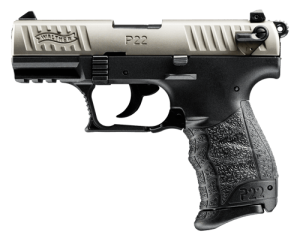
Walther sells the P22Q in several configurations, and the differences that matter are barrel length, threading and finish.
P22Q 3.42 inch (standard) $242
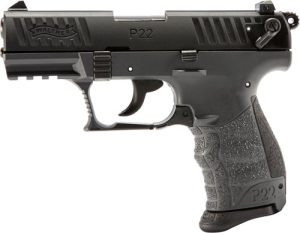
The gun tested here and the one most people should buy. Standard 87 mm barrel, adjustable rear sight, 10 rounds. Black is cheapest; nickel, silver and tungsten gray cost a little more for the same mechanism.
P22Q Threaded / Military $300
Same pistol with a threaded muzzle for a suppressor or a compensator. Worth the premium only if a can is genuinely in your plans, since .22 is one of the cheapest and most pleasant things to suppress.
P22 Target 5 inch $260
Longer barrel and a longer sight radius for bench and plinking work. Better on paper than the 3.42 inch gun, though it gives up the compactness that is the standard model’s main argument.
You’ll also see P22 CA models. Those are California-compliant versions with a 10-round limit and roster-legal features, mechanically the same gun.
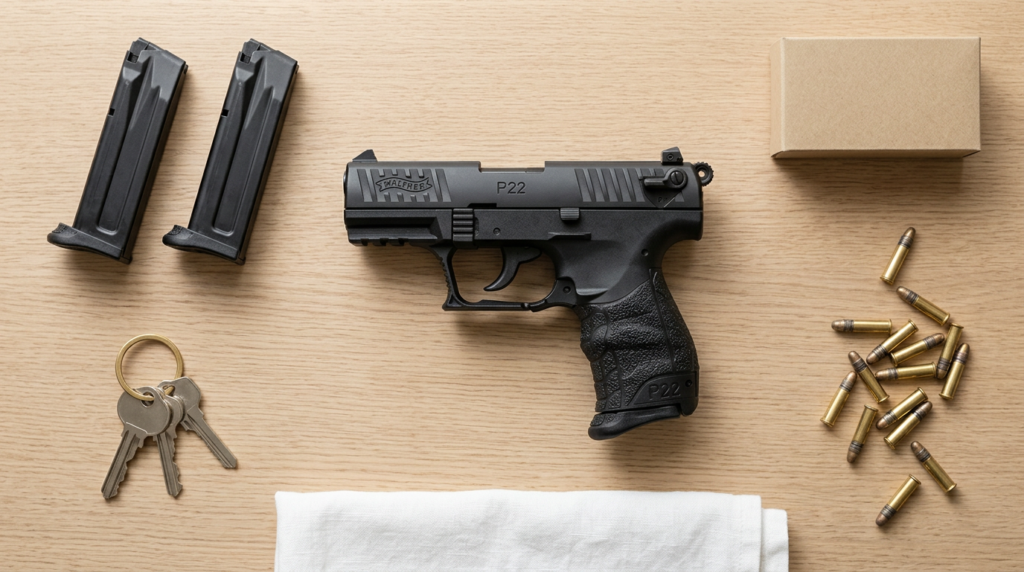
Upgrades Worth Making
| Upgrade Category | Recommended Component | Why It Matters | Cost Estimate |
| Ammunition | CCI Mini-Mag 40gr, bought in bulk | The single biggest reliability upgrade available to this pistol | $11 – $14 per 100 |
| Magazines | Factory Walther 10-round spares | Two in the box is not enough for a range day | $35 – $45 each |
| Cleaning | Bore brush and a dedicated rimfire solvent | Rimfire fouls fast and this gun notices | $15 – $30 |
| Grip | The spare backstraps already in the box | Free, and most owners never try the other one | $0 |
| Optic | Skip it | The adjustable irons are good and the slide is not cut for a dot | – |
Common Problems & Solutions
- Failures to eject on bulk ammunition: the defining P22 complaint. Switch to high-velocity 36-40gr loads such as CCI Mini-Mag and the problem largely disappears. This is a design characteristic, not a fault to send back.
- Stoppages increasing as the session goes on: carbon under the extractor. Clean the breech face and extractor every 300 rounds.
- Will not dry fire: the magazine safety is doing its job. Insert an empty magazine.
- Stiff slide-mounted safety: normal when new and it eases with use. Work it a few hundred times while watching television.
- Slide bite or a high grip feeling cramped: swap to the larger backstrap that came in the box before concluding the gun is too small.
Who Should NOT Buy This Gun
- Bulk-ammo plinkers: if the appeal of .22 is shooting 500 rounds for the price of a box of 9mm, this is the wrong pistol. A Taurus TX22 handles cheap ammunition far better and holds 16 rounds.
- Competition and bullseye shooters: the sight radius is short and the slide is light. A Ruger Mark IV or a Browning Buck Mark is the serious answer, and our Mark IV review explains why.
- Glock owners buying a trainer: the Glock 44 replicates your carry gun’s manual of arms exactly. That is worth the extra $120 if you carry a Glock.
- Anyone wanting a red dot: the slide is not cut for an optic and there is no factory optics-ready version of this pistol.
- High-volume shooters: the zinc slide is not built for six-figure round counts. If you shoot rimfire weekly and hard, buy steel.
Final Verdict
The Walther P22 is a genuinely good idea executed to a price. It’s the right size and the right shape for the people who most need a rimfire pistol, it costs $242, and it comes with adjustable sights and spare backstraps that guns twice the price omit. As a first pistol or a teaching pistol it is very hard to argue with.
The ammunition sensitivity is real and you should plan around it rather than hope. Thirteen times the stoppage rate on bulk ammunition compared with high-velocity is not a rounding error, and anybody telling you it runs on anything has not counted. Budget for Mini-Mags and the gun is a pleasure. Feed it whatever is cheapest and you’ll sell it inside a year.
Know what you’re buying and it’s excellent value. That’s a narrower recommendation than the sales figures suggest, but it’s an honest one.
Final Score: 7.8/10 – The best-shaped trainer in the class, as long as you feed it properly.
FAQ: Walther P22
Why is the Walther P22 so picky about ammunition?
Because it is a straight blowback pistol with a light zinc alloy slide. Nothing locks the breech shut, so the cartridge itself has to generate enough energy to cycle the slide fully and strip the next round. High-velocity loads sit inside that window; cheap bulk standard-velocity ammunition, which is also the most variable ammunition made, frequently does not. In our testing bulk ammo produced 13 times the stoppage rate of high-velocity.
What ammo works best in the Walther P22?
High-velocity 36 to 40 grain loads. CCI Mini-Mag 40gr was flawless for us and is the standard recommendation. Federal Punch ran clean too. Avoid cheap bulk standard-velocity like Federal Champion and Remington Golden Bullet, which caused most of our 26 bulk-ammo stoppages. Budget roughly $11 to $14 per hundred rather than bulk-pack prices.
How much does a Walther P22 cost?
Street pricing starts around $242 for the standard black 3.42-inch model. Nickel, silver and tungsten gray finishes run a little more, the threaded-barrel version around $300, and the 5-inch Target around $260. Check the live pricing above, since rimfire pistol stock and pricing both move quickly.
Is the Walther P22 reliable?
It depends entirely on what you feed it. Across 800 rounds we recorded 2 stoppages in 300 high-velocity rounds and 26 in 300 bulk standard-velocity rounds. Same gun, same day, same magazines. On the right ammunition it is reliable; on the wrong ammunition it is genuinely frustrating. Clean the breech face and extractor every 300 rounds, since fouling makes it worse.
Walther P22 vs Taurus TX22, which should I buy?
The TX22 is the better shooter and the P22 is the better fit for small hands. The Taurus holds 16 rounds to the Walther's 10, has a noticeably better trigger, and handles cheap bulk ammunition far better, starting around $265. Buy the P22 if you need the smaller grip, want a DA/SA hammer gun as a trainer, or the lower price matters.
Why won't my Walther P22 dry fire?
The magazine safety is working as designed. The P22 will not fire or dry fire without a magazine seated in the gun. Insert an empty magazine and it will function normally. This is deliberate on a pistol built largely to teach new shooters, and it is not a fault.
Is the Walther P22 slide really zinc?
Yes. The slide is zinc alloy rather than steel, which is how Walther hits both the 480 gram weight and the sub-$250 price. It is the correct engineering call for what this pistol is, but it costs cycling margin and it means the P22 is not built for six-figure round counts. High-volume rimfire shooters should buy a steel pistol like the Ruger Mark IV.
Can you put a red dot on a Walther P22?
Not easily. The slide is not cut for an optic and there is no factory optics-ready version. The good news is that the adjustable three-dot rear sight is genuinely useful and lets you zero the pistol properly, which several rivals at this price do not allow. There is an accessory rail under the dust cover for a light or laser.
4,715+ Gun & Ammo Deals
Updated daily from 200+ top retailers. Filter by category, caliber, action type, and price.
Related Guides