

Last updated September 2026
Some of the links below are affiliate links, meaning at no additional cost to you, we may earn a commission if you click through and make a purchase.
- Treat every gun as loaded
- Point the muzzle in a safe direction
- Keep your finger off the trigger until you’re ready to shoot
- Know your target and what’s beyond
The Walther P38 is the pistol that replaced the Luger, and the one every modern service pistol quietly borrowed from. It was the first locked-breech military pistol with a double-action trigger, it had a decocker and a loaded-chamber indicator in 1938, and its falling locking block lives on in the Beretta 92. About 1.2 million were made for the German army during World War II, and Walther kept building it for the West German army for decades after.
That long life is exactly what makes it confusing to buy. A “P38” on a dealer’s table can be a matching 1941 Walther, a late-war Spreewerk, a French-assembled “gray ghost,” a Soviet-refinished capture gun or an alloy-framed P1 from 1978, and they’re worth very different money. We sorted 277 completed sales by maker and condition, decoded the markings, settled the +P question as far as the evidence allows, and took a wartime Walther and a P1 to the range side by side.
Quick take
A wartime P38 is still one of the most affordable ways to own a genuine WWII German service pistol, and a postwar P1 is one of the cheapest classic 9mm pistols you can shoot regularly. Buy the wartime gun for history, the hex-bolt P1 for range time, and feed both standard-pressure 9mm only.
- Typical price (2024 to 2026 sales): about $1,170 median for a WWII-made gun, about $1,340 at 90%+ finish, about $545 for a P1 and $615 for a postwar P38
- Caliber: 9mm Luger, 8+1 rounds
- Made: 1939 to 1945 in wartime; postwar P38 and P1 from 1957 until the early 2000s. Walther doesn’t make it today
- Legal: every wartime gun and every ex-military or police P1 is on ATF’s curio and relic list
How we tested: Every pick here is ranked against our testing methodology. Minimum round counts, accuracy and reliability protocols, the failures that disqualify a gun.
Walther P38 Pros and Cons
Pros
- Genuine WWII pistol for Luger-beating money
- Double action, decocker, loaded-chamber indicator
- Accurate, with mild 9mm recoil
- Hex-bolt P1s make cheap range guns
- All wartime guns are curios and relics
- Common 9mm ammo, no special orders
Cons
- Standard-pressure ammo only, no +P
- Heavy double-action first pull
- Slide cracks and broken firing pins happen
- Refinished and force-matched guns everywhere
- Big for carry, magazines add up
- Alloy P1 frames wear with heavy use
Walther P38 at a Glance
| Spec | Walther P38 |
|---|---|
| Action | Short recoil, locked breech with a falling locking block; double action / single action |
| Caliber | 9mm Luger (9x19mm Parabellum); a few in 7.65mm Parabellum and .22 LR |
| Capacity | 8+1, single-stack magazine with a heel release |
| Barrel | 125 mm (4.9 in) |
| Weight | Wartime steel frame about 1.9 to 2.1 lb empty; postwar alloy P1 about 27 to 28 oz |
| Overall length | 216 mm (8.5 in) |
| Controls | Slide-mounted safety and decocker on the left; loaded-chamber indicator pin at the rear of the slide |
| Made | 1939 to 1945 by Walther, Mauser and Spreewerk; postwar by Walther in Ulm from 1957 |
| Legal | Curio or relic (all wartime and government-issue guns); never an antique |
Table of Contents
What a Walther P38 Is Actually Like to Shoot: Myth vs. Truth
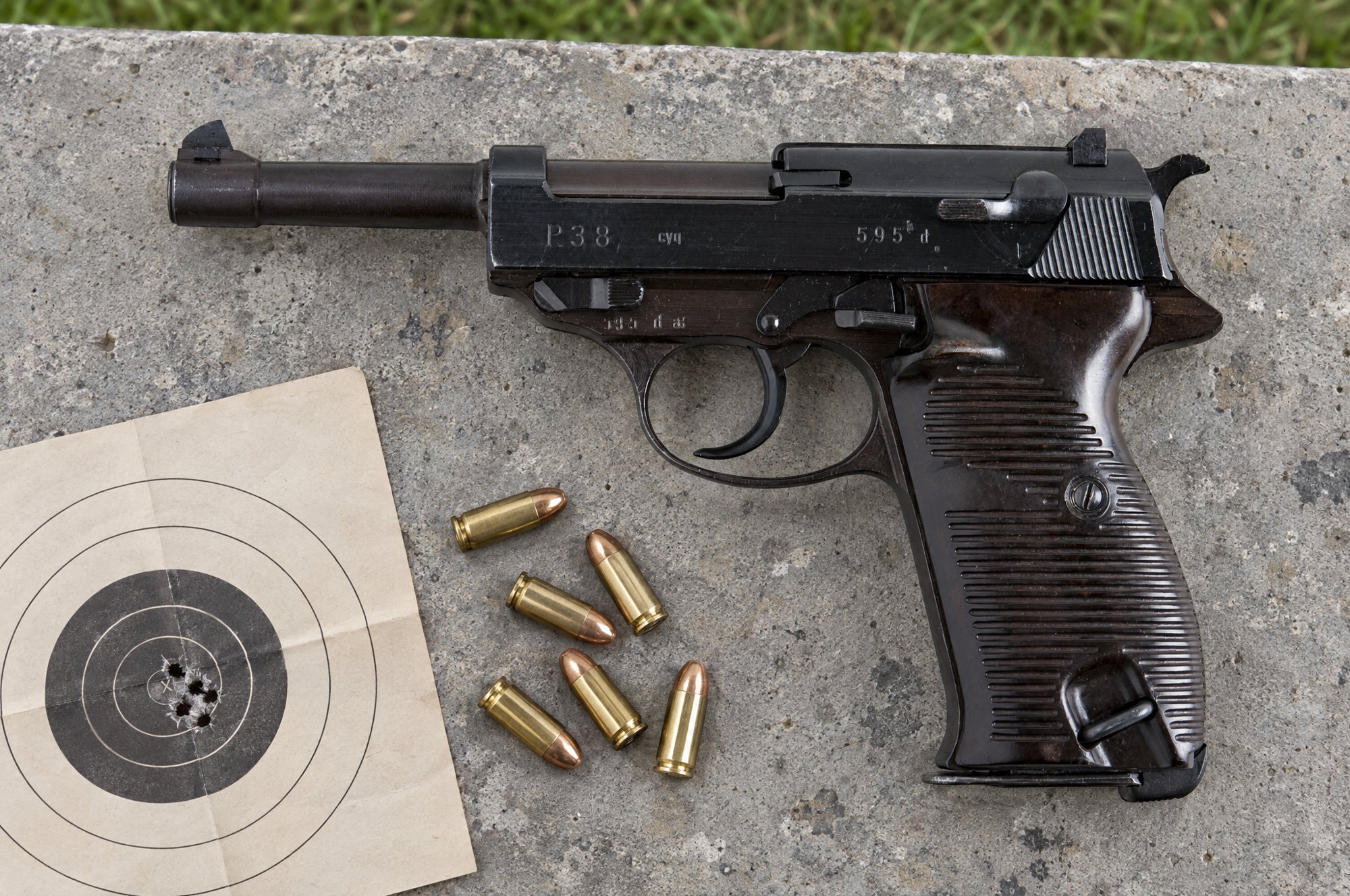
We shot two guns for this guide. The first is a 1943 Walther “ac 43” with matching slide, frame and barrel, a replacement locking block and about 80% of its original blue. The second is a 1978 P1, an ex-Bundeswehr alloy-frame gun with the hex bolt in the frame and the thicker slide. Before either fired a shot we checked the slide bridge for cracks, pulled the firing pins, and fitted fresh recoil springs. Over two sessions we fired 300 rounds, 150 through each gun: Fiocchi 124 grain FMJ, Remington UMC 115 grain FMJ and Federal American Eagle 124 grain FMJ. All standard pressure.
The P38 is easy to like. It points well, the grip fills the hand more than a Luger’s, and the recoil of standard 9mm in a 2-pound steel pistol is soft. The first shot is double action, and that pull is long and heavy: our wartime gun averaged 10 lb 9 oz on a Lyman gauge, the P1 11 lb 2 oz. After that, single action broke at 5 lb 3 oz on the ac 43 and 4 lb 12 oz on the P1, with a fair amount of take-up. Empties fly out to the left and up, and a right-handed shooter will get the occasional one on the hat brim.
Rested at 25 yards, the ac 43 averaged 2.7-inch five-shot groups with Fiocchi 124, and the P1 averaged 2.4 inches. Both printed high with a center hold, about 4 inches at 25 yards on the wartime gun, so a six o’clock hold is the fix. Offhand at 10 yards, ragged one-hole groups came easily. Through our chronograph, the Fiocchi 124 averaged 1,118 fps from the 4.9-inch barrel and the Remington 115 grain 1,167 fps.
We had one stoppage in 300 rounds, a stovepipe in the wartime gun with an old magazine that had a tired spring. With a newer magazine it ran clean for the rest of the session, and the P1 didn’t stop once. The decocker on both guns dropped the hammer safely every time on an empty chamber, which is the first thing we’d test on any P38 you’re thinking of buying.
| The myth | What we found | Evidence |
|---|---|---|
| “The P38 is unreliable.” | Not when it’s sound. Failures trace to tired springs, old magazines, worn firing pins and damaged guns. | One stoppage in our 300 rounds, from an old magazine. Published range sessions split evenly, and the failures come with a worn part attached |
| “+P and NATO ammo are fine in it.” | Don’t. Walther’s own postwar manual specifies only 9mm Parabellum, and slide cracks are the P38’s known weak point. | Five collector and magazine sources say standard pressure only; two say +P is fine with accelerated wear |
| “The alloy P1 frame always cracks.” | Real, but long-term. Walther reinforced the frame with a hex bolt in 1975. A hex-bolt P1 is the one to shoot a lot. | Walther’s own design changes, plus owner reports on high-round-count guns |
| “Shooting a wartime gun kills the value.” | Firing doesn’t. Breaking a numbered part does, because a replacement never matches. | Every range test we read used a wartime gun; the price gap is between matching and mismatched guns |
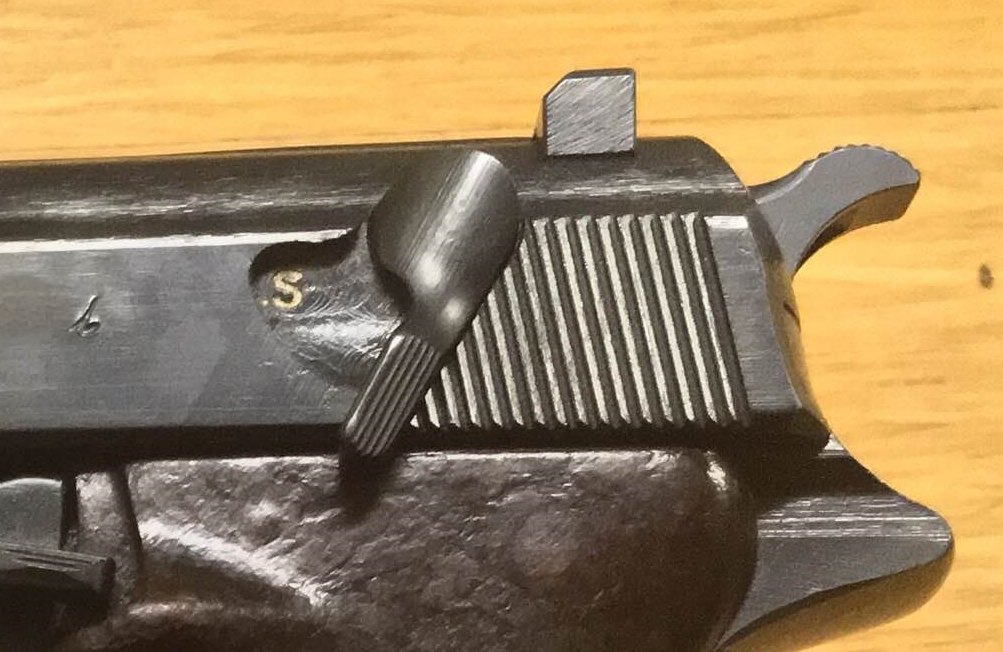
| “The P38K was a Gestapo gun.” | No. The factory P38K was a 1970s and early 1980s gun, about 2,495 made. Any “WWII P38K” is a cut-down. | Forgotten Weapons and American Rifleman |
| “A P1 is just a lighter P38.” | Mechanically, yes. For value, no: the alloy frame, plastic grips and postwar markings make it a different collectible. | Our price data below |
Who the Walther P38 Is For (and Who Won’t Enjoy It)
Buy a P38 if you are
- A WWII collector on a budget. A matching wartime P38 costs a fraction of a comparable Luger and is just as much a part of the story.
- A shooter who wants a classic 9mm. A hex-bolt P1 is one of the cheapest vintage pistols you can put real rounds through.
- A C&R license holder. Every wartime gun and every government-issue P1 is on the list, so they ship to your door.
- Someone who likes design history. The decocker, double-action first shot and falling locking block all started here.
- A fan of Lupin III or The Man from U.N.C.L.E. This is the gun.
Skip the P38 if you are
- Looking for a carry gun. It’s big, heavy and eight rounds deep. A modern DA/SA 9mm does the job better.
- Planning to shoot +P defense loads. Buy a Beretta 92FS, the P38’s rated-for-+P descendant.
- Buying a “rare variant” from a story. Fake P38Ks, force-matched guns and restamped slides are common. Buy the gun, not the tale.
- Wanting a mint wartime gun cheap. High-condition matching guns cost real money, and most cheap ones are refinished or mismatched.
What a Walther P38 Costs in 2026
These are sale prices, not asking prices. We tracked 277 completed sales from January 2024 to September 2026: 141 Morphy Auctions lots, which include the buyer’s premium, and 136 GunBroker sales. Zero-series guns, engraved guns and guns sold with capture papers are left out so they don’t skew the numbers. Grade is unstated on many GunBroker sales, so read the condition figures as a guide, not a price list.
| Variant | Median sale | Range seen | Sales tracked |
|---|---|---|---|
| Walther “ac” (wartime) | $1,200 | $554 to $4,800 | 75 |
| Mauser “byf” and svw45 (wartime) | $1,230 | $676 to $3,690 | 40 |
| Spreewerk “cyq” (wartime) | $1,058 | $615 to $1,599 | 30 |
| French svw45 and svw46 | $1,107 | $523 to $1,476 | 10 |
| All WWII-made guns | $1,168 | $554 to $4,800 | 156 |
| Postwar P38 | $615 | $400 to $1,500 | 24 |
| P1 | $545 | $301 to $1,107 | 47 |
| P38K | $1,999 | $995 to $2,675 | 17 |
| WWII-made guns by condition | Median sale | Sales tracked |
|---|---|---|
| Refinished, mismatched or under 70% finish | $984 | 23 |
| 70% to 89% original finish | $1,184 | 12 |
| 90%+ original finish | $1,336 | 42 |
Two things surprised us. Condition moves the price less than on most collector guns, about $350 between a shooter and a 90% gun at the median, and a holster added nothing we could measure on wartime guns. So pay for the gun, not the leather. Spreewerk guns are the cheapest wartime P38s, and P1s are the cheapest P38 of all, at well under half the price of a wartime gun.
Asking prices run above what these guns sell for. On the day we checked, dealer asking prices for WWII-made P38s had a $1,599 median, about 37% over the $1,168 median sale, and P1s were listed at a median $798 against a $545 median sale. For a wider view, TrueGunValue’s 650 used P38 sales average $1,018.43, up $149.53 over 12 months, and its 260 used P1 sales average $632.11.
These are the P38s and P1s our dealers have listed right now. Most are single used guns, so they come and go.
Guns.com lists more P38s and P1s than any other dealer we track, with close-up photos of each gun. See every Walther P38 on Guns.com
Compare other guns in the USA Gun Shop price checker, and see our guide to buying vintage guns online for auction houses and collector dealers.
Which Walther P38 to Buy: The Variants
The P38’s variants split into two worlds. Wartime guns, made from 1939 to 1945 by three factories, are the collector pieces. Postwar guns, made by Walther in Ulm from 1957, are the shooters. Inside each world, the maker code and the condition decide the price.
| Variant | Years | How to spot it | Who wants it |
|---|---|---|---|
| Walther 0-series and 480 | 1939 to 1940 | Walther banner or the code 480 on the slide, zero-prefixed serials | Advanced collectors |
| Walther “ac” | 1940 to 1945 | “ac” plus a two-digit year (ac40 to ac45), eagle/359 acceptance marks | The classic wartime buy |
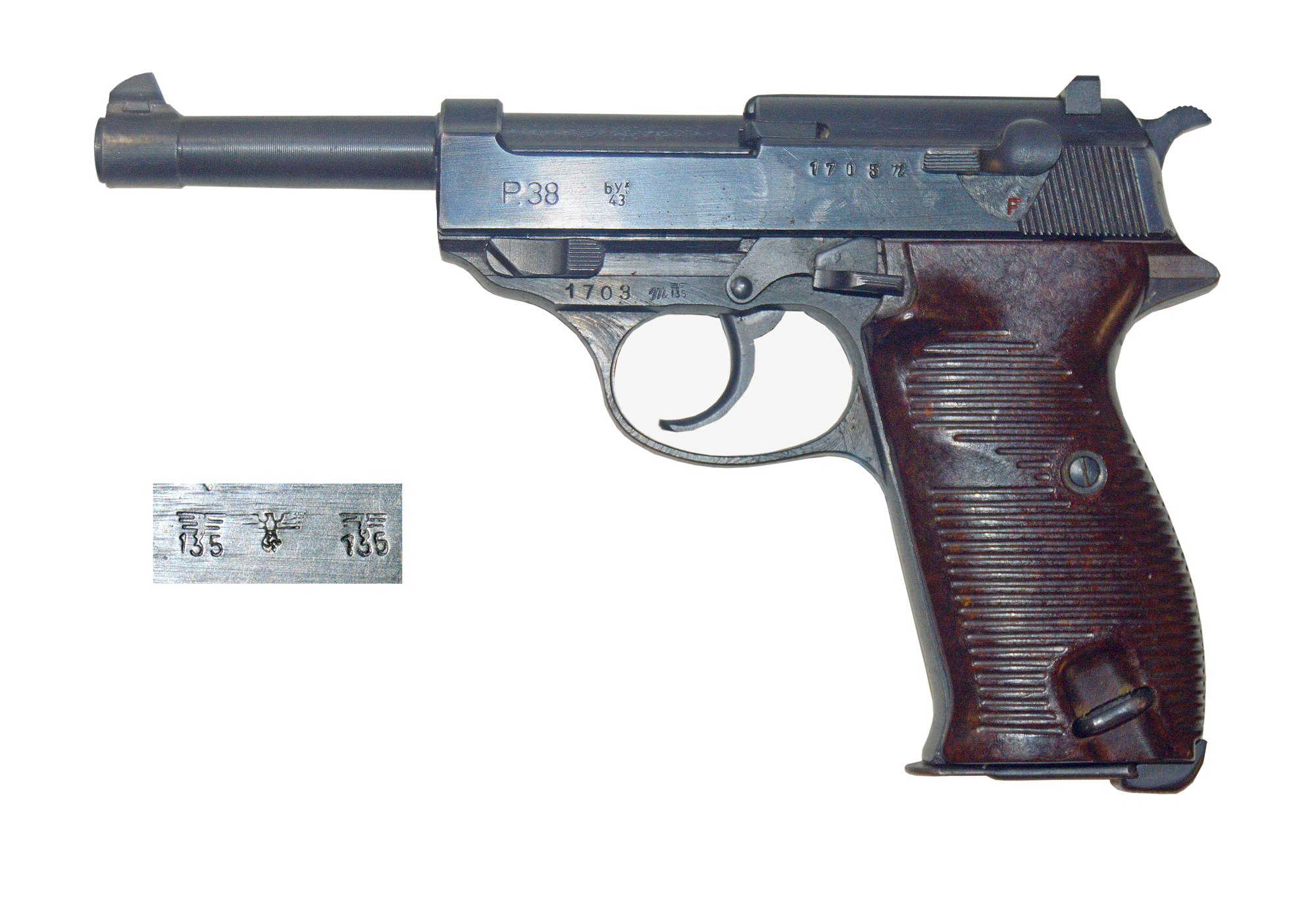
| Mauser “byf” and “svw” | Late 1942 to 1945 | “byf” plus year, then “svw45”; eagle/135 marks | Collectors, often priced alongside Walther guns |
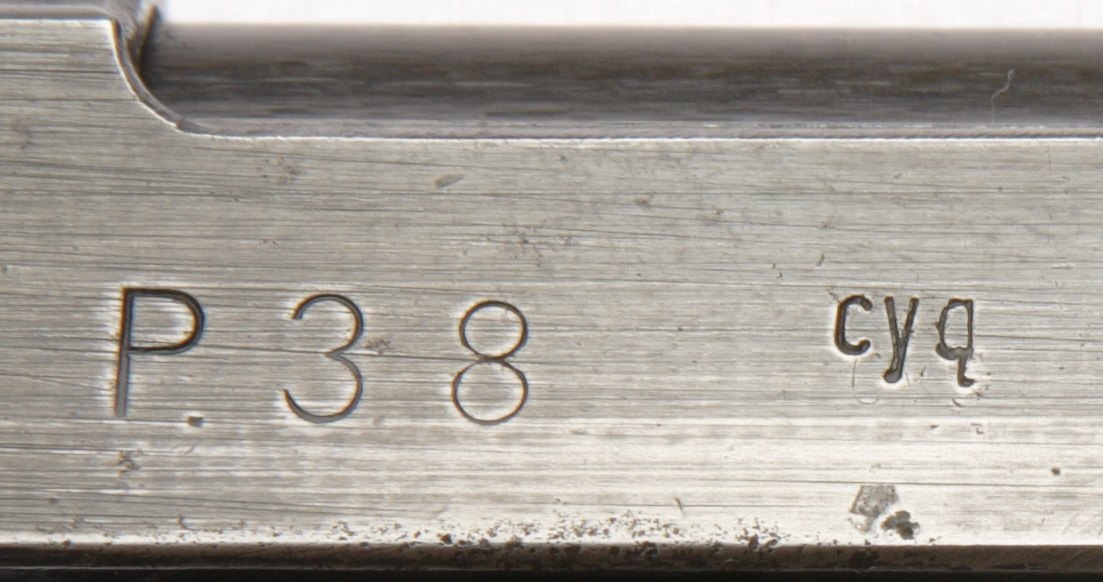
| Spreewerk “cyq” | 1943 to 1945 | “cyq” with no date; rougher finish; eagle/88 marks; “cvq” from a broken die | Budget wartime buyers |
| French “gray ghost” | 1945 to 1946 | “svw45” or “svw46”, star proofs, gray phosphate finish, sheet-metal grips | Collectors of oddities |
| Soviet capture | Postwar refurbishment | Dipped refinish, often an electropencil “X” or mismatched parts forced to match | Shooters |
| Postwar P38 and P1 | 1957 to early 2000s | Alloy frame, black plastic grips, Ulm markings; P1 on government guns from 1963 | Shooters; hex-bolt guns from 1975 are best |
| P4 and P38K | 1970s to 1981 | P4: shorter barrel, decocker only. P38K: 2.8 in barrel | Collectors; P38Ks are faked |
Walther “ac” Guns (1940 to 1945)
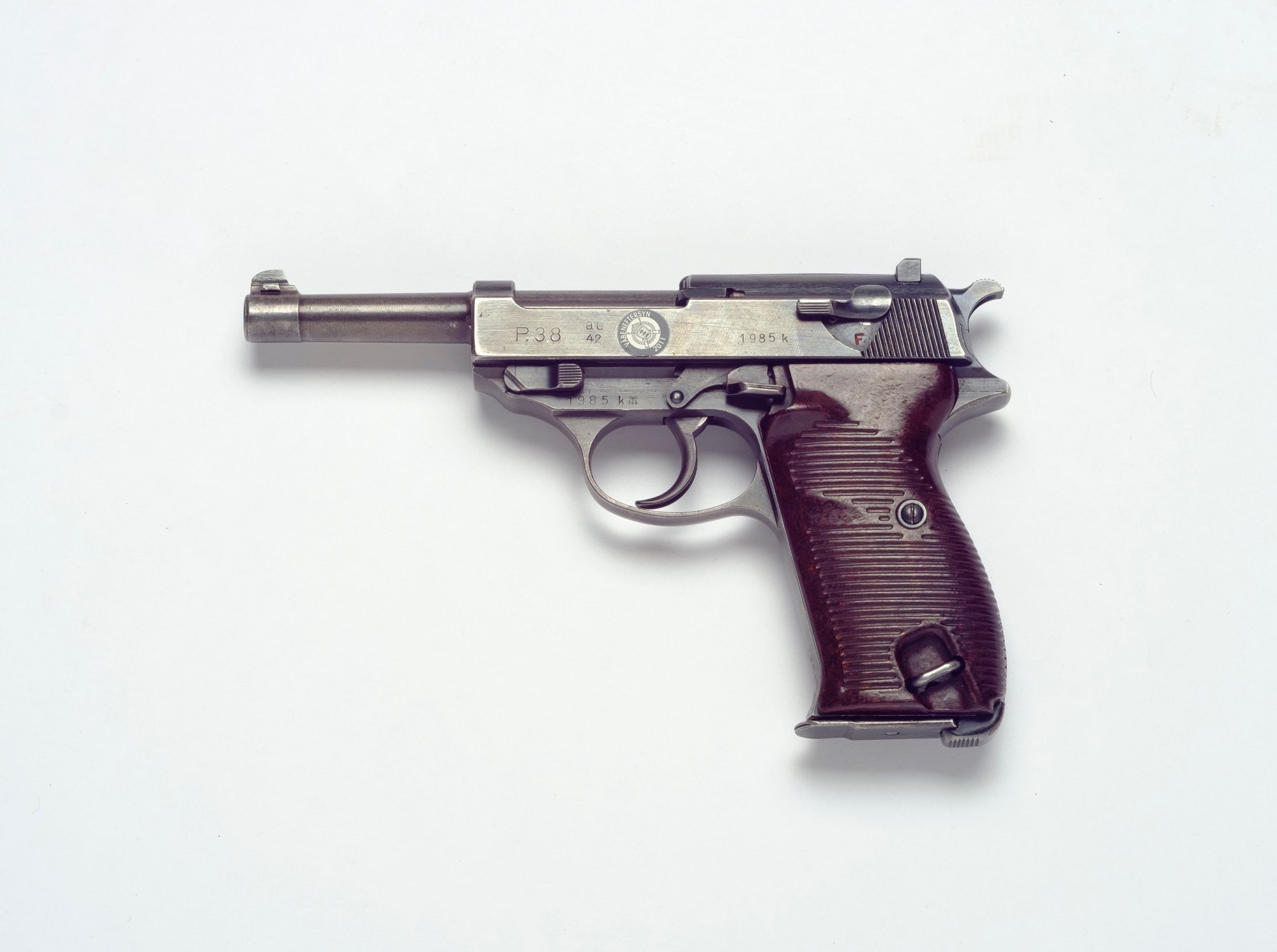
Walther’s own guns carry the code “ac” and a year on the slide. The earliest wartime guns used the Walther banner, then the code 480 for a few months in 1940, before “ac” arrived that August. Through mid-1943 the code and date sit stacked on two lines, then on a single line. Walther’s acceptance mark is an eagle over 359. Walther made roughly half of all wartime P38s, so ac guns are the most common, and matching early ones are the most prized.
Mauser “byf” and “svw” Guns (1942 to 1945)
Mauser started P38 production in late 1942 under the code “byf” with a two-digit year, and switched to “svw” in 1945. Mauser guns carry eagle/135 acceptance marks, later “WaA135.” Matching byf guns sell in the same range as Walther guns: a $1,230 median across 40 Mauser sales in our data, against $1,200 for Walther.
Spreewerk “cyq” Guns (1943 to 1945)
Spreewerk, the third maker, built P38s at its plant in Grottau, now Hradek nad Nisou in the Czech Republic. Its guns carry “cyq” with no date, and about 31,400 read “cvq” because of a broken stamp. Spreewerk guns are the roughest finished of the three, with tool marks you won’t see on an early Walther, and collectors report more broken firing pins on late ones. They’re the cheapest wartime P38s, and a sound one is a fine shooter once a gunsmith has looked it over.
French “Gray Ghosts” (1945 to 1946)
When the war ended, the Mauser plant at Oberndorf fell in the French zone, and the French kept building P38s for their own forces. About 38,780 came off the line by summer 1946, marked “svw45” or “svw46” with French star proofs, often next to leftover German eagles. Their gray phosphate finish gave them the collector nickname “gray ghost.” They’re interesting, undervalued guns, as long as you know what you’re buying.
Soviet Capture Guns
The Red Army captured P38s by the tens of thousands, refinished them and stored them. These “dipped” guns have a thick, often shiny refinish, and parts from different guns were sometimes put together and restamped. They’re shooters, priced as shooters, and the ones that came in through import companies carry import marks. Never pay matching-gun money for one.
Postwar P38 and P1 (1957 to the early 2000s)
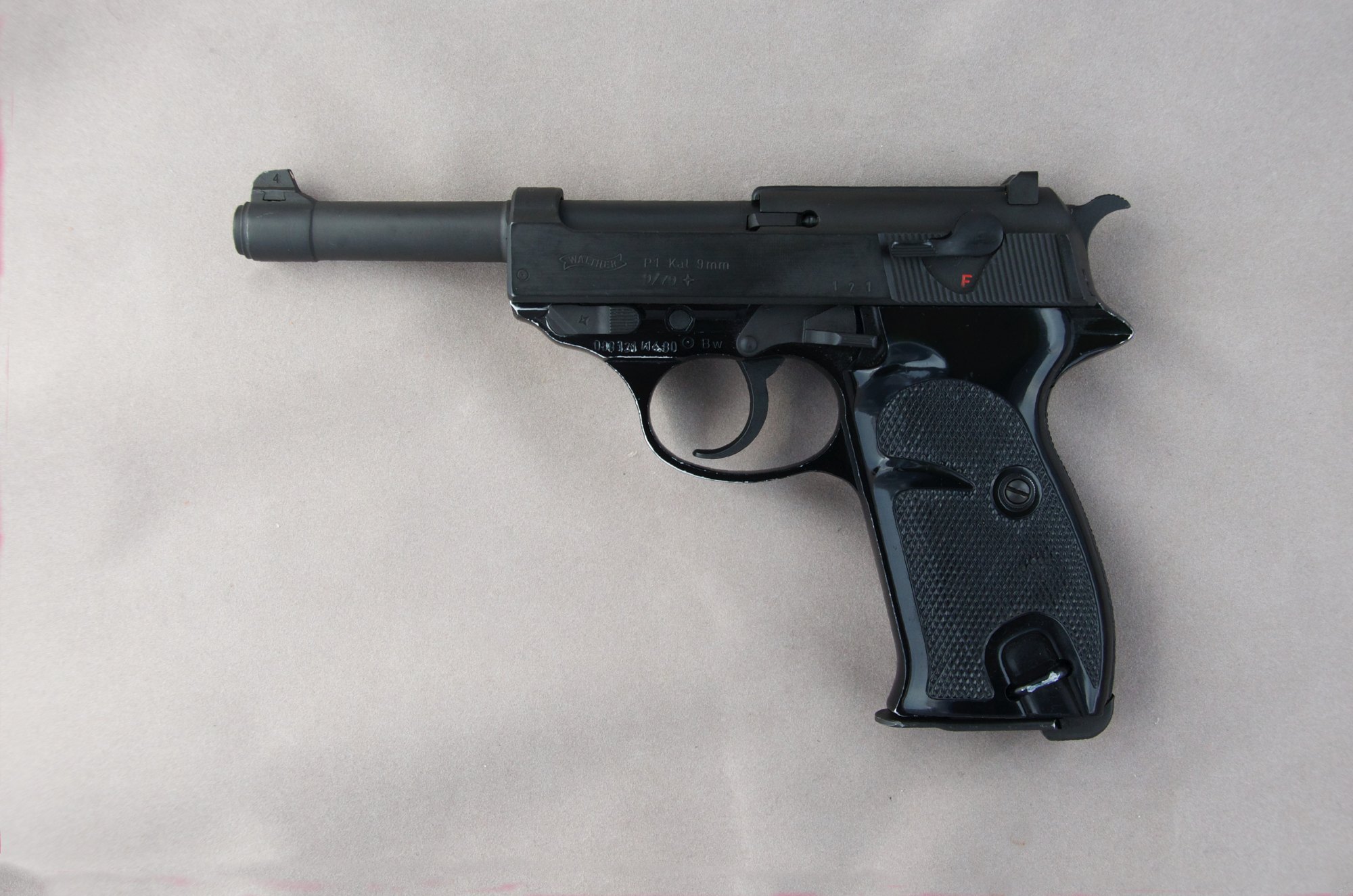
West Germany’s new army took the P38 back in 1956, and Walther delivered the first new guns from Ulm in June 1957. Postwar guns have an aluminum-alloy frame and black plastic grips. From October 1963 the government version was called the P1, while commercial guns kept the P38 name. Walther strengthened the slide in 1968, and from 1975 added a hex-head bolt through the frame above the trigger to reinforce the locking-block area, with a thicker slide to match. About 600,000 postwar guns were made, and the Bundeswehr retired its P1s in 2004.
For a shooter, the hex-bolt P1 is the buy. It’s the same design as the wartime gun, it’s lighter, it’s cheap, and its frame is the reinforced one. West Berlin’s police guns, finished and marked by Manurhin in France, are a collectible sub-variant without the hex bolt.
P4 and P38K
The P4 was a late-1970s update with a shorter 110 mm barrel and a decocker-only lever instead of the old safety, sold mainly to German and South African police. The P38K was a factory short-barreled version, with a 2.8-inch barrel, a P1 frame and a P4 slide, made in the 1970s until 1981, about 2,495 in all. Most “P38Ks” offered today are cut-down P38s, so buy one only with provenance you can check.
Walther P38 Condition Guide
Collectors grade a wartime P38 on original finish and matching numbers. Shooters should grade it on the slide, locking block, firing pin and decocker. The two gradings often disagree, and the matching, high-finish gun isn’t always the best one to shoot.
| Grade | What you see | What it does to price |
|---|---|---|
| 90%+ original, matching | Deep original blue or phosphate, sharp slide codes and acceptance marks, numbers matching on slide, frame, barrel and locking block | Top of the market: $1,336 median for WWII guns in our data |
| 70% to 89% original | Holster wear on the slide edges and muzzle, thinning finish on the frame, markings still crisp | About $1,184 median |
| Refinished, reworked or mismatched | Soft markings, too-shiny blue, a Soviet dip finish, or parts with other numbers | About $984 median, the cheapest way into a wartime gun |
| Postwar P38 or P1 | Alloy frame, black plastic grips, Ulm markings; check for the hex bolt | $545 to $615 medians |
Wartime finish changed as the war went on. Early Walther guns have a deep, polished blue. By 1944 and 1945, and on most Spreewerk guns, the finish is thinner and the machining rougher, so rough tool marks on a late gun are normal, not a sign of a refinish. A late gun with a mirror polish, on the other hand, has almost certainly been reworked.
Markings, Codes and Matching Numbers
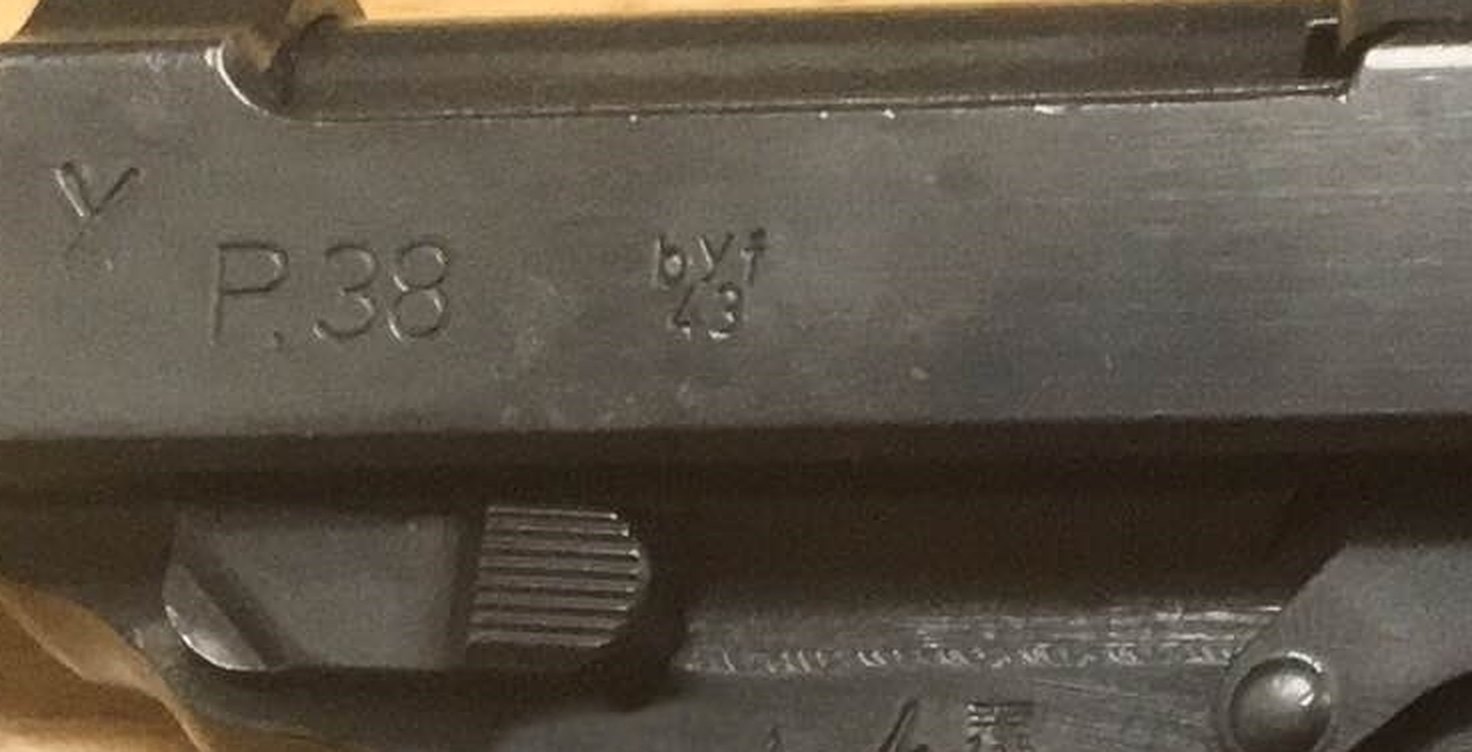
Everything you need to identify a wartime P38 is stamped on the left side of the slide: the model “P.38”, the maker code and, on Walther and Mauser guns, a two-digit year. The serial number is on the slide, the frame and the barrel, and the last three digits with the suffix letter appear on the locking block. Serials ran in blocks of 10,000, from 1 to 10000, then started again with the next suffix letter, so “4471e” is the 4,471st gun in the “e” block. The letter doesn’t stand for a month.
| Marking | Where | What it tells you |
|---|---|---|
| 480 | Slide | Walther, 1940 only |
| ac + year (ac40 to ac45) | Slide | Walther, Zella-Mehlis |
| byf + year, svw45 | Slide | Mauser, Oberndorf |
| cyq (or cvq) | Slide | Spreewerk, no date |
| Eagle over 359 | Slide, frame, barrel | Walther acceptance |
| Eagle over 135, later WaA135 | Slide, frame, barrel | Mauser acceptance |
| Eagle over 88 | Slide, frame, barrel | Spreewerk acceptance |
| Five-pointed star | Slide, barrel, locking block | French postwar proof |
| P1 or P38, Ulm, date code | Slide and frame | Postwar Walther |
| Importer stamp | Frame or slide | Imported after 1968; normal on surplus guns |
A matching wartime gun has the same serial on slide, frame and barrel, and the same last three digits and suffix on the locking block. Magazines are a separate question: many wartime magazines carry only maker and acceptance codes, so a magazine numbered to a late gun deserves a close look.The matching premium is smaller than on most collector pistols: in our data, WWII guns described as matching sold for a median $1,230, against $1,100 for guns whose listings didn’t say.
Fakes, Refinishes and Force-Matched Guns
- Force-matched guns. Mismatched parts with the numbers ground off and restamped to match. Look for stamps in the wrong font, the wrong depth or the wrong place, and a flat spot where the old number was.
- Refinished guns sold as original. Soft or blurred markings, rounded edges, a mirror polish on a late-war gun and a too-even finish all point to a reblue.
- Soviet capture guns passed off as bring-backs. The thick dipped finish is hard to hide. A bring-back story needs paperwork.
- Fake P38Ks. Cut-down P38s and P1s sold as the rare factory short gun, or as a wartime “Gestapo” pistol.
- Reproduction grips and holsters. Good reproduction wartime grips and holsters exist. Nothing wrong with them, but they shouldn’t be priced as original.
- Postwar parts on wartime guns. An alloy frame, a postwar slide or plastic P1 grips on a gun sold as wartime.
Walther P38 Pre-Purchase Inspection Checklist
Here’s the check we run on every P38 and P1 before we pay, with the gun unloaded and pointed in a safe direction:
- Lock the slide back and confirm the chamber and magazine are empty.
- Check the slide for cracks, especially at the bridge ahead of the ejection port. A cracked slide means don’t shoot it.
- Compare the serial on the slide, frame and barrel, and the last three digits and suffix on the locking block.
- Look at the locking block for cracks or battered edges.
- On a P1, look for the hex bolt above the trigger and check the alloy frame around the locking block for cracks or wear.
- With the chamber empty, cock the hammer and lower the safety lever. The hammer should fall without firing the pin. Do it several times.
- Check that the loaded-chamber indicator pin moves freely and doesn’t stick out when the chamber is empty.
- Make sure the slide cover over the firing pin is tight and clipped in place.
- Pull the trigger in double action and single action and feel for grit, dragging or a hammer that won’t hold.
- Look down the bore with a light, and check the grips for cracks. Wartime Bakelite grips are brittle.
- Read the slide codes and acceptance marks and make sure they agree with each other and the claimed maker.
- Ask for a return privilege in writing if you can’t handle the gun first.
Shooting and Caring for a Collector P38
Walther’s postwar manual specifies only “9 mm Parabellum” and says nothing about +P, and there’s no evidence Walther ever rated the P38 for it. Slide cracks and broken locking blocks are the P38’s known weak points, and hot ammo makes both more likely. So the rule is simple: standard-pressure 115 or 124 grain FMJ in any P38, wartime or postwar. If you want to shoot a lot, shoot a hex-bolt P1 and keep the matching wartime gun for occasional outings.
| Use | Avoid |
|---|---|
| Standard-pressure 115 or 124 grain 9mm FMJ | +P and +P+ defense loads |
| New recoil springs before the first range trip | Wartime or submachine gun surplus ammo |
| A spare firing pin, and snap caps for decocker practice | Dry-firing a wartime gun for hours |
| Newer or refurbished magazines for range use | Using your numbered original magazine at the range |
Field stripping is simple: lock the slide back, turn the takedown lever down, release the slide and run it forward off the frame. The barrel and locking block lift out together. Keep the locking block and its recess clean and lightly oiled, and look them over every time you strip it. On a matching gun, a broken locking block, slide or barrel is the expensive kind of break, because a replacement will never carry the gun’s number.
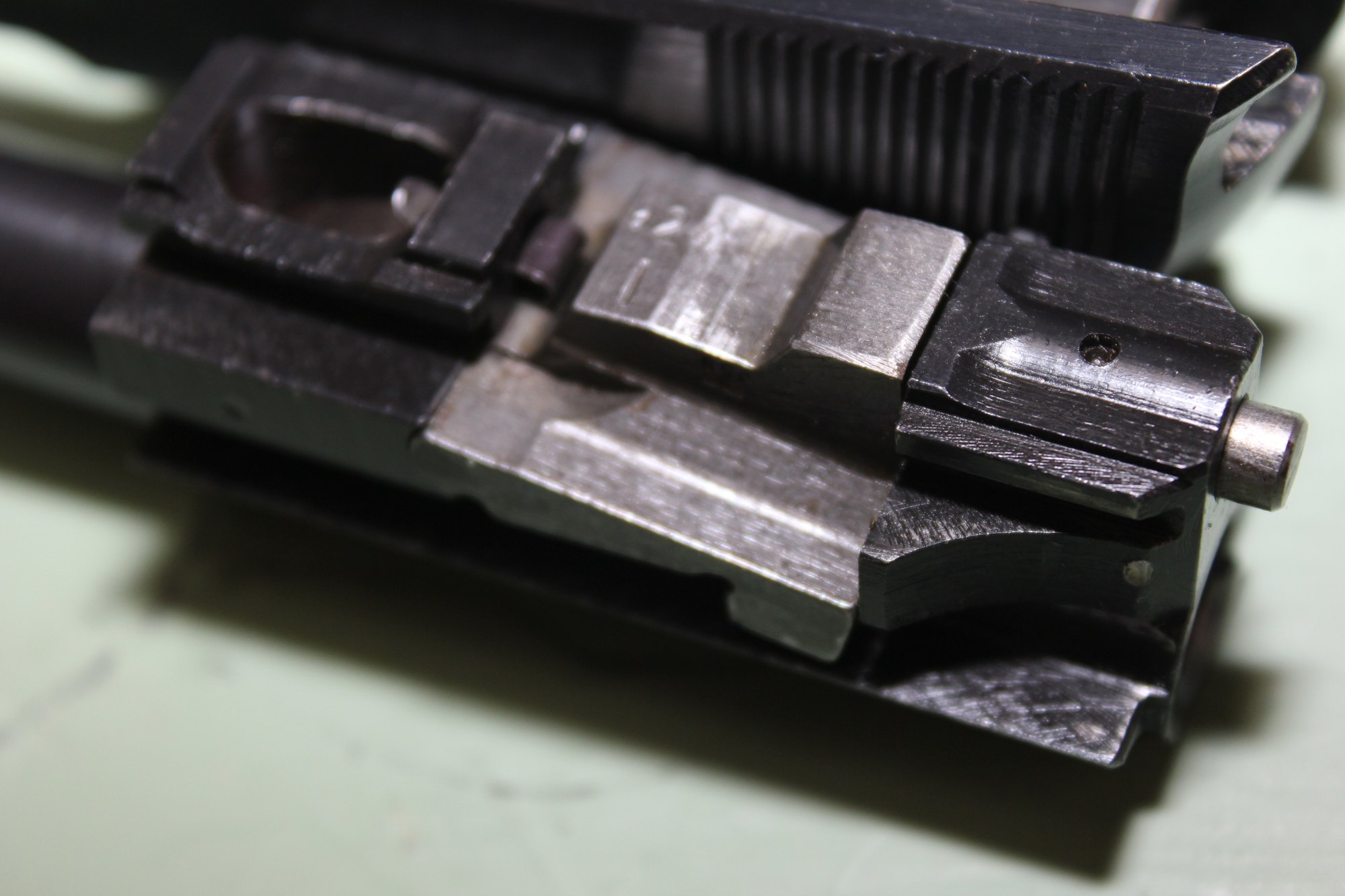
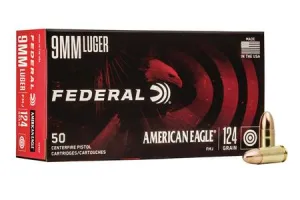
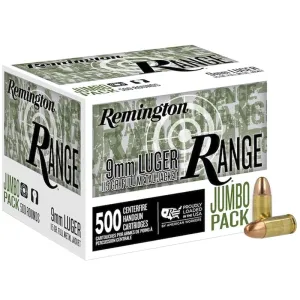
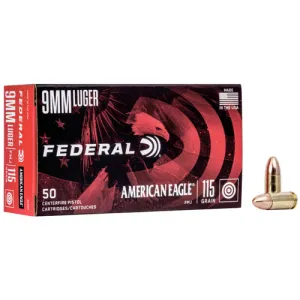
These standard-pressure 9mm loads are on sale at our dealers right now. We filter out +P, NATO, steel-case and subsonic ammo.
Standard 9mm Deals for a Walther P38
On-sale 9mm luger standard from 200+ retailers · Updated every 4 hours


Our best 9mm ammo guide covers modern loads in more depth.
A Short History of the Walther P38
In the early 1930s the German army wanted to replace the Luger P08, which was expensive and slow to make. Walther began work on a military pistol in 1932. After an early version with a hidden hammer, the army asked for an exposed one, and the result, patented in the names of Fritz Walther and his chief designer Fritz Barthelmes, was accepted as the Pistole 38 in 1938. Walther also sold it commercially as the HP, for Heeres Pistole, or “army pistol,” and Sweden bought HPs in 1939.
It was cheaper and quicker to build than the Luger: NRA museum figures put it at about $4.13 a gun against $7.83 for a Luger in 1940. A trial order and the “0-series” came in 1939 and 1940, with mass production from mid-1940. Mauser joined in late 1942 and Spreewerk in 1943, and the Luger stayed in production alongside it until 1942 or 1943. By 1945 the three factories had made about 1.2 million P38s.
The P38 outlived the regime it was built for. The French made about 38,780 at Oberndorf after the war, the Soviets stored and refinished captured guns, and in 1957 Walther began making new ones in Ulm for the West German army. Renamed the P1 in 1963, it served until 2004, and Norway, among others, adopted it too. Walther stopped making it in the early 2000s, and told a collector in 2008 that the P38 was no longer produced. Its locking system lives on in the Beretta 92 and the U.S. military’s M9.
Why the P38 Is Still So Popular
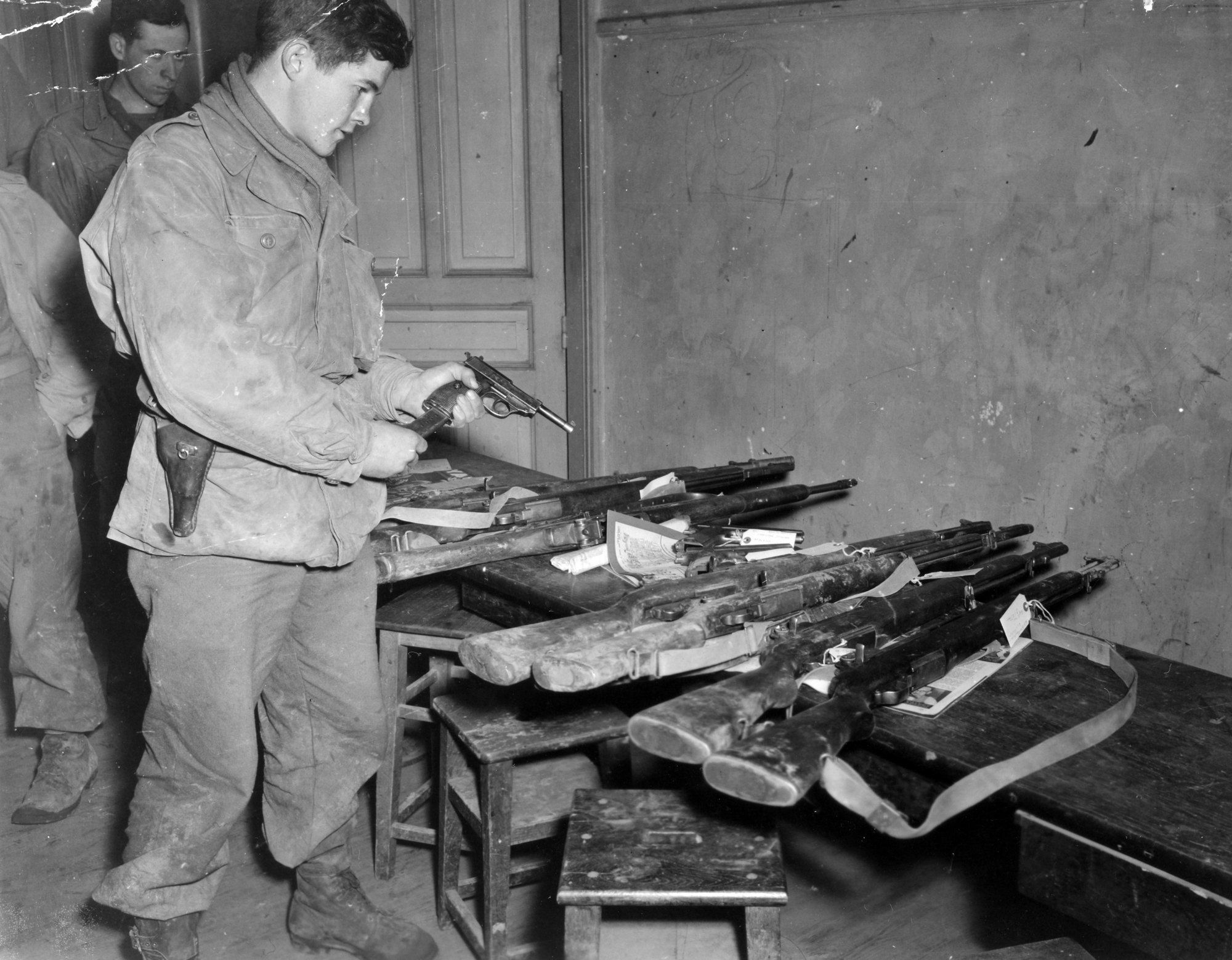
Part of it is history: it’s the standard German pistol of World War II, and it came home in countless GI duffel bags. Part of it is pop culture. Lupin III, the gentleman thief of Monkey Punch’s manga and anime, has carried a Walther P38 since 1967, which is why the gun has a big following in Japan. The Man from U.N.C.L.E.’s famous “U.N.C.L.E. Special” was built on a P38, and Indiana Jones used one in The Last Crusade.
And part of it is that it’s still a good pistol. The controls and the double-action first shot feel modern, the recoil is mild, and a shootable P1 costs less than most new 9mms. There aren’t many WWII-era designs you can still say that about.
P38 Legal Status: C&R, Import Marks and States
No P38 is an antique firearm, because every one was made long after 1898. But ATF’s Curios or Relics List covers most of them directly. It lists “German, P38 pistols, cal. 9mm Parabellum, mfd. prior to 1947,” which covers every wartime gun and the French svw45 and svw46 guns, and “Walther, post World War II production Model P38- and P1-type semiautomatic pistols made for or issued to a military force, police agency, or other government agency or entity.” That second entry makes every ex-Bundeswehr or police P1 a curio or relic regardless of its age.
Postwar commercial P38s qualify once they’re 50 years old, a rolling date: as of 2026, guns made in 1976 or earlier. C&R guns can ship to a C&R license holder; everyone else buys through an FFL. Surplus guns imported after 1968 carry an importer’s stamp, which is normal and costs little on a shooter. Your state may have its own rules on handgun rosters and transfers, so check before you buy.
Where to Buy a Walther P38
- Guns.com. The deepest used selection we track, with detailed photos. Browse P38s on Guns.com.
- Surplus dealers. Classic Firearms and others list original wartime P38s and surplus P1s. Our price cards above show what’s in stock today.
- Auction houses. Morphy, Rock Island and others describe matching status and refinishes in detail, but add a buyer’s premium of roughly 20 to 25%.
- GunBroker and gun shows. The widest choice, including Soviet capture guns and gray ghosts. Insist on close-ups of every serial number.
Wherever you buy, ask the same questions before you pay:
- Do the slide, frame, barrel and locking block all match?
- Is the finish original, or has it been reblued or refinished?
- Is the slide free of cracks at the bridge?
- Does the decocker drop the hammer safely on an empty chamber?
- Is it a wartime gun, a Soviet capture or a postwar alloy frame?
- Can I return it if it isn’t as described?
Walther P38 vs. Its Rivals
| Pistol | Caliber | Years | Why you’d pick it |
|---|---|---|---|
| Walther P38 | 9mm Luger | 1939 to early 2000s | Affordable WWII history, DA/SA, easy to shoot |
| Luger P08 | 9mm Luger | 1908 to 1942 | The icon, the better grip angle and the bigger collector market |
| Walther P1 | 9mm Luger | 1957 to early 2000s | Lighter, cheaper, the one to shoot |
| Beretta 92FS | 9mm Luger | 1976 to today | The P38’s locking block, rated for +P, 15 rounds |
P38 vs. the Luger P08
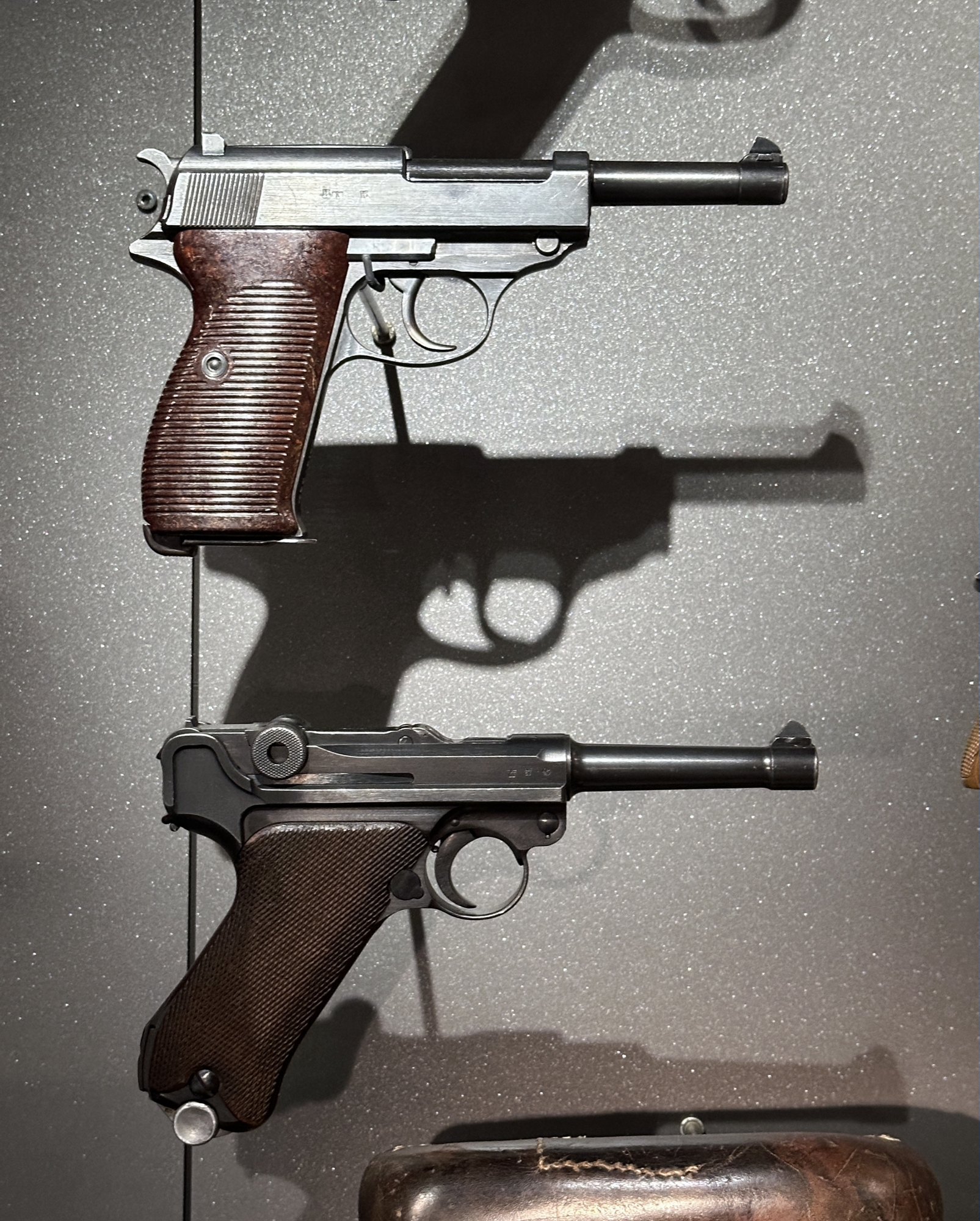
The P38 replaced the Luger P08 because it was cheaper and faster to make, and it’s the more practical pistol: a double-action first shot, a decocker and simpler maintenance. The Luger has the better grip angle, the more famous silhouette and a much bigger collector premium. If you want a German WWII pistol to shoot, the P38 is the easier gun to buy and to own.
P38 vs. the Beretta 92FS
The Beretta 92 uses a falling locking block that traces straight back to the P38, and our Beretta 92FS review covers the modern gun. The Beretta is rated for +P, holds 15 rounds, has parts and service everywhere, and a new one runs from about $650 at our dealers, well under the $1,168 median for a wartime P38. The P38 has the history. Pick the Beretta to shoot hard and carry; pick the P38 to own a piece of where it came from.
For more classic military handguns, see our Mauser C96 buyer’s guide, our guide to the guns of World War II and our Tokarev guide.
Final Verdict
The Walther P38 is the best-value WWII German pistol you can buy and one of the easiest vintage 9mms to shoot. Buy a matching Walther or Mauser gun if history is the point, a Spreewerk or Soviet capture gun if you just want a wartime pistol that shoots, and a hex-bolt P1 if you want a range gun. Check the slide, locking block and decocker before you pay, and keep it on standard-pressure ammo.
It replaced the Luger, armed an army for 60 years and handed its locking block to the Beretta 92. That’s a lot of pistol for the money.
FAQ
How much is a Walther P38 worth?
In 277 completed sales from January 2024 to September 2026, WWII-made P38s sold for a median of about $1,168, and guns with 90% or more original finish for about $1,336. By maker, Walther ac guns had a median of $1,200, Mauser byf guns $1,230 and Spreewerk cyq guns $1,058. Postwar P38s sold for about $615 and P1s for about $545. Factory P38Ks brought about $1,999.
Is the Walther P38 still made?
No. Walther made wartime P38s from 1939 to 1945 and postwar P38s and P1s from 1957 until the early 2000s, and it told a collector in 2008 that the P38 was no longer produced. Walther's current US legacy line is the PP, PPK and PPK/S. Any P38 you buy today is used.
Can I shoot +P or NATO ammo in a Walther P38?
We wouldn't. Walther's postwar manual specifies only 9mm Parabellum and says nothing about +P, and cracked slides and locking blocks are the P38's known weak points. Shoot standard-pressure 115 or 124 grain FMJ in any P38 or P1.
What do ac, byf and cyq mean on a P38?
They are wartime maker codes. "ac" is Walther, "byf" is Mauser, which switched to "svw" in 1945, and "cyq" is Spreewerk. The two digits after ac or byf are the year, so "ac 43" is a 1943 Walther gun. Spreewerk guns were not dated.
What is the difference between the P38 and the P1?
Mechanically they are the same design. Wartime P38s have steel frames. Postwar guns made from 1957 have aluminum-alloy frames, and from October 1963 the West German government version was called the P1. From 1975 a hex-head bolt reinforced the frame. Commercial postwar guns kept the P38 name.
Is a Russian capture P38 worth buying?
As a shooter, yes, if the slide, locking block and decocker check out. Soviet capture guns were refinished and sometimes assembled from mixed parts, so they sell for much less than original matching guns. Never pay matching-gun money for one.
Is the Walther P38 a curio and relic?
Yes. ATF lists all German P38 pistols made before 1947, which covers every wartime gun, and all postwar P38 and P1 pistols made for or issued to a military, police or government agency. Postwar commercial guns qualify once they are 50 years old. No P38 is an antique.
Is the Walther P38 a good gun?
Yes. It is accurate, easy to shoot and was far ahead of its time, with a double-action first shot, a decocker and a loaded-chamber indicator. Buy a sound one, keep it on standard-pressure ammo, and it will shoot well for years.
5,305+ Gun & Ammo Deals
Updated daily from 200+ top retailers. Filter by category, caliber, action type, and price.
Related Guides