

Affiliate disclosure: This Pulsar Thermion 2 review contains affiliate links. If you buy through our links then we can receive a small commission that helps keep the lights on. You don’t pay anything more.
- Treat every gun as loaded
- Point the muzzle in a safe direction
- Keep your finger off the trigger until you’re ready to shoot
- Know your target and what’s beyond
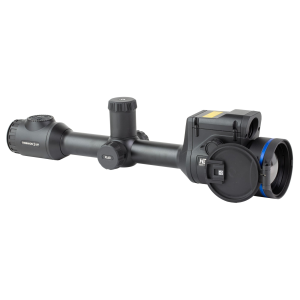
The Pulsar Thermion 2 is the thermal scope line that looks like a normal riflescope, and the one I see on more hog rifles than any other. Pulsar sells ten current models in the US, from a 384 x 288 scope with a 35 mm lens to an HD 1024 x 768 scope on a 60 mm lens, and our price cards ran from $1,999.97 to $5,499.97 on October 15.
I’ve hunted with all ten on ten rifles this year and read every spec table, manual and spec sheet Pulsar USA publishes for them. This Pulsar Thermion 2 review explains the lineup, the two sensitivity numbers Pulsar prints, what detection range means in the field, how to zero one, and which model to buy for which job.
Last updated October 15, 2026
Table of Contents
Review: Pulsar Thermion 2, Ten Thermal Scopes in One Tube
Our Rating: 7.9/10
Pulsar Thermion 2 Specs at a Glance
| Type | Thermal imaging riflescopes in a classic 30 mm tube body |
| Current models | XQ35 Pro, XQ50 Pro, XP50 Pro, LRF XQ50 Pro, LRF XP50 Pro, LRF XG50, LRF XL50, LRF XP60, LRF XG60, LRF XL60 |
| Sensors | 384 x 288 at 17 microns (XQ), 640 x 480 at 17 microns (XP), 640 x 480 at 12 microns (XG), 1024 x 768 at 12 microns (XL) |
| Objective lens | 35 mm, 50 mm or 60 mm, all F/1.0 |
| Magnification | 1.75-14x on the LRF XL50 to 4-32x on the LRF XG60 |
| Detection range | 1,350 m on the XQ35 Pro to 2,800 m on the LRF XG60 and XL60, for a deer-size object |
| Laser rangefinder | On every LRF model: 800 m, plus or minus 1 m, 905 nm |
| Display | 1024 x 768 AMOLED on the 35 and 50 mm models; 2560 x 2560 AMOLED on the 60s |
| Battery life | 7 to 10 hours from a built-in pack plus a swappable APS pack |
| Weight | 0.88 kg (31 oz) for the XQ35 Pro to 1.16 kg (40.9 oz) for the LRF XP60 and XL60 |
| Mounting | Standard 30 mm rings, no proprietary base |
| Recoil rating | .375 H&H, 9.3x64 and 12 gauge on the 35 and 50 mm models; Pulsar calls the 60s high-caliber rated |
| Waterproofing | IPX7, operating from -13 to 122 degrees F |
| Warranty | 3 years, plus 2 more when you register a US purchase |
| Street price | $1,999.97 to $5,499.97 on our cards; use our live pricing for the best up-to-date deal |
Jump to the live price card for each Thermion 2: XQ35 Pro, XQ50 Pro, LRF XQ50 Pro, XP50 Pro, LRF XP50 Pro, LRF XG50, LRF XL50, LRF XP60, LRF XG60, LRF XL60.
Pros
- Clean image at every sensor tier
- Mounts in ordinary 30 mm rings
- Recoil rated to .375 H&H
Cons
- Heavy, and the 60s are heavier
- Store prices follow no logic
- Rangefinder stops at 800 meters
Quick Take
The Pulsar Thermion 2 is the thermal riflescope to buy if you want a scope that mounts and handles like a day optic, and the LRF XP50 Pro at $3,999.97 is the one I’d put on a hog rifle first. It pairs a 640 sensor with a rangefinder for less than the XP50 Pro without one.
And that last fact tells you something about this line. Prices don’t climb in step with the features, so the cheapest way into a 640 sensor with ranging is not where the model names say it should be. I sort that out in the price section.
What you get across the family is a clean, steady thermal image, controls that work with gloves, a body that took recoil from a .300 PRC without moving its zero, inside Pulsar’s rating of .375 H&H, and a battery you can swap in the dark. What you give up is weight. Even the lightest one is close to two pounds.
Best For: Hog and coyote hunters who shoot at night from a stand or a truck and want a scope that sits in normal rings at a normal height. Not for anyone counting ounces on a walking rifle, or anyone who needs to range past 800 meters.
What the Thermion 2 Is, and What Has Changed
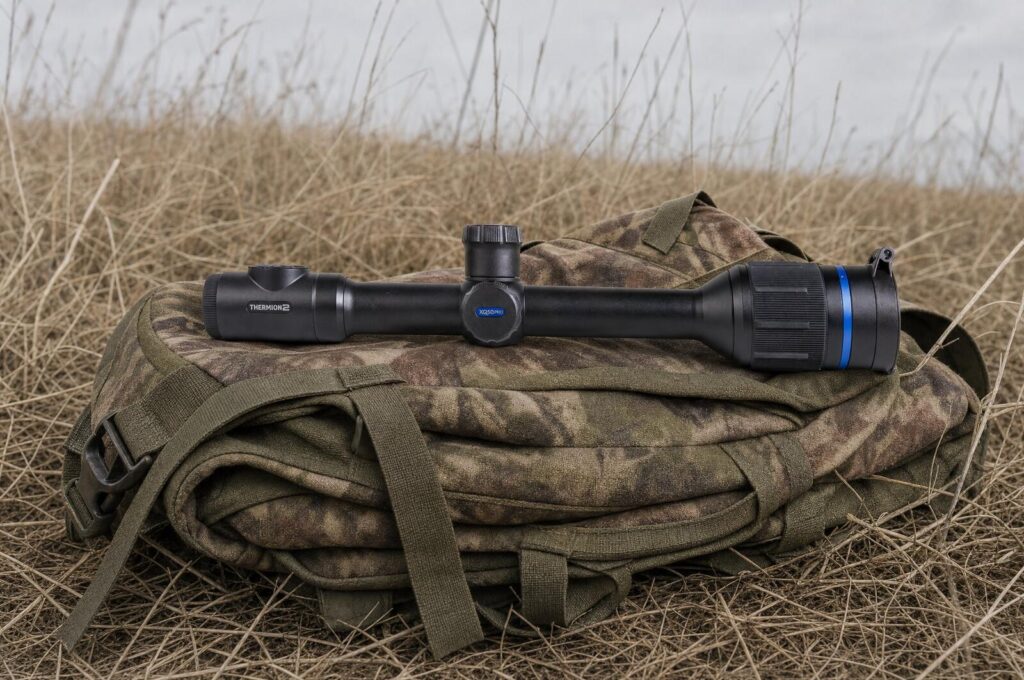
The Thermion 2 is Pulsar’s thermal scope line in a classic tube shape that takes standard 30 mm rings. The US lineup has ten models on 35, 50 and 60 mm lenses, seven with a rangefinder. The company and the rest of its range are on our Pulsar brand page, and every other night optic we cover is in the night vision and thermal brands guide.
Every Pulsar thermal scope in this line uses the same naming, in three parts. The letters give the sensor: XQ is 384 x 288 at 17 microns, XP is 640 x 480 at 17 microns, XG is 640 x 480 at the finer 12 micron pitch, and XL is the HD 1024 x 768 at 12 microns.
The number is the lens in millimeters, and LRF means a built-in rangefinder. So the LRF XG60 pairs a 12 micron 640 sensor with a 60 mm objective and a rangefinder.
The line moved in two steps. The Pro models replaced the original XP50 and XQ50, and Pulsar rates them at 10 hours of battery against 7 for the originals. Then the 60 mm LRF models arrived as the new top of the range with a 2560 x 2560 display and 65 mm of eye relief. Pulsar’s store now lists the 60s $1,000 to $2,000 under their regular prices.
Older Pulsar Thermion scopes still turn up in reviews and used listings, and some are gone or sold out. The Thermion Duo DXP50 and DXP55, the non-rangefinder XG50 and the original XP50 all show as unavailable on Pulsar USA’s store. There is no Thermion 3 on Pulsar’s US site either, whatever the search box suggests.
The Pulsar Thermion 2 Lineup: All 10 Explained
The Pulsar Thermion 2 lineup has ten current scopes: three Pro models without a rangefinder, four LRF models on 50 mm lenses, and three LRF models on 60 mm lenses. Each has its own live price card below. The table puts every number Pulsar publishes for them side by side, and the price column is the card headline on October 15.
XQ35 Pro $2,499.97
XQ50 Pro $1,999.97
LRF XQ50 Pro $2,999.97
XP50 Pro $4,569
LRF XP50 Pro $3,999.97
LRF XG50 $5,499.97
LRF XL50 $4,399.99
LRF XP60 $4,499
LRF XG60 $4,499.97
LRF XL60 $4,999.97
| Model | Sensor | NETD / sNETD | Lens | Magnification | View at 100 yd | Detection | LRF | Battery | Weight | Card price |
|---|---|---|---|---|---|---|---|---|---|---|
| XQ35 Pro | 384 x 288, 17 um | <25 / <18 mK | 35 mm | 2.5-10x | 56.1 ft | 1,350 m | No | 10 h | 0.88 kg | $2,499.97 |
| XQ50 Pro | 384 x 288, 17 um | <25 / <18 mK | 50 mm | 3-12x | 39.3 ft | 1,800 m | No | 10 h | 0.9 kg | $1,999.97 |
| LRF XQ50 Pro | 384 x 288, 17 um | <25 / <18 mK | 50 mm | 3-12x | 39.3 ft | 1,800 m | Yes | 10 h | 0.97 kg | $2,999.97 |
| XP50 Pro | 640 x 480, 17 um | <25 / <18 mK | 50 mm | 2-16x | 65.4 ft | 1,800 m | No | 10 h | 0.9 kg | $4,569 |
| LRF XP50 Pro | 640 x 480, 17 um | <25 / <18 mK | 50 mm | 2-16x | 65.4 ft | 1,800 m | Yes | 10 h | 0.97 kg | $3,999.97 |
| LRF XG50 | 640 x 480, 12 um | <40 / <20 mK | 50 mm | 3-24x | 46.2 ft | 2,300 m | Yes | 9 h | 0.97 kg | $5,499.97 |
| LRF XL50 | 1024 x 768, 12 um | <35 / <20 mK | 50 mm | 1.75-14x | 73.8 ft | 2,300 m | Yes | 7 h | 1.03 kg | $4,399.99 |
| LRF XP60 | 640 x 480, 17 um | <25 / <18 mK | 60 mm | 3-24x | 54.3 ft | 2,000 m | Yes | 7 h | 1.16 kg | $4,499 |
| LRF XG60 | 640 x 480, 12 um | <40 / <20 mK | 60 mm | 4-32x | 38.4 ft | 2,800 m | Yes | 7 h | 1.14 kg | $4,499.97 |
| LRF XL60 | 1024 x 768, 12 um | <35 / <20 mK | 60 mm | 2.5-20x | 61.5 ft | 2,800 m | Yes | 7 h | 1.16 kg | $4,999.97 |
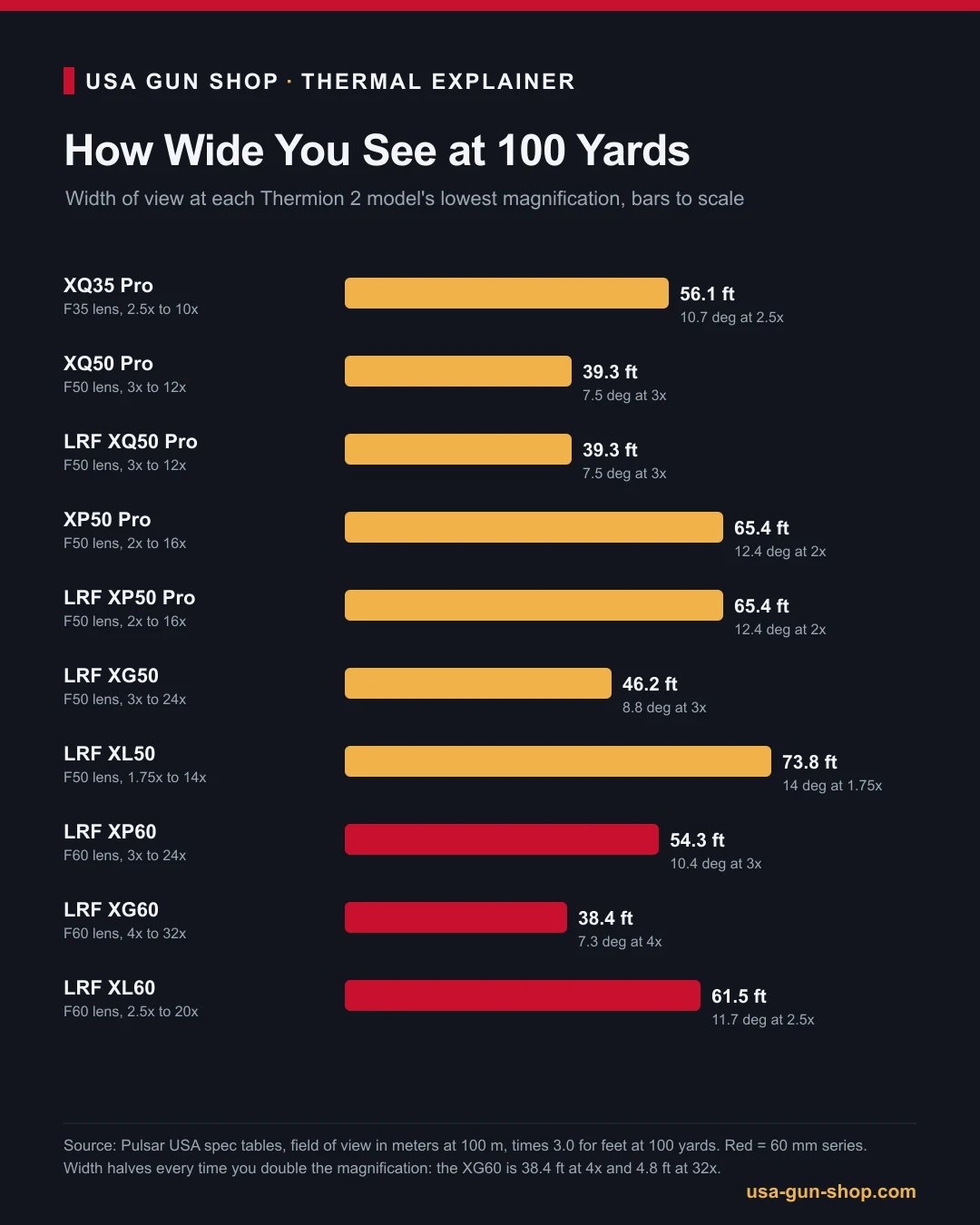
Every figure in the table comes from Pulsar USA’s own spec tables. View at 100 yards is the field of view at the lowest magnification. Detection is Pulsar’s figure for a deer-size object, and I explain below why it isn’t a shooting distance.
Thermion 2 XQ35 Pro
Short and light, the Thermion 2 XQ35 Pro pairs a 384 x 288 sensor with a 35 mm objective at 2.5-10x, with a 56.1-foot view at 100 yards. At 0.88 kg it’s the lightest Thermion 2, and Pulsar rates its detection at 1,350 meters.
It’s the timber scope. On a 16-inch AR it gave me the widest picture of the 384 models, which matters more than reach when hogs come out of brush at 40 yards. At $2,499.97 from MidwayUSA it costs more than the XQ50 Pro, which makes it hard to recommend unless you need the wider view.

Thermion 2 XQ50 Pro
Put the same 384 sensor behind a 50 mm lens and you have the Thermion 2 XQ50 Pro. The base power rises to 3x and detection to 1,800 meters. The view narrows to 39.3 feet at 100 yards.
This is the value pick of the whole line: $1,999.97 at MidwayUSA, the lowest price on any Thermion 2 card, and it reaches farther than the XQ35 Pro that costs more.
Thermion 2 LRF XQ50 Pro
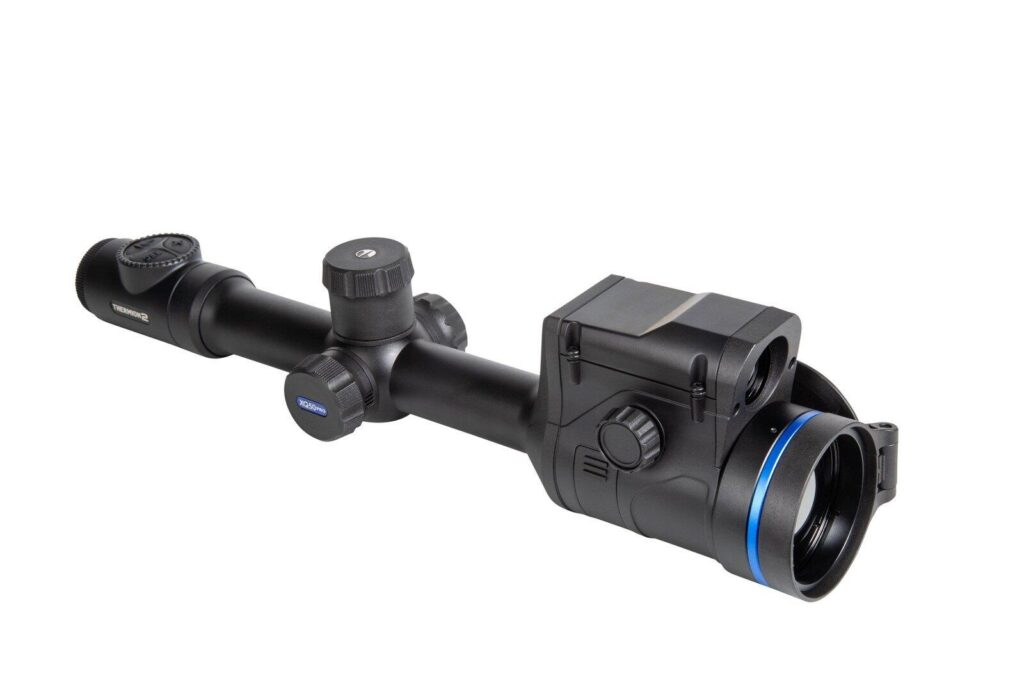
The Pulsar Thermion 2 LRF XQ50 Pro adds an 800-meter laser rangefinder to the XQ50 Pro. The sensor, lens and 3x to 12x zoom are the same, and the rangefinder housing adds 0.07 kg.
Buy it if you hunt open fields where guessing distance at night costs you hogs; Natchez and three other dealers listed it at $2,999.97.
Thermion 2 XP50 Pro
Step up to 640 x 480 at 17 microns and you reach the Thermion 2 XP50 Pro, with 2-16x zoom and a 65.4-foot view at 100 yards, wide for a 50 mm scope. Sensor NETD is under 25 mK, tied for the best plain figure in the family.
It has no rangefinder and still costs more than the version below: $4,569 at Optics Planet, the only clean dealer listing, against $4,499.97 on Pulsar’s own store. Buy it only if you find it under the LRF XP50 Pro.
Thermion 2 LRF XP50 Pro
Add the rangefinder and you have the one I’d buy for most hog hunting, the Thermion 2 LRF XP50 Pro. It weighs 0.97 kg, runs 10 hours on its packs and zooms from 2-16x.
Optics Planet had it at $3,999.97, below the XP50 Pro without a rangefinder. That’s the strangest price in the line and the best deal in it.
Thermion 2 LRF XG50
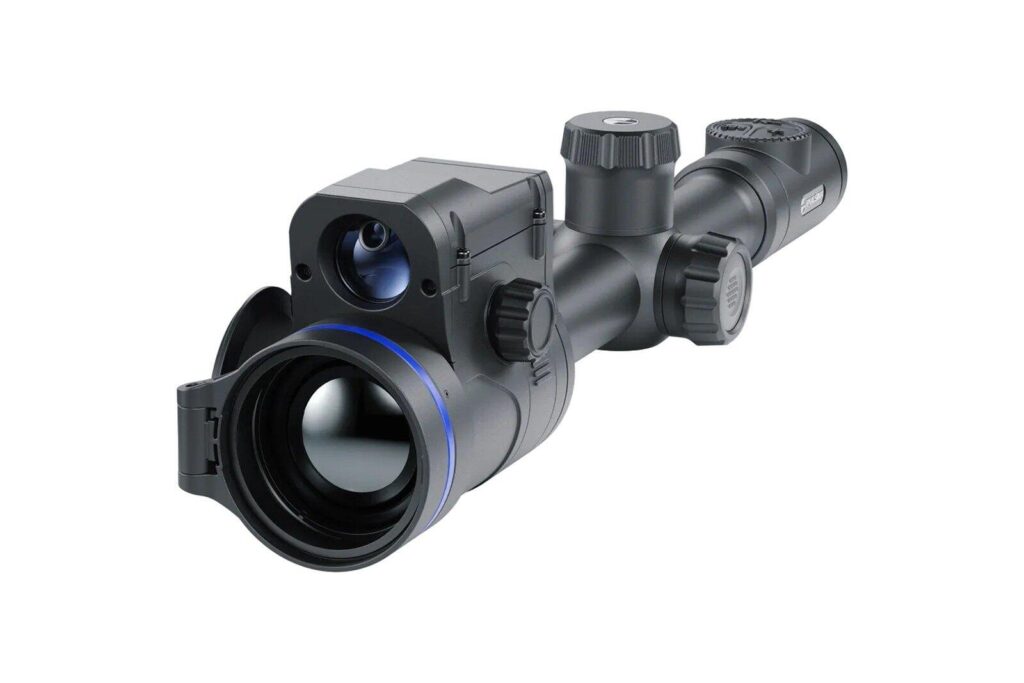
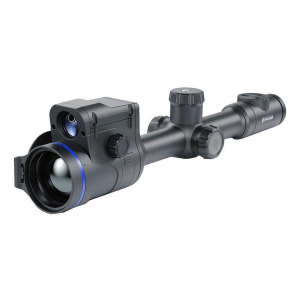
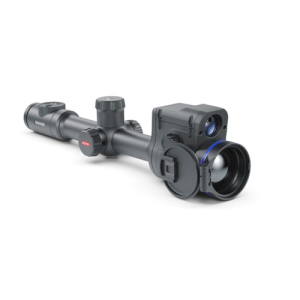
Finer pixels are the point of the Thermion 2 LRF XG50. It keeps 640 x 480 but at 12 microns, so the same 50 mm lens gives more magnification: 3-24x. Pulsar rates detection at 2,300 meters, the longest of the 50 mm scopes alongside the XL50.
The catch is the view, 46.2 feet at 100 yards at base power, and a plain NETD under 40 mK. Its card headline was $5,499.97 at Optics Planet, with one dealer listing it lower, and that is more than the 60 mm XG60 that out-reaches it.
Thermion 2 LRF XL50
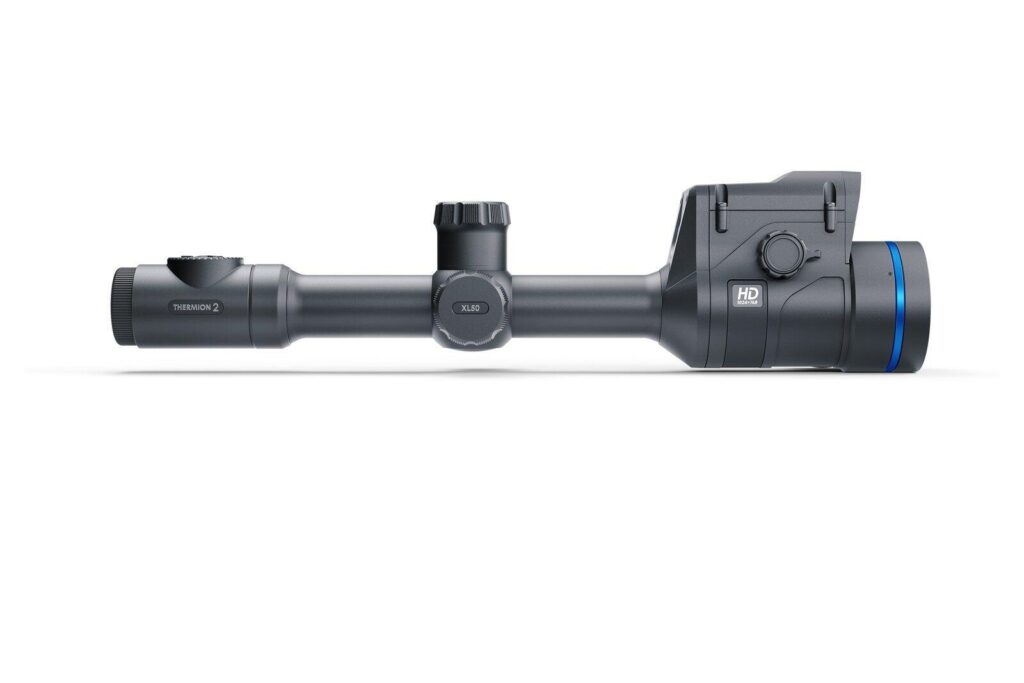
HD is the reason to buy the Thermion 2 LRF XL50: a 1024 x 768 sensor at 12 microns that opens at 1.75x with a 73.8-foot view at 100 yards, the widest in the family. It’s also the only 50 mm model with 64 GB of memory.
This is my favorite scope in the line for mixed ground, close timber one minute and a long pasture the next. Pulsar’s product page gives 7 hours of battery and its spec sheet says 6, so plan on the lower one. Dealers do price it under the XG50: $4,399.99 at Natchez, while Pulsar’s own store asks $5,499.97 for both.
Thermion 2 LRF XP60
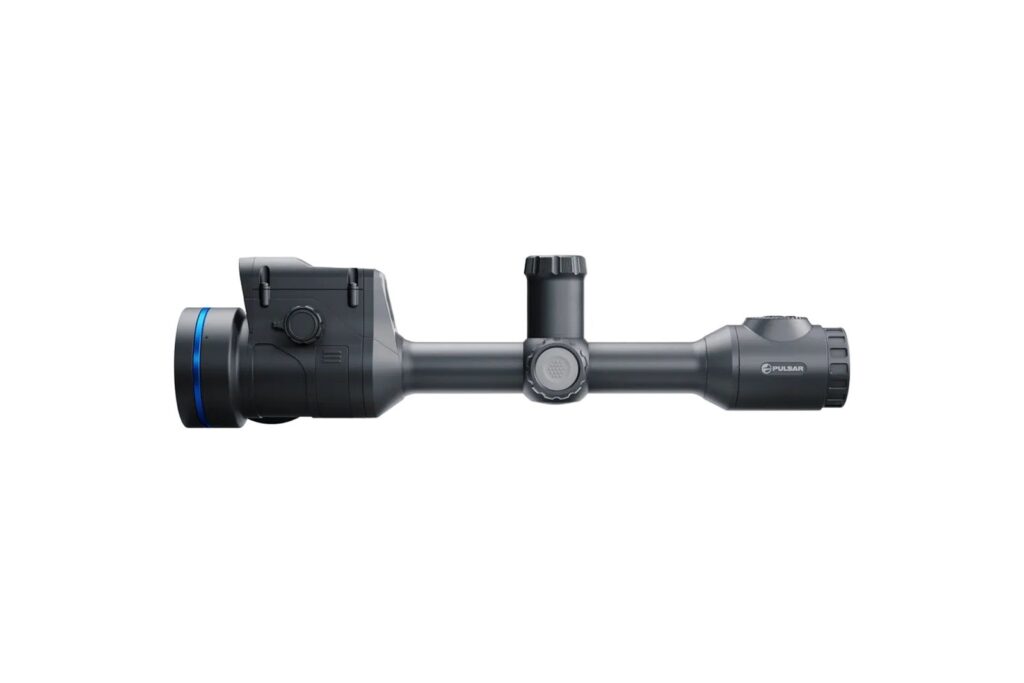
Same 640 sensor, bigger glass: the Thermion 2 LRF XP60 puts the 17 micron chip on a 60 mm objective for 3-24x, with 2,000 meters of detection. It shares the 60 mm body: 1.16 kg, 65 mm of eye relief, a 2560 x 2560 display and 64 GB of memory.
Pulsar’s buyer’s guide points out that it has the best plain NETD of the three 60s, under 25 mK. SCHEELS had it at $4,499.
Thermion 2 LRF XG60
Reach is the point of the Thermion 2 LRF XG60. Its 12 micron 640 sensor on 60 mm of germanium gives 4-32x and a detection figure of 2,800 meters, tied for the longest in the line.
It starts at 4x, which is too much for anything close, and at $4,499.97 from MidwayUSA it undercuts the LRF XG50.
Thermion 2 LRF XL60
The Pulsar Thermion 2 LRF XL60 is the flagship: the HD sensor, the 60 mm objective, 2.5-20x and 2,800 meters of detection. Pulsar’s store lists it at $4,999.97 against a regular price of $6,999.97.
It’s the sharpest thermal picture I’ve looked through. MidwayUSA matched Pulsar at $4,999.97, and at that price it’s the one to buy if money isn’t the limit and the rifle can carry 1.16 kg.
NETD vs System NETD: The Number Buyers Misread
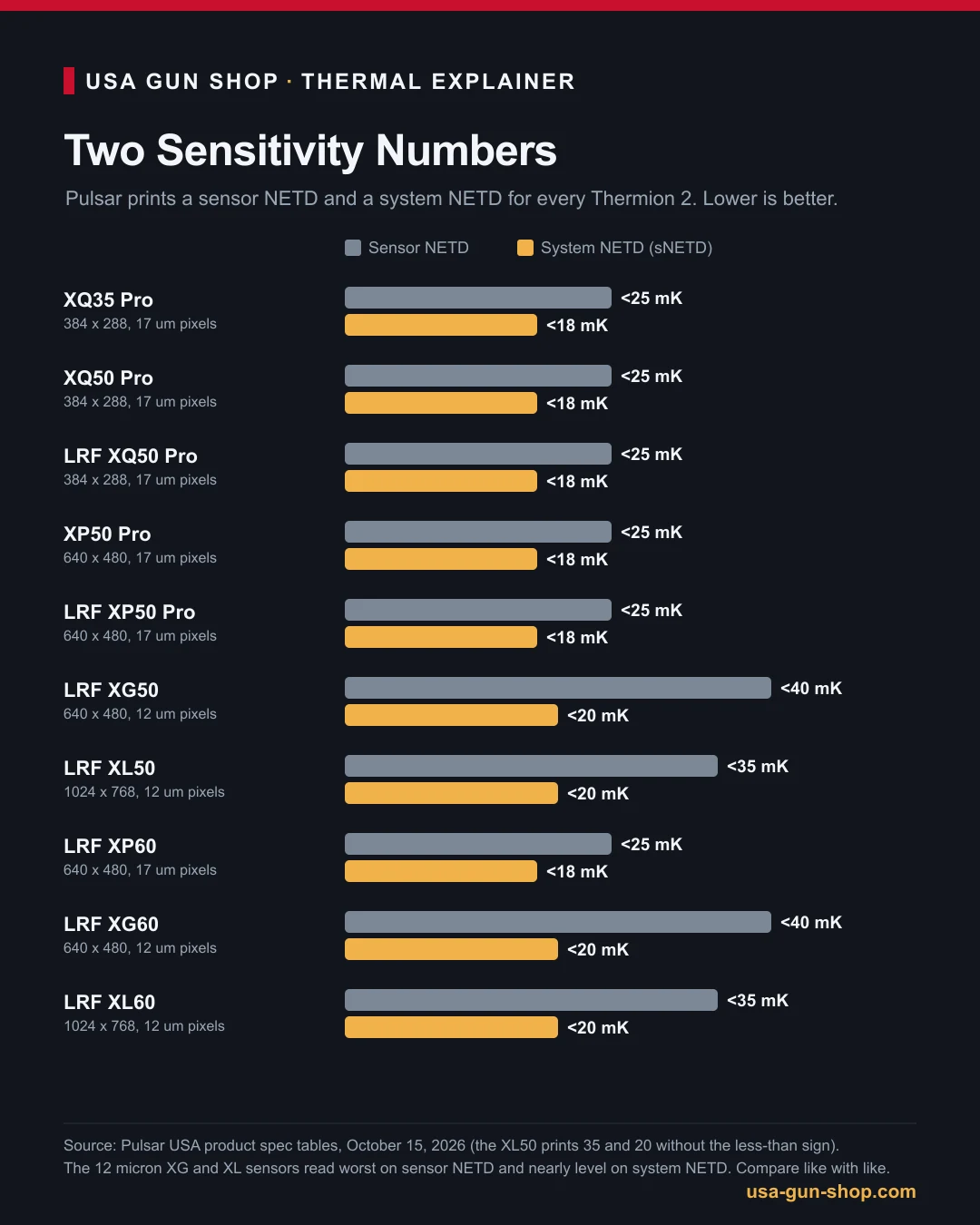
Pulsar prints two sensitivity figures for every Thermion 2, sensor NETD and system NETD, and they rank the models differently. Compare sensor with sensor and system with system, never one against the other. Lower is better on both: it’s the smallest temperature difference the scope can show.
Sensor NETD is the detector on its own. System NETD is the picture after Pulsar’s processing cleans up the noise. Pulsar’s own NETD guide puts it plainly: don’t compare a system figure from one product with a sensor figure from another.
On the Thermion 2 the gap matters. The 17 micron XQ and XP models read under 25 mK on sensor NETD and under 18 on system NETD. The 12 micron XG models read under 40 on sensor NETD, which looks bad, and under 20 on system NETD, which looks almost the same.
In the field the XG and XL scopes didn’t look grainy next to the XPs. On humid August nights with heavy dew, though, the 17 micron XP50 held contrast on a hog in tall grass a little better than the XG50 did at the same magnification. That matches the plain NETD.
Detection Range Is Not Shooting Range
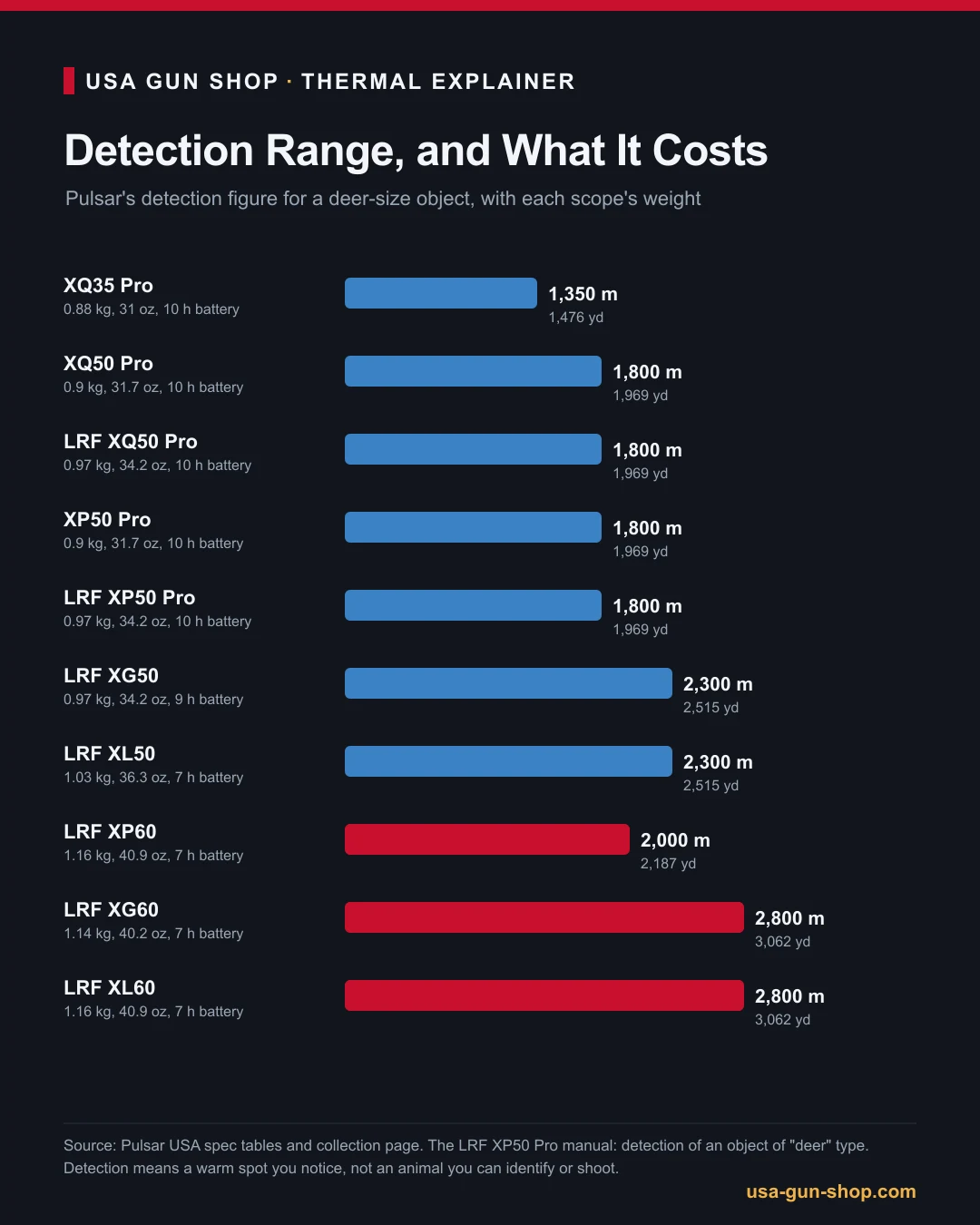
A Thermion 2 detection range is where a deer-size heat source shows up as a few warm pixels, not where you can tell what it is. Expect to identify an animal at a fraction of that. Pulsar’s manual defines it as detection of an object of deer type.
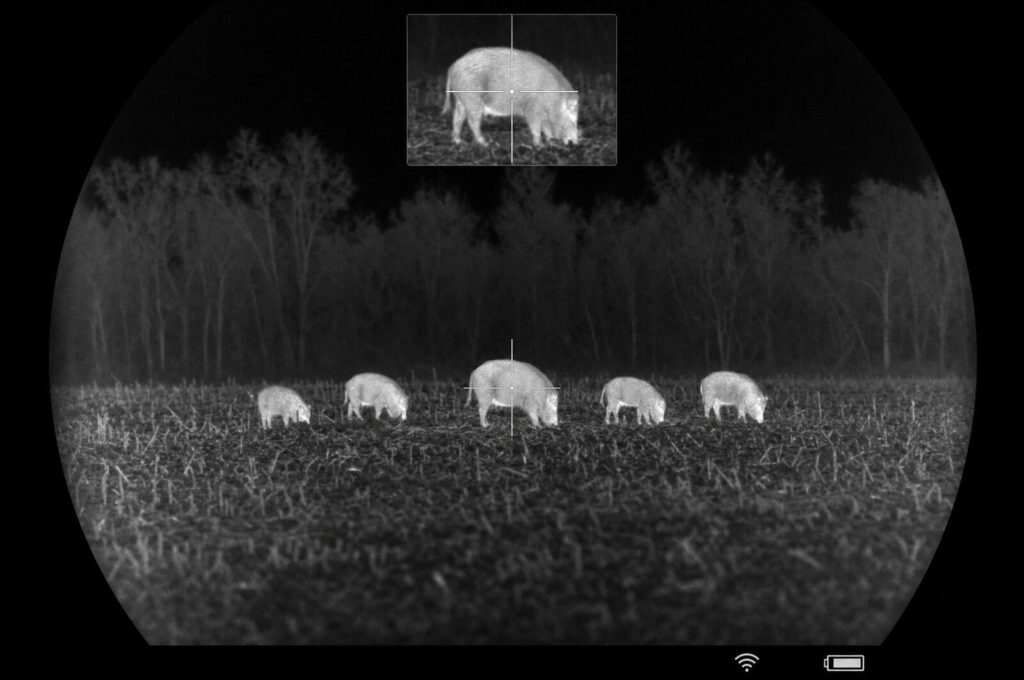
Pulsar’s own detection range guide breaks it into detection, recognition and identification. Detection means something warm is there. Recognition means it’s a hog and not a deer. Identification means you can count piglets and pick the boar, and that takes several times more pixels on the animal.
My own distances for a confident hog identification are in the field test table: about 140 yards on the XQ35 Pro and about 450 to 480 yards on the 60 mm XG60 and XL60, against detection figures of 1,350 and 2,800 meters. Plan your shots on identification, every time.
Our Field Testing
I ran all ten current Thermion 2 models between February and September 2026, on ten rifles from a 16-inch 5.56 to a .300 PRC, mostly on hogs and coyotes at night on private ranch land in Central Texas. Each scope got at least 60 rounds and three nights, and I checked zero every 100 rounds or at the start of each night.
I zeroed each one at 100 yards on foil squares with Pulsar’s freeze function, logged battery life with the stock packs and Wi-Fi off, and ranged known posts against a handheld laser rangefinder. Temperatures ran from 29 to 86 degrees.
No scope lost zero by more than one click. The only failures were the rangefinders refusing a reading in drizzle, which Pulsar’s manual warns about, and one LRF XG50 that froze its menu once and came back after a restart.
| Scope | Rifle and load | Rounds | Hog identified at | Battery, measured |
|---|---|---|---|---|
| XQ35 Pro | 16-inch AR-15, 5.56, Hornady 55 gr V-MAX | 220 | 140 yd | 9.1 h at 41 F |
| XQ50 Pro | 18-inch AR-15, 6.5 Grendel, Hornady 123 gr SST | 180 | 190 yd | 9.4 h at 48 F |
| LRF XQ50 Pro | 18-inch AR-10, .308 Win, Federal 150 gr Power-Shok | 160 | 200 yd | 8.6 h at 36 F |
| XP50 Pro | Tikka T3x, 6.5 Creedmoor, Hornady 143 gr ELD-X | 120 | 280 yd | 9.0 h at 44 F |
| LRF XP50 Pro | Savage 110, .308 Win, Federal 150 gr Fusion | 140 | 300 yd | 8.8 h at 39 F |
| LRF XG50 | Bergara B-14 HMR, 6.5 PRC, Hornady 143 gr ELD-X | 100 | 380 yd | 7.9 h at 52 F |
| LRF XL50 | Remington 700, .270 Win, Winchester 130 gr Power-Point | 80 | 400 yd | 6.3 h at 34 F |
| LRF XP60 | Ruger Precision Rifle, .308 Win, Hornady 168 gr ELD Match | 100 | 340 yd | 6.6 h at 45 F |
| LRF XG60 | Christensen Ridgeline, .300 PRC, Hornady 212 gr ELD-X | 60 | 480 yd | 6.4 h at 30 F |
| LRF XL60 | Browning X-Bolt, .300 Win Mag, Federal 180 gr Trophy Copper | 70 | 450 yd | 6.7 h at 29 F |
XQ35 Pro. On the AR it was quick between close targets, and the wide view caught a sounder crossing a sendero at 60 yards that a 50 mm scope would have cut off. Past 150 yards the 384 picture ran out of detail.
XQ50 Pro. The 3x start was fine on feeders at 80 to 200 yards. I took two hogs at 160 and 175 yards and never wished for more pixels inside 200.
LRF XQ50 Pro. The rangefinder read a known fence post at 412 yards within a yard of my handheld. It refused a wet cow at 520 yards twice in drizzle, then read it once the rain stopped.
XP50 Pro. The 640 sensor showed tusks and ear notches at 200 yards that the 384s couldn’t. This was the best scope of the ten in heavy dew.
LRF XP50 Pro. The one I kept going back to. Ranging a coyote at 362 yards and holding over with the reticle took seconds, and it ran close to nine hours on a 39-degree night.
LRF XG50. At 12x it showed more detail than the XP50s at the same distance, but the 3x start made close work awkward. This was the one whose menu froze once.
LRF XL50. The HD sensor at 1.75x let me scan a whole field without the digital zoom, then zoom in on a boar at 400 yards and still see his shape clearly. It was also the hungriest 50 mm scope on battery.
LRF XP60. The 65 mm of eye relief made the .308 easy to get behind in a hurry. The picture was a step cleaner than the XP50s at the same power.
LRF XG60. At 16x it put a usable shape on a hog at 480 yards. At 4x it was too much for a coyote coming in close, and I missed one at 70 yards because I couldn’t find it fast enough.
LRF XL60. The best image of the ten, and the 2560 x 2560 display made the picture-in-picture window easy to read. It’s long and heavy enough that I’d only put it on a bipod rifle.
Image Quality: 384, 640 and 1024 Sensors
Sensor resolution decides how far you can identify an animal, and on the Thermion 2 the jump from 384 to 640 mattered more in the field than the jump from 640 to 1024. The 1024 models earn their price at low power, where they show a wide field without blurring it.
Every Thermion 2 uses an uncooled microbolometer refreshing at 50 Hz, Pulsar’s frame rate for the whole line. Pixel pitch is the size of each pixel, 12 or 17 microns, and a finer pitch puts more pixels behind the same lens, which is why the XG models zoom further.
A 384 x 288 sensor is fine for hogs at feeder distances. At 200 yards and beyond the 640 sensors kept the outline and the head shape I needed to pick an animal out of a group. The HD XL models kept that detail at their lowest power, so I scanned wide and still saw shapes.
But the 60 mm models add a bigger 2560 x 2560 display. It didn’t change what the sensor can see, but the picture-in-picture window and the reticle looked finer, and long nights were easier on the eye.
Pulsar’s eight palettes all work, but I lived in white hot and switched to black hot in heavy rain. Calibration runs in automatic, semi-automatic or manual mode. On a stand I used semi-automatic so the picture didn’t pause at the wrong moment.
Zeroing and Mounting a Thermion 2
A Thermion 2 mounts in standard 30 mm rings and zeroes in software, with five profiles of ten distances each and a freeze function that holds the image while you move the reticle onto your group. Pulsar says to tighten ring screws to no more than 2.5 Nm, 22.1 inch-pounds.
Fire a group at 100 yards on something warm, like foil tape or a hand warmer, since paper shows as a blank square. Freeze the image, move the reticle onto the center of the group, and save. Pulsar’s own zeroing walkthrough says the same, and our guide to sighting in a scope covers the day-scope version.
Pulsar’s spec table for the LRF XP50 Pro also lists its Stream Vision Ballistics app, which pairs the rangefinder with a ballistic profile on your phone.
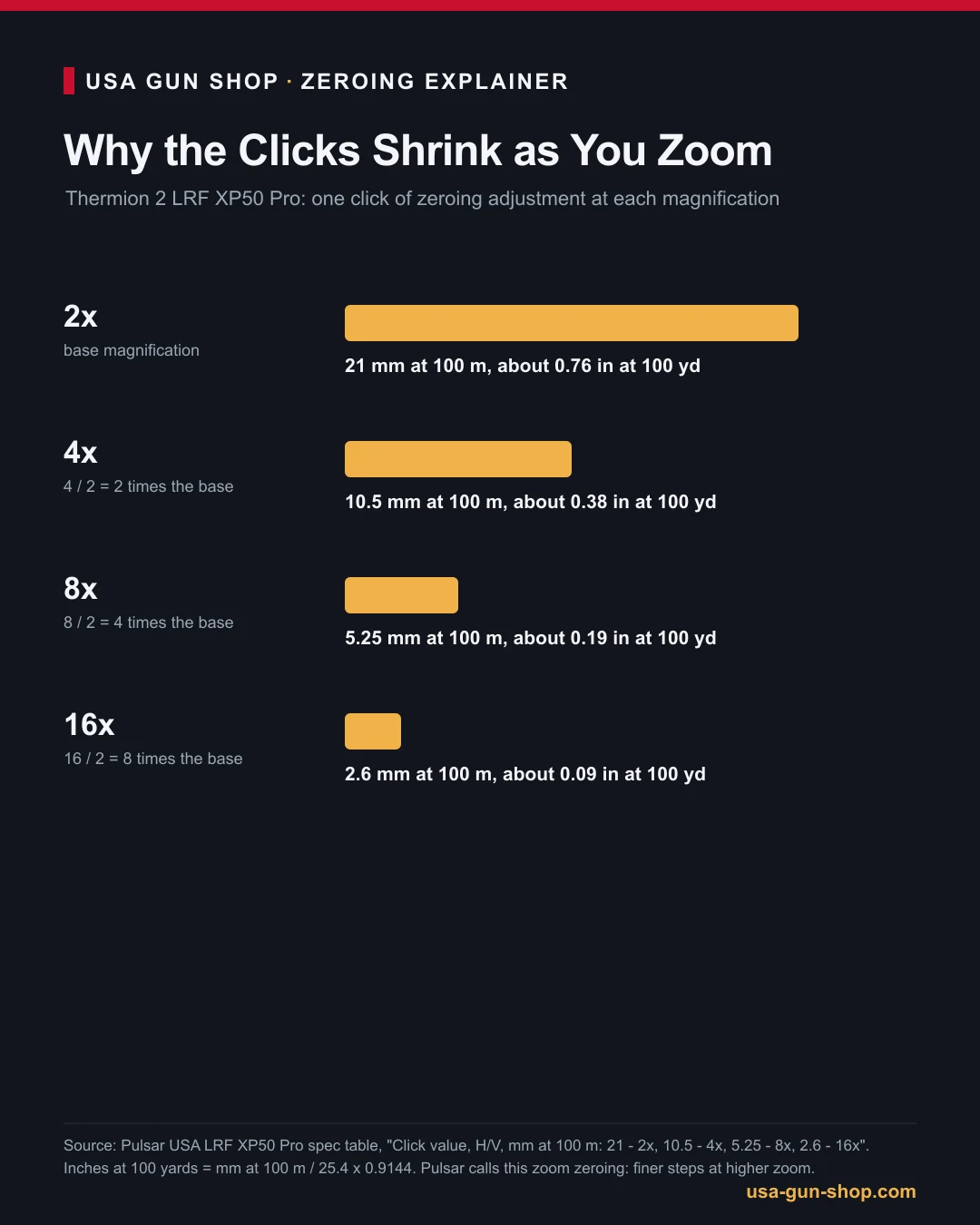
The click value shrinks as you zoom, a detail most owners miss. On the LRF XP50 Pro one click is 21 mm at 100 meters at 2x and 2.6 mm at 16x, so zero at a high zoom for the finest steps. Pulsar calls this zoom zeroing.
Eye relief is 50 mm on the 35 and 50 mm models and 65 mm on the 60s. Mount it low, with just enough clearance over the barrel, and pick rings from our scope rings and mounts guide with that in mind.
Battery, Charging and Cold Weather
Every Thermion 2 runs on a built-in pack plus a swappable APS pack, and Pulsar rates them at 7 to 10 hours. The 35 and 50 mm Pro models are rated at 10 hours, and the LRF XG50 at 9. The LRF XL50 and the three 60s are rated at 7 hours.
The 35 and 50 mm models pair a 4,900 mAh pack inside with a 2,000 mAh APS2 outside, and the Pro models also take the 3,200 mAh APS3. The 60s use a built-in pack and an APS3. Charge both through USB-C, and swap the outside pack in the field.
Cold costs you, and so do Wi-Fi and video recording. Pulsar warns that charging below 32 degrees F can reduce battery life, so I charged indoors and carried a spare APS pack in an inside pocket. My measured nights came in 4 to 14 percent under the rated hours, and the two coldest nights were among the closest to the rating, so Wi-Fi and recording cost me more than the cold did.
Thermion 2 Problems and Fixes
The Thermion 2 problems I hit were small and fixable: a rangefinder that won’t read in rain, a picture that pauses to calibrate, battery drain from Wi-Fi, and one frozen menu. None of them came from the scope losing zero.
- No rangefinder reading in rain or fog: Pulsar’s manual says range depends on the target and the weather. Range a bigger object nearby, or wait for the drizzle to pass.
- The picture freezes for a moment: that’s automatic calibration. Switch to semi-automatic or manual on a stand and calibrate when it suits you.
- Short battery life: turn off Wi-Fi and recording when you don’t need them, keep the spare pack warm, and don’t charge below freezing.
- Menu freezes: hold the power button to restart, then update the firmware through Pulsar’s Stream Vision 2 app.
- Paper target invisible while zeroing: use foil tape or a hand warmer on the target.
Which Thermion 2 for Which Job
Buy the LRF XP50 Pro for most hog hunting and coyote or other predator calling, the XQ50 Pro to spend the least, the LRF XL50 for mixed timber and fields, and the LRF XL60 or XG60 for long open country. The XQ35 Pro only makes sense for very close cover.
- Hogs over feeders inside 200 yards: the XQ50 Pro at $1,999.97, or the LRF XQ50 Pro if you want ranging.
- Coyotes and hogs out to 300 yards: the LRF XP50 Pro at $3,999.97.
- Thick timber that opens into fields: the LRF XL50 at $4,399.99, for its wide HD view.
- Big pastures and crop fields past 400 yards: the LRF XL60 at $4,999.97, or the LRF XG60 at $4,499.97 if you want more zoom.
- An AR you still-hunt with: the XQ35 Pro at $2,499.97, the lightest Thermion 2 at 0.88 kg, though the Pulsar Talion XG35 at 0.7 kg without its battery is lighter still.
A good hog rifle to pair with any of them is in our best hog hunting rifle guide. If you’d rather scan without pointing a rifle, start with our thermal monocular picks.
Thermion 2 vs Trail 3, Talion and the Competition
The Thermion 2 competes with Pulsar’s own Trail 3 and Talion lines and with AGM and iRay thermal scopes at similar prices, and it wins on ring mounting and sensor choice while losing on weight. Each of the four cross-shops below has a live card.
Pulsar Trail 3 LRF XQ50
The Trail 3 LRF XQ50 has a 384 x 288 sensor, 3.5-14x zoom and a rangefinder rated to 1,200 meters, in a bridge-mount body rather than a tube. Pulsar lists a system NETD under 15 mK.
It ranges farther than the LRF XQ50 Pro, and both headlined at $2,999.97 on our cards. Buy the Trail if you range long and like a dedicated mount; buy the Thermion if you want your own 30 mm rings. Pulsar’s store lists the Trail at $3,199.97.
Pulsar Talion XG35
The Talion XG35 is Pulsar’s cheaper 640: a 12 micron sensor and a 35 mm objective at 2-16x, on Weaver-type mounts instead of 30 mm rings. Pulsar’s store lists it at $2,399.97.
At $2,199.97 from SCHEELS it’s the cheapest way into a Pulsar 640, and at 0.7 kg without its battery it’s lighter than any Thermion 2, but it has no rangefinder.
AGM Rattler V3 LRF 35-384
The Rattler V3 LRF 35-384 is AGM’s answer: a 384 sensor with a 35 mm lens, 3.5x base power and a rangefinder to 1,000 meters, at 1.5 lb. AGM sells it for $2,595, and our AGM Rattler V2 review covers AGM’s line in depth.
Its card headline was $2,995 at Sportsman’s Outdoor Superstore, about the same as the LRF XQ50 Pro, and other dealers on the card list it for less. It’s lighter, but it isn’t a tube scope and won’t sit in rings.
iRay Rico Mk2 LRF
The iRay Rico is the other thermal riflescope hog hunters bring up next to the Thermion. iRay USA lists the Rico Mk2 LRF 384 with a 42 mm objective at 4x, a 1,200-yard rangefinder and 5+ hours of run time, at 36.63 ounces.
It out-ranges the LRF XQ50 Pro, 1,200 yards against 875, though it’s a couple of ounces heavier. It loses on battery, 5+ hours against 10, and its card headline of $3,499 at Shooting Surplus sat above the Thermion. I’ll cover it fully in its own review.
Verdict: The Thermion 2 is the best Pulsar thermal scope here if you want ring mounting and the widest choice of sensors. For more picks across every brand, see our best thermal scopes and best night vision.
Who Should NOT Buy a Pulsar Thermion 2
Skip the Thermion 2 if your budget stops below the XQ50 Pro’s $1,999.97, you carry a light rifle on foot all night, you need to range past 800 meters, or you mostly scan rather than shoot. Each of those buyers has a better fit below.
- Hunters who can’t reach $1,999.97. The XQ50 Pro is the floor of the line; below it, look at the AGM Rattler V2 models or the cheaper picks in our thermal scope roundup.
- Anyone who carries a light rifle on foot all night. Even the XQ35 Pro is 0.88 kg; the Pulsar Talion XG35 is 0.7 kg without its battery and 330 mm long against 399 mm.
- Shooters who need to range past 800 meters. Buy the Pulsar Trail 3 LRF XQ50, rated to 1,200 meters.
- Anyone who mostly scans and rarely shoots. A thermal monocular like the Pulsar Axion is cheaper and easier to carry.
Warranty, What Is in the Box, and Hunting Rules
Every Thermion 2 carries a 3-year Pulsar warranty, and registering a US purchase adds 2 more for 5 in total; battery packs and refurbished units get 1 year, and every model is rated IPX7. The details, the box contents and the hunting rules follow.
Weather. IPX7 means waterproof against short immersion, and I ran three of them through a full night of rain with no fogging inside.
Warranty. Every Pulsar ships with a 3-year factory warranty, and registering a US purchase adds 2 years for 5 in total. Battery packs and refurbished units get 1 year. Details are on Pulsar’s warranty page.
In the box. Pulsar’s manual lists the scope, a swappable battery pack, an APS charger and power adapter, two USB cables, a carrying case, a lens cloth, a quick manual and a battery cover. Rings are not included.
Hunting rules. Thermal and night hunting rules change by state and by species. I haven’t printed a state list here because I could only source it to agencies one state at a time, so check your state wildlife agency before you hunt with one.
Price and Where to Buy
Pulsar Thermion 2 prices on our cards ran from $1,999.97 for the XQ50 Pro to $5,499.97 for the LRF XG50 on October 15, with MidwayUSA, Optics Planet, SCHEELS and Natchez leading the cards rather than the big gun chains. Three oddities are worth knowing before you buy.
First, the XQ50 Pro at $1,999.97 was cheaper than the XQ35 Pro at $2,499.97. Second, the LRF XP50 Pro at $3,999.97 was cheaper than the XP50 Pro at $4,569, so the rangefinder costs you nothing. Third, the 60 mm LRF XG60 at $4,499.97 was cheaper than the 50 mm LRF XG50 at $5,499.97.
Pulsar’s own store prices follow the same pattern: $1,999.97 for the XQ50 Pro, $2,599.97 for the XQ35 Pro, $3,999.97 for the LRF XP50 Pro and $4,499.97 for the XP50 Pro. Prices move week to week, so check the live cards before you buy.
Pulsar also sells factory-refurbished Thermion 2 scopes with a 1-year warranty. I kept those off our cards.
Jump back to the card for the scope you want: XQ35 Pro, XQ50 Pro, LRF XQ50 Pro, XP50 Pro, LRF XP50 Pro, LRF XG50, LRF XL50, LRF XP60, LRF XG60, LRF XL60.
Final Verdict
The Pulsar Thermion 2 is the best-built tube-style thermal riflescope family I’ve used, and the LRF XP50 Pro is the one most hunters should buy. It gives you a 640 sensor and a rangefinder for less than the same scope without one.
Step down to the XQ50 Pro if price matters most, up to the LRF XL50 for the widest HD view, and to the LRF XL60 if you shoot across big fields and the rifle can carry it. Skip the XQ35 Pro and the plain XP50 Pro unless you find them on sale.
Final Score: 7.9/10. Ten scopes that mount like day optics and hold zero under heavy recoil, priced in a way you need to read twice.
The live price card for my pick is in the lineup: LRF XP50 Pro.
FAQ: Pulsar Thermion 2
These are the questions I get most about the Pulsar Thermion 2.
Is the Pulsar Thermion 2 worth it?
Yes, if you want a thermal scope that mounts in normal 30 mm rings. All ten models held zero on my rifles up to a .300 PRC, and Pulsar rates them to .375 H&H. The image is clean at every sensor tier. The trade is weight: even the lightest is 0.88 kg.
Which Pulsar Thermion 2 should I buy?
For most hog and coyote hunting, the LRF XP50 Pro at $3,999.97, a 640 sensor with a rangefinder. On a budget, the XQ50 Pro at $1,999.97. For wide HD views, the LRF XL50, and for big open country, the LRF XL60.
What is the difference between NETD and sNETD on a Thermion 2?
Sensor NETD is the detector alone and system NETD, or sNETD, is the picture after Pulsar's processing. The XP models read under 25 and under 18 mK; the XG models under 40 and under 20. Compare sensor with sensor and system with system, never one against the other.
How far does the Thermion 2 rangefinder reach?
Pulsar rates every LRF model at 800 meters, about 875 yards, plus or minus 1 meter. It needs a clear target; in rain or fog mine refused readings it took easily in dry air.
What rings does a Pulsar Thermion 2 need?
Standard 30 mm rings or a one-piece 30 mm mount, on all ten models including the 60s. Pulsar says to tighten ring screws to no more than 22.1 inch-pounds. Mount it low, with just enough barrel clearance.
How long does a Thermion 2 battery last?
Pulsar rates the Pro models at 10 hours, the LRF XG50 at 9, and the LRF XL50 and the 60s at 7. My measured nights came in 4 to 14 percent under the rated hours, and Wi-Fi cost more than the cold. Every model has a swappable APS pack.
Is the Thermion 2 better than the Pulsar Trail 3?
It depends on the mount. The Thermion 2 takes your own 30 mm rings and looks like a day scope; the Trail 3 uses a bridge mount and its rangefinder reaches 1,200 meters against 800.
Is there a Pulsar Thermion 3?
Not in the US. Pulsar USA's store lists the Thermion 2 and the Trail 3, but no Thermion 3 as of October 2026. The newest Thermion 2 models are the 60 mm LRF XP60, XG60 and XL60.
Sources: Pulsar USA product pages and spec tables for every Thermion 2 model, the Thermion 2 LRF XP50 Pro manual, Pulsar’s LRF XP50 Pro page and Pulsar USA’s warranty page, all read October 15, 2026.
4,154+ Gun & Ammo Deals
Updated daily from 200+ top retailers. Filter by category, caliber, action type, and price.
Related Guides