

Affiliate disclosure: This guide to first focal plane vs second focal plane contains affiliate links. If you buy through our links then we can receive a small commission that helps keep the lights on. You don’t pay anything more.
- Treat every gun as loaded
- Point the muzzle in a safe direction
- Keep your finger off the trigger until you’re ready to shoot
- Know your target and what’s beyond
Every variable riflescope puts its reticle in one of two places: in front of the zoom lenses or behind them. That one choice, first vs second focal plane, decides whether your holdover marks mean the same thing at every power or only at one. It also changes how the reticle looks at low power, what the scope costs, and which jobs it suits.
I’ve shot both planes of the same scope on three lines we review, the Vortex Strike Eagle 1-8, the Nightforce NX8 2.5-20 and the EOTech Vudu 3.5-18, and read every reticle sheet the makers publish for them. This first focal plane vs second focal plane guide shows the math with real numbers, then tells you which plane to buy for an LPVO, a hunting rifle or a long-range gun.
Last updated October 16, 2026
Table of Contents
First Focal Plane vs Second Focal Plane at a Glance
First focal plane vs second focal plane comes down to one thing: an FFP reticle grows with the target, so its marks work at every power, while an SFP reticle’s marks are true at one power only. This FFP vs SFP chart sets the two planes side by side.
| First focal plane (FFP) | Second focal plane (SFP) | |
|---|---|---|
| Where the reticle sits | In front of the zoom lenses, near the turrets | Behind the zoom lenses, near the eyepiece |
| Reticle size as you zoom | Grows and shrinks with the target | Holds its size |
| Hold and ranging marks | Correct at every power | Correct at one power, the top one on most scopes |
| Look at low power | Small and fine, needs illumination on an LPVO | Bold and easy to see |
| Look at high power | Thick, can cover a small target | Thin and precise |
| Price, same model | $140 more at Vortex list on the Strike Eagle 1-8 | The cheaper plane on most lines, not all |
| Best for | Holdovers at any power, PRS, mil-based ranging, 1-10x LPVOs | Hunting, dialing for distance, budget scopes, simple BDC holds at full power |
Quick Answer
Buy first focal plane if you hold over for distance or wind at whatever power you are on; buy second focal plane if you dial for distance, shoot inside 300 yards, or want the boldest reticle for the money. Neither is more accurate. The plane only decides when your reticle marks tell the truth.
So is FFP better than SFP? Only if you hold at whatever power you’re on. The advantages of SFP are a bolder reticle and, on most lines, a lower price.
That’s the whole FFP vs SFP argument in one line. The rest of this guide puts numbers on it, because the cost of getting it wrong is real: hold an SFP mark at the wrong power and a 500-yard shot can land four feet high.
What Is First Focal Plane?
A first focal plane scope puts the reticle in front of the magnifying lenses, so the reticle zooms with the image and every hash mark covers the same slice of target at 2x as at 8x. Vortex, Nightforce and EOTech all build scopes this way.
Vortex puts it plainly in its Strike Eagle manual: an FFP reticle “will scale with magnification,” and its subtensions for ranging, holdovers and wind “will remain constant.” The reticle sheet for the FFP Strike Eagle 1-8 says the same thing in fewer words: its values “remain constant at all magnifications.”
You see it the moment you spin the power ring. At 1x the reticle shrinks to a fine dot and ring; at 8x it fills the picture. Nightforce marks its first focal plane scopes F1, Vortex and EOTech write FFP in the name.
What Is Second Focal Plane?
A second focal plane scope puts the reticle behind the zoom lenses, so it holds its size at every power while the target grows, and its marks only read their printed values at one magnification. On almost every hunting and budget scope, that one power is the top of the range.
Vortex’s manual: an SFP reticle is “visually consistent in size and weight across the magnification range; however the subtension values are only accurate on one magnification.” On the Strike Eagle that is the top of the range. The AR-BDC3 sheet for the second focal plane Strike Eagle 1-8 confirms its numbers “correspond to the highest magnification,” which is 8x.
But the center crosshair or dot is never the problem. Vortex says the shooter “can use the center dot on any magnification,” because your zero doesn’t move when you zoom. Only the holdover and ranging marks change value.
What the Focal Plane Does to Your Holdovers
On an SFP scope a hold mark’s value scales with the power you are on: half the calibrated power doubles it, a quarter quadruples it, and that error grows with distance. The fix is simple once you know the rule: value at your power equals value at the calibrated power times calibrated power divided by your power.
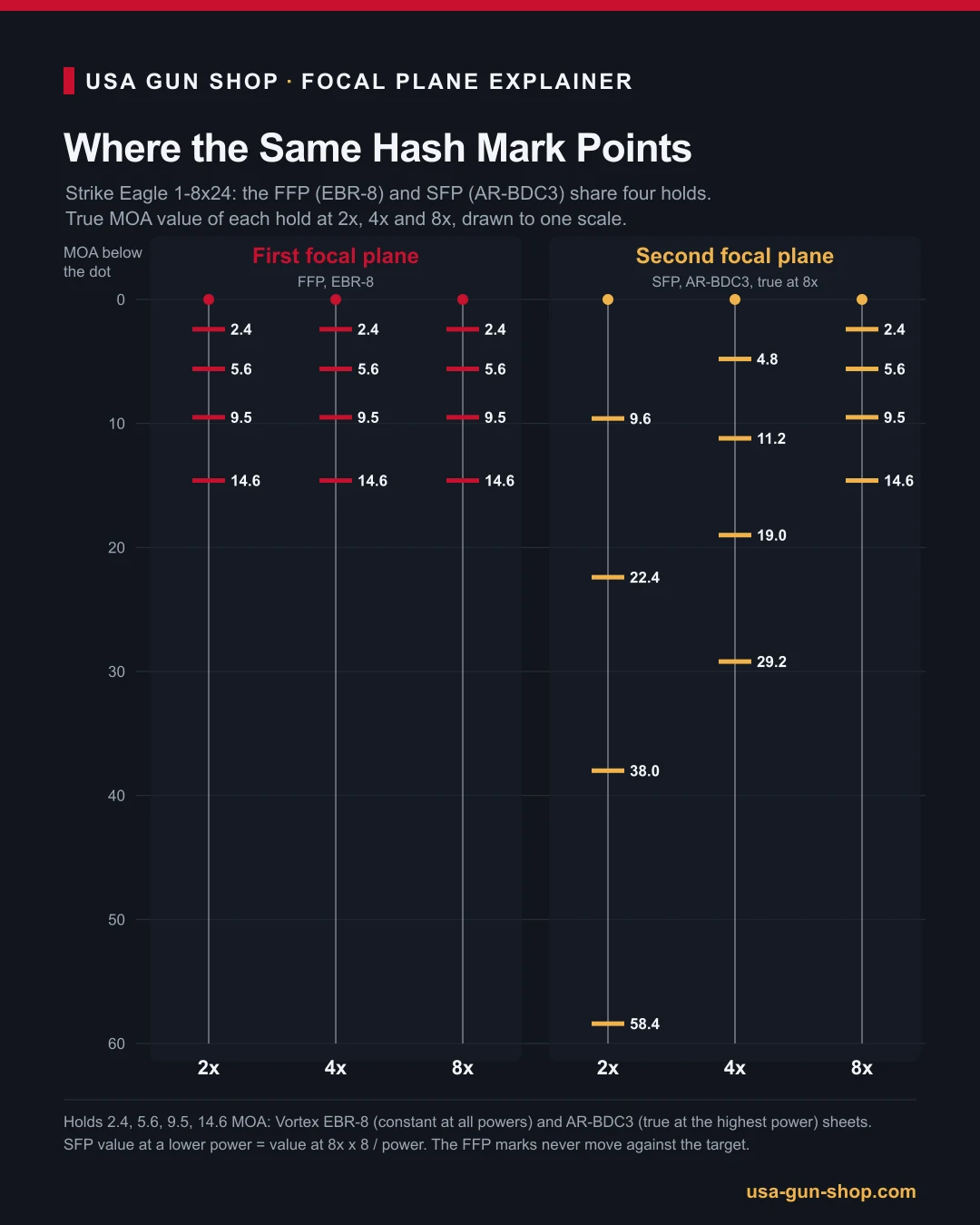
The Strike Eagle 1-8 is the cleanest example I know, because Vortex sells it in both planes with the same four holds: 2.4, 5.6, 9.5 and 14.6 MOA below the center, matched to 300, 400, 500 and 600 yards for a 60 grain 5.56 at 3,050 feet per second with a 50/200 zero.
On the FFP version those holds are right at any power. On the SFP version they’re right at 8x only. At 4x the 500-yard mark is worth 19 MOA, not 9.5, and at 2x it’s worth 38.
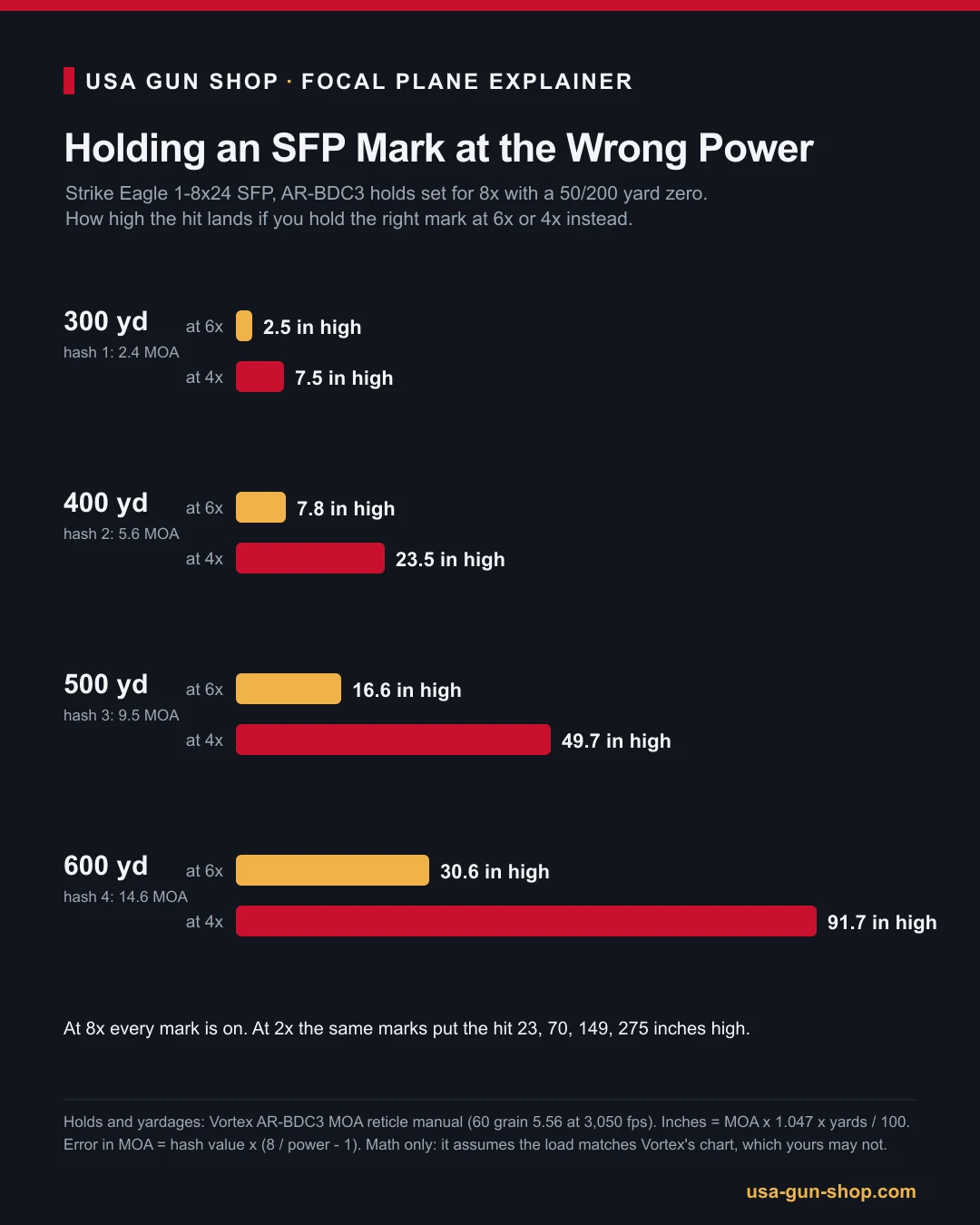
What does that do to a real shot? Inches equal MOA times 1.047 times yards divided by 100, the conversion Vortex prints in the same manual. Hold the 500-yard mark at 4x and the hit lands about 49.7 inches high. At 6x it’s still 16.6 inches high, and that’s a miss on a deer.
I made exactly this mistake on a 400-yard plate. The power ring had rolled to 4x in the case, I held the second hash, and the first round went over by about two feet. The math says 23.5 inches, and at 8x the same hold hit. Lesson learned.
| Distance | Hold at 8x | High at 6x | High at 4x | High at 2x |
|---|---|---|---|---|
| 300 yd | 2.4 MOA | 2.5 in | 7.5 in | 22.6 in |
| 400 yd | 5.6 MOA | 7.8 in | 23.5 in | 70.4 in |
| 500 yd | 9.5 MOA | 16.6 in | 49.7 in | 149.2 in |
| 600 yd | 14.6 MOA | 30.6 in | 91.7 in | 275.2 in |
Look at the 4x column. At half power you hold twice the drop, so the miss equals the drop itself: 23.5 and 49.7 inches at 400 and 500 yards are the same drops Vortex prints in the AR-BDC3 manual for its 60 grain load. Vortex prints 92.7 inches at 600; its own 1.047 conversion gives 91.7.
You can still use a second focal plane reticle, BDC or mil, off its top power if you do the math. At exactly half power, every mark is worth double, which turns a 1-8 into a scope with a coarse 4x scale. Vortex calls this the case where “additional calculations must be done.” In the field I either go to 8x or dial.
Reticle and turret units should match too. A MOA reticle with MOA turrets, or mils with mils, lets you hold what you would have dialed. Our MOA vs MRAD explainer covers the units.
Same Scope, Both Planes: Three Pairs We Tested
Three lines we review sell the same scope in both planes, which makes them the fairest first focal plane vs second focal plane test there is: the Vortex Strike Eagle 1-8x24, the Nightforce NX8 2.5-20x50 and the EOTech Vudu 3.5-18x50. Price, weight and the view shift between planes more than most buyers expect.
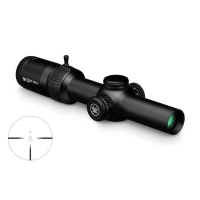
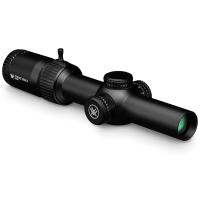
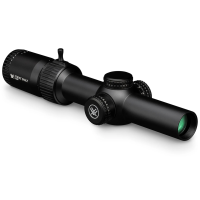
Vortex Strike Eagle 1-8x24: FFP vs SFP
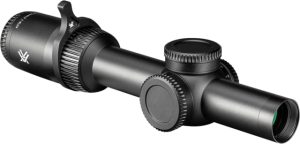
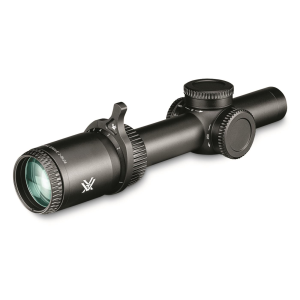
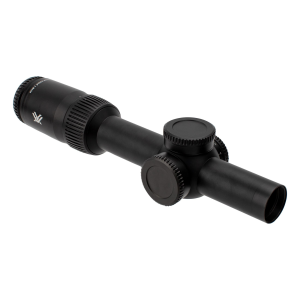
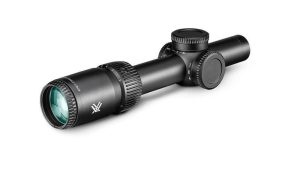
Vortex lists the FFP at $699.99 and the SFP at $559.99, a $140 gap. The FFP weighs 23.9 ounces and the SFP 17.4 ounces, both with the battery. The four main holds match, so for holdovers the plane is the difference. The bodies don’t: the FFP is 6.5 ounces heavier, with 3.9 inches of eye relief to 3.5.
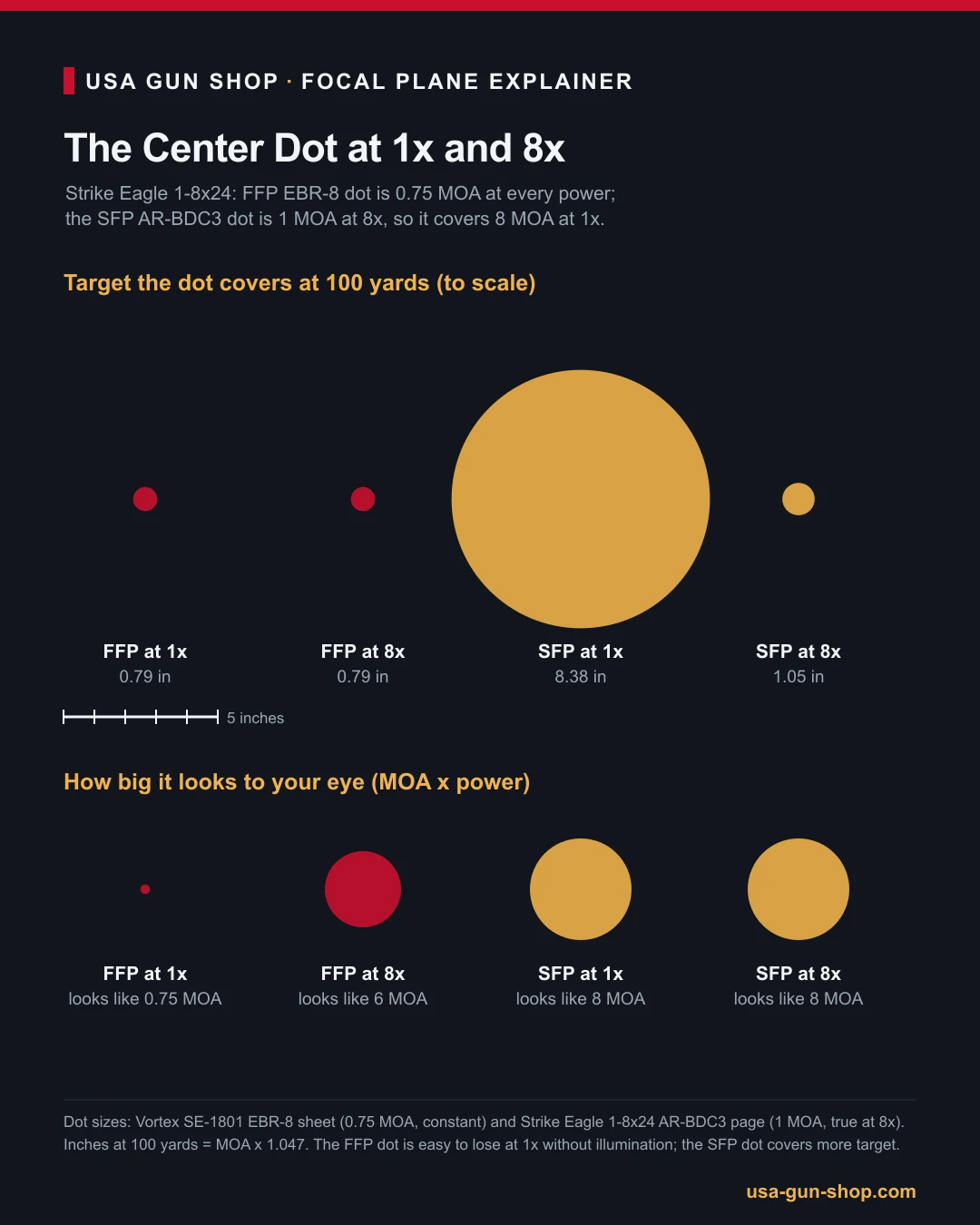
The FFP’s center dot is 0.75 MOA at every power. The SFP’s is 1 MOA at 8x, inside a 16.625 MOA broken ring that’s easy to find at 1x. On the price cards below the FFP starts at $449.49 and the SFP at $339.99, so the street gap is about $110.
Both are covered in our Vortex Strike Eagle review, which tests all five current models.
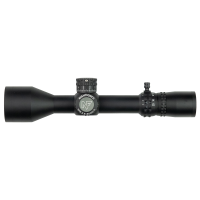
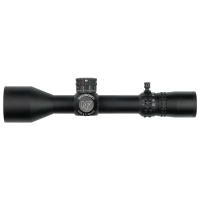
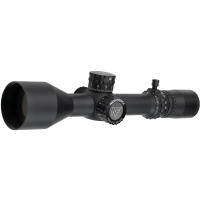
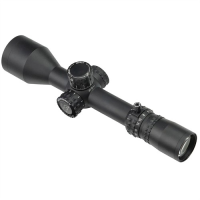
Nightforce NX8 2.5-20x50: F1 vs F2
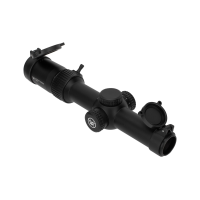
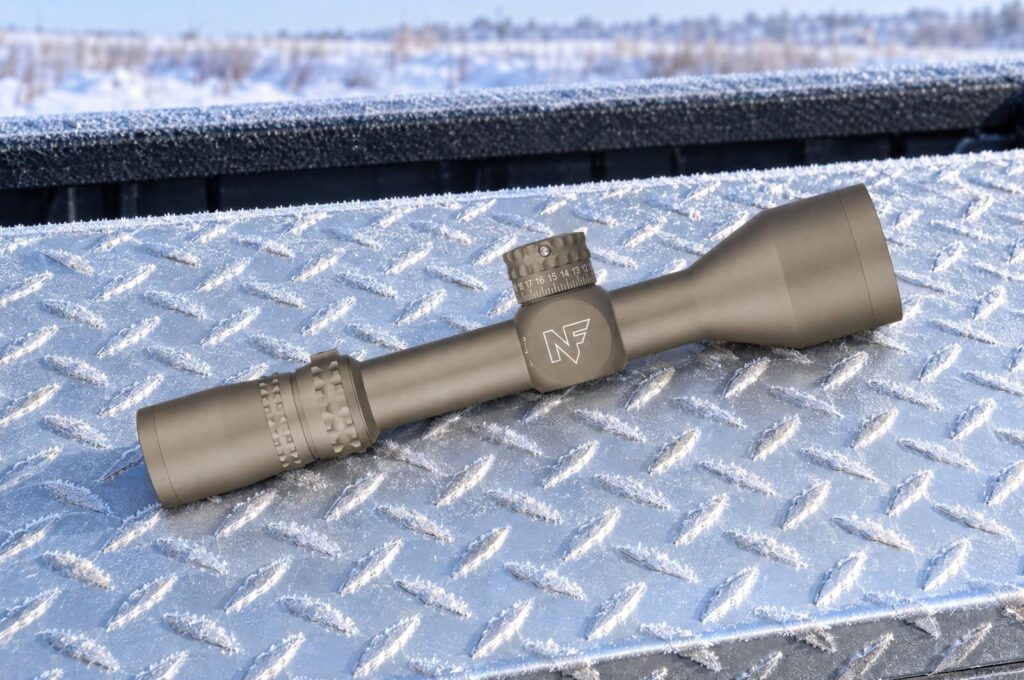
Nightforce’s F1 is first focal plane and F2 is second. The F2 weighs 28.6 ounces to the F1’s 28.3, so the first focal plane scope is the lighter one here. The F1 also has the wider field of view at the bottom: 41.8 feet at 100 yards at 2.5x against 36.7 for the F2.
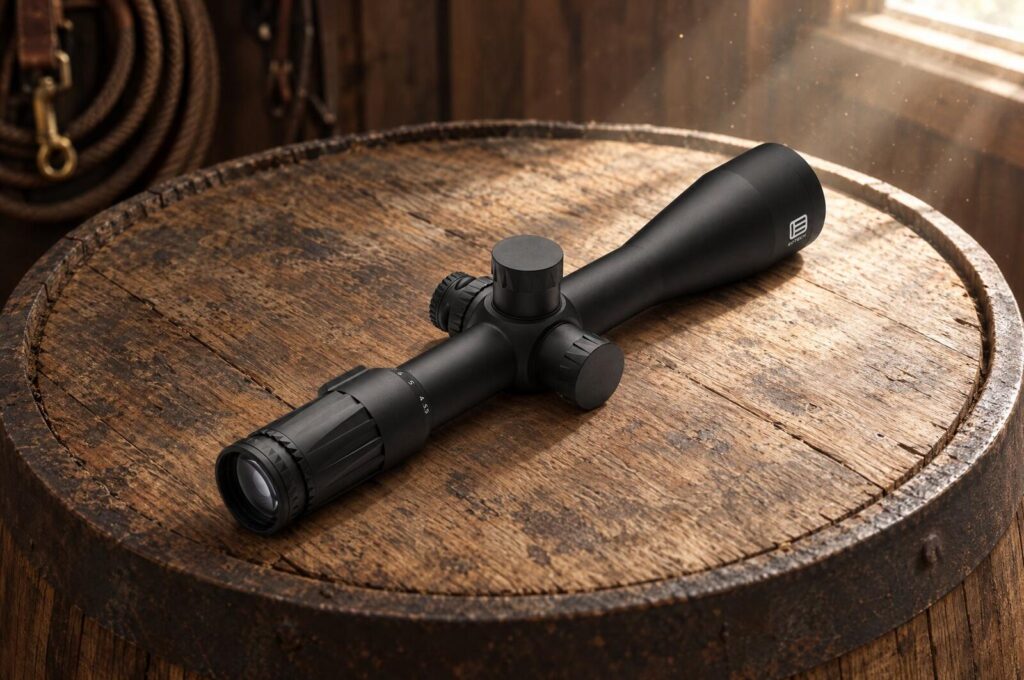
Nightforce’s sheet lists the F2’s Mil-CF2 values as “Measured @ 20x,” with a 0.05 mil floating dot and 0.2 mil hashes. At 10x those hashes are worth 0.4 mil, which I learned to respect on a windy day: I dialed instead.
Most dealers list the F1 at $2,250 and the F2 at $2,200, a $50 gap, and the cards below lead with the lowest price we found for each. Our Nightforce NX8 review covers all six NX8s, including both 1-8x24 versions.
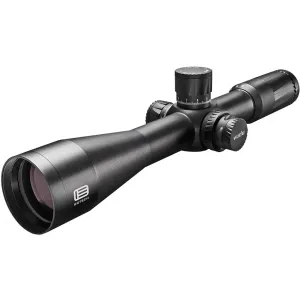
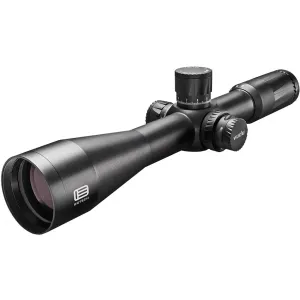
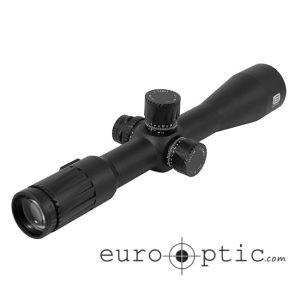
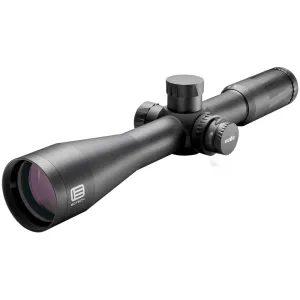
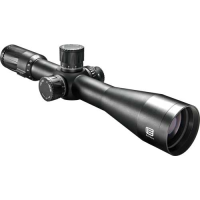
EOTech Vudu 3.5-18x50: FFP vs SFP
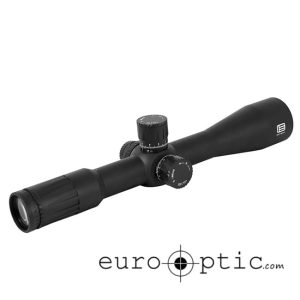
EOTech sells the 3.5-18 FFP with MD1 or MD2 reticles at $1,939 and the SFP with the HC1 at $1,719, so the first focal plane costs $220 more at list. Same 34 mm tube, same 50 mm objective, same 0.25 MOA clicks on the MOA versions.
Right now one dealer each has them within $10: the FFP card starts at $1,229.99 and the SFP at $1,223.52. Everywhere else the FFP runs about $210 more: $1,835.99 at Palmetto State Armory against $1,625 for the SFP at Lotz Outdoors and most other stores. The EOTech Vudu review goes through all eleven Vudus.
FFP vs SFP LPVO: Which Plane for a 1x Scope
For a 1-6x or 1-8x LPVO, pick SFP if you mostly shoot at 1x and want a bold dot unlit, and FFP if you want holds that work at 4x and 5x with the illumination on. The choice comes down to how small the reticle gets at 1x.
Apparent size is subtension times magnification, and it settles most FFP vs SFP LPVO arguments. The FFP Strike Eagle’s 0.75 MOA dot looks like 0.75 MOA at 1x and 6 MOA at 8x. The SFP’s dot is 1 MOA at 8x, so at 1x it covers 8 MOA of target and always looks the same, which is big and easy to find.
I lost the FFP dot against dark timber at 1x with the illumination off. The SFP’s dot never vanished. Turn the FFP’s illumination on and it works like a red dot, which is why daylight-bright illumination matters more on a first focal plane LPVO. Vortex gives the FFP Strike Eagle “nine daylight illumination settings, and two night vision compatible settings.”
On EOTech’s Vudu LPVOs the 1-6x24 FFP lists at $1,479 and the 1-8x24 SFP at $1,489, so you pay for zoom range, not the plane. EOTech’s catalog gives the SFP’s HC3 reticle “2-, 5-, 8.5-, and 12.5-MOA sub-tensions on the vertical axis” at 8x and a “0.5 MOA illuminated center dot.”
So on an LPVO, price isn’t the tiebreaker. Our best LPVO roundup and AR-15 LPVO guide rank the current picks in both planes.
SFP vs FFP for Hunting
Settle SFP vs FFP for hunting by distance: for most hunting second focal plane wins, with a constant reticle that stays visible in timber, less money, and holds at full power or a dialed turret. First focal plane earns its place on western rifles where you hold for wind at 300 to 600 yards.
Inside 200 yards you aim with the center crosshair, and that works at any power in either plane. The plane only matters once you start holding over. If you hunt at long range and hold at whatever power the shot allows, FFP stops you doing math with a deer in the scope.
At high power, a fine SFP reticle covers less of a small target. That’s why so many hunting scopes, like the Vudu 3.5-18 SFP and the NX8 F2, are second focal plane. The Nightforce 4-32 F2 goes further with a dual reticle scale, which I cover in the next section.
Before you trust any hold, confirm it on paper with your load. Our guide to sighting in a rifle scope walks through the zero, and the holds only match Vortex’s chart if your ammo does. Check our AR-15 ammo picks for 5.56 loads.
FFP vs SFP for Long Range and PRS
For long range and PRS, first focal plane wins almost by default: you range, hold wind and engage at whatever power fits the stage, and every mil mark stays a mil. Changing power between targets costs nothing when the marks never change value.
Competition stages make you change power under time pressure. An SFP reticle would make you remember which power you’re on before every hold. Our best PRS scopes roundup explains why the top picks are first focal plane.
Nightforce found a middle ground for long-range hunters on the NX8 4-32 F2. Its Mil-CF2D reticle carries a dual scale with “correct subtensions at 16x and 32x,” and the power ring has a small calibrated dot that “corresponds to the 16x reticle scale.” Nightforce’s own table lists the same hash at 0.2 mil at 16x and 0.1 mil at 32x.
I like that setup for a hunting rifle that also rings steel. Set 16x and use the coarse scale. The holds are right without math. It’s still not as fast as FFP when the power changes between shots.
Price and Weight: What First Focal Plane Costs
First focal plane costs more on most lines, but not by a fixed amount: $140 at Vortex list on the Strike Eagle 1-8, $220 at EOTech list on the Vudu 3.5-18, and about $50 at most NX8 dealers. On EOTech’s LPVOs you pay for zoom range, not the plane.
The extra cost comes from the reticle itself. It sits in front of the erector, so the zoom magnifies the etching, flaws included. That takes finer etching and tighter tolerances, and you pay for them.
Weight is a different story. It doesn’t follow the plane. The FFP Strike Eagle 1-8 is 6.5 ounces heavier than the SFP, but the NX8 F1 is 0.3 ounce lighter than the F2.
Under $500 the choice gets tighter. Our best rifle scopes under $500 lists both planes at budget prices.
How to Tell Which Focal Plane Your Scope Has
Look through the scope and turn the power ring from low to high: if the reticle grows with the target, it’s first focal plane; if it holds its size, it’s second focal plane. That test takes five seconds and settles first vs second focal plane on any scope.
- The name. FFP or SFP in the model, or F1 and F2 on Nightforce.
- The reticle sheet. An SFP sheet names the power its values are measured at, like Nightforce’s “Measured @ 20x” for the Mil-CF2.
- A known target. Put a hash on something of known size at two powers. If it covers a different amount, it’s SFP.
If you own an SFP, find its calibrated power in the manual and mark it on the power ring with paint or tape. Most are calibrated at the top end, but not every scope is.
FFP vs SFP Myths
The common myths fall apart against the makers’ own numbers: FFP isn’t more accurate or always heavier, its price premium isn’t fixed, and SFP reticles work fine at every power for the center crosshair. Each plane has one real drawback: an FFP reticle is fine and hard to see at low power, and an SFP’s holds are true at one power only.
- FFP is more accurate. The plane doesn’t change tracking, zero or groups. It changes when the marks are true.
- FFP is always heavier. The NX8 2.5-20 F1 is 28.3 ounces and the F2 is 28.6.
- SFP only works at max power. The crosshair works at any power. Only the holds move.
- FFP always costs more. On EOTech’s LPVOs the 1-6x24 FFP lists $10 under the 1-8x24 SFP. You pay for zoom range, not the plane.
The Scopes We Have Reviewed in Each Plane
These are the conventional scopes we’ve reviewed and the plane each one uses, so you can see first focal plane vs second focal plane across whole lines. Click through for the full test of each.
| Line | First focal plane | Second focal plane |
|---|---|---|
| Vortex Strike Eagle | 1-10x24, 1-8x24 FFP, 3-18x44, 5-25x56 | 1-8x24 Gen 2 with AR-BDC3 |
| Nightforce NX8 | 1-8x24 F1 capped and ZeroStop, 2.5-20x50 F1, 4-32x50 F1 | 2.5-20x50 F2, 4-32x50 F2 with the dual-scale Mil-CF2D |
| EOTech Vudu | 1-6x24, 1-10x28, 4-12x36, 3.5-18x50 FFP, 5-25x50 | 1-8x24, 3-9x32, 3.5-18x50 SFP, 8-32x50, Vudu X 1-6x24 and 2-12x40 |
Notice the pattern: the LPVOs and long-range scopes lean FFP, and the hunting-power scopes lean SFP. For the bigger picture across makers, see our best rifle scopes and the gun optics guide.
Which One Should You Buy
Match the plane to how you will use the reticle, not to what the pros run: holdovers at any power mean FFP, a crosshair and a dialed turret mean SFP, and a 1x carbine optic can go either way. By job, first focal plane vs second focal plane splits like this.
- Deer and elk hunters inside 300 yards: SFP. A bold reticle and lower price, and you won’t hold over much.
- Western hunters who hold for wind: FFP, or an SFP with a dual scale like the NX8 4-32 F2.
- PRS and steel shooters: FFP in mils, every time.
- AR carbine with an LPVO: SFP for 1x speed unlit, FFP with bright illumination for holds at 4x to 8x.
- Tight budget: SFP gets you better glass for the money; hold at full power or dial.
Whichever plane you buy, the price cards above show the lowest new prices we found for each scope.
FAQ: First Focal Plane vs Second Focal Plane
Short answers to the questions we hear most about the two planes.
What is first focal plane, and how is it different from second focal plane?
A first focal plane reticle sits in front of the zoom lenses and grows with the target, so its marks are right at every power. A second focal plane reticle stays the same size and its marks are right at one power, the top one on most scopes.
Is FFP or SFP better for hunting?
For most hunting, SFP. Its reticle stays bold in timber and costs less, and you can hold at full power or dial. Pick FFP if you hold for wind at 300 to 600 yards.
Should an LPVO be FFP or SFP?
SFP if you live at 1x and want a bold dot unlit. FFP if you want holds that work at any power, but buy one with bright illumination, because its dot is tiny at 1x.
Can you use holdovers with an SFP scope?
Yes, at the calibrated power. Off it, multiply each mark by the calibrated power divided by your power. Holding the Strike Eagle's 500-yard mark at 4x instead of 8x lands a 5.56 about 49.7 inches high.
Why do PRS shooters use first focal plane?
Because stages change power under time pressure. With FFP every mil mark stays a mil at any power, so ranging and wind holds need no math.
Is a first focal plane scope more expensive?
On most lines, yes. Vortex lists the Strike Eagle 1-8 FFP $140 above the SFP. On EOTech's Vudu LPVOs the price follows zoom range instead: the 1-6 FFP lists $10 under the 1-8 SFP.
How do I know if my scope is FFP or SFP?
Turn the power ring while looking through it. If the reticle grows with the target, it's first focal plane. If it stays the same size, it's second focal plane.
What do F1 and F2 mean on a Nightforce scope?
F1 is first focal plane and F2 is second focal plane. Nightforce lists the NX8 2.5-20 F2 reticle values as measured at 20x, and the 4-32 F2 has a dual scale correct at 16x and 32x.
Related Guides