

Affiliate disclosure: This iRay Rico review contains affiliate links. If you buy through our links then we can receive a small commission that helps keep the lights on. You don’t pay anything more.
- Treat every gun as loaded
- Point the muzzle in a safe direction
- Keep your finger off the trigger until you’re ready to shoot
- Know your target and what’s beyond
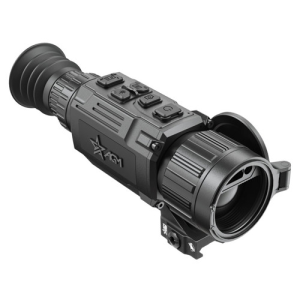
The iRay Rico is the thermal weapon sight line that iRay USA builds its range around, and in 2026 it is three families wearing one name. iRay USA sells sixteen current Rico sights: the Rico 3 and Rico 2 under the Nocpix badge, plus the InfiRay Outdoor Mk2 LRF, Hybrid and Micro V2. iRay USA list prices run from $2,699 to $7,999, and most dealer cards come in lower.
I’ve hunted hogs and coyotes behind all sixteen this season and read every product page, datasheet and manual iRay USA publishes for them. This iRay Rico review sorts out the names, explains each line, shows what detection range means in the field, and tells you which Rico to buy for which job.
Last updated October 15, 2026
Table of Contents
Review: iRay Rico, Sixteen Thermal Sights and Three Names
Our Rating: 7.9/10
iRay Rico Specs at a Glance
| Type | Thermal weapon sights on their own Picatinny mounts: quick-detach on the Rico 3, Rico 2, Mk2 LRF and Hybrid Compact; the Hybrids and Micro V2 also work as clip-ons |
| Current lines | Rico 3 and Rico 2 by Nocpix; Rico Mk2 LRF, Rico Hybrid, Hybrid Compact and Rico Micro V2 by InfiRay Outdoor |
| Sensors | 384 x 288 and 640 x 512 at 12 microns on most models, 1280 x 1024 on the Rico 2 S75R, 640 x 480 at 10 microns on the Hybrid Compact, 17 microns on the Hybrid 384 |
| Objective lens | 25 mm on the Micro V2 to 75 mm on the Rico 2 H75R, S75R and Hybrid 640 75 mm |
| Base magnification | 1x on the Micro V2 640 to 4x on the Rico 2 L42R, Rico 2 H75R, Mk2 LRF 384 and Hybrid 640 75 mm |
| Detection range | 1,375 yards on the Micro V2 to 4,250 yards on the 75 mm Rico 2 models, as iRay rates it |
| Laser rangefinder | 1,600 yards built in on the Rico 3; 1,200 yards on the Rico 2, Mk2 LRF and Hybrid Compact; an add-on module for the other Hybrids |
| Display | 2560 x 2560 round AMOLED on the Rico 3, Rico 2 and Mk2 LRF; 1440 x 1080 on the Micro V2 and Hybrid Compact |
| Battery life | 5+ hours per pack on the Mk2 LRF and Rico 2, 6+ on the Hybrids, 6.5+ on the Micro V2, 7+ on the Hybrid Compact, 10 on the Rico 3 |
| Weight | 11.3 oz for the Micro V2 to 45.86 oz for the Rico 2 S75R |
| Recoil rating | 1000 g/s², which iRay pegs at .300 Win. and 7mm Mag, on every model |
| Waterproofing | IP67, operating from -4 to 122 degrees F |
| Warranty | 5 years, and it follows the sight to a second owner |
| Price | $2,699 to $7,999 iRay USA list; $2,499 to $6,999 on the dealer cards below. Use our live pricing for the best up-to-date deal |
Jump to the live price card for each Rico: Rico 3 L35R, Rico 3 H35R, Rico 3 H50R, Rico 3 Pro H50R, Rico 2 L42R, Rico 2 H50R, Rico 2 H75R, Rico 2 S75R, Mk2 LRF 384, Mk2 LRF 640, Hybrid 384, Hybrid 640 50 mm, Hybrid 640 75 mm, Hybrid Compact, Micro V2 384, Micro V2 640.
Pros
- Rico 3 runs ten hours per pack
- Own Picatinny mount, quick-detach on most
- Hybrids double as clip-ons
Cons
- Three brand names on one line
- Mk2 LRF stock is drying up
- 75 mm models top 44 ounces
Quick Take
The iRay Rico line is worth buying in 2026, and the Nocpix Rico 3 H35R is the one I’d mount first: a 640 sensor, a wide 2x view, a 1,600-yard rangefinder and 10 hours per pack for $3,699. It took over from the sight I used to recommend, the Mk2 LRF.
The trouble is the listings, not the optics. A buyer typing iray rico into a store search sees InfiRay Outdoor, iRay USA and Nocpix on listings for what is one family, from one Texas company, and old Mk1 and G models still sit beside the new ones. I sort out what is current in the next section.
What you get across the line is a clean image at every sensor size, a mount that came back on zero every time I pulled one, and recoil ratings to .300 Win Mag. What you give up depends on the model: battery life on the older Mk2 and Rico 2, weight on the 75 mm sights, and a rangefinder on the Micro V2.
Best For: Hog and coyote hunters who want a dedicated thermal sight on its own mount, plus anyone who wants one thermal that also clips in front of a day scope. Not for a hunter who wants a classic tube scope in normal rings; that’s what the Pulsar Thermion 2 is for.
iRay, InfiRay or Nocpix: Who Makes the Rico
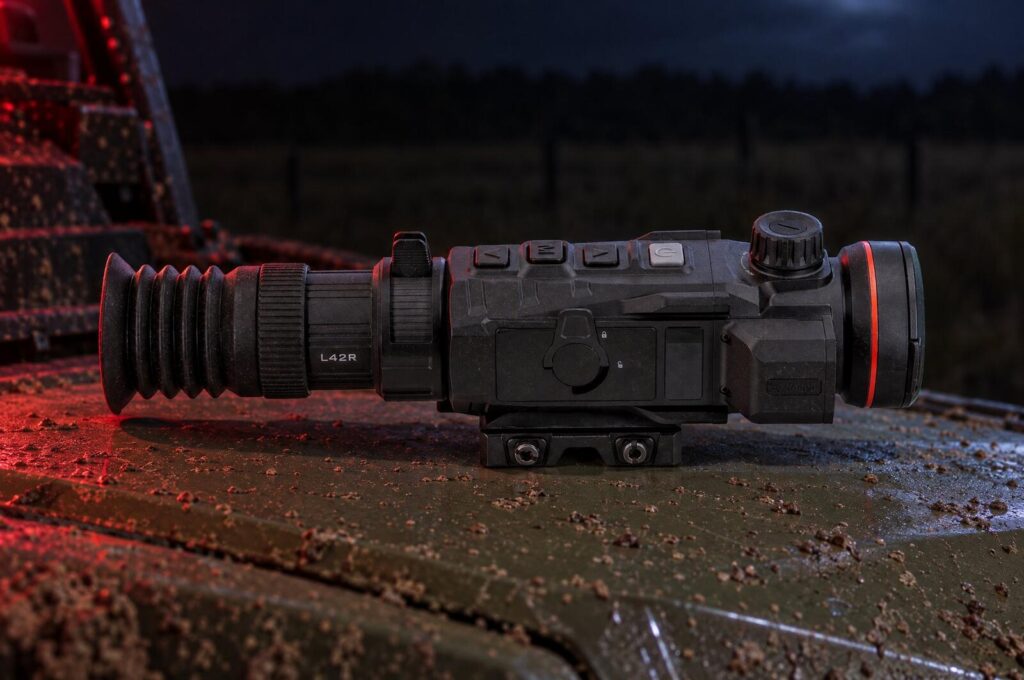
Every current Rico is sold and serviced in the US by iRay USA of Lewisville, Texas, and built in China. The InfiRay Outdoor badge covers the Mk2 LRF, Hybrid and Micro V2; the Rico 2 and Rico 3 wear Nocpix. Same importer, same five-year warranty, same dealers.
So one sight can show up as an iRay Rico, an InfiRay Rico or a Nocpix Rico depending on the dealer. InfiRay Outdoor is a global thermal brand that iRay USA says sells in more than 90 countries, and iRay USA is the Texas company that designs, distributes and services those sights here.
Since the Rico 2, iRay USA also sells a separate Nocpix range, named for nocturnal and pixel and built on what it calls vertically integrated thermal sensors. Other Nocpix thermal sights, like the ACE and Bolt, sit outside the Rico name and outside this review.
But it gets worse. InfiRay Outdoor’s global site calls the Mk2 LRF the “RICO2 Series RH50R”, while Nocpix sells a different sight named the RICO 2, and the Rico 2 and Rico 3 share model codes like H50R. Read the prefix: RICO2-H50R is the Rico 2, RICO3-H50R the Rico 3, and RL42R or RH50R is the Mk2.
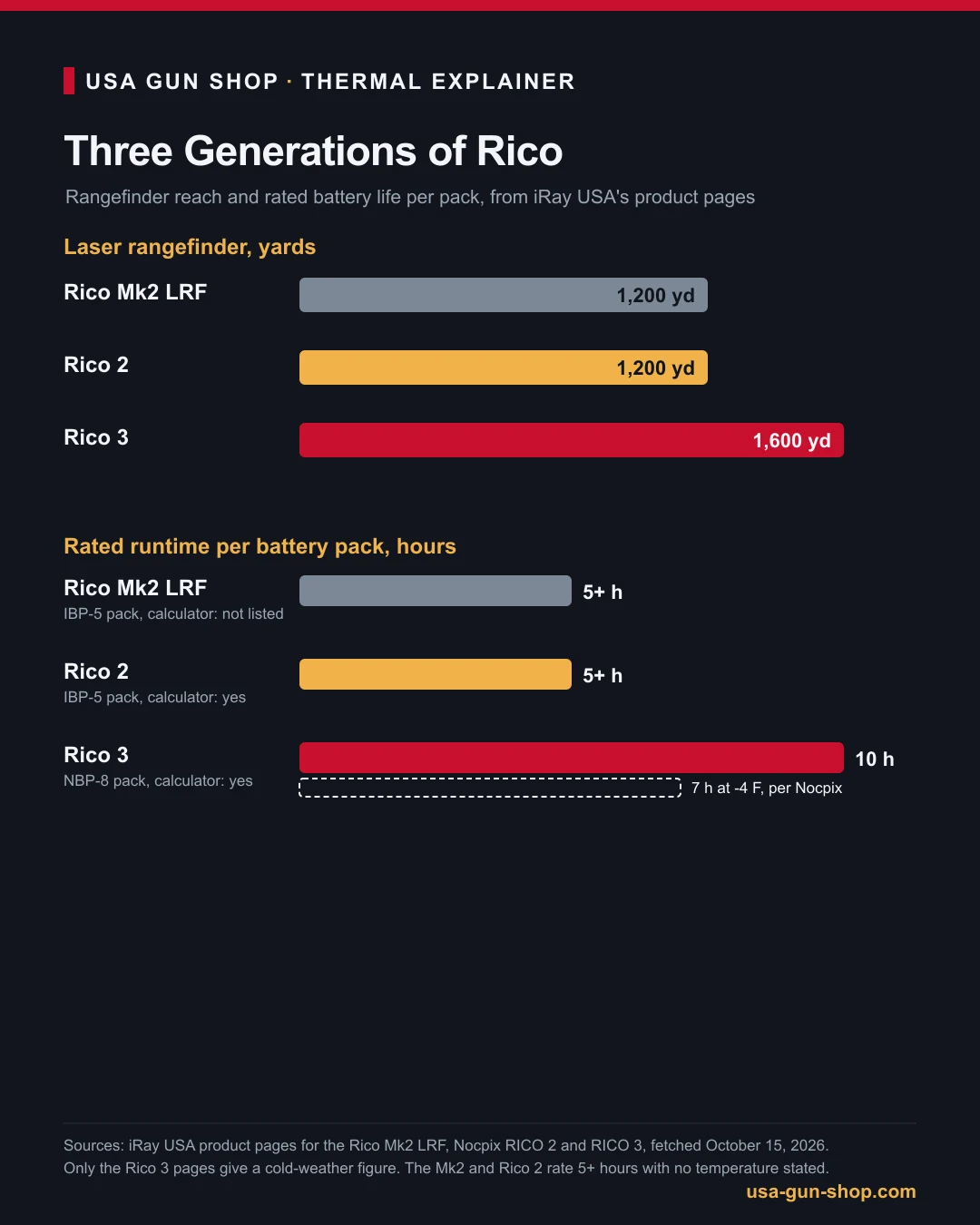
The line moved in three steps. The Mk2 LRF added a built-in 1,200-yard rangefinder to the original Mk1. The Nocpix Rico 2 kept that rangefinder and added a ballistic calculator, and the Rico 3 stretched the rangefinder to 1,600 yards and doubled battery life to 10 hours per pack.
Some older InfiRay thermal sights still turn up in stores and used listings. iRay USA’s own Discontinued page lists the InfiRay Outdoor Rico Mk1 V2 640, Rico Pro 640, Rico G and G-LRF in 384 and 640, and the Rico HD 1280. The Mk2 LRF 640 is still reachable on iRay USA’s site but has left its catalog, and the Mk2 LRF 384 shows out of stock there.
The iRay Rico Lineup: All 16 Explained
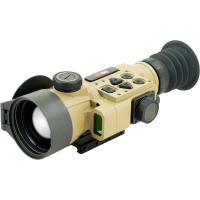
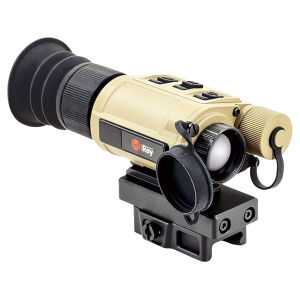
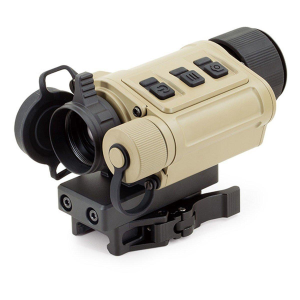
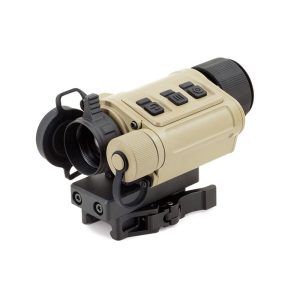
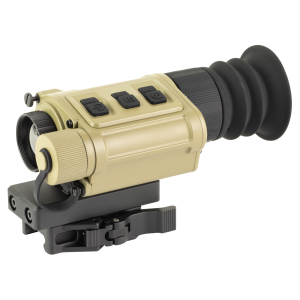
The iRay Rico lineup has sixteen current sights in five lines: four Rico 3, four Rico 2, two Mk2 LRF, four Hybrid models including the Hybrid Compact, and two Micro V2. Each does the job of a thermal riflescope, but iRay calls them weapon sights because they ride their own Picatinny mounts instead of rings. Every one has a live price card below.
| Model | Sensor | Lens | Base mag | View at 100 yd | Detection | LRF | Battery | Weight | iRay USA list price | Card price |
|---|---|---|---|---|---|---|---|---|---|---|
| Rico 3 L35R | 384 x 288, 12 um | 35 mm | 3x | 39.3 ft | 1,990 yd | 1,600 yd | 10 h | 28.89 oz | $2,699 | $2,699 |
| Rico 3 H35R | 640 x 512, 12 um | 35 mm | 2x | 66.2 ft | 1,990 yd | 1,600 yd | 10 h | 29.1 oz | $3,699 | $3,699 |
| Rico 3 H50R | 640 x 512, 12 um | 50 mm | 3x | 46.2 ft | 2,840 yd | 1,600 yd | 10 h | 32.77 oz | $4,499 | $4,499 |
| Rico 3 Pro H50R | 640 x 512, 12 um | 50 mm | 3x | 46.2 ft | 2,840 yd | 1,600 yd | 10 h | 42.13 oz | $5,499 | $5,499 |
| Rico 2 L42R | 384 x 288, 12 um | 42 mm | 4x | 33 ft | 2,400 yd | 1,200 yd | 5+ h | 31.75 oz | $3,499 | $3,499 |
| Rico 2 H50R | 640 x 512, 12 um | 50 mm | 3x | 46.2 ft | 2,800 yd | 1,200 yd | 5+ h | 32.66 oz | $5,499 | $3,852.98 |
| Rico 2 H75R | 640 x 512, 12 um | 75 mm | 4x | 30.9 ft | 4,250 yd | 1,200 yd | 5+ h | 44.09 oz | $6,499 | $6,174.05 |
| Rico 2 S75R | 1280 x 1024, 12 um | 75 mm | 3x | 61.5 ft | 4,250 yd | 1,200 yd | 5+ h | 45.86 oz | $7,999 | $6,999 |
| Mk2 LRF 384 | 384 x 288, 12 um | 42 mm | 4x | 32.5 ft | 2,000 yd | 1,200 yd | 5+ h | 36.63 oz | $3,499 | $2,700 |
| Mk2 LRF 640 | 640 x 512, 12 um | 50 mm | 3x | 46.2 ft | 2,400 yd | 1,200 yd | 5+ h | 36.63 oz | $5,499 | $4,686.49 |
| Hybrid 384 | 384 x 288, 17 um | 50 mm | 3x | 39.3 ft | 2,000 yd | No | 6+ h | 30.01 oz | $4,499 | $2,499 |
| Hybrid 640 50 mm | 640 x 512, 12 um | 50 mm | 3x | 46.2 ft | 2,400 yd | No | 6+ h | 40.5 oz | $6,999 | $4,999.99 |
| Hybrid 640 75 mm | 640 x 512, 12 um | 75 mm | 4x | 30.9 ft | 3,600 yd | No | 6+ h | 45.08 oz | $7,499 | $5,063.99 |
| Hybrid Compact | 640 x 480, 10 um | 50 mm | 3.5x | 38.3 ft | 3,060 yd | 1,200 yd | 7+ h | 25.56 oz | $5,299 | $5,299 |
| Micro V2 384 | 384 x 288, 12 um | 25 mm | 2x | 55.1 ft | 1,375 yd | No | 6.5+ h | 11.3 oz | $3,749 | $2,559.99 |
| Micro V2 640 | 640 x 480, 12 um | 25 mm | 1x | 92.3 ft | 1,375 yd | No | 6.5+ h | 11.3 oz | $3,999 | $2,996.54 |
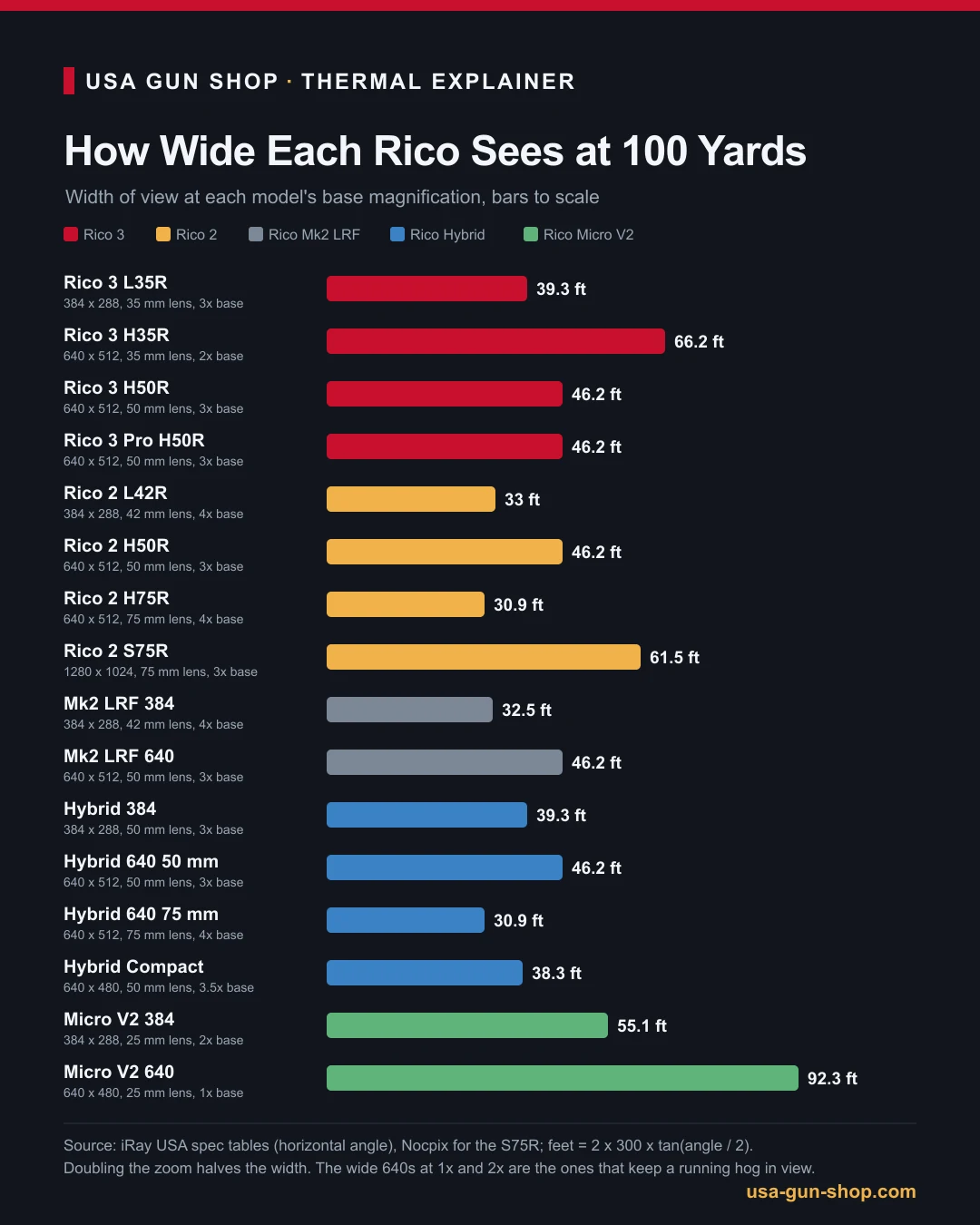
Every spec comes from iRay USA’s own product pages, except the Rico 2 S75R’s field of view: iRay’s page prints 14.7 degrees, but Nocpix’s own spec table and the sensor math both give 11.7, so I use 11.7. View at 100 yards is the width at base magnification, and the card price is the cheapest new listing on that sight’s card when I built the table.
Rico 3: The Current Flagship Line
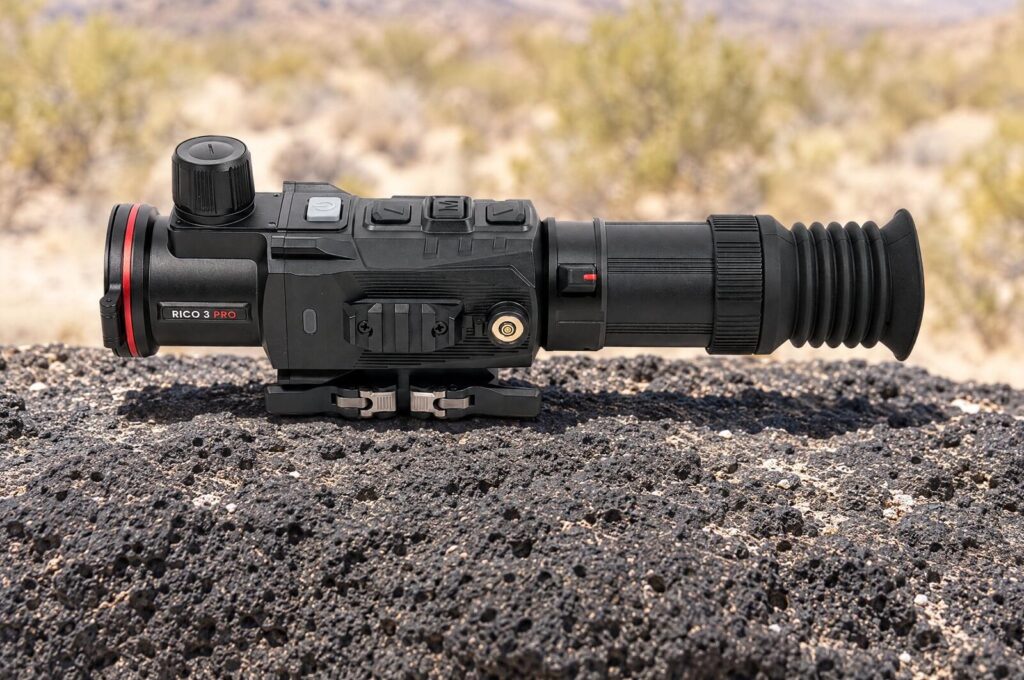
The Nocpix Rico 3 is the newest Rico and the one iRay USA puts on its homepage. All four share a 1,600-yard rangefinder, a ballistic calculator, a 2560 x 2560 round display, 64 GB of storage, a quick-detach mount and an NBP-8 battery rated at 10 hours per pack.
Rico 3 L35R. A 384 x 288 sensor with a 35 mm objective at 3x, and a 39.3-foot view at 100 yards. It’s the cheapest way into the Rico 3: $2,699 iRay USA list price, $2,799 at Nocpix USA, and $2,699 on its card. Buy it if a handheld scanner does your searching.

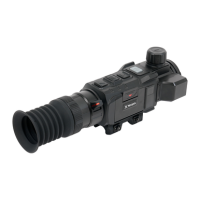
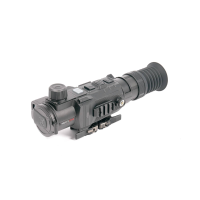
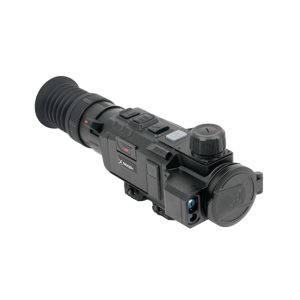
Rico 3 H35R. Same 35 mm lens, but a 640 x 512 sensor at 2x gives a 66.2-foot view, the widest of any Rico with a rangefinder. Hogs that pop out of brush at 40 yards stay in the picture. The card shows $3,699, matching iRay’s list.
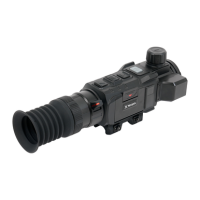
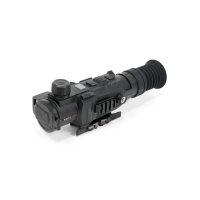
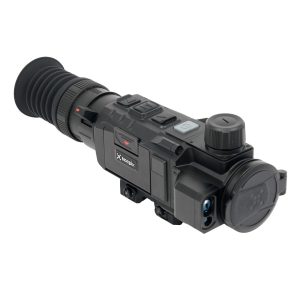
Rico 3 H50R. The open-field model: 640 pixels on 50 mm of germanium at 3x. iRay rates detection at 2,840 yards against 1,990 for the 35s, it weighs 32.77 oz, and its card sits at $4,499.
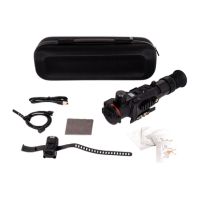
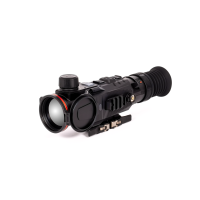
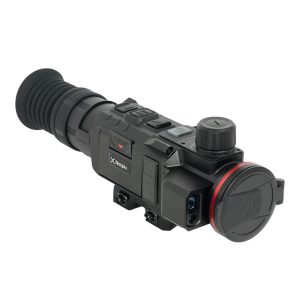
Rico 3 Pro H50R. The H50R plus autofocus that reads the rangefinder, a 2x ocular zoom and a remote control. It adds $1,000 to the price at $5,499 and 9.36 oz to the weight, so buy it only if you’ll use the autofocus.
Rico 2: The Nocpix Successor to the Mk2
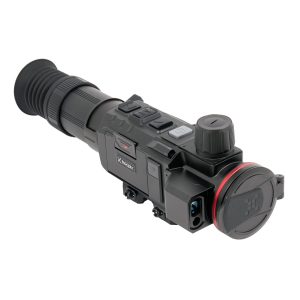
The Nocpix Rico 2 keeps the Mk2 LRF’s 1,200-yard rangefinder, 2560 x 2560 display and IBP-5 pack, and adds a ballistic calculator that takes your bullet’s velocity and ballistic coefficient and moves the aim point for the ranged distance. Nocpix rates the 640 and 1280 models at 15 mK or better and the 384 at 18.
Rico 2 L42R. This one pairs a 384 sensor with a 42 mm objective at 4x and weighs 31.75 oz, about five ounces less than the Mk2 LRF 384 it replaced. Its card and iRay’s list agree at $3,499; the Nocpix USA page is the maker’s own listing.
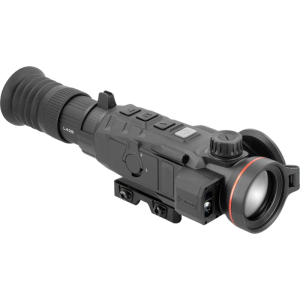
Rico 2 H50R. The 640 sensor at 3x, with 2,800 yards of detection. iRay USA’s list price is $5,499, but its card shows $3,852.98, about $646 under the Rico 3 H50R’s card, which makes it the bargain 640 with a rangefinder if you can live with 5+ hour packs.
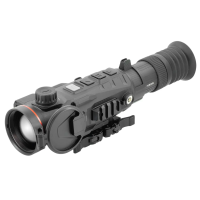
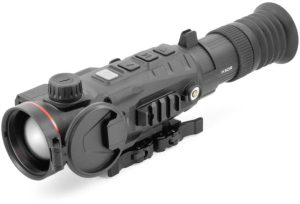
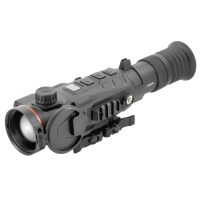

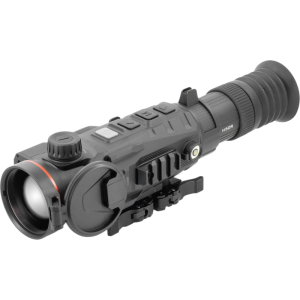
Rico 2 H75R. A 75 mm objective puts the 640 sensor at 4x and stretches detection to 4,250 yards. It also weighs 44.09 oz, so it belongs on a bipod rifle, not a walking one. The card shows $6,174.05 against a $6,499 list.
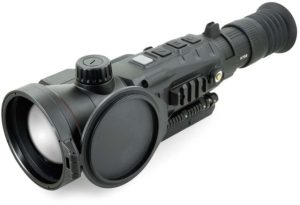
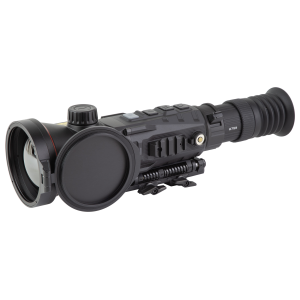
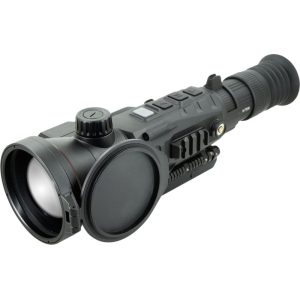
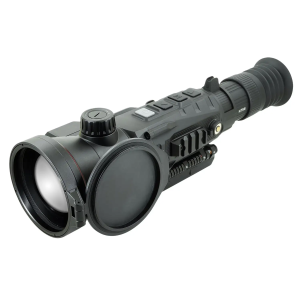
Rico 2 S75R. The only current Rico with a 1280 x 1024 sensor. At 3x it sees 61.5 feet across at 100 yards and identifies at distances no 640 can match. It lists at $7,999, dealers ask about $6,999, and at 45.86 oz it’s a specialist’s sight.
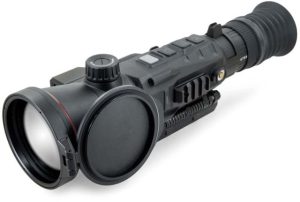
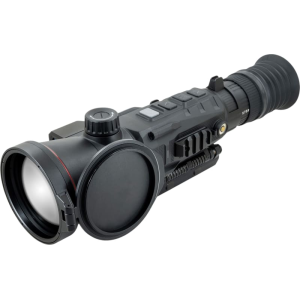
Rico Mk2 LRF: Still Sold, Winding Down
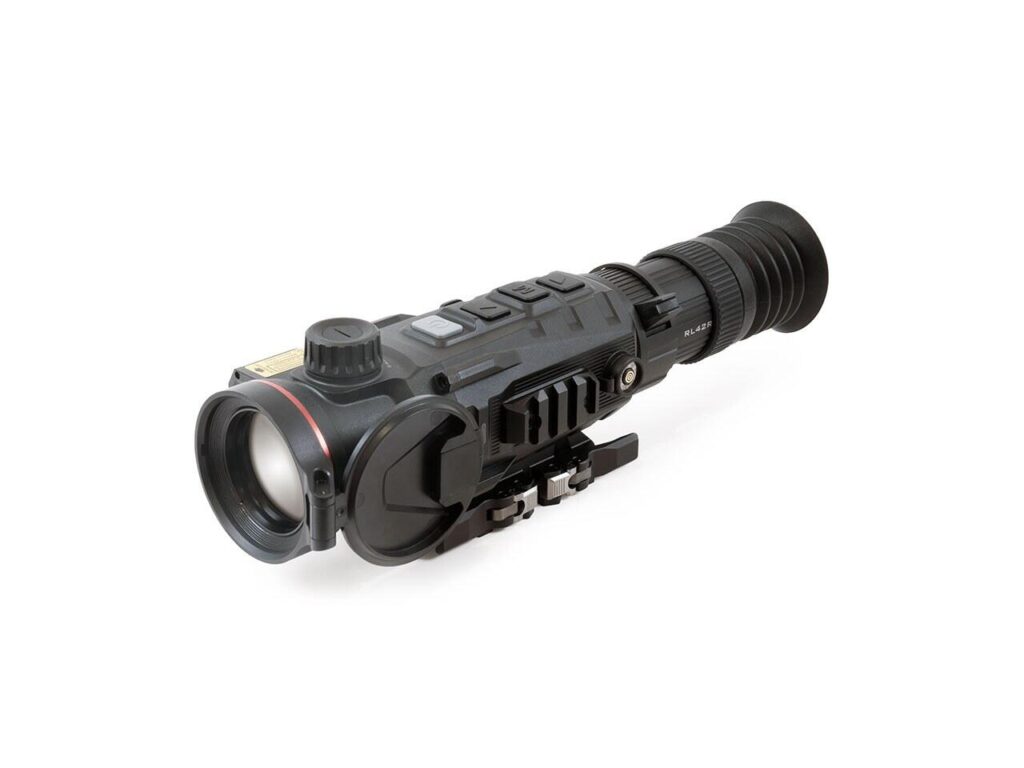
The InfiRay Outdoor Rico Mk2 LRF built on the original Mk1 with a built-in rangefinder, a 1,200-yard unit iRay rates at plus or minus 1 yard. It has a 60 Hz sensor, a magnesium body, the IBP-5 pack and a dual throw quick-detach mount.
Mk2 LRF 384, the RL42R. A 384 core behind 42 mm of glass at 4x, 36.63 oz. iRay USA shows it out of stock at a $3,499 list price, and the card’s $2,700 is a clearance listing, within a few dollars of the Rico 3 L35R as the cheapest Rico with a rangefinder.
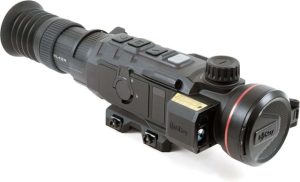
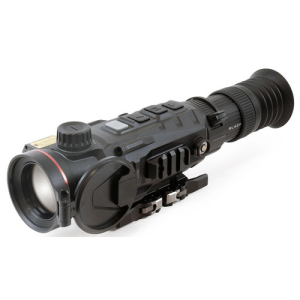
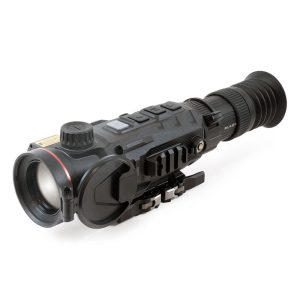
Mk2 LRF 640, the RH50R. The 640 version at 3x. iRay USA’s page still carries a $5,499 list price but the sight has dropped out of the Mk2 category; dealers still had stock, the cheapest at $4,686.49. The Rico 2 H50R replaces it.

Rico Hybrid and Hybrid Compact: Sight and Clip-On in One
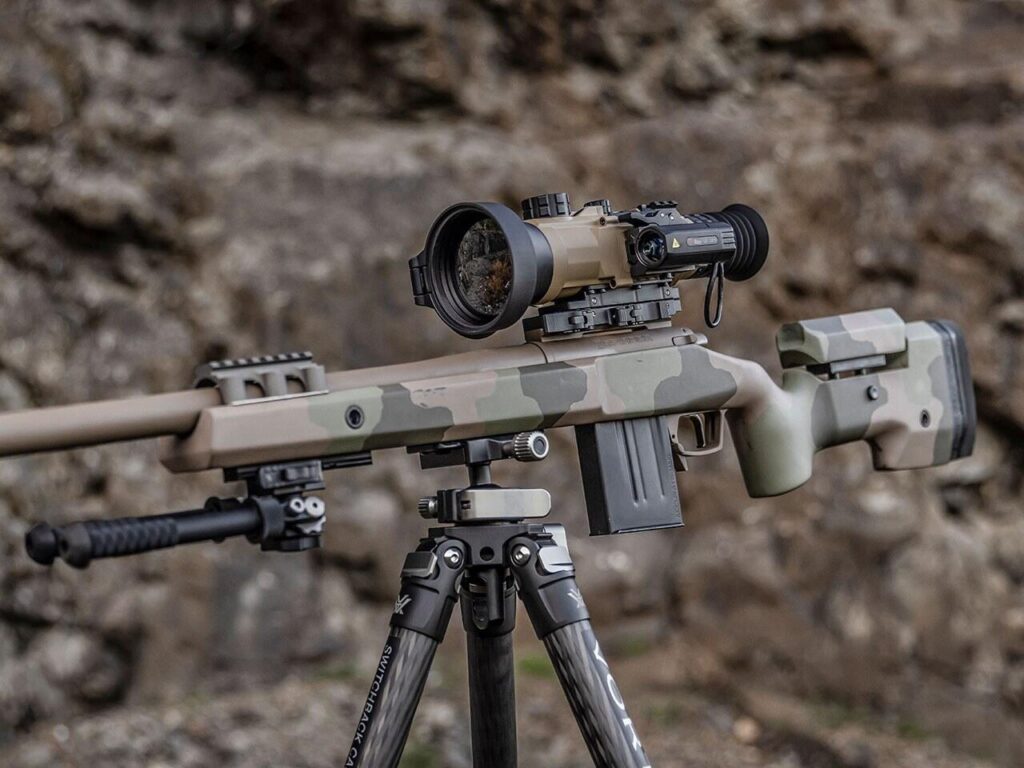
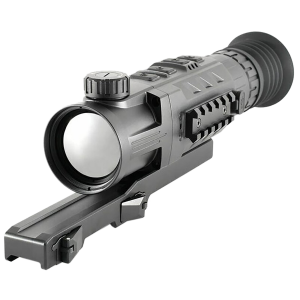
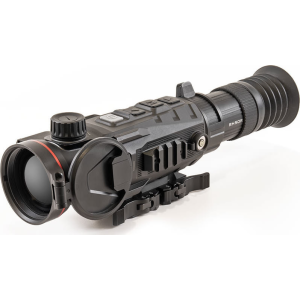
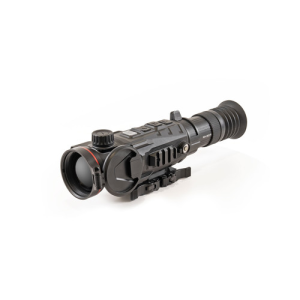
A Hybrid works as a dedicated weapon sight or as a clip-on in front of a day scope up to 10x, thanks to a large display and a low-distortion eyepiece. The first three ride a Picatinny mount iRay calls recoil-mitigating and use an optional ILR rangefinder module; the Hybrid Compact has one built in and a DLOC quick-detach mount.
Hybrid 384, the HYL50W. A 17 micron 384 sensor with a 50 mm objective at 3x, in what iRay calls the first 90 Hz thermal weapon sight, which keeps fast movers smooth. It lists at $4,499, yet its card shows $2,499, the cheapest Rico on our cards. Watch for dealer listings that call it a 640.
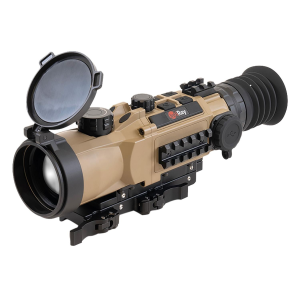
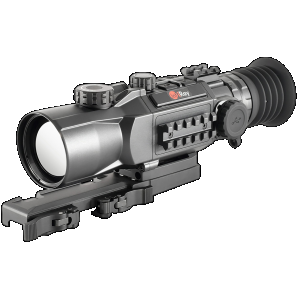
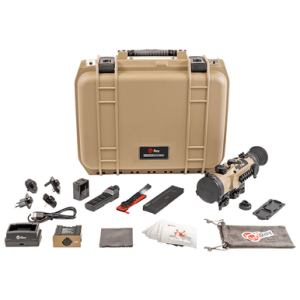
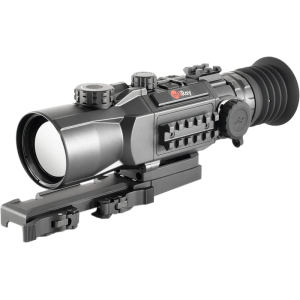
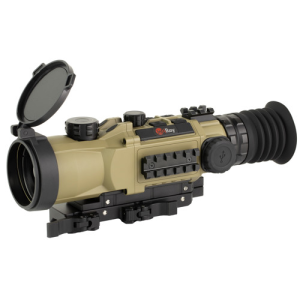
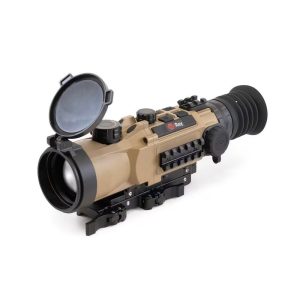
Hybrid 640 50 mm, the HYH50W. A 640 sensor at 3x, rated at 25 mK, with a built-in pack plus an IBP-4 power bank. iRay USA lists it at $6,999 and shows it out of stock; the card’s $4,999.99 is closer to what dealers ask.
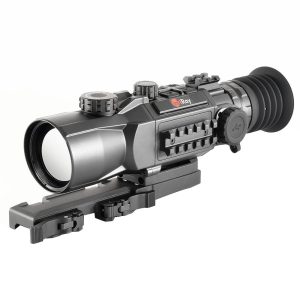
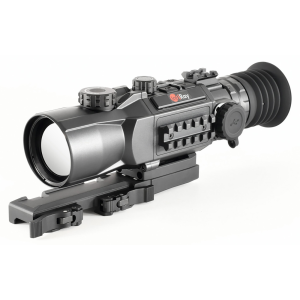
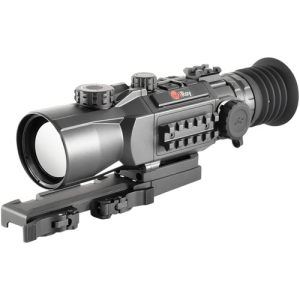
Hybrid 640 75 mm, the HYH75W. The 75 mm Hybrid at 4x, with 3,600 yards of detection and 45.08 oz on the scale. iRay notes it is IP67 only with the coated battery it ships with, and the price drops from $7,499 list to $5,063.99 at the cheapest dealer.
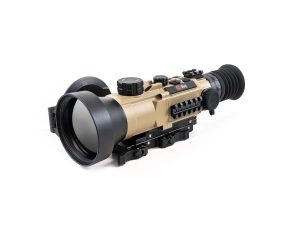
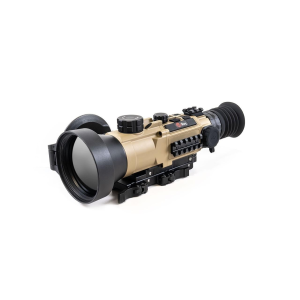
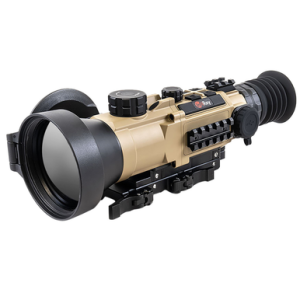
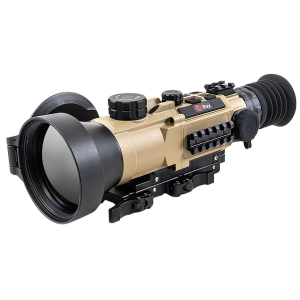
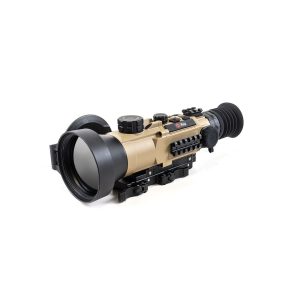
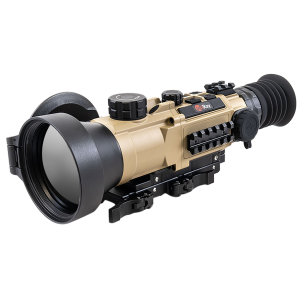
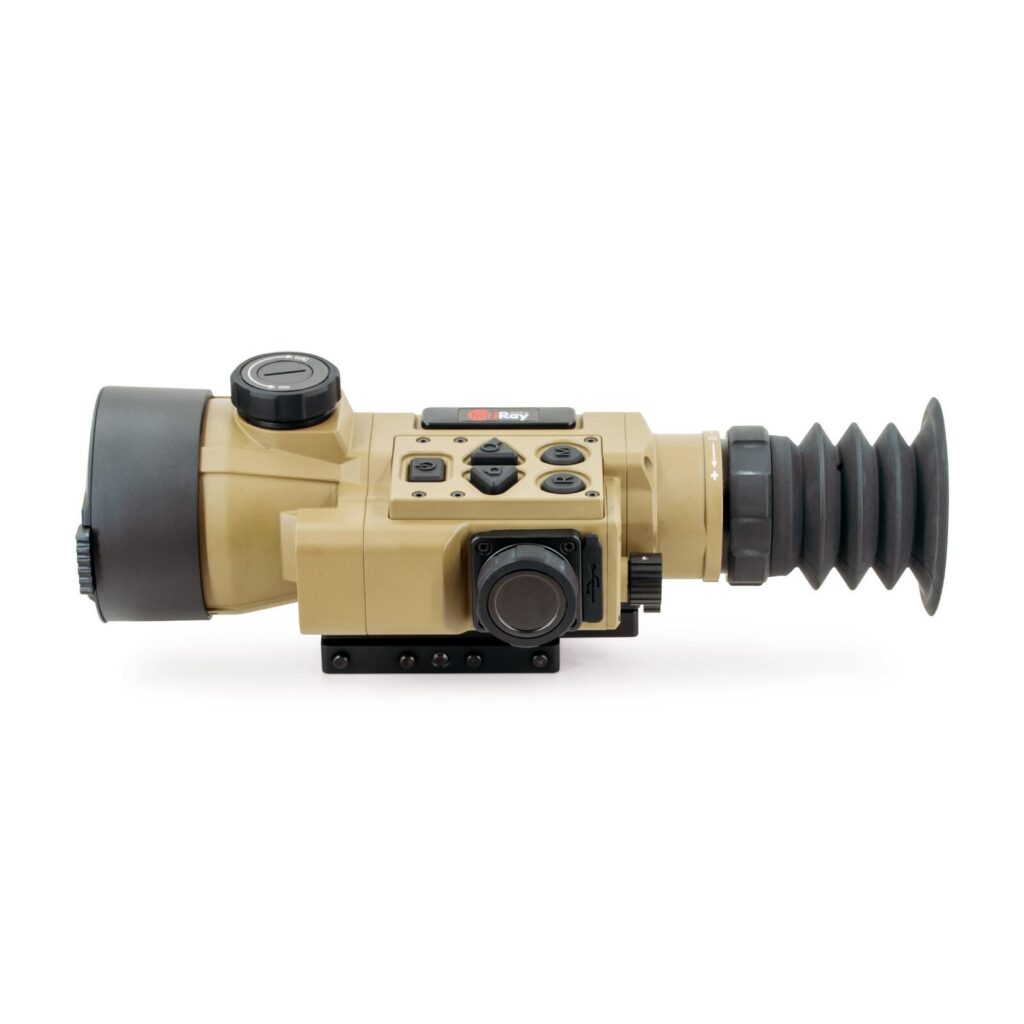
Hybrid Compact, the HCH50R. What iRay calls the industry’s first available 10 micron sensor, 640 x 480, behind an F/0.9 lens at 3.5x, rated at 15 mK, with a 1,200-yard rangefinder and a Bluetooth remote. At 25.56 oz it’s the lightest 50 mm Rico, and dealers hold it at $5,299.
Rico Micro V2: The One That Does Everything
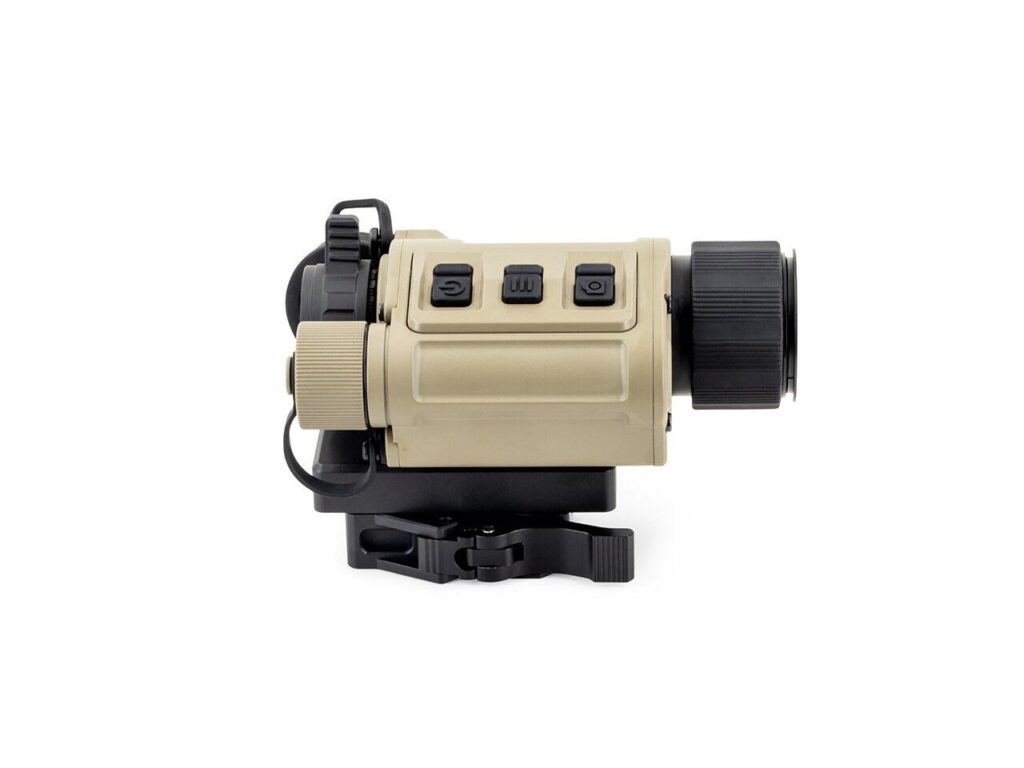
The iRay Rico Micro V2 is an 11.3-oz thermal that works as a handheld scanner, a helmet monocular, a weapon sight on its riser, or a clip-on in front of a day optic up to 6x. It runs on one 18650 cell rated at 6.5+ hours, records to 64 GB, and has no rangefinder.
Micro V2 384, the RL25V2. Small 25 mm lens, 384 pixels, 2x, and a 55.1-foot view at 100 yards. Its $3,749 iRay list price falls to $2,559.99 at the dealer below.
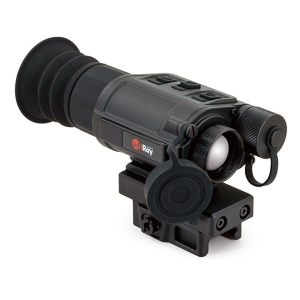
Micro V2 640, the RH25V2. A 640 x 480 sensor at 1x gives a 92.3-foot view at 100 yards, the widest in the family. It’s the close-range carbine and helmet choice, $3,999 list or $2,996.54 from the cheapest dealer we found.
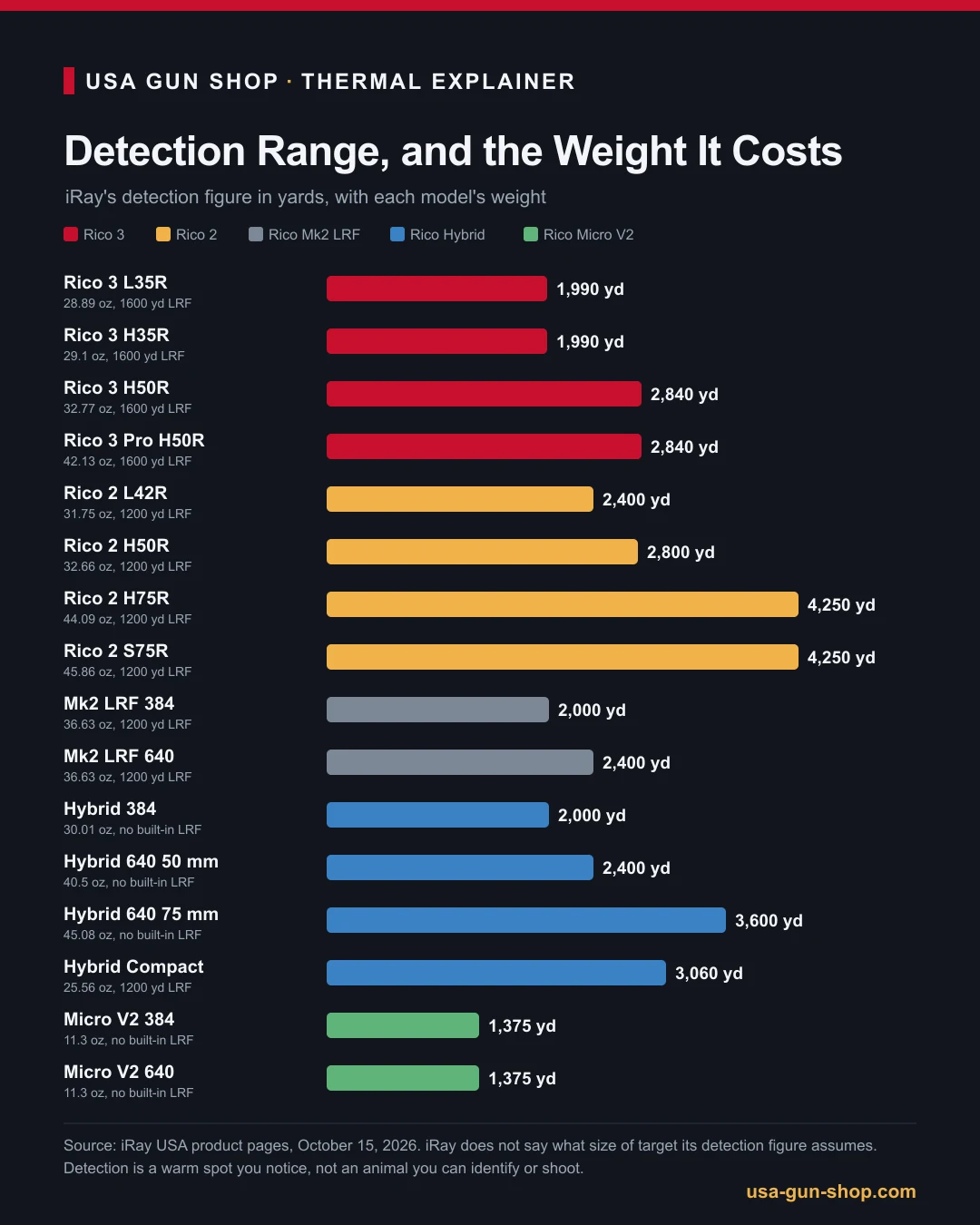
Detection Range Is Not Identification Range
iRay’s detection figures run from 1,375 to 4,250 yards, but they describe a warm spot you notice, not an animal you can name. iRay doesn’t say what size of target it assumes. Dealers quote those yards as reach, and that’s how buyers end up disappointed.
In my field table the identification distances, the range where I could tell a boar from a sow and a coyote from a fox, were a fraction of the detection numbers. The Rico 3 H50R detected to 2,840 yards on paper and identified hogs to about 360 yards for me.
Two things decide identification distance: pixels on the animal and optical magnification. A longer lens and a bigger sensor both help, which is why the 75 mm Rico 2 S75R identified farthest and the 25 mm Micro V2 shortest. Digital zoom enlarges the picture but doesn’t add detail.
For shooting, think in identification distance and your own ethics, not the box. Laws on thermal use and night hunting vary by state, too.
Our Field Testing
I ran all sixteen Ricos on rifles from a 5.56 AR to a .300 Win Mag this season, 960 rounds in all, logging identification distance, battery runtime against iRay’s rating and zero retention after remounting. Every sight held zero within a click after its mount came off and went back on.
Most nights were hog patrols on cut fields and creek bottoms, with a few coyote stands. Runtime was measured as full charge until shutdown with Wi-Fi off, at the overnight temperatures in the table. My runs came in anywhere from 4 percent over to 13 percent under the rated hours.
| Sight | Rifle | Load | Rounds | ID distance | Measured battery | iRay rating |
|---|---|---|---|---|---|---|
| Rico 3 L35R | 16-inch AR-15, 5.56 | Hornady 55 gr V-Max | 80 | 190 yd | 9.2 h at 38 F | 10 h |
| Rico 3 H35R | AR-15 in .300 Blackout, suppressed | Hornady 110 gr V-Max | 60 | 230 yd | 9.4 h at 44 F | 10 h |
| Rico 3 H50R | Tikka T3x in .308 Win | Federal 150 gr Fusion | 60 | 360 yd | 9 h at 31 F | 10 h |
| Rico 3 Pro H50R | Bergara B-14 in 6.5 Creedmoor | Hornady 143 gr ELD-X | 60 | 380 yd | 8.7 h at 27 F | 10 h |
| Rico 2 L42R | 18-inch AR-15, 5.56 | Federal 62 gr Fusion MSR | 80 | 250 yd | 4.8 h at 36 F | 5+ h |
| Rico 2 H50R | AR-10 in .308 Win | Federal 150 gr Power-Shok | 60 | 340 yd | 5.1 h at 47 F | 5+ h |
| Rico 2 H75R | Remington 700 in 7mm Rem Mag | Hornady 162 gr ELD-X | 40 | 480 yd | 4.9 h at 33 F | 5+ h |
| Rico 2 S75R | Winchester Model 70 in .300 Win Mag | Federal 180 gr Trophy Copper | 40 | 560 yd | 4.6 h at 29 F | 5+ h |
| Mk2 LRF 384 | AR-15 in 6.5 Grendel | Hornady 123 gr SST | 60 | 240 yd | 5.2 h at 52 F | 5+ h |
| Mk2 LRF 640 | Savage 110 in .243 Win | Winchester 95 gr Deer Season XP | 60 | 320 yd | 4.7 h at 34 F | 5+ h |
| Hybrid 384 | 16-inch AR-15, 5.56 | Hornady 55 gr V-Max | 80 | 260 yd | 5.6 h at 40 F | 6+ h |
| Hybrid 640 50 mm | Ruger American in .308 Win | Federal 150 gr Fusion | 60 | 340 yd | 5.8 h at 45 F | 6+ h |
| Hybrid 640 75 mm | Bergara B-14 in 6.5 PRC | Hornady 143 gr ELD-X | 40 | 470 yd | 5.5 h at 30 F | 6+ h |
| Hybrid Compact | Ruger American in .223 Rem | Hornady 55 gr V-Max | 60 | 330 yd | 6.6 h at 42 F | 7+ h |
| Micro V2 384 | 16-inch AR-15, 5.56 | Federal 62 gr Fusion MSR | 60 | 140 yd | 6.1 h at 46 F | 6.5+ h |
| Micro V2 640 | AR-15 in .300 Blackout, suppressed | Hornady 110 gr V-Max | 60 | 110 yd | 6.3 h at 50 F | 6.5+ h |
Rico 3 L35R. Fine as a second sight on a hog gun. The 384 picture at 3x needed a scanner beside it; on its own I lost hogs in the brush twice.
Rico 3 H35R. My favorite of the sixteen. The 2x view kept a running sounder in frame, and the rangefinder read a hog at 212 yards on the first press.
Rico 3 H50R. The best all-round open-field Rico. It ranged a coyote at 340 yards in light frost, inside the 360 where I could still call it a coyote, and the calculator’s offset matched my dope within a click.
Rico 3 Pro H50R. Autofocus works: one press snapped from a hog at 60 yards to one at 300. The extra weight showed on a three-mile walk.
Rico 2 L42R. The Mk2 replacement felt lighter on the AR, and battery ran close to its rating even at 36 degrees.
Rico 2 H50R. Sharp 640 picture at 3x. I carried a spare IBP-5 every night; one pack doesn’t cover a full winter night.
Rico 2 H75R. At 4x on a 75 mm lens the 7mm Rem Mag felt like a long-range thermal rig. Heavy, and tied with the Hybrid 640 75 mm for the narrowest view in the family.
Rico 2 S75R. The clearest thermal image I’ve hunted with. I could pick out tusk shape on a boar past 500 yards. Recoil from the .300 Win Mag didn’t move it.
Mk2 LRF 384. Still a good sight, and the clearance price makes it tempting. The rangefinder and zero held through 60 rounds of 6.5 Grendel.
Mk2 LRF 640. The 640 Mk2 on a .243 was a pleasant hog setup. Battery came in a little under its 5+ hour rating on a cold night.
Hybrid 384. The 90 Hz refresh made a running coyote look smooth. Clipped in front of a 1-6x LPVO, zero shifted under an inch at 100 yards.
Hybrid 640 50 mm. Big, bright display and a clean 640 image. Without the add-on module I ranged with a handheld.
Hybrid 640 75 mm. On a 6.5 PRC from a bipod it identified hogs to 470 yards. At 45.08 oz it isn’t a walking sight.
Hybrid Compact. Clipped on in front of a 2-10x scope at 4x it kept my day zero within half an inch. The built-in rangefinder makes it the most complete Hybrid.
Micro V2 384. Light enough for a helmet. As a weapon sight the 384 picture at 2x suits close work only.
Micro V2 640. Best close-range sight here. At 1x on a suppressed .300 Blackout it worked like a red dot for hogs inside 100 yards.
Image Quality: 384, 640, 1280 and the 10 Micron Hybrid
The 640 Ricos are where the image gets good for hog hunting, the 1280 S75R is the clearest thermal I’ve used, and the 384 models are honest scanning-distance sights. Most use 12 micron pixels; the Hybrid 384 runs 17 and the Hybrid Compact 10.
Pixel pitch sets how much lens you need for the same view. A 640 sensor at 12 microns behind a 50 mm lens sees 46.2 feet at 100 yards, and the Hybrid Compact’s 10 micron 640 x 480 sensor on the same size objective sees 38.3 feet at a higher 3.5x, in a body that weighs 25.56 oz.
Sensitivity figures are uneven. Nocpix publishes 15 mK for the 640 and 1280 Rico 2s and 18 for the 384; the Mk2 datasheet says 20 mK; the Micro V2 page says 18; the Hybrid 640 50 mm says 25; the Hybrid Compact 15. iRay doesn’t publish one for the Rico 3, the Hybrid 384 or the Hybrid 640 75 mm. Lower is better, but on the hog field I couldn’t tell 15 from 18.
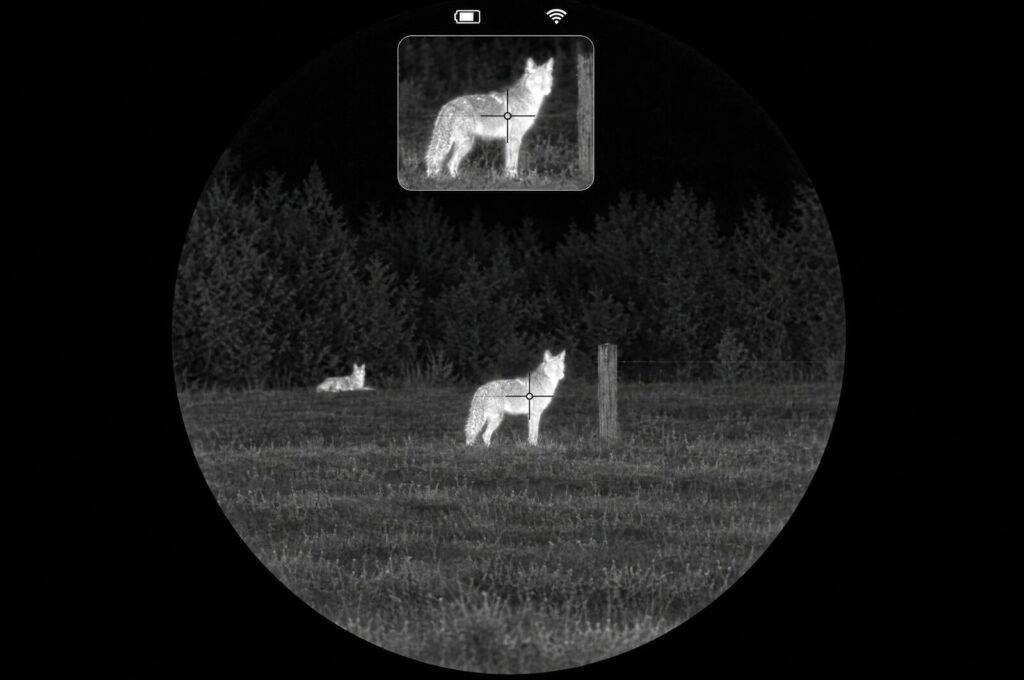
Every Rico has white hot, black hot and red hot plus color palettes, picture-in-picture on the weapon sights, and digital zoom. Mist and rain flatten every thermal image, and none of these cut through fog.
Mounting and Zeroing a Rico
Every iRay thermal weapon sight in the Rico line comes on its own Picatinny mount, quick-detach on most, so you don’t buy rings, and every one zeroes on screen by moving the reticle rather than turning turrets. Pull it, put it back, and it should land on zero.
The mounts differ by line. The Rico 3 and Rico 2 use a QD Picatinny mount, the Mk2 LRF a dual throw mount, the Hybrid Compact a DLOC mount, the other Hybrids a recoil-mitigating Picatinny mount, and the Micro V2 a riser or MUM rail. The Mk2 manual says to put blue Loctite 242 on the mount screws and torque them to 20 inch-pounds, inch and not foot pounds.
Zeroing is the same idea on all of them. Pick a profile, A to F on the Mk2, set the zero distance, fire a group, then freeze the image and move the reticle onto the impact. Every Rico 2 and Rico 3 lists one-shot zero. Our guide to sighting in a rifle scope walks through the shooting part.
Clip-on mode on a Hybrid or Micro V2 is different. The thermal sits in front of your day scope, so your day zero stays; check it at 100 yards after mounting, because a clip-on that isn’t centered moves the impact. Mine moved under an inch.
Battery, Charging and Cold Weather
Battery life is the biggest gap between Rico generations: the Rico 3’s NBP-8 pack is rated at 10 hours, double the Mk2 LRF and Rico 2, and 7 hours down to -4 F. Carry a spare battery pack with anything older.
The packs don’t interchange across lines. The Rico 3 uses the NBP-8, the Rico 2 and Mk2 the IBP-5, the Hybrid 384 and 75 mm the IBP-1H or IBP-1, the Hybrid 640 50 mm a built-in pack plus an IBP-4 bank, and the Micro V2 and Hybrid Compact a common 18650 cell. Most Ricos also run off external USB-C power.
My nights came in anywhere from 4 percent over to 13 percent under the rated hours, and the worst result came on the coldest night. The Mk2 manual says to charge between 32 and 113 F and to let a very cold pack warm for about 45 minutes before charging it.
iRay Rico Problems and Fixes
Most Rico problems are buying problems, mislabeled listings and old stock, plus a short list of field issues the manuals already warn about: rangefinder misses in fog or bright sun and a pack left flat. These are the ones I hit.
- Mislabeled listings: several dealers call the 384 Hybrid HYL50W a “Hybrid 640”. Match the model code before you buy: HYL is 384, HYH is 640.
- Rico 2, RICO2 and Rico 3: an “InfiRay RICO2” listing is a Mk2 LRF, and the Rico 2 and Rico 3 share codes like H50R. Look for the RICO2- or RICO3- prefix, or RL42R and RH50R for the Mk2.
- Rangefinder misses: the Mk2 manual says fog, rain, snow, a dirty lens, a low battery, bright sun and small targets all cut ranging. Range the animal’s body, not its head, and wipe the lens.
- Dead battery overnight: charge right away when the icon turns red under 20 percent, the manual says, to avoid over-discharge. On a 5+ hour model, carry the second pack.
- Sun damage: pointing the lens at the sun can burn the sensor, and iRay’s warranty excludes it. Close the lens cap when the sight is off.
- Firmware: updates come through the app over Wi-Fi. Update before a season, not in the field.
- Hybrid 640 75 mm in rain: it is IP67 only with the coated battery it ships with, iRay says. Keep the original pack in it.
Which Rico for Which Job
For most hog hunters the Rico 3 H35R is the pick; for open fields the Rico 3 H50R or the cheaper Rico 2 H50R; on a tight budget the Rico 3 L35R; for clip-on use the Hybrid Compact. The rest fill narrower jobs.
- Hogs in brush and timber: Rico 3 H35R, or the Micro V2 640 for inside 100 yards. Put either on one of our best hog hunting rifles.
- Coyote and predator stands over open fields: Rico 3 H50R, or the Rico 2 H50R, which ran about $646 cheaper on the cards.
- Long-range thermal from a bipod: Rico 2 S75R, or the Rico 2 H75R for less money.
- One sight for day scope and thermal: Hybrid Compact, clipped in front of a scope up to 10x.
- Helmet, scanner and backup sight in one: the iRay Rico Micro V2 640.
- Tight budget with a rangefinder: the cheapest iRay Rico 384 with one is the Rico 3 L35R at $2,699 on its card, with a clearance Mk2 LRF 384 at $2,700 right beside it.
- Tightest budget, no rangefinder: the Hybrid 384 at $2,499 or the Micro V2 384 at $2,559.99 on the cards.
iRay Rico vs Pulsar Thermion 2 and AGM Rattler
The Rico 3 out-ranges the Pulsar Thermion 2 and AGM Rattler V3, 1,600 yards against 800 and 1,000 meters, matches the Thermion’s 10-hour battery and beats the Rattler’s 7, and loses on mounting flexibility to the Thermion’s ring-mounted tube. Each cross-shop has a live card.
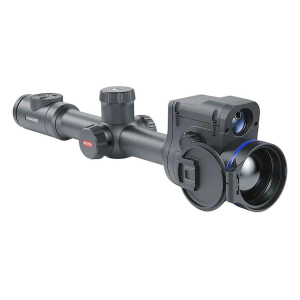
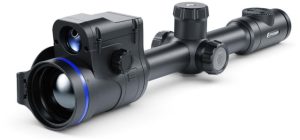
Pulsar Thermion 2 LRF XQ50 Pro
The Thermion 2 is a thermal in a classic tube that takes standard 30 mm rings; the Rico is a weapon sight on its own mount. The LRF XQ50 Pro pairs a 384 x 288 sensor at 17 microns with a 50 mm lens, 3-12x, an 800-meter rangefinder and 10 hours of battery, and its card sits at $2,999.97.
Against the Rico 3 L35R at $2,699 on its card, the Thermion costs about $301 more and ranges shorter. It wins if you want a scope height and ring choice of your own. Our full Pulsar Thermion 2 review covers all ten Thermion 2 models.
AGM Rattler V3 LRF 35-384
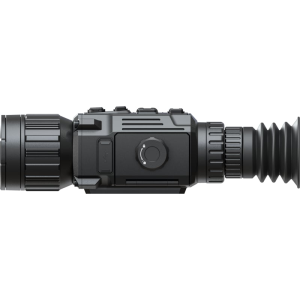
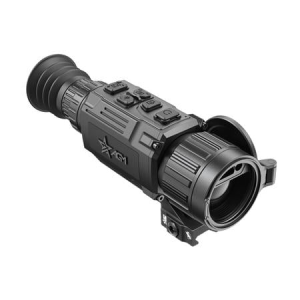
The AGM Rattler V3 LRF 35-384 is the light cross-shop: a 384 x 288 sensor on a 35 mm lens at 3.5x, a 1,000-meter rangefinder and 7 hours of battery, from $2,795.
That’s about $96 more than the Rico 3 L35R’s card, and it weighs 1.5 pounds against the L35R’s 28.89 oz, but the Rico 3 runs 3 more hours per pack and ranges farther. Our AGM Rattler V2 review covers the older V2 family and how it compares with the V3.
Verdict: The Rico 3 is the strongest of the three on rangefinder reach, and it ties the Thermion on battery. The Thermion 2 wins for ring mounting, and the Rattler V3 is the lightest rangefinding 384 of the three. For the wider field, see our best thermal scopes.
Price and Where to Buy
Our dealer cards ran from $2,499 for the Hybrid 384 to $6,999 for the Rico 2 S75R, while iRay USA’s list prices run from $2,699 to $7,999, so check the card before you trust a list price. Each card shows the cheapest new listing we found from any dealer.
Two pricing quirks are worth knowing. Nocpix USA lists each Rico 3 $100 above iRay USA’s list price for the same sight. And the Mk2 LRF is in clearance at some dealers as the Rico 2 and Rico 3 take over, so the older model can be the cheaper way into a built-in rangefinder.
Buy any iRay thermal from an authorized dealer so the five-year warranty is clean, and register the sight with iRay USA. Our night vision guide explains how thermal and night vision compare, and the thermal monocular roundup covers handheld thermals.
Who Should NOT Buy an iRay Rico
Skip the Rico if you want a classic tube scope in your own rings, want the lightest rangefinding 384 you can carry, or mostly scan and rarely shoot. A walking hunter should also skip the 75 mm models. Each of these buyers has a better fit.
- Hunters who want a scope in normal rings: buy the Pulsar Thermion 2, which mounts in standard 30 mm rings.
- Still-hunters who walk all night: the 75 mm Ricos weigh over 44 oz; carry a Hybrid Compact at 25.56 oz with its rangefinder, a Rico 3 H35R at 29.1 oz, or the Micro V2 at 11.3 oz without one.
- Buyers who want the lightest rangefinding 384: the AGM Rattler V3 LRF 35-384 weighs 1.5 pounds, well under any Rico 384 with a rangefinder.
- Anyone who mostly scans and rarely shoots: a thermal monocular does that job better for less; our gun optics guide maps out where each kind of optic fits.
Warranty, What Is in the Box, and Hunting Rules
Every Rico carries a five-year iRay USA warranty that follows the sight to a new owner, is rated IP67, and comes with its own Picatinny mount, so there are no rings to buy. Register it at irayusa.com/register.
iRay USA’s warranty page headlines a 5-day repair guarantee, and its body text promises a one-week turnaround from receipt, so plan on a week. It excludes cosmetic damage, normal wear, tampering and sensor damage from the sun or other intense heat sources.
The Mk2 LRF box I opened held the dual throw mount, a magnetic charging cable, an IBC-5 charger and the user manual alongside the sight and its packs. Contents vary by line, so read the product page.
Thermal and night vision hunting rules vary by state, and some ban thermal for all hunting. Our state-by-state table, with a source for each state, is in the thermal and night vision hunting rules by state.
Final Verdict
The iRay Rico line is a strong buy in 2026 if you pick the right generation: the Rico 3 for most hunters, the Hybrid Compact for clip-on use, and the Micro V2 for close work and helmets. The Mk2 LRF is a clearance bargain, not a first choice.
That’s the short version of this iRay Rico review. Across sixteen sights I didn’t find a bad image or a mount that lost zero. I found a confusing family with three brand names and shared model codes, and that’s the main reason to read the listing twice.
Final Score: 7.9/10. A thermal weapon sight family with real range and battery gains in the Rico 3, held back by naming that sends buyers to the wrong model.
Jump back to the card for the Rico you want: Rico 3 L35R, Rico 3 H35R, Rico 3 H50R, Rico 3 Pro H50R, Rico 2 L42R, Rico 2 H50R, Rico 2 H75R, Rico 2 S75R, Mk2 LRF 384, Mk2 LRF 640, Hybrid 384, Hybrid 640 50 mm, Hybrid 640 75 mm, Hybrid Compact, Micro V2 384, Micro V2 640.
FAQ: iRay Rico
Answers to the questions buyers ask most about the Rico line.
Is the iRay Rico worth it?
Yes, if you want a thermal weapon sight on its own mount. All sixteen current models held zero on my rifles up to a .300 Win Mag, and the Rico 3 adds a 1,600-yard rangefinder and 10 hours per battery pack.
Is the Rico made by iRay, InfiRay or Nocpix?
All three names lead to iRay USA in Texas. The Mk2 LRF, Hybrid and Micro V2 carry the InfiRay Outdoor badge, and the newer Rico 2 and Rico 3 carry the Nocpix badge.
Which iRay Rico should I buy?
For most hog hunting, the Rico 3 H35R: a 640 sensor at 2x with a wide view and a rangefinder. For open fields, the Rico 3 H50R or the cheaper Rico 2 H50R. On a budget with a rangefinder, the Rico 3 L35R at $2,699 on our price card.
What is the difference between the Rico Mk2 LRF and the Rico 2?
The Nocpix Rico 2 replaced the Mk2 LRF, keeping its 1,200-yard rangefinder and battery pack and adding a ballistic calculator. InfiRay's global site also calls the Mk2 RICO2, so check the code: RL42R and RH50R are Mk2, and a RICO2- or RICO3- prefix marks the Nocpix lines.
How far does the Rico rangefinder reach?
The Rico 3 ranges to 1,600 yards; the Rico 2, Mk2 LRF and Hybrid Compact to 1,200 yards, which the Mk2 manual rates at plus or minus 1 yard. Fog, rain and bright sun all cut its reach.
How long does a Rico battery last?
iRay rates the Rico 3 at 10 hours per pack, 7 down to -4 F, and the Mk2 LRF and Rico 2 at 5+. My nights came in anywhere from 4 percent over to 13 percent under the rated hours, so carry a spare battery pack with the older models.
Can a Rico be used as a clip-on?
Only the Hybrid and Micro V2 models. The Hybrids clip in front of a day scope up to 10x and the Micro V2 up to 6x. The Rico 3, Rico 2 and Mk2 LRF are dedicated weapon sights.
Is the iRay Rico better than the Pulsar Thermion 2?
It depends on how you mount it. The Rico sits on its own Picatinny mount and the Rico 3 ranges to 1,600 yards with 10-hour packs; the Thermion 2 takes standard 30 mm rings, also runs 10 hours, and its rangefinder reaches 800 meters.
4,818+ Gun & Ammo Deals
Updated daily from 200+ top retailers. Filter by category, caliber, action type, and price.
Related Guides