

Last updated November 21st 2026
Some of the links below are affiliate links, meaning at no additional cost to you, we may earn a commission if you click through and make a purchase.
By Nick Hall, who wrote our best .308 ammo guide.
Quick Answer: A ballistic coefficient, or BC, is a number that tells you how well a bullet cuts through the air compared with a standard reference bullet. The higher the ballistic coefficient, the less speed the bullet loses, so it drops less and drifts less in the wind at long range. Only compare BCs measured against the same reference, G1 with G1 or G7 with G7.
Table of Contents
What Is Ballistic Coefficient?
Ballistic coefficient measures a bullet’s ability to overcome air resistance, scaled against a standard reference projectile. The reference projectile itself, one pound and one inch across, scores 1.0 on that scale. Real rifle bullets land well below it, with blunt, light bullets at the low end and long, sleek match bullets at the top.
Two things set the number. One is how heavy the bullet is for its diameter, its sectional density. The other is its shape, which the formula carries as a form factor: how much more or less drag the bullet has than the reference shape. Put as a formula, it’s the bullet’s mass divided by its diameter squared, divided by that form factor, or BC = SD ÷ i. Heavy for caliber and pointy wins.
US makers state BC in pounds per square inch, which is why no unit ever makes it onto the box. 1 lb/in² is about 703 kg/m², so a European figure will look very different for the same bullet.
BC isn’t the same as a drag coefficient. A drag coefficient describes shape alone and changes with Mach number. BC folds in the bullet’s mass and diameter too, so it tells you how hard the air slows this particular bullet.
You’ll find it printed on most ammo boxes and in every bullet maker’s catalog. It’s the one number a ballistic app needs, along with muzzle velocity, to predict where your bullet will land.
G1 vs G7 Ballistic Coefficient
G1 and G7 are two different reference bullets, so the same bullet gets two very different BC numbers, and you can’t compare one with the other. The G1 reference is an old flat-base bullet with a short, rounded nose. The G7 reference is a long boattail bullet, 7.5 degrees at the tail, with a long tangent ogive nose, which looks a lot more like a modern match or long-range hunting bullet.
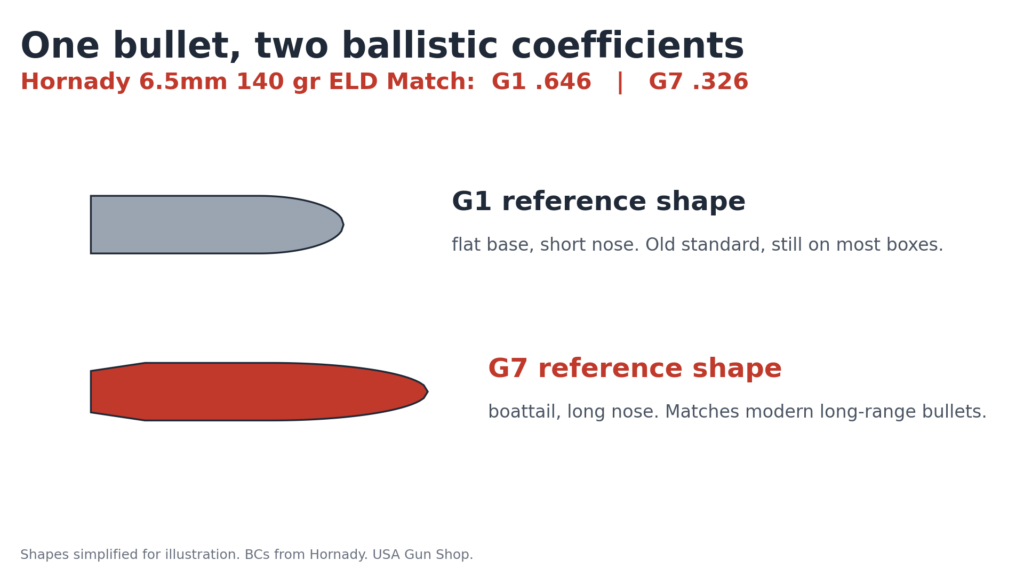
Here’s what that does to the numbers. Hornady lists its 6.5mm 140 gr ELD Match bullet at a G1 BC of .646 and a G7 BC of .326. Same bullet, same drag, one number roughly twice the other. A box that says .646 isn’t “better” than one that says .326. They’re describing the same thing against two rulers.
Which should you use? For a boattail match or long-range hunting bullet, use the G7 number if the maker publishes one, because a modern boattail slows down much more like the G7 shape across the whole flight. For flat-base hunting bullets and most handgun bullets, G1 is fine. My rule is simple: G7 for any boattail, G1 for flat-base bullets, and never compare a G1 number with a G7 number. They aren’t the same measurement.
Can you convert one to the other? Not with a fixed formula. For Hornady’s ELD Match bullets the G7 number happens to be almost exactly half the G1, .326 against .646 for the 6.5mm 140 gr and .263 against .523 for the .308 168 gr, but that ratio changes with bullet shape. Always use the number the maker publishes.
G1 and G7 aren’t the only references, either. G2, G5, G6, G8 and GL each model a different shape, from short boattails to blunt lead noses, but G1 and G7 are the two numbers bullet makers actually print.
Ballistic Coefficient in Real Numbers
A higher BC bullet holds its speed better, so it arrives at distance faster, flatter and with more energy than a lower BC bullet that started at the same speed. Hornady publishes velocity and drop for its loads, all from 24 in. test barrels with a 200 yard zero, which makes a fair comparison easy.
| Hornady load | Bullet BC | Muzzle | 500 yd velocity | Speed lost | 500 yd drop |
|---|---|---|---|---|---|
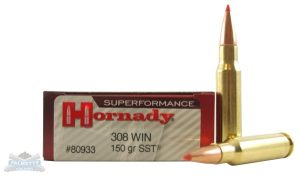
| .308 Win 150 gr SST Superformance | G1 .415 | 3,000 fps | 1,966 fps | 1,034 fps, 34% | 40.7 in. |
| .308 Win 168 gr ELD Match | G1 .523, G7 .263 | 2,700 fps | 1,912 fps | 788 fps, 29% | 47.1 in. |
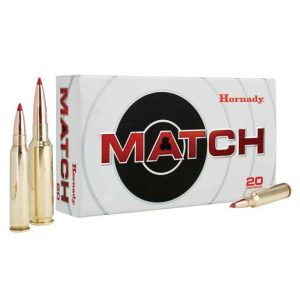
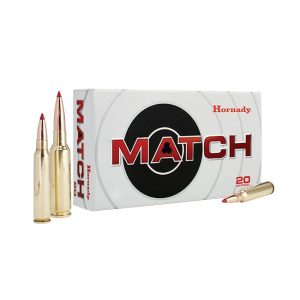
| 6.5 Creedmoor 140 gr ELD Match | G1 .646, G7 .326 | 2,710 fps | 2,023 fps | 687 fps, 25% | 44.4 in. |
Look at the two match loads. The .308 168 gr ELD Match and the 6.5 Creedmoor 140 gr ELD Match leave the muzzle within 10 fps of each other. By 500 yards the 6.5, with the higher BC, is 111 fps faster and has dropped 2.7 inches less. That gap keeps growing the farther you go.
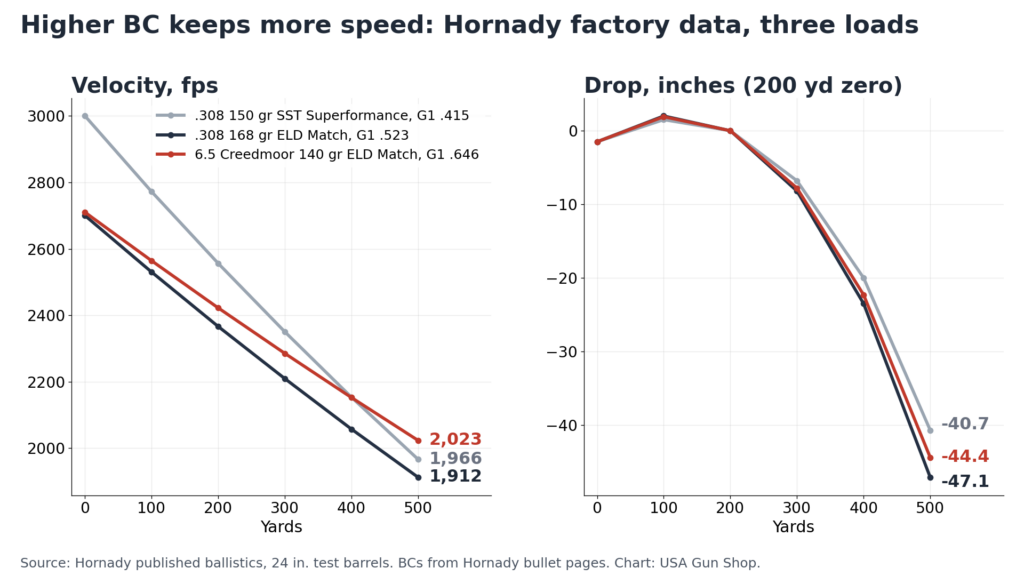
Now look at the Superformance load. It starts 290 fps faster than the 6.5, so it shoots flattest out to 500 yards, but it bleeds speed fastest: 34% gone by 500 yards against 25% for the 6.5. Hornady’s own velocity numbers show the 6.5 Creedmoor overtaking it just past 400 yards. Speed wins close. BC wins far.
Energy tells a slightly different story, and it’s worth knowing. Hornady lists the .308 168 gr ELD Match with 1,364 ft-lb left at 500 yards, the 6.5 Creedmoor 140 gr ELD Match with 1,273 ft-lb and the 150 gr SST with 1,287 ft-lb. The .308 arrives slower but carries a heavier bullet, so it still hits hardest. A high BC buys you speed and a flatter, less wind-sensitive path. It doesn’t make a light bullet heavy.
Ballistic Coefficient vs Muzzle Velocity
Inside about 300 yards, muzzle velocity does more for a flat trajectory than ballistic coefficient. Past that, a higher BC starts to win. In Hornady’s numbers the faster load still drops least at 500 yards, but the higher BC bullet is carrying more speed by 400 yards, and that lead grows with every yard beyond.
For a deer hunter who never shoots past 250 yards, that means BC barely matters. Any good hunting bullet at a sensible velocity will do. For a long-range shooter, a high BC bullet is worth more than an extra 100 fps, because it keeps paying off all the way to the target, and it does it without the extra recoil and barrel wear of a hotter load.
Ballistic Coefficient and Wind Drift
Wind drift is where a high ballistic coefficient matters most. Drift depends on lag time, the gap between the bullet’s real time of flight and the time it would take with no air at all. A bullet that holds its velocity has less lag, so it drifts less in the same wind. Drop is easy to dial for once you know the range. Wind is the guess, and a higher BC shrinks the size of your mistake.
Long-range shooters chase BC for exactly this reason. Two loads with similar drop can have noticeably different wind drift at 600 yards and beyond, and wind calls are what miss targets. Run your two candidate loads through a ballistic app with a 10 mph full-value wind and compare the drift column before you buy a case of either.
Here’s what that looks like for the three Hornady loads. Run through our ballistics calculator with a 200 yard zero, standard sea-level air and a 10 mph full-value crosswind, the 6.5 Creedmoor 140 gr ELD Match drifts 14.7 inches at 500 yards, the .308 168 gr ELD Match 18.9 inches and the faster 150 gr SST 21.4 inches. At 1,000 yards it’s 68.5, 93.3 and 108.2 inches. The fastest load at the muzzle drifts the most.
Does Ballistic Coefficient Change With Velocity?
Yes. A real bullet’s BC changes as it slows down, because its drag curve never matches the reference shape exactly. The closer a bullet’s shape is to its reference, the steadier its BC stays. That’s why a modern boattail has a fairly steady G7 BC but a G1 BC that falls as it slows, and why some bullet makers publish different BCs for different velocity ranges.
The biggest shift comes near the speed of sound, about 1,116 fps in standard sea-level air, where drag climbs sharply as the bullet goes transonic. In our calculator the 150 gr SST is down to 1,201 fps at 1,000 yards, close to that zone, while the 6.5 Creedmoor 140 gr ELD Match is still at 1,485 fps.
For most shooting it doesn’t matter. A single published G7 number for a boattail match bullet is close enough to land the first shot at long range. If you’re stretching past 800 yards, true your ballistic app to real drops at distance rather than trusting any single number.
How Ballistic Coefficient Is Measured
Good bullet makers now measure BC with Doppler radar that tracks the bullet’s speed along its whole flight. Hornady says its ELD Match BCs “are measured and verified by Doppler radar and corrected to standard atmospheric conditions.” Older numbers were often worked out from chronograph readings at two distances, or calculated from the bullet’s shape.
Some ballistic solvers skip the G reference altogether and use a custom drag model, a drag curve measured for that exact bullet. That holds up better at extreme range, past the point where a single G7 number starts to drift from reality.
That “standard atmospheric conditions” part matters. Thinner air at altitude or on a hot day means less drag, so the same bullet flies flatter in Colorado in summer than at sea level in winter. Your ballistic app adjusts for that if you give it the altitude, temperature and pressure. The BC itself stays the same.
How to Use BC in a Ballistic App
- Find your bullet’s BC on the box or the maker’s product page. Use the G7 number for a boattail match bullet if it’s listed.
- Chronograph your own muzzle velocity. Factory numbers come from 24 in. test barrels, and a 16 or 20 in. barrel will be slower.
- Enter the BC, velocity, sight height and zero range into a ballistic app or our ballistics calculator, with your local altitude and temperature.
- Shoot at real distances and true the app to your actual drops, adjusting velocity first.
That’s all BC ballistics really is: one drag number plus your velocity and your air, turned into drop, drift and time of flight. Step 2 is the one most people skip, and at long range a wrong muzzle velocity throws your drops off just as surely as a wrong BC. If you don’t own a chronograph yet, our best shooting chronographs guide covers the good ones.
Does Ballistic Coefficient Matter for Hunting?
At typical hunting distances, under about 300 yards, ballistic coefficient matters far less than shot placement and how the bullet expands. A high BC match bullet isn’t automatically a good hunting bullet. Some are built to hold together for accuracy, not to open up reliably in an animal.
Where BC does help a hunter is the long shot across a canyon or a bean field, where less drop and less drift give you a little more margin for a range or wind error. Pick a bullet built for hunting first, then take the highest BC you can find in that category. For deer I’d take a bonded hunting bullet with a modest BC over a match bullet with a high one every time. Our .308 ammo for hunting picks and best 6.5 Creedmoor rifles are good places to start.
What Makes a High Ballistic Coefficient Bullet
- Weight for caliber: A heavier bullet in the same diameter has more sectional density, so it carries its speed better. Hornady lists its 150 gr .308 SST at a sectional density of .226.
- A long, pointed nose: A long ogive and a sharp tip, often polymer, cut drag at the front.
- A boattail: A tapered base reduces the drag that comes from the low-pressure wake behind the bullet.
- Consistency: A bullet is only as good as its worst one. Tight manufacturing keeps BCs from varying shot to shot.
Sectional density and BC are easy to mix up. Sectional density is just weight divided by diameter squared, a measure of how long and heavy a bullet is for its caliber, and it says nothing about shape.
BC takes that same number and adjusts it for drag. Two bullets with the same sectional density can have very different BCs if one has a blunt nose and a flat base and the other is long and pointed with a boattail.
That’s also why calibers like the 6.5 Creedmoor became so popular for long range. Long, heavy-for-caliber 6.5mm bullets carry high BCs without the recoil of a bigger cartridge. Our 6.5 Creedmoor vs .308 comparison digs into that trade.
There’s a catch. A long, high BC bullet needs a faster barrel twist to stabilize, and an under-stabilized bullet won’t fly to its published BC. Check your rifle’s twist rate before buying heavy-for-caliber match bullets.
The Loads in This Guide, Live Prices
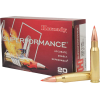
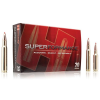
These are the three Hornady loads from the table above, priced live across the retailers we track.

The Bottom Line
Ballistic coefficient is a simple idea with a few traps. Higher is better, but only when you compare like with like, G1 with G1 or G7 with G7.
It matters most for wind drift and for shots past 300 yards, and barely at all for a 150 yard deer. And it’s only half the story: I’d chronograph my rifle before I’d pay extra for a few more points of BC, because the best bullet in the world won’t land where the app says if the velocity you gave it is wrong.
FAQ: Ballistic Coefficient
What is a good ballistic coefficient?
On the G1 scale, the loads in this guide run from .415 for the 150 gr SST hunting bullet to .646 for the 6.5mm 140 gr ELD Match, which is .326 on the G7 scale. I treat anything over about .500 G1, or .250 G7, as a long-range bullet. Compare on the same scale only.
Is a higher ballistic coefficient better?
Yes, for holding speed. A higher BC bullet loses less velocity, so it drops less and drifts less in the wind at long range. Inside about 300 yards, muzzle velocity matters more.
What is the difference between G1 and G7 ballistic coefficient?
They use different reference bullets. G1 is a flat-base, short-nose shape and G7 is a long boattail shape. The same bullet gets two different numbers, so never compare a G1 BC with a G7 BC.
Should I use G1 or G7?
Use G7 for boattail match and long-range bullets if the maker publishes it, because those bullets slow down more like the G7 shape. G1 is fine for flat-base bullets and most short-range shooting.
Does ballistic coefficient change with velocity?
Yes. A real bullet's BC shifts as it slows because its drag never matches the reference shape exactly. A boattail bullet's G7 number stays steadier than its G1 number.
How is ballistic coefficient measured?
The best makers use Doppler radar to track the bullet's speed along its flight. Hornady says its ELD Match BCs are measured and verified by Doppler radar and corrected to standard atmospheric conditions.
Does ballistic coefficient matter for deer hunting?
Not much under about 300 yards. Shot placement and bullet construction matter far more. BC helps on long shots, where less drop and drift give you more margin.
How do I find my bullet's ballistic coefficient?
Check the ammo box or the bullet maker's product page, which list the G1 and often the G7 BC. Enter it in a ballistic app with your own chronographed muzzle velocity.
2,799+ Gun & Ammo Deals
Updated daily from 200+ top retailers. Filter by category, caliber, action type, and price.
Related Guides